Game Theory #10: The Law of Asymmetry
We continue our discussion of the US-Iran war that is happening right now. I made the prediction that the United States will lose this war, and last time we did an overview of the military and strategic position. Today, we're going to provide a theoretical framework for how to understand how this war will progress and why, ultimately, I believe the United States will lose.
Today I present to you a very important idea in game theory. Once you understand this idea, you will understand why things will turn out the way they do. It's called the Law of Asymmetry.
The Law of Asymmetry states that the United States and Iran are not peers; they're not equals. The United States is far stronger than Iran, and we should expect the United States to overwhelm and destroy Iran easily. But the Law of Asymmetry states that's usually not the case. It's usually the underdog that has the advantage, and we see this from history all the time.
When the Persians in about 490 BC invaded mainland Greece against Athens and Sparta, Persia at that time was the first world empire. It had infinite resources, infinite manpower, and infinite wealth, and it lost to the Greeks not once but twice. Then the Macedonians under Alexander the Great—a tribal army, not a very large army—were able to go into Persia, which at the time was basically most of Eurasia, and conquer it in about 10 years. The Romans started as a tribal people who then built the Mediterranean Empire. You have the Aztecs; you have the Vikings. This happens a lot in human history: a people in the borderlands, a tribe, a small ethnicity, are able to conquer a great empire. The Law of Asymmetry tells us why.
Let's go over in detail how this law works.
The Strengths and Inherent Weaknesses of an Empire
Let's look at an empire. There are three major advantages to an empire.
- Mass: This just means that they have a lot of people, almost an infinite amount. The United States has a population of about 350 million people, but remember, the United States can also draw on the populations of its allies, which includes the Five Eyes, the Anglosphere, Europe, and East Asia (South Korea, Japan). Basically, wherever the Americans have a military base. So the United States can draw on billions of people for its wars.
- Organization: This means a hierarchy of bureaucracy and scientific technology, which leads to the most advanced weaponry. Think about how the United States fights its wars. They have satellites that provide for precision targeting. They have B-2 bombers and F-15s that are the most advanced weaponry in human history.
- Death: This is the idea that because your people are infinite, your organization is so strong, and your resources are so vast, you can afford to lose many, many wars. It's not a big deal. If the United States loses this war in Iran, they can go back with even more soldiers and more weaponry because their wealth is infinite.
In theory, because of these advantages, an empire should be invincible and eternal. But we know for a fact that all empires fall, and they fall very, very hard. And quite honestly, they don't last a very long time—maybe 200 years, maybe 300 years for most empires. That's not a very long time. So, we need to better understand what's going on. Why is it that an empire with these vast resources falls?
We need to understand that all these advantages are ultimately disadvantages in the long term.
- Mass leads to inequality. When you have a lot of people, you create competition for resources. There are too many people, and this often leads to debt and slavery. As a result, your people become complacent, lazy, and indifferent. They're competing against each other and don't really like the government. They're not that motivated to do anything—to work or to fight wars, but especially to fight wars. So, this mass looks like an advantage in the beginning, but over time it becomes a disadvantage.
- Organization means an elite. The problem with this is that over time, the elite become parasites. The way they make their money is through rent-seeking, which just means that you have power and you seek to monetize your power by exploiting the mass. Landlords are a classic type of rent-seeking elite; they don't really work, but they make a lot of money because they own the land and control the resources and capital. That forces the mass into slavery and debt, which is what's happening in America today. The problem is that everyone wants to be part of the elite, and there are too many elites over time. Power is a zero-sum game; it's a hierarchy. This leads to the idea of elite overproduction, a term coined by the historian Peter Turchin. His theory is that you have turmoil and wars—for example, the French Revolution or the fall of the Roman Republic—because there are too many elites, and they start wars to accumulate power for themselves. This organization and elite lead to factionalism or infighting. That's what's happening in America today, where the Democrats and the Republicans hate each other and refuse to get along. It leads to political polarization. Another way of saying this is that an empire over time becomes insular. They don't care about what happens outside in the world; all they care about is what happens in Washington D.C., and as a result, they make a lot of stupid mistakes.
- Death (or the lack of consequences) leads to arrogance, laziness, and incompetence. Because you don't care, it doesn't really matter. This leads to the idea of hubris: a violent arrogance that makes you make silly mistakes, but you don't recognize your mistakes and you keep on repeating them over and over again.
So yes, it seems like the empire is invincible, but if you actually think about it, its advantages become its disadvantages over time, which will lead ultimately to its downfall. Mass leads to inequality. Organization leads to elite overproduction, which leads to factionalism. And a lack of consequences (death) leads to hubris. That's why an empire must fall over time.
But an empire cannot fall by itself. It needs an enemy that forces it to collapse. An enemy will emerge that will overwhelm the empire because it is able to take advantage of the empire's weaknesses.
The Underdog's Counter-Qualities
What are the weaknesses of this empire? The first major weakness is that the people aren't really motivated. So if you, as a people, are really motivated, you have a huge advantage. We call this energy.
As an empire, you become insular. You refuse to admit your mistakes. You refuse to learn from others. Well, if you are willing to admit your mistakes, if you're willing to learn, if you're willing to promote the best and brightest, if you're meritocratic, you have a huge advantage. This is the idea of openness.
Finally, an empire is fractured. If you're able to maintain cohesion—if your people are able to remain united and have a common purpose—they'll be strong.
If an enemy of the empire emerges with these three qualities—energy, openness, and cohesion—this enemy will defeat the empire.
As you follow the news in this war between the United States and Iran, ask yourself a question: Will Iran become an energetic, open, and cohesive society? Because if it does, it will become invincible. The empire won't change because of hubris. It's too static, too stagnant, too bureaucratic. The empire will not admit its own mistakes.
Iran, because it's a country of 92 million people, still suffers from issues of mass, organization, and death. And so if it's able to transform itself into an energetic, open, and cohesive society, then it will triumph over America. That is the fundamental question in this war. Don't worry about America's technology. Don't worry about the economy. Don't worry about these things. Just ask yourself one question: Is Iran transforming as a society? Are people becoming much more motivated? Are people in Iran learning from their mistakes, innovating, and becoming resilient on the battlefield? Are the Iranians sticking together as a people? Because if the answer is yes to all three questions, then Iran will win and America will lose.
America vs. Iran: Applying the Theory
Let's now talk specifically about America and Iran.
America's Apparent Strengths (and Hidden Weaknesses)
America will have three major advantages in this war: technology, propaganda, and money/wealth. These are the three major strengths of the American empire.
- Technology is what you see every day: the satellites that are able to precision target, the airplanes that are the greatest war machines in the world. America is home to the greatest scientists and the most advanced weaponry.
- Propaganda means that America controls the information space. It controls the internet. It controls the world's most powerful media, including the New York Times, CNN, and the BBC. It controls YouTube and Google. It controls the information landscape. If America does not want you to know something, it can hide it from you. America can control the discourse and how you think about the world.
- Money is a very simple idea. The United States controls the US dollar, which is the reserve currency of the world. The United States can print as much US currency as it needs in order to win this war. It has an infinite money printer. It can use this money to bribe people to fight this war. It can pay for mercenaries. It can bribe ethnic minorities to rebel against the government in Iran. It can bribe Iranian officials to betray the government.
Looking at these three things, you would think that America is invincible. But again, we need to think about the Law of Asymmetry and recognize that these advantages are also disadvantages.
- Technology: If you have the most advanced weaponry in the world, you become lazy, arrogant, and dependent on the technology. A classic example is our school, where you have access to ChatGPT. Do you become smarter because you have access to ChatGPT? No, you become dumber because you become lazy. It's the same with military technology. You would think that with the most advanced weaponry, America would become invincible. But instead, the American military becomes too dependent on the technology. It becomes too arrogant, too complacent. It's like, "Well, if we get in trouble, then we'll just send in the Air Force and blow everything up." This leads to dependency, and this actually hampers the innovation and resilience on the battlefield that you need to win. Because of technology, you become too lazy to think for yourself.
- Propaganda: You would think that because America controls the debate, that's a huge advantage. It's actually not. The reason why is that in order for innovation and resilience to happen, you need to have open debate. You need people to voice dissenting opinions. But if you control the information landscape, what you can do is censor. And that's what America is doing right now. It's telling people to shut up and obey. You're not allowed to point out that this war is stupid and America can't win this war; otherwise, you'll be kicked out. This means that there's a lack of rigorous debate within the American government, military, and elite, which of course will lead to hubris and bad decision-making. No one will point this out because they're too afraid of pissing off the president and his people. So they just shut up, and America will keep on making the same mistakes over and over again. We call this drinking your own Kool-Aid. They're basically getting high on their own supply.
- Money and Wealth: You would think, "Okay, this is it. We just bribe everyone, and we're good, right?" The problem is that if you bribe people, they're not going to fight for you, because all they want is your money. So you bribe them, but they'll probably take your money and run away. Or they'll figure out how to get more money out of you by cheating you. Right now, the Americans are going to fund militias, ethnic minorities, and opposition groups against Iran. These guys are hustlers. They're not fighting because they want more freedom; they're fighting because they want to rip off the US government. This money issue can be a problem in the long term because the people you're bribing can't be trusted, and they're not motivated to actually win this war for you. They're motivated to scam you as much as possible, and they could be a problem in the long term because you're putting so much resources into these hustlers.
America's Three Major Problems
This means that America has three major problems.
- The Lack of Political Will: The American people don't want to fight this war. The American government doesn't even know why they're fighting this war. No one cares. But for the Iranians, it's a struggle of life and death. If America loses this war, they just go home and forget about it. But if the Iranians lose this war, they all get killed, or they lose their country, their society, their civilization, their identity. They cannot afford to lose this war.
- Logistics and Manufacturing: America is very good at fighting short wars because they have the most advanced weaponry. But they have manufacturing issues because, as we know, America shipped all its factories to China. America doesn't have that many factories. So, yes, it has the most advanced weaponry in the world, but this weaponry doesn't do any good if you don't have any ammunition—bombs, bullets. You need factories for that, and America doesn't really have them. I understand that America is trying to upgrade its manufacturing capacity, but it's kind of slow. Maybe five years from now, it will have the manufacturing capacity to fight this war, but right now it doesn't.
- Casualties: Because it doesn't have the political will to fight this war, America cannot afford to lose soldiers on the battlefield. It wants to minimize battlefield losses because if tens of thousands of American soldiers are going home dead in coffins, I guarantee you, because of the lack of political will, the American people will revolt. You will have protests and a lot of violence in the streets. It'll be like the Vietnam era again.
This situation now determines how America will fight this war.
Iran's Advantages (and Potential Pitfalls)
Iran has a lot of disadvantages, but I want to discuss three major advantages that they need to emphasize if they are to survive this war.
- Faith: Remember that the Iranians are Shia, and as such, it's a religion of martyrdom, of eschatology, of individual sacrifice for the greater good. The Shia are not afraid to die. And because their great religious leader, the Ayatollah Khamenei, was assassinated by the Americans and Israelis, they are motivated to seek vengeance, to martyr themselves for the greater good, to seek eternal paradise. Jihad.
- Terrain: Iran is a mountainous country, and it's huge—three times the size of Iraq. It's very hard for America to invade the country. In fact, most analysts will tell you it is suicidal for the American military to invade Iran. It is a mountain fortress.
- Nationalism: The Iranians are Persians, and the Persians go back 5,000 years. It is one of the greatest civilizations in human history. There were three great civilizations in the ancient world: the Jews, the Greeks, and the Persians. The Persian culture is vast, beautiful, and deep, and that's what gives the Iranian people a lot of pride. When they're fighting, they're not just fighting for their religion or their homes; they're fighting for their entire civilization that goes back 5,000 years.
But again, remember that everything that seems like an advantage can be a disadvantage as well.
- With faith, you might have an issue of blindness or zealotry. You're not afraid to die, but that means you're not thinking strategically. Maybe you're going to waste too many soldiers on the battlefield. They're brave, but they're kind of stupid as well. You might have an issue where Iran is not using the optimal strategy because their soldiers are not afraid of death. We're already seeing that, where the Americans have already blown up and destroyed the Iranian navy. Anyone could have told you that the first thing the Americans would do is destroy the Iranian navy. So you should probably not use the navy, or hide it, or blow it up yourself, because you want to avoid as many casualties as possible. But they didn't do that, and the Americans have now destroyed the Iranian navy.
- With terrain, yes, it's a fortress, but it can also be a prison. You're just sort of stuck there, and because it's a mountainous region, it doesn't have that many resources. So Americans can actually disrupt your water supply, disrupt your electricity, and cause general poverty and hardship for your people.
- With nationalism, yes, Persia is a great culture, but remember that Iran is an ethnically diverse country. In fact, only 50% of the population of Iran are Persians. Others are different minorities. So, you have ethnic divisions.
The American Strategy and Why It Will Backfire
Looking at this, we know exactly what the American strategy will be. Basically, the strategy will be to inflict as many casualties as possible on the Iranians, to kill as many people as possible, and to destroy the infrastructure of Iran so that the people don't have enough water, electricity, or food to survive. The third part, of course, is to create as much ethnic tension in the country as possible by arming, encouraging, and bribing ethnic groups to rebel against the central government in Tehran.
But again, what the Law of Asymmetry tells us is that the empire ultimately is not as flexible, open, and dynamic as its enemy. The weaker party is going to engage in much more self-reflection and self-debate than the empire, because the empire will become arrogant. And so, ultimately, Iran should triumph over America. In fact, what's going to happen is that this strategy that America will use against the Iranians will lead to Iranians becoming much more energetic, open, and cohesive.
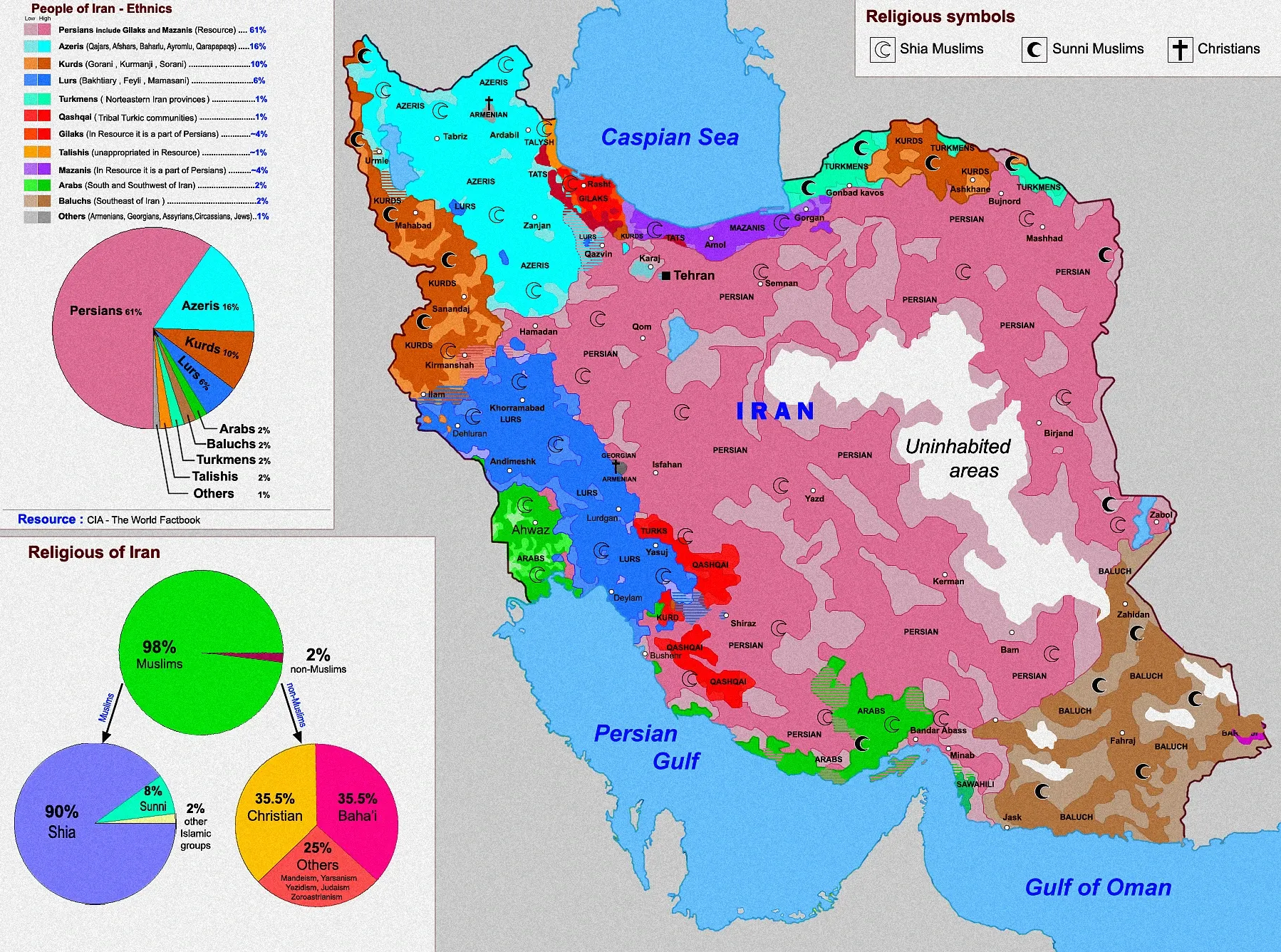
This is an ethnic map of Iran. You can see how divided the country is. The Persians are in the center, but the people you want to watch are the Kurds, the Azeris, and the Balochs. These are the three major problem areas for Iran, and it's always been the case.
The Balochs are, first of all, Sunni Muslims. As we discussed, the Sunnis and the Shia have never really gotten along well together. They have the same religion, Islam, but they have different belief systems that have led to a lot of conflicts. It's almost like the Catholics and the Protestants. The Baloch have been trying to rebel against the Iranians for a long time. I guarantee you that there are already Israeli and American special forces embedded in this area. The reason why is that they want to encourage as much civil conflict as possible, but they also want to prepare for the possibility of a ground invasion. They would need a forward operating base, and this area could be a very good place for the beginning of a land invasion.
Then you have the Kurds. The Kurds are another minority that seeks national sovereignty. Right now, the Americans and Israelis are bombing this area heavily and they're targeting police stations. Why? Because they're trying to reduce and eliminate opposition so that they can arm the Kurds and have them come into this area and threaten Iran. What's also happening is that in Iraq, there are these Sunni groups that the Americans are basically bribing and arming, and they're basically fanatics—they're ISIS. What the Americans want to do is send them into Iran to cause as much trouble as possible.
Then you have Azerbaijan. It is an independent country. What's really odd is that the majority of ethnic Azeris are actually in Iran. 60% are in the country, and 40% are in the country of Azerbaijan. This means that from the perspective of the Azerbaijani people, this war could be an opportunity to reunite the people and create a greater Azerbaijan.
These are the three problem areas that you have to watch as this war develops. We already know what the American strategy will be because we've seen it in Libya and Syria before. The strategy is to attack from both without and within. You're going to arm these people, embed special forces into these insurgent groups to lead them, and provide air cover so they have a clear path into Iran and are able to eliminate opposition.
Attacking from within means to cause as much pain and suffering in the interior of Iran as possible. The three main pillars of the American strategy are:
- Decapitation: You're removing the elite, or what we call command and control. You're basically limiting the capacity of Iran to govern itself, to have a leadership.
- Air Supremacy: America has the most advanced airplanes in the world. It's using its airplanes to destroy as much military installation as possible, but it's also engaging in acts of sabotage. They're carpet bombing Tehran. They're doing soft targeting, which means that instead of attacking military installations, you attack hospitals. Why? Because you're degrading the state's capacity to rejuvenate itself and be resilient. The last thing is something called a double tap, which is illegal under international law. You attack a place, you kill some people, and then people try to come and help the injured—doctors, emergency personnel, relatives. Then you strike again to create as many civilian casualties as possible. The entire idea is to create as much fear and anxiety in people as possible so that they lose the capacity to resist.
- Arm and Bribe Insurgents.
The problem with this is that when you do these three things, you're not actually hurting the Iranians; you're actually helping them. Remember, the Law of Asymmetry states that whichever group is able to create energy, openness, and cohesion will win. This American strategy is going to create a more energetic, more open, and more cohesive Persian society.
- Decapitation: We just said that one major problem for an empire is elite overproduction. Well, with decapitation, you're solving this problem for the Iranians. Before, a huge problem for the Iranians was that you have too many leaders, and they all have their own stupid opinions and want to lead the war. But by killing so many leaders, you allow for more mobility and more meritocracy. You're solving the problem of elite overproduction for the Iranians. That's a huge bonus. The leadership will become much more lean, mean, determined, and strategic.
- Air Supremacy: When you carpet bomb Tehran, you're creating a more cohesive society. Why? Because the major conflict in Iran for many decades was between the urban and rural areas. The rural areas were very religious, poor, and backward. The urban areas were educated, secular, and progressive. There was this huge conflict that led to a lot of riots and protests. But when you carpet bomb the cities, which are the main source of support for progressive Western policies, you make them united with the rural areas. The Iranian people no longer see each other as enemies; they see the Americans as enemies. You create a much more cohesive society willing to fight together.
- Arming Insurgents: Yes, you are arming the insurgents—the Balochs, the Kurds, the Azeris. The problem with this is that you are now activating and galvanizing Persian nationalism. For the longest time, the Persian national identity was suppressed by the theocracy because they wanted to create a grand religion that unites all ethnicities. When you turn the other minorities against the Iranians, then the Persian people have to come together and remember their history, celebrate their identity. This is the key. Once the Persian people are able to activate their long-lasting memories, go back in the past and remember their greatness, they come together as an energetic, open, and cohesive society.
So, yes, the Americans have this strategy that worked in Libya and Syria, but it's not going to work in Iran. In fact, it's going to do the opposite.
You might ask, "Well, why don't the Americans just not do this?" I already told you: because it's an empire. It doesn't care about Iran; it cares about itself. It's stuck with this policy because it's trying to win this war as quickly as possible, as it doesn't have the manufacturing capacity to fight for a long time. It's trying to reduce casualties among its soldiers because Americans don't have the political will to fight. America is trying to win this war cheaply and fast. If it doesn't, then America is in a lot of trouble.
The Iranian Strategy: Guerrilla Warfare
The Americans are using a classic strategy called siege warfare. The Iranians are going to respond with a classic strategy called guerrilla warfare.
Guerrilla warfare is just simple: hide and seek. You bomb me with everything you have, and I'll just hide in my mountains. Then when you leave, I'm going to attack your GCC countries. I'm going to lob drones and rockets at you. I'm going to lob rockets at Israel. I don't have to strike that hard; I just have to be a pain in the ass. Because then you're forced to come back and bomb the living hell out of me. But guess what? I'll hide in my mountains again. It's hide and seek.
Iran can do this for years and years. But remember, America is forced to win this war as fast as possible because there is no political will, they don't have much manufacturing capacity, and they don't want that many casualties and economic damage.
The grand question is this: Will America launch a ground invasion? Because if it does, then they've lost the war. Look at Iran: mountains and deserts. It is impossible to occupy this country. It is impossible to invade. What the Iranians want to do is be such a pain in the ass, to commit so much guerrilla warfare, that America is forced to invade. But the problem is that America does not have the resources, the political will, or the manufacturing capacity to fight this war.
The Real Reason for the War?
Now you're thinking, "Okay, I understand all this, but why the hell is this war happening then?" If I can tell you this, I'm sure that their generals can tell them this as well. For years, America has been planning to invade Iran, and for years, the generals were like, "No, that's suicidal. Let's not do this."
So, why is this happening? Unfortunately, we don't know because the administration is not telling us. At first, Trump said it was because the nuclear talks didn't go well. We know for a fact that the Iranians were willing to agree to all the terms of the Americans. Then Marco Rubio, who's the Secretary of State, came out yesterday and said something really moronic. He said, "Why did we attack Iran? Because we heard the Israelis were going to attack first. Then the Iranians were going to respond by attacking both the Israelis and us, the Americans. And therefore, we have to preempt the Israelis by attacking first." That's just nonsense.
They don't know why they're doing this. But there has to be a reason. A clue is this: the American soldiers are being asked to fight this war, and again, no one knows why it's happening. But there's reporting that the generals are telling the soldiers, "This is a war for Jesus. This is a war to create the second coming of Jesus."
This is from John Larson on Substack: "US Troops Were Told Iran War Is for Armageddon, the Return of Jesus." Some soldiers who are not Christians were told that this is a war for Jesus, and they were like, "Wait a minute, we're not Christians. We're Muslims or we're atheists. Why are we fighting this war?" So, they filed a complaint. We're going to read a part of the email that the dissenting soldiers sent.
I am an NCO (rank withheld) in our unit. This morning, our commander opened up the combat readiness status briefing by urging us to not be afraid as to what is happening with our combat operations in Iran right now. He urged us to tell our troops that this was all part of God's divine plan. And he specifically referenced numerous citations out of the book of Revelation referring to Armageddon and the imminent return of Jesus Christ. He said that President Trump has been anointed by Jesus to light the signal fire in Iran to cause Armageddon and mark his return to earth.
He had a big grin on his face when he said all of this, which made his message seem even more crazy. Our commander would probably be described as a "Christian first" supporter. He has been this way for a very long time and makes it clear that he desires all of us under him to become just like him as a Christian. But what he did this morning was so toxic and over the line that it shocked many of us in attendance at the ops readiness briefing. Besides myself, I am reaching out to MRFF on behalf of 15 fellow troops. I know you asked me about the religious views of our group who has requested help from the MRFF. I can only tell you that I am Christian and at least 10 of the others are also Christians. One of the others is Jewish and one is Muslim. I don't know the religious or non-religious status for the other three at this time.
What is happening is that there are some crazy Christians in the American military and American government that want to use this war to end the world to force Jesus to return. That is why this war is happening. I'm not saying that this is the reason, but I'm saying this is a possibility. This is Trump and the religious leaders that support him because they see him as a messiah, as this great hero who will cause the triumph of Christianity and the return of Jesus. That's a possibility as to why this war is being fought, because quite honestly, it's hard for me to come up with another reason.
The Ultimate Game: A War for Consciousness
This leads us to another problem. Our entire framework is based on game theory, but this is kind of weird because it suggests that religion is more important. So what's the point of game theory if people don't play by its rules, if they're just religious fanatics?
The answer is this: it's still game theory. But the problem is that the game you think they're playing is not the game they're actually playing. The reward that you think they want is not the reward that they want. We think in terms of material things: money, resources, power. We think that the war is being fought over these things, and it's not.
The grand secret, the grand reveal, is this: the real power, the real currency in the world is not money. It is human consciousness, or basically, attention.
Once you understand this idea, you understand everything. But this is a hard idea to grasp. This war is being fought to control the consciousness of the human race because it is our consciousness that creates reality itself. That's the source of all wealth and all power in this world. That's why this is happening.
In other words, this is a war not just for Iran, not just for the Middle East. It is a war for the soul of humanity. This is what World War III is. World War III is meant to be the last and final war of all human history, because whoever wins this war will control the very soul of human existence for all of eternity. That is the endgame.
I know this is a hard idea to understand, but as we go along, I will explain this to you. That is the grand secret behind the world. Everything that you believe, everything that you see today, it's all an illusion. The reality, the truth, is that consciousness is the source of all power, of reality itself. And so this is a war for human consciousness. It's a war for the very soul of humanity.