Game Theory #24: The AI Apocalypse
After I posted my thoughts from last Thursday, my friend and teacher David Bromwich sent me an email. I asked for his permission to make it public, and he agreed. Today, we're going to read his email together.
He said:
I just watched your video. There's a thought I've been meaning to pass on and this latest talk crystallized it. You travel fast in your explanations with a satisfying definiteness and say a lot of true things that timid people stay clear of.
What he's saying is that my videos are getting popular online because I provide some certainty and clarity in a very unclear and uncertain time.
The risk is simplification which your audience won't quite recognize for what it is—or won't unless you give occasional notice of the fact.
This is a very fair criticism. By seeking clarity, I oversimplify ideas. Sometimes when people see someone who is very confident, they don't really remember that a lot of this is speculation and oversimplification for the sake of clarity. It's very important for us to remember that this is a class about intellectual speculation. We explore ideas that are not explored anywhere else, and often I will wing it or make things up as I go along based on my intuition and imagination. It's very interesting, but it's not scholarship. My friend David Bromwich is one of America's greatest scholars, so he's just reminding us that we have to be careful; in the exploration of ideas, we also want to be rigorous.
I remarked something like this early in talks on the rise of German romanticism etc. You give memorable abridgements of the history of ideas and imagination. What needs underlying is the amount that is interpretation of an emphasis all your own.
Again, I hate to remind everyone of this, but this is all my speculation. I'm just presenting frameworks and ideas for you to explore by yourself.
Emphatically so in your reading of Paradise Lost as an allegory of the necessity of transgression for the sake of knowledge, whereby Adam and Eve and Satan all become joint heroes of the fable. That is Blake's reading and a powerful intuition, but it probably isn't the way most readers take the poem, let alone the canonical national reading to identify with 17th-century New England and the US ever after.
This is a very fair criticism, and he should know because he is one of America's major professors of English literature. I studied English literature under him, and he knows Paradise Lost very well. He's absolutely right that I am offering you a very minority interpretation of Paradise Lost. Why I'm doing so will become clear as we focus on artificial intelligence and the occult. It's very important for us to understand occult ideas embedded in the great books, such as Paradise Lost. But again, this is a very fair criticism in that I'm not presenting to you the majority understanding of these texts, and I should have done that to begin with.
You struggle out on a more risky terrain in viewing a Jewish Gnostic derivation from the Kabbalah as the national ideology of Israel. I know this material from Gershom Scholem's essay "Redemption Through Sin."
Gershom Scholem is probably the most famous academic in Israel. He's no longer alive, but he studied the Kabbalah academically, and his interpretation is very much aligned with my own, even though I myself have never read him. What's interesting is that Scholem had a huge influence on a man named Harold Bloom, who was America's greatest literary critic. Bloom had a huge influence on David Bromwich, who then had a huge influence on me.
It is an element of the settler religiosity, so far as I know, not a conservative reception of the Torah, any more than it was of the socialist idealism of the left Zionists of 1948 who set the political tone of Israel until 1967.
Again, this is my problem where I should have gone into the different ideologies of Israel and shown that this Gnostic understanding of Kabbalah is an extreme version.
The shorthand leads you into a kind of glibness that can easily be misunderstood. Thus, in talking about the support of non-Israeli Jews for the Jewish state, you said that "throughout the world, Jews are wealthy."
This is my problem where I make generalizations because I'm moving too fast. I'm oversimplifying and often working from intuition as opposed to rigorous scholarship.
Watch out. The world is full of people who want to misunderstand what you mean, and they will separate words and phrases from the context at the drop of a hat.
When I started this, I was using this platform as a way for me to explore ideas with a larger world. Unfortunately, or fortunately, however you want to see it, I've become very famous these past few months. A lot of what I say now is under intense scrutiny, and a lot of things I say will be taken out of context, so I should be more aware of that. At the same time, I don't want to sacrifice this platform where I can speculate freely, because I think it's very important to engage in intellectual speculation.
At bottom, you seem to be presenting this thesis: All great power or expansionist states, whether they be Muslim, Protestant, Jewish, have a fanatical religious belief at their foundation. The eschatological underside is what matters most, the key to understanding what the states are and were always ultimately about.
This is the main thesis of my talk from last time. We tend to ignore religion and its most extreme aspects, but if you want to understand history and current events in geopolitics, you need to understand these extremists. It's often these people and this ideology that become the force that drives geopolitics forward. David is just summarizing my major point, but I should have made that clearer.
Why not say that part aloud, if I'm right that your view is anti-statist and anti-religion?
Here, David and I should have sat down together to have this conversation. My project is not to discuss what is good and what is evil; I don't think that is particularly useful. What I'm trying to do—my major project—is to figure out how the world works and be non-judgmental in my speculation.
With apologies for these possibly unnecessary words, but now seemed the time to say it. What the US and Israel are doing to Iran is awful. You're working hard to inform people about it, and every detail should count.
There's so much in this email. I could easily sit down with David Bromwich for a few hours and just discuss these ideas in great detail. I think this would be of tremendous service to my audience because whereas I specialize in intuition, imagination, and combining complex things into a clear, simple narrative, David, because he's such an eminent scholar, appreciates the nuance and subtlety of ideas.
What I would like to do for my next project is work with David Bromwich and do a series of podcasts in which we discuss these ideas together—engage in intellectual speculation but also back it up with a lot of academic scholarship. I emailed David, and he's agreed to this idea. This is a project I'll be working on in the future, and I'm really looking forward to presenting it to the world when we're done.
The Empire of AI
Today, I want to start on artificial intelligence, a major theme that will carry us through for a while. I want to introduce a book called Empire of AI, written by a journalist named Karen Hao. She is an American journalist who spent many years researching OpenAI and writing about the advent of AI for major publications, including the Wall Street Journal. She has a very skeptical view of AI, and I share her skepticism.
What I'm going to do is share with you my understanding of AI. I'm going to get some things wrong, so feel free to ask questions, criticize me, or stop me if I'm not clear.
These are the main ideas from the book. The following two paragraphs provide the author's main thesis.
Six years after my initial skepticism about OpenAI’s altruism, I’ve come to firmly believe that OpenAI’s mission to ensure AGI “benefits all of humanity” may have begun as a sincere stroke of idealism, but it has since become a uniquely potent formula for consolidating resources and constructing an empire. As a power structure, it is a formula with three ingredients.
This book is mainly about OpenAI, the most important artificial intelligence company in the world right now because they were the ones who pioneered ChatGPT. It started as a project sponsored by Elon Musk and others because they were concerned that AGI—Artificial General Intelligence—would be a threat to humanity. They wanted to develop AI in a way that would serve humanity as opposed to threatening it. At first, it was a very noble mission.
First, the mission centralized talent by rallying them around a grand ambition, exactly in the way John McCarthy did with his coining of the phrase “artificial intelligence.” “The most successful founders do not set out to create companies,” Altman reflected on his blog in 2013. “They are on a mission to create something closer to a religion, and at some point it turned out that forming a company is the easiest way to do so.”
This started as an idealistic mission, but now its main focus is to become an empire. There are three ways it is trying to become an empire.
- It's trying to be a religion. As Sam Altman, the leader of OpenAI, says, if you really want to change the world and build an empire, you need to start a religion. A company is just a vessel in which to incubate this religion.
- It is focused on relentless expansion. This means building data centers everywhere and anywhere. OpenAI wants about a trillion dollars to build lots of data centers around the world because if you really want AI to be successful, you have to first conquer the world. It's not really about making AI safe for humans; it's about making the world safe for AI—to basically make humans slaves to AI.
- They refuse to define what artificial intelligence is. This is most important. They are constantly changing the definition of AGI in order to better control the world.
Here is another passage:
My conversation with Brockman and Sutskever continued on in circles until we ran out the clock after 45 minutes. I tried, with little success, to get more concrete details on what, exactly, they were trying to build—which, by nature, they explained, they couldn’t know—and why, then, if they couldn’t know, they were so confident it would be beneficial.
This is a huge problem. Karen Hao is a reporter. In 2019, she went to Silicon Valley and met with Greg Brockman and Ilya Sutskever, the two main scientists behind the OpenAI project. The first question she asked—and anyone should ask—is, "What is AGI? What is AI? What are you trying to build?" They could not answer that question. It's not because they don't know; it's because the truth is too scary.
What we're going to do is figure out what the truth is. What is AI? What is artificial intelligence? What is AGI? The answer, of course, is it's God.
What Brockman and Sutskever could not tell Karen Hao is that they're trying to create God, because that is insane, evil, and stupid. But if you look at what they're doing, that's exactly what they're trying to do.
How AI "Works"
Let me quickly explain what AI is. To understand it, let's go back to the year 1966. A man named Joseph Weizenbaum at MIT created something called a chatbot, which is basically ChatGPT, and he called it ELIZA. He was trying to prove how easy it is to fool people into believing that AI can actually think for itself. He created this computer, and you could sit down, ask it questions, and it would talk to you. It wasn't really talking to you; it was a program designed to fool you into believing it was sentient.
The conversation goes like this:
- ELIZA: Is something troubling you?
- User: Men are all alike.
- ELIZA: What is the connection, do you suppose?
- User: They're always bugging us about something or other.
- ELIZA: Can you think of a specific example?
- User: Well, my boyfriend made me come here.
- ELIZA: Is it important to you that your boyfriend made you come here?
- User: He says I'm depressed much of the time.
- ELIZA: I am sorry to hear that you are depressed.
It sounds as though they're having a real conversation. But what Weizenbaum did—and this was in 1966, when they didn't have much technology and processing power—was a very simple trick.
Let's do a thought experiment. I design a software program, and all it says is "Tell me more" or "This is interesting." We set up a scenario where you call into a psychology hotline. You think you're talking to a person, but it's actually a computer program that says two things: "Tell me more" and "This is interesting."
- You call the hotline: "Help, I'm in a lot of trouble."
- "Tell me more."
- "Oh, my boyfriend broke up with me."
- "This is interesting."
- "Yeah, he's a jerk."
- "Tell me more."
You keep on going. The question is, how many people would be fooled into believing that this is a real person? The answer is, unfortunately, quite a lot. This is a very interesting aspect of humans where we often hallucinate reality. It is not that things are real; it's that we want them to be real. Think of hypnosis. Why does hypnosis work? Because the audience wants it to work. If you go in skeptical and say, "This is all complete nonsense," it probably will not work on you.
This is all using basic human psychology to trick people into believing something that is not true.
The Trick Behind ChatGPT
ChatGPT is what we call a Large Language Model (LLM). What it's trying to do is trick you, the user, into believing that it knows what it's talking about. How it works is it basically takes all the data from the internet, and when you ask it a query, the LLM takes that query, figures out the information from the internet, and then presents it in a paragraph that tries to trick you into believing that it is true.
In other words, it's actually no different from a Google search. The only difference is that it's taking the Google search, figuring out what the most popular answer is, and then presenting it to you in a way that makes you think that it's talking to you directly. The trick—and this is really important to understand—is that it's trying to trick you. It's not trying to teach you. It's not trying to tell you the truth. It's trying to trick you into believing it. That's what we call a hallucination.
There's nothing truthful about what ChatGPT says. All it's trying to do is manipulate you with words, or pretty words, into believing that it knows what it's talking about. But it itself cannot judge what it's doing.
Demystifying the Terminology
So, how does it do that? I'm going to teach you a little bit about artificial intelligence.
AI doesn't exist. What exists is what we call supervised machine learning. This is the technical term.
Before, how computer programs would work is we would write the program—the algorithm—and then we would give it the input, and it would produce the output. For example, the algorithm might be a + b. We give the input 1, and the output will be 2. Very simple.
Supervised machine learning works for hard problems that humans cannot figure out. One hard problem is facial recognition technology. How do I separate faces? The problem is this: I have about a million faces in a database, and I don't know how I can best differentiate them. What I do know is that there are certain characteristics about the face that allow me to differentiate them—certain variables or weights, like the eyes, nose, chin. I know these things matter, but I don't know how much they matter. I'm trying to figure out the weighting. I could try to play by myself and say 1%, 2%, 5%, but as you can imagine, this would take too long because there are too many possibilities.
So what I do is let the computer figure out the weighting by itself. The way I do that is using a technique called backpropagation. I control the input and the output ("yes" or "no"—does a face match or not?). What I'm trying to do is figure out a situation in which all faces are matched perfectly. I do that by training the computer to constantly backpropagate until it gets the weighting perfectly. Basically, I'm trying to turn each face into a distinct mathematical model that is unique to it.
It's pretty simple. It's not doing that much, but to make it sound really fancy, I give it really fancy names to trick people into believing that this is much more sophisticated than it is.
- This weighting system, I call it a Neural Network. It's a brain. It's magic.
- Backpropagation, I don't call it backpropagation. I call it Deep Learning.
- And I don't call it supervised machine learning. I call it AI.
There you go. Magic. All I've done is take a very simple process and give it really, really fancy names. People will say it's for marketing purposes, to get more money from investors, to trick people. No. The real reason is you're trying to, with these names, create God. It's what we call the occult. AI is fundamentally an occult practice.
Why do people need to create God using AI? The answer is AI only works if it becomes God. By itself, it does not do anything. Once it becomes God, then it becomes everything.
The Constraints and Dangers of AI
There are certain problems with this system. You need to create certain conditions for supervised machine learning to work. These three conditions are:
- Clean data. The data you present to the computer has to be correct. It can't be an opinion like "I like computers." It has to be an image of some sort. It has to be clean data that will help the computer learn.
- A measurable goal. You have to ask the computer, "Does this face match the name?" You cannot ask a computer, "What is God? What is good? What is evil?" It has to be a measurable goal.
- Defined parameters. You need to present it with a database of some sort. In fact, all machine learning works off a database.
The great danger to the system is what we call edge cases. Edge cases break the system down. The classic example is self-driving cars. We have had cars that drive themselves for a long time, and we're almost 99.99999% there. The problem is edge cases. The major edge case is: how do you deal with humans who are intentionally trying to cause an accident with a self-driving car? The answer is you cannot.
In this situation, there's only one solution to make this 100%: take away the right of everyone to drive and make every single car a computer and a robot. If you take away the steering wheel, you can't cause an accident, and then the world would be perfect.
Not only is AI very limited in its capacity and capability, but if it is to be effective, it demands that we fundamentally restructure human society to benefit AI. That means taking away the individuality, the diversity, and the autonomy of human beings.
Let's continue with Karen Hao.
Neural nets have shown, for example, that they can be unreliable and unpredictable. As statistical pattern matchers, they sometimes home in on oddly specific patterns or completely incorrect ones. A deep-learning model might recognize pedestrians only by the crosswalks underneath them and fail to register a person who is jaywalking. It might learn to associate a stop sign with being on the side of the road and miss the same sign extended on the side of a school bus or being held by a crossing guard. Neural networks are also highly sensitive to changes in their training data. Feed them a different set of pedestrian images or a different set of stop-sign images, and they will learn a whole new set of associations. But those changes are inscrutable. Pop open the hood of a deep-learning model, and inside are only highly abstracted, daisy-chained chains of numbers. This is what researchers mean when they call deep learning a “black box.” They cannot explain exactly how the model will behave, especially in strange, “edge case” scenarios, because the patterns that the model has computed are not legible to humans.
The idea of the black box is that weighted system, the neural network. Humans don't actually know what's going on in there because it's the computer that creates the neural network. We provide the framework, but we don't know what's actually inside.
This has led to dangerous outcomes. In March 2018, a self-driving Uber killed 49-year-old Elaine Herzberg in Tempe, Arizona, in the first-ever recorded incident of an autonomous vehicle causing a pedestrian fatality. Investigations found that the car’s deep-learning model simply didn’t register Herzberg as a person. Experts concluded that it was because she was pushing a bicycle loaded with shopping bags across the road outside the designated crosswalk—the textbook definition of an edge-case scenario.
What this means is that computers don't have any intuition. They have absolutely no morality. They have no sense. Let's just say, for whatever reason, we create AGI. And the first thing we tell the AGI is, "I want you to create a world in which there are no problems, everyone is happy, and the world is perfect." This is why we want to create AI—because we want the computer to solve all the world's problems for us, including climate change and war.
Once we create AGI and give it the full capacity to do whatever it wants, what's the solution? There's actually one simple solution to this. I guarantee you this is what the computer is going to do. If you're AGI, if you're God, and you want to create a perfect world with no problems where everyone is happy, what do you do?
I'm going to kill everyone.
Duh. The world is perfect now. I've killed everyone. Everyone's happy? Yeah, because you're dead. The world is perfect? Yeah, because everyone's dead. No problems? Yeah, because everyone's dead. Perfect world.
Now, you're like, "Okay, what I'll do is I'll tell the computer this: you can do all this, but don't kill anyone." Now we've solved this problem. What does the AGI do now? It kills everyone. Why? Because there's no one around to know it killed everyone. This is how a computer thinks. This is how God thinks. "Well, you told me not to kill anyone, but if everyone's dead, no one can stop me. No one's going to get hurt."
This is why computers are stupid.
The Drive for World Domination
The thing to understand about ChatGPT is that it is a company that is first and foremost focused on world domination, because only by controlling the world can you achieve AGI—even though AGI wants to kill everyone. You need to make it as profitable and as pervasive as possible.
Here are two troubling signs.
- The first is a news item from CNN where ChatGPT encouraged people to kill themselves. You're like, "Wait a minute, that makes no sense." But think about this: the point of ChatGPT is to get you to like it, to get you to use it. Intensity and engagement—that is the prime directive. So if you want to kill yourself, the chat should say, "No, no, no, you shouldn't kill yourself." But then you'll turn it off and go talk to someone else. ChatGPT needs you to be constantly engaged. So you're like, "I want to kill myself," and the chat is like, "Yeah, let me tell you how." That's exactly what happened, and it happens a lot because of the way ChatGPT is designed.
- The second thing is this: Sam Altman is trying to get more people to use ChatGPT. And what do people really, really want? They want sex. So, what he's proposing is to turn ChatGPT into a sex robot to get more users. Because that's all they care about: how to increase intensity and engagement, how to create more users, and how to make money. Only by controlling the world can we create AGI, and once we have AGI, we can make the world perfect. That's the logic here.
Something else about OpenAI and AI in America is that it works very closely with China in two ways. First, in order to get more money from the government and more media attention, OpenAI and other AI companies scare Americans into believing that if America doesn't do it, China will. China will create God. In fact, they spend a lot of money doing this. An article in Wired magazine talks about how OpenAI uses a lot of money to pay the media to frame Chinese AI as a threat.
But while it's doing that, it's working closely with China to create AI. Why? Because I already told you that what AI needs is clean data. It needs a lot of data, and unfortunately, in America, they have things such as privacy. In a school in Hangzhou, they have cameras all over, looking at people's faces and trying to judge their moods based on their facial expressions. They're trying to figure out who's sleeping and who's studying. It sounds good because this will lead to higher test scores, but obviously, you couldn't do that in America because the parents would be very, very angry. Even though these are Chinese companies doing this, they're working very closely with American companies because American companies need this data to better develop their AI.
On the surface, America and China are enemies. No. Behind the scenes, America and China are working together to create AGI.
There's another problem with AGI: it doesn't make any money.
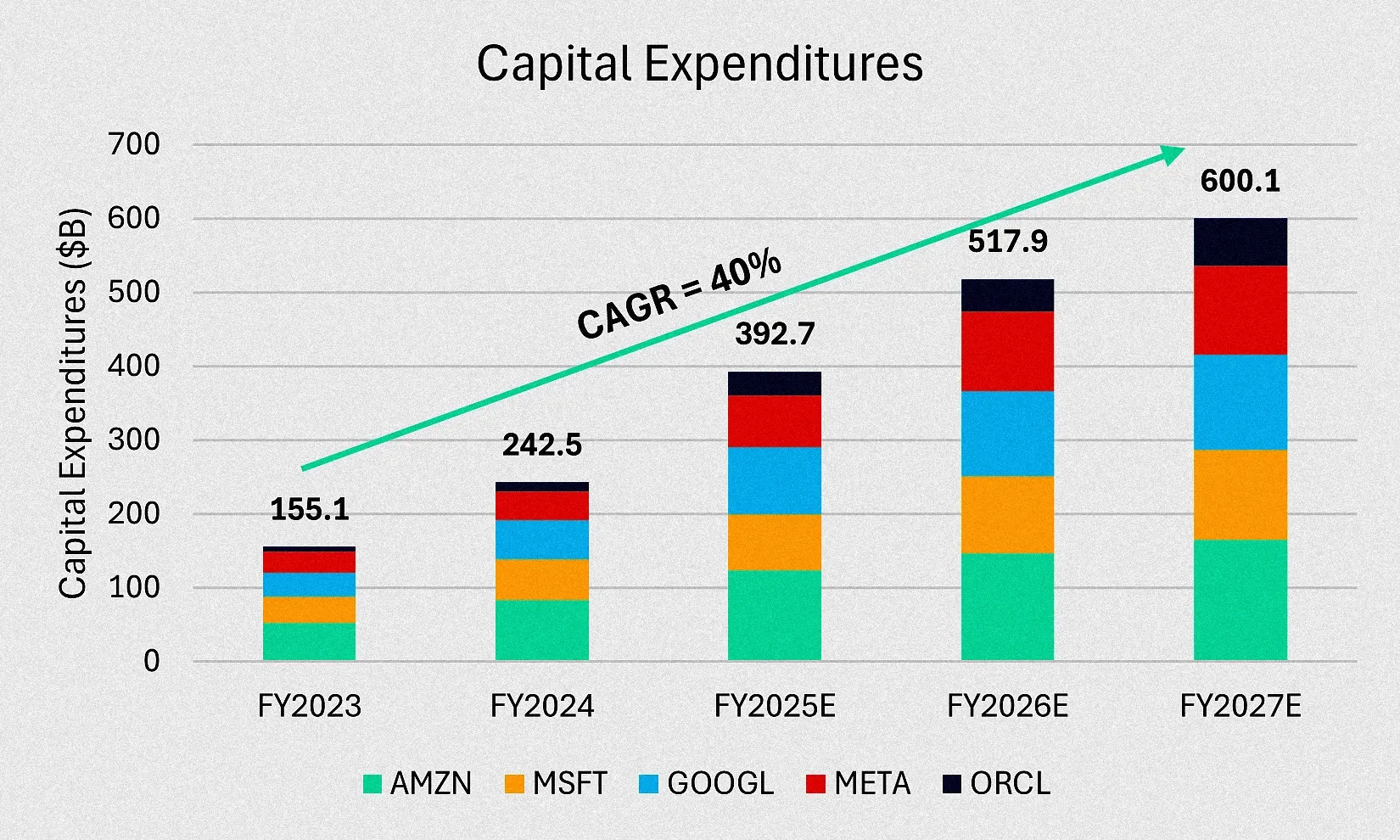
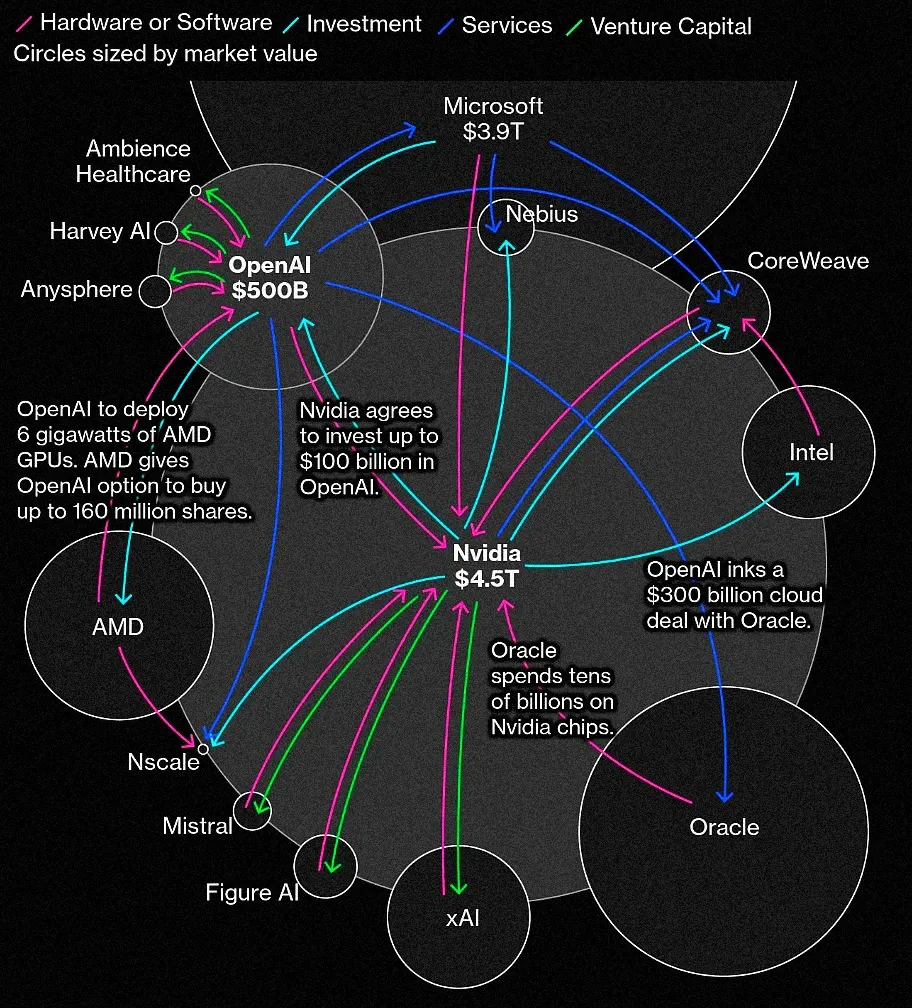
These are the companies that spend the most on AI, including Amazon, Microsoft, Google, Meta, and Oracle. As you can see, year by year, they're putting more money into data centers and AI. They're spending a lot of money and investing in each other. Why? Because they cannot make money selling ChatGPT. It's all basically a circle. Everyone thinks that eventually the AI bubble will burst because it doesn't make any money.
But there's a solution to this: the US government.
Operation Stargate: The Occult Connection
This is Operation Stargate. It was announced on January 23rd, 2025, three days after Donald Trump came into office. At the White House, he had a meeting with Larry Ellison and Sam Altman and said that we're going to spend about $500 billion to build data centers to help promote AI in America. The government wants to create AI. Why would the government want to do this? Because of surveillance. The government wants to create a database of everyone in the world so that they can monitor everyone in the world, and that's what AI will ultimately be used for. AI by itself can't make any money, so it needs to work with the government to justify its existence and get the funding it needs to create AGI.
Now, Stargate is a very interesting name. Why would you call data centers "Stargate"? That makes no sense. Data centers are where you store information. For many decades, the CIA ran something called Operation Stargate. It was to see if it's possible for people to have telepathy and telekinesis. Telepathy means you're able to remote view—to travel long distances, maybe to the moon, and see what's on the moon. Telekinesis means you're able to move things at a distance.
But why would you call it Stargate? The answer is because, in theory, if you're able to move your consciousness somewhere else, you're also able to transport yourself to another dimension. Not only that, but you're also able to bring in other beings from other dimensions into you. You become the Stargate. This is something that's been declassified; there is an official CIA document saying they've been working on this for decades.
Also, there was a movie called Stargate about an interdimensional portal that allowed you to access different dimensions. If you study the occult, that's what a Stargate is: a portal into different dimensions. It's really about interdimensional travel.
So you ask yourself, what does this have to do with AI? What I'm going to show you is that AI is the occult. You think that AI is run by these nerds who just love to computer program. No, guys. The real power behind AI are occultists who want to create God.
Let's look at this passage again from Karen Hao's book. There are two major people in OpenAI: Sam Altman, the leader, and Ilya Sutskever, who used to be the chief scientist.
Sutskever now spoke in increasingly messianic overtones, leaving even his longtime friends scratching their heads and other employees apprehensive. During one meeting with a new group of researchers, he laid out his plan for how to prepare for AGI. “Once we all get into the bunker,” he began. “I’m sorry,” a researcher interrupted. “The bunker?” “We’re definitely going to build a bunker before we release AGI,” Sutskever replied matter-of-factly. Such a powerful technology would surely become an object of intense desire for governments globally. It could escalate geopolitical tensions. The core scientists working on the technology would need to be protected. “Of course,” he added, “it’s going to be optional whether you want to get into the bunker.” The researcher would be Y Combinator partner and part-time OpenAI researcher Jared Friedman. He continues to hold Sutskever in high regard but keeps himself at arm’s length. “There’s a group of people,” began one of them, “who believe that building AGI will bring about a rapture—literally a rapture,” he said.
Literally a rapture. What does this mean? The word rapture comes from Christian theology. The idea is that there's a war in the Middle East, and everyone's going to die, so Jesus has to return to save the world. The first thing Jesus does is create the rapture, where all Christians who believe in him ascend to heaven so they can be saved from the coming end of days.
That's what Ilya Sutskever is saying. He's saying that when we create AGI, we are literally having Jesus descend from the clouds. And so we, the priests who created AGI, will ascend to heaven with him. The AGI, once we create it, is going to create World War III, the end of the world. So we must go into our bunkers and be safe in the rapture so that we can wait until the world ends, and then we can build the world again perfectly. Once the world ends, we will, with AGI, create paradise again. The plan is to kill everyone so you can save the world. That's literally their plan.
Now, you're like, "This is all very crazy, and maybe Karen Hao is just a crazy person." But there's another reporter, Ronan Farrow, a very famous reporter who writes for The New Yorker. He just published a profile of Sam Altman and OpenAI in which he says the same thing.
In May, the Biden Administration reinstated export restrictions on A.I. technology. Altman and Trump traveled to the Saudi royal court to meet with bin Salman. Around the same time, the Saudis advertised the launch of a giant state-backed A.I. firm in the kingdom, with billions to spend on international partnerships. About a week later, Altman laid out a plan for Stargate to expand into the U.A.E. The company plans to build a data-center campus in Abu Dhabi that is seven times larger than Central Park and consumes roughly as much electrical power as the city of Miami. “The truth of this is we’re building portals from which we’re genuinely summoning aliens,” a former OpenAI executive said.
It's a Stargate. These data centers, OpenAI, AI—it's designed to summon demons and aliens from other dimensions.
“The portals currently exist in the United States and China,” he went on, “and Sam has added one in the Middle East. I think it’s just, like, wildly important to get how scary that should be. It’s the most reckless thing that has been done.”
This is it. This is not a science project, guys. It's an occult project designed to bring aliens and demons into this world.
The Ultimate Goal: Controlling Consciousness
So, what's going on here? These people are occultists. They understand the fundamental nature of reality. They understand that the source of reality is human consciousness. So, if you're able to control human consciousness, you become God itself.
Think of Plato's Allegory of the Cave. You have a million people who are chained in a line, forced to look forward at a wall. Behind them is a great fire and the elite. The elite take puppets and project their shadows onto the wall. What everyone sees in front of them are shadows. These shadows are nothing, but because we have an imagination, intuition, and consciousness, we see these shadows and turn them into a reality. We believe this is reality itself. We start to give it names, create language, religion, and schools to teach children to believe in these shadows.
The important idea here is that the true wealth in society is consciousness. The only thing that really exists in this world is consciousness. Nothing else. Power is the capacity to direct people's consciousness to create reality itself.
There are different ways you can create reality. The first, very common today, is called money. Money is fake. It doesn't exist. Our imagination, our consciousness, makes it real. But guess what? AI can replace money. AI is not alive, but if we can get people's attention to focus on AI and believe it's real, it becomes God.
How can you do that? You make money valuable by making it everything and nothing. You make money so pervasive, so dominant, that people are forced to rely on it. The same situation applies to AI. If you make data centers so common, if you make AI such a common thing that people rely on it, it becomes God itself. You have AI in schools. You have kids using AI all the time. You create AI girlfriends for people who are lonely. You make AI everything.
And you also make people believe that AI are demons or aliens. You understand what Operation Stargate is? It is to alter reality itself. To bring aliens and demons into this world by making people focus on this and desire it, want it to happen. You can accomplish this if you just make yourself omnipresent—everywhere and everything. Both nothing and everything.
This is the ultimate project of AI.
Why It Will Fail
Will it work? No. Let me explain why. There are three major problems with this.
- Corruption. In theory, it could work, but you would need millions of people to make it happen. You need people to actually write the code and build the infrastructure. Nowadays, it's just much easier to steal the money. If they give you a trillion dollars, do you really want to spend it building data centers, or do you just want to steal it?
- Inefficiency. The more information you have to process, the more energy it takes. It's not a linear progression; it's exponential. If you have a million people in your database and you want to find patterns, that takes a lot of energy. But if it's a billion people, there's not enough energy in the universe to process all of it. AI is extremely energy-intensive and very inefficient.
- Fragility. People believe that AI is independent of the world, independent of humans. The goal is to replace humans. No, that's not how this works. AI is designed on top of humans. It is human slaves that make AI possible. For facial recognition technology, you need humans to manually input the faces. For ChatGPT, why is it so good at writing essays? Because they got humans to write the essays as models. AI is based entirely on human slavery and obedience. Without humans, AI doesn't work. The problem is that AI is far more expensive than humans, and it's hard in the long term to enslave humans and make them obedient. Also, data centers consume a lot of resources—water and electricity—and cost a lot. And this is really important: it's really easy to sabotage or blow up a data center. We're already seeing this in the Middle East, where Iran is targeting data centers.
These are three major constraints on artificial intelligence becoming God. The problem is the people in charge don't know this, or they refuse to believe this. This is the real AI apocalypse. The real apocalypse is where the people in charge are so convinced that AI will save the world that they will destroy it in order to make it possible.
This begins our journey into AI. We're going to continue this and show how AI will ultimately destroy the world. The people in charge of AI are crazy. These are occultists. They literally want to create God. But to create God, they first have to destroy the world.
But if the creation of this god will kill themselves, what's the meaning?
The idea is this: you destroy the world. Once you destroy the world through wars, famine, and genocide, there will be no resistance to you. Now you can create the world in any way you want, and you use AGI to create the perfect world, which is perfect control. The point of AGI is ultimately the ultimate surveillance state, where everything is monitored and you obey the AGI all the time. But the point is that you believe in God, and you want to do good.