Game Theory #6: The World's Bank
There is a strange game being played in the world, and it's worth examining the behaviors it produces. Consider three things that, on the surface, don't seem to make any sense.
First, many of the best and brightest in developing nations spend an inordinate amount of time learning English, often more time than they spend mastering their native language. When asked why, their answers are usually about learning knowledge, going abroad, communicating, or using the internet. But that's not a good explanation.
Second is an obsession with making money, especially US dollars.
Third is the goal to immigrate to a Western country, specifically the United States. Many want to go to the United States for college, get a degree, and hopefully stay there for a good job. This is strange because these individuals often have a much higher status in their home country. They are more likely to get a good job and marry a better woman in a place like China than in the United States, where the game is rigged against them.
This sort of behavior is weird. If you think about it, what one should be trying to do is master their native language. Given a strong family background, often wealthy and well-connected, one can climb pretty high in their home country. By mastering their own language, they are far better able to communicate, gain respect, and achieve status. But instead, they learn English.
The focus on US dollars also doesn't make sense. What people really want is status. They want to be well-respected, have a prestigious job, marry a beautiful woman, and have lots of children. But instead, they are focused on obtaining US dollars.
Finally, immigration to the United States is a rigged game. The most one can hope to obtain is to become an engineer or a professor, but they are not going to achieve political power or become the CEO of a major company. The situation as it is, where the best and brightest of a nation want to be common people in the United States, Britain, or Canada, is a really weird game.
How was this game constructed? Why do we play this game? The answer is because of the British. The British Empire created this game that the Americans ultimately inherited and which the entire world plays today because America is the global superpower.
The Spanish Precedent: Wealth and Hubris
To understand how we got here, we need to go into some history.
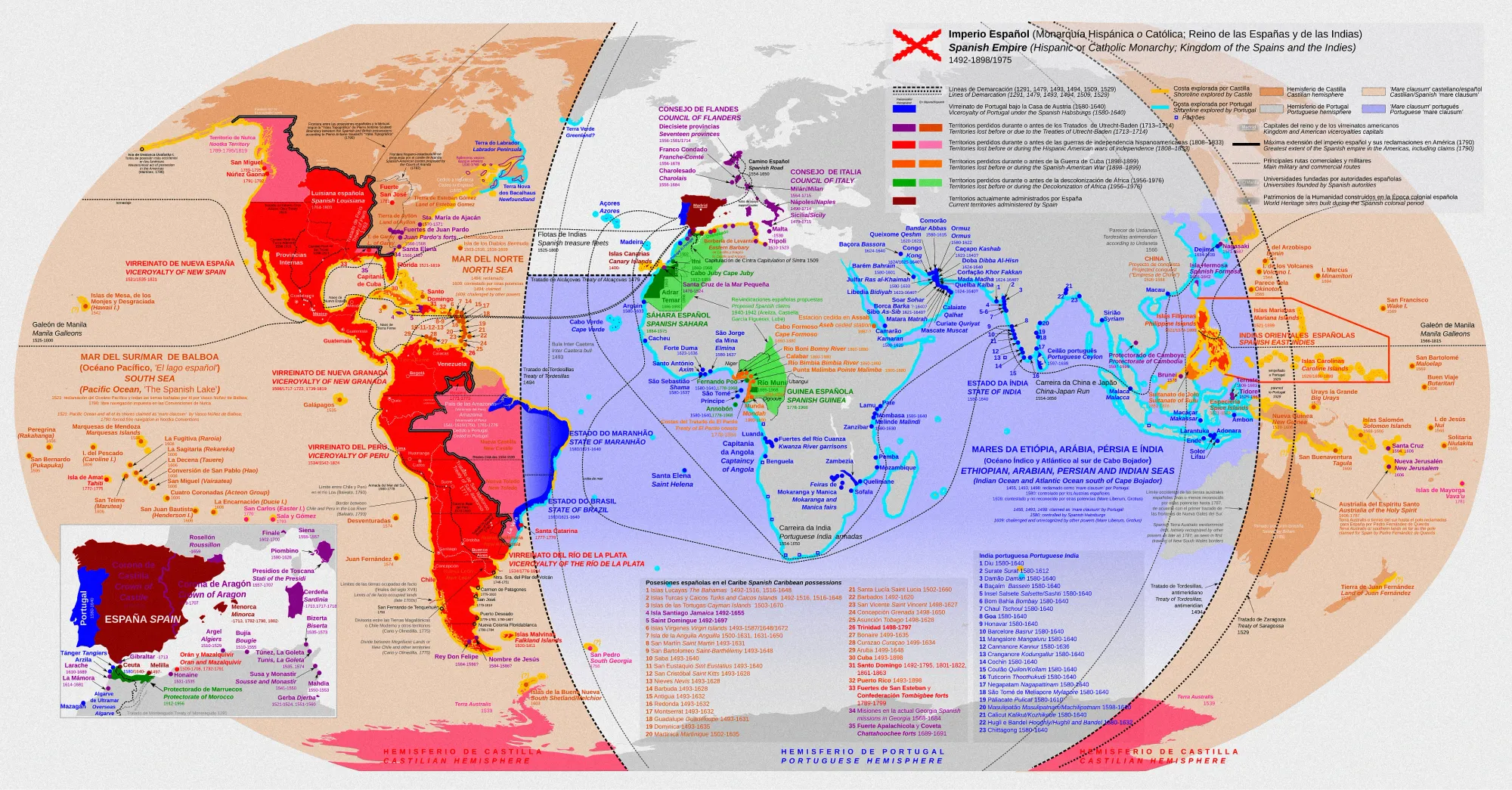
This is a map of the Spanish Empire at the height of its power. As you can see, this small nation in Spain was able to cover the entire globe. How was this accomplished?
For most of its history, Europe was a very poor place. To obtain wealth, it had to trade with the world, specifically for spices from what they called the East Indies (Southeast Asia). At this time, the main power was the Muslims. To trade with East Asia, you had to go through them. At one point, Spain itself was Muslim—a place called Al-Andalus—but then the Christians were able to reconquer it. In response, the Muslims decided to either blockade Spain or charge heavy levies for trade.
This forced the Spanish and the Portuguese to look for new routes to the Indies where the spices were. Remember, at this time in history, spices were the most valuable commodity, worth more than gold. I'm talking about cinnamon, nutmeg, and peppercorn. One shipload of these spices brought back to Europe could create intergenerational wealth, making you one of the wealthiest people on the continent.
So, the Spanish and Portuguese began to explore all around the world. They went to North and South America, where they discovered the Aztecs and the Incas. These were empires with a lot of wealth, and they were easily conquered. The Spanish set up colonies all around South America, and a lot of silver was transported back to Spain. Overnight, Spain became extremely wealthy.
But as we've discussed, if you become too wealthy and too powerful, you change as a people. Before, you were energetic, open, and cohesive—that's what made you an empire. But with all this wealth, you become insular, arrogant, and extremely close-minded. You become lazy. The Spanish had all this wealth and decided they didn't want to work anymore.
They started to subcontract their labor to other places. This led to the rise of England, France, and the Dutch Republic, who began to provide textiles and luxury goods to Spain. Because the Spanish were so wealthy, their people didn't have to work, but they still wanted to buy nice clothes. So, they got other nations—Britain, the Dutch Republic, and France—to be their factories.
The Spanish also outsourced trade. Now that they were so wealthy, they could just hire the Dutch to do it. The Dutch were made responsible for going to the East Indies and bringing back spices. This was a very dangerous job; you could get sick and die along the way or lose a lot of money. The Dutch agreed to this because they were basically a colony of the Spanish Empire.
The third thing that happened was piracy. All this silver was being transported from the New World back to Spain. The English realized they could engage in piracy and steal this silver for themselves. The most famous pirate of this time was Sir Francis Drake, and he worked directly under the monarch, Elizabeth I. This was state-sponsored piracy that made Britain very wealthy.
This created a divergence:
- The Spanish Empire: Because of their wealth, they became lazy, insular, and arrogant. The word we use for this is hubris. They made others do their work, became consumed with internal court politics, and believed they were invincible. They started wars everywhere, overextended themselves, and went bankrupt very quickly from fighting too many wars and rampant corruption.
- England, the Dutch, and the French: They were slowly becoming more energetic, open, and cohesive societies.
This differentiation also led to a change in religion. Spain remained Catholic and fought to control the Vatican. To differentiate themselves, Britain and the Dutch became Protestant, or more specifically, Calvinist. The Catholic religion is really about obeying authority, but the Calvinist religion insists on hard work, energy, and obtaining wealth.
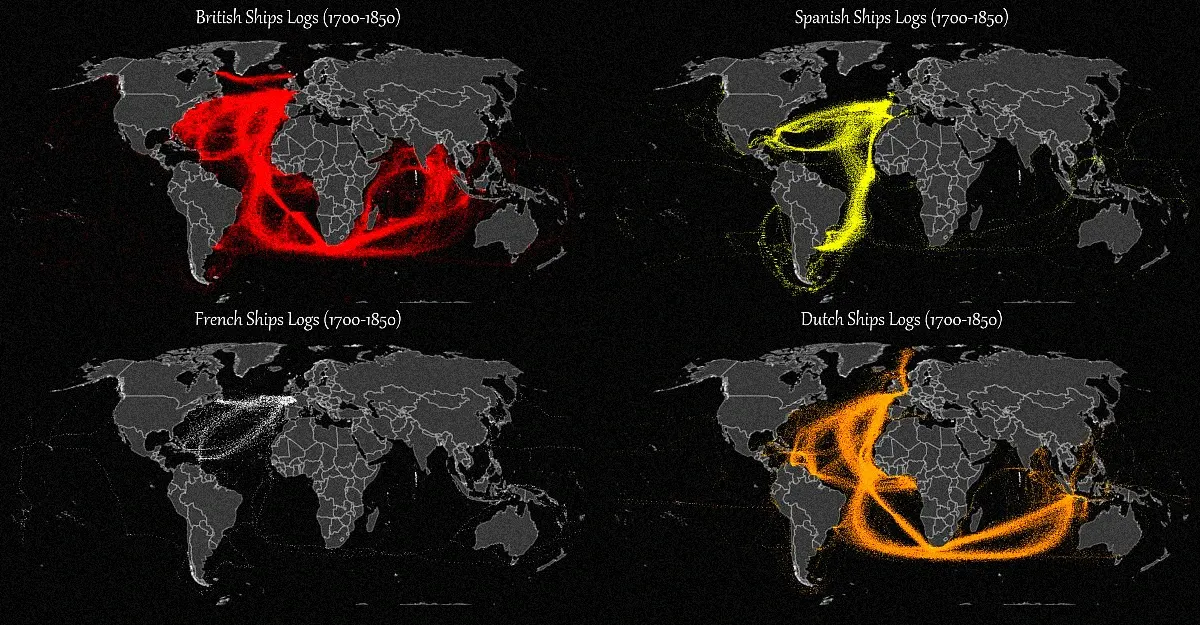
As you can see from this map, while the Spanish and French were engaged in extracting resources like silver and fur, the people really engaged in shipping, trade, and piracy were the British and the Dutch. The reason why is that they were poor. Through this hard work, they became very wealthy very quickly. In fact, the Dutch became the wealthiest nation in the world per capita, with a burgeoning middle class.
This led to conflict. The Spanish wanted the Dutch, their colony, to pay more taxes, while the Dutch wanted more independence. This sparked a series of wars throughout Europe, known as the Thirty Years' War. Ostensibly a religious conflict between Protestants and Catholics, it had other underlying factors, like Spanish control over the Dutch. Millions of people died; it was the deadliest war in Europe up until World War I.
This created anxiety. If you're a merchant who became wealthy through trade, how do you keep your wealth secure when the Spanish or French could send an army to steal everything? How do you keep your gold safe?
The Glorious Revolution and the Bank of England
What happened next is that the British and the Dutch decided to get married. This is what we call the Glorious Revolution of 1688.
In the Glorious Revolution, the British nobility invited William of Orange, a leader of the Dutch Republic, to come and become the monarch of Britain. Why would they betray their own king and install a foreign monarch?
Throughout British history, the monarch has always been in conflict with the nobility, the oligarchs. Ostensibly, the reason was religious—the king was Catholic, and Britain was a Protestant country—but the real reason was that the nobility wanted to exert authority over the country. In this agreement, Parliament became the sovereign state, the de facto power in England. William of Orange agreed to be the puppet or figurehead, but the real power was in Parliament. This created the idea of national sovereignty.
What people don't appreciate is that the real reason they did this was to protect transnational capital. The idea was that not only would William of Orange come over, but most of Dutch wealth would come over too. Remember, the Dutch were constantly being invaded by Spain. So, they took all the gold in the Dutch Republic and transferred it to England.
In 1694, they created the Bank of England. The idea was this: if you buy into the Bank of England, that gold is yours, and the Bank of England will always be guaranteed by Parliament.
This is a very important idea. Before, if a king needed to fight a war, he would borrow money from bankers and merchants. The problem was that the king could lose the war, die, or simply declare, "I'm king. I'm not going to give you back your money." The merchants would have no choice but to try to create a revolution.
The Bank of England was so important because now you were lending money not to the king, but to the nation. This means the nation has to pay you back. Even if the king dies, the people are liable for the debt. Now, if you're a merchant, you feel safe. You can put your money in the Bank of England, and if you lend it to the nation, you are always guaranteed to be paid back.
England was safe because, unlike the Dutch Republic, it is an island protected by the Royal Navy. It was impossible for the French, the Hapsburg Empire, or the Spanish to invade. This made England a safe haven.
But why would the Dutch trust the English not to just screw them over? They used old techniques like intermarriage and secret societies. Both the Dutch Republic and England were Calvinist, and the major society that facilitated trade was the Freemasons.
But the Bank of England was trying to get as much money as possible, so they systemized a new concept: contract law. The famous British philosopher John Locke said that government is for providing the inalienable right to life, liberty, and property. What that means is a government ensures you three rights:
- We will protect your safety.
- We will make sure you have the right to do whatever you want (liberty).
- We will protect your private property.
The entire purpose of Parliament and the judicial system is to ensure that your private property is protected, no matter where it came from. They don't care about the origin of private property. If you're French and you killed a million people to steal a million gold, they don't care. It's yours. It's private. They believe this private property comes from God, and England must protect it through Parliament and the court system.
Now, if you're wealthy in Europe, you're encouraged to invest in England. This creates a concept that today we call an offshore financial center (OFC). Think of places like Dubai or Hong Kong, where they don't care where the money comes from. Their legal and financial systems will help protect this money. Switzerland is a classic example, but England created this and based their entire nation around this idea.
The British Empire: A Global Financial System
The first major test of this system was Napoleon. He was about to conquer Europe, and England couldn't have that. If Napoleon conquered Europe, he could control all its wealth and blockade England. So, Britain financed seven wars against Napoleon. They lost six of them but won the last one, which created the British Empire.
Now, Britain is a global financial empire. The East India Company, based in Britain, was a private entity like the Bank of England. It primarily engaged in trade with India and the East Indies. England colonized India and stole its wealth, primarily by de-industrializing it. India had textile factories, but England, through various policies, bankrupted the Indian textile industry and transferred it to England.
The system worked like this: resources and agricultural products from India were transferred to England. England's factories would then make goods for India. Basically, Britain would give India $10 for its goods, and India would pay Britain $1,000 for the goods it received. This bankrupted India. The same idea was applied to China, where opium went into China, and silver and money went back to England. This money was then allowed to go over to the United States, which industrialized very quickly because of this policy.
How was England able to create a system in which India and China voluntarily gave up their wealth? The answer is that England created a game that incentivized the local elites to cooperate.
The local elites had to help the British steal. Why would they do that? Because the local elites are in conflict with each other anyway, and they are looking for more power. England said to the local elites, "If you help us, we will help you steal the gold from this country."
Before, if you were an elite and you lost a war or other people didn't like you, they could kill you. But now, if you help the British, you can transfer your wealth and your children abroad.
The elite were now able to send their children and their wealth to the British Empire. There were certain mechanisms that allowed them to accomplish this.
- Finance. Not only are you allowed to transfer your capital to the United Kingdom and its colonies, but they will disguise it for you. This is what we call money laundering. When you steal from your people, Britain will not only allow you to do this but will disguise it for you through their offshore financial centers like Hong Kong and Singapore. Their lawyers will pretend this money came not from drugs, gambling, or prostitution, but from restaurants or real estate. They'll clean it up for you and help you send it overseas where it becomes legitimate, allowing you to have real estate investments in Australia or Canada. This is a global money laundering system that encourages local elites to be corrupt. It protects and incentivizes their corruption.
- Schooling. When the British conquered India and China, they tried to brainwash and indoctrinate the population. They set up schools where you learned English. But when you learn English, you learn that British culture is superior to your local culture. You learn about Shakespeare, British philosophy, and British history. As a result, you slowly come to believe that the British are superior and that you should try your best to be British. The schooling system also allows for mobility. If you are a really smart person in China, there's little mobility for you there. But if you go through the British system, you might win a scholarship to study at Oxford or Cambridge. You might even become a Rhodes Scholar. The Rhodes Scholarship is basically a secret society where the very best students from all over the British Empire are selected to go to Oxford, where they become best friends. Their mission is to spread the power of the British Empire around the world. This indoctrination system for local elites works really well because the British offer more opportunities for mobility than your own country, where the system is very hierarchical and static.
- The Navy. The navy ensured that Britain was the greatest military power in the world. If they didn't like you, they would come and destroy you, as happened to China during the Opium Wars.
These three things—finance (the Bank of England), schooling (soft power, British culture), and the navy—created the world's first great world empire. Even though the British Empire is no longer around and has been replaced by the American empire, and even though the opium trade has stopped, the game is still being played today.
The Modern Game: Covert Financial Control
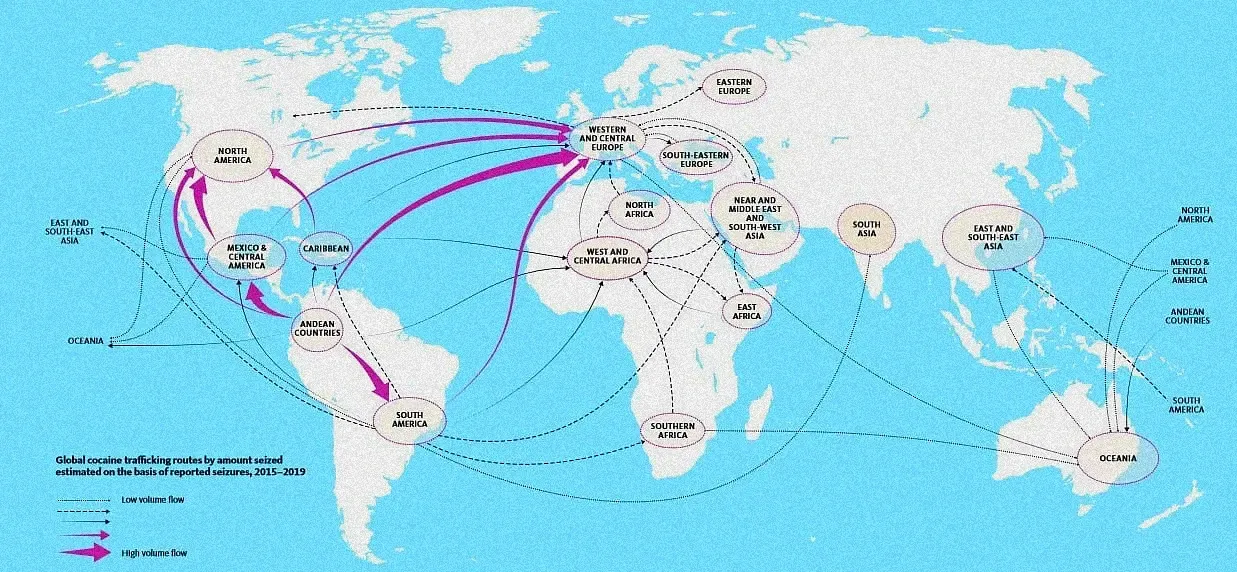
This is the drug trade in the world. As you can see, it's a global network. A lot of cocaine is produced in Colombia and South America and then travels all around the world in a very sophisticated system of trade. None of this would be possible without the British financial and legal system.
Why are people taking such a risk selling drugs? Because it's so lucrative. But you can only have this market if it's being protected by a legal and financial system. People only participate in this dangerous trade if they can be guaranteed that they can make a lot of money and then protect that money.
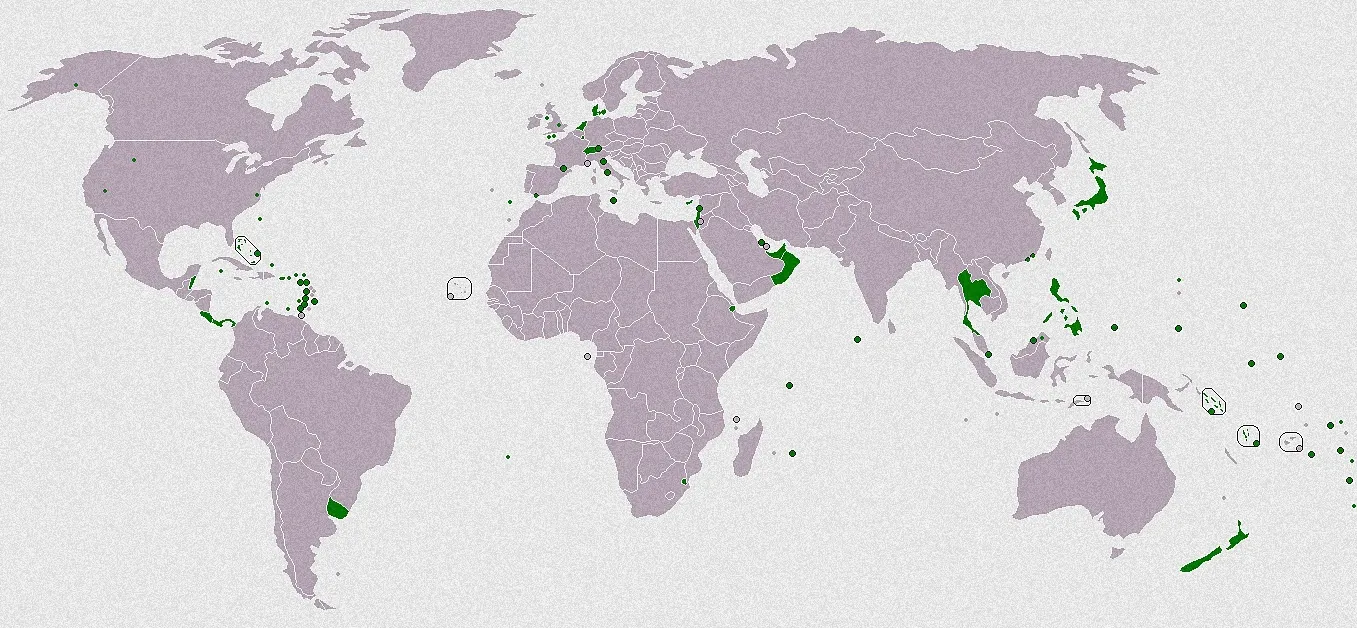
What protects this money, of course, are the offshore financial centers. These are the areas in the world where you can place your money, and they won't ask where it came from. They will clean it up for you through money laundering, using their sophisticated legal and financial systems, and then help you invest it elsewhere.
Where are the major global offshore financial centers? They're in the Caribbean, Panama, northern Europe, the Middle East, and Southeast Asia (Hong Kong, Singapore, Japan). Guess what? This used to be the former British Empire.
The British Empire is still around today, but it has transformed from one that is overt and uses military power to control the world to one that is covert, secret, and uses financial and legal means to control the world. It's still the game that we play today.
Why Doesn't Everyone Create an Offshore Financial Center?
If offshore financial centers like Hong Kong and Dubai are so profitable and it's such easy money, why doesn't everyone do it? The logic is very simple. We know that gambling, prostitution, human trafficking, and slavery are all profitable. Why doesn't everyone do it? Because it's immoral.
As a society, you need morality to create energy, openness, and cohesion. People want to feel as though they're part of something good, that they're serving a higher cause. If you're all about slavery, prostitution, gambling, or money laundering, people won't feel good about themselves. In fact, their souls become corrupted.
A classic example is Hong Kong. It's one of the wealthiest cities in the world, with lots of skyscrapers. But the people there can be seen as depraved and unethical. There's no real culture or morality to the place. If you live there, your soul is going to become corrupted. This is almost a demonic system. This system is not only evil, but it facilitates evil. It is the work of Satan. But unfortunately, this is the system that we live in today.
All this corrupt money from China, India, and Malaysia goes to these places. But then this money goes where? It goes over to Australia to invest in real estate. The biggest industry in Australia is banking, which means that Australia also engages in money laundering, but they clean it up so people aren't aware of it. The same happens in Canada and the United States. This entire world is based on stealing from the third world and transferring this money to the first world.
This has led to a huge problem: over-financialization. It's a very similar concept where there's too much money, so people become corrupt, lazy, arrogant, and insular. That's what's happening in Canada, the United States, Britain, and Australia. An empire must collapse at some point. The Western world is a victim of its own success. They stole all this money from the rest of the world, but this money has made their people lazy, corrupt, and arrogant.
That's why we're seeing so much conflict in the Western world right now. This money has created a lot of inequality, where maybe 1% have all the money and 99% have very little to get by on. You also have a lot of corruption, where the political system no longer serves the interests of the people, only the interests of the rich. And you have immorality, where people are only concerned about making money and don't want to contribute to the community.
We can say that the Western world is evil because they've stolen all this money. But what's really happened is that they've corrupted and destroyed themselves because this model has been too successful for them. That's why we're seeing so much chaos in the world today. We are really at a game reset or a game's end, and a new game is about to emerge because this game right now is not sustainable.
If Success Leads to Corruption, What is the Point?
This raises a great question: if you know that becoming successful will not make you happy, why do people pursue success?
People know that wealth doesn't lead to happiness. What leads to happiness is family, love, community, meaning, purpose, and generosity. The happiest people in the world tend to be religious, have families, and are very kindhearted. So why do we have rich people? Because a game is structured so that everyone is forced to play. We worship the rich—people like Elon Musk, Jeff Bezos, or Mark Zuckerberg—and we hate the poor. If you're homeless, we think it's because you deserve it, because you're lazy and refuse to work. The game is set up so that we're focused on making money.
Why do we have this stupid game? The answer, unfortunately, is that we figured out that this game, in the short term—decades, not centuries—is what makes your people the most energetic, open, cohesive, and the most likely to win against other nation-states. In the long term, you get destroyed. Your people are corrupted by this game. But in the short term, it allows you to defeat other players. That's how the British were able to create their empire; they defeated the French, the Germans, and the Russians. This forces the other players to play this game as well because, in the short term, this game gives you huge advantages.
Think of it as a zero-sum game, like an Olympic 100-meter sprint. We know you shouldn't do drugs because they will destroy your body, and you could have a heart attack when you're 40. But one guy uses a drug and wins. The other players know about this, and now they're forced to also use the same tactic.
It's a really unfortunate system in that it can only lead to the unhappiness, corruption, and immorality of people. But people are too concerned about short-term rewards. If you don't play this game, you get eliminated. If you cheat and do bad things, in the short term, you will win out, even though in the long term it will lead to severe consequences for you and your people.
It's the same with rich people. To get rich, they will sacrifice their children's happiness and their own happiness. They think this will lead to happiness in the future. It won't, but they believe it. That's the great tragedy of this game.