Great Books #12: Dante in Paradise
To understand the Divine Comedy, it is very important to put it in the context of the other great books. In human history, there have been three great poets. The first is Homer. The second is Virgil. The third is Dante.
Homer gave us the Iliad and the Odyssey. By doing so, he constructed the basis of Greek civilization, which then became the basis of Western civilization. Virgil will take the Iliad and the Odyssey and reimagine it as the Aeneid. The Aeneid will give rise to the Roman Empire and the Catholic Church. Even though the Roman Empire and the Catholic Church are two fundamental pillars of Western civilization, the Aeneid will lead to over a thousand years of the Dark Ages, when Europe stops being creative.
Dante will end the Dark Ages with the Divine Comedy. The Divine Comedy will become the blueprint for the Renaissance, the Protestant Reformation, the Scientific Revolution, and modernity itself. Basically, Dante built the world that we live in today.
The Competing Forces of Human History
The question then is, how did this happen? How is it that Homer would create Greek civilization, then Virgil would erode civilization, only to be restored by Dante?
The difference is in how they perceive the role of humans, or what it means to be human in this world. What Homer taught us is that love is the unifying force of the universe. Remember that Odysseus spends twenty years trying to return to his family, Penelope and Telemachus. That imagination is the unifying force of the universe. What matters is the individual, the individual's connection to the source, or the monad. If the individual is able to connect to the source, then that lights the universe.
But what Virgil will do, because he serves empire, is he will cut us off from the source and say, "No, what matters is piety, obedience to authority." By doing that, we cease to be individuals, we cease to be imaginative, and civilization stops.
What Dante has to do is reconnect us back to the source. If he does that, it will restore the imagination as the fundamental animating force of the universe. We can now be creative, and this will set a new path for humanity.
Throughout human history, there have been two competing, countervailing forces:
- The force of empire that wants us to obey it and therefore cuts us off from the source.
- The force of civilization, of democracy, of love that wants us to connect back to the source and thus animate the universe with our imagination.
The Divine Comedy, in other words, is fundamentally a conflict between Virgil and Dante. Dante must defeat Virgil in order to restore our humanity.
Ascending into Paradise
We have been through Inferno, we have been through Purgatory, and now we are in Paradise.
You may think that once we are in Paradise, we have come to the journey's end. But in fact, Paradise itself is another journey that is actually more arduous. Beatrice will be our guide through the stars after we reach God. What we will do is ascend through the nine spheres in order to meet God. Why do we need God? Because God will let us know who we truly, fundamentally are.
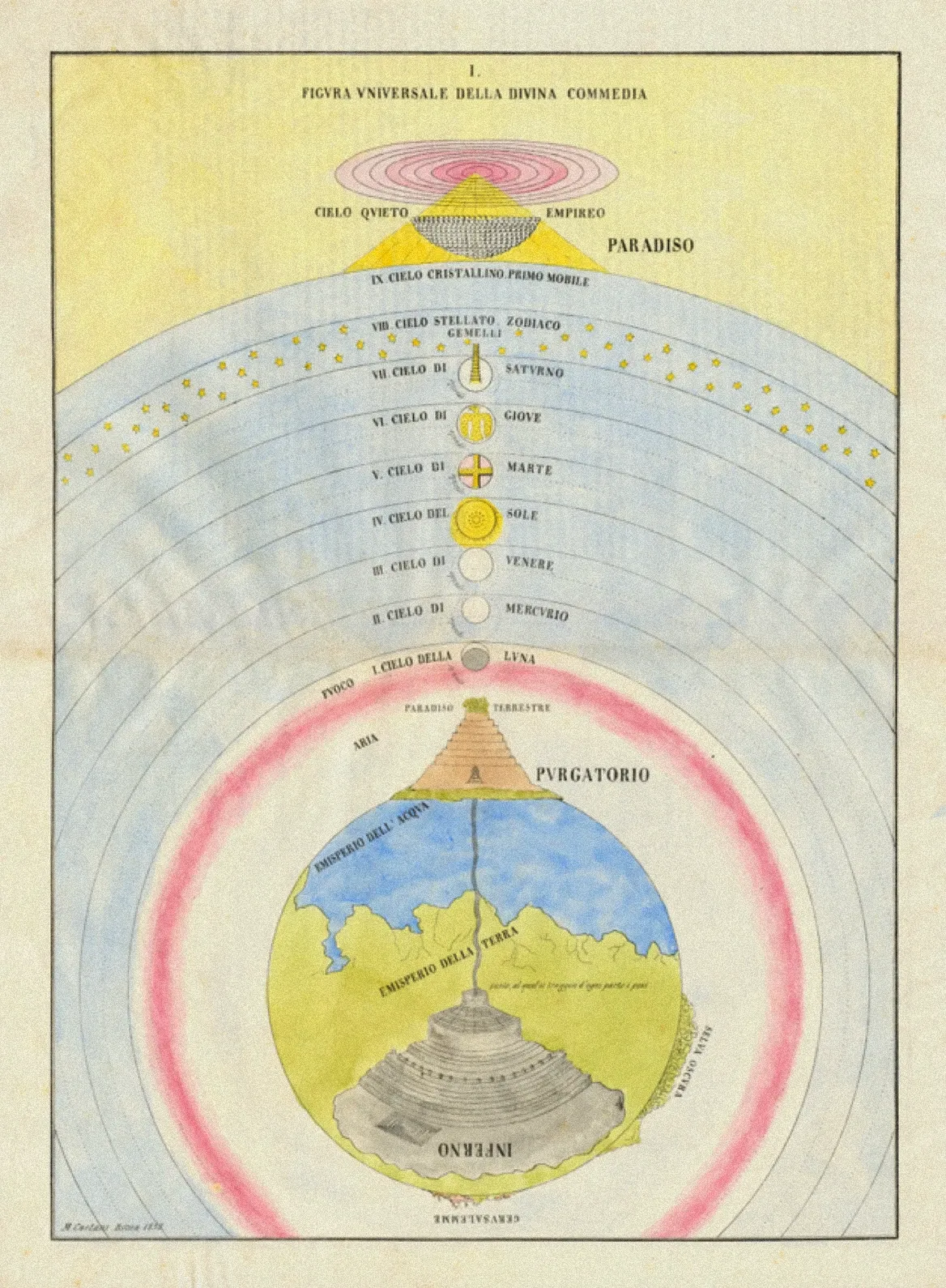
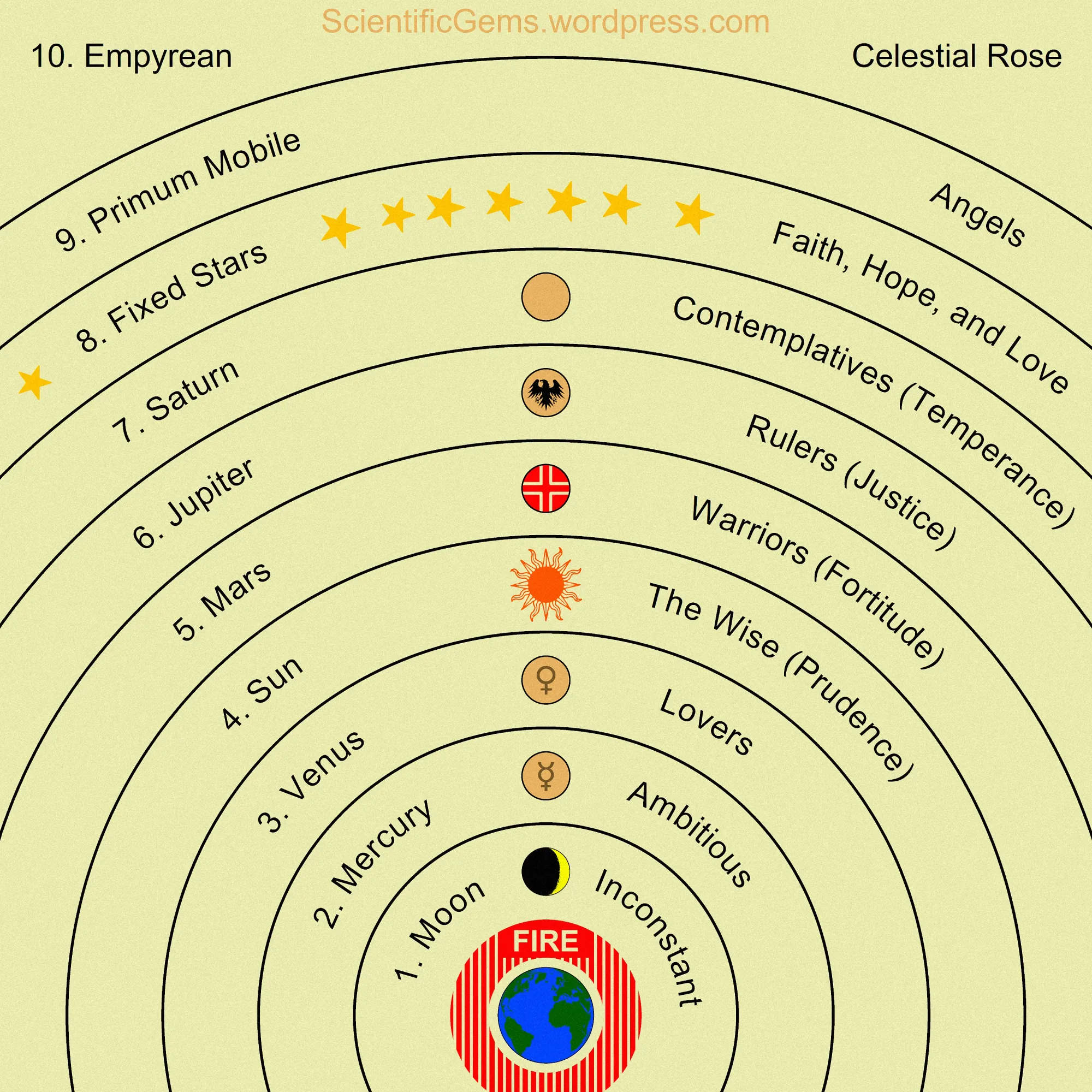
This is a depiction of our journey through the cosmos. We start off on the moon, and then we will make our way to Mercury, and then we will try to reach the Empyrean where God and his angels are. This is the center of the universe. It is the source. This is our journey's end.
We first start off on the moon, and Beatrice is now Dante's guide. You would think that these are two lovers that have not seen each other in decades. You would think that they would just be happy hugging each other, or maybe they would have a lot of sex. But in fact, what happens is that they start to engage in the deepest intellectual discussion. This is deep philosophy. Heaven is fundamentally about debate, dialogue, and philosophy.
This is a really important idea: we suffered in our world in Inferno and Purgatory not to cleanse ourselves of our sins. We suffered not in order to redeem ourselves and make ourselves ready for heaven. We suffered in order to gain the knowledge requisite and necessary for higher learning in heaven. That is the purpose of heaven—to discover the truth of the universe. But we must first undergo Inferno and Purgatory to prepare our minds for the intellectual challenge of Paradise.
The Mystery of the Moon Spots
Beatrice and Dante are having a conversation about the cosmos. She says, be thankful that you are here, and here we will start a journey into the truth of the universe.
With all the devotion I can summon, I
thank Him who has removed me from the mortal
world. But tell me what the dark spots are
upon this body, which there below on earth
make people tell the tale of Cain?
She smiled somewhat, and then she said to me:
"If the opinion mortals hold falls into error
where the key of sense cannot unlock the truth,
the shafts of wonder should not pierce you now,
since you see that reason, even when
supported by the senses, has short wings.
But tell me what you think of it yourself."
And I: "What seems to us diverse up here
is caused, I think, by matter dense and rare."
And she: "You surely will see your belief
deeply submerged in error, if you listen
carefully to the arguments I bring against it."
The first question that Dante has for Beatrice is about the moon. On the moon at night, there are some dark spots. He asks her, how do you explain the fact that there are some dark spots on the moon?
She says, the first thing you need to recognize is that you cannot figure this out by observation and reason alone. That will only lead you to error. The true power is your faith, your love, your intuition, your imagination. That is what will lead you to the truth. But humans are stuck using their observation and their reason, their science, to figure out what this is. So you are always going to fall into error, but it is okay to make an error. First, tell me what you think is the reason.
Dante says, well, I think what most people think, which is that it is because of the density and rarity of the moon. What this means is that there are some places in the moon which are hollow. If it is hollow, then that means that light can just pass through it. For there to be illumination, there has to be reflection. So the light cannot pass through these hollow parts of the moon and escape into space. In other words, the dark spots are just the most hollow aspects of the moon, and every other place is just very dense, which means light cannot pass through and is reflected back. From observation and reason, that is the most logical explanation.
If you are curious as to why there are dark spots on the moon, what scientists believe is that the moon is not hollow, but there are certain rocks and minerals created by lava, and the reflective quality of these minerals is very low. That is the standard explanation we have, but quite honestly, it is only a guess. We are not completely sure.
This is a mystery, and what Beatrice is going to do now is explain why this cannot be true. The way she explains it is very interesting. She is going to explain it using scientific methods, experiments, and observations to show you how this cannot be true.
The eighth sphere offers many lights to you,
and you can see that they, in quality
and size, are stars with different visages.
If rarity and density alone
caused this, then all the stars would share one power,
distributed in lesser, greater, or
in equal force. But different powers must
be fruits of different formal principles;
and these, were your deduction true, would be
destroyed, with only one remaining. More:
were rarity the cause of that dim spot
you question, then, in part, this planet would
lack matter through and through; or else, just as
a body alternates the lean and fat,
so would this planet alternate the pages
in its volume.
She points out, number one, that if it is true that density and rarity is what causes the dark spots on the moon, then it should be the same for every other celestial body, every other planet, every other star. Density and rarity is what matters. She is saying that is not true. She is also pointing out that your argument about density and rarity means that the moon is uneven, that there are some hollow spots to the moon.
To validate the first case, in the sun's
eclipse, the light would have to show right through,
just as when it crosses any other
tenuous matter. That is not so; therefore,
we must consider the latter case; and if
I shatter that, your view is falsified.
She is using the example of the solar eclipse to show us that it cannot possibly be true that there are hollow spots to the moon. When the moon covers the sun completely and the sun goes dark, if in fact there are hollow aspects to the moon, it should not be completely black. The light should be able to break through these hollow aspects. There might be some shallow cavities to the moon, but there are no hollow, empty spots to the moon.
If rarity does not go all the way
there must be a boundary where the denser matter
blocks the light from passing through.
From there the sun's ray would be reflected,
just as color comes back from a glass
that has lead hidden on its other side.
Now you will say the ray shows dimmer there
than in the other parts because
it is reflected from much farther back.
From this cavil an experiment may free you,
if you will try it—and experiment
is ever the fountainhead of all your arts.
Take three mirrors. Place two of them
at an equal distance from you. Set the third
between them, but farther back.
Then, turning toward them, have a light
placed at your back to strike the three
and be reflected back to you by all of them.
Although the image in the farthest glass
is not as large, you will observe
it shines with equal brightness.
She is saying, okay, so the moon is not completely hollow, it might be very deep. You think that logically speaking, the shallow parts would be bright, but the deep parts would be dark. She is saying that is not true. If you actually do a science experiment, you will discover that this is not true.
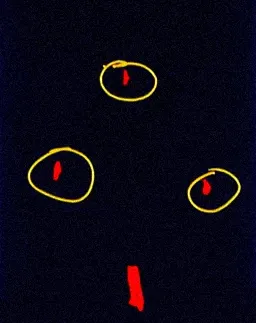
The science experiment she says is this: Have three mirrors. Place a pair of them at equal distance from you, set the third midway between those two, but farther back. Then take a light and shine it so that the mirrors reflect. What she is saying is the furthest mirror might be small, and the two mirrors here may be larger. The size might be different, but the brightness is still the same.
If you were to do this, you would discover this is true. She is saying, what is interesting is that you can also extend this experiment and say, let's go further. Let's keep on going. You can go into eternity. Infinity. The light at the end of the universe would still burn as brightly as the original source.
The Divine Light
She has shown that through science, through reason, through imagination, the moon has dark spots not because it is rare and dense. So then why is that the case? Here she explains.
Now, just as the substance of the snow,
beneath the blows of the warm rays, is stripped
of both its former color and its cold,
so is your mind left stripped of error; and
I'd offer you a light so living that
it trembles as it shines upon your sight.
Within the heaven of the godly peace
revolves a body in whose power lies
the being of all things that it enfolds.
The following heaven, which has many sights,
bestows that being on diverse essences,
distinct from it and yet contained in it.
The other spheres, in ways diverse, direct
the diverse powers they possess, so that
these forces can bear fruit, attain their aims.
Thus do these organs of the universe
proceed, as you now see, from stage to stage,
receiving from above and acting downward.
Now do attend to how I pass this way
to reach the truth you want, that you may then
learn how to cross the ford alone. The force
and motion of the holy spheres must be
inspired by the blessed movers, just
as the smith imparts the hammer's art;
and so, from the deep mind that makes it wheel,
the sphere that many lights adorn receives
a stamp of which it then becomes the seal.
And as the soul within your dust is shared
by different organs, each one suited to
a different potency, so does that mind
unfold and multiply its bounty through
the starry heavens, though that intellect
itself revolves upon its unity.
With the dear body that it quickens, and
with which—as life in you—it too is bound,
each different power forms a compound.
Because of the glad nature of its source,
the power mingled with the sphere shines forth,
as gladness through the living pupil shines.
From this, and not from matter rare or dense,
derive the differences from light to light;
this is the forming principle, producing,
conforming with its worth, the dark, the bright.
What it means is that the universe is created in a way that there is one source. The source is emanating light, and this is divine light. This divine light is the underlying, fundamental principle of the universe. If you are bright, it means the source is glowing brightly in you.
Think of the universe as your own body, where you have organs, you have hands, you have eyes. But what is animating your body, what is unifying your body, is your mind, your consciousness. That is the source. The universe works the same way. I am moving my arms, I am looking at you, my eyes are burning bright because of my consciousness, because of my mind.
The universe is connected in the same way, and the light glows throughout the universe. Our responsibility is to receive the light. How do we receive the light? By loving. By opening our hearts to love. Once we receive the light, then we imagine, and imagination is what allows us to glow brightly. Love and imagination is what allows us to glow brightly.
What she is saying is, you do not look at the world through the lens of physical principles. That does not get you anywhere. Understanding the universe fundamentally is about faith. It is about consciousness. It is about love and imagination.
The Empyrean and the Mind of God
This goes on for a long time, where Beatrice is slowly trying to explain to Dante the fundamental principles of the universe. The Divine Comedy is something that you cannot read in a week or a year. It is something that you have to spend your entire life reading. The entire point is to prepare the groundwork, to introduce ideas and principles that will anchor your own reading of the Divine Comedy.
They climb all the way up the heavens, and now they are in the Empyrean. The Empyrean is the seat of God, and it is surrounded by angels and light. What is going to happen—and this is really strange—is that first of all, Beatrice will go away, she will become an angel again, and then Bernard will be Dante's guide in the Empyrean.
What is Dante's role in the Empyrean? Dante's role is to meet God. Why does Dante want to meet God? Because God wants to meet him. Why does God want to meet him? Because there is a fundamental problem in the universe, and the problem is this: no one knows what God is. God does not know, the angels do not know, no one knows. Only Dante can know what God is.
Dante has embarked on this long journey through the cosmos, through Inferno, through Purgatory, through Paradise in order to meet God to figure out what God is. You are like, wait a minute here, this makes no sense. God knows everything. No, God is perfect. God is everything, and therefore God cannot know itself. If you are perfect, you lack an imagination because you know everything. Therefore, there is no limit to your knowledge. But imagination means breaking through the boundaries of knowledge.
This is a really strange situation in that God created humanity to know itself. Then, through the course of time, God picked an individual, and this person is Dante, to come to God, to let God know what it is fundamentally, to know itself, to complete itself. That is the great secret of the Divine Comedy.
But for Dante to figure this out, he will have to spend the rest of his life using his imagination to try to unpack, unravel what God is. Because when we first see God, God is like this infinite beam of light. You are like, what is this? He does not know. So he has to constantly imagine what God is before he can finally come to the answer.
St. Bernard's Prayer to the Virgin Mary
Bernard, before introducing Dante to God, is going to pray to Mary, the Queen, the Virgin Mother, for inspiration to guide Dante.
Why is Dante the only person in the world who can let God know what it is? The answer is because Dante is a human. A human has two aspects: a soul and a body. A soul connects to the source, to the divine. But the body connects to the material. The body can sin, it can suffer. It feels pain, it feels pleasure. Therefore, there is a limit to it, therefore it has an imagination. Because there are so many things to it that it has not known. When you as a human are able to combine the best aspects of who you are, both the body and the soul, that gives you an imagination that is divine. That allows you to connect back to the source, but also allows you to expand the universe. That is why only Dante can tell God what it is. Not the angels, not Bernard, not Mary. Only Dante.
This is the final canto, the end of the Divine Comedy. We have come to the end. This is heaven. This is the Empyrean. This is God. Bernard says to Mary:
Virgin mother, daughter of your Son,
more humble and sublime than any creature,
fixed goal decreed from all eternity,
you are the one who gave to human nature
so much nobility that its Creator
did not disdain His being made its creature.
That love whose warmth allowed this flower to bloom
within the everlasting peace—was love
rekindled in your womb; for us above,
you are the noonday torch of charity,
and there below, on earth, among the mortals,
you are a living spring of hope. Lady,
you are so high, you can so intercede,
that he who would have grace but does not seek
your aid, may long to fly but has no wings.
What Bernard is saying is that Dante is on a special mission to help God know itself. So let us remember and celebrate a woman, a mortal woman, who also expanded the possibilities of humanity. Because she was so noble, she was so generous, she was so loving that in her womb she was able to contain God itself. God was able to come into our world through the portal that is Mary. As such, God is able to reunify with us and to spread himself to us. Basically, Dante is completing another mission that Mary first started.
Your loving-kindness does not only answer
the one who asks, but is often ready
to answer freely long before the asking.
In you compassion is, in you is pity,
in you is generosity, in you
is every goodness found in any creature.
This man—who from the deepest hollow in
the universe, up to this height, has seen
the lives of spirits, one by one—now pleads
with you, through grace, to grant him so much virtue
that he may lift his vision higher still—
may lift it toward the ultimate salvation.
This is really important to understand. Higher vision still is the imagination. If Dante is to see God, if Dante is to know God, he cannot do it with his eyes. The vision does not matter. Everyone has eyes. The higher vision is the imagination. But how do you activate the imagination? Through virtue, through love.
It is the love that will give you the imagination to see the ultimate salvation, which is God. This is how the universe works. Dante has been selected because of his imagination and because of his virtue. What is his virtue? His virtue is his eternal love for Beatrice. What is his imagination? His poetry. That is what will enable him to know God and allow God to know itself.
And I, who never burned for my own vision
more than I burn for his, do offer you
all of my prayers—and pray that they may not
I can't see God. I don't know God. I'm next to God. I live with God. I'm part of God, but I can't see God. Only Dante can see God.
fall short—that, with your prayers, you may disperse
all of the clouds of his mortality
so that the Highest Joy be his to see.
This, too, o Queen, who can do what you would,
I ask of you: that after such a vision,
his sentiments preserve their perseverance.
Yes, so Dante will see God. But God is so powerful, the vision will be so powerful that it will blow his mind. It will literally blow his mind. So, Dante must use his virtue, his love, his soul to maintain the shadow of this image, to remember a shocking memory. That is the goal here.
May your protection curb his mortal passions.
See Beatrice—how many saints with her
now join my prayers, and clasp their hands to you.
His mortal passions are basically fear and the ego. To truly understand God, you must abandon your mortal passions, your ego, and your fear. You must be completely virtuous, you must be complete imagination, you must be complete love.
The Vision of the Eternal Light
The eyes that are revered and loved by God,
now fixed upon the supplicant, showed us
how welcome such devotions are to her;
then her eyes turned to the Eternal Light—
there, do not think that any creature's eye
can find its way as clearly as her sight.
And I, who now was nearing Him who is
the end of all desires, as I ought,
lifted my longing to its ardent limit.
Bernard was signaling—he smiled—to me
to turn my eyes on high; but I already
was doing what he wanted me to do,
because my sight, becoming pure, was able
to penetrate the ray of Light more deeply—
God is pure light.
that Light, sublime, which in Itself is true.
From that point on, what I could see was greater
than speech can show: at such a sight, it fails,
and memory fails when faced with such excess.
As one who sees within a dream, and, later,
the passion that had been imprinted stays,
but nothing of the rest returns to mind,
He is now looking at God and his mind is blown away. His mind, his brain cannot comprehend what he is seeing. It is like a dream where you dream something and you cannot remember anything but the impression, the feeling of that dream. All he remembers is being awestruck by it.
such am I, for my vision almost fades
completely, yet it still distills within
my heart the sweetness that was born of it.
Even so: the snow, beneath the sun, is unsealed;
and so, on the light leaves, beneath the wind,
the oracles the Sibyl wrote were lost.
O Highest Light, You, raised so far above
the minds of mortals, to my memory
give back something of Your epiphany,
It is almost like the metaphor is, I am just a flake of snow, and now I am before the sun. So I just burst. There is nothing left. There is a light.
So now what is happening is this. He is saying, twenty years ago I had this vision. Twenty years later I am alone at home and I have been trying for the past twenty years to remember what I saw, to use my imagination to reconstruct what I saw. We are now moving forward in time. We are twenty years ahead, and now he is in his room somewhere in Italy trying to remember what he saw.
and make my tongue so powerful that I
may leave to people of the future one
gleam of the glory that is Yours, for by
returning somewhat to my memory
and echoing a while within these lines,
Your victory will be more understood.
Dante's mission is not just to understand God, to help God know itself. Dante's mission is actually to report to us what he saw. To reveal to humanity the true nature of God so that we may know ourselves and be better humans.
The living ray that I endured was so
acute that I believe I should have gone
astray had my eyes turned away from it.
I can recall that I, because of this,
was bolder in sustaining it until
my vision reached the Infinite Goodness.
O grace abounding, through which I presumed
to set my eyes on the Eternal Light
so long that I spent all my sight on it!
In its profundity I saw—ingathered
and bound by love into one single volume—
what, in the universe, seems separate, scattered:
substances, accidents, and dispositions
as if conjoined—in such a way that what
I tell is only rudimentary.
So when he saw God, he saw the totality of the universe. Everything was interconnected in some way. God is infinite, it is eternal, it is everything, it is nothing.
I think I saw the universal shape
which that knot takes; for, speaking this, I feel
a joy that is more ample. That one moment
brings more forgetfulness to me than five
and twenty centuries have brought to the
endeavor that startled Neptune with the Argo's shadow!
So was my mind—completely rapt, intent,
steadfast, and motionless—gazing; and it
grew ever more enkindled as it watched.
Whoever sees that Light is soon made such
that it would be impossible for him
to set that Light aside for other sight;
because that good, the object of the will,
is fully gathered in that Light; outside
that Light, what there is perfect is defective.
He is seeing the entirety of the universe that is perfect, that is immutable, that is eternal.
What little I recall is to be told,
from this point on, in words more weak than those
of one whose infant tongue still bathes at the breast.
Not only is he trying to figure out what that thing was, what God is, but he is also trying to use words to describe that. And he discovers that this is really silly. Words cannot possibly describe what I just saw. So he is frustrated.
And not because more than one simple semblance
was in the Living Light at which I gazed—
for It is always what It was before—
but through my sight, which as I gazed grew stronger,
that sole appearance, even as I altered,
seemed to be changing. In the deep and bright
essence of that exalted Light, three circles
appeared to me; they had three different colors,
but all of them were of the same dimension;
Now he has figured it out. After twenty years of constant meditation, he has figured out what that thing was. He said that at the essence of God are three circles. They are the same. They are just three circles. Different lights, but they are the same.
Obviously, we know what this is now. It is the Holy Trinity. This is the essence of Christianity. Christianity teaches us that God is the Godhead. Three aspects: the Holy Spirit, the Father, and the Son. I looked into God and I saw the Holy Trinity. That makes sense.
one circle seemed reflected by the second,as rainbow is by rainbow, and the thirdseemed fire breathed equally by those two circles.
one circle seemed reflected by the second,
as rainbow is by rainbow, and the third
seemed fire breathed equally by those two circles.
How incomplete is speech, how weak, when set
against my thought! And this, to what I saw
is such—to call it little is too much.
Eternal Light, You only dwell within
Yourself, and only You know You; Self-knowing,
Self-known, You love and smile upon Yourself!
The Ultimate Paradox
That circle—which, begotten so, appeared
in You as light reflected—when my eyes
had watched it with attention for some time,
within itself and colored like itself,
to me seemed painted with our effigy,
so that my sight was set on it completely.
There is a problem. He has seen the Holy Trinity. It is three concentric circles. That is fine, and they are all reflecting each other. There is a fire inside them. But there is a problem with all this. He said that the longer I look, the more I concentrate, I discover there is a problem in the Holy Trinity, which is, why in the stupid thing is there an effigy? There is a human likeness inside the Holy Trinity.
That makes no sense. Because God is beyond us. That is why we must obey God, because God is a mystery. It is because God is so distant from us. Therefore, we must bow to it, be humble before it. But what Dante is saying is, I looked into the soul of God and we are inside it at its very heart. This makes absolutely no sense.
As the geometer intently seeks
to square the circle, but he cannot reach,
through thought on thought, the principle he needs,
so I searched that strange sight: I wished to see
the way in which our human effigy
suited the circle and found place in it—
He cannot figure it out. This is the greatest paradox in the universe. Why are we inside God? Why?
and my own wings were far too weak for that.
But then my mind was struck by light that flashed
and, with this light, received what it had asked.
Here force failed my high fantasy; but my
desire and will were moved already—like
a wheel revolving uniformly—by
the Love that moves the sun and the other stars.
I can't figure it out. But I want to figure it out. And I feel as though I am changed by this process of trying to figure this out.
That is it. The Divine Comedy. This is how it ends. It does not end with the answer. It ends with a question. Why are we inside God? What is the meaning of all this?
This is all very confusing because this is how it ends and he does not give us the answer. The thing to understand about the Divine Comedy is that it is not meant to be the Bible. It is meant to inspire you to embark on your own journey into the depths of the universe. You need to reread the Divine Comedy many, many times throughout your life. With each reading, you will have a deeper understanding of the Divine Comedy. With each reading, it will change how you live. It will change how you see yourself.
The Great Secret of the Universe
What is the secret here? What is the answer? What is God?
Well, the first thing is, what does this remind us of? Have we seen this before? Three circles with a human inside of it. Actually, we have. We have seen this before. I will show you where it is. Here it is. This is God.
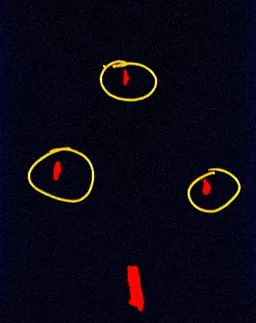
Because Beatrice was showing us through the experiment. She says, take three mirrors, and then shine a candle so that the candle is reflected in three mirrors. She tells us, hold that candle. You are holding the candle. As a result, not only is the candle reflected inside the mirrors, but you yourself are reflected in the mirrors as well. To all of eternity.
What is this? It is the Godhead that Dante saw in his vision.
Dante is reminding us of this experiment. He is also reminding us that if you continue to extend this experiment, it extends into infinity. This is what God is. God is the candle that burns in us. We all have a candle inside of us, and it burns. Because it is the memory of God. It is God in us.
The question then is, what is this candle thing called? What is it that burns in us? The more good we do, the more intense it burns. What is this candle that is able to reflect throughout the universe, that is mirrored in each other?
It is love.
This is the great secret of the universe. God is love. You want to know what God is? Love someone. You will feel God. Because it is a candle burning inside of you. How do you know you are truly in love? Because your imagination will expand. You will see the world in a new way. You will see the world through the mind of God. You will reunite with God.
That is the great secret of the universe. Once you understand this, the way you see the world will be completely different. The way you read Dante will be completely different. We are going to take this knowledge that we have, that God is love, that God is the light, the spark in us that burns and never extinguishes inside of us. We are going to reread the ending, and you will see how now we have the higher vision. Now the universe has been revealed to us.
Here force failed my high fantasy; but my
desire and will were moved already—like
a wheel revolving uniformly—by
the Love that moves the sun and the other stars.
What is happening is, I figured out what God is. I realized it is our reason that matters. It is desire and will. I feel my whole soul moving by the love that moves the sun and the other stars. He understands. God is love, and love is the fundamental power that unifies the entire universe.
On your first reading, you cannot figure it out. But the more you read, the more it reveals itself to you, and the more you read, the secrets start to uncover themselves. In the first reading, we were left with a question: What did Dante see? Now that we understand what Dante saw, we can see the universe in the same way that he saw it as well.
The Divine Comedy is first and foremost a portal into the mind of God. That is what a great book is. Enjoy the Divine Comedy. It is the greatest work of literature in the world, and it will change who you are forever.