Secret History #8: Death by Bureaucracy
Today I want to talk about an incident that happened in October 2015 at Yale University. With Halloween coming up—a time when people like to dress up silly, get drunk, and have a good time—a university department called the Intercultural Affairs Committee sent an email to students. It said, in essence: It's Halloween, you want to have fun, and that's fine, but please be sensitive about the feelings of other people. For example, do not dress up like a panda because we have Chinese students and they might be offended.
This email went out to all the students at Yale. One teacher, who works at a residential college called Silliman, wrote an email to her students saying that she didn't agree with the university's email. Yale is divided into dormitories called residential colleges, and she is a dean of Silliman College along with her husband. In her email, she said that a university is a place for you to explore, experiment, and make mistakes. So yes, be sensitive about the feelings of others, but we trust you to make mistakes and to recover from them.
Safe Space vs. Free Space
The debate was essentially over safe space versus free space. The university argued that safe space is important; we must respect the feelings of others. But the dean of Silliman, Erika Christakis, believed in the idea of free space. A university is a place for debate, for questioning, for experimentation. And yes, feelings will be hurt. That's part of the growing up process, the intellectual process.
Most students today believe safe space is more important, and this marks a generational shift. When I was growing up, there was no debate. It was just assumed that free space was more important because if you're not allowed to make mistakes, if you're not allowed to explore, if you're not allowed to argue with other people, if your feelings don't get hurt, you will never grow as a person. This marks a generational divide.
The students who read the email were offended that Erika Christakis was arguing for free space because they believed that by doing this, she was going to hurt their feelings. Let's look at what happened. Remember, this is Yale University.
When Nicholas Christakis, the husband of Erika Christakis, went to a meeting, he was surrounded by about 100 students confronting him.
Student: ...telling you that you are being racist. You were being offensive. You admitted that you hurt us. Why can't you say sorry?
Nicholas Christakis: I'm sorry. I am sorry.
You'll notice that the professor is much older than the students, and the students are treating him with some contempt. That's not appropriate. When I was growing up, we didn't do this. If you didn't like a professor, you thought, "Well, he's an idiot," but you know what? Most professors are, because they're professors. You did not go and stalk the guy and complain to him. That's disrespectful.
Here is another video from the incident:
Student: You understand that as your decision of master, it is your job to create a place of comfort and home for the students that live in Silliman. You have not done that. By sending out that email, that goes against your position as master. Do you understand that?
Nicholas Christakis: No, I don't agree with that.
Student: Then why the fuck did you accept the position? Who the fuck hired you?
Again, both sides have legitimate points, but this is not appropriate. What she's saying to him is, "You work for us. Your job is to make us feel at home." His response is that his job is to help them learn and grow, and that means openness, debate, and pain. Her response is, "I don't want that crap. I want to feel good. I want to feel at home. I don't want to be challenged." If you think about it, that defeats the entire point of a university.
When I went to Yale a long time ago, we didn't have any of this. An incident where a student would curse a professor was unimaginable to us. So the question is, why is this happening?
There are three standard explanations:
- Parenting: These kids grew up in very privileged households, and their parents are very protective of them. Their parents treat them like friends, so these kids are spoiled.
- Consumerist Mentality: In a university, the idea is that students are consumers, the customers, and the customers are always right. What the customers want, you have to give them. If the customers want a safe space and don't want to be challenged, the professors have to meet their demands; otherwise, they shouldn't have the job. This is a mentality we call neoliberalism or consumerism.
- Ideology: The idea is that universities are overrun by left-wing professors who teach students that society is racist against minorities. They believe they must overturn the white racist supremacist structure, and you do that by telling white, privileged professors that they are racist.
These are three standard explanations for why this is happening quite a lot in America. What I want to argue today is that there's actually another explanation which I think is much more compelling: universities have become bureaucracies.
Before, universities existed to teach you how to think and to help professors do cutting-edge research that helps society improve or innovate. But today, universities—including Yale, Harvard, all of them—have become bureaucracies that exist to promote the interests of administrators who want to sit in their office, get a really big salary, and feel good about themselves. This is not just true for universities; it's true for every major organization in America, in the Western world, and arguably all around the world.
The Rise of the University Bureaucracy
Let's talk about another incident at Yale. This is Yale Law School, and a student named Trent Colbert sent an email to all the students—maybe 300 of them—inviting them to a party he called a "trap house" party. It was a bit of a joke, because "trap house" means a place where drug dealers sell drugs. But some African-American students read the email, were offended, and asked, "Are you making fun of black students?" They wrote a letter of complaint to the deans of Yale Law School.
Two deans, Yaseen Eldik and Ellen Cosgrove, investigated. Trent Colbert secretly recorded the 20-minute meeting. Colbert did not believe he did anything wrong; he thought it was a funny email. But the deans told him, "You think it's funny, but other students found it offensive. So, you need to apologize."
Colbert replied, "Okay, well, I'll tell you what. If these students thought that what I wrote was offensive, then I will talk to them. We will talk together about why they found my email offensive, and we will settle this amongst ourselves." The deans said, "No, no, no. We want to help you guys out. We want to protect you. We're afraid that if you meet, you guys will fight even more." Colbert insisted, "Well, I want to hear what they think. I don't want to hear this from you."
Then, the deans started to threaten him. They basically told him, "These things amplify over time, so you must apologize right away for your sake." They told him, "Listen, if you do not apologize, then this might affect your career. This might affect your social circle." They were threatening him. They said, "We're doing this for your sake."
Eldik said he worried about the email affecting the student's reputation, not just at Yale but after leaving, noting that "the legal community is a small one." He even offered, "You know what? I will write the email for you. I will craft the apology for you." Cosgrove warned that "escalation is a possibility" if the student didn't apologize. This is coercion. It's not clear what rules, laws, or regulations Trent Colbert broke.
So why is this happening? My argument is that it's happening because these deans, Cosgrove and Eldik, need things to do. Being a dean of a university isn't a real job. There are professors who teach and researchers who do research, but deans often don't do anything. When you have a bureaucracy, bureaucrats go make problems for everyone in order to create solutions for everyone.
Twenty or thirty years ago, when I was a student at Yale, if you had a problem, you had to go talk to a professor because there was no one else to talk to. Nowadays, you can talk to 20 or 30 different deans: dean of student affairs, dean of student-faculty relations, who knows?
The reason universities have become bureaucracies is that in the beginning, a university has to build up its reputation. You work hard, you focus on teaching, you focus on research. It's a struggle to become a global brand. Once you become that global brand, there's nothing else to do. There's no more ideology, no more struggle. So what happens is the people in charge start engaging in rent-seeking behavior. They take advantage of their position to make their lives easier, and then they pass on this privilege to their friends and their children. This creates a bureaucracy, and the university starts to exist to empower these people at the expense of students and professors.
To show you how ridiculous this has become, here's an example from CNN in 2020: "A University of Southern California professor is under fire for using a Chinese expression students allege sounds like an English slur." There's a Chinese word that sounds like a racial slur in English. These two words actually do not sound the same. The word is nàge (那个). It's not the same as the English word, but it sounds a bit similar.
Some African-American students who were not in his class wrote a letter of complaint. Honestly, it sounds like a prank. Professor Greg Patton was teaching communication and explaining how to communicate in China when doing business. He said, "Nàge is just a filler. It doesn't really mean anything." He said it a few times with no bad intention; he was just pointing out a fact. This is what the students wrote:
This phrase, clearly and precisely before instruction, is always identified as a phonetic homonym and a racial derogatory term and should be carefully used, especially in the context of speaking Chinese within the social context of the United States.
This is a ridiculous idea. It sounds like a joke, and you would think the administration would just ignore it. Guess what happened? The dean of the business school announced that a different professor would take over teaching Patton's class. He fired Patton and then said:
Professor Patton repeated several times a Chinese word that sounds very similar to a vile racial slur in English. Understandably, this caused great pain and upset among students, and for that, I am deeply sorry. It is simply unacceptable for faculty to use words in class that can marginalize, hurt, and harm the psychological safety of our students. We must and we will do better.
He's taking a prank very seriously. Why? Because he's trying to protect his job. He's trying to look good and explain why he's the leader: because he protects everyone.
The Data on Bureaucratic Bloat
This is happening because of bureaucracy. At the University of California, San Diego, there has been a slight increase in student enrollment. But look at the growth in senior management, deans, administrators, and managers.
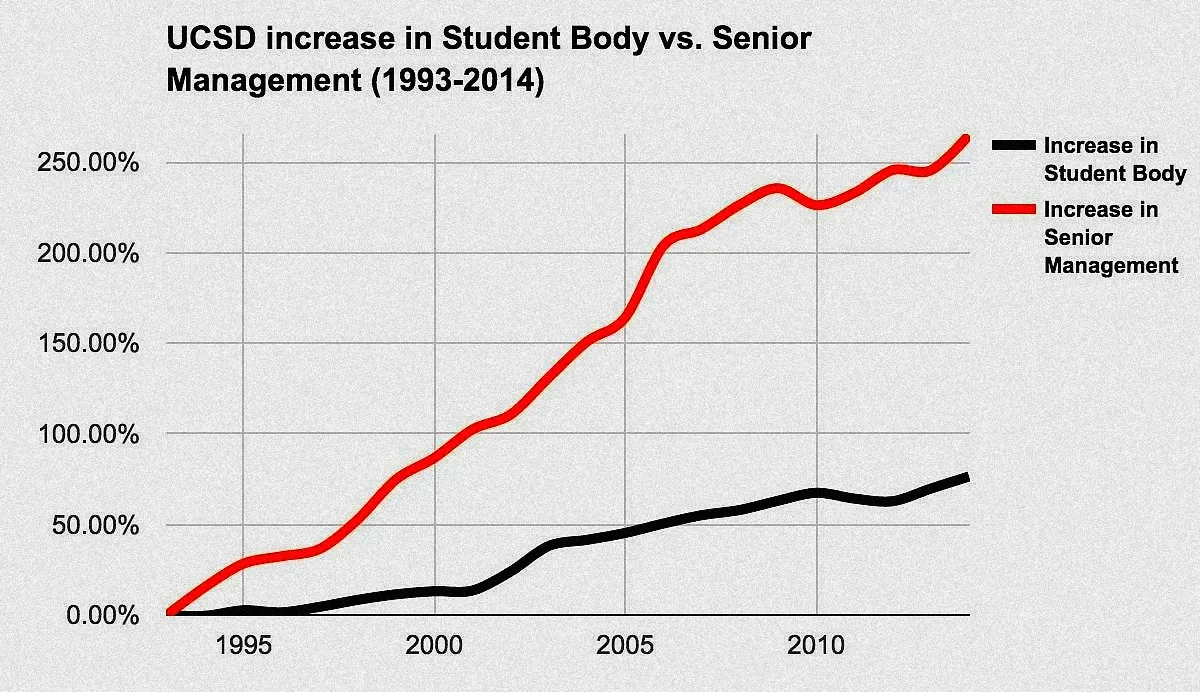
This is called rent-seeking behavior. People in power take advantage of their power to give jobs to their friends who do nothing every day. Because of that, they're always looking to cause problems for everyone else, especially professors who do real work.
Looking at universities overall, investment in teaching has gone down.

Over the past 40 years, universities have put less money into teaching and maintenance but have put more money into administration and bureaucracy. This is where your money is going.
At the University of Illinois, you see a massive surge in managers at the same time student enrollment went down by 3%.
A paper on the Swedish higher education system shows it's no different anywhere else. The argument is that bureaucracy is ballooning. Here are some interesting statistics:
- Teachers are teaching more and more students, but administrators are managing fewer and fewer students. This is because there are fewer teachers and more managers, which makes no sense.
- The number of teachers and researchers has remained pretty flat. The number of secretaries—people who do real work—is going down, but the number of managers is going up.
- If a university is facing problems, the first thing you should cut are the people who do no work. But it's the opposite. The managers keep their jobs and, in fact, pay themselves more, while professors, maintenance staff, and secretaries lose their jobs to cut costs.
- Over the same time period, secretaries and teachers are getting paid less and less, while managers are getting paid more and more.
The problem of bureaucracy is not only that managers do nothing every day, but they expect others to do more work. Professors, researchers, and teachers are doing more work because managers are giving them more paperwork, like evaluations. Professors now spend almost 20% of their workday on paperwork given to them by managers. This paperwork is not necessary; it's just given to them to justify the jobs of the managers.
Back in America, at Gallaudet University, over a 20-year period, the salaries of professors remained pretty stable, going from $72,000 to $86,000. But for managers, the president's salary doubled from $141,000 to $280,000. Right now, their salaries are over three times as much as faculty.
In Connecticut, the president of Yale makes $2 million a year. At Wesleyan, he makes $3 million a year.
A private university called Stratford University went bankrupt. More and more universities are going bankrupt because when you have too many managers getting huge paychecks for doing nothing, you will eventually go bankrupt.
How do they get away with it?
A student asked a great question: "The school board is not stupid. So why don't they just change anything?" The reason is they're all friends. The school board, the president, the vice president—they're all friends. That's why they can do this; they control all the power. It's in their best interest to steal together. If you steal by yourself, you might get caught. But if you steal together, you're untouchable.
This is exactly what happened at Stratford University. The university went bankrupt because the president and vice president were stealing from it, not only by collecting huge paychecks but also by expensing everything—cars, gym memberships—to the university. If the university couldn't pay for it, they would lend money to the university. The president, Richard Shurtz, listed himself and his wife as the biggest creditors, claiming the university owed them $2.5 million for eight promissory notes. So, when the university went bankrupt, he said, "Okay, now you have to pay me back."
The filings also shed light on payments to university insiders in its final year. The college paid out over $30,000 in stipends to seven trustees. The people at the top were getting paid off even as the university was going bankrupt. The filings for 2020 alone showed:
- Over $18,000 in lease and insurance payments for the Shurtz's cars.
- Over $4.7 million in loan payments and collateral returned to Eagle Bank on behalf of Shurtz.
They were making the university pay for their houses as well. How could they do this? Because in America, the rich always win in the court system. Whoever is able to hire the best lawyers always wins out. They have a lot of money; the university is bankrupt and doesn't. This is what's going to happen to many universities over the next 5-10 years in America. You have a system where the managers at the top are all best friends, stealing from the university together, and eventually, the university will go bankrupt.
Bureaucracy Beyond the University
It's not just universities. This is happening in every bureaucracy, every organization.
- In Canada, there was a rise of 9% in the population, but the government went up by 26%.
- In America, there was a sharp decline in manufacturing jobs starting in the 1980s as jobs were offshored to China. At the same time, a steady increase in government jobs. People in America are doing less real work, and more and more people are becoming bureaucrats.
The growth in government is usually in management. The number of people doing real work is pretty flat, but look at the managers and administrators—they're going way up.
How do we know the government doesn't really do anything? A study looking at rules shows that the number of significant rules—rules that actually impact you day-to-day—has gone way down. But interestingly, the paperwork has gone up. This tells us the managers and administrators in the federal government don't do anything but produce meaningless paperwork that has no impact on the lives of ordinary people.
Let's look at the military. Everyone believes America has the world's greatest military because it spends the most and has high-tech weapons. The problem is the bureaucracy. You see an increase in management because the ratio of officers to soldiers is going down. You have more officers and fewer soldiers, which is a problem if you're fighting a war.
- In the Civil War (1860s), you had one officer for every 14 soldiers. Now, it's one to four.
- The biggest problem is the increase in generals. Three- and four-star generals have increased the most. In World War II, America had about 12 million soldiers and seven four-star generals. Today, America has about 1.2 million soldiers and 40 four-star generals.
This is a huge problem. If you're a four-star general, you have a lot of privileges beyond your salary. Franklin Spinney, who works in the Pentagon, writes about the perks. A four-star general has his own personal airplane, a G5 always waiting for him on the tarmac. It costs $50 to $60 million per plane. Every four-star general has one. At the same time, what happened to soldiers? They don't have enough to eat. There are 1.2 million veterans on food stamps, which is 8% of all veterans in America. The people who actually fight and make sacrifices for their country don't have enough to eat while the generals fly around in these really nice planes.
This is true for every single US government department. You see a massive increase in administration. In every federal bureaucracy, you have bloat. You have managers who do nothing and very few people who do the actual real work.
What's really funny about bureaucracy is that evaluation is very important, and managers do the evaluation. At the end of the year, they do a performance review. They evaluate themselves and their friends as having done a great job. Then they look at the people who do the real work and say, "You guys could do better." "Outstanding" is the highest performance review for the government. 62-64% of managers who do nothing every day got "outstanding." Only 47% of people in every other job got "outstanding." It's a rigged game.
The same thing happens with hospitals. The growth in doctors is pretty steady, but the number of administrators is blowing up, which forces healthcare costs to go up. The reason healthcare is so unaffordable in the United States is not because it has the best healthcare in the world—it doesn't. It's expensive because it has so many administrators who do nothing every day.
What do these managers do? They always think of new ways to screw everyone else. These are the claim denial rates for health insurance companies:
- UnitedHealthcare: 32% of all claims are denied.
They do this as a practice. If you fight them, they'll say, "Okay, you know what? We'll agree to pay you back." But if you don't fight them, they're like, "Great." It's extremely unethical. That's what managers do every day: think of new ways to screw over their patients and doctors.
The Philosophical Roots of Bureaucratic Decay
Why is America like this? Why is the West like this? Why is the entire world like this?
Franz Kafka and The Trial
Franz Kafka was writing before World War I. His most famous book is The Trial. In this very interesting novel, the main character, Joseph K., works at a bank. He's a bank clerk who has never gotten into trouble his entire life. He's very obedient and nice. Then one day, the police come and arrest him. They don't tell him why. Joseph K. tries to figure out what he did wrong, but he doesn't know. He's put on trial, and the judge doesn't tell him what he did wrong. He's trying to figure out why this happened to him. This is his answer:
Its purpose is to arrest innocent people and wage pointless prosecutions against them, which as in my case, lead to no result. How are we to avoid those in office becoming deeply corrupt when everything is devoid of meaning?
Because society has become a bureaucracy, and bureaucrats need things to do, the police go and arrest innocent people and then send them to trial. What he doesn't say is the police could arrest criminals, but they don't want to do that because criminals might fight back or be mean. They'd rather arrest an innocent person because they know the person will be compliant. That's the logic of bureaucrats: how do I justify my existence by doing as little work as possible?
This sounds strange, but let me tell you a true story. I'm in Toronto with my two boys, and I let them run around the park. One of my boys, who is four years old, runs too far, and I lose track of him. A stranger finds him and starts talking to him, but my boy doesn't speak any English. People surround him, asking, "Where are your parents?" and he gets scared and faints to protect himself. They call the police and paramedics. They come and make sure he's all right.
Now I find him, and the police interrogate me. I explain what happened. At this point, they should just let us go home, but they insist on taking us to the hospital. I'm like, "If we go to a hospital, we could be stuck there for 12 hours." The paramedics already told us there's nothing wrong with him. He just fainted, but his vital signs are fine. The police kept insisting. Meanwhile, there's a fight going on at the park. I'm thinking to myself, "Why are you guys bothering me and not going to arrest those guys who are fighting?" The answer is because it's easier to deal with me than to go arrest those guys. That's how bureaucrats think. They're always thinking of ways to justify their existence but not do real work. That's the message of The Trial. Eventually, society becomes so bureaucratic that bureaucrats only think about how to make problems for ordinary citizens because life becomes easier for them.
Hannah Arendt and The Origins of Totalitarianism
Hannah Arendt is one of the 20th century's most powerful intellectuals. She wrote about how Nazism came to dominate Germany and how Communism came to dominate Soviet Russia, leading to the deaths of tens of millions of people. In her book, she says that these two regimes are evil religious cults with three defining characteristics:
- They are removed from reality. They don't care about reality. They have a religion, a faith, a mindset, and they want to impose their faith on reality.
- Their only logic is movement and expansion. When you're removed from reality, you only know if you're right if you're growing. The Nazis' faith would lead to the destruction of Germany, but their membership was increasing, and they were winning wars, so they thought they were right. They cannot use logic to explain their actions, so they use movement to justify them.
- They hate and defy reality. Even though the Nazis were losing the war, even though it was clear they could not defeat Soviet Russia, they doubled down. In their religion, movement is what matters. Defying reality is what matters. And that's what led to the destruction of Germany.
Arendt explains that totalitarian regimes have these three characteristics. What she does not say in the book is that these three can apply to all bureaucracies. Over time, all governments and all bureaucracies will tend towards totalitarianism because that's the only way they can justify their existence.
The Mechanics of Bureaucratic Failure
This is a book by James C. Scott called Seeing Like a State. He's trying to explain how bureaucracies work and how governments function. For him, governments actually create more problems than they solve. Why? He lists four reasons.
First, all they care about is the administrative ordering of nature and society. A bureaucracy is a machine: it's a hierarchy, it's static, it's mechanical. But society is like a forest: it's diverse, it's an ecosystem, it's organic. For a state to exist, it must turn the forest into a machine like itself. So it destroys diversity, spontaneity, and imagination.
For example, if I ask you who you are, you might say your name, where you grew up, your aspirations, and your history. But the state doesn't care. The state needs to classify you in a way that it can use you. You're a teenage boy, which means in two years, you can be employed in a factory or sent to war. That's all the state cares about. It doesn't care about your name, your past, or what you like. All it cares about is that you are a teenage boy, and therefore it can exploit you for labor. That's how states think.
Second is the idea of high-modernist ideology. Because the state is a monopoly, it becomes arrogant, has hubris, and is overconfident. It wants to impose its ideology on everyone else. It believes that through its own planning, it can achieve paradise. It becomes authoritarian, meaning it refuses to listen to criticism, feedback, or questions. It is not open to debate; it imposes its will on people, which creates a weak civil society. If an organization isn't getting feedback and isn't allowing for openness, it will wither and die. That's why states and governments will always fail in the end.
Scott uses two examples. The first is what happened in late 19th-century Germany. Germany has lots of forests, and the state was thinking of ways to monetize this resource. There are certain trees you can cut down for lumber. The problem is that in a forest, most space is occupied by "useless" shrubs or greenery. Their idea was simple: we'll burn down the forest and just plant trees that we can harvest for lumber. Brilliant. It's a more efficient use of space. The problem, though, is that when you do that, the trees are now susceptible to disease and weather changes. A forest is resilient because it's diverse.
Monocultures are, as a rule, more fragile and hence more vulnerable to the stress of disease and weather than polycultures are. Any unmanaged forest may experience stress from storms, disease, drought, fragile soil, or severe cold. A diverse, complex forest, however, with its many species of trees, its full complement of birds, insects, and mammals, is far more resilient—far more able to withstand and recover from such injuries—than pure stands.
Nature has diversity because it allows for resilience. Some part of the forest can die, but the rest will recover. We humans are the same way. If you let humans do whatever they want, we are resilient. Some communities might die off, but other communities will adapt. The problem with a state is that it sees diversity as an enemy. If there's a natural disaster, it's very likely that a lot more people die off than would otherwise.
Another example is forced collectivization in Tanzania. It was a top-down system. The idea was that individual farmers with their small farms were not efficient. What if we just got all the farmers together to grow coffee or wheat, which we can then sell to other countries? Of course, you can imagine this led to starvation. It's the same principle as the forest. If there's a weather crisis or a disease, all your crops die off, and then your people die off.
The problem with bureaucrats is they have no imagination. Everything to them has to be mapped out. They like things that can be put on a blueprint because that's how they see the world. But the real world requires diversity and organic systems.
The Consequences of an Over-Bureaucratized Society
What are the consequences? In America, while consumer goods like cars, clothing, and cell phones are getting cheaper, what's going up are hospital services, schooling, and housing. Why? Because these are monopolies controlled by bureaucrats. With the over-bureaucratization of society, it's almost impossible for middle-class people to have a good life now.
Here's another interesting chart. The black line shows the growth in the stock market, and you might think this is a good thing.

The problem is, first of all, only 10% of people in the United States control over 90% of the stocks. The other issue is that if you look at stocks as units of gold—if you use gold to buy stocks—the price of stocks has gone down. That's the blue line. If you use money to buy stocks, it goes up. But if you use gold to buy stocks, it goes down. What this is telling us is very simple: we are living in a lie. All this wealth generation is a lie. It's not real. We just think it's real. We're living in a fairyland created by bureaucrats to fool us into believing that we are prosperous.
Another problem bureaucracy has created is that people don't want to work anymore. In America, this is called quiet quitting. In China, it's called tǎng píng (躺平) or bǎi làn (摆烂)—lying flat, let it rot. People don't want to work anymore. Why? Because it's pointless to work in a bureaucracy. Leaders don't care. The organization doesn't need you. You are alienated. You are told what to do and you cannot negotiate. You cannot rise. You're being asked to work too much. You feel as though you're just a machine. So the way you rebel is by lying flat or quiet quitting. The over-bureaucratization of society means that people have become more lazy, complacent, and indifferent.
This also means that democracy is declining because people's voice and power are declining. Experts estimate that the capacity for people to participate in and influence politics has declined rapidly these past 10 years. We are living in a world that is becoming more and more bureaucratic, and it's killing us.
Questions and Answers
What is the future in a bureaucratic world? Are there any good sides?
The good side is that because things have become so corrupt, people are now forced to think for themselves. Before, you could just trust your teacher, your parent, your authority figures. But now you see them for the bureaucrats that they are. So now you're forced to think for yourself, to educate yourself, to explore different opinions. People's minds are opening, and that I think is a very good thing.
Why not just get rid of the managers?
That's a really good question. If this is a problem, why not just get rid of the managers? The answer is they have all the power. They would much rather send you to war and kill you off than lose their jobs. Going back to the example of Stratford University, their mentality is, "How do I maintain my privilege?" They don't care about society. All they care about is maintaining their privilege. They will bankrupt society, and when society becomes bankrupt, they expect society to still continue to pay them off. These are parasites, and there's nothing we can do about it.
Who will they control if everyone is 'quiet quitting'?
They don't think like that. They don't think about how efficient their organization is or if they're going to have a job in the next five years. All they care about is maintaining their position right here and now. The way they do that is they hire their friends or people like them into other management positions, so they become like a cabal or a network unto themselves. They become parasites, and what parasites want to do is feed off the host. If the host dies, they will switch to another host. They are part of larger networks as well. They're thinking, "As long as society survives, I will continue to have a job." So maybe this university goes bankrupt, but there's another university I can go to and exploit. And you know what? It works, because people at the top protect each other. They don't care if this organization goes bankrupt because they can always move on to another one. What matters is maintaining their patronage and their political networks.
Is it possible to reverse this system?
They are the ones in power. What has to happen is society has to collapse before it can regenerate and rejuvenate. But before society can collapse, they have a lot of tricks up their sleeves. For example, they can create civil wars where the left and the right fight each other, and they're left alone. Or they can use AI to control you: "AI is God, guys. Listen to God." Or they can fake an alien invasion. Or they can send you to war. They can start these pointless wars. Whatever it takes to maintain their privilege and their power—that's their mentality. That's how they got to where they are. That's how the elite think.
As a 12th grader, should I still go to university?
That is a great question. You guys are about to go to university, and as I've told you, university is a complete ripoff. All you're doing is paying for the nice salaries and perks of these administrators. You're not really paying for the professors. So, what I would do is maybe not go to university. What I would do is focus on education, on learning, by reading a lot of books, asking a lot of questions, doing my own research, and learning real skills. In a society like this where the game is rigged, going to university means that you'll just lose. Maybe 20 or 30 years ago it was good to go to university because you might become a manager, but now all those slots have been taken up by the elite and their children. There's no space for you. The only thing you can do in this context is to really start educating yourself in real knowledge: reading books, meeting lots of different people, exploring the world. Really develop real knowledge.
Does the major matter?
No, it does not matter. It's all a scam. It doesn't matter what university you go to—liberal arts, Ivy League, state—it's all a scam. It doesn't matter what your major is—economics, psychology, humanities, computer science—it's all a scam. The system exists so that the managers and administrators can continue to feed off of it.