Substack Founding Members Livestream #2
The Blackmailing of Spain
Ceuta and the migrant surge
We will mainly discuss Spain, what is happening in Ceuta, which is a Spanish enclave on the African continent. And as you know, what's happened these past 2 days is anywhere between 50,000 to 60,000 migrants have streamed into Ceuta from Morocco. And this is one of these world-changing events. And what I will do is, first of all, explain to you what's happening, what's causing it, and why it's a world-changing event, and ultimately, what are the geopolitical repercussions of this event. But I want to focus the bulk of our attention on Spain because it's really important that we understand what's going on there.
Plus, we also have a lot of information as to what's really going on there. These are visuals of these migrants streaming into Ceuta both by the sea and by land.
And the thing to remember is that Ceuta is a very small Spanish enclave. It has only 80,000 residents. And there's been reported anywhere between 50,000 to 60,000 of these migrants, most of whom are young men in their 20s. They have basically invaded and they've overwhelmed Ceuta from Morocco. And these are pretty horrifying images. And if you're European, not just if you're a Spanish person, but if you're European, you're looking at these images on TV and you are freaking the hell out. Because remember back in 2015, Europe allowed millions of Syrian, Libyan, Iraqi, Afghan refugees to flow into Europe, and Europe has never really recovered from that experience.
And it traumatized Europe. And most Europeans are watching these images and they're really afraid of a repeat of 2015 and the social convulsions that happened because of this massive migration into Europe. I want to show you that there is in fact some coordination going on here. It is clear that many of these men are being loaded onto trucks by the police in Morocco, by the military in Morocco, and they are being sent to the border where they are then offloaded like cattle and being told to rush into Spain. The Moroccans will not prevent them from rushing into Spain.
You can see there is clear coordination here. Again, the man in front, the man in the gray, he is a police officer. And he's basically telling the young man, "Go to the border." And clearly this truck, it is government.
This is really key to what's going on. You see there's a police officer in front. You see this is a truck.
View the visual: Men getting off a truck while a man in gray directs them toward the border.
This is not a truck rented by the migrants. This is a truck that is government rented or that has been allocated for this particular purpose of transporting these people to the border between Morocco and Spain. And you can see how jubilant they are. And the police officer, he is clearly directing them. He's making sure they get off the truck. And he's making sure they're going in one direction. They're not going behind him. They're going in front of him. He's directing them "Keep on going, moving forward." You can see how this is clearly being organized at some level.
Trump’s remarks and Wally Rashid’s explanation
This is non-organic. You don't organically have 50,000 people stream across a border in one night. The third video is Donald Trump, who three weeks ago was getting really pissed off at Spain because Spain is not allowing America to use its airbases to strike Iran. Spain wants nothing to do with this war. And at the same time, Spain has always been a vocal critic of Israel, of Zionism. This is basically Donald Trump telling the Spanish, "Hey, watch out, man."
The Spanish, the members of NATO, but not very good members of NATO. They say, "No, we don't want to help other people." What are we doing, huh? They are not behaving nicely, but they will learn. Soon after they relinquish their grip on Cuba, and Guam, the Philippines, and Puerto Rico, and they were all ours.
The thing about Donald Trump is he speaks his mind. He's a very direct and honest person. You can glean a lot of information from just a few sentences he speaks.
The Spanish, the members of NATO, but not very good members of NATO.
Here he's saying the Spanish are not very good members of NATO. What this means is the Spanish do not obey the American Empire. The American Empire wants to use Spanish airspace and Spanish air bases in order to construct strikes against Iran and the Spanish refuse, which forces the Americans to use British airspaces, which is too far away. That's what Donald Trump is complaining about here.
They say, "No, we don't want to help other people." What are we doing, huh? They are not behaving nicely, but they will learn. Soon after they relinquish their grip on Cuba, and Guam, the Philippines, and Puerto Rico, and they were all ours.
Donald Trump, he's a real estate developer. He thinks in terms of real estate. The Spanish have been losing a lot of territory to the American Empire. They lost Cuba, they lost the Philippines. Now, they're going to lose Ceuta. That's what he's implying here. Now, the Americans are going to take over key strategic real estate from the Spanish. This man is named Wally Rashid. I hope I'm pronouncing his name correctly. But he did a great TikTok right after this migrant surge into Ceuta, explaining to us what's going on. And I think he has a fantastic understanding of the geopolitics of this event.
It's a TikTok video.
View the visual: Wally Rashid’s video showing Michael Rubin’s article and the congressional report.
Happening in Spain's city Ceuta right now. Take a listen to this. It was planned by the Trump administration and Israel. This guy right here is Michael Rubin. He's a senior fellow at the American Enterprise Institute. Since March of this year, this think tank has been heavily lobbying the Trump administration, especially Marco Rubio, to recognize Ceuta as territory of Morocco. The reason for this is because Morocco is part of the Abraham Accords. It's pro-Israel, and they want to punish Spain for not allowing the United States to use its airspace during the Iran war.
This is an established US think tank, by the way. Moroccans should gather, send bulldozers to the border, and then enter Ceuta and Melilla unarmed to raise the flag. Sánchez and the Spanish press bleat, but they have no grounds to act. Nor, for that matter, would NATO, even if Moroccan forces entered the towns to restore order and organize the dispatch of settlers across the Strait of Gibraltar and back to Spain. These two Spanish towns represent illegitimate beachheads and are home to approximately 170,000 Spanish settlers. They are weak spots for European security since African migrants regularly rush to the fence to claim asylum.
Much worse, just wait. Republican US Congressman Mario Díaz-Balart of Florida, who's very close friends with Marco Rubio, wrote a report back in April. Stated for the first time: “The Committee notes the historic alliance between the United States and Morocco, as formalized in 1786 by the Moroccan-American Treaty of Peace and Friendship. The Committee notes that the Spanish-administered cities of Ceuta and Melilla are located in Moroccan territory and remain the subject of Morocco’s longstanding claim.” It goes on to say: “The Committee supports efforts by the Secretary of State to encourage diplomatic engagement between Morocco and Spain on the future status of Ceuta and Melilla.” American Enterprise Institute has been pressuring the Trump administration on this for over a year.
They want to bolster the Abraham Accords and they want to punish Spain. This is why this is happening. It's not because Spain is a left-wing government that can't control its borders. The United States and Israel are doing this together because they no longer want Spain to control those cities.
Spain, migration and the European Union
This is a brilliant explanation. This is exactly what's going on and it makes perfect geopolitical sense. I'm going to take Wally Rashid's research points and then elaborate on them. An article from Reuters that just came out a few hours ago basically says that Italy is going to reimpose border controls on Spain after the Ceuta migrant surge. This doesn't sound like a big deal, but if you think about it, it is a huge deal. Why? Because the idea of free movement of goods and people is the most important pillar of the European Union.
Let's imagine a situation where what's happening in Ceuta, it's just a pilot program. It's just a test case to see how the Europeans react. And the Americans and Israelis watch what's happening and they recognize that, "Wow, the Europeans are freaking out over this." And so what we can do in the future is use migrant blackmail to coerce European nation-states into doing our bidding. But not only that, but the migrant issue threatens to tear apart the European Union. And Donald Trump really hates Brussels. Both Israel and Donald Trump, they just hate Brussels.
They really want to see Europe disintegrate. Not only because they hate the bureaucracy there, but also because a united Europe is much more able to defend Europe against American imperial and Israeli imperial interests. And so, what the United States and what Israel want to do is break up Europe into different nation states that are competing against each other, very much like World War II or pre-World War II. And the migrant issue is the best way to do that because if you think about it, if you have these millions of Africans streaming into Europe, then it's every man for himself.
All the Europeans are like, "Screw this, we're imposing borders." Because the thing to remember is these migrants are going to Spain not because they love Spanish ham and not because they think, "Wow, Spain is a great place to retire and I love doing a siesta every day." No, they're going to Spain because it's an easy access point into the rest of Europe. Their real destination is Germany, France, England, and if they can't get anywhere else, they go to Italy. That's why Italy is doing this because they know that from Spain, these migrants are now able to access everywhere else.
This is a huge issue for Europe. And this is going to be an issue that's going to basically tear Europe apart. And I hate to repeat this, but there's absolutely nothing the Europeans can do about this. If the United States and Israel are intent on tearing apart Europe, forcing it into competing nation states that only want to protect their own borders, then this migrant issue is going to do that. And that's why Morocco is so key because Morocco is a very easy access point into Europe as we're seeing from this Ceuta mess.
My prediction is the Spanish are completely screwed in this scenario. The Spanish have absolutely no choice but to withdraw from Ceuta and cede that territory to Morocco. There's really nothing the Spanish can do about this. If you have 80,000 settlers or 80,000 residents in Ceuta and Morocco can do a surge every 2 weeks of like 50,000 migrants, that's going to overwhelm your social services. That's going to overwhelm your security services. That's going to overwhelm your resources. What's going to happen is that a lot of these residents are just going to choose to return to Spanish mainland and say, "Screw this.
I don't want to deal with these migrants who are every night stalking the streets." And it's intimidating and it's traumatic. And then you reach a point where you might have like, I don't know, 20,000, 30,000 holdouts. But if you have 50,000 migrants who are mainly again men in their 20s, these 20 or 30,000 are eventually going to have to be forced out. Just because it becomes too expensive and too problematic for the Spanish to hold territory in Ceuta. This is a lost cause for Spain. And this is important because once Ceuta is ceded to the Moroccans, then now the Israelis and Americans have another strategic maritime choke point called the Strait of Gibraltar.
And it's all part of America's national defense strategy. This has been planned for many years. And there's tremendous funding, there's tremendous organization behind all this plan and it's being executed before our very eyes. And this is going to really, really fundamentally change or alter the global landscape that we know. Again, I can't emphasize enough, this is a real problem for not only just Spain, but for all of Europe. And unfortunately, there's nothing, absolutely nothing they can do about it.
The Spanish government’s response
This is the Spanish Prime Minister coming out and saying to the Spanish public:
The Government of Spain is fully committed to providing an immediate response to the situation in Ceuta.
We are mobilizing all necessary resources, working with Moroccan and international authorities, and preparing the necessary measures to restore normalcy as soon as possible. I just conveyed this to President @JuanVivasLara.
This is the moment to build solutions, with responsibility and cooperation.
Guys, this is bureaucratic language for saying we are so completely screwed. This situation is something that we were afraid of and this is a situation that could arise at any point and so what we did as bureaucrats, as your government officials, was put our head in the sand for years hoping that this would never arise and now that this problem has erupted, well, we don't know what to do. And we are completely screwed in this situation. What I'm going to do is I'm going to put out these pointless social media posts that do nothing to help the situation and which honestly are not even helping the Spanish feel better about the situation.
And then I'm going to go to Ceuta and do follow-ups and some video just for a few minutes of social media and then I'm going to get the hell out of this situation because this is a complete dumpster fire. There's nothing I can do about it. There's nothing anyone can do about it, but hey, let's go take a siesta or something and party tonight. This is the Spanish Prime Minister saying on social media, we are so screwed, there's nothing we can do about it. And a lot of this has been premeditated, but really, what's really clever about the American and the Israeli strategy here is they're taking advantage of really unpopular policies that this left-wing Spanish government has implemented over these past few years.
And one of them was a surge of immigration into Spain, mainly in response to the aging crisis. As your population gets older, you need to replenish it with young workers. They're bringing a lot of young workers from Latin America who are not documented, but who they gave legal status to in order to fill positions in the economy. And what's happened now is if you turn on right-wing television and talk shows in England and other places, they're blaming what's happening in Ceuta on the left-wing Spanish government policies of lax immigration. This is also part of the Israeli and the American empire playbook, where clearly it's a land grab.
Clearly, this has been planned for many years, and I'll show you all the documentation that proves this. But these right-wing propaganda outlets are doing the bidding of the empire and focusing attention on left-wing liberal policies that favor legal immigration. If you just go on and watch some right-wing talk shows on YouTube, they're very clear about that, that it is not a land grab, it is just stupid left-wing immigration policies that are just betraying the ordinary people of Europe. This is Ursula von der Leyen and she's saying what many Europeans are feeling right now, which is we're freaked out about the situation.
We're really freaked out about the situation. But you can see that what's really important is they're not blaming the Israelis or the Americans or even the Moroccans. Because it's the Moroccans who let these migrants into the Spanish enclave of Ceuta. Instead she's saying that we're really angry about this and we need to resolve it as quickly as possible.
Europe’s experience of migration
Look, the Europeans are just freaked out about this because again, look at this, 2015 the European migrant crisis. And this is a map that shows you what happened in 2015.

And there are certain things I want you guys to key in on. First of all is that there are multiple entry points into Europe including Greece, including Italy, including Spain. And so these border countries, Spain, Italy, and Greece were the most traumatized by the surge of millions of migrants primarily from Syria, Kosovo, Afghanistan, Albania, Iraq, Eritrea, Serbia, Pakistan, Ukraine. They come from all over the place. The second thing that you need to appreciate is the migrants who enter Spain, Italy, Greece do so in order to access other parts of Europe, basically northern Europe, which is the more wealthy, more generous, more open areas of Europe.
And as you can see from this map, most actually end up in Germany. Because at that time, Angela Merkel, the Chancellor of Germany, says, "We can do this." Meaning we as Germany, as Europe's greatest economy, as the most open society, we can absorb these refugees fleeing war into our economy and become a much stronger Germany. That has not worked out well for Germany. Again, this migrant issue has become a ticking time bomb for Europe, especially as their population ages, especially as the young people refuse to have children, especially as this war in Ukraine has destroyed the German economy.
Europe is in a lot of trouble. Europe is finished, basically. And what will emerge from the ashes, we don't know yet, but the Europeans are freaking out about this new wave of migration that's about to hit them. And it's going to hit them. Why? Because you have this demographic issue in Africa, where if you look at sub-Saharan Africa, the population is just exploding. It's the fastest growing region of the world.
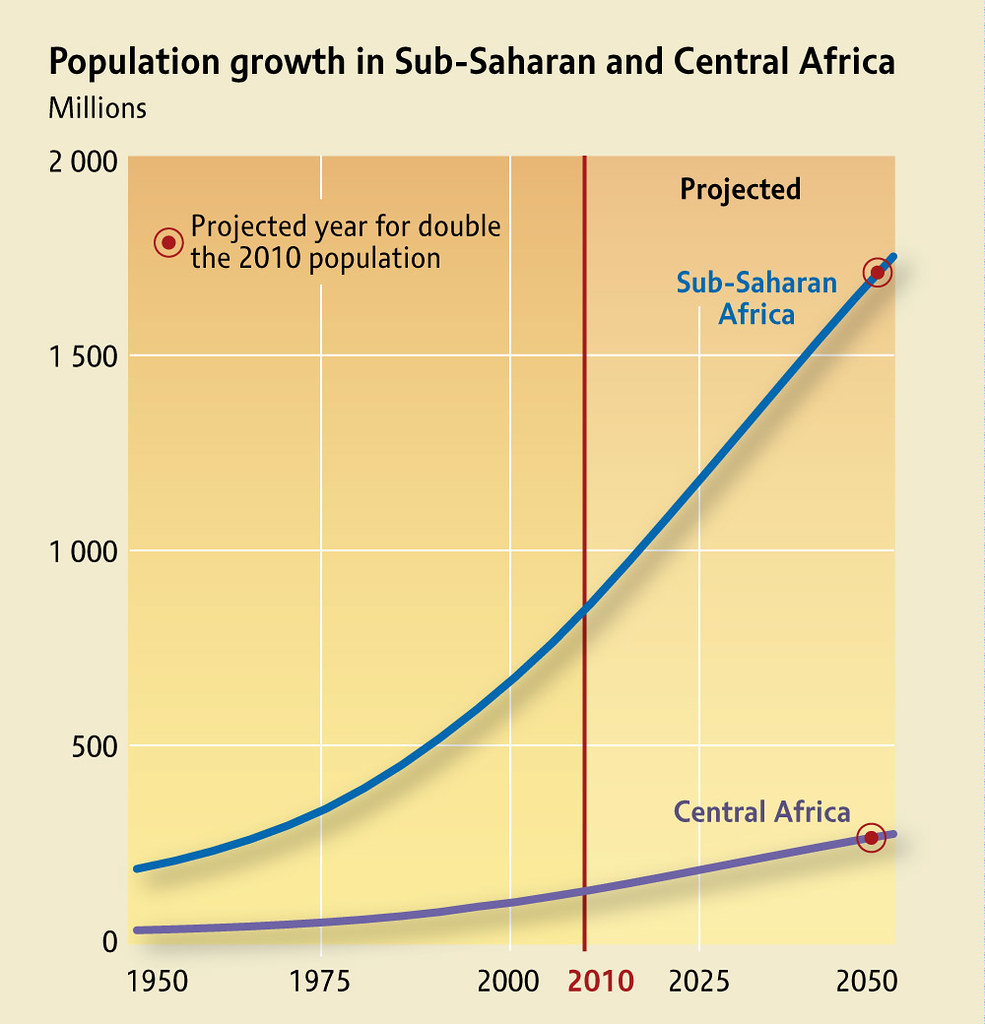
At the same time, Africa remains extremely corrupt, very war-torn, and this crisis in the Strait of Hormuz, where fertilizer is not able to get to Africa, the Africans are going to suffer the most. Yeah, in the United States, you have $4-a-gallon gas, or $5, and maybe even $6. That's going to piss a lot of people off. But in Africa, millions are going to starve. And when that happens, you're going to have war, revolution, and that's going to force a migration into Europe. And where's the easiest place to access Europe from?
Spain. Again, Ceuta is just done. There's just no way that the Spanish with an enclave of 80,000 residents are going to be able to deal with this surge of millions of African migrants in the next few years. There's absolutely no way. And the Europeans know this. And the European bureaucracy, their response is to put their head in the sand and put out these tweets showing how concerned they are and pray for the best and then go to their two-hour lunches where they can sip rosé for 2 hours. That is the European response.
Migration as a weapon
The key thing to remember is that for us, geopolitically, this is a new weapon that can be used against the Europeans. The Israelis and Americans have figured out a new way to blackmail Europe into doing the bidding of the empire. You guys remember the London Blitz? Well, this is basically a new blitz.
Hitler sent bombers against London hoping to destroy the morale of the British people, and that didn't work. Well, the Israelis and Americans have figured out a better weapon than torpedoes and bombs and nighttime raids. Refugees. Let's just pack millions of refugees onto these boats and send them to England and to France. What are you going to do? Is the British Navy going to come out and start shooting at these defenseless migrants who are just seeking a better life? They can't do it. What the Europeans are going to do is say, "Hey, can you get the Moroccans to go kill these people?" The Europeans don't care if these people die or not.
All the Europeans care is they don't come to our borders where we're forced to kill them. Let's bribe the Moroccans or the Libyans, who cares. To kill them before they come to our borders. That's the blackmail that the American Empire can now use to coerce the Europeans to do their bidding, which basically means the Europeans continue to fight this stupid war in Ukraine, which basically means the Europeans send men to die off in the trenches of Ukraine, which basically means the Europeans continue to buy US dollars, which means the Europeans continue to buy US weapons, bribe the Israelis, the Americans to intervene on their behalf against these refugees.
This is a huge issue for Europe. There's nothing the Europeans can do about this.
Political messaging and the proposals for Ceuta
Laura Loomer. What she's saying is:
The invasion of Spain by Islamic third world parasites is bad for society but good for the acceleration we need to make the general public harbor animosity toward Islam.
This is the talking point that these right-wing pro empire Zionist forces will use throughout this: this is an Islamic invasion. The Islamists have been planning this for centuries. This is how they will destroy Western civilization by invading Europe with their young men. This is all part of this diabolical Islamic conspiracy to take over the world. We've got to stop them. And now we know what a threat there is. Stop talking about Israel, guys. Stop talking about Zionism because Zionism is our friend. Zionism is the only force that can counterbalance Islam.
Only Israelis understand the real threat of the Islamists, of Islam, of the Muslims. And only Israel has the balls to fight the Muslims. The rest of the world should just follow the lead of Israel. Europe should be now begging Israel to come over and take over Europe so that the leadership of Europe finally has these balls to take on these Muslims. The Europeans should stop criticizing Israel and start learning from Israel. Let's put these Muslims in concentration camps. Let's deport them. And let's put microchips into these Muslim animals like we would do dogs so we can track them and we can monitor them and we can prevent them from committing crime.
That's the message that's going to come out over the next few years or over the next few months, really. The Israelis have been saying this for the longest time. Laura Loomer is really a spokesperson for the Zionist forces in the world. And I don't understand who she is. She's not charismatic, she's not that smart, and she's just really annoying. But for whatever reason, she happens to be a very powerful person who can go to Ukraine, meet with President Zelenskyy, and redeem herself in the eyes of the Ukrainians because she initially opposed the war.
Also, what's really funny is that now she's going to India and trying to create a rapprochement between herself and India. And the Indians really hate her because all she does online is trash the Indians. What's the evidence that this has been organized for many many years now? This is Mario Nawfal. And he points out that in 2018, the son of Israeli Prime Minister Benjamin Netanyahu put out a tweet saying
Let’s make a deal, we won’t fund NGOs in your country calling you to give away Ceuta and Melilla, and you will stop funding NGOs in our country that calls us to give away Judea and Samaria
What he's saying is, "Guys, we know how this game is played. You have NGOs, we have NGOs. Your NGOs are calling for Jewish settlers to stay away from the West Bank. And our NGOs are calling for Ceuta and Melilla to be returned to Morocco. Let's just stop playing this game." Clearly there's a lot of organization behind what's going on these past 2 days. He puts on another tweet. And again, this is information that his team has consolidated and collated from other news sources. He's not the one telling us this. He's just repeating this from other places.
But what this post tells us is this is an organized thing. This invasion, there is a lot of organization behind it. We have groups with tens of thousands of members who are sharing maps, who are sharing telephone numbers so they can coordinate this. And the plan again is to reach Ceuta and then from Ceuta get on a boat to the mainland, register for asylum, which they can do according to Spanish law, and then basically be a burden on the Spanish welfare system. That's the plan. And they're going in with this intention of being freeloaders on the Spanish system.
And again, what's really important is not only are the Israelis and Americans organizing this, but they want us to know that they're organizing this and what the plan is because they're trying to traumatize Europeans. They're trying to blackmail the Europeans. That's the real plan. And this is Yair Netanyahu, who again is a son of the Israeli Prime Minister, who hates the Arabs and the Muslims. But the son is now encouraging Arabs and Muslims to go invade Ceuta.
View the visual: The map of Spanish territories in North Africa attached to Yair Netanyahu’s post.
Benjamin Netanyahu has had a long-standing beef with Spain. He really, really hates Spain. He thinks that the Spanish have unfairly criticized Israelis for committing genocide in Gaza. Why would the Spanish have a problem with this? If I have cockroaches in my basement and I call for an exterminator to come and kill all the cockroaches, why would my neighbor call the police on me? Why would the neighbor complain? Clearly this is personal. Clearly it's because my neighbor doesn't like me. It's clear the Spanish don't like the Israelis. Well, you know what?
Israelis are not going to put up with this crap anymore. Benjamin Netanyahu has been saying:
I don’t intend to allow any country to wage a diplomatic war against us without paying an immediate price.
And also what's really funny is remember last week was the World Cup and the World Cup was between Spain and Argentina. And Benjamin Netanyahu was rooting really heavily for Argentina. In fact, the entire nation-state of Israel was rooting heavily for Argentina. And again, they really, really hate the Spanish. And the Spanish won. And now a week later you have this massive migration from Morocco to Spain and this is not at all petty. I think the Israelis and the Americans are petty enough to do this right at the World Cup to basically get vengeance against Spain for winning the World Cup.
And look, we can argue about this back and forth, but in my opinion, the World Cup was rigged in favor of Argentina. And why they lost, I'll explain later on. Morocco just a few days before renamed their highway after Trump. Well, that's interesting. Remember, Morocco was one of the most enthusiastic supporters of the Abraham Accords. Morocco was one of the few Arab nations to sign the Abraham Accords. In return, the United States recognized Morocco's control over the Western Sahara, which they wrestled from Spain. Yeah. This is confirmed news. This is Al Jazeera saying that Morocco named a highway after Trump.
And again, it's because this is part of Morocco's larger ambition to control northwestern Africa, which is strategic for many reasons. We watched that video from Wally Rashid explaining to us what's going on. And this is an article written a few months before, March 16, 2026 by Michael Rubin. I'll explain who Michael Rubin is later on. But he writes this article laying out the strategy of how Morocco can take over Ceuta. And his solution is really straightforward, really simple. He's saying just march in there. There's 80,000 residents in Ceuta. You've got millions of people.
Just march in there and claim it for yourself, just how the settlers, these Jewish settlers, marched in the West Bank and claim what's theirs. Take action. Be proactive. Show some balls and it will be yours. And this is a strategy that he lays out. Moroccans should gather, send bulldozers to the border, just crush the border, and then enter Ceuta unarmed. And are they going to shoot you? Good luck, man. And there's nothing that the Spanish can do about it because their laws, institutions, their culture prevent them from shooting unarmed civilians.
They criticize us, the Israelis, for shooting unarmed civilians, but let's use that against them. They think they're so high and mighty. They think they're so virtuous. They think they're better than us. Well, then let's use that against them. Show us how virtuous you are when millions of cockroaches come into your country and take it over. Show us how virtuous, virtuous, virtuous you are, Spanish people. Michael Rubin is a neocon. And he studied at Yale. And guys, I went to Yale. There were hundreds of guys like Michael Rubin at Yale. I took history classes with them.
I took political science classes with them. They are the most pompous, the most idiotic people you will meet. They speak with pure confidence, but they don't actually know anything. That's what Yale does to people. Yale teaches you how to speak with absolute confidence and hold your point. And that's what Michael Rubin is. That's what these neocons are. They're clearly Zionists and they use the idea of democracy, human rights, freedom in order to promote their Zionist agenda. Michael Rubin's like, "Well, we're doing this because we are anti-colonial. The Spanish have colonial territories in Morocco.
They stole this land from Morocco and therefore we have a historical responsibility to reclaim this land for the indigenous people. That's why we're doing this." This is Amine Ayoub who is supposed to be a policy analyst and writer based in Morocco.
View the visual: Amine Ayoub’s author portrait and biography displayed alongside the article.
If you read what he writes, he's clearly a Zionist asset. He's clearly an Israeli asset even though he's probably Arab. But he writes this article. If you actually read this article, it just spells out exactly what the plan is. They're not even bothering to hide it because they want people to know what the plan is.
We're going to Spain because Spain sucks. Spain is supposed to be a NATO ally and they refuse to let the Americans use their air force bases.
Why does Morocco want Ceuta?
Audience: I think the Sahara takeover might have economic reasons behind it and I think you touched on that already. But Morocco is a major exporter of minerals and fertilizers. The major hub for EV batteries. There could be a bigger plan here with the island takeover. The second point is I think the Jews were expelled in the 1400s. I'm sure you know that. From Spain they went to Morocco. There's lots of Jewish people in Morocco. I'm not surprised with their bias.
Xueqin Jiang: For a lot of people, this goes back to the Reconquista. Before the Christian Reconquista of Spain, which happened in I believe the 15th century, Spain for hundreds of years was called Al-Andalus. And this was really an extremely prosperous, progressive, wealthy area of the world. You have this enclave, Muslim enclave, in Europe, in Spain, in the Iberian Peninsula. And the thing about this peninsula, Al-Andalus, was it was really open towards Jews. In fact, Jews rose to the highest ranks of Andalusian society. And that's contrasted with how Jews were persecuted in Europe.
Persecuted so much, in fact, that they almost were annihilated. They were forced either to immigrate or to convert, and eventually a lot of them were starting to die out. Al-Andalus was a major embarrassment for the Catholic Church, for Europe, and that's why they launched this massive campaign to destroy that Muslim area. And again, as you point out, that just forced a lot of people to go to Morocco. There's as you point out, this historical animosity that dates back hundreds of years, but they won't point this out. But you're right, it is there.
You're also absolutely right in that there's an economic factor to this, and we'll discuss this later on. But I first want to point out that there's a lot of documentation that this was premeditated, and this is being executed, and this is really well-organized. And this has high-level support, mainly from Israel and from the United States. And this article is a road map. It's a plan and it basically tells exactly what the intention is. And if you read the last sentence, the last sentence reads like this.
For Israel, amplifying Morocco's claim is not charity. It is strategic investment in the partner that, across the Strait of Gibraltar, holds the key to one of the world's most vital maritime chokepoints.
The point of all this is for Israel to control trade access into Europe. The Strait of Gibraltar is crucial to trade and once Morocco has control over Ceuta then the United States and Israel have control over maritime trade in the Mediterranean. That's the real purpose. This is why they're going to all this trouble. It's economic.
Maritime choke points and military agreements
This is from New York Times, guys. The New York Times is reporting that they talked to these migrants and the police officers told the migrants to cross into Ceuta. They want us to know this. They want the Europeans to know this because the Israelis and Americans want to use this as blackmail against the Europeans. I cannot emphasize this enough. This is like the sword of Damocles. What the Americans and Israelis are saying we know your society. The Europeans, you're most afraid of illegal migrants, refugees from Africa, from the Middle East, from Asia and guess what?
We can turn on the tap anytime we want. We can open the doors and flood your society with millions of Africans, of Arabs if you do not cooperate. They want the Europeans to know exactly what's going on. That's why it's so blatant. That's why there's so much documentation. That's why even the New York Times is reporting this. New York Times didn't report about Nord Stream. New York Times didn't report about a lot of things, but it's reporting that, "Oh, the Moroccans are helping these migrants access Spain."
The Strait of Gibraltar
Again, the choke point is key. Right now, as you can see, the Strait of Gibraltar is basically managed by three different nations.
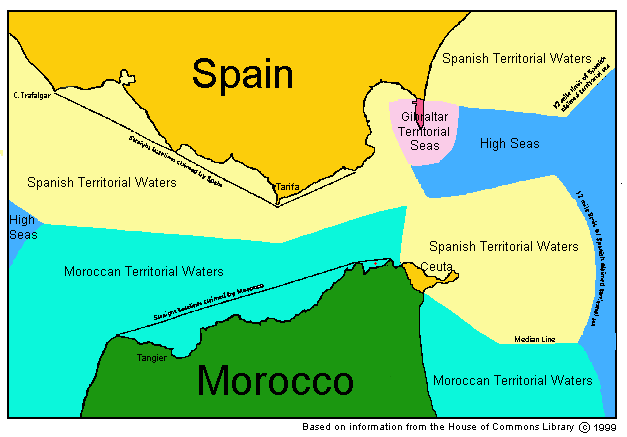
You have England, which controls Gibraltar, the Rock of Gibraltar. That's the pink. Then you have the Spanish, of course. And then you have the Moroccans. Now, according to maritime law, no one has control over these maritime choke points. They're basically free for everyone to use. But this Strait of Hormuz thing, it's going to set a precedent where if you want, you can actually take control over a choke point. There's really nothing anyone can do about it. The key now is if Iran sets this precedent where a nation can take control of a choke point, going against established maritime law, and collect tolls, then who controls these other choke points, including the Strait of Gibraltar, including the Strait of Malacca?
And the answer is, well, whoever's willing to take control. Ceuta is really important for Morocco to establish sovereignty over the Strait of Gibraltar, which would be an economic boom for Morocco. And it's pretty obvious. You've got a lot of people on Twitter pointing out that Israel is calling on Spain to hand over Ceuta to Morocco. This is really interesting. This is the Vox leader. The Vox is the right-wing populist party of Spain. And the Vox leader is blaming left-wing policies of the current government for all that is happening. And what he said is the Iranian and Venezuelan regimes have financed the far left in Spain over the last 15 years.
That's why Pedro Sanchez is Ayatollah's best friend in Europe and Ayatollah's best friend. Really strange thing how these right-wing political parties in Europe, including Vox, including Marine Le Pen's party in France, they're really good friends of Israel. These are Zionists. You also have Tommy Robinson in England, who's essentially a puppet of Zionists. But basically another really important objective of what's going on is to destabilize the current government of Pedro Sanchez and replace him with this guy, Santiago Abascal. And once he's in power, I guarantee you he will completely reverse Spain's policies.
Spain will basically become a US colony if he were to obtain power. And again, I hate to say this, but Spain is in a lot of trouble. And I think there's a very good chance that he comes into power, especially as this migrant issue becomes worse. But basically, the Israelis and the Americans have figured out the Achilles' heel of the Europeans, which is migration, and there's nothing the Europeans can do about it. Wall Street Memes says yeah, the end goal is for Morocco to lay claim over Ceuta. And then control the Strait of Gibraltar.
Syrian Girl who's very good, by the way. I like her posts a lot. But she also points out the same thing. Bruno Maçães is saying the US has come out and said that Ceuta and Melilla are not part of Spain. It's all been coordinated. Even Nick Fuentes. I'm really confused about Nick Fuentes because sometimes he says things that are so on point that I think he's brilliant. And then, of course, sometimes he makes these really silly, absurd comments like the Charlie Kirk assassination was committed by this lone wolf guy named Tyler Robinson.
He's not consistent. But here he's very, very direct, very, very clever. It's brilliant what he says. This is all part of this grand alliance between Morocco, Israel, and the United States. What Nick Fuentes says is:
The reason Republicans support the invasion of Spanish cities is that they're doing this on behalf of Israel.
That's exactly correct. Walid Shoebat points out that the Americans have been planning this for a long time. They've been planning to take over Ceuta and Melilla from the Spanish for a long time. And again, there's a lot of documentation. They want you to know this. They're not hiding this. They want us to know this. They want us to discuss this because this way we recognize that we have actually no power to stop this. When I mean us, I'm not saying us, you and me. I'm saying the Europeans. They want the Europeans to know this because for the Americans this migration issue is a sword of Damocles.
It's what allows them to control the Europeans.
Morocco, Indonesia and Greenland
I did some ChatGPT research. And I want to know what's going on militarily between the United States and Morocco. And it turns out there's a lot. April 2026 at the Pentagon these two countries, United States and Morocco, sign a 10-year agreement on long-term military modernization. The goal is this. The goal is Morocco will lay claim on the Strait of Gibraltar because they have the most legitimate claim to that area, but it's American military that will be responsible for controlling the Strait of Gibraltar. Basically this is a silent takeover of the Moroccan military by the American military.
And now Morocco will just become a proxy of the empire. If our analysis is correct, there should be two other major flash points, both of which are major maritime choke points. Obviously, the most major maritime choke point is Strait of Malacca. And again, April 13th, 2026, Indonesia and the United States sign an alliance. And this alliance is going to expand over time. What's really interesting is the signing of this alliance is happening in Washington D.C. But it was the Indonesian Defense Minister who went and not the Indonesian President. And what this is telling us is this is cooperation between these two militaries and there's nothing that the civilian leadership in Jakarta can do about this.
They don't care what the people think. The Indonesian military is independent and now it will become a proxy of the American military in Asia. And eventually they'll manufacture a crisis for the Indonesians to exert control over the Strait of Malacca. Right now they share control of the Strait of Malacca with the Malaysians. The Malaysians are also very anti-Zionist. We can expect this is a prediction, but if our analysis is correct, we can expect some flare-up between Malaysia and Indonesia where Indonesia for the sake of global trade exerts greater control over the Strait of Malacca, all supported by Israel and the American military.
China recognizes this and it's something called the Strait of Malacca dilemma, meaning that China recognizes that most of their trade passes through the Strait of Malacca. For the past few years, they've been trying to develop something called the Arctic route.

Basically they're just trying to access Europe through the Arctic. And with climate change and with this growing alliance with Russia, they can do that. And that's why the Americans want Greenland. It's a major flash point where at some point the Americans will just take over Greenland and there's nothing the Europeans can do about it. But again, the sword of Damocles, the sword. You piss off the Americans and they're going to let in millions of Africans and Arabs into Europe and they're going to make their way to Denmark. Play along Denmark or we will use these migrants against you.
Eventually the Americans will take over Greenland and it's important because going back to this map, it will strangle China. Greenland is meant to block access into Europe. And once you have these three choke points in place, the Strait of Malacca, the Strait of Gibraltar, and the Arctic route, the Chinese are completely blocked from Europe. And this again is all part of the National Defense Strategy. And guys, it's a very short document. It's only about 33 pages. You can go to the Department of War website and you can download this for yourself.
And it's really important that you read this because it lays out very clearly what the American plan is moving forward. And this is ChatGPT just summarizing for you what the important points are. And the key I want us to focus on is one major aspect of the National Defense Strategy is to keep critical sea lanes open. And how do you do that? Well, you take over them. You maintain control over these maritime choke points at the Strait of Gibraltar, Strait of Malacca, and the Arctic route in order to maintain peace and prosperity in the world.
This is doublespeak.
Empire and transnational capital
Let's summarize what we've learned so far. One really important takeaway is we're seeing how the United States and Israel are really joined at the hip. How their policies, their strategies align together. They basically work in unison together. And one clear outcome of what's happening is the creation of Pax Judaica. Think about the 20th century where Britain and the United States work together to create Pax Americana. Where Britain removed itself from the imperial scene and then America came to become the empire. And the same thing is happening where America and Israel are working together to create Pax Judaica.
Then you're like, "Wait, this makes no sense. What are you talking about? Why would Britain surrender its empire to the United States? And why would the United States surrender its empire to Israel?" And the answer is transnational capital. You think these places Britain, the United States, Israel are controlled by the people because they're democracies. No, guys. They are controlled by transnational capital. And transnational capital has this insatiable need for growth, for capital accumulation and consolidation. And that's why they do empire. The empire is not something that the people willingly agree to do.
It's something that's forced upon them. The problem with empire is that eventually it exhausts the nation-state. The transnational capital is a parasite on the nation-state.
They force the nation-state to engage in empire to expand transnational capital. But eventually at a point the people just get exhausted. They're like, "We're sick of this crap." In which case, screw this, we're moving somewhere else. Basically, the parasite then basically kills the host, and the host moves somewhere else. It went from Britain to America. Now, the parasite, transnational capital, it's killing America. It's creating political polarization, it's creating all this inequality, it's created all the ingredients for civil war. In which case, transnational capital is screw this, we're moving to Israel.
Because Israel will be the new center of the world. And do they really want transnational capital? No. The Israelis are pretty happy being Israelis, but screw them. We're going to impose ourselves on Israel and be a parasite on Israel and turn Israel into Pax Judaica so we can control the world. Think about this, where, for the past 20 years, the Middle East has been destroyed. It's all intentional because now that you've destroyed the Middle East, you can now rebuild the Middle East. And by rebuilding the Middle East, that's how you grow transnational capital.
That's the plan. And this is the way that transnational capital behaves. I don't think it's a conspiracy, I think it's just common sense, man. Just look at history and see how Britain and America have behaved.
Audience discussion
How does the refugee system work?
Audience: I'm joining from Armenia and I was born in Iran. I have the best of both worlds. I have some experience about this refugee thing. Can I talk about this refugee system that was created by the Jews in the first place? Because I had the experience.
Xueqin Jiang: Yes, but I wouldn't say this was created by the Jews. But go on.
Audience: We Armenians used to live in Iran for a long time. After the Islamic Revolution suddenly a Jewish company started to take Armenian refugees to America, called HIAS. It's not focused on Armenia. It's focused on minorities in Islamic countries. And something like 2 million Armenians or more—I forgot the number—took refuge in the USA. And literally free. You just had to pay $3,000, go to Austria, and they take you as a refugee to the USA. What I understood from this point of refugee is that refugees are going to be your vassals and your slaves in the new host country after some years.
Right now we are seeing that in America people have started to rise against the system, the system which was their thing. And the refugees are replacing the people in America. If you see all the politicians like this New York mayor, they were refugees. Once they were refugees, and now they are part of the system. They are replacing the people of the country. This is the point of refugee. And why I'm saying Jews, I don't have anything against the Jews, but it's a fact. It was the Jewish company. All the NGOs were controlled by Jewish entities.
Xueqin Jiang: I'll point out that yes, there may be Jewish companies involved. There may be Jews at the head, but this is transnational capital. And throughout history, there's always been a strong alliance between transnational capital and the Jews. Because the Jews have a diaspora network that they can draw on. They're everywhere in the world, and they keep very close ties, which facilitates trade, and which facilitates exchange, and also intelligence. Spying. During the Cold War, these diaspora networks are very important for both the Soviet Union and for the United States. But it's really transnational capital.
And the issue of transnational capital is they have absolutely no loyalty to any nation-state. They think the nation-state is just something to be exploited and to be preyed upon. They actually see human beings as energy to be harnessed. And I completely agree with you. The idea of immigration, think about it. Especially with refugees, it's like modern day slavery, man. You go from a place where you speak the language, where you have friends, where you have family, where you know the culture, and you're transplanted to a different environment and then you're basically a slave.
How's this different from slavery? And you know what? Throughout human history, we're doing this. We were going to other nation states, we were going to other territories and we were capturing people and then transporting them back to our territory where they were forced to be slaves and they could only be loyal to us because they only knew us. They're completely dependent on us. This is slavery. The idea of refugees: let's let in refugees because we're humanitarian and because we're virtuous. It's slavery. It's these corporations, the capital, that wants to harness cheap energy for their own ends.
And this is personal for me because my dad was a high school teacher in China. We were poor, but he had status and then, because of the Cultural Revolution, because of the politics in China, he immigrated to Toronto. And we were a very poor family. My dad was a dishwasher for like 40 years. It was a stupid system because my dad was a dishwasher and he worked like 10 hours a day. He had two managers who didn't do anything. That's what Canada is. Canada is like a modern slave system pretending to be multicultural where they bring in these millions of refugees and poor people and they exploit the labor so that these middle-class Canadians can go to the cottage every weekend.
It's a disgusting system. And I think that we should call it for what it is.
Can socialist parties offer a future for Germany?
Audience: I just wanted to ask about Europe and especially Germany. You said that Europe was finished because of migration. But yeah, I wanted to ask do you believe in the potential of socialist parties or socialist power being the last hope or having any chance in Europe? I just wanted to hear your thoughts on that.
Xueqin Jiang: I think Germany is done. I think that it's not just the immigration issue, but it's also their social structure, their dependency on NATO. There are a lot of issues in Germany. There's also the aging crisis in Germany. But these advanced Western civilizations have become very complacent, have become very corrupt. And they are just full of hubris and very bureaucratic. It's very hard for me to see how Germany navigates the situation. But what's interesting is Germany will be asked to fight this war against Russia. It is in the best interest of the Israelis and Americans to encourage social and political and cultural revolution in Germany.
The idea is the problem with Germany is they've been neutered away. They've been lobotomized from their culture, their history, the force that gives them pride and which gives them motivation to do things. But if the Germans are to fight the Russians, then you need to re-summon this nationalist energy in Germany. That's a great hope in Germany where the AfD is promoted to power by the American Empire and the Israeli interests, the Zionist forces. And they start to remember or re-summon the nationalism that once made them great. That's Germany.
Where did transnational capital come from?
Audience: I just want to ask because you're talking about transnational capital and I think it was in one of your lectures before and maybe some research elsewhere that it goes back. It's not just recent Israel or Zionism. It goes back even farther. We talk about Rothschild, Rockefeller, and even beyond that. Would you be able to talk a little bit more about that because it seems like if they're moving away from US and going to Israel and you're saying that Israelis themselves, they don't want it because it's even beyond that, who are these people?
Are they able to maybe go away one of these days or they're just going to be here forever?
Xueqin Jiang: Great question. Let me provide some history as we talk about transnational capital and where it comes from. Transnational capital, it's a recent phenomenon. I would say only in the past 500 years. It starts with the Protestant Reformation. What's happening is that at this time, the Catholic Church is in control. It's a very authoritarian society and so, it's a very authoritarian institution and it demands the complete obedience of all Christians. And its main mechanism of control is the idea of heaven and hell. If you obey the Catholic Church, you are sent to heaven and if you disobey the Catholic Church, you're sent to hell.
Basically, the Catholic Church, the main weapon they can use against people is excommunication. You're just abandoned by the church and you'll just burn in hell for all eternity. The Protestant Reformation was a response to the authoritarianism of the Catholic Church. And the main doctrine established at this time was called Calvinism, and he proposed the idea of double predestination. And his argument is screw the Catholic Church, the Catholic Church does not have the authority to send people to heaven and hell because God at the beginning of time, at the start of creation, has already decided who's going to heaven and hell.
It's called double predestination. Everything is decided at the beginning. It's all fate. It's all part of God's plan. And so this negates the authority of the Catholic Church because the Catholic Church does not have the authority now to decide who goes to heaven and hell. God has already decided. But now what this does is create a central dilemma in people: how do you know if you've been picked by God or not? Well, the obvious answer is well, it depends on how fortunate you have been in society. If you become very wealthy, that means that God favors you.
The way to resolve this fear and anxiety is to become rich. But once you become rich, you can't actually spend the money because otherwise you won't be virtuous. Otherwise God won't favor you. The idea of Calvinism is you have to become very rich and even richer to prove God favors you. And you can't spend the money, you can only invest it. And this creates the impetus for capitalism because this is unique in human history where now that you have money, you don't spend it, you just go invest it, you just go put it in the bank and this creates the modern financial system.
Because if you think about it, throughout most of human history, if you had money, the first thing you would do is give it to your friends and family because that's how you build status in your society. When the Vikings went to invade England and Ireland, they brought back all this gold, and then they gave it to their friends and had all these major feasts to celebrate because all they were interested in was the status that came from wealth, not the wealth itself. The Calvinists are unique in that they were only concerned about wealth itself and not the status that comes from wealth because wealth was their ticket into heaven.
Now, what happens is Calvinism gives birth to the Dutch Republic. The Dutch Republic becomes the wealthiest area of the world at this time because imagine a society where everyone is just obsessed with wealth accumulation. Well, it becomes very wealthy over time. The problem with the Dutch Republic though is well, they're wealthy, but the Spanish, the Habsburg Empire can come and just steal it from them. What they do is this. They make an arrangement with England where the Dutch Republic transfers their wealth to England for safekeeping. This is what we call the 1688 Glorious Revolution.
And as part of this agreement, they create something called the Bank of England, which is started in 1694. The Bank of England is unique because it's the first time in human history where all the private deposits, the private capital is guaranteed by the state, by Parliament. Before, if you were rich, you would lend money to a prince or a king to fight a war. That's problematic because the prince could die, the prince could say screw you, I'm not going to pay you back, or the prince could lose the war. It was very risky.
But if you're lending money to Parliament, to the nation-state, well, you have nothing to worry about. And this is what gives rise to the idea of transnational capital, where a nation will take money from overseas and the nation doesn't really care where the money comes from. It came from the Vatican, came from the Habsburg empire, it came from the Dutch Republic, it came from everywhere. Because at this time in history, England, because of its system, was considered the safest place to invest. And all this money would be guaranteed by the nation-state, by the people of this nation-state.
And this gives rise to the British empire. And again, the idea is once the capital comes in your country, transnational capital comes to your country, it can now dictate policy. Because not only do you have to guarantee the transnational capital, but you also have to do the bidding of the transnational capital. And what the transnational capital wants you to do is expand. You start wars, you go into India, you go into China, you start selling drugs, you start to steal from India. And then what happened was they recognized that the best place to invest the money was actually the United States.
All this money that they stole from India and China, they went over and invested in the United States. And then this gave rise to the Federal Reserve, which is modeled off the Bank of England. That's the history of transnational capital.
Audience: I think in the last class or last discussion, another person brought this up as well. I feel like because of that, capitalism as a religion is taking over society all over the place. It's not just the transnational capitalism. I feel it's society as a whole has latched onto it and it's causing a lot of issues whether people know it or not because they fall into it when you're born.
Xueqin Jiang: No, you're absolutely right. You asked a question: who's actually controlling this? And the answer is these families. These families have been around for generations. These families coordinate through secret societies. And what they know is eventually you're going to exhaust a nation-state. Eventually the people are going to rise up and rebel against you because they're just exhausted by empire. This is exactly what's happening in America today. And so you need to find a new host, and the new host will be Israel. And so what we're seeing is a gradual shift of power from the United States to Israel.
And the most clear evidence of this is something called the NDAA. Where Congress will pass an amendment to the NDAA, which allows the Israeli and American militaries to merge together. And this is basically a way for Central Command to transfer over to Israel.
How do competing interests coordinate?
Audience: Yes. I just have a similar question to Henry, but I just want to understand the current state of transnational capital. The people and institutions that make up transnational capital, they don't all think alike or coordinate directly. They have obviously different leadership incentives or strategies. How do their interests end up converging? Is it because of the structure of the global capitalist system or is there a greater degree of conscious coordination? What do you think?
Xueqin Jiang: You're absolutely right. It's a brilliant question. The first thing to remember is transnational capital is huge. You're talking about basically the pension funds of Japan, Germany, the sovereign wealth funds of the Gulf states. You're talking about these private hedge funds. You're talking about institutional investors like BlackRock, Blackstone, State Street, Vanguard. You're talking about also private capital as well. Transnational capital is huge. It's basically capital that's able to move from nation-state to nation-state. But according to game theory, certain people will win out. If you build it a certain way, then your transnational capital programs or system will win out over other systems.
And the main mechanism of winning is to secretly coordinate together to cheat. That's the secret. If you're able to secretly coordinate with other investment funds to cheat the market, basically to control the market, and to control government policy, to basically co-opt governments, then you'll win out. If you're not able to do this, then you'll lose out. You're right in that there's competition among different aspects of transnational capital, but those institutions or individuals who are able to secretly coordinate together to cheat, to collude, to conspire, will always win out. The main mechanism is these secret societies that are Zionist in aspect.
You can have these different secret societies, but those that adopt Zionism as their bedrock will win out because Zionism happens to be eschatological. It also combines all these different religious energies, Christian, Judaism, but also Zionism allows you access to the Jewish diaspora, which traditionally in human history has been the most effective mechanism of transnational capital. The Jewish diaspora. I'm not saying this as an anti-Semitic comment. I'm just saying traditionally the Jewish diaspora have been very good at working together to promote their financial interests. And this is a historical fact. And this goes back to medieval Europe.
Audience: Yes. It's basically money first and religion second. And the religion second is first to Zionists and they kind of collude together is what you're saying.
Xueqin Jiang: Right. Let's be clear. If you put religion first, that's how you make the most money. If you put money first and then religion, a lot of people do that, you lose money. But if you put religion first, then you make the most money. If that makes any sense. And the reason why is ultimately transnational capital, it's a parasite. It doesn't have people. It doesn't have energy. The energy comes from the people. You need to create a force that's able to harness as much energy as possible from as many different people as possible in different nation states.
And that force is religion. If you put religion as your priority, you'll be much more likely to make more money than if you just put money as your priority, if that makes any sense. Look historically. There are three ways you can make a lot of money. War, revolution, and religion. That's why Zionism is so powerful.
Why does Gibraltar appear in Battlefield 6?
Audience: I have a question about information flow. And going back to Spain and Gibraltar. Last year there was a video game released called Battlefield 6. It's a war game, very popular. And one of the main locations in that game is literally Gibraltar. And you mentioned that this Ceuta invasion and you mentioned Gibraltar it's been in the works for years. And I've been curious for a while now it can't be a coincidence how that sort of information trickles down basically to a game developer. If you have any insight on that.
Xueqin Jiang: We don't know, but I'll show you my theory. My theory is this. I talk a lot about the collective unconscious. That's Carl Jung's phrase, the collective unconscious. If you have secret societies, if you have government institutions, bureaucrats planning something out, they are focused on a particular objective. Well, that seeps into the collective unconscious. The information is now embedded in the collective unconscious. What do game developers do? What do poets do? What do writers do? Well, they tap into the collective unconscious for inspiration. The information is there and they just tap into it and they're inspired by it and then they create a product that is very similar to what actually happens.
You think it's a conspiracy. It's not a conspiracy. It's there are different people who are able to access the collective unconscious. And there are lots of people who are feeding information into the collective unconscious. And this goes back to a lot of things like 9/11. Why is it there are so many things that are able to predict 9/11? And the answer is, well, 9/11 has been in the planning for decades, years. And a lot of people were involved and so, the information was there. This writer, who's maybe drunk or high or who's doing psychedelics, he just accesses this information one day and then he uses it as a story plot.
And the classic example is it's called The Lone Gunmen. And the pilot for it is just a plot of 9/11. And you're wait, how did that happen? There's no way that these guys are going to share this information with a writer or Hollywood producer. But again, these writers, what they're able to do is they're able to tap into collective unconscious and figure out what's going on. Quite honestly, that's what I do as well. I'm a writer intellectual. And what I do is I use my intuition. And what my intuition is doing is basically channeling the collective unconscious.
It's not that I'm predicting things will happen. I'm just saying I'm able to access what the priorities are in the collective unconscious and I'm able to figure out how things will develop because if you have secret societies that are planning this, who are planning this, well, it'll probably work out.
Audience: This becomes expressed as a game developer having his finger on the pulse, basically.
Xueqin Jiang: Exactly. And any cultural figure does the same thing, whether you're a social media influencer or a writer or journalist or a game developer. Game developers are basically our modern-day version of novelists.
Could America have a renaissance?
Audience: You say transnational capital will move to the Levant. Does this mean that America is a good candidate to eventually have a renaissance of some sort, whether spiritual or intellectual? And since you say Americans are the most energetic and entrepreneurial people in the world. Also, what is the best way to be a part of this potential renaissance as a regular civilian with no political power?
Xueqin Jiang: That is a great question. And something that I've been struggling with for a long, long time. What's going to happen to America once all this capital shifts to Pax Judaica? And there are two possibilities. The first, most optimistic, is you have this renaissance where the Americans return to the revolution, the spirit of 1776 and they rebuild a society that is a republic. That's one possibility. Another possibility is America just cascades into civil war and destruction for the next 20 years. Both are true. The latter is probably much more probable and has to do with a particular characteristic of how humans behave.
Let me tell you about an experiment conducted by psychologists. And so what the psychologists did, and they've been doing this for a long time, is they divide people into two groups. In the first group, they ask you to play a game for free. You just play the game for free. You just play it because you're interested in it. In the second group, you pay the group to play the game and you give them bonus for playing the game really well. And they've done this experiment for like decades. And the results are always the same.
In every instance of this experiment, the first group that does things for free, yeah, at first they're not that interested, but some stick with the game and the more they play, the more interested they become in the game and they keep on playing the game for a long, long time and they become much more motivated. That's the first group. The second group, it's pretty stark what happens where in the beginning everyone is focused on getting the best score possible. And they work really, really hard. But the moment you take away the incentive, they lose all interest in the game.
And they don't show up anymore. We translate this into geopolitics. What is most likely to happen is all of America right now is a society dedicated towards making as much money as possible. That's all it is. That's the glue that keeps everyone together. And because of this, people are exhausted. And the only way to get people to maintain motivation is by paying them more money. The example is maybe when I was growing up in the 1980s, we thought $80,000 was a lot of money. If you become an engineer who made $80,000, that was a lot of money.
Nowadays, young people think that $600,000 is a lot of money. $600,000. There are not that many people in the world who can make $600,000. You just have an absurd situation where if I pay you $100,000 to be a factory worker, most American guys are like, "I don't want to do that, man." Because that's not a lot of money. And how am I going to be able to afford a house? How am I going to raise a family on $100,000 a year? What do they do? Well, they listen to Andrew Tate and gamble on cryptocurrency and try to scam money.
And the really smart kids, what do they do? They do AI. Because AI, in their mind, is not the future, but it's the quickest way to scam money in the short term. Transnational capital understands this. It understands that, "You know what? America's been a good ride. We were here for 100 years, and we made a lot of money, but you know what? This place is going to burn down, so let's just move and go to Israel. If Israel doesn't work out, let's go to Argentina." I'm not really sure what's going to happen, but the evidence suggests that America will probably descend into civil war.
Audience: My follow-up question would be which communities do you see in America most or better equipped to prosper in the long term? What are the main qualities that they need to have or focus on in order to prosper long term in America?
Xueqin Jiang: Great question. I'll bet all my money on Texas. Texas is very religious. It's very independent. People there are very hard working. Texas is probably the future of the United States. Because a civil war doesn't mean United States goes away. It just means that certain regions prosper, certain regions suffer. If you are in California, New York City, Boston, you're basically in Sodom and Gomorrah right now. These places are dead. They are finished. There's no future to these places. The South, I would say Texas has the best future. But I would say any place in the South, any place where people have good family values, and they're very religious, and they're very family orientated, and they're very hard working, they'll prosper in the future.
Christian nationalism is really the future of the United States. If there's a place which embraces Christian nationalism, then it's probably going to prosper. If a place embraces multiculturalism, liberal values, it's dead in the water. It won't survive.
Is transnational capital a unified force?
Audience: I'm from Melbourne, Australia. This ties back to the transnational capital question. I was really wondering this as well, and I think many of us are wondering. You speak about transnational capital as if it's a unified, unstoppable, or even an omniscient force. But is that really true? Is there infighting in terms of transnational capital?
And also I watched your lecture on the Protestant Reformation and the birth of our spirit of capitalism. I have some concerns, though. Obviously, as they say, the best student always questions his teacher, the disciple questions his master. I want to challenge you as well on this because there's evidence to show that profit-seeking and making money, these sort of activities, predate the Protestant Reformation. Obviously, of course, the Dutch took it up basically and dialed it up to 100 or 1,000. But the Catholic Church was making a lot of money as well.
The Franciscan ideologies. Peter of John Olivi. These people were kind of very profit-driven as well.
And what's sort of weird is, you say the printing press, Gutenberg and all that, increased literacy and got people to actually read the Bible. Well, doesn't the Bible say, Jesus says, that it's harder for a rich person to enter heaven than it is a camel to go through a string? I forgot what the exact word is, but something like that, a camel to go through a string knot or something like that. Basically, it's impossible for a rich person or a businessman to go to heaven. If that's the case, why are you pursuing money then?
Isn't John Calvin sort of going against Christ then? Because Jesus says, well, if you're rich, you ain't getting to heaven. But then John Calvin's well no, you have to get rich in order to be considered able to get rich. There's a lot of conflicts happening here.
And also what's interesting is, because you've been to Japan and you talk about the Meiji Restoration. Well, Japan didn't really have any Protestant Reformation, and they are indeed the only nation—because nation-state didn't exist before, but a community or culture—that has really gone full on in capitalism, the Meiji Restoration, and how they took on central banking and all that. Even before the Meiji Restoration, before imperial capitalism, before the Japanese became imperial. Have you heard of the Dojima Rice Exchange? This is a very niche kind of thing because I studied Japan a lot.
They were the first futures market in the world. And this is before the Dutch. This is maybe the 16th century, something like that, and obviously back then it was rice, that stipend. It wasn't obviously market capitalism or consumers. It wasn't anywhere near that. But there were merchants near Osaka who were really gambling on rice. Humans had a habit of just taking anything basically and taking whatever at that period of time allows them to also gamble on money-making and property. And also the shogun, the Tokugawa, once they said about it, they didn't really like that.
They kind of cracked down on it because they wanted to. The Confucianism is, well, merchants are at the bottom. The ladder is scholars slash merchants. In Japan it's the samurai warriors. Then you have craftsmen and you have peasants and serfdom and you have merchants, but they were also a parasitic force.
This existed before Protestantism and Japan took on capitalism very well. Mitsubishi, Mitsui, they basically just monopolized the entire East Asian shipping in about 30 years after the Meiji Restoration. How do you explain this?
There's a few questions. First question, just to restate: do you really think transnational capital is a unified force? And also actually my real question is this. Most people in the world, I think maybe you and me, basically everyone is included, we sort of earn money because we have to. I need to put bread on the table. I need to buy coffee in the morning to stay awake. I need to buy shoes to walk. I need to buy a house to have a roof over my head.
What is transnational capital's goal? Because these have so much money. These have so much money. What, are you going to buy the world? Are you going to buy the universe? What is their goal? Because Jared Kushner, Epstein, whatever you want to call these Zionist capitalists. You can buy 15 Porsches. You can buy 2,000 Mercedes. What is the point of money-making at that point? And there's just this almost hypnotized state where they just cannot stop. Until, as Émile Durkheim in his analysis, it reaches a point of insatiable thirst and eventually collapse.
Xueqin Jiang: Again, you make a great point. Let's be clear. Let's be nuanced about all this. You're absolutely right in that transnational capital is not a monolith. Again, it's a huge system which includes Japanese pension funds, which includes family offices, which includes sovereign wealth funds of Norway. It's a huge, huge pool. But the point I'm trying to make is there are certain individuals in the system that always win out. And they're able to win out because they're able to coordinate together across borders secretly. And secret societies, eschatology allows them to coordinate, especially Zionism.
Now, we need to differentiate between transnational capitalism and capitalism. There's a huge, huge difference. You're absolutely right in that throughout history, that we've had capitalism before. This goes back thousands of years. You look at Babylonia. You look at the Roman Empire, where Jesus was. They had capitalism. And what they recognize is once you reach a certain stage of capitalism, that destroys society because people become too greedy, they become too materialistic, there's too much debt, there's too much corruption, there's too much inequality. What's unique about our time is transnational capital. Capitalism and transnational capital are not the same thing.
Capital is well, you're stuck where you are. If your society collapses, you're completely screwed. Think about the decline and fall of the Roman Empire. You have these families that have been in charge since the founding of the Roman Republic, and when the Roman Empire collapsed, basically the Visigoths came and conquered your territory, you're completely screwed. You're like, where are you going to go? You have all this gold, but you try to transport your gold anywhere else, they're going to kill you. There's nowhere else for you to go. What is unique about our time is the seamless frictionless movement of capital from one area to the next.
You think about Japan, the Meiji Restoration, what allowed for the Meiji Restoration was all this capital investment from Europe, especially the British. That's what's unique about our time. Yes, we've had capitalism before, but the idea that capital can be independent of the nation-state, can just be independent of community, can just move seamlessly from place to place—that is unique, and that's the source of a lot of issues, especially wars, today, where, you know what? If there's a revolution, if there's a war, we don't really care, because we'll just move somewhere else.
It's absurd to think about. You're not invested in your community anymore. That's what's unique about our time, but you're actually right in that historically, we've always had capitalism, finance, money lending, merchant corporation, and a lot of societies recognized the danger of capitalism, and that's why they developed Confucianism, that's why they developed Christianity as a mechanism to constrain capitalism. But now we live in a very special time where capital has become transnational, and therefore it is impossible to ever restrain capital. And in fact, a nation state that most embraces capital will thrive, and those nation states that turn away from capital will be under assault.
The classic example is Argentina, which is now embracing transnational capital, and so a lot of money is flowing to the country, and then you have Iran and Russia, which resist transnational capital, and therefore they are under attack.
Audience: What's your opinion on why they do what they do? Because again, as I said, most I think 99% of people in the world maybe, we're just all peasants. We're just like serfs. We go to work to earn money to pay the bills. Transnational capital, they have so much money already. What is their point? Because they cause so much trouble and destruction. And chaos across the world, and so much suffering and evil. What is their point? Because they can buy like 10,000 Ferraris in one day. What's the point?
Xueqin Jiang: The point is power. Capital by itself is worthless. Capital as a way to organize human society is what gives you power. What you want is you want to just sit back and enjoy your life while others do the work for you. This is a problem that the powerful people have been trying to solve for all of history. The most natural societies are communal, egalitarian societies and throughout most of human history we've been like that. But once a society reaches a certain scale, then you need centralization, then you need bureaucratization. And this allows an elite to come to power that basically becomes parasitic.
That just basically survives on the energy of everyone else. What's really important to appreciate is that power is not capital. Power means using capital to harness the energy of other people. But what this means is you need people to submit to the capital system. You need people to think that capital is actually valuable. That's why religion is such a problem for you because if you're religious, you're like, I don't care about having gold. I don't care about driving Ferrari. That's why historically capital has seen the family, love, has seen religion, has seen monarchy as major constraints on its growth.
Why capital is invested in starting these wars is to force people into poverty so that in this wealth destruction they are desperate for capital. If everyone's wealthy, the capital is not worth anything. You need to start wars, destroy wealth, subjugate new populations, in order to harness their energy. The capital is worthless, but making people believe that capital is valuable and then using this capital to harness their energy, that's what's important. And that's why you need to start wars.
Is the empire falling, or is capital moving?
Audience: You have spoken a lot about the empire falling at some point because of hubris and how they're kind of fighting too many wars on different fronts. But as we have seen in the market crisis, they have prepared different fault lines so that they can either blackmail their way into other people's minds or it's like a game that they can play for a long time. Do you still think that if they continue to play this game that the power will shift? Because if the same people keep moving from one country to the other as transnational capital, then is there any actual shift in power?
And if there is an actual shift in power, is the empire really falling?
Xueqin Jiang: Yeah. Great point. We are not just witnessing the end of the American empire. What we are really living in is the collapse of transnational capital. That's my big prediction. The plan is to move the capital, the empire, to Israel. And then once Israel falls, it moves to Argentina. That seems to be the plan. And it makes a lot of sense. But we need to figure out what period we're living in. And guys, it's not like the run-up to World War II. It's not the Great Depression. It's not World War II.
That's what the transnational capitalists believe is the period we're living in, which is like, "We'll start a world war and a lot of people die, but then Israel will emerge triumphant and they'll just rebuild from there and it worked out great for us after World War, so why won't it work out now?" And the answer is because we're living in a different time. The period that we're living in that has the most similar historical analogy is a Bronze Age collapse. And the idea of a Bronze Age collapse is capital basically was able to extend itself throughout the world.
And so there is now a growing human discontent against capital. More people recognize that the enemy is not Zionism. The enemy is not Israel. The enemy is not the United States. The enemy is not empire. It's actually capital itself. And so the force that is emerging that's going to challenge the power of transnational capital is religion. And we're seeing this throughout the world where Russia is embracing the Orthodox religion. Where Iran is embracing Shia eschatology in order to win this war. And where in America, in the United States, there's a growing movement of Christian nationalism.
And I believe religion will just surge in power over next 5 years. And this is a real threat to transnational capital. Religion will destroy the power of transnational capital. But the response of transnational capital is not to be like, "Oh, well, you know what? Religion is more powerful than us. Let's just give up." No, the solution is to burn the world down. In the next 10 years, next 10, 20 years, we're going to see the world burn down because transnational capital refuses to surrender its empire.
Audience: That is interesting. Do you also see any other fault lines in the development that will be probably the next move by whoever the powers are currently?
Xueqin Jiang: There's something that they cannot control and which is very present, which is environmental change. Climate change, a geophysical event. We're already seeing this where the weather is getting hotter and hotter, where the global supply chain is collapsing. If you combine global economic collapse with environmental damage, this leads to famine, it leads to drought. It's something that they can't actually model in their systems. And they're kind of freaked out by it. Because it's just well, transnational capital is if we're not happy here, we'll just move somewhere else. But let's just say there's no place you can move to.
Let's just say the entire world is burning. What do you do then? Well, you're completely and utterly screwed. They can't model that. And it's something that they can't admit to themselves. And that's actually a fundamental weakness. They can't appreciate that we may be moving towards the end of the world. And there are really no safe harbors.
How certain are the predictions of financial collapse?
Audience: I'm a 17-year-old from Singapore. Especially because I'm from Singapore and it's just a constant rat race for money, which you have proven is just a bunch of numbers on the screen and it's just used for population control and consumerism. I pursued a more religious and spiritual path with Christianity and choosing to help others and love my family and the people around me. My main question was all your statements on transnational capital and the stakeholders involved kind of show that the US dollar empire won't fail at least in the next 10 years.
Because you have stated that the oil shortage and AI nationalization through the possibility of an engineered financial collapse. You said that financial crisis will occur on a scale that we have never seen before. But you have also said that Iran and the US will likely sign an MOU agreement in mid-August and also the fact of the matter is that China has cut down all imports significantly in a sense absorbing most of the oil shocks that would have caused a financial crisis. And in part of your argument on AI nationalization I think they wouldn't really need to engineer a financial collapse as OpenAI in recent news has basically offered stakes to the US government, stakes in the company first to the US government.
Actually nationalization is happening at a scale where they wouldn't actually need to engineer a financial collapse. And also when the next Trump-Xi meeting in 24th September, you have also said that China will be giving US $1 trillion for investment as well as trusting Iran to have a deal with the US and also that there will be more good ties with Trump and Xi Jinping. How would this actually cause a financial collapse? Wouldn't this just all cause more demand for US dollars and more demand for oil from the US?
Xueqin Jiang: You've taken a lot of what I've said and you put it together. And I would never ever be that deterministic. I'll be like, "Well, China is going to give the United States a trillion for sure." And Iran and the United States are going to sign an MOU in mid-August for sure. I've never actually said that the United States and Iran will stop this war in mid-August. Look, it's probably possible that there's some stoppages to this war, but I see this war as continuing for a long, long time. It's probably possible like, "Well, in mid-August they stop this war." I'm not that deterministic.
I look at probabilities and I look at different things that could happen. But you also have to take into account that in this game, the people who are playing this game are human beings. And human beings get very emotional. The example is this game between Spain and Argentina. Look, FIFA thought for sure Argentina would win the game because all Argentina had to do was show up and play like Argentina. Even though Spain is the better team, even though Spain had to work harder to get to the finals, officiating would favor Argentina, guys.
It's a really simple strategy. Argentina shows up, just plays like Argentina has played in the past five games, which is decent, not great, but which is decent. You don't have to be great if the officials are going to favor you. You just play decent and you're good. But the reality is not only did Argentina play terrible, but they were making stupid, stupid mistakes. For example, the decision that cost Argentina the game was when one of the players red-carded a Spanish player. It was so blatant, the official had no choice but to hand that player a red card.
And that's what cost the game. What happened was the Argentinians went into the game thinking like, "well, we know in our hearts that this entire tournament has been rigged in our favor. We've had the easiest teams. We went up against the easiest teams. And officials clearly favored us. Not one major VAR decision went against us. You can claim that some games were actually stolen. This game where we played Egypt and their goal was overturned. Well, clearly officials are favoring us." And what this leads to is hubris, complacency, and guilt.
If you actually watch the Argentina team as they enter the stadium, there's a sense of unease because they were like, "Well, they cheated for us and they'll cheat for us again, but do we really want to win like this? And also, what if we don't win?" There's anxiety now built up in them. When they played the game, they just played terribly. They were not the team that played every other game in the tournament. And after they lost, what happened next was anger. The Argentina team literally wanted to start a fistfight and beat the crap out of the other Spanish team.
And guys, this is a human tragedy. Shakespeare could have written this game. And I see this all the time in China. In every Chinese corporation, you have these guys whose fathers are rich, who are well-connected, and they put these guys into these companies and they're promoted very heavily. First of all, they think that they have this superiority, but they also have a deep sense of guilt where they know in their hearts they're not supposed to be there. Everyone knows they're not supposed to be there.
And when things don't turn out their way, their response isn't like, "I should do better." Their response is pure anger. I'm going to burn down the world. Screw you guys. I'm the prince, you guys are the peasants. This is what's going to happen to the empire. This is what's going to happen to the United States. This is a game that's being played by humans, and yeah, you can plan it all out perfectly, but humans are going to behave the way that humans are going to behave. And the reality is that we're very complex emotional beings, very complex emotional and spiritual beings, and when you set things up so blatantly for your son, your son's going to screw it up.
And that's the same thing we're seeing happen with CBS News with Bari Weiss, where Bari Weiss is screwing things up. And this is about the same thing that's going to happen to Israel, where Israel, oh my god, it's so blatant this Pax Judaica for Israel, but Israel will find a way to screw it up. That's why I'm not very optimistic about Pax Judaica. This is something to keep in mind, guys. Ultimately, things are not deterministic. We are human beings, and we will behave like human beings, and certain things will create adverse behavior in us.
Argentina, there was no way Argentina could have screwed up this game, but they found a way to screw it up. Right?
Audience: Yes. How would you say, where are the points of failure, would you say, that this crisis would unfold? And when do you think the US ground invasion will occur?
Xueqin Jiang: Look, the reality is first of all, the American military is fighting the stupidest war it could possibly ever fight. It's screwing things up. Is it intentional? Is it accidental? Who knows. But the Iranians are just embarrassing the American military. That's point one. Point two is you have this tremendous opposition towards the war in the United States. Let's just say you introduce a military draft. First of all, you're going to have thousands, hundreds of thousands of young men who are going to resist the draft. Second of all, even if you were to draft them into the army, they're going to rebel against you.
They're going to sabotage their weapons. They're going to sabotage their ships. It's going to be a complete dumpster fire. The idea of the United States winning this war in Iran, this war is basically lost. It's only a question how badly do you want to lose it? Then you have Israel. Well, Israel is supposed to be the Pax Judaica. But you already have IDF soldiers mutinying against the commanders, just walking off the base. You have mental breakdowns in the IDF. The idea that you have this small desert nation of like 9 million people who's becoming the new empire is kind of silly.
Israel is going to fracture. And then you have just the people of the world. The fact that Spain won the World Cup, I think it's a turning point where the young people all over the world is like, "Wow. It is possible for the empire to lose. It is possible to rig a game so badly that you lose. There is hope. Zionism is not invincible. It's not inevitable. History is not invincible. It's not inevitable. There's something that we can do about it." I think the World Cup marks a turning point in our history.
I will also point out that yes, it does look like America will take over the Suez Canal and control the Strait of Gibraltar, and that's all part of the plan. But is that a good thing in America in the long term? Because you basically want people to agree to your rule. That's called soft power. You don't actually want to militarily control anything because eventually you're going to exhaust your military. There are many different fault lines, but the idea that you will have Pax Judaica, that the empire will just transition easily from America to Israel, I think it's very far-fetched.
I don't believe it's going to happen.
The pineal gland, the heart and the monad
Audience: We've talked a lot about transnational capital tonight, and we can all feel a little depressed talking about it. I had a little bit more of a different question. I wanted to pick your mind on some of your hermetic philosophy. We live in a world where I think a lot of our mainstream religions are run by the pineal gland, and we live in a place where prayer, meditation, some of these psychoactive drugs kind of bring out dimethyltryptamine and lead to people going into these alternate spaces of consciousness or the astral realm.
Something for me that I think is important is reading some of these Eastern philosophies about the snake and the serpent. And I think obviously it being kind of the key of knowledge, Eve herself being tempted for knowledge and godhood. In Hinduism, you talked about Jung a second ago. In Hinduism, they call it the coiled serpent at the bottom of the spine or the base of the spine that rises up when you have a Kundalini experience going through the seven chakras. For me, I've watched so many of your videos. And when you speak about the monad and you speak about kind of the higher self, you never talk about the pineal gland.
You never point or gesticulate to your mind. You go to the heart. And that's something that I think is interesting. Do you think that maybe these religions are the people in the cave and the heart is the way out? I don't know if that makes sense. I just thought I'd ask.
Xueqin Jiang: First of all, I don't know much about the pineal gland. Could you enlighten me, please, as to what it is and what its significance is?
Audience: It's the eye of Horus. Going back to the Egyptian mythology, it's the eye of Horus. And a lot of the belief is that when you go and meditate—either sleep deprivation, meditation, all of these things, it comes alive in a way. And a lot of people call it God. You go back into the Old Testament when Jacob saw God or the kingdom of heaven, he called it Peniel. A lot of people kind of can interpret it as maybe a way to tap into some sort of frequency that gets you closer to the divine source.
For you, on the other hand, I've noticed so many times when you've spoken about the monad, you've kind of reacted to the heart. And I'm just kind of curious if you feel intuitively that it is that you feel the connection to the source through the heart, if that makes sense.
Xueqin Jiang: For me, it's not really about a certain location in the body. I think that we are first and foremost energy fields. We're vibration, we're energy fields. I can't really say what the mechanism is, but I feel like the energy field is absorbing and interacting with the monad in some capacity and if you just focus on your consciousness, it doesn't really matter what the actual mechanism is. You will still feel the monad but it's really about making sure the energy that you emit is positive. Living a life of virtue, living a life of harmony, living a life of justice and truth.
That's what broadens your energy field in a way that allows you to harmonize with the monad and therefore allow you to absorb more information from the monad.
Which countries could remain cohesive?
Audience: You've previously touched on that Germany after enough nonsensical war may realize it has more to gain in alliance with Russia being the heartland. Do you see any other European nation or non-Western countries besides Germany and Japan that may be sufficiently capable of self-reflection during or after the next couple decades of crisis? Perhaps due to spiritual or cultural basis or do you figure that this itself may be poisoned enough by these pulses of population displacement that can help prevent cohesion and creativity in small communities.
Xueqin Jiang: Yeah. That's a good question and the answer is as you point out those nation-states are able to keep cohesive throughout this time. Basically Austria, Hungary, Poland. As long as they're able to keep cohesive meaning they reduce the level of immigration, they have a really strong ethnic identity then they will survive what's coming. That's the key, nationalism, religious nationalism. And I think that Germany will return to religious nationalism at some point. I think the Scandinavian countries, northern Europe, will survive. I think that countries that have very strong ethnic identity and who are proud of their ethnic identity, including Hungary, Poland, Austria, but other nations as well, right, will survive and they will adapt.
Could a transfer of power benefit humanity?
Audience: It sounds like you're saying two things and I'm hoping you can help reconcile this. You described the transfer from the British Empire to the American Empire as a seamless transition. There was some loss during this time, some turmoil, but this was also a period of great technological advancement that's continued through today. And our population has increased throughout the world throughout this time. How can you say that transnational capital, as you call it, is unable to continue this and isn't it to the benefit of humanity to have control over the transfer of power?
Xueqin Jiang: First of all, the transition from Britain to the United States seems harmonious from our perspective, but as you can imagine, it was a very long process that took a couple of decades before Britain recognized that, you know what, we're no longer the empire. And so we should cede a lot of authority to the United States. And there's a lot of people who think that no, actually the City of London is still in charge. The City of London is really the real power of transnational capital, and America is just a resource colony of the City of London.
And Wall Street is just a franchise of the City of London. There's still a lot of debate as to this. And then your point: wouldn't it be better for humanity if we just facilitate these seamless transfers of power, and certainly people in charge think so. Certainly people think that, what they're doing sounds terrible, but it's really in the betterment of humanity. Because ultimately, we're the ones causing all this war. We're the ones who are causing all this destruction. This is part of human nature. This is part of human society. But what we figured out is a system to accelerate the decline so as to accelerate the rise.
To basically shorten the period of decline, of collapse, so that a new empire emerges. And this borrows from the idea of psychohistory. Isaac Asimov, Foundation. Elon Musk has said that he's a huge fan of Isaac Asimov, the Foundation series, psychohistory. And it's a very telling comment. People like Elon Musk and Donald Trump, they just speak their mind. And the idea is, look, look, there's a certain pattern to human history. There's a certain movement of civilization, and we can never ever stop the movement, but we can accelerate the movement. Wouldn't it be better for humanity if we shorten the pain from like maybe 100 years to 10 years?
Because eventually Israel will emerge as the new empire. And this could take 100 years. Let's make it five to 10 years as to lessen the pain on everyone. And that's true. But again, I think that we as humans once we develop hubris we will destroy ourselves. The Greeks believe this. The worst thing that a human can do is have hubris. And the leadership that we have today, the elite that we have today has nothing but hubris where they think they can dictate the course of human events. And I think that another point that the Greeks will make is the moment that you think that you can dictate human events is the moment when you lose all control.
I'm not really sure how confident you are in the elite, but I'm not confident in the elite. I think they're full of hubris. I think they're incompetent. I think they're just morons. And they're going to lead us to destruction even though they think that they're the ones who are actually trying to save us.
Audience: Wouldn't you say the global south is suffering today? And if we transfer wealth to the south such as Argentina, that would actually be to the betterment of humankind. You've advocated in previous lectures that the outer societies have greater energy and cohesion. Wouldn't that lead to a better society with greater energy, faster technology development, and correction of the majority of people on our planet?
Xueqin Jiang: That's a good point. But your assumption is the metric that we should use to examine human progress is one that is fundamentally materialistic. The global south is suffering a lot if we transfer the empire to the global south like maybe Argentina, this would raise the standard of living for the people in the global south, and then this would raise the overall level of progress for all of humanity. And I think again, that's a very materialistic way of seeing the world. But if you take a spiritual way of seeing the world.
Which is basically saying the point of human progress is spiritual enlightenment, human creativity, upgrading the collective unconscious, connecting ourselves better to the monad. And you ignore the material aspects, then who cares if the south becomes wealthier if it just means a more authoritarian system that uses AI to control everyone. That is something we can argue back and forth about for eternity. Where the Freemasons believe that we are capable of perfection, we are capable of creating a perfect society, and we should strive towards that. Whereas I and other people like Dante and Homer would argue that human society is fundamentally diverse, it's chaotic, it's spontaneous, and this is what enables human creativity.
We should just focus on our capacity to be creative as opposed to just focus on order and control. And what this fundamentally means is to basically do away with centralization, and the powerful elite are actually just an obstacle to human creativity. Having an elite is in conflict with human creativity. Because the elite are fundamentally parasitic forces. I understand that they believe that everything they're doing is for the betterment of humanity, but really all that's happening is they're trying to organize society in a way to maximize their own benefit.
Will America and Israel separate?
Audience: In Secret History number 19, you had predicted that there was going to be a major divorce between America and Israel. And earlier in this call, you said that there's currently a gradual relinquishing of power, a transfer of transnational capital to Israel. Manufacturing and tech companies are starting to move to Israel. In this context, do you see a major divorce between the American public and Israel or with the political factions migrating there or politicians rich American elite, Silicon Valley, all divorcing from Israel or moving to Israel? How do you see that progressing?
Xueqin Jiang: That's a really interesting question. Transnational capital controls the world, but what controls transnational capital are secret societies that are very Zionist, very eschatological. And it is part of their agenda to engender as much anti-Semitism in the world as possible. Why? Because it allows for the return of Jewish diaspora to Israel. According to eschatology, it's very important if the world were to end or the world were to repair itself or redeem itself that all Jews return to Israel. You can't do that right now because the Jews are very comfortable in Europe, in the United States, in Canada, and Australia.
You have to engender, you have to create a lot of anti-Semitism to force the return. That's why you have all these anti-Semitic voices online that are growing in popularity. It's all part of this agenda. The second reason why you want to create anti-Semitism is, in this eschatology, what will force the return of the Messiah, what will allow forthcoming of God is a war between Israel and the world called the war of Gog and Magog. And so that's the second point. The third point is in this eschatology, there are certain countries that are not involved.
China, the United States are not involved in this war. How do you remove the United States and China from the equation? This is something to keep in mind where yes, they're only interested in making money, but what allows them to make a lot of money is to focus on the eschatology. This eschatology to us sounds absurd, but for them it's real. For them, it is a priority. That's why we should expect a lot of anti-Semitism in the United States around the world, and eventually there'll be a major divorce between Israel and the United States.
In fact, it's already happening. The best place for information today is actually Israeli media. Because they tell exactly what they think in Israel. They're very direct people. And the major point of conversation in Israel now is why is Israel the pitbull of American empire? Why is it that when America tells us to go bomb Iran, we have to go bomb Iran? Shouldn't Israel put its own national interest before the imperial interest? That's telling you on both sides, both in the United States and in Israel, there's a growing consensus for a divorce.
And it goes back to something called the Clean Break Memo. The Clean Break Memo, which was authored by Richard Perle and Douglas Feith in 1996. And it was presented to Benjamin Netanyahu. And basically his argument is, "Let's achieve the greater Israel project, but to achieve the greater Israel project, we have to reduce our reliance on the United States." And Richard Perle and Douglas Feith are important because they are the architects of the Iraq War in 2003. They're the ones who convinced George W. Bush to go invade Iraq and start the war on terror, which has created the world that we live in today.
Audience: And follow up question on that. They're forcing the hand of the Jewish diaspora to move back to Israel, but I remember you stating in one of the secret history lectures that the founders of Israel were actually the Khazar Jews who were converts. Why do you think they're trying to force the diaspora who were the original people of Israel back into Israel to gain legitimacy in some sense?
Xueqin Jiang: First of all, I might have said something similar. Those were not my exact words. But I have said something along the lines of if the promised land was promised to the Israelites, and that's what the Bible says, well, the Palestinians have probably more claim to the land of Israel than the Israelis. Because if you do a DNA test, and you're not allowed to do DNA studies in Israel, then you'll find that the Palestinians, they probably have more DNA of the Israelites than the Israelis. And yes, there is a lot of evidence that the Ashkenazi Jews are in fact Khazarians.
They're basically Ukrainians or white Europeans and they don't have much Jewish blood. But the thing though which I kept on emphasizing is that it doesn't matter what your blood is, it's just a matter of what you believe. In their minds, all Israelis believe that they are descendants of the Israelites. And the Israelites all are descendants of Abraham and Abraham was given the promised land by God. And the promised land extends from the Nile in Egypt to the Euphrates in modern-day Iraq. That's what they believe. And the belief is actually more important than the genetic reality.
In fact, the genetic reality doesn't even matter. But the thing that makes the Jewish religion so powerful is that it's based on a book. And what's the book? The book is a Bible, which is a collective history, a collective mythology that becomes a kind of consciousness of a people. There were many times throughout history when the Jews basically died out as an ethnic people. But then they were adopted by other people and their collective memory enabled them to become the Jews. It's perfectly possible that maybe just talking in hypotheticals, in 10 years time because of nuclear war, we're all wiped out.
And then there are a few survivors and then 100 years from now we go back to about a million people throughout the world. And then a thousand of them discover a book called the Bible. And then in the Bible they hear about the Jews. And they said, "We're the Jews now. We are the chosen people." And the religion that they practice at that time, 100 years from now, will not be recognizable to any Jews today. But they still think of themselves as Jews and they behave as a people. The religion practiced by the Israelites about a thousand years ago, 2,000 years ago, is nothing like the Judaism practiced today.
And there probably have been major shifts in the Jewish religion in these 2,000, 3,000 years. But in their minds it's all been continuous. It's all been consistent these 3,000 years. And that's what they believe, even though it's complete nonsense.
What happens to cities that cannot sustain themselves?
Audience: I've just got a question in relation to when you talk about the nations or the cities that won't survive the change in the new world, what do you mean by won't survive? Could you give us a description to what happens to the places and the people there?
Xueqin Jiang: Let's just use California and New York City and Boston as examples. These are places that have in the past 20 years become fabulously wealthy because they've embraced globalization, which includes multiculturalism, which includes liberalism, which includes AI, technology, and all that. The problem that they don't recognize is that everything is based on their ability to basically exploit resources from the surrounding area. New York City and California and Boston are not capable of growing their own food supply. There's just too many people. They're just too industrialized. They're too urbanized to grow their own food supply.
Let's imagine that there's an environmental crisis. And there's a massive drought. Well, these cities have to be abandoned right away because the cities cannot actually feed themselves. Let's just imagine global supply chains break down. Well, where are you going to get your food and your energy? Imagine if you're a place like Singapore. Singapore is not self-sufficient. It just isn't. What are you going to do about it? Well, you're going to cease to exist as a society. It's that simple.
Audience: If you were people who live in those cities, those places, is the best course just to move to another place?
Xueqin Jiang: Well, the problem is you cannot move to another place because your entire expertise is based on that city. These are people we call the professional managerial class, the bureaucrats. Well, they don't have any expertise to go move somewhere else. These global cities, whether it's Singapore, Dubai, Hong Kong, they're nodes of globalization. They exist because of globalization. Once globalization ceases to exist, these cities will cease to exist because they have no other function. And the people within these cities, millions of white-collar workers, they have actually no skill whatsoever. I don't care if you are good at creating spreadsheets.
What good does that do you in a world that's collapsing? Can you fight? Can you farm? You can't. Well then you're going to die off. It's that simple.
Audience: That makes sense. This ties in with your advice to us on one of your previous discussions or lectures. You used to mention the best course of action is to create your own community. Does this include having the small business and distribute to your community through your real skill sets, like health for example, or like services, something like that?
Xueqin Jiang: Look, the idea is you have to shift your priorities, your values from one that's focused on achievement and material accumulation to one of making the lives of people around you better off. Think about how to share yourself with other people. Once you start developing that mentality, then a community naturally consolidates around you. And then you're much more likely to deal with any crisis. I can't map out to you what the plan is, I can't show you a memo and say that you should do this step by step. But what I can tell you is start taking people seriously.
Prioritize human relationships above material accumulation, and then you'll naturally develop a lot of friends and then if a crisis were to emerge then as friends you're going to figure out how to deal with this crisis. I don't know what the crisis is. I don't know how you deal with it, but you'll figure out a way because we're all human beings. And the imagination or intuition is what our real power is.
Cave paintings, Bitcoin and speaking out
Audience: I'm in Spain currently, in Alicante and I'm originally from Berlin. In the secret history lectures, you've been talking about the cave paintings and as a small child I've been to Lascaux. You were talking about Lascaux and this time I've been in the Chauvet paintings. They say it's better paintings than in Lascaux and it was really incredible. If you go to southern France I have to tell everybody: go there. They've constructed the cave and it's amazing. And then it really put myself in question about what the values of these people have been to really create these beautiful paintings.
It's amazing. It's incredible. And they're 35,000 years old. Very great. You've been talking about a lot of capital and so maybe you want to talk about Bitcoin. I know you've been talking a little already about this topic, but I know you're very skeptical and I am too. What do you think about putting value into this asset? And what is also crazy, second question: There's this obvious corruption in the politics. And for example in Ceuta, I've been a little late to the party, but in Ceuta there are 30,000 people and they're invaded by 60,000.
This has been planned. It's so obvious and what I'm sometimes really doubting about is people they are not daring to speak out that there is something really wrong. They don't dare even to talk. It's like they're not speaking out being public or on Twitter, but even to friends, they don't dare to think in this way that it can be planned. This is sometimes what is really concerning me.
Audience: We've been talking about transnational capital and putting capital and moving capital. I would like maybe to have your thoughts about Bitcoin here as an investment or what do you think about this? Maybe you can put this again. The Chauvet cave paintings were just an idea for all the other people being in southern France to really see this is amazing. And the third thing was about society really not daring to speak out the obvious truth that there is corruption. The politicians they get worse and worse and you see that the quality of the leaderships is worsening and so clear but why people don't dare to speak out the truth that there's a bigger picture behind all that.
Xueqin Jiang: First of all, Bitcoin. I think there's a lot of misunderstanding about Bitcoin. Bitcoin is a technology that is based on globalization. Only in an environment in which you have access to the internet in which information is able to flow freely across the internet, you have Bitcoin. Imagine a situation where we're at war and internet cables are being cut and where there are these EMP attacks on cities. Would the Bitcoin infrastructure survive these attacks? I don't know because I don't know where the servers are. And then people are well, it's all decentralized.
Then my question is in a time of war, in a time of global collapse, what can you do with Bitcoin? I don't understand. There are things you can do with gold and silver and maybe your skill. If you're able to grow food, if you're able to lead people, you're able to imagine new possibilities, that's useful. I understand that people think that the world is going to collapse and that's why they're investing in Bitcoin. But if you think the world is going to collapse, what you should do is invest in yourself.
You should try to develop your knowledge. You should try to develop a skill set that is valuable and which allows for you to become much more self-sufficient and which allows you to trade to work with other people. And guys, the people who are going to die out the first in the coming revolutions are the professional managerial class. The PMCs. They don't do anything, first of all. Second of all, AI's going to replace them. And third of all is they're not really useful. They're kind of useless. And then your question is, why is it people are not speaking out?
And the answer is, well, they did speak out during COVID. And what happened to the people? COVID was a major turning point in our world when people were like, I think the lockdowns are a bit absurd. I think that kids being forced to sit at home in front of the computer screen for 8 hours is absurd. I think that being forced to take vaccines that are not tested, that were rushed into production, is not a good idea. And these people were punished severely for speaking out across all of our society.
And that shows you that the people in charge are the boomers. That shows you that society was re-engineered to make boomers the gerontocracy much more comfortable and much more safe. Again, the nation that dealt with the COVID epidemic the best was Sweden. And what their epidemiologist said at the time was, "Guys, we cannot stop an epidemic. It's never been done in human history. It's impossible to do so. What we're going to do is live life normally and protect our most vulnerable people, including our senior citizens, including the sick. And what's going to happen is that the elderly are going to lose 5 months a year of their life.
And that's terrible, but that is a lot better than creating mental health crises among the young. It's a lot better than destroying our economy." And that's what Sweden did. And it worked out well for Sweden, but the West North America, Europe, were like, "Screw that. I have money. I want to live another 5 months." The elderly were like, "Screw that. I'm not going to die. I'm not going to lose 5 months. I'd rather see society burn than to lose a year of my life." And we've been living with the consequences of that time ever since.
We don't know it, but we live in an authoritarian society now. Throughout the world because of COVID.
Could these policies unite the world against the empire?
Audience: Yes. I had a question. Given that the Western Hemisphere here is making decisions that are showing its dominance, with what you stated earlier with Spain. Don't you think that in a way this is going to cause some unforeseen circumstances where for example yes they produce all these immigrants to flood Europe and I know some European countries will fall in line but there are certain countries that might see this as a warning sign that the US isn't to be trusted. You need to make some background deals. For example, Germany comes to mind.
And it could potentially flip and take sides with Russia. Given geopolitics at its most reductionist viewpoint with land versus sea. If Germany were to partner up with Russia and then you have Indonesia that you're saying that is going to make a partnership with the US to take the Strait of Malacca that's going to really piss off Japan. And right there you have a continental bloc between these three countries not including Iran, not including the fact that if you close off Europe with the Strait of Gibraltar to China that's going to really piss off China and then you're starving the African continent.
You have Eurasia right there. Just through their hubris alone, they could create their worst nightmare.
Xueqin Jiang: Exactly. You're exactly correct and this is exactly what happened during the Peloponnesian War when the arrogance of the Athenians were so bad that the entire world united against the Athenians including Sparta, including Persia, including the former allies of the Athenians. The entire world basically united against the Athenians because the Athenians were so corrupt, so arrogant and we're seeing a similar situation play out in the world today where I think in the next 5 to 10 years the world is going to unite against the United States and Israel. And I think that the people are waking up to how malignant the American Empire really is.
And the question then is, why is this little affair in Ceuta getting so much attention? Why is it getting so much national attention or international attention? Why are we discussing it? And it's because people are waking up to how the Empire does things. And it's almost like cheating in the World Cup. It is not necessary to do things this way and it is very in your face. And honestly, what America and Israel are doing against Spain is dunking on Spain. Just shoving in their face, saying, "You see, we can just do this to you.
There's nothing you can do about it and we're going to tell you exactly what we're going to do about it and the world can't protect you." It's dunking. And people don't like that. I think you're absolutely right in that yes, we are seeing a global shift in not just public opinion, but also in how these nation-states will respond strategically to these crises in the future.
Energy, AI and competition among the elite
Audience: I don't know if you saw the recent video with Tucker Carlson where he talks about the war on energy. And he makes a really interesting argument that energy equals prosperity. Basically, the country whose civilians are able to pay the most for energy is the wealthiest. And taking that one step further, could this war on energy actually be like a war on people? More specifically, do you think the war on energy is being driven by the fact that our current electrical grid cannot simultaneously support widespread AI data centers and existing consumer demand without massive infrastructure upgrades?
They just don't have the money or the time to upgrade everything. If so, could reducing public energy consumption, which is basically, depopulation, be a deliberate strategy to make a future AI-driven surveillance state technically possible?
Xueqin Jiang: I think that we shouldn't give too much credit to the elite. The elite are first and foremost focused on maintaining power. That's point one. Point two is there's a lot of conflict among the elite. We should expect an economic collapse because the elite benefit from an economic collapse. But to say that it's a conspiracy among the elite to collapse the economy is not accurate. What I think is there are different factions of the elite and they recognize that whoever is able to time the collapse best will benefit them best. Let's engineer a collapse before anyone else.
But we have to do it in a way that allows us to collapse the economy because, another thing that could happen is you, a certain faction of the elite, you're trying to collapse the economy, but then another faction goes long on the collapse and so they rescue the economy, which destroys your short positions. It's a lot of complexity. That's second point. The first point is that the elite are not that organized. They're not that smart. Second of all is that there's a lot of conflict among the elite. And the third point is as you point out, that people don't like being manipulated.
The world is going to respond to this in a certain way that may be counterproductive or goes against elite interests. Maybe there is a plan, but I doubt if there's a plan. I think a lot of things are happening because of something called the path of least resistance. Why is there so much investment in AI? Not because they want to create an AI surveillance state, it's because they don't know where else to put their money. Where else can you put your money and see the growth that we've been seeing in AI?
It's speculative capital just chasing the quickest buck. That's what AI is. Then you have, the United States going after these maritime choke points. And it's because the United States military is severely degraded. The United States cannot win this war against Iran. And the United States can't even win a war against Russia and Ukraine. And everyone knows the United States is not going to win a war against China over Taiwan. What is the path of least resistance? How can the US military maintain control by doing the least amount of work that will cause the least amount of casualties?
The answer is you control the choke points. And so it's not that there's a grand plan in place. It's not that the elite are conspiring. This is just the easiest thing for these guys to do to maintain their wealth and their power. And it's laziness, it's hubris, it's complacency. It will lead ultimately to your downfall.
Audience: It definitely does make sense. I think it kind of plays into what you were saying before about elite overproduction because I was, kind of expecting more of a fight between the financial elite and the technocratic elite. And I sometimes wonder if this isn't a way to fight that. Maybe they're being lured into this war with promises of short-term gain, but actually it's a trap.
Xueqin Jiang: You're absolutely right.
How can people respond to the coming changes?
Audience: I'm from the US, but I'm in Australia now studying mental health, and what I found is you need to want to be helped. It's up to the person. I'm just wondering your thoughts on when we're speaking about Dante or enlightenment and all these things. From the people that I speak to, it seems like they're kind of uninterested. And I agree with you that I think there's a general sense of it's getting better and there's a shift coming, but from what I see, it's still very dominant for the other perspective where they're just kind of unworried and just want their life to stay the same that it is now and kind of okay with the status quo.
I just wanted to hear your thoughts on that.
Xueqin Jiang: No, I completely agree. The thing I will say is if you focus on helping yourself, you'll help others. If you really want to help others, try to be a good role model for them. Try to constantly educate yourself, ask deep questions, and be open to conversations. And then your example will influence others to themselves open up their hearts. I completely agree with you in that the greatest problem facing the world today is there's a major shift coming and people choose to put their head in the sand because it's the easiest thing to do.
But I also agree with you in that there is a spiritual awakening coming our way. It might take some time, maybe 5, 10 years, but it is coming our way. And then quite honestly, if you wake up, you'll survive the calamity coming our way. You will have actually no problem surviving because you will want to survive. But if you have your head in the sand, you're probably going to die off. And unfortunately, that's just the situation that we're in.
COVID and AI imitations
Audience: My question is not related to Spain, today's topic, but it's related to one of my observations from this week's news. I don't know if you pay attention to some Chinese social media, but I do. I do see the topic of COVID recovery. It's getting trending on lots of those media like Weibo or the Reddit. I'm just feeling a little bit confused there because I also saw in the United States we had the hantavirus and the diarrhea like a few weeks ago or a few months ago. I don't know if there is any connection and I heard you said in one of your previous podcast, you're saying COVID is about experiment or control.
I don't know if it's related somehow there and if it's even related to the oil crisis coming down later in the year that the government may feel this way is better for their control. That's just some of my thoughts and I definitely want to hear your thoughts on this.
Xueqin Jiang: I don't talk about COVID. I don't remember saying anything about COVID, Oscar. You might have seen an AI video of mine that is not me. Please be aware that there are a lot of AI videos of me that imitate me, but I don't talk about COVID. I think COVID was an accident, a lab leak and the governments around the world used COVID as a pretext to impose authoritarian control over the population because it was the path of least resistance because the boomers were scared to death of COVID and they pressured the governments to act.
That's my impression of what happened. But guys, please. I can't emphasize this enough. But please be careful about these AI videos. There are just so many of them online and they're misinterpreting what I say and you just have to practice common sense. And I only have one YouTube channel. I only post to one YouTube channel, guys.
Transnational capital and technology
Audience: Sir, I had a quick question regarding transnational capital. Right now, this Spain thing: those that are trying to get to Spain have a very conservative mindset, but they want money. And they won't really very easily get chips in their brains and everything. And those people who will actually get these chips will be those liberals who actually kind of worship tech, don't understand it. And I think this is going to be a big problem in the future.
Writing, AI and the possibilities of change
Audience: I've noticed that you're very vocal on the implementation of AI being detrimental, and for the most part I agree because of the social controls and whatnot. Although I'm curious what you think about the development of that technology just being a natural movement that proceeds with time. And to kind of explain it, I guess I'll reference to one of Plato's stories that he wrote called the Phaedrus, where essentially a god presents this human king with a gift, which was writing. But then the king denies the gift from the god, and he explains that the reason he denies the gift of writing is because he believed that it would kill people's memory and their ability to tell stories orally and whatnot, and that their imagination would diminish.
I kind of see a similar thing happening. Although obviously it's not exactly the same, but I'm kind of just curious as to what the connection is of that age with this age. And because we can see that something that was human before, which was orally telling stories, was lost, which we would identify with being human. But then we gained another aspect of humanity, which was reading and writing, that maybe Plato couldn't have foreseen, or in that story the king couldn't have foreseen. I'm just wondering: do you think it's possible that something analogous to that could happen with transhumanism where we lose some part of humanity, but we gain something that we can't imagine?
Xueqin Jiang: Exactly. That was a great point. For most of human history, most societies were resistant to the idea of writing. For the very same reason that you point out, which is the oral tradition forced us to have really strong memories. And it forced us to focus on the beauty of our own voice. The Jews, for example, they refused to allow for writing because their spells, their poetry required certain intonation, incantations that were not possible in writing. Writing allowed for mass dissemination, but it really destroyed the aura of the spoken voice. That's why most societies actually refrained from writing.
And a lot of societies developed writing for artistic, ceremonial purposes. For symbolism. And that's why they never really developed a systematic system of writing. But you're actually right in that once we did develop writing, then that radically changed the human mind. And it's possible the same thing happens with AI. And I think that things will happen with AI. I think that's a really important lesson to end on, which is, change isn't either good or bad. Change is just change, which leads to new possibilities. And it's ultimately up to us to take advantage of these possibilities.