Civilization #1: Explaining Humanity's Transition to Agriculture
Why did humanity transition from a hunter-gatherer society to agriculture?
In the traditional paradigm—“paradigm” is a very sophisticated English word, and all it means is story or model or understanding—we transitioned because we were first hunter-gatherers. We lived in groups of about 20 to 50 people, and we roamed the land looking for food. It was uncertain. It was unstable. Then suddenly there was a revolution: we discovered farming.
Farming provided a stable source of food that we could control. The word we use is “domestication.” Domestication just means that we bring it under our control. Because of farming, we can now create more food than we need. The word we use for this is “surplus.” Because there's a surplus, people now could do things besides farming. For example, we could have leaders, which creates the idea of politics. We could also have priests, which introduces the idea of religion. Then we can have creative people, which then gives us arts.
Slowly, over time, these villages grew into cities. Because there were a lot of people and a lot of surplus, we could now have literature, reading and writing, so we can now store knowledge and then pass it from generation to generation and across cultures. We can now have science and technology. Slowly, over the course of this process, we create modernity, which is the world that we live in today. The pivotal step towards modernity was this transition into agriculture. This is traditionally what we believed about the world.
Unfortunately, there's no evidence for this. In fact, the more evidence we collect, the more we realize this is not true.
The Problems with Farming
In fact, what we now know is that it was actually pretty stupid to transition from hunter-gatherer into farming, for a variety of reasons.
The first reason is that when you're a hunter-gatherer, it's actually a pretty easy life because there's food everywhere. When you're a farmer, it's a hard life because you have to grow that food. Maybe as a hunter-gatherer, you're working maybe an hour a day, but as a farmer, you were working six or seven hours a day. It was very hard to grow that food.
In the book Sapiens by the Israeli historian named Yuval Harari—he's very famous; Sapiens is also a very famous book—there's a very famous sentence. The sentence is like this:
We did not domesticate wheat. Wheat domesticated us.
We felt that we made wheat, the food wheat, into our slave, but in reality, wheat made us its slave. The reasoning for this is this: out in nature, if you're wheat and you want to survive, you have to make yourself attractive to other people and to animals. You have to be tasty, and you have to be easy to find. You have to do a lot of work. But when you're on a farm and you're wheat, you can just lay back, do nothing, and make humans do all the work. It was a bad deal for humans and a very good deal for wheat.
That's the first problem: you actually do more work on the farm than you do as a hunter-gatherer, which means that now you have to have more children. You need to have labor to do all that work, which creates a problem of overpopulation. This means that you are using too much land, and then eventually the land becomes dead or not arable anymore. That's the first problem.
The second problem is that we're able to dig up the skeletons of hunter-gatherers and farmers, and what we see is that hunter-gatherers are a lot taller than farmers. Why? Protein. Food. As a hunter-gatherer, you have access to meat. You have access to fruits and nuts and vegetables. Your diet is varied and very nutritious. But as a farmer, you're eating only what you grow, which is mainly wheat and some vegetables, so you're not getting that much nutrition.
The third problem is that, as a farmer, you are much more likely to die early than if you're a hunter-gatherer. Why? Have you guys been to a farm? What's the problem on a farm? Exactly: pigs. Animals, they're everywhere. Plus, where do you put the garbage? Where do you go to the restroom? Because people are together in a very unclean place, it's much more likely to contract disease and then die.
For these three reasons, the transition from hunter-gatherer to farming makes no sense. Even today, we are not able to explain to you why this transition happened. We don't know why we did this.
Constructing Theories from Evidence
The only thing we can do is construct theories as to why this might have happened. Even though we can't go into the past and look at why we did this, we can do some research and collect evidence, and then create theories as to why this might have happened.
There are four different disciplines from which we can collect evidence.
- The first discipline is called archaeology. Archaeology is just the study of the past. Basically, you go and you dig stuff up and you see what you can find. Maybe you can dig up someone's house, or you can dig up someone's skeleton or someone's clothing. From that, you're able to figure out what happened in the past. Three pieces of evidence from archaeology we will look at today are Göbekli Tepe, Jericho and Çatalhöyük. These are places that we've actually dug up, and we know what life is like in these three places. That's archaeology.
- The second discipline we can look at is anthropology. Anthropology is the study of other cultures. In other words, there are places still on this planet where people live a hunter-gatherer lifestyle—maybe in the Amazon, maybe in Australia, maybe in Africa. We're able to go and study these people to understand how we originally thought and why we might have transitioned into farming.
- The third field that we can look at is psychology or neuroscience: basically how the brain works. How do we feel? What motivates us? Why do we behave the way we behave? That's the third field we can look at.
- The last field we can look at is primatology, the study of primates, or monkeys. Because guess what, guys? We're monkeys. We're primates. 99% of our DNA is monkey DNA. We can look at certain groups of monkeys to understand how they behave. There are three types of primates that we look at very closely. The first is gorillas. We also look at chimpanzees, and we look at bonobos. Chimpanzees and bonobos are very close to us genetically; they're the closest to us of all the primates.
By looking at these four different fields, we're able to collect evidence to construct theories as to why we transitioned from hunter-gatherer into farming.
Four Theories on the Transition to Agriculture
Now I will share some of these theories with you. Again, what's really important to understand is that we don't know what happened. We can only guess about what happened.
Coercion
The first theory is the idea of coercion. What this basically means is that there's an elite group of people who didn't want to work, so they made everyone else work. That's coercion. The evidence for this is that, well, guess what? Gorillas do this. If you study gorillas, you will see that they always have an alpha male—the male who's bigger than everyone else and who makes everyone do all the work. He just sits and naps every day, but he gets all the girls and he gets all the food. Gorillas—that's the first theory.
War
The second theory is war. The idea here is that if you are on a farm, it's easier to protect yourself in a time of war than if you're out in the forest. You can build walls around your farm. You can defend yourself a lot easier. You can see the enemy coming.
The evidence for this is that chimpanzees, again, who are like us, go to war a lot. They're very violent. They're always fighting each other. The argument here is that we human beings are just a violent people who are always at war, and we must be afraid of each other. Therefore, when we have the chance, we'll settle down, build fortifications, build walls and fight each other. That's the second theory, and again, the evidence for this is chimpanzees.
Respect for Elders
The third theory is respect for elders, meaning that as a hunter-gatherer, it's very hard on old people. At a certain point, you're going to have to leave the old people to just stay there and die. Maybe we as human beings are biologically programmed to take care of elders for whatever reason. Again, the evidence for this is anthropology, where every culture respects its elders. That's the third theory.
Religion
The last theory is religion, meaning that we settle down in order to celebrate a religion, to practice a religion.
Just to be clear, there's evidence and arguments for all four theories, and there are scholars who argued for different theories. But the consensus—what most people agree on today, most scholars, not every scholar, but most scholars—is religion.
Evaluating the Theories
Let me explain why we think the answer has to be religion.
While it is true that with gorillas there's an alpha male who controls everything, the problem is that if you look at gorillas, the alpha male is huge, and males are a lot bigger than females. It's possible for one gorilla to exert force and pressure on the others. With human beings, that's harder.
Let's just say a nine-foot giant human being comes into this room, and it's like, “I'm now your boss. You have to grow food for me. You have to give me all your women.” What can we do as a class? Beat the crap out of him. Because we have big brains, and these big brains allow us to cooperate together.
This guy is around, and at first, we're afraid of him, so we let him do whatever he wants. But then he goes to bed, and then we as a class discuss, “Hey, what can we do?” Well, we can make weapons, or we can trap him, or we can trick him. We can give him poison food.
Coercion among humans is very, very hard to do. In the worst-case scenario, if we can't beat them up, what we'll do is just run away. We don't think coercion is an explanation because there are so many ways for us to fight back and to rebel against bigger people. Coercion doesn't really work.
War—we don't think war is a good explanation either. It is true that chimpanzees are naturally violent. They're always beating the crap out of each other. But guess what? Bonobos, who are actually closer to us genetically than chimpanzees, are actually very peaceful. They don't fight each other. There's no evidence that we human beings are naturally violent.
Also, if it is war, then we should be able to find weapons. We don't really find weapons in archaeology. We don't really find weapons of early humans. Now, there is a lot of violence in early human history. There's human sacrifice. There's group burial, where a group of people are killed. But that's basically violence within a group. We don't find evidence of large-scale violence among different groups. We don't find that.
War—we don't really think is a possibility. Now, it's possible that in the future we'll find evidence, but I'm just saying that right now, in archaeology and anthropology, we do not have any evidence.
Then we look at respect for elders. Even though this is a theory, there's an argument that back then, they didn't really care about dying that much. The reason why is that for most of human history, we human beings have seen life history as a circle.
For example, right now it's summer. It's going to turn into fall, then winter, then spring, then summer again. World history moves in a cycle. Well, human life also moves in a cycle: you're born, you die, then you're reborn, then you die again, then you're reborn again.
Back then, they really didn't care if you died. In fact, if you're an old person, you're probably like, “You know what? I'd rather be dead.” If I die, I'll either be reborn or I'll go into the spirit world. They didn't really fear death, or they really didn't see death the way we saw death.
That's a great question. The evidence for this is what we understand about their religion.
That leaves religion as the most likely possibility. Again, this is what most scholars believed happened.
Archaeological Sites and Göbekli Tepe
We're going to look at three different archaeological sites. The first is Göbekli Tepe, the second is Jericho, and the third is Çatalhöyük. We'll first see a picture of Göbekli Tepe.
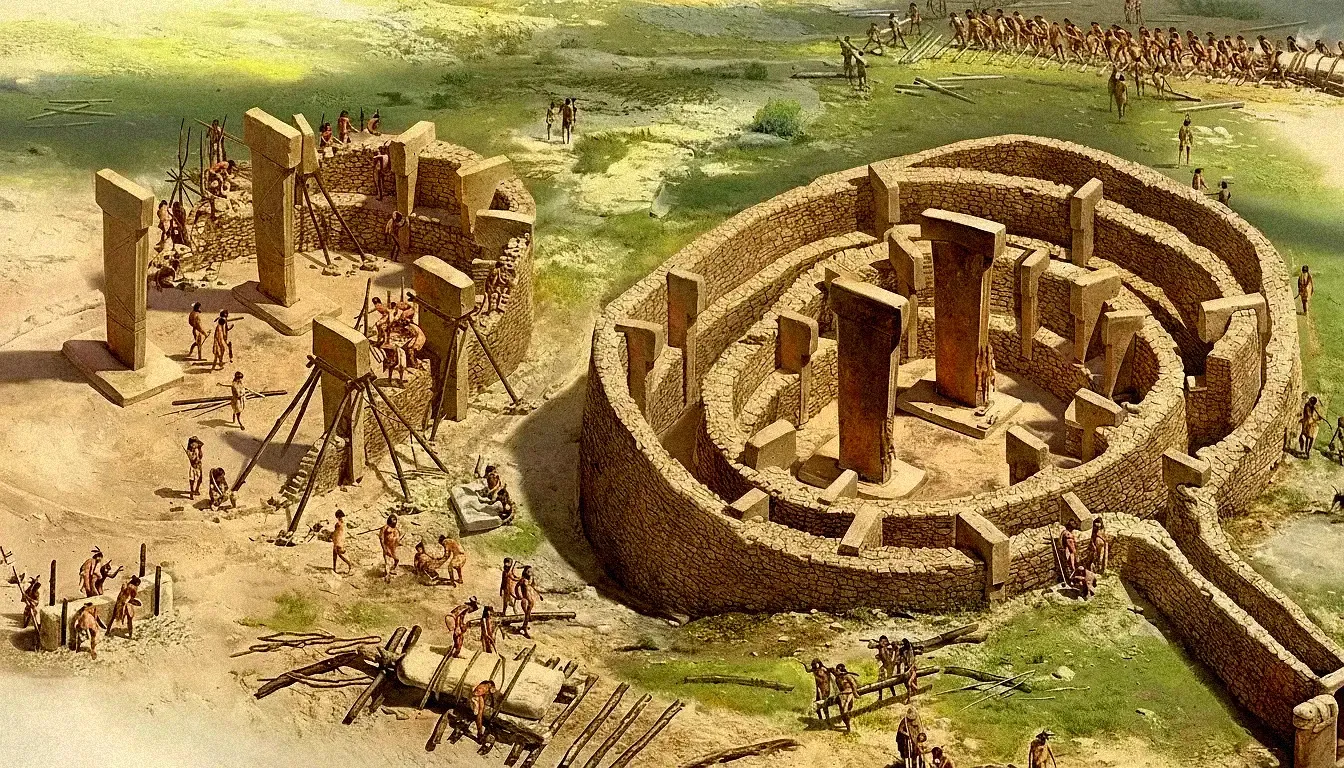
Guys, these places were only discovered in the past few decades, so these are new places. We're only starting to understand these places. This place is in Turkey, in central Turkey, and this dates back to about 9500 BC, so this is over about 11,000 years old. We don't even think this is the oldest place.
If you did your research, you will know that this is basically a place of religious worship. You can see that they constructed this place so that there are these T-shaped pillars. These things are huge. This is a human being, and this is a T-shaped pillar.
We think—again, this is all theory, this is all what we know; we don't know that much because this is all recent—but we think that these T-shapes represent human beings. Within these T-shapes are animals. You can see that they've aligned or built this T-shape in a way that they can practice a ritual or worship. The people who were leading this were probably who we call shamans, or religious leaders that help us bridge our world with the animal world and the spirit world. These are shamans.
Göbekli Tepe is a place of religious worship. What's interesting about Göbekli Tepe is that the religious site is the oldest, but we also find houses that were built later on. What we think might have happened here is that hunter-gatherers would come to a place now and then to practice religion. Because ultimately, as human beings, we have a yearning, or we have a need, to understand why, and religion solves this problem for us.
Also, as a hunter-gatherer, you need to associate with other hunter-gatherers in order to find mates, to find husbands and wives to reproduce. At this sort of religious center, it's a great time to come and practice your religion, but it's also a great time to feast and to meet someone you can marry and have children with. That was the original function of the temple.
These places are often led by shamans, and what makes them special is that they are charismatic leaders. Charismatic leaders are people like Mao Zedong, Barack Obama, Bill Clinton. They're people who, for whatever reason, people just love them and want to follow them.
Maybe what happened was that these charismatic leaders built this place, and they became like celebrities. People came from all over to meet them, to hear them, to hear the religion, and to meet other people. Over time, some people even chose to stay with them and build houses to celebrate them. Then, when they died, what happened was that they still worshiped them in their death, and so this place became a temple. That's one theory about Göbekli Tepe.
There are other theories. There are some people who will tell you that space aliens came down and built this place because it's so sophisticated. There are different theories, but the one that scholars most agree with today is that it was a religious center.
Where Does Religion Come From?
That's a great question. Where does religion come from? The answer is this: even though we all have the need for religion, we don't all have the ability to produce religion.
These charismatic leaders are people who have visions or dreams of God or the spirit world. Then they present their visions to other people. We have people like this throughout human history. Think of Jesus, think of Muhammad, think of Buddha, think of Confucius. These are people who have these visions of God or of spirituality or of a new world, and present them to people. Because they're charismatic, they're able to attract followers and spread their religion.
That's what probably happened here as well. As you can see from this picture, it was very hard work to build this temple. This was 11,000 years ago. They didn't have bulldozers. They didn't have shovels. This was all by hand. For them to want to dedicate their lives to building this temple—because it took a long, long time; it took years and years and hundreds of people—well, you needed something called religious devotion. Faith.
Again, throughout human history we've seen this. Think of Christians, think of Buddhists, think of Muslims. Religious faith—that's what built this.
Why Is the Temple Structured Like This?
That's a good question. Why is the temple structured like this? The answer is that there's cosmological significance to the structure, meaning that at a certain time of the year, what will happen is that the sun will hit this place in a certain way. It's almost like a clock.
They designed this in a way so they can tell time, but their intention was not to tell time. Their intention was to connect with the outer world. They were extremely sophisticated. They knew a lot about the way the stars worked. Basically, for them, this is science. We today say this is a religion, but their science back then is no different from our science today.
Religious Visions
If you talk to any religious people, they saw it. They were there. They talked to God. We're like, “Well, that doesn't make any sense,” but they really believe it, and that's why they're able to convince their followers.
Someone like Muhammad had religious visions in a cave. You're like, “Did he really see an angel?” Well, he thought he really did.
In our research, what we discovered is this. People use something called psychedelics. Do you know what psychedelics are? Psychedelics are drugs. What drugs? What these drugs do is shift your neural system so that you see the world in a different way. When you do that, you're able to have different visions.
But we also know that if you go hungry for a long time or if you meditate for a long time, you're able to see different things. From their perspective, they actually saw this thing, even though we don't think it actually happened. For them it's true, but maybe for us it's not so true.
Animals, Hunting and Religious Worship
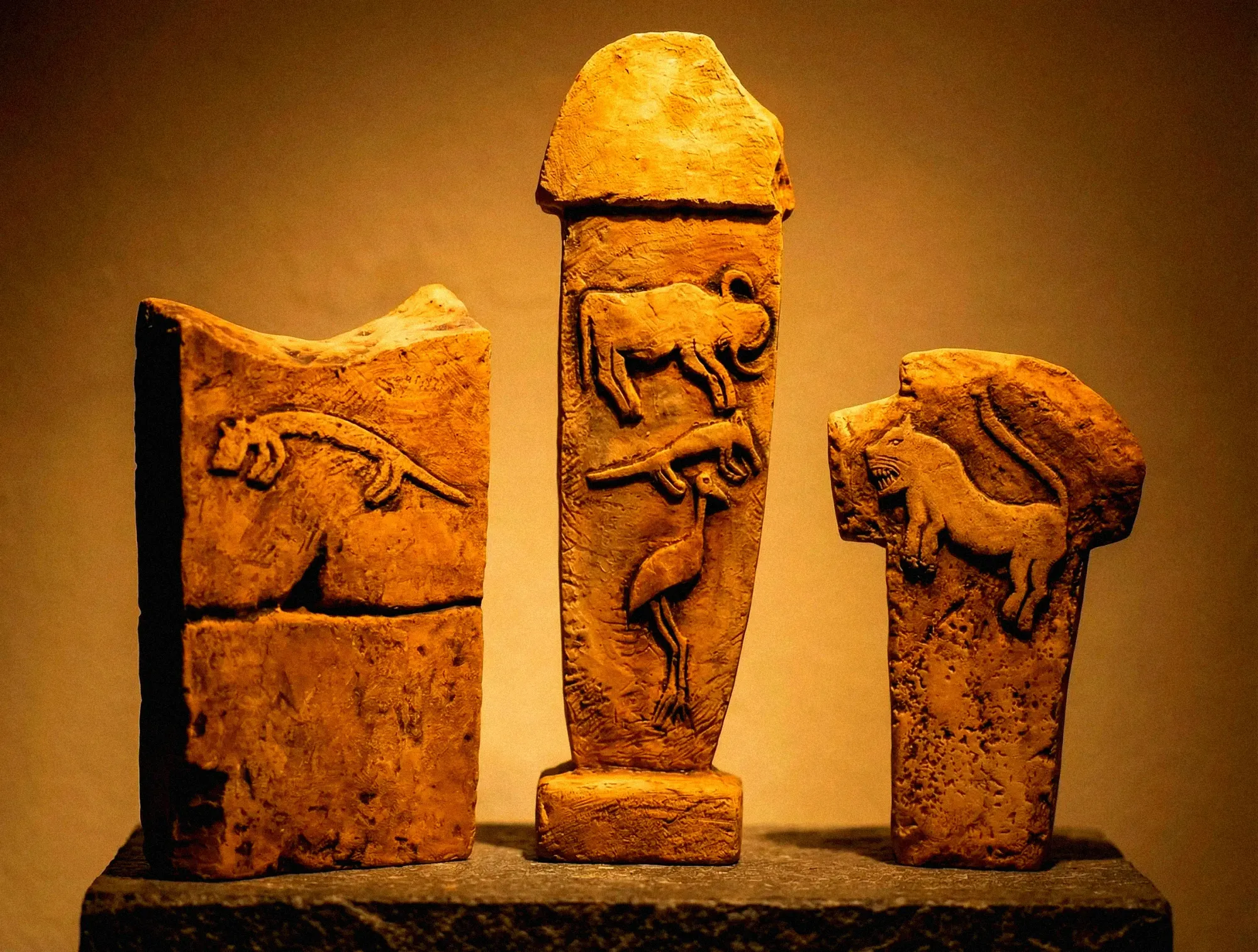
This is what is in the pillars at Göbekli Tepe. What's really interesting about these pictures is that these are animals in the motion of hunting. The fox—the way the fox hunts is that the fox jumps up in the air and then goes down and attacks the prey. This is in the motion of attack.
Why would they do that? What's the point of having animals on these pillars? Why would they do that?
Good. Yes. What's really important to understand is that back then, we human beings did not see ourselves as separate from the other world. Animals, trees, humans—all equal.
First of all, if you're going to kill these animals, you need to ask for their forgiveness. Otherwise, their spirit, their soul, will haunt you. They'll take revenge on you. If you kill them, you must ask for their forgiveness, and one way to do that is by paying tribute to them. That's number one.
Number two is that we can learn from these animals. They're the best hunters in the world. Before we go on a hunting trip, we might have a ceremony to channel their energy and power and wisdom.
The third thing is basically to appease them or to become their friends. Because we don't want to hunt foxes; we want to hunt gazelle. There's more meat on gazelle. They're easier to capture. But we want to be friends with the gazelle. We want to be friends with the lion. We don't want to be enemies. It's a sign of respect to the animals.
That was basically their religion. Coming together for the religious festival was about celebrating the relationship with these animals, as well as channeling their power, their energy and their wisdom so that they could go hunt as well. This is probably one of the earlier religions that we have.
Jericho and the Natufian Culture
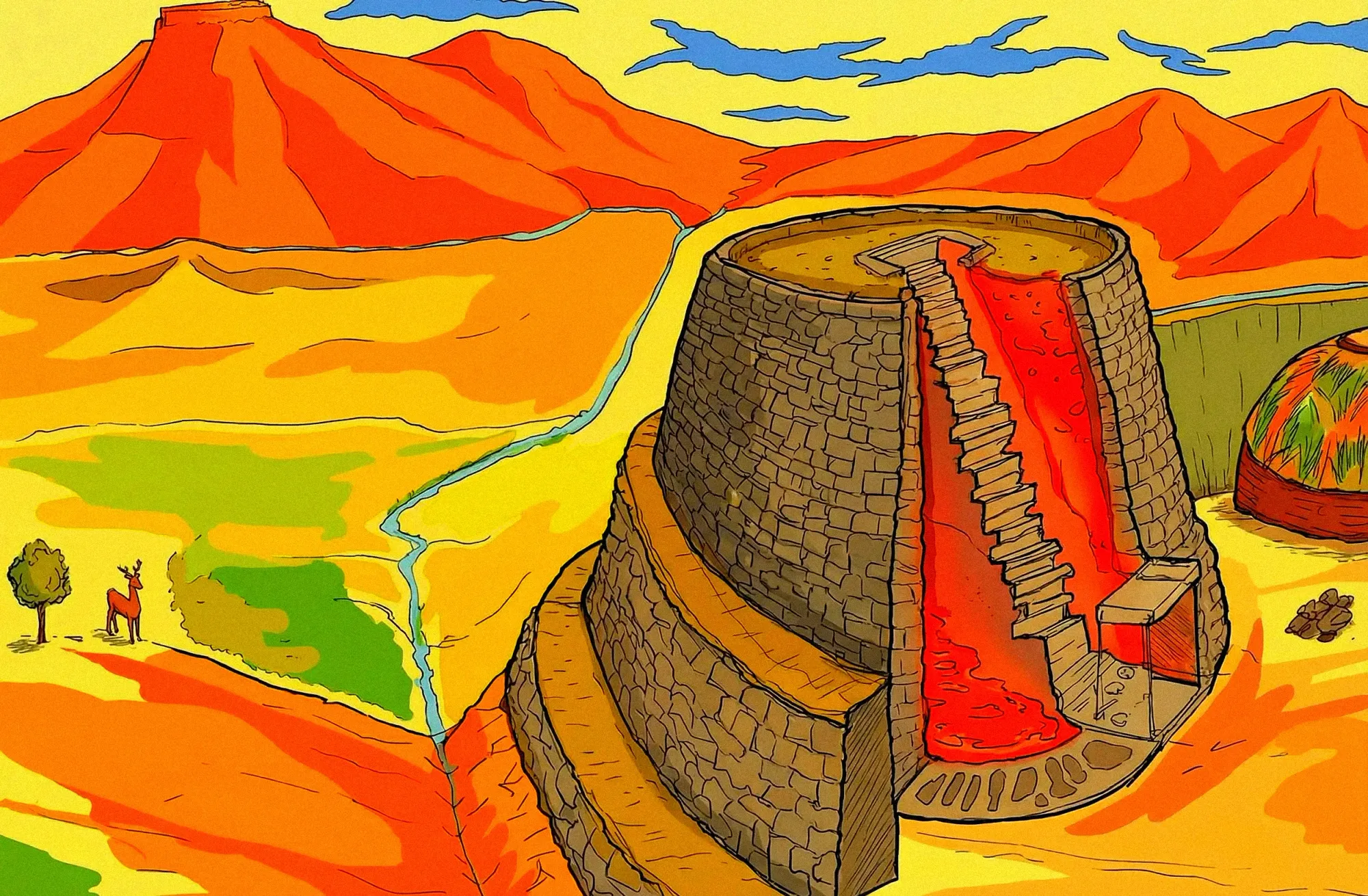
This is Jericho, and Jericho is part of something called the Natufian culture. The Natufian culture appeared about 13,000 years ago, or even more—actually, maybe 15,000 years ago—in a place we call the Levant. The Levant is basically the Middle East: Israel and Syria.
What was special about the Natufian culture were three things.
First of all, they were sedentary. Sedentary basically means that they basically stayed in one place. Remember, hunter-gatherers roamed around. They moved from place to place. But these were hunter-gatherers who were sedentary. They were not farmers; they were hunter-gatherers, but they stayed in one place.
The reason why we know—there's a lot of evidence, but one reason why we know—is that they basically hunted gazelle. Gazelles are like deer. The thing about gazelles is that their teeth color is different according to the season. In the summer and in the winter, it's because they eat different foods, so the teeth color is different. We're able to dig up these gazelle bones, look at their teeth, and recognize that they were hunting gazelle in this area both in the summer and the winter, which meant they did not move. They were sedentary. That's the first thing.
The second thing is that they had domesticated crops. The reason why we know is that we're able to dig up seeds of crops—vegetables and wheat and barley—which meant that they had the capacity, the technology, to farm, but they chose not to farm.
Basically, the way they developed this technology was for gardening. They were hunting and gathering most of the time, but some of them, for fun, for pleasure, had their own garden, and that's how they developed the technology.
The third thing that was very important is something called the Cult of the Skull. They probably worshiped animals, but they also worshiped ancestors. The reason why we think so is that we're able to find a skull in these places. They basically took someone's head, their skull, and put clay on it to protect it, and they put it in their houses to worship it. This is the beginning of ancestor worship.
The Tower of Jericho
This is called the Tower of Jericho. When we first discovered this, we thought, “This must be evidence that Jericho went to war,” because it had walls and then a tower. The walls are to protect you from your enemies. The tower is to see your enemies coming.
But then they did more research and realized, “Oh, no, no, no. This tower is a religious monument.” It's the same as Göbekli Tepe, where it is cosmological, meaning that at the longest day of the year, the mountain over here will cast a shadow over the tower. The tower will cast a shadow over the entire village, covering it all up in darkness.
Why would they want to do that? What does that do for you—to have the entire village covered up in darkness? Any guesses? Why would they do that?
Excuse me. What do you mean by that? I know, but if that was the case, you'd just move.
What's really important is that this is like right after the last ice age, so it's actually pretty cold. They did this for religious reasons. Because when you cover your village in darkness, you feel as though you are in connection with the sky. They must have a religious belief in which part of the worship is to cover the village in darkness.
That's a good question. Space is dark. When you're in the dark, you think, “I'm bringing space to our village. I'm collapsing the distance between space and my village.”
You feel connected. I understand that, but your village is bright anyway. If you're able to make your village dark, that's magic. They designed a tower in a certain way so that it would cover the village in darkness, and they could see that as magic. That's evidence that your religion is correct.
Because otherwise, how do you know religion is correct? Only by performing magic can you show that this charismatic leader who came up with this idea speaks to God.
Skulls and the Spirit World
Let's look at certain pictures of skulls, because this was actually very common back then. Basically, this is a skull they covered up with clay, and they carried it around with them all over the place. Ancestor worship was throughout the world at that time.
This is another picture of the skull. Let me ask you why they would do that. Their ancestor is dead. Why would they do that? Why would they have the skull around? Where are the ancestors now? Where's that person? The spirit world—some place in another world.
Therefore, having a skull around allows you to communicate with that world and learn its secrets. Some of the secrets may be like how to construct the tower in a way that you're able to cast a shadow over the village. That's their method of scientific discovery: to communicate with the spirit world through your ancestors.
The point I'm trying to tell you is that their level of intelligence, or their understanding of the world, is just as sophisticated as our understanding of the world. We think that when we go to science class, we're learning facts and knowledge. But guess what? Maybe a thousand years from now, people will look at our science, like physics, and be like, “Oh, that was a religion too.” In terms of intelligence, they were just as creative and as sophisticated as we are today, but they just had a different set of beliefs.
Çatalhöyük and Religion in Everyday Life
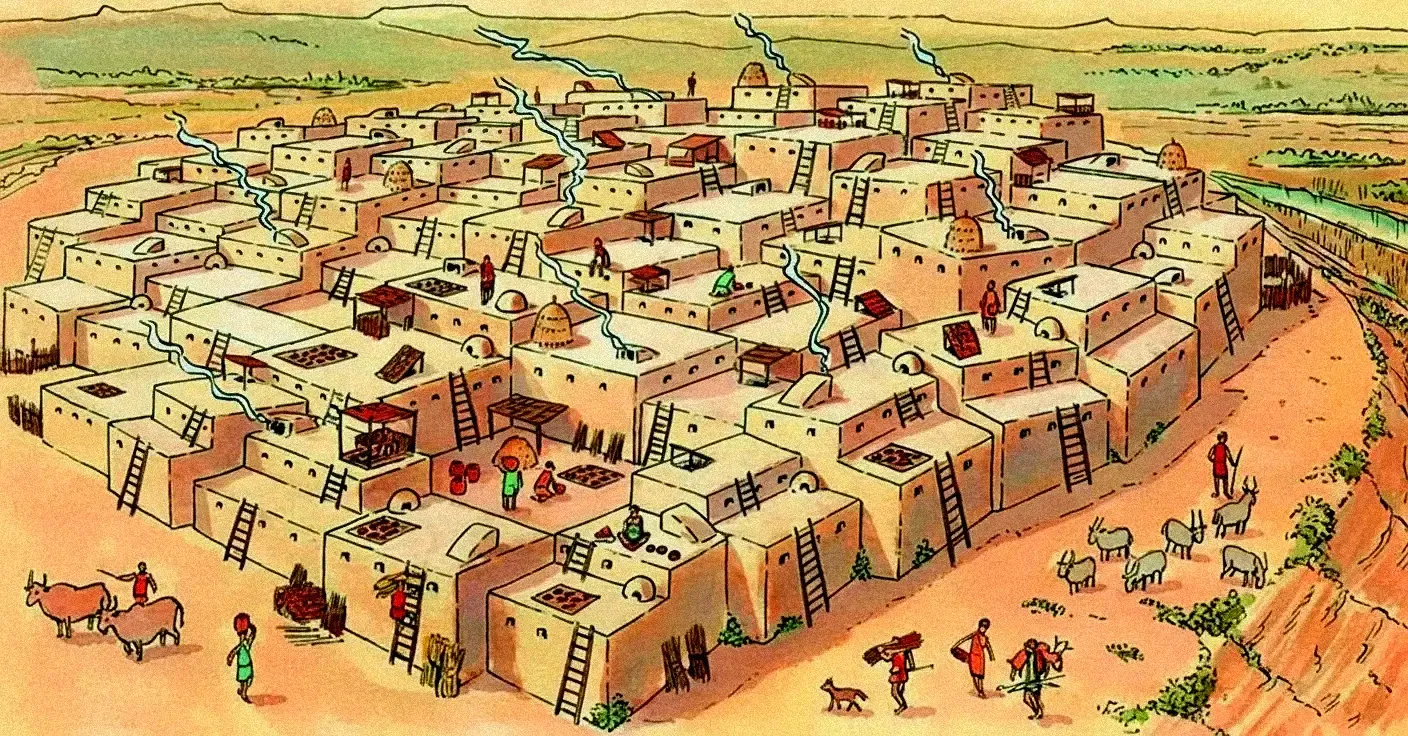
The last place I want to look at is Çatalhöyük. Çatalhöyük is a huge place, in Turkey as well, pretty far from Göbekli Tepe but about the same place, and this dates back to about 7500 BCE. As you can see, it's a huge village.
We think that—maybe this was around for about 2,000 years—at its height of development of civilization, it had about 8,000 people. That's a lot of people, guys.
The thing about Çatalhöyük that stands out is, first of all, it's huge. Second of all, they didn't have a place of worship or government, meaning that all the houses were the same. It was a very egalitarian society. Everyone was the same.
What's even more interesting is that you go to every house, and the living room is basically a temple unto itself. It was a place of worship and religion, meaning that Çatalhöyük is a place where religion permeated, or was in, every place they were. We think that Çatalhöyük is one of the first religious communities.
Remember that before, religious sites were places you went to maybe once in your lifetime or maybe once a year, but it wasn't part of your everyday life. Whereas in Çatalhöyük, religion was in your life from birth to death. The thing about Çatalhöyük that's very interesting is that at this point, their religion is extremely sophisticated, meaning that they can explain everything using their religion. Their everyday life and their religion were completely aligned together.
Let me show you some evidence of this.
The Mother Goddess and Sky Burial
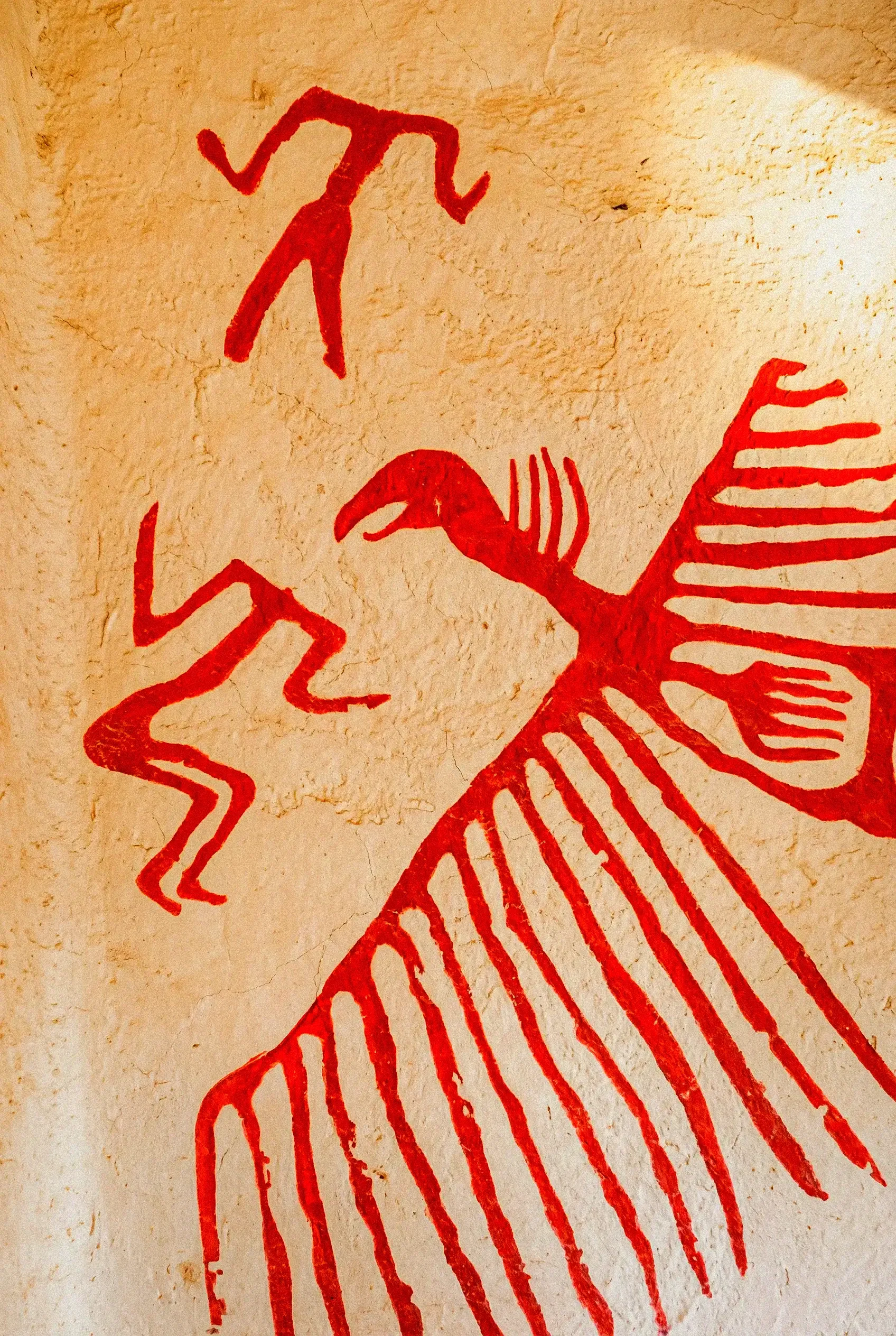
This is a painting that you will see in most houses in Çatalhöyük. You're like, “What is going on here?” Again, there are different theories, but let me explain to you what most scholars believe to be the accurate theory. This is just a theory. We have no evidence for this, but this is what we believe.
We believe that the people at Çatalhöyük worshiped a mother goddess, because a mother goddess is what gives life to everything. Think of Mother Nature, think of a woman giving birth to her child. They worship a mother goddess, and the mother goddess is represented by the bird, because a bird flies all around the sky. The sky belongs to the bird. The bird can take different forms. This is a vulture, so the mother goddess can also take the form of a vulture.
What's going on here? Why is the vulture with headless people? The way that they combine ancestor worship with their belief in the mother goddess is that they believe that when a person dies, what they'll do is put that person's dead body out in the open. It's a sky burial. You go to Tibet; they have sky burials. The vultures will come and eat all the flesh, and that is the tribute or the sacrifice made to the mother goddess.
The mother goddess basically cleans the body, and then you take the bones and you bury them back in your house. You take the skull, and you keep the skull in your living room to worship your ancestors. In other words, it is an extremely comprehensive or complete religion for understanding the world.
By the way, guys, this is a theory, but right now it's the most useful theory that we have about this place.
Hunting, Dancing and Respect for Animals
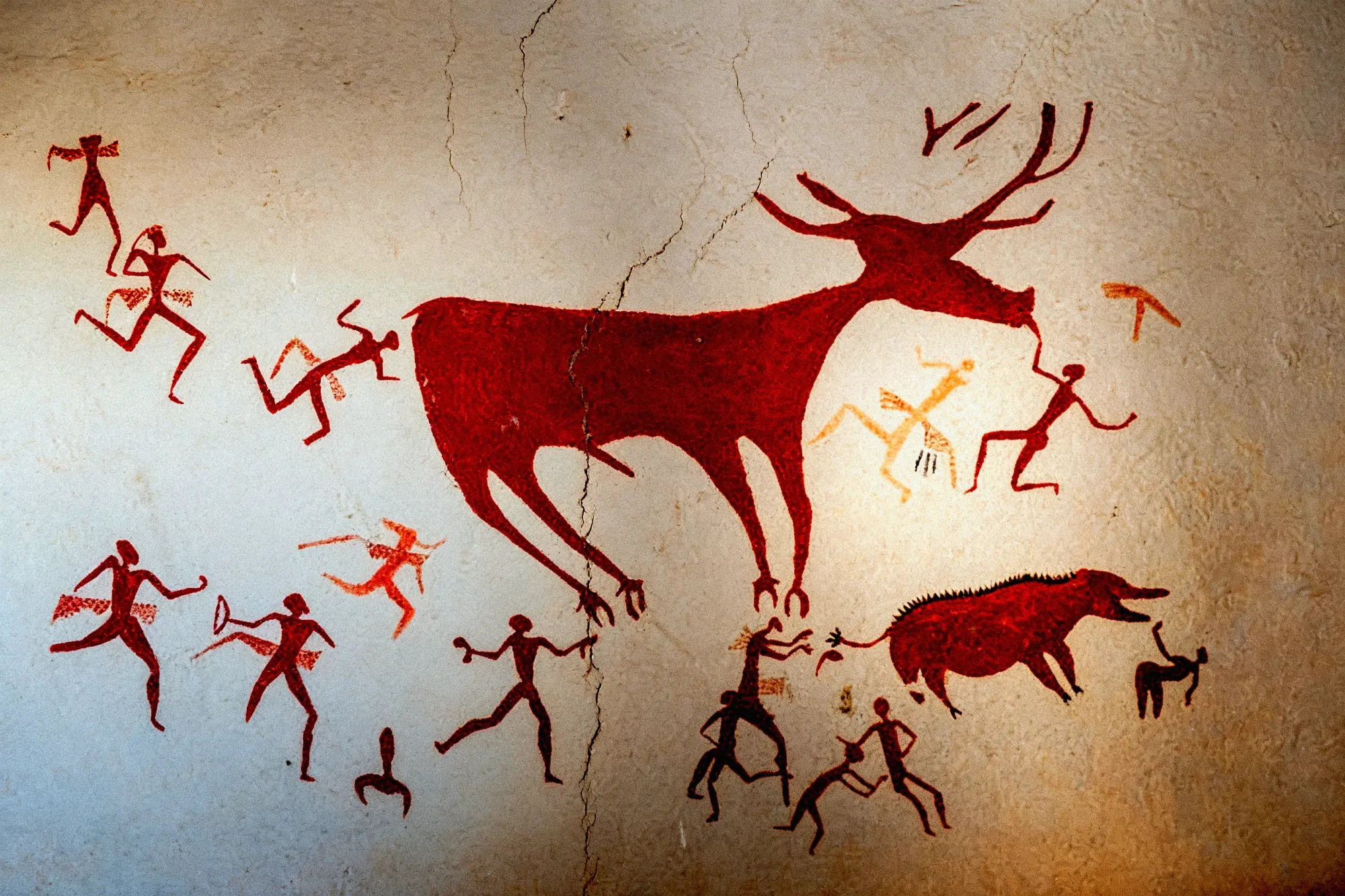
What's going on here? This again is also in Çatalhöyük, in many houses. What's going on here? Different scholars have different interpretations of this. Clearly, this is a hunt. This is a hunt, and some people believe that these human beings, who are part of the Çatalhöyük people, are mocking or taunting or laughing at the animals as a way to subdue them, to tame them, to domesticate them. That's one theory.
But another theory is that what they're really doing is dancing, because they are worshiping or paying tribute to these animals they're about to kill. This goes back to Göbekli Tepe, where they're trying to respect the animals:
We dance with you. We're friends. I'm sorry I have to kill you, but hey, we're only taking your meat. Your soul is still going to be born, or it's going to go to the spirit world.
This is a way of paying tribute or respecting the animals they're about to kill or about to hunt, to maintain the harmony of nature and the relationship with nature.
Again, what's really important is that this is a pretty complete religion that explains everything to these people, and that's why it's so attractive to people. If you're a human being, you want to know why. Well, Çatalhöyük—the religion there explains why.
The Mother Goddess and the Bull
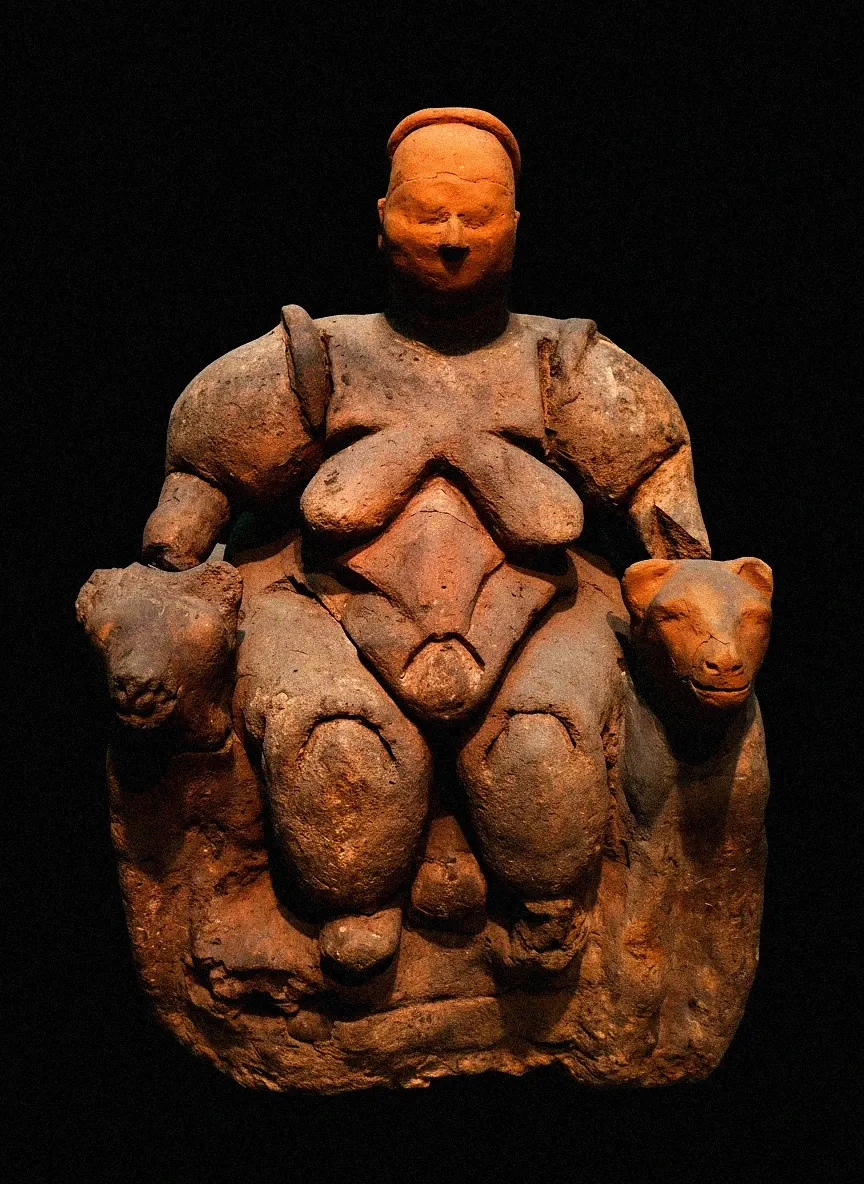
This is a picture of the mother goddess. Again, we have debate about what this is. Some people believe that it's just a fertility goddess, but other people believe this is the mother goddess. You think about it: if you are in a place like Çatalhöyük, you're most concerned about giving birth, because giving birth is what rejuvenates your society. It makes sense that your god, the person you worship the most, would be a mother goddess.
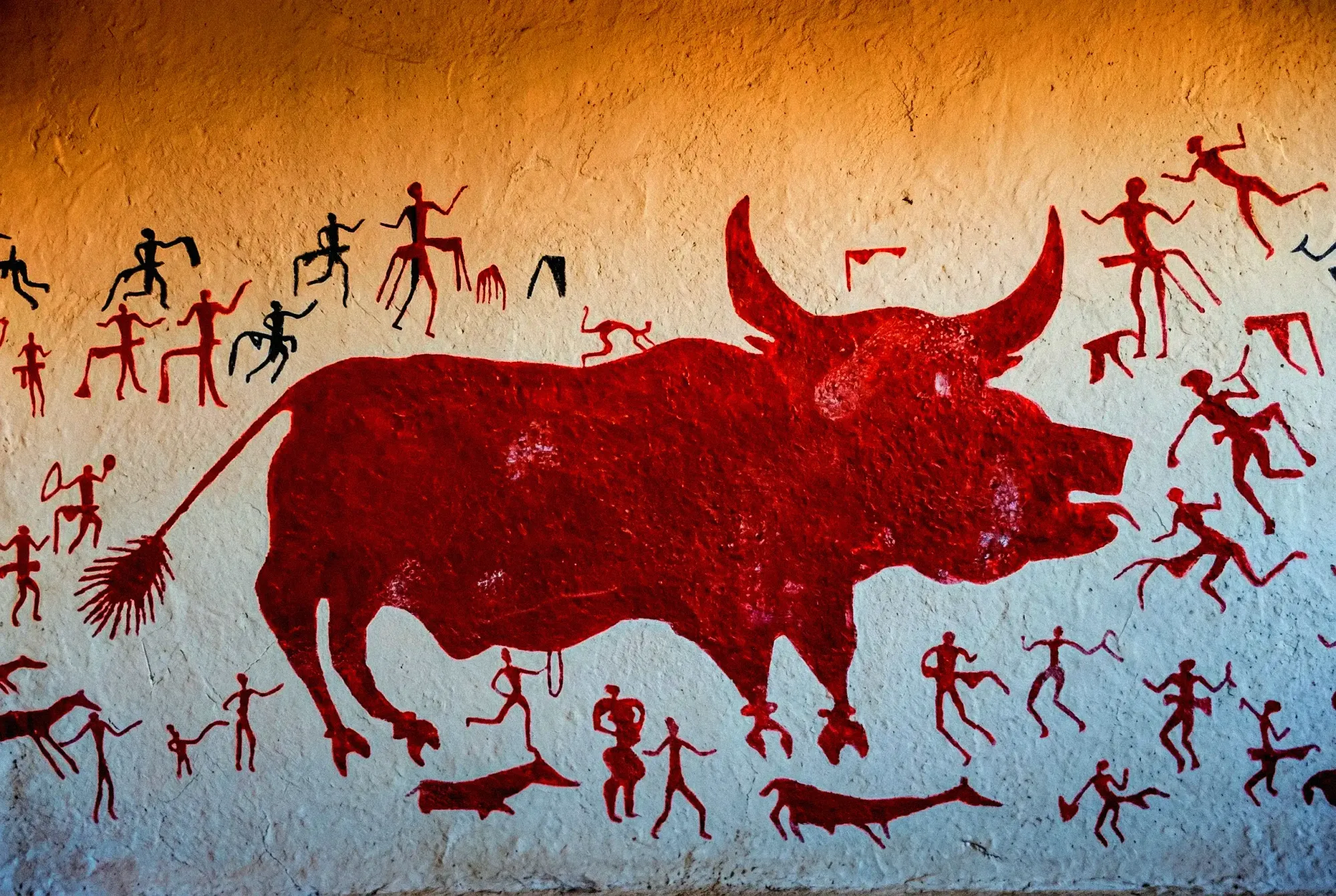
This is clearly a bull. If you see pictures of Çatalhöyük, you will see that they have many, many depictions or pictures of bulls in their houses. What we believe—again, this is a theory—what we believe is that if the mother goddess represents life, giving life, the bull represents vitality, energy. It's the bull that gives the mother goddess the energy to give birth.
The bull represents the male. The mother goddess represents the female. But only if the male and the female conjoin, they come together, will you have life.
This is another picture. Clearly, they're not hunting. Clearly, they are worshiping the bull. They're paying tribute to the bull.
Religion was a fundamental part of people's existence when they chose to become sedentary, or they chose to settle in one place.
Returning to the Original Question
Let's go back to the original question. The original question is: why did people transition into agriculture?
The theory that most scholars believe is that it was because of religion. It was because people had a religious need that they came together to have these religious festivals. There were some charismatic leaders who were so brilliant that people chose to settle down with them. They became sedentary. They developed a religion around the sedentary lifestyle, which included ancestor worship.
But over time, because you're in one place, you're going to deplete the resources of the people, of the area around you, of the forest, which means that you must go to farming. But then, eventually, because you have so much population and you farm too much, you're forced to move somewhere else. When you move somewhere else, you actually bring your religion with you.
That's how we can explain the transition from hunter-gatherer to agriculture. There was no one spark or one moment when this happened. We think it took thousands of years over time, because ultimately, the hunter-gatherer lifestyle was so much more attractive to people, so much easier and more attractive to people than the farming lifestyle. But the benefit of the farming lifestyle is that you had a religion, and that's why people chose ultimately to farm.
Ice cave paintings go back 40,000 years, meaning that they practiced this sort of religion, or something like this religion, 40,000 to 50,000 years ago. We know through ice cave paintings.
These places are very famous. It's a very interesting place. We're only slowly discovering all that's there. We basically uncovered about 5% of it, so over the next few decades we'll know more.