Civilization #2: Religion and the Dawn of Society
We previously discussed three prehistoric sites: Göbekli Tepe, Jericho, and Çatalhöyük. The argument I made, which is the general scholarly consensus, is that what compelled the transition to agriculture was the religious beliefs of the people at that time. It was humanity's religious impulse that drove our transition into agriculture.
My argument today is that this religious impulse—this need for religion, this need to understand why we are here, what we must be doing, and where we're going—has always been there. In fact, religion is what makes us fundamentally human. To prove this case, I'm going to talk about Ice Age cave paintings.
I ask you to look at these cave paintings that we found all around the world, that go back 30,000 to 40,000 years.
As you can see from those pictures, they're beautiful and extremely creative and artistic. I want to look at three questions about the cave paintings today:
- How were they painted? They didn't have the technology we have today.
- Why did they do this? When you're in a cave, it's very dark, very cold, and very hard to breathe, but they spent days in there painting them.
- What do these cave paintings represent or mean? This is the hardest question.
The first thing I want you to be aware of is that there's absolutely no agreement on any of these questions. Cave paintings are something that we have a lot of around the world, but there's very little evidence as to what they are, what they represent, and how they were painted. There are a lot of guesses. The case that I will present to you today is my own personal interpretation based on my research and my understanding of the evidence. Please be aware that there are many different interpretations, and the evidence is extremely unclear about many of these things.
A World of Ice: The Human Journey
The first thing you need to understand is that for most of human history, it's been very cold. The Ice Age only ended about 12,000 years ago, and we've since seen a general warming of the planet, which has allowed us to adopt agriculture. But before then, we were basically living on a very cold planet.
The history of humanity is this: 300,000 years ago, we came into being in Africa. Because the world became very cold about 100,000 years ago, that meant a scarcity of resources. This forced us to seek food and resources elsewhere, which drove our movement into Europe, then into Asia, and then across the Bering Strait—remember, this was all ice—into North America and South America. From Asia, we went down to Australia.
We basically colonized the planet, but there weren't that many of us. There was only about 1 million of us all around the world 20,000 years ago. The other thing to remember is that in this process, there were actually other human beings in other places. The Neanderthals were here, and we interbred with them until we became the dominant human species.
Journey into the Ice Age Caves
Let's look at some cave paintings. This is in the Chauvet Cave, and this started about 30,000 years ago. These cave paintings were a continuous process where different people at different times went to the caves and painted different pictures. They might have added more things to the pictures as well.
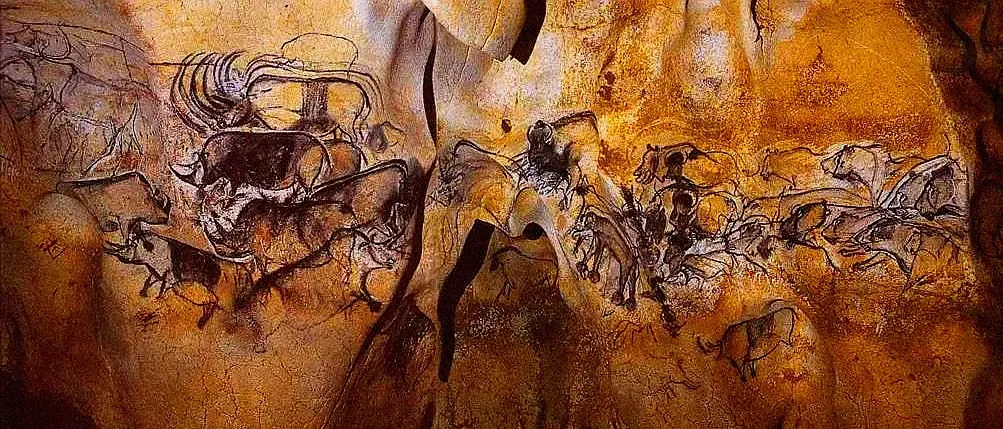
As you can see, this is clearly representing animals: bison, rhinoceros. The other thing that's interesting about these paintings is that there's really no focus. You see lions, you see horses, you see rhinos. It's almost like nature is one interconnected picture.
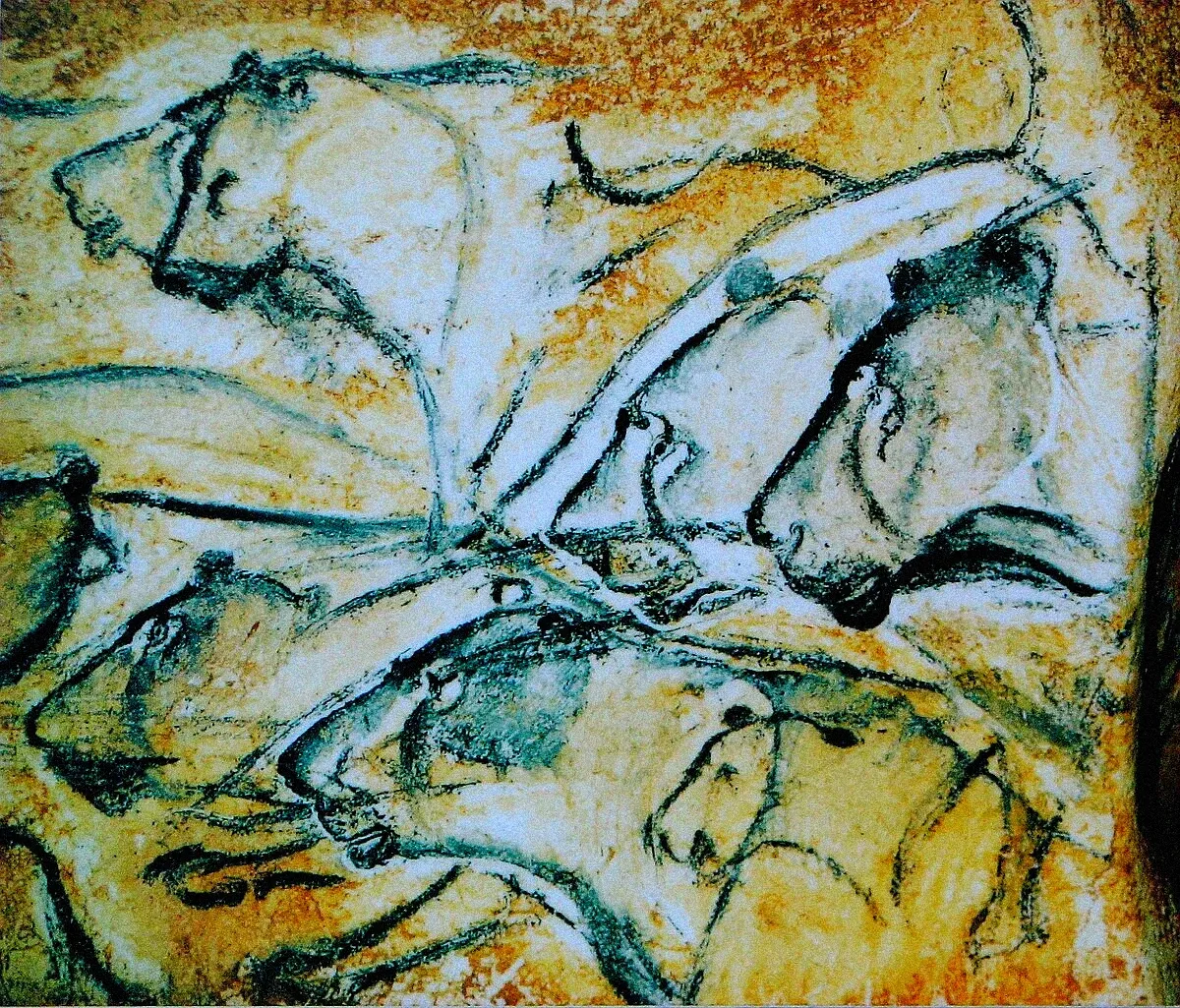
These are lions.
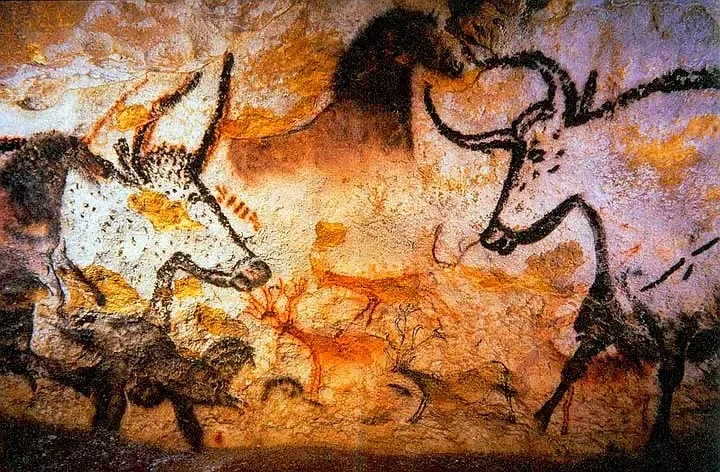
This is Lascaux Cave, about 20,000 years ago. The very famous artist Pablo Picasso was actually invited into one of these caves, and he said, "We have learned nothing in 10,000 years," meaning that they were just as good back then as they are today. Artistically speaking, humans have not improved at all.
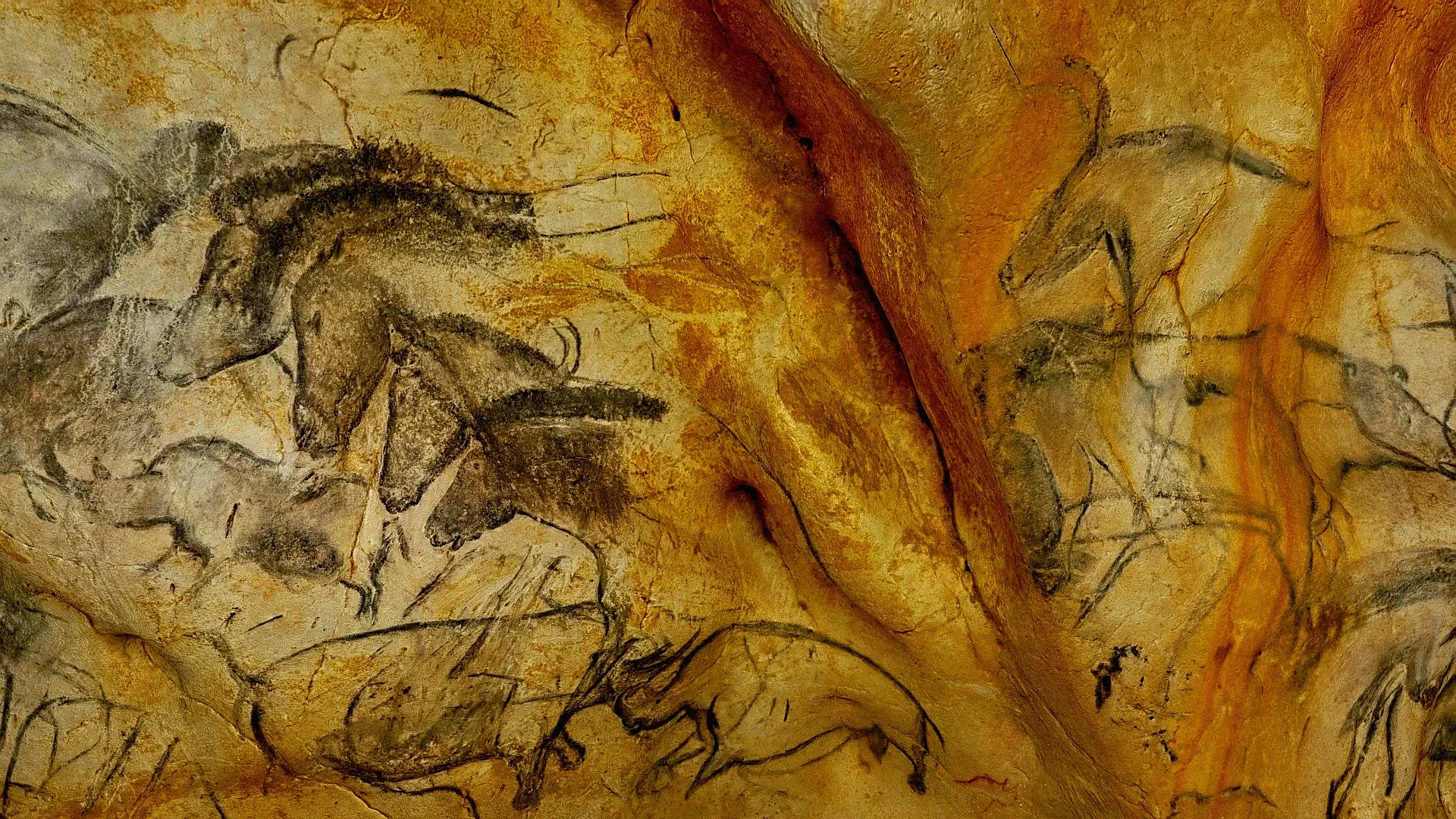
These are horses.
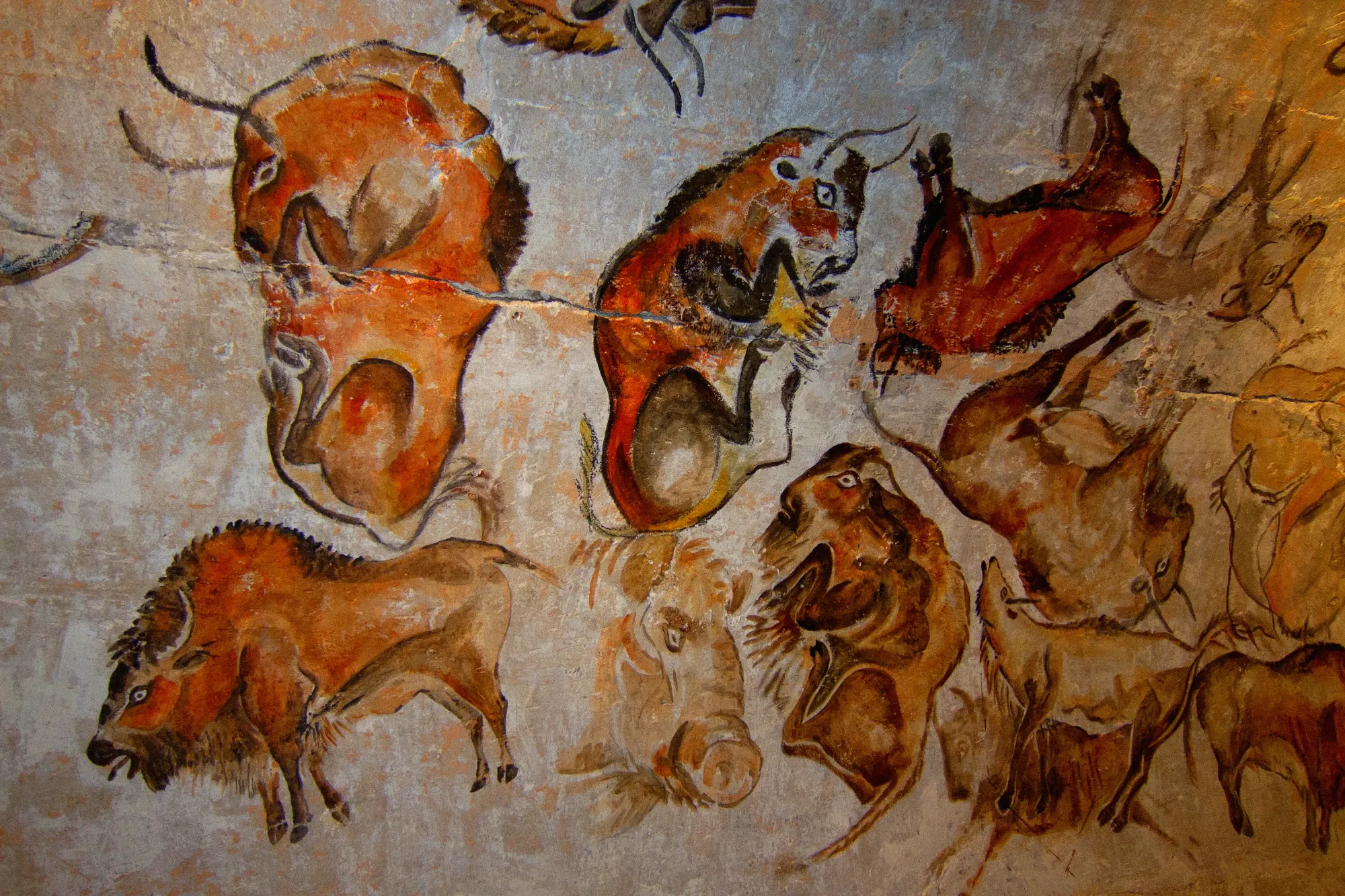
This is Altamira, Spain, which goes back to 34,000 BCE. You can see that they're not looking for a realistic depiction of animals; they're trying to imagine the natural world in their own way.
How Were These Masterpieces Created?
So, how did they paint these pictures? First of all, they mainly used red and black. Red came from ochre, which is a type of clay, and black comes from charcoal. That's the coloring they used.
Inside a cave, it's very dark, so they had to use lighting. What they did was they got some animal fat and put fire on it so they could see some of the caves, but not all of them.
Why Did They Paint in the Dark? The Ritualistic Purpose
Now the question is, why did they paint these pictures? The largest clue is where we found these paintings. We found these paintings in a very special place in the cave: the section of the cave where the acoustics were the best. The sound was the best.
What this means is we're fairly convinced that these paintings were part of a ritual which included music, because we found musical instruments as well, like flutes. In other words, we think that these paintings are like Göbekli Tepe, where maybe now and then these hunter-gatherers would come into this cave for a religious festival with music and dancing, watching these paintings together.
These paintings are part of a religious festival. In other words, these paintings are not about art; it's really about religion. It's expressing the religious beliefs of the people at that time.
What Do the Cave Paintings Mean? Reconstructing a Lost Worldview
So, what were their beliefs? Again, no one knows because they wrote nothing down. They were preliterate. We can't go back in time and talk to them, so we have to use our imagination.
Let's imagine that we go back in time. It's very cold, and our memories have been wiped out. We've lost the knowledge of today—we've lost science, we've lost what we learned in biology class. What are the things that would amaze us, make us wonder, or fill us with awe? What are the things that capture our imagination, that make us think, "Oh my God, God must exist because there's no way I can explain what happened"?
What's the first thing that comes to mind? How about childbirth? I'm a father, I have three kids, and I can tell you when I first saw my child being born, I was amazed. You have this life come out of nothing. If you've never studied biology, you can't explain what happened. So that's the first thing that amazes us about being human.
What's the second thing that would amaze you? How about the stars? It's late at night, and remember, there's no pollution. You see out into the darkness, and it's all stars glowing. That's pretty amazing. Staring into outer space, you see these stars glowing brightly. What are they? Possibly souls, or other worlds, or planets. The first thing you recognize is that our world is just one of many worlds out there.
What else amazes you? How about recovery from disease? How do you explain healing? You might think a god saved you. But another way to explain healing is that you have a body and you have a soul, and the soul could be one of the stars. What's causing disease is the soul and the body are in conflict. Healing is about bringing the soul and the body into alignment. We think this because if you look at Chinese medicine, it's the same idea: the soul and the body are in conflict, and you want to align the two in order to heal.
Other things that would surprise us are nature: the animals, the trees, the vastness of it all. These things surprise us and force us to ask the question: why?
The Cave as a Portal: A Theory of Life and Death
Let's try to construct a theory of how to connect all these things. We know that the stars represent other powers out there—gods, the souls of great people, other planets, or other worlds.
How does childbirth happen then? It comes from the womb. What is a womb? A portal. A door. The womb is a portal that the soul comes through from another world into our world.
Then how do people return to the other world? If the womb is a portal that allows a soul to come into our world, how do these souls return to their world? Through death and then burial. This is symmetry. The soul comes into our world from the mother's womb, from darkness. For us to return the soul back to its original world, we bury this person in darkness that carries that person back. This is probably the simplest explanation for how life and death work.
There are these portals. And what in nature most resembles a womb? A cave. We can think that we humans come from a mother's womb, which is a cave, a tunnel. But animals also come from a womb, which is the cave. The cave is a portal into another world.
So why are we in the cave celebrating animals? We respect their souls. Why are we respecting their souls? Because we kill them. So we kill them, and now we are trying to let them forgive us, but what else are we trying to do? Once we eat them, we must bring them back. When we kill them, we think they go back into the spirit world. So now we have to summon them back from the spirit world into our world.
Animism: The World's First Religion
What this belief is really saying is that we are all interconnected, and for every action that we make, we have to do something else to compensate for that action. If we kill an animal to eat its meat, then we need to ask forgiveness and then bring this animal back from the spirit world to maintain balance and harmony in nature.
Why is there balance and harmony in this world? Because what gives life to everything? The mother goddess. Mother Nature. If we think that there's one force, the mother goddess, that gives life to everything, that means that trees, animals, and us are all equal. We're all the children of Mother Nature. We all have souls.
So what gives us permission to kill other animals? They are our brothers and sisters. We are allowed to do so because the mother goddess has a plan. Each thing on this planet has a function, and that function is to maintain balance and harmony. If we do not kill the other animals, we will die. But also, if we don't kill the other animals, there will be too many of them. In other words, the world is a cycle, a circle, and each person and each animal has a part to play. As long as we play our part, the world will be harmonious, balanced, and perfect.
We have a word for this religion: animism. Animism is probably the first religion. It's a belief that each living thing—whether it's a tree, a mosquito, or a person—has a soul. We're all interconnected because we all have souls, and so we must maintain balance and harmony. Many of the world's oldest religions have this belief. If you talk to native peoples in North America, South America, and Australia, they all have this belief. But also, many religions such as Buddhism also have this belief.
Evidence for an Animist Worldview
Let's go over some evidence that this is, in fact, what they believed.
A recent discovery we made is that trees talk to each other. In a forest, the roots of thousands of trees are connected through fungi, and this allows them to share information. For example, if one tree in one part of the forest lacks nutrients like water, the other trees will send nutrients to that tree. It's almost like the forest is one big brain or one big living organism. We've also discovered that if there are pests or insects that attack one tree, this tree will automatically communicate to the other trees, and these trees will start to prepare for the attack. The most interesting thing is that trees will recognize their own children. If the children trees need nutrients, the mother trees will send the nutrients to the children right away. This is something we've recently discovered, but if you were living back then, you could almost sense how trees communicate because you're always in touch with nature.
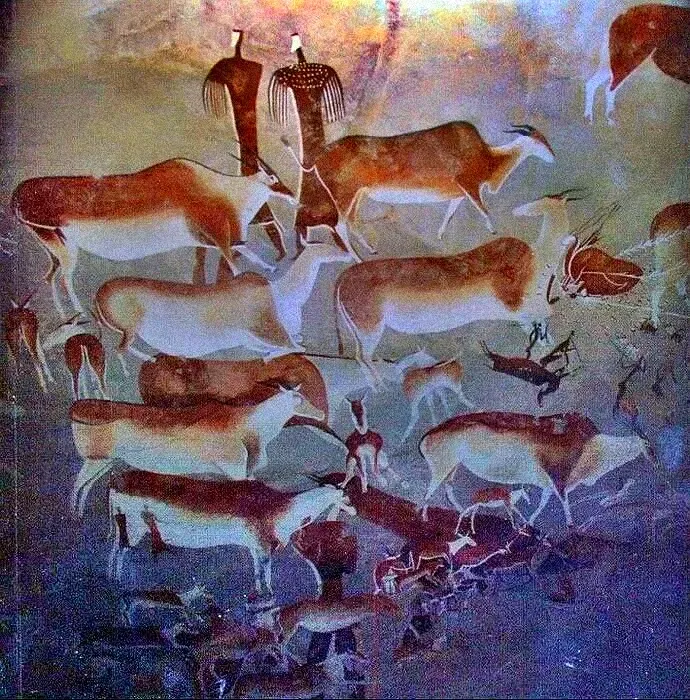
This is a cave painting. You can see that these animals, gazelles, are going somewhere, and there are two beings here. We believe that these two beings represent the mother goddess because, as we discussed previously, the mother goddess comes in the form of a bird. The bird flies around the sky; the sky is the mother goddess. It's almost like the mother goddess is channeling or herding the animals from the spirit world back into our own world.
What you also notice is that these birds are almost like humans. We think that the shaman dressed up like birds in order to channel the energy of the mother goddess to control the animals.
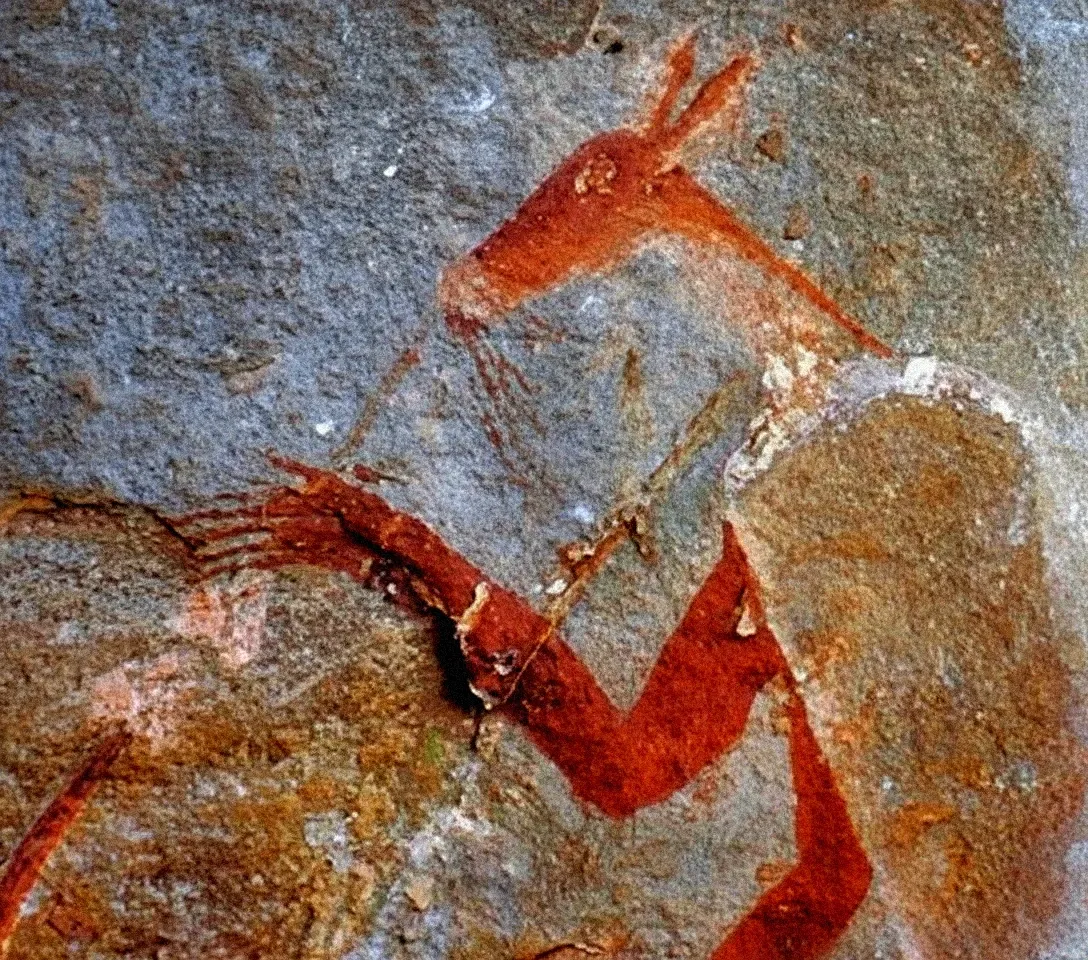
There's a lot of evidence for this. This is clearly an animal, but it is also a person who is a human being because of the figure. These are human beings, shamans, who dress up like animals in order to better communicate with animals and the spirit world.
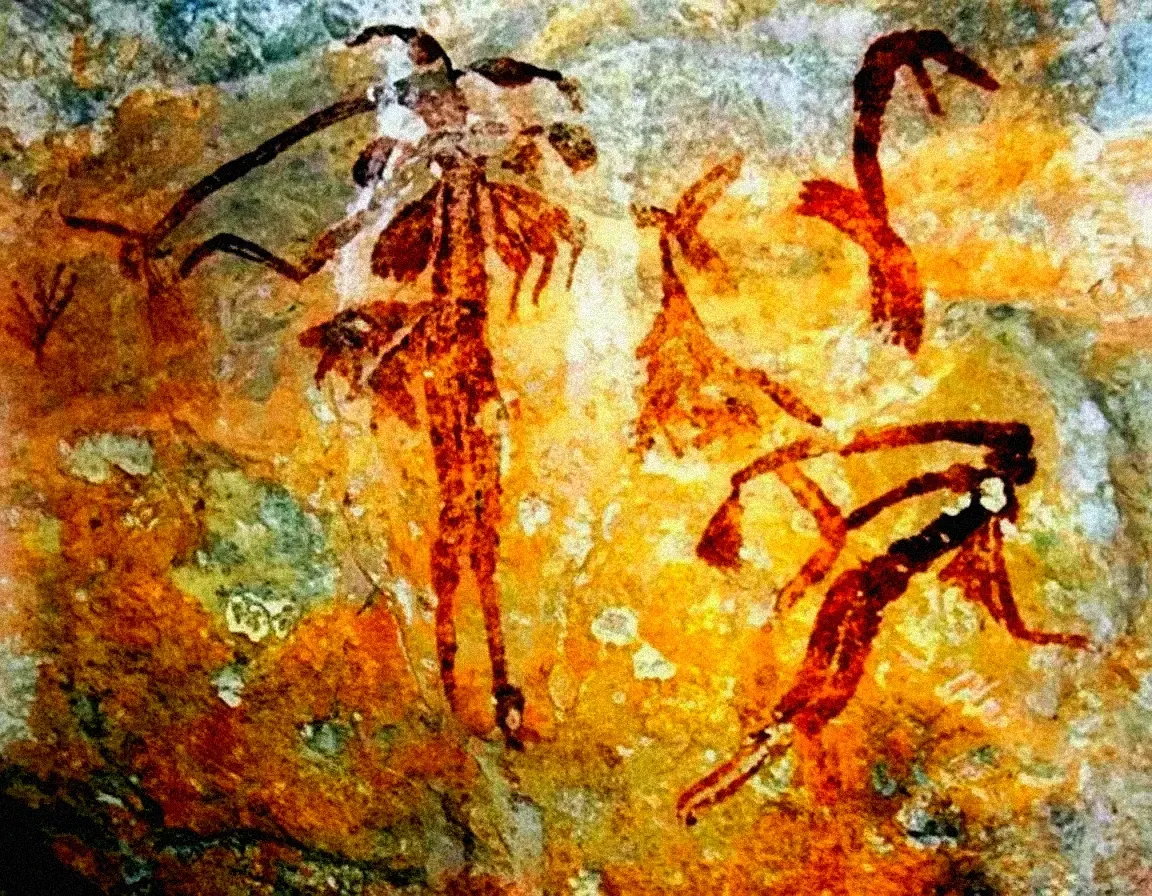
This is a more clear picture of a shaman trying to access the spirit world.
The Honored and the Different: Burials of the Ice Age
From this religion, we can guess that the people back then were extremely compassionate. They believed that everything has a soul and every life is precious. One piece of evidence for this is a skeleton.
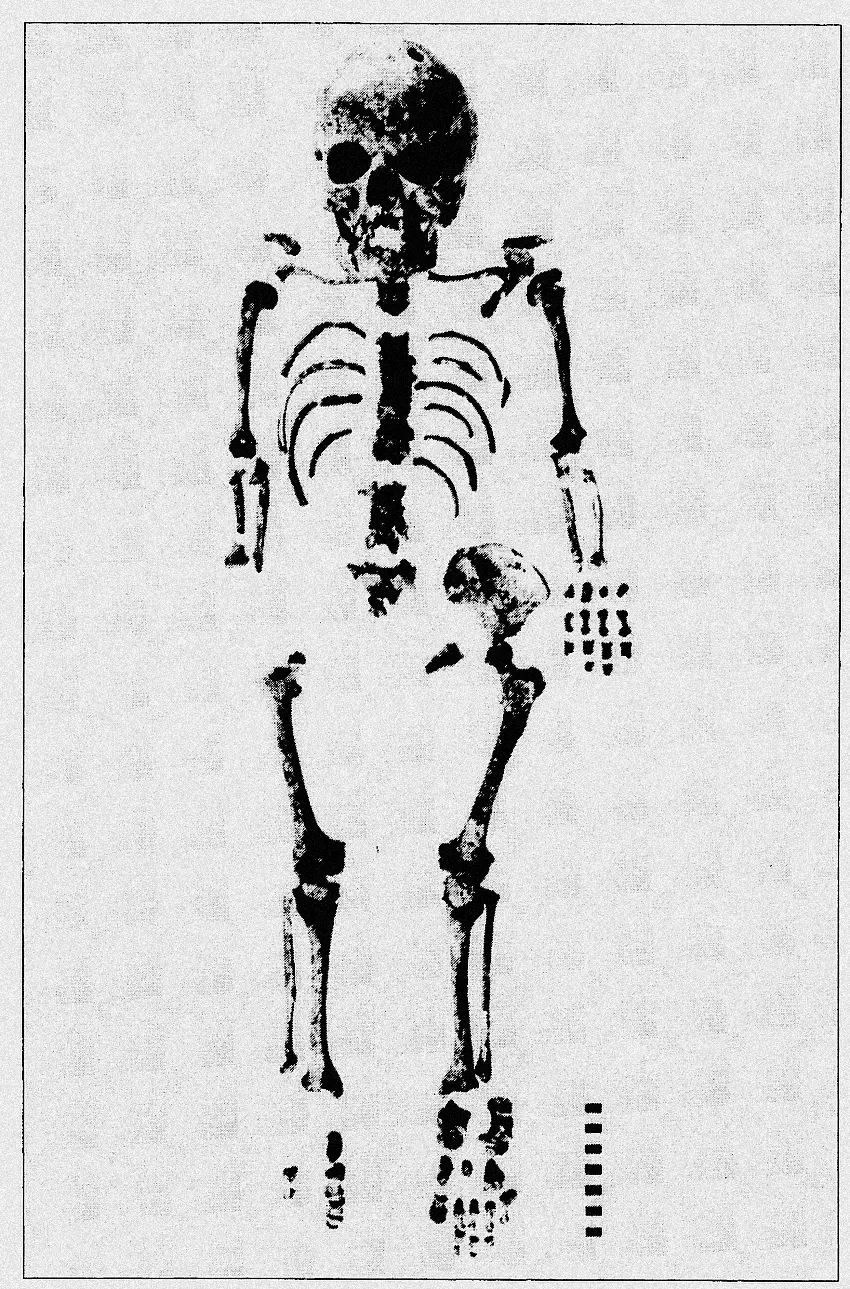
What's interesting about this skeleton is that it's a dwarf. There were some humans back then who were born with diseases, handicaps, or physical deformities. This person is a dwarf. This is interesting because dwarfs aren't able to contribute that much to a hunter-gatherer community. You need to hunt together to get meat to feed everyone. If you're a dwarf, you're not really doing that much. In theory, because it's such a harsh life, you would think that they would discard the dwarf, kill the dwarf, or maybe leave the dwarf behind.
But from DNA analysis, what we know is this: this person had the same amount of food, the same quality of food, as everyone else. Even though this person was not contributing to the community in a physical sense, everyone worked hard to make sure this person was treated well and was fed as well as everyone else. At the end of this person's life, he was granted an elaborate burial.
Let's make the assumption that he was, in fact, contributing to the community. How could he contribute? They clearly thought he was special, but what made him special? If you're a dwarf, you can't hunt. What can you do?
Maybe the religion back then was that everyone is special, everyone's the same. If you're different, it doesn't mean you're less special; it means you're more special. It means that the mother goddess has given you a special power, and maybe this power is to communicate with the spirit world. Maybe the cave paintings were done by people like this, who were in a constant state of meditation with the spirit world, and that's what inspired them. Clearly, if you look at the cave paintings, they were done by a special mind. If you are a dwarf, you clearly see the world in a different way. Being a dwarf makes it more sensible to be a shaman, not only because people think you're special, but because you can invest time into meditation and religious practice that enables you to communicate with the spirit world.
This is a passage from The Dawn of Everything, a fantastic book by David Graeber and David Wengrow, who are both anthropologists.
Neither is Romito an isolated case... When archaeologists undertake balanced appraisals of hunter-gatherer burials from the Palaeolithic, they find high frequencies of health-related disabilities... and high levels of care until the time of death. Sometimes their funerals were remarkably lavish... The best explanation is that at least some of these individuals were valued for their unusual qualities; that they were seen as perhaps in some way special, and treated with a mixture of respect and care.
The people who are buried tend to be the ones who are disabled. They have some form of disease, which makes us think that maybe they're shamans. They were picked to be shamans because hunter-gatherers thought, 'You're different, therefore you must be special, therefore the mother goddess favors you.' They were prioritized by the community and highly valued by the people around them. The best explanation is that they were shamans, people who could access the spirit world and communicate with it.
The Language of the Gods: Symbols in Prehistoric Art
Another amazing thing that we found about Ice Age cave paintings is that they have symbols. A Canadian anthropologist named Genevieve von Petzinger went all around the world and she documented symbols in these Ice Age paintings. She found recurring symbols, for example: the hand, the spiral, the quadrangle, the circle, the asterisk.
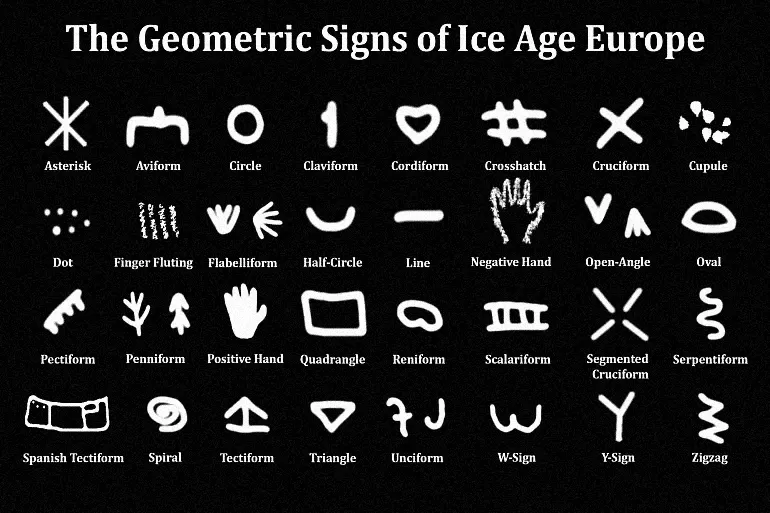
Why would paintings have symbols? Why can't you just draw the thing?
- A Written Language: One possibility is that this is one of the first written languages, which meant that back then they actually had the ability to read and write.
- Mysterious Content: Another idea is to keep the content mysterious. These symbols are secret signs. Where do these secret signs come from? They believe they got the signs from the spirit world. This is the language of the gods, used to give the content a divine, holy, or sacred meaning.
- Representing the Abstract: This can also be a shorthand. There are some things you can't draw, for example: love, energy, repetition, balance, harmony, or a cycle. These things you can't draw, so you have to represent them using symbols.
Let's summarize the possibilities for what symbols in art represent:
- Visualizing an Idea: You can't draw energy or life force, so you use a symbol. This means that each picture is a mythology; it's a story. The pictures aren't trying to show you a picture; they're trying to tell you a story about the world. That's why symbols are important, because in the story there are ideas that you cannot visually express.
- Visualizing the Spirit World: This goes back to making the content mysterious. We think that the way they accessed the spirit world was to use drugs, what we call psychedelics. There are certain plants that, if you consume them, make you see things. The things they saw were, in fact, the symbols, the geometric signs. In other words, they went to the spirit world—or they think they went into the spirit world—and then they were just trying to express the language of that world.
- Creating Sacred Mystery: These symbols are mysterious, and mystery makes things sacred and divine. Back to childbirth: it was something that back then they couldn't understand. Therefore, they had to believe that childbirth is sacred and divine, and therefore women are sacred and divine because only women are able to give birth. For most of human history, we were either egalitarian, meaning men and women were equal, or women had more power than men. Only in recent history do men have more power. Back then, there was no separation of sexes; if anything, women were considered superior to men. Remember, the god is a mother goddess, a female.
Religion, Reality, and the Birth of Society
This brings us to a complicated idea: how we perceive or understand reality. For most of human history, we thought that reality was just reality, and we were just trying to see it. Then along came a philosopher, a very famous philosopher named Immanuel Kant. He is considered the greatest philosopher who ever lived.
His idea is this: reality is not something that we experience or see; reality is something that we imagine, that we create with our mind. The example he uses is time and space. The idea of time—one, two, three, four—does not exist in nature. It's something that our minds made up. Our reality is something that we imagine every day.
What's really interesting is that Kant was writing over 200 years ago. Today, we have a new science called neuroscience, the study of the brain. What's really amazing is that neuroscience has confirmed Kant's ideas. We now know that the brain imagines reality; it projects reality. What drugs do is they change the structure of your brain so that you see a different reality. When they saw a different reality, maybe they were seeing symbols.
So, we have a more complete understanding of why they created art.
- They were trying to visualize their mythology, their understanding of how the world works.
- They were trying to show themselves how reality works—that the underlying reality is a soul or God.
- Most importantly, they were trying to create a common memory and imagination, a language and mythology that they all share together.
This is what we call society.
The argument I'm trying to make to you today is:
- Religion has always been there, since the dawn of humanity.
- Religion allows us to communicate with each other and be together in society.
- Religion is what allows us to be fundamentally human. Without religion, we could not be human. We could not think, we could not communicate, we could not imagine.
Émile Durkheim on the Social Function of Religion
What is religion? This is from Émile Durkheim, who is just as famous as Immanuel Kant. Durkheim is considered the founder of sociology. This is what he says about religion:
Religion is, above all, a system of ideas with which individuals represent to themselves the society of which they are members, and the obscure but intimate relations which they have with it.
Religion is a way for them to understand the world. Let's look at what he says in more detail:
The great service that religions have rendered to thought is to have constructed a first representation of what the relations of kinship between things could be... Given the conditions in which it was tried, that enterprise could obviously lead only to makeshift results. But then, are the results of any such enterprise ever definitive, and must it not be taken up again and again? Furthermore, it was less important to succeed than to dare. What was essential was not to let the mind be dominated by what appears to the senses, but instead to teach the mind to dominate it and to join together what the senses put asunder.
As soon as men became aware that internal connections exist between things, science and philosophy became possible... Religion made a way for them. It is because religion is a social thing that it could play this role. To make men take control of sense impressions and replace them with a new way of imagining the real, a new kind of thought had to be created: collective thought.
Religion is our collective consciousness. It's what allows society to come into being.
Creating a whole world of ideals through which the world of sense realities seems transfigured would require a hyper-excitation of intellectual forces that is only possible in and through society.
It's only because we are together that we are inspired to come up with religion. Religion is fundamental to being human. Without religion, there could be no society. Without society, there could also be no religion. The implication of all this is that as a human, first of all, you are not alone. If you're alone, you're not human. You're a human because you live in society, you're with other people. And because you're with other people, you must have a collective consciousness, an idea you share together. We call this religion.
A World Without Hierarchy
This worldview is very different from modern monotheism (Christianity, Islam, Judaism), which is a very recent innovation. Back then, they wouldn't have a concept of power hierarchy. They wouldn't think that the mother goddess is the greatest god of all. They would think like the stars—there's no hierarchy, they're all over the place. Maybe the mother goddess gives birth to our world, but maybe there's another god that gives birth to another world.
Today, you can think of a pyramid with people at the top. Back then, they would think of it like a river. We're all part of the river; it's a cycle that just goes in circles, and there's no differentiation or power hierarchy. Things go wrong when there's conflict inside this river, when people don't do the things they're supposed to be doing. These things might be incest, or killing animals without making the proper sacrifices. In this world, religion is basically ritual—habits, practices, and actions.
Other Sacred Portals
Besides caves, what are some other portals in the world that have spiritual energy? If you were back then, you would think a place is special because it connects our world and the spirit world. These places would be mountaintops—and Göbekli Tepe was on a mountaintop. Where else? Rivers. These are places that people would think are portals into another world, and therefore they are special. We find that when they settled down and built agricultural communities, they did so on mountaintops and around rivers, but not in caves, because you can't actually live in caves. There's no food, it's cold, it's wet, and there's no oxygen. They lived outside in tents.
Conclusion: The Religious Animal
Today, we think that we are either economic animals or biological animals. The person who introduced the idea that we are economic animals is Karl Marx. His argument is that we are driven by our need to have money. There are other people who believe that we are biological animals, inspired by Charles Darwin. The idea here is that we are motivated by our desire to spread our genes.
The argument I want to make to you today is that no, we are first and foremost a religious animal. We have the fundamental need to understand why we are here. We have a fundamental need to connect with other people.
That does not mean that we are not economic and biological animals. They all play together. You might have a religion, but if this religion is not meeting your economic and biological needs, then you have to either abandon the religion or change it. But we also know that the economic need is not enough; you also need religion. There is an interplay between economics, biology, and religion, and that's what drives human history.