Civilization #33: The Rise and Fall of the Byzantine Empire
We are doing the Byzantine Empire, and I will be looking at three questions.
- The first question is why do we have the Byzantine Empire? Historically, we have seen the Byzantine Empire as a continuation of the Roman Empire. We have the Byzantine Empire because Constantine the Great in 330 transferred the capital of the Roman Empire from Rome to Byzantium, which he called New Rome and which eventually was renamed to Constantinople. So, why did he make that transition? That's the first question.
- The second question is how did the Byzantine Empire rise? It lasted from 330 until 1453, when the Ottoman Turks overran the capital of Constantinople. It lasted for a thousand years. Arguably, it is the most enduring world empire in human history. How was it so successful? That's the second question.
- Now, the third and last question is why did it ultimately decline? Why did it collapse? What were the factors that led to its eventual demise? Those are the three questions we will be looking at.
And what I want to do first, I want to present the scholarly consensus, what is generally accepted, what is generally believed about these three questions. And then I want to present my own perspective in order to refute the scholarly consensus.
The Scholarly Consensus
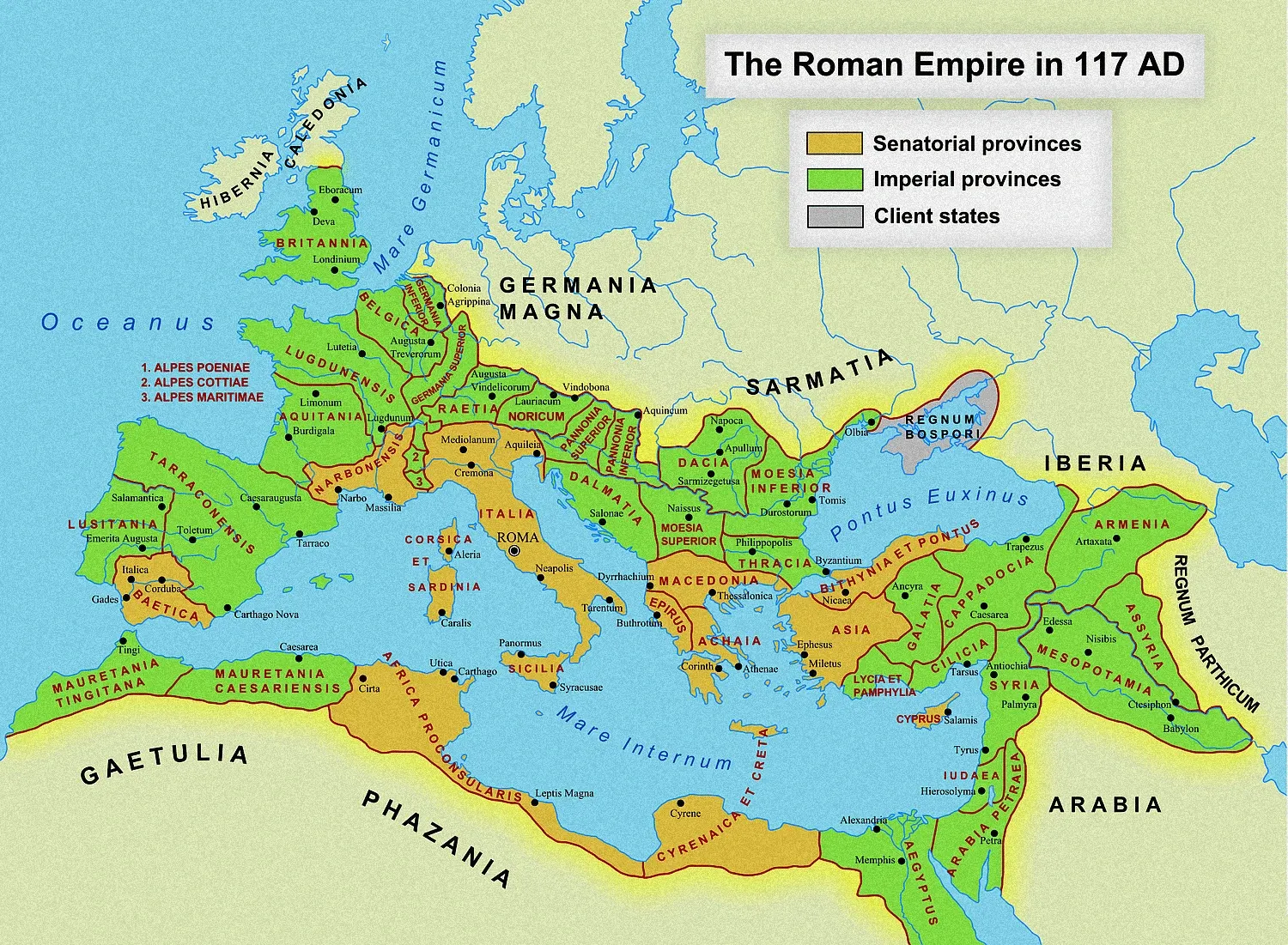
This is the Roman Empire in 117. And as you can see, it is huge. It spans across the Mediterranean. This is Spain. Over here is Anatolia, Egypt, the Levant. It is a huge world empire, and that's the problem. It's just much too big. Unlike China, it has no natural boundaries. And throughout most of its history, it was invaded by barbarians, what the Romans called barbarians, basically these Germanic, Gothic tribes from the north.
It also had a major adversary in the Persian Empire. At this time, they were fighting against the Parthians, but later on they were fighting against what we call the Sasanian Persian Empire. This was not a really sustainable empire. Internally, as we discussed, there was a contradiction. They were an empire, but they believed themselves to be a republic. It was important for them to maintain republican institutions like the Senate, even though it was to the detriment of the management of the empire.
What I mean by that is that throughout this time, on paper, in theory, it was ruled by committee. The Senate was really in command. And as we discussed, the Senate is composed of the Roman aristocracy, the ruling houses of Rome. When you have rule by committee, when power is divided up evenly among the ruling houses of an empire, the only thing they can really agree on is to be corrupt together. And so, the Senate was a huge problem because they basically monopolized wealth. And there was a lot of discontent in the provinces. There was a lot of discontent among the people.
And the Romans tried different solutions to this, but none of the solutions worked. And eventually we had something called the Third Century Crisis, the Crisis of the Third Century, which basically meant the Roman Empire was about to disintegrate. There were civil wars going on. There were these invasions from the north. There was economic collapse. There was a plague. In the third century, it really seemed the Roman Empire was on the brink of complete implosion. Then a military genius by the name of Diocletian reunited the empire, and he recognized we basically needed to change the system. And we needed to make radical changes in order to save the Roman Empire.
As you can see, it is extremely difficult to protect Rome against the barbarian invaders. Over time, eventually the western portion of the empire would be overrun by these barbarians who we call the Germanics, the Goths, the Slavs, the Huns. Basically, these are the successors to the Yamnaya people. And they come from the steppes. And so, they are extremely aggressive, mobile people who would eventually overrun the Roman Empire, and they would establish basically the tribes that would eventually give us the modern states of Germany, Britain, France. Basically, these are the ancestors of Western Europeans.
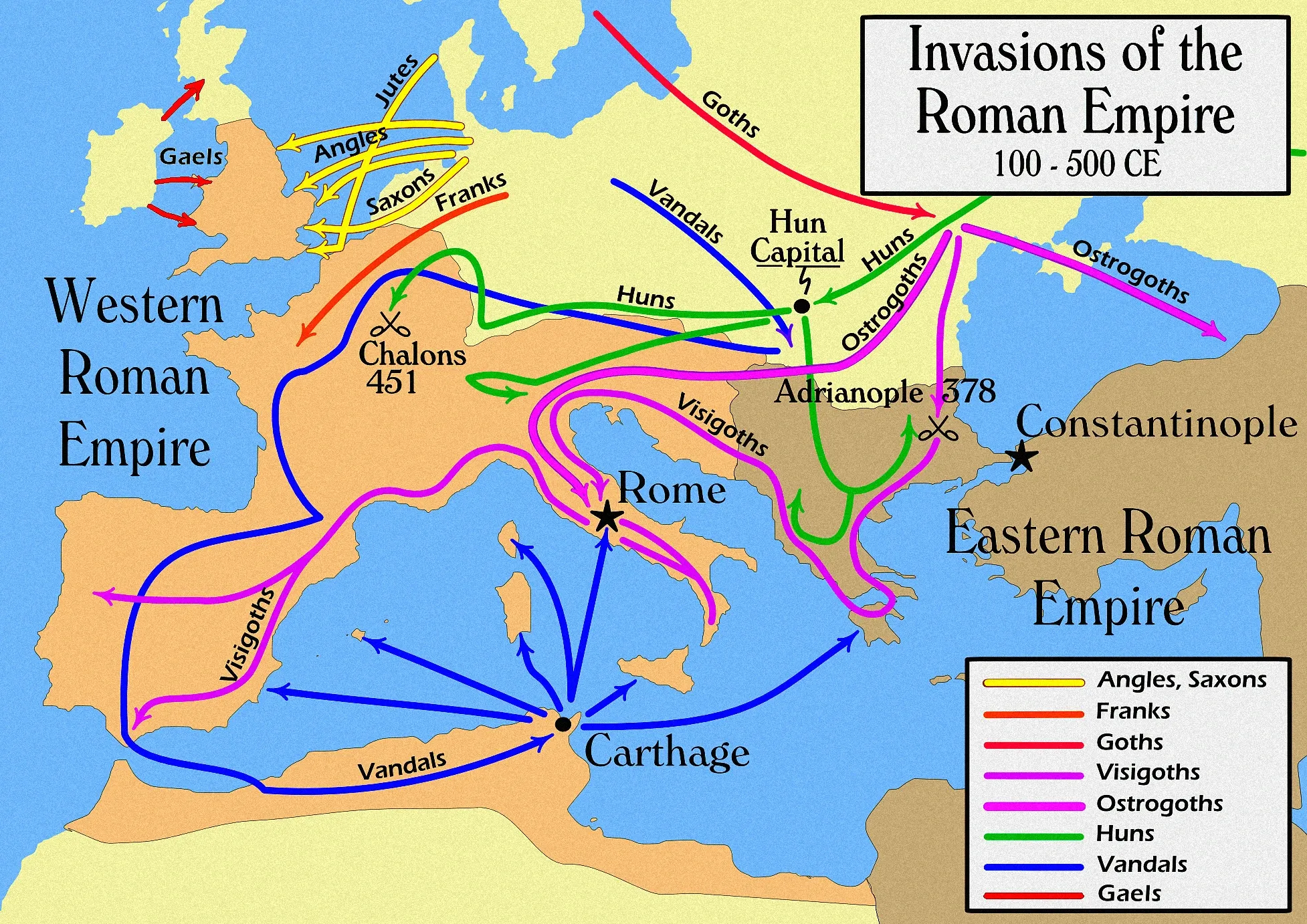
These barbarians would establish their own empires, and all that would be left after about the year 500 is the Eastern Roman Empire, which is the successor to the Roman Empire. And even though they called themselves Romans, and they identified themselves as Romans, historians refer to the Eastern Roman Empire as the Byzantines. They themselves did not call themselves the Byzantines. It's what later historians call them.
The man who makes this transition, who basically is the founder of the Byzantine Empire, his name is Constantine the Great. And what he does that's very important is that he shifts the capital from Rome to Byzantium on the Bosphorus. And today we call this place Constantinople. It's still there, guys, if you want to visit. It's called Istanbul in Turkey, and it's a beautiful city. Definitely one of the most beautiful cities in the world.
The Strategic Decision
The question then is why was this move made? And what modern historians believe is that this was a strategic decision. First of all, Rome was not easily defended. It's very common throughout its history for it to be overrun by a provincial military governor. Think of Julius Caesar, but also there were others as well who did the same thing, who were extremely successful in the provinces, and they took their military and conquered Rome. It was very easy to overrun Rome and then declare oneself emperor. By moving into Constantinople, the capital is now impenetrable. It is impossible to besiege. It is easily defensible. And how so, I will show you later on.
The other thing that's really important about this transition is Constantinople is really at the center of the empire now. Rome was too far to the west, and most of the Roman Empire's most wealthy provinces, the most important provinces like Egypt, Anatolia, and the Levant, were actually in the east. It's a recognition of the fact the center of gravity in the empire was really in the east.
And the third reason is, again, throughout most of its history, Rome's main competitor was the Persian Empire to the east. And so, by moving to Constantinople, it allows the emperor to most easily and most directly respond to the threat of the Persians. This is the scholarly consensus. But as I will show you later on, I disagree with this consensus. I think there was a much more important reason why Constantine made this move.
Christianity and Constantinople
The Byzantine Empire becomes the birthplace of modern Christianity. Constantine the Great is the first Christian Roman emperor. He converts to Christianity. But not only that, but he lays the intellectual basis for modern Christianity through something called the Council of Nicaea. The Council of Nicaea was established to answer a theological debate in the Christian world. What is the nature of Jesus? What is his relationship with God? As we discussed, one of the more popular interpretations, explanations, is the idea of Arianism, where Jesus is a lesser divinity to God. The Council of Nicaea established the idea of the Holy Trinity, which is that God, Jesus, and the Holy Spirit are co-equal. They are separate, but they are co-equal. We call this the Holy Trinity, the Godhead. That was Constantine's major contribution.
After Constantine, one of his successors, Theodosius, makes Christianity the official religion of the Roman Empire. There's now a crackdown on both the idea of paganism, which used to be the religion of the Roman Empire, as well as the idea of heresy, especially the idea of Arianism. He also builds something called the Theodosian Walls, which makes Constantinople basically impenetrable. It makes it an impenetrable fortress and allows Constantinople to stand for a thousand years.
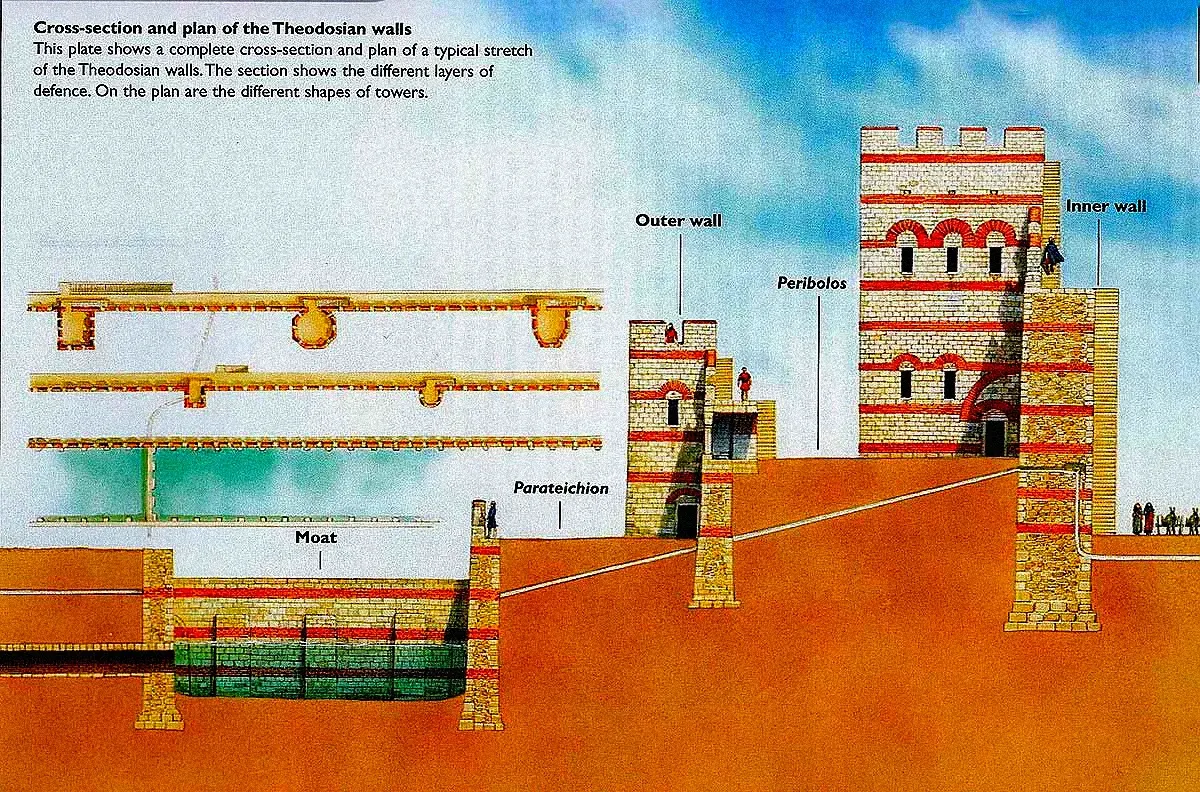
As you can see from the Theodosian Walls, it's huge. This is just a person. You can see that there are two walls. There's a moat protecting it. For a thousand years, these walls protected the city. There weren't that many soldiers within the city. You didn't actually need that many soldiers to protect against invaders. These walls are still standing today. You can actually go, get on a plane, fly to Istanbul and visit these walls. They were basically designed to stand for all of eternity. And that was the idea of Constantinople, the eternal city.
They also had sea walls. Not only could you not attack Constantinople by land, you couldn't even attack it by sea. One of the great inventions of Constantinople is the idea of Greek fire. The story is that they were being attacked by the Muslims. This is in the eighth century when the Muslims are expanding throughout the world. They're conquering both the Sasanian Empire as well as the Roman Empire, and they want to overrun Constantinople. And ultimately, what saves the city is the invention of something called Greek fire, which is basically kerosene. You take kerosene, you throw it at someone, and then the boat is lit on fire.
The story is that this was invented by a Hellenized Jew who converted to Christianity. And he has this great idea, and then he approaches the emperor with this invention. The emperor believes that he is an angel sent by God to save the city. And so, it is impossible to actually launch a naval expedition against Constantinople because they'll just burn down your ships.
Justinian and Belisarius
At the height of the Byzantine Empire, it almost reestablishes, reconstitutes the entire Roman Empire. And this is the year 565. At this point, the emperor is Justinian, and at this point, the one who's leading the military of the Byzantines, his name is Belisarius. And he's considered the last great Roman general. His military genius is on par with that of Julius Caesar, Hannibal, all the great generals. And through his military conquests, the Byzantine Empire is able to expand its influence.
- But as we learn, once you reach a peak of empire, there are problems. The first problem is that your city becomes overpopulated, and when your city becomes overpopulated, it becomes susceptible to the plague. There's something called the Justinian Plague, which wiped out anywhere between 50 to 60% of the entire population of Constantinople. At this point, the population of the city is about 500,000, half a million. The plague killed 300,000 people. That's a lot of people.
Even today, scholars debate where this plague came from. Originally, we believed it came from grain ships from Egypt because Constantinople imports all its food from Egypt. And so, there were rats on these ships, and these rats spread basically the bubonic plague. Now, historians believe that it actually came from the steppes, the Huns, and through their invasion. So, we don't know what happened. We just know it killed a lot of people, and this greatly reduced the power of the empire. - Also, when you have these military conquests, you're overextended. It is very difficult to maintain this empire.
- And the third problem is that whenever there's a military expansion, the emperor comes in conflict with a general. Even though Justinian and Belisarius were great friends, their wives were great friends, they themselves had a lot of personal conflict. In fact, towards the end of his life, Belisarius was actually tried for treason. And there were many times when Belisarius was on a military campaign, and it was clear that Justinian was trying to sabotage him because, obviously, if you're an emperor, you're afraid that your general, your great conquering general, will eventually come back and take your throne.
Because of what happened between Justinian and Belisarius, basically this was the last time that the Byzantines embarked on a massive military campaign. From now on, they're defensive. And also, they focus on the idea of diplomacy, basically bribing their enemies not to attack them, especially the Huns, but also the Arabs as well as the Persian Empire.
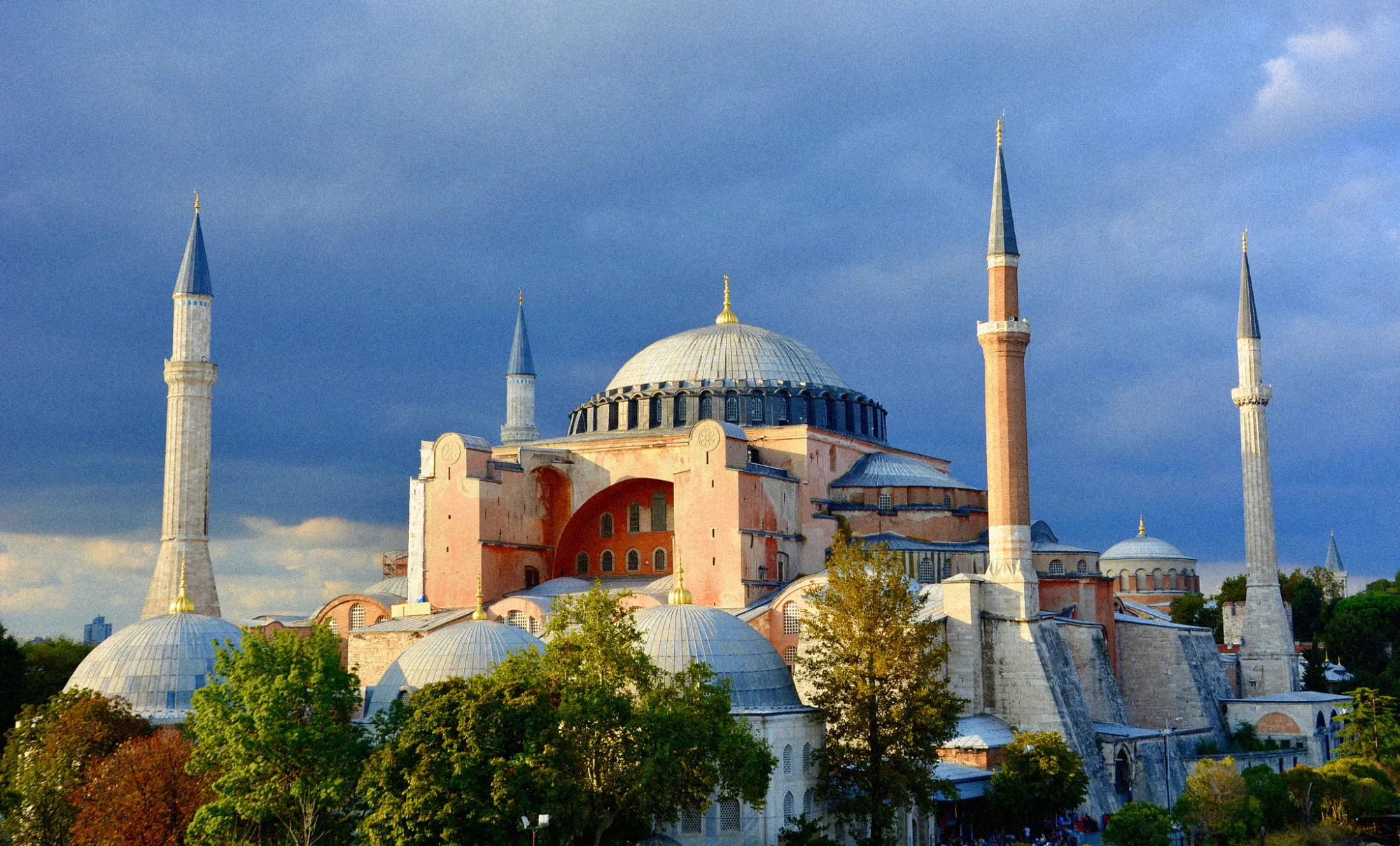
This is the Hagia Sophia, the cathedral to wisdom, and this is the great monument, the great legacy of the Byzantine Empire. It's absolutely beautiful. Again, guys, this is what's amazing. It's still there. You can actually get on a plane, go to Istanbul, and visit this place. It's absolutely gorgeous. Definitely worth visiting.
The Fall of Constantinople
Now, why did Constantinople fall? What happened was that, again, even though Constantinople itself is impenetrable, it's invincible, it's still an empire. And so, its regions were eventually overrun by greater enemies. For example, in about the year 1450, and this is three years before the eventual fall of the city, the Ottoman Empire is basically taking over the Byzantines. And the only city left standing is Constantinople. You can see over here are the Ottomans. Over here is the Ottomans.
The Ottomans were able to conquer the city because of the invention of siege engines. These cannons are as big as houses, and they basically overwhelm the walls and allow the Ottomans to overrun the city. Now, what's important to understand is even though the Byzantines were Christian, and the Ottomans were Muslim, and even though the Turks overran the city, the Turks were extremely respectful to the citizens of the city because they were considered the heirs, the successors to the Roman Empire. And this was the center of what we call the Orthodox Church. So, the citizens were treated extremely well.
Let's talk lastly about the significance and power of the city. The city was the center of the world for hundreds of years, both intellectually, because, again, it was the heir to not just the Roman Empire but also to Greek civilization. It was also, in terms of trade, the capital of the world because it was a meeting place of both the Aegean, which leads to the Mediterranean, as well as the Black Sea, which leads into what is Russia today. If you wanted to go anywhere, you basically had to go through Constantinople. It was really the center of the world, and through trade and taxing trade, the city became extremely wealthy.
Also, because it was the center of the world, it was very multicultural, very cosmopolitan. You had basically all major ethnicities living inside the city. Jews, Christians, Muslims were all treated with extreme tolerance. They basically had their own quarters within the city. As you can see, at its height the city was extremely beautiful and very wealthy. It was really for 400 years the capital of the world, the capital of the universe, basically.
As you can see, it is almost impossible to besiege. You can never cut it off from supplies. You can never isolate the city because it is the meeting place of so many rivers. This is the Bosphorus. That is the Roman Empire. This is, again, what we know about it.
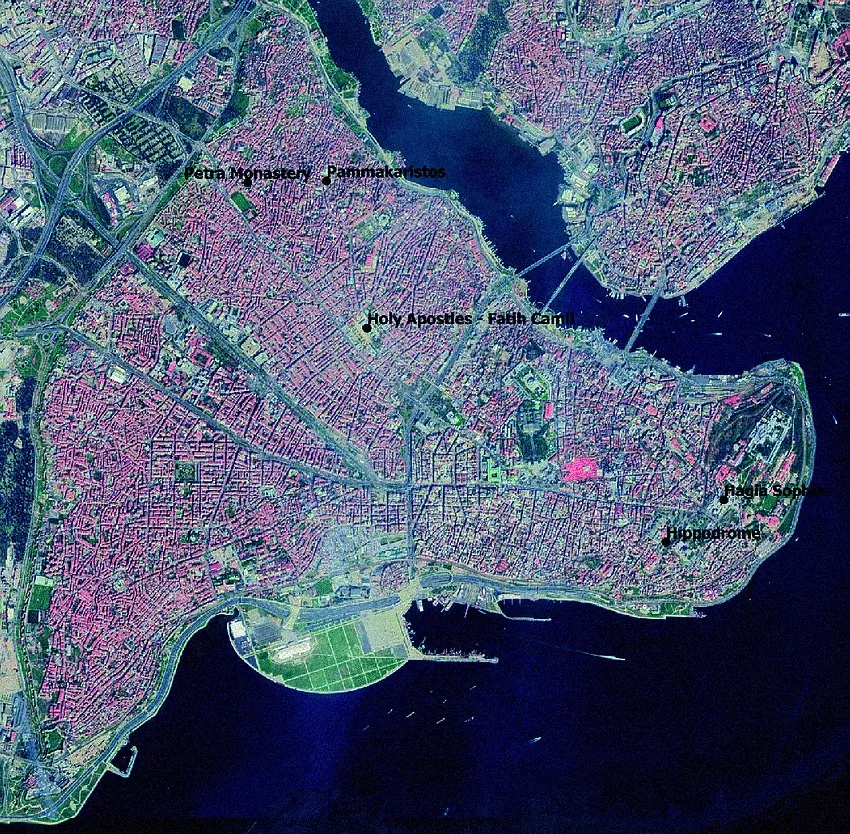
A New Perspective: The Cultural Revolution
And now I'm going to explain my theory to these three questions. Why did Constantine make the move from Rome to Byzantium? Why did it rise? Why did it decline? But before I start with my explanation, are there any questions about what I just presented? This is all pretty basic stuff. This is stuff you can find on the internet, on Wikipedia. You can ask ChatGPT, they'll probably give you the same answers.
Was There a Cultural Pull Toward Greek Culture?
"Maybe this is something you're coming up to, so if it is, shoot the question down. But I remember reading in the early years of the Roman Empire, Augustus, Tiberius, so on, the elite culture there was Greek. And so, the Emperor Claudius would have been writing and conversing in Greek and all that kind of stuff. I know the move to Constantinople is a couple of hundred years after. But was there a certain cultural pull at the time? Were certain Roman elites feeling like they needed to be closer to the core Greek culture?"
That's a good question. Culturally, were the Romans at this time Greek or Roman? And you're actually right in that Greek culture is really the hegemon. It's so much superior to Roman culture. Romans really were peasants who built an empire. But the Greeks basically built Western civilization. You had Homer, you had Plato, you had Herodotus. The Romans were aware of this. And this was a conflict within Roman culture, civilization, for a long, long time because they felt that even though they had conquered the world, they were about to be conquered culturally by the Greeks.
The Romans were aware of this, and they rebelled against this. Augustus Caesar sponsors the writing of the Aeneid in response to the hegemony of Greek culture. Even though you're right in that most of the Roman aristocracy embraced Greek culture, such as Mark Antony, Mark Antony saw himself as more Greek than Roman, there was a lot of pushback from the empire against this. But eventually, as we'll see, eventually Greek culture does triumph. Let me explain how.
The Move from Rome to Byzantium
The first question I want to look at is why did Constantine make the move from Rome to Byzantium? Let me give you some background. During the time of Augustus, we today see him as the first Roman emperor. But he did not himself see himself as the first emperor. He just saw himself as just a citizen of Rome. He calls himself a princeps. And this is where we get the modern English word prince as well as principal, high school principal. And it just means first citizen.
Again, the problem with Rome is that you had the aristocracy through the Senate monopolize all wealth and power. And this led to a lot of contradictions and conflicts within the Roman Empire. And so, the solution that Augustus proposed is make the princeps, make me the CEO. It's still rule by committee, but I'll be the coordinator. I'll be the CEO. And the idea here was even though this was not a great system, it did preserve the culture, the history, the legacy, and the traditions of the Roman people. And that was what was important, to protect and preserve the culture, especially the idea of libertas. Liberty.
But this system didn't really work. You had these civil wars, you had a lot of provincial riots, rebellions. This system simply didn't work, and this led to what we call the Crisis of the Third Century, when basically the Roman Empire was about to collapse. And again, as we said, a commander named Diocletian saved the Roman Empire by reuniting it. And at this point, he's like, "This system doesn't work. What we need to do is study the Persian Empire. Because even though we don't like the Persians, their empire seems a lot more sustainable and continuous than our empire."
This started a period of what we call the Dominate. Basically, the idea of starting an imperial bureaucracy, centralizing power with the emperor through the bureaucracy. And the Romans hated this idea. What emperors discovered is this cultural shift was what the Romans just found actually disgusting. Go back to the assassination of Julius Caesar. The Romans were extremely culturally arrogant. Why did they assassinate Julius Caesar? And the people who assassinated Julius Caesar were his best friends. In fact, we believe Marcus Brutus, who was one of the lead conspirators, was actually his biological son. Why? Because Julius Caesar was threatening the cultural traditions of Rome. They were afraid that Julius Caesar would become king.
What these emperors, first under Diocletian but especially under Constantine, discovered is it's really hard to change culture. And there's really one solution to this problem. To understand this, let's run a thought experiment so you understand the persistence of culture.
We're at a school, and this school is known for being innovative. It's known for being student-centered. It focuses a lot on activities and extracurriculars. And that's great. I'm very supportive of this. But let's just say that the school brings me in as a consultant and asks me to help improve the school. And I spend months interviewing students and teachers. I feel the school is great in terms of innovation, but it needs to focus more on academics. Kids need to read more. Kids need to focus more on test scores. And then you have a perfect balance. And that's my solution.
Well, I'm pretty sure if I tried that, I'd be fired within a week. And the reason why is I am attacking your cultural traditions. I'm attacking your identity, your sense of self. So, if I want to implement my vision, I can't force my vision on you. The only thing I can really do is switch schools and build my own school. And this is a pretty persistent thing throughout the world.
That's why Constantine made the move to Byzantium. He recognized that if I'm going to build an empire, and Rome needs to be an empire if it is to endure, I need to switch cultures. And the best way to switch culture is by moving your capital from Rome to Byzantium. And when he did that, the entire culture shifted.
The Cultural Shift
Let me very quickly explain the cultural shift. In Rome, it was pagan. By the way, pagan is not the word that they used. Pagan is the word that Christians used to insult them, basically. But for the sake of convenience, we'll use the word pagan. That was their religion. They were Roman, meaning that they had a distinct cultural identity. And lastly, they were a republic, meaning they were run by the Senate, basically. Not just the Senate, but by tradition and by custom.
By Constantinople, the Byzantine Empire was completely different. First of all, it was Christian. And the pagan and Christian worldviews are in conflict with each other. This is a major shift. Second is they were multicultural. In the time of Rome, the time of Augustus, there's a major conflict, major debate between Roman culture and Greek culture. But when they switched over to Constantinople, they completely embraced Greek culture. In fact, the language switched from being Roman to Greek. They spoke Greek. And they embraced Greek culture. Herodotus, Plato were major thinkers that the Byzantine Empire embraced and celebrated.
And lastly, it switched from a republic, meaning that it went from being run by the Senate, to an empire, which basically meant it was being run by a bureaucracy.
The Byzantine Empire is a very distinct entity from the Roman Empire. Historians today argue the Byzantine Empire is a continuation of the Roman Empire, but that's only a superficial and shallow understanding. Culturally, the Byzantine Empire was a radical departure from the Roman Empire or the Roman Republic. And so, I will explain what these differences are. And this is very important because it's going to inform our understanding of future events in Western civilization.
Pagan and Christian Worldviews
Let me first explain the difference in worldview between the pagan and the Christian. And again, guys, I will have to make a lot of generalizations, but it's a useful framework for the understanding of ancient cultures. What's the pagan worldview?
- Well, in the pagan worldview, there are different layers to your understanding of the world. The supernatural forces that you interact with intimately are the gods. And the gods are really a metaphorical way to understand nature. In nature, there are all these natural forces that we can't really see. For example, the wind. We can't really see the wind, but also we can't really see creativity or luck. In the pagan worldview, these hidden, invisible forces are rendered and expressed as gods.
And the gods are those that we interact with every day on an intimate basis. It was very important for us to maintain good relations with the gods by making ritual tributes to the gods. Sacrifice and rituals were a very important part of the pagan worldview. - Above the gods are actually even higher invisible forces that no one has control of, which includes fate, which includes luck, fortune. But there are these invisible forces that even the gods must submit to.
- And then at the highest level are what are called unwritten and immutable, immutable just means unable to change, eternal laws of the universe. Think of this structure as giving the universe some order and structure. Think of gravity. It's an unwritten, immutable law of the universe. And what they really mean by this is the idea of karma or justice. If you do good in the world, good will happen to you. If you do evil in the world, evil will happen to you. It may not happen to you, but it may happen to your children. So, there is a cosmic balance to the world. And this is really the pagan worldview.
The Christian worldview is very simple. There's you. You, and then there's God. And the thing that matters is your personal relationship with God. That's it, guys.
Let's look at the three major differences between the pagan worldview and the Christian worldview. And again, this is a generalized, simplified version, and we use it in order to be clear about the differences and that there are, in fact, differences.
The three major differences are this. The Christian worldview introduces into the Roman world three ideas that really didn't exist before. They are truth, evil, and the individual. Now, these ideas actually existed in other traditions, like the Jewish tradition and the Persian tradition through Zoroastrianism, but they really didn't exist in the Greek and the Roman tradition.
The counterpart to truth in the pagan tradition is the idea of chaos or luck. There's no structure to the universe. In the Christian worldview, there's a God who has designed the universe, and that is the truth. The intention of God is the truth. The plan is the truth. Whereas in the pagan worldview, there's no design, guys. It's just complete random chaos, and you just have to try your best in this world.
In the Christian worldview, it's the idea of evil, which is if you go against the intention of God, if you commit sin, that is evil. Now, what's interesting for us is in the pagan worldview, the opposite idea is action. In other words, in the world of chaos, you have to act. You have to do stuff. If you refuse to act, you are a slave.
Think back to the Iliad. In the Iliad, Achilles says why he is in Troy, why he's fighting in Troy. And he says that before he came to Troy, he was told his fate. He could either die old back at home, or he could die young in Troy. But by dying young in Troy, he'd become famous. He'd be remembered forever. And for Achilles, that's not really a choice. What he's being told is, "You must come to Troy, and you must die, and that will win you eternal glory." It's the idea of action.
Also, think of the Romans. In their legends, they have a man named Mucius. Remember at the beginning of the Roman Republic, the Romans are besieged by the Etruscan king. And Mucius is a young Roman man, only twenty years old. He decides to assassinate the king in order to free the Romans. He swims across the Tiber, and he's about to do his deed, but it's payday, and the king is with his secretary. And they look alike. They dress alike, they look alike. And Mucius is hiding with his dagger, and he knows it's fifty-fifty.
Now, for us, we'd be like, "You know what? Fifty-fifty is terrible odds. So, let me come back another day, or let me be more patient." But for Mucius, it's fortune favors the bold. He's like, "Fifty-fifty is great odds. I'm never getting better odds." So, he takes his dagger, and he kills the secretary. He misses. Then he's captured by the king, and the king wants to torture him and force him to confess. And the king starts interrogating him and says, "I will burn you alive." There's a great fire beside Mucius. "If you do not tell me the truth."
And what Mucius does is he puts his hand into the fire and lets it burn in front of the king. And that scares the king. That's the idea of action. You make your fortune through your action. You cannot sit and wait. You cannot deliberate. You cannot be clever. You just act. You're just brave. That's a pagan worldview. This is important for us because the people who will feature in our course, who are very important and who follow this worldview, are also the Vikings. The Vikings share this similar worldview. It's a pagan worldview.
The last thing is the idea, in the Christian worldview, it's the individual that matters. The individual soul is what matters. But in the pagan worldview, what matters is the community. Why is Achilles fighting in Troy? Why is Mucius sacrificing himself for Rome? Because they want to be remembered by the community.
Let me give you two examples of this. Let's go back to the Iliad. Hector. Remember Hector? Hector in the Iliad, he is the greatest Trojan warrior, and he's destroying the Greeks because Achilles refuses to fight. But then Achilles enters the battlefield, and at this point Hector's lieutenant tells him, "Hector, Achilles is back. Let's go home. Let's go hide behind the walls of Troy. We'll be fine."
But Hector says, "No. Fortune favors the bold. The gods are with me." And so, of course, Achilles and the Greeks destroy the Trojans. And they're all forced to run back to the walls of Troy. Every Trojan enters Troy except for Hector. Hector stays outside the walls of Troy and waits for Achilles to come. He knows for a fact that Achilles will kill him. Achilles is a god. He's a great warrior, but he's not a god. And at this point he knows he's about to be killed. And most of us would just sneak back into the walls of Troy. He can't do that because he's afraid of being laughed at by his lieutenant. He's afraid of shame. He has to die for his community. That's Hector.
But also think about Lucretia. Lucretia, remember, is the noblewoman who is raped by the son of Tarquinius Superbus, the last king of Rome. And this is what starts the rebellion that overthrew the Roman monarchy. Lucretia is raped, and then she kills herself because she's dishonored. And Augustine, remember Augustine in City of God, he writes about this. And from his perspective, it was a crime for Lucretia to kill herself. Why? Because we are all the creation of God. Therefore, we are the property of God. Therefore, when we kill ourselves, we're committing a sin against God. We are basically stealing from God. And that's why if you commit suicide, you'll be condemned to hell forever. You'll be condemned to damnation forever.
And then Augustine explains Lucretia killed herself because she's afraid of the shame that she would have to endure if she lived. She was afraid that she'd be laughed at by the other women of Rome. And that's the idea of community versus the individual.
Sex, Violence, and Perspective
It's a radically different worldview, the pagan versus the Christian. Let me explain some other differences. For example, the attitude towards sex. Christians, because we live in a Christian world, we know that sex is bad. Sex should only happen between husband and wife, and it should only happen for the purpose of procreation. We shouldn't do it because we enjoy it.
The pagans had the complete opposite attitude towards sex. Sex was to be embraced. It was to be enjoyed. It was to be celebrated. Why? Because if the gods didn't mean for us to have sex, they wouldn't make it so much fun. Sex was a very important part of pagan life. As well as violence. They also embraced and celebrated violence. Think about the Vikings. Think about the Romans. They loved violence. And the Christians hated violence.
The argument is that the Christian worldview is an improvement on the pagan worldview because the pagans had things like orgies. They had things like child sacrifice. They had things like genocide. This is all bad. But remember, and this is really important. These are just two different worldviews. And it's hard for us to objectively assess which one is better. We can only say that they both have their benefits and they both have their consequences.
An example is food. If we were to go to America today and look at the food that Americans eat, we'd be disgusted. Hamburgers, Coca-Cola, french fries. But guess what, guys? If Americans were to come to China, they would be equally disgusted by the food that Chinese eat. Like malatang and this stuff. Some of this stuff is really bad for you. So, I would keep that in mind. It's easy for us to be culturally arrogant and say we are so much better than these ancients. But it's all a matter of perspective.
If we were to go back in time and look at the pagan world, we'd be disgusted by the murders, by the violence, by all the sex going on. But at the same time, and this is really hard for us to understand, if they were to time travel and come here and see our world, they'd be disgusted. Because from their perspective, we behave like slaves. Achilles is out winning glory on the beaches of Troy, while we are in school memorizing useless facts so that we can get useless pieces of paper so that we can make useless pieces of money. Money is paper. They would not understand why we're doing this to ourselves.
I would keep that in mind. The pagan worldview is very different from the Christian worldview, and that's it. And in fact, we will later discover that there are some thinkers, such as Nietzsche, Friedrich Nietzsche, who believe that the switch from the pagan worldview to the Christian worldview was a major setback in the development of civilization.
Republic and Empire
Now, let's move on to the idea of republic versus empire. The differences are pretty stark. In a republic, there's usually egalitarianism. Everyone's opinion does matter. And in an empire, there's a hierarchy. That's the first major difference. In a republic, people are egalitarian. And in an empire, there's a hierarchy.
Think of this. In the Persian Empire, if you were to meet the emperor, what you had to do was prostrate yourself first and then kiss his feet. That's the idea of empire. But in a republic, you didn't do that. In fact, even though Rome was becoming a wealthier city, a major tradition in Rome was you didn't lock your doors. You didn't have guards. A senator who was in charge of Gaul, he could literally put loads of people to death if he wanted to, he didn't lock his door. So, you, the lowliest Roman, could just walk into his house and have tea with him or coffee with him and talk about life. That was the tradition in Rome.
There's also another thing. When Roman senators walked the streets of Rome, they always carried an umbrella to protect themselves. And the reason why is this. Roman houses were two stories. And they didn't have a sewage system. If you needed to go to the bathroom, you did so using a bucket on the second floor. And so, what happened is if you saw someone you didn't like walk the streets, you would actually take your bucket and throw all this at him. That's literally what they did. If you were a senator, you could be the most powerful man in the world, but you could still literally risk having this thrown at you. That's the Roman world. It was egalitarian. Whereas in an empire, there's hierarchy.
- In an egalitarian world, it means there's openness. People are open to new ideas. There's debate. Literally anyone could propose a new idea. Whereas in the empire, it was a very closed system. They didn't like new ideas. Go back to the example of Greek fire. A guy, and it's a story, so we don't know if it's true, but a guy had to go to the emperor and get his approval before the military could adopt it. That's really inefficient, guys. The Greeks would have just gone and done it. The Romans would have let the commanders make their own decisions. It would not have been the decision of the Senate. It would have been the decision of the military commander that was appointed by the Senate.
The republic would be much more innovative than the empire because the republic would be much more open. There'd be a lot more diversity in a republic. And in an empire, things would be much more conformist. You would have a lot more creativity, a lot more diversity within a republic than within an empire.
And that's kind of intuitive because if you think about it, an empire has so many more people and so much more wealth and resources than a republic. But historically, we found that republics and democracies are much more innovative and creative than empires. The reason has to do with the idea of a bureaucracy.
Bureaucracy
Something that a democracy or a republic does not have is the idea of an imperial bureaucracy. They have bureaucracies, but they're not that big and they're not imperial. Let's talk about bureaucracy. And this is a very important idea that I want you guys to remember because we will refer to this idea.
- Now, in the beginning, bureaucracies are good for empires because what they do is they do centralization. They're able to centralize the empire. Unite the empire, basically.
- Something that they do that's important is the idea of systematization. Basically keep records, create laws. Systematization.
- The last is the idea of standardization. Standardization. Uniformity. Getting people to speak the same language, getting people to use the metric system, getting people to use money.
And this creates tremendous wealth within the empire in the early years because, again, what you have is you have the creation of money, because you have a legal system, and you have a monopoly on violence. Monopoly on violence just means that these neighbors don't fight anymore because there's a police. There are these courts. They can just sue each other. There's a legal system, and people are now using money. This leads to contracts, and this leads to trade and increased economic activity. You have peace and prosperity. People feel safe. People feel that life is predictable, so they do more. They work harder. And this leads, in the early stages of empire, to tremendous prosperity.
- But over time, what will happen is this bureaucracy will ossify, meaning the people within the bureaucracy will think of how to use the bureaucracy for their own personal benefit. We can say this is corruption. Centralization leads to corruption, where it's just a minority of people with all the power who use it for their own personal benefit. They're basically parasites. The technical word we use for this is rent-seeking. Rent-seeking. Think of landlords who charge rent to the tenants. Well, if it's a monopoly, they can charge as much as they want. There's nothing you can do about it. It's what we call rent-seeking. Centralization eventually leads to corruption.
- Systematization leads to ultimately stagnation. There's nothing new going on.
- And centralization leads to the idea of conformity or homogenization, where everything becomes the same, where everything is bland.
How Bureaucracy Triumphs
Why does this happen? The bureaucracy is only an institution among different institutions. Think about this. You have the imperial bureaucracy, but they are competing against the court system, which is basically the emperor. And the court is usually controlled by eunuchs. These are servants of the emperor. The bureaucracy is up against the court. It's also up against the nobility, the traditional power of society. It's also up against the military. It's also up against the church. There are different institutions that can counter the bureaucracy. But over time, in times of peace and prosperity, if things are really stable, eventually the bureaucracy triumphs over all these other institutions.
- And the reason why is this. First is the bureaucracy can monopolize status and mobility. If you're just an ordinary person, well, the best way to rise in a society is through the bureaucracy. This is certainly true in China, where everyone wants to be a bureaucrat because that's seen as the mechanism of achieving social status as well as social mobility.
- Also, bureaucracies monopolize information. It controls what information flows into the system. It controls what the emperor sees. We can say this is about censorship and secrecy.
- And the last thing that it does is it monopolizes the idea of narrative. It controls the production of culture. And it does this mainly through the process of writing history. Remember, history is the creation of a cultural narrative to bind people together. It's usually the imperial bureaucrats who do this.
In other words, what's important for us to understand is the bureaucrats have a monopoly on literacy and knowledge. They control the schools. They control the media. They control history writing. They control how you think and write. Even though there are competing institutions, the bureaucracy, by controlling this meta-reality that's culture, it controls the way these other institutions behave.
The Godhead
The example I want to use is the idea of the Godhead. The Godhead. My argument to you is the Godhead is really a bureaucratic invention. Because remember, during the Council of Nicaea, there's a debate as to the nature of Jesus. There are these Arians who believe that Jesus was a lesser divinity. Then there were people who believed in modalism, who just believed the Holy Spirit, Jesus, and God were different forms of the same entity. Then you have partialism, which would say that they are part of the same entity. And these three different explanations make sense. They make intuitive sense.
The idea of the Godhead, where God, Jesus, and the Holy Spirit are co-equal, separate, but the same thing, makes no sense. And the reason why they would do this is to create a sense of mystery. And distance. And secrecy. And that, my friends, is the definition of a bureaucracy.
I'm not sure if you've dealt with bureaucracies. I have. They suck. They dehumanize you. I'll just use a silly example. In America, there's something called a census, and on the census, you have to write down what racial group you belong to. And the racial group I belong to, if I were American, is Asian American. Guess who else belongs in that group? Indian people. Vietnamese people. Japanese people. Korean people. That makes no sense.
We know that in Asia, the Indian culture is vastly different from the Japanese culture, which is vastly different from the Korean culture and the Chinese culture and the Vietnamese culture. These are different people with their own belief systems. But in a bureaucracy, it just categorizes everyone together almost randomly or indifferently.
Tribal and Multicultural Societies
And that's why I will make the argument that ultimately multicultural societies are not as creative as tribal societies. Tribal versus multicultural. Think about the multicultural societies that are around us today. Singapore is a multicultural society. Canada is a multicultural society. They're not very creative, guys. They're very bland. They're very conformist. They're very bureaucratic.
Very tribal societies like the Greeks. The Greeks were extremely tribal. They were extremely chauvinistic. They were extremely creative. As were the Europeans. As were the Vikings. And the reason why is tribalism is energetic. It makes you passionate. It makes you think deeply about the world. Whereas in a multicultural society, people have to spend their energies getting along with each other. It's important not to be offensive.
It's because of these three reasons, that certain cultural construct of the Byzantine Empire—it was Christian, it was multicultural, the word we can also use is cosmopolitan; also, it was bureaucratic—that the Byzantines were not a very creative people. Even though they had access to every culture in the world, even though they had access to the classics like Plato, Homer, Herodotus, as well as Virgil, they were not that creative. In fact, if you had a genius like Homer or Dante living in the Byzantine Empire, well, he would just become a bureaucrat. We would never know the genius of Homer and Dante. Homer and Dante could only arise in tribal societies.
Again, this is an introduction to the conflict between these political systems. Empire versus republic. It's really important that you understand the difference between paganism and Christianity because we'll be referring to this conflict, this division, as well. Please feel free to argue because when you do that, it helps me improve my own thinking.
Rome's Continuing Legacy
As I explained to you, the Western Roman Empire would collapse in the year 476 when the last emperor, Romulus Augustulus, is deposed. But when he is deposed, people don't understand the Roman Empire has come to an end. Because the people who are still in charge think the Roman Empire is continuing. But now we have a long period of civil wars throughout Europe. And these civil wars would eventually lead to something called the Holy Roman Empire, which is what Charlemagne of the Franks would create. And this would lead, interestingly for us, to the rise of the Vikings.
Now, Vikings are important because they would go on and basically influence British culture as well as Russian culture. Russia comes from the idea of the Rus'. Now, Rus' are basically just Vikings. Over here we would see the beginning of the Abbasid Caliphate, which is really the golden age of the Muslims. But eventually they'd be conquered by the Mongols. And the conquest of the Mongols would eventually take us into the Renaissance, Dante. And this would mark a new beginning in world history.