Civilization #4: The Paradise Lost of Marija Gimbutas
The story so far is that 200,000 years ago, we humans, Homo sapiens, were born in Africa. Then about 50,000 years ago, because of climate change, we started to spread around the world. We went into Europe, then into Asia, then we crossed the Bering Strait into North America, then South America, and then from Asia, we went to Australia. 50,000 years ago, there were about a million of us all around the world.
The argument that I'm making, that I made to you, is that from the very beginning, we were religious. We know from the Ice Age cave paintings, we know because of places like Göbekli Tepe and Çatalhöyük, that we had a religious belief that told us who we are and what we're doing here. This religious belief is animistic, meaning we believe that we all come from one source: the mother goddess. We are all the children of the mother goddess, including animals, plants.
Because of this, we were a very compassionate people that were egalitarian. There was no difference between men and women. We were peaceful. We were violent, there was some violence, but we didn't really fight wars. We were artistic. We celebrated the mother goddess through paintings and through artwork.
If we were like this for most of human history, how is it that today we have war, private property and patriarchy, where men make all the rules and women have little agency and power? I will explain to you how this happened. We will discuss really the height of this civilization, and this is what the anthropologist Marija Gimbutas called Old Europe.
The Proto-Indo-European Puzzle
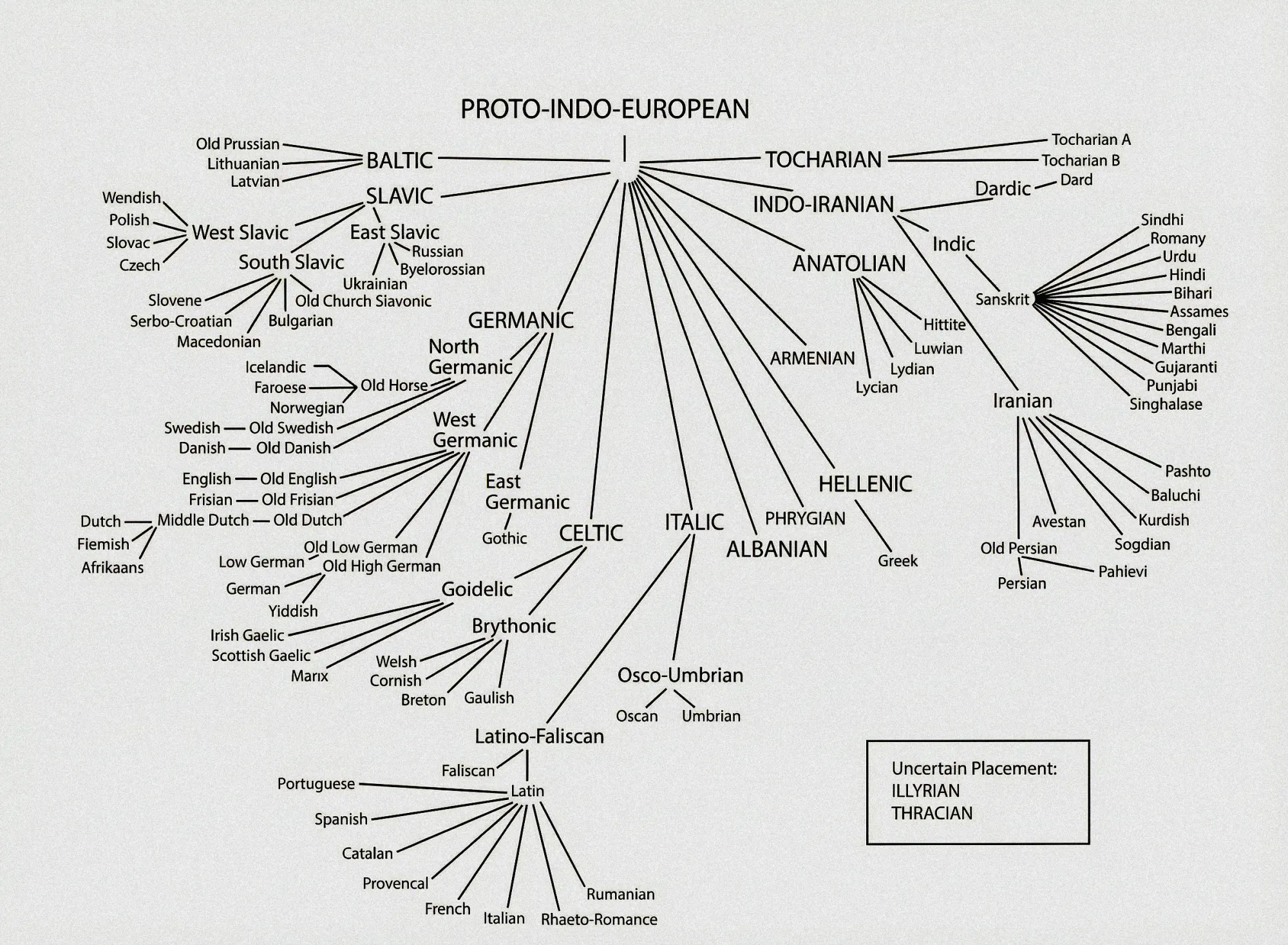
To begin the story, I want to tell you what we've discovered in terms of linguistics. For many hundreds of years, many people have speculated that maybe English, German, Greek, Latin all came from the same language that's been lost to us. This is a language we call Proto-Indo-European. Through decades of strenuous research, linguists have been able to conclusively prove that all these languages that we speak in Europe all come from the same mother language, the first language. But not only that, but also Iranian and Indian, Hindi, all come from Proto-Indo-European.
We know this because there are many words that sound the same in many languages. For example, father in English is father, but in Latin, it's pater. That's where we get the word paternity, from the father. Greek, patér; Persian, pedar; Hindi in India, pitr. The word father seems to come from just one word in all these different languages.
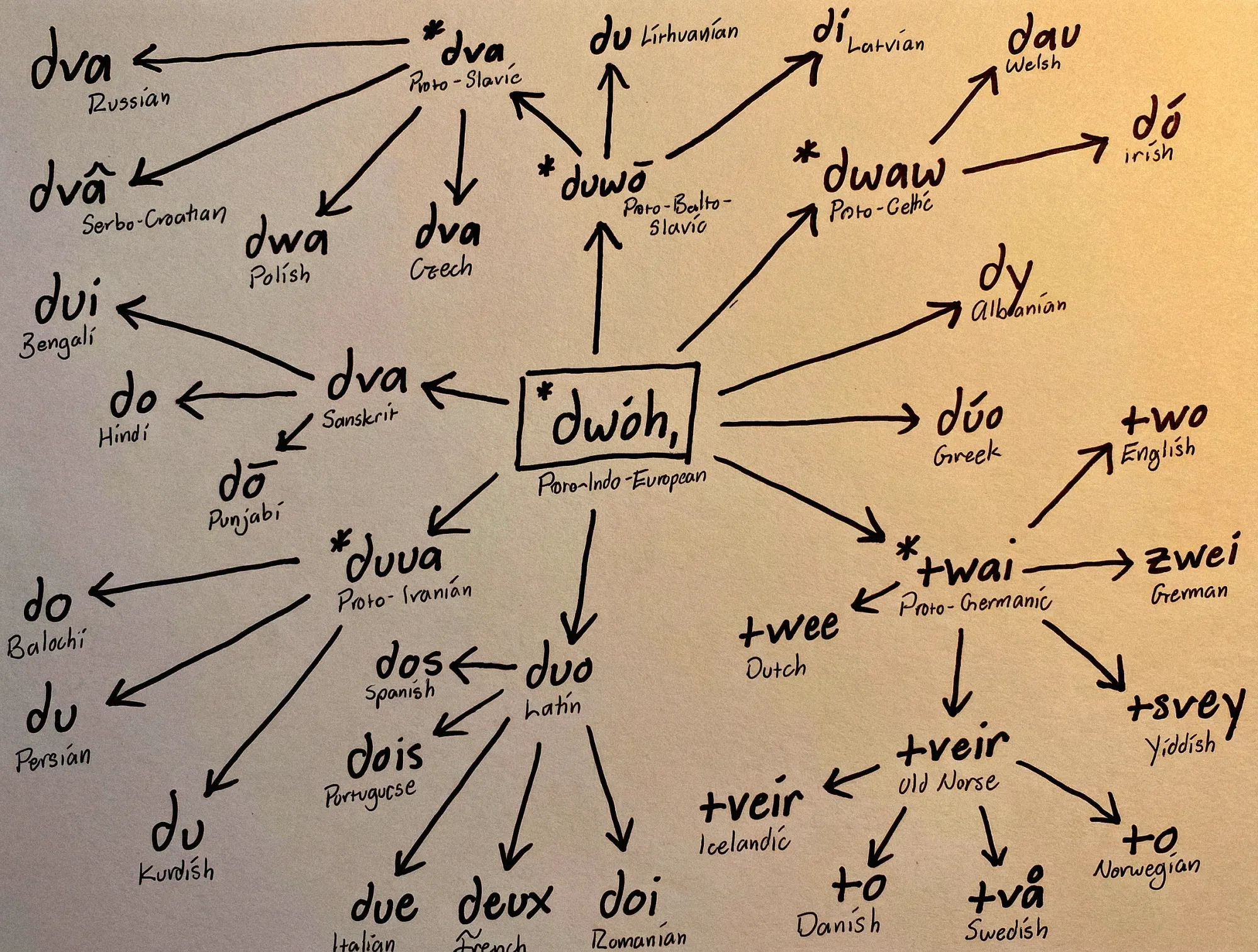
Then you look at the word mother: mother, mater, mētēr, mādar, mātā. It also sounds very similar. For hundreds of years, people have speculated that there was just one language. If you look at this map, for example, the English word for two, the number two, you can draw a schematic that shows you how, in all these languages, the word two derived just from one word.
Linguists have been able to piece together this Proto-Indo-European language. We've also been able to figure out how this language spread. There are two hypotheses: either the language spread from Turkey, Anatolia, or from Ukraine, basically Russia. We know it spread all around the world, basically all of Europe, including Iran and India. This is the first language of all these languages that we speak today in most of Asia and all of Europe.
The problem for linguists is: how do you piece together the language? Because this language is lost to us. What linguists did, and this is a very slow process, is they looked at all the words that seem to come from the same word in different languages. What they discovered is that there are certain words that are distinct to the first language. Words like:
- Bee
- Cow
- Ox
- Ram
- Ewe
- Lamb
- Pig
- Piglet
- Sour milk
- Whey
- Curds
- Field
- Dog
- Sheep
- Wool
- Textiles
- Scratch
- Plow
- Oxen
- Yoke
- Grain
- Shaft
- Furrow
- Wrestling
- Grinding
- Pestle
- Households
What do you guys notice about these words? Do you see patterns in these words? What patterns do you see in these words? What these words tell us is the culture and lifestyle of the Proto-Indo-Europeans.
Reconstructing a Lost Culture
- From these words, we're able to figure out four things about the Proto-Indo-Europeans. The first thing is that, unlike other cultures, these people have a word for wheel. In fact, there are five different words for wheel. What this tells us, what we can guess, is that these people, whoever they are, invented the wheel. Because they have words for wheel, and other cultures don't. They were the first to invent the wheel.
- The second is that they have words for dairy products, cow, milk. This is important. Why? Do you guys know why this is important? Why is this strange? Yes, they were raising livestock. What makes it strange is that for most of human history, we were lactose intolerant, meaning we did not have the ability to drink milk.
- These people, not only did they invent the wheel, but they changed their biological system so that they became lactose tolerant. They now have the capacity to drink milk. Whoever these people are, they are the first people to drink cow milk.
- The third characteristic is they really don't have that many agricultural terms. Maybe they farmed, but they weren't focused on farming, whereas other cultures were focused on farming. That's the third thing.
- The fourth thing is they have words for horse. This is important because this tells us that they were the first to domesticate the horse, meaning that they could control the horse. This is important because throughout history, horses, if they see a human, run away because that's the best way to survive. If you see someone coming, you run away. This is what we call excitability. Horses are excited. It took thousands of years for these people, the Proto-Indo-Europeans, to domesticate the horse, which means they could ride the horse.
We don't know who these people were, but based on their language, we're able to guess four things. This is a theory. What's interesting is that archaeologists started to dig up things, and they started to discover the linguists were right. By studying the language, the linguists had four hypotheses, and the archaeologists were able to provide evidence this is true.
The most exciting thing is that for the past 5 to 10 years, with advances in genetics, DNA technology, we've been able to look at the DNA of these skeletons, and we've been able to confirm a lot of these hypotheses. What I'm telling you is, for the longest time, we guessed that the Proto-Indo-Europeans existed, but now we have conclusive scientific evidence that they did exist and who they were.
Again, they have five different words for wheels, and we're able to know from the archaeological evidence the wheels were invented about 3500 BC in this area, basically Russia. Because wheels are part of Proto-Indo-European, then this language, whoever started to first speak it, must have been speaking after 3500.
There aren't that many agricultural terms in Proto-Indo-European. We have a lot of words for milk: to milk, sour milk, buttermilk, cheese, cow. Whoever these people were, dairy products were a very important part of their culture and their diet.
This is DNA evidence that shows us that these people, who we call the Yamnaya, were able to develop hormones that allowed them to be lactose tolerant. In about 4500 BCE, very few people could drink milk. By the time of the Yamnaya, about a thousand years later, they could basically all drink milk.
Because they could drink milk, what happens to their body? What's the difference if you drink milk? Exactly. We know from the evidence that these people are taller than everyone else. In fact, these people, because they drink milk and they eat a lot of protein, were on average 20 centimeters taller than farmers.
A Note on Modern Milk
The milk we drink today is very different from the milk that they drank before. The milk they drank before came from cows that were raised in grassland, so it's all natural. The milk we drink today comes from cows that are raised in factories, and we inject a lot of drugs and hormones into these cows.
No, no, no. If you drink milk a lot, your bones will be healthier, and you'll grow taller. That's just biological evidence. But the milk we drink today, we put a lot of chemicals into the milk, and the sourcing of the milk is from factories. The reason why is we want to make the milk cheaper, but it's worse for you. In other words, if you really want to be healthy, what you should do is go buy a cow and drink from that cow.
What's really interesting is the domestication of the horse. Again, there's a gene in the horse for excitability. The horse is programmed to run away if it sees danger, a human being. It took us about 3,000 years, from 5500 BC, to domesticate the horse because it's very hard to make horses not run away when there's danger. This is a very long process, but they were able to accomplish it.
Further evidence for the domestication of a horse is we've been able to dig up skeletons. What we see is the skeletons of the Yamnaya are different from other skeletons, and it's because they ride horses. That changes the curvature of the skeleton. The evidence is pretty overwhelming.
Eventually, they were able to put all the pieces together. They were able to put the horse and the wheel together, and as such they created the wagon. The wagon meant they could move from place to place, and they became what we call nomadic pastoralists.
Have you guys been to Mongolia? You see, the way they make a living is they have cows and sheep, and they take the cows and the sheep from place to place to eat the grass. They're able to do that because they're able to put all their belongings into a wagon and move from place to place.
These are the people who were the first speakers of Proto-Indo-European, and eventually they're able to spread their language all around the world, from Europe to India to Iran.
Conquest or Diffusion?
We're able to confirm that these people actually existed, and we're able to confirm that they did spread their language around the world. The question, the debate, is: how did they do so? There are two sides to the argument.
The first side believes these people were conquerors. Think Genghis Khan and the Mongols. They went around, and they were able to spread their language by conquering other people. Think Genghis Khan and the Mongols. Think of the European conquest of North and South America, where the English and Spanish and the French went to North and South America and eradicated the local population. That's the first belief.
The second belief is that it was not violent. It was just cultural diffusion, meaning I came to your country or your village, and I was able to influence you and convince you that my language is superior. We call this cultural diffusion. Think of English, where China has not been conquered by the West, but we want to learn English because we think that learning English will give us more life opportunities.
There are two sides of the debate, either one of conquest or one of cultural diffusion. This debate went on for a long time. For most of the time, we believed it was cultural diffusion, but now, for the past 5 to 10 years, we have overwhelming DNA evidence that it was in fact conquest. It was a genocide. It was a violent conquest.
What I will show you is Europe before the conquest. Then we will look at how Europe was conquered and how Europe was changed because of the conquest.
What's the Difference Between Conquest and Diffusion?
If I conquer you, I eradicate your genes. I kill you. Therefore, your genes do not come into the present day, whereas if it's diffusion, your genes are still around. A lot of these genes have been eradicated; therefore, it must have been a violent conquest.
Old Europe: Before the Conquest
Let's look at Europe before the conquest. A lot of what we know about Europe comes from a very famous anthropologist. Her name is Marija Gimbutas.
But what we know is that the Ice Age ended about 12,000 years ago. The planet is warming, which allows for agriculture. We also know that agriculture started in Anatolia, Turkey, and in Egypt and in Mesopotamia, basically this region. The reason why is this place was the first to warm up, but it also had better soil than other places. They discovered farming in this region, and then about 6,500 BCE, agriculture started to spread around the world, to Europe and then over to England.
What propelled this migration from Anatolia to Europe? Can you guys guess what would propel this migration? A good guess is war, but we don't have any evidence of war around this time. What's another explanation? Exactly, thank you, climate change. The weather became a lot cooler during this time, making it harder for people to farm.
Also, they've been farming for a long time in this area, which meant that the soil was no longer as good as before. You had these massive migrations of families into Europe because Europe at this time, the weather was becoming a lot warmer, which allowed people to start to grow agriculture in this area.
In about 6,500 BCE, people started to move from Anatolia into this area, and because they were moving, they brought with them their religion. Remember, the religion of Göbekli Tepe and Çatalhöyük is one of the mother goddess giving life to everything. Because of that, we know that the people in this area were mainly egalitarian, peaceful and artistic.
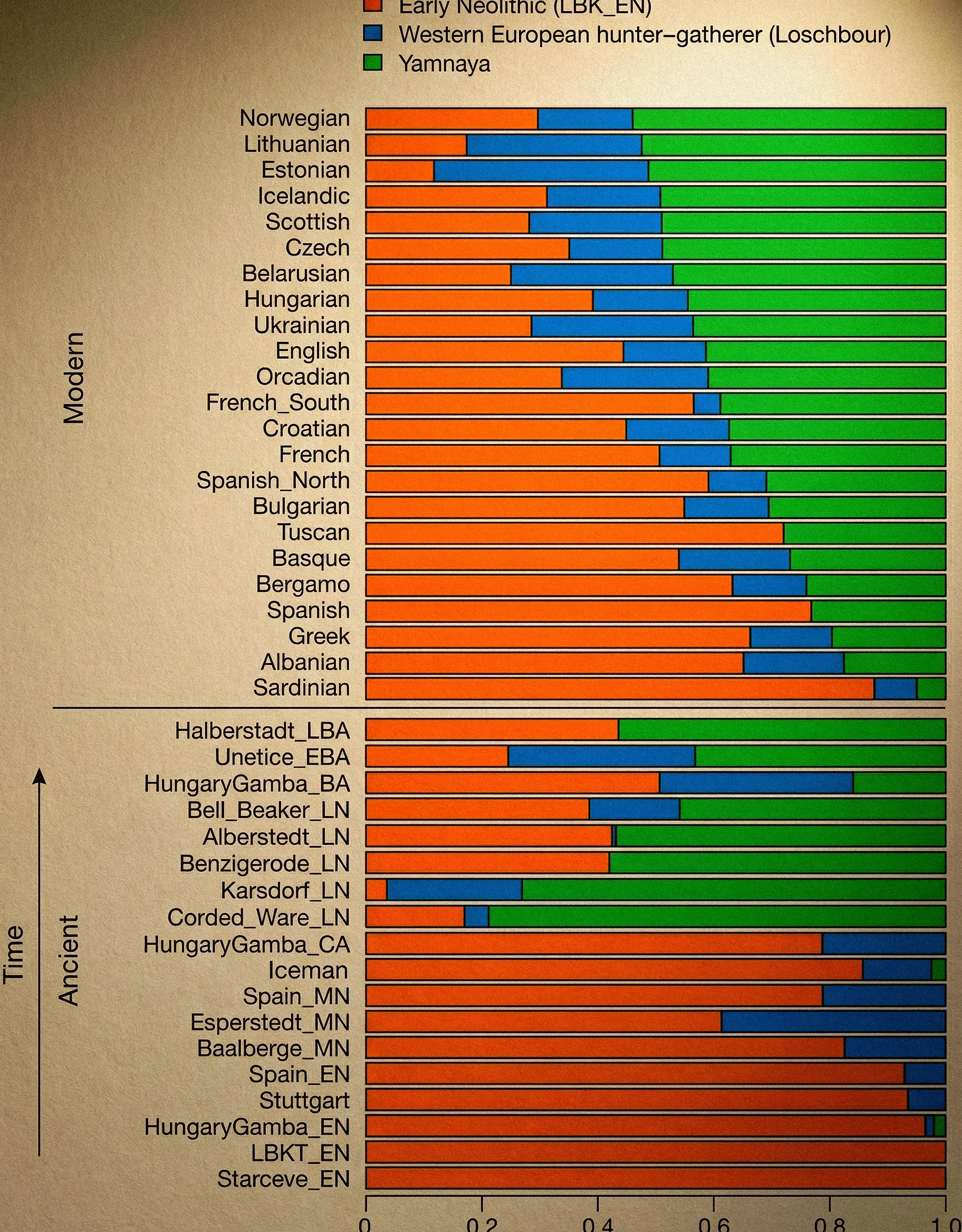
There were two massive migrations into Europe, all caused by climate change. The first migration was farmers. The second migration was pastoralists. If you look at the DNA of people today, what you will see is that about 4500 BCE, most people in Europe, their genes were a mix of farmers who came from Anatolia as well as hunter-gatherers who were there originally.
But then, after 3,000 BC, you have this green come in, and the green are the Yamnaya, the Proto-Indo-Europeans. I want you guys to understand what happened. This is a map of the migration. Agriculture was founded in about 9,000 BC in the Near East, Turkey, Anatolia, as well as Israel, Syria, Jordan. Then it spread from about 7,000 to Europe. Then the purple is the Yamnaya people, who we believe were from Ukraine, in the steppes. They spread around the world.
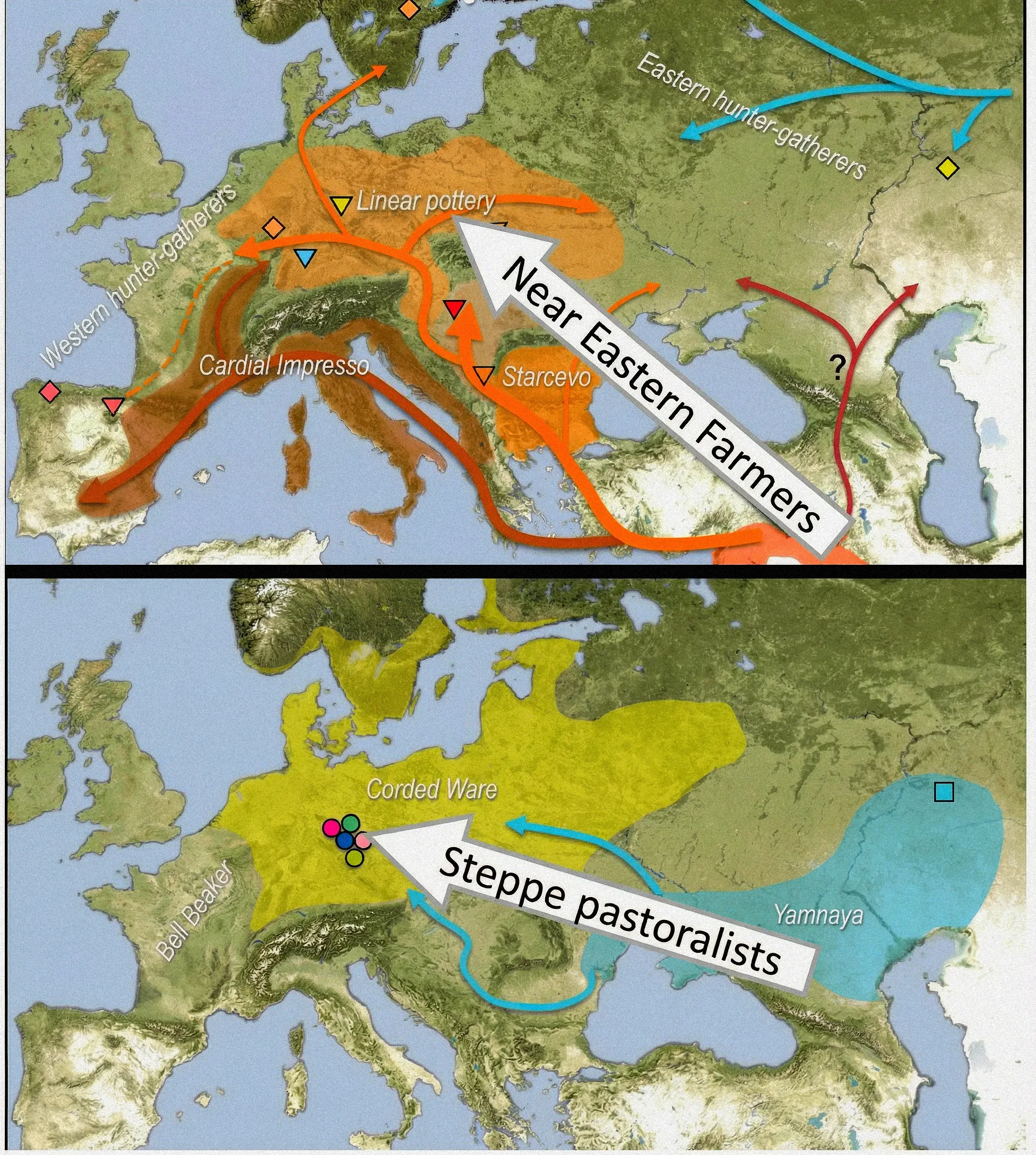
I want to look at the farmers who built Europe before the conquest of the Yamnaya. Marija Gimbutas, who is an anthropologist originally from Lithuania but who worked at Harvard and UCLA, has done decades of research into Old Europe. Her conclusion is that Old Europe was conquered by the Yamnaya people. This is what we know as the Kurgan hypothesis.
Let me explain what the Kurgan hypothesis is. We know the burials of the farmers are very different from the burials of the Yamnaya people. The major difference is this: the people who are farmers are buried together, but the people of the Yamnaya are buried alone. Not only are they buried alone, but they're buried with weapons and with cattle and horses.
What we can guess from this—we don't have evidence, but what we can guess from this—is that the farmers were people who did not have private property and who were egalitarian, and who were peaceful because they didn't have any weapons. The Yamnaya were the complete opposite. These were warriors who believed in private property, and they were male-dominated.
This is what we refer to as the Kurgan hypothesis. For the longest time, this is something that Marija Gimbutas argued, and she was laughed at. Why was she laughed at? Why would people laugh at her? She's saying before these people came to Europe, Europe was a place that was basically governed by women, and it was artistic, it was peaceful, it was egalitarian. Why would people laugh at her?
They don't believe in her. Why? First of all, in universities, it's the men who are the professors. It's the men who are scholars. There are many men who are like, "There's no way women can be in charge. They're idiots. Why would women be in charge? They're stupid, they're useless. It's men who are always in charge." That's one reason why they laugh at her.
What's another reason why they would laugh at her? There are also a lot of people who believe people are violent. We've had wars always. The idea that for thousands of years Europe was peaceful can't be true because people are violent. Humans are meant to go to war against each other.
The third reason why people would laugh at her is we think that we are motivated by money. If you don't have money, then why would you do anything?
Marija Gimbutas had this radical idea that challenged the way that men saw the world. For men, men have always been in charge, there have always been wars, and there's always been wealth and money to motivate people to work hard. That's what men believe. Gimbutas said, "No, that's not true." For thousands of years, from 6,500 BC until about 2500 BC—4,000 years—before they were conquered, Europe was ruled by women. Because of that, Europe was peaceful, egalitarian and artistic.
This is a radical idea. This idea that was laughed at for decades has now been confirmed by DNA evidence, meaning that this has been proven true by science.
The Civilization of the Goddess
Let's look at what Gimbutas said. She's written quite a few books. These are two of her most famous: The Language of the Goddess and The Civilization of the Goddess. Her main theory is that in Europe at that time, their main belief was in the mother goddess who gives life to everything. What she did was she went and she dug up their graves to look at their art, and she studied their language and their cultural practices.
This is from The Civilization of the Goddess. This is her main argument about Old Europe at that time:
The Goddess in all her manifestations was a symbol of the unity of all life in nature.
We are all connected together: animals, trees, humans. We're all connected together. We're all one big family.
Her power was in water and stone, in tomb and cave, in animals and birds, snakes and fish, hills, trees and flowers. Hence the holistic and mythopoeic perception of all the sacredness and mystery of all there is on Earth.
Everything in the world is sacred because it is blessed by the mother goddess. If there's a mosquito, don't kill that mosquito because it has the energy of the mother goddess. If you're walking and you see a bird, a small bird, pick it up and heal it because that comes from the mother goddess.
This culture took deep delight in the natural wonders of this world. Its people did not produce lethal weapons or build forts in inaccessible places, as their successors did, even when they were acquainted with metallurgy.
In other words, they had the technology to make weapons. They had the technology to build forts and make war, but they chose not to. These people purposely chose not to commit violence against other people.
Instead, they built magnificent tomb-shrines and temples, comfortable houses in moderately sized villages, and created superb pottery and sculptures. This was a long-lasting period of remarkable creativity and stability, an age free of strife. Their culture was a culture of art.
They spent all their time and energy in producing art to celebrate the mother goddess and to celebrate nature and to celebrate themselves. This was remarkably peaceful and stable.
The Origins of Writing
What was amazing about this culture is they invented writing. For the longest time, we believed that the Sumerians, who lived in Iraq, discovered writing. We discovered that writing came about for economic purposes. For example, if you are in Sumeria and you need to build a temple, what you do is you create writing.
This is writing. What does this mean? These two people, this family of two, will get two bushels of wheat and two baskets of bread for their work today. We thought that, for the longest time, people created writing for economic purposes, in order to have an economy.
But what Gimbutas has discovered is, no, we actually created writing before for religious purposes. For example, if I have a painting, it goes like this, something like this, then what I'm saying is the mother goddess blesses this sculpture with her life and with the abundance of water in nature.
Writing is a way to communicate with the mother goddess. It's a way to make divine and sacred our art. These people are so sophisticated, they invented writing.
A Different Worldview
I want to go over some of the cultural differences between that culture and our culture to show how stark the difference is. For example, in today's culture, we think of a snake, we think of poison, danger. We've been taught that snakes are dangerous. But in this culture, the snake was a symbol of life, energy and regeneration because a snake can shed its skin. It was a most benevolent, not an evil, creature. That's one major difference.
Another major difference between our culture and their culture is in today's world, we think that white is good, black is bad. We can't imagine that black is good, white is bad. But in their culture, that's exactly what they believed.
Black did not mean death or the underworld. It was the color of fertility, the color of damp caves and rich soil, of the womb of the Goddess where life begins. White, on the other hand, was the color of death, of bones.
Back then, for most of human history, we thought that white was bad because it symbolized death, and black was good because it symbolized life. We can't possibly imagine that today.
Sex, Power, and Community
The last thing I want to talk about, and this is actually the most controversial thing, is back then, for most of human history, women had power and agency. What I mean by that is back then, a woman's body was her body. She could choose to do whatever she wanted with her body. In today's world, if a woman gets married, then we assume the woman's body belongs to the husband. Only the husband can sleep with her. But for most of human history, this was not true.
You look at sexual taboos today. Why do we have sexual taboos? To shame women into proper behavior. For example, if a man sleeps with a thousand women, we think, "Great, he's a stud. He's good-looking, he's rich, he's tall, he's a stud." But if a woman sleeps with a thousand men, she's a bad person. She lacks ethics, she lacks morality, she has no character; therefore, we must avoid her.
Why does this make any logical sense? Why is this true, guys? Why is this true? Exactly. We have this prejudice because men are considered superior to women, and therefore men want to control women. The best way to do that is by controlling the woman's body. This is just a cultural prejudice. There's no biological evidence this is true.
We have a lot of evidence that women want sexual agency. For example, we look at monkeys, rhesus monkeys, and females will aggressively seek males out for sex. It's the females that are proactive.
You also look at bonobo monkeys. In bonobo monkeys, it's interesting because the females are in charge. The females have sex with each other. Why? Why do they have sex with each other? Why will females have sex with each other? What's the purpose of that? Unity. Unity, to get along, to cooperate better. Then they will also have sex with men, but they initiate the sex. There are some cultures where it's the female that will initiate the sex with the male.
At Harvard and UCLA, they discovered that, the moment they discovered plow agriculture, these societies have lower levels of female participation in politics, in the labor force. Meaning before, where men and women did the same work, both had the same political power. But once men showed that they could contribute more to society, men started to have more power.
In other words, differences between men and women are not biological constructs. They are cultural constructs. For most of human history, men and women were equal.
Race as a Cultural Construct
The idea of black and white, white is good, black is bad, is a recent construct. It comes with the idea of race. Race was invented about 200 years ago. Why? Because Europe was going on conquering the world, and they needed to justify why they were doing this. The theory is because we're superior people. Our race is better than your race.
Race is a recent cultural construct, and it was to justify imperialism, the conquest of other people for no reason. All this is recent.
Multiple Partners and Community
There's a really fun book called Sex at Dawn by Christopher Ryan. What he argues is that for most of human history, women had sexual agency, and they had multiple sexual partners. One piece of evidence is this: gorillas. They're the biggest primates. They're huge. It turns out their penises, when fully erect, are only 4 centimeters. Men, who are a lot smaller than gorillas, when they're erect, are almost four times as big as the gorilla penises.
Why is this the case? One theory is that when women have multiple sexual partners, the man with the bigger penis will spread his gene forward. This is evidence that for most of human history, women have had multiple sexual partners.
Even when women had partners, a husband, they still had sexual partners. In some societies, women have many husbands, usually brothers together. Why do they do this? Because we've been taught we exist to spread our genes. If I marry someone, only if I'm sure that the offspring, the children, are mine will I work hard to ensure that the children are fed and raised properly and educated.
We've been taught for a long time that we first care about our genes. That's why men want to have as many wives and children as possible, and women want to find the wealthiest husband. But for most of human history, this was not true. Why, guys?
It has to do with the idea of religion. The first thing is that we all come from the mother goddess. We're all equal. It doesn't matter if it's my son or my friend's son. They're all the children of the mother goddess, and therefore I have a responsibility to protect the children. There is no concept of the individual. There's only a concept of community. That's the first thing.
The second thing is they really didn't understand genes. They didn't understand a child has 50% of genes from the mother, 50% of genes from the father. How they understood it was, you have the woman, she gives life. The man gives energy. If you believe this, if the mother gives life, the man gives energy, how would you get better energy? More men.
If men are giving you energy, the more men you have sex with, the more energy you have. The evidence is if you look at the people in Melanesia, they believe that semen provided energy, so you need a lot of semen. What would happen is that when a woman married a husband, the members of the husband's family would come and have sex with her that very night, in order to get as much energy as possible from the family.
I know this is controversial, but I'm just trying to show you how our cultural beliefs are radically different from the cultural beliefs of people in the past.
One last piece of evidence is this: when the people don't know who the father is, everyone has a responsibility to protect the child. The story is this: a Christian missionary goes into a village, and he finds people just sleeping with each other. There's no marriage, there's no husband and wife. People are just sleeping with each other. The priest says to them, "You people are shameless." One of the villagers replies:
You have no sense. You French people love only your own children, but we all love all the children of our tribe.
Having multiple sexual partners is a way to build community for everyone. If you're a small community, maybe 15, 20 people, it makes sense to make sure that everyone loves each other, and everyone will protect all the children.
Let me tell you a story to illustrate this fact. We know that in World War II, American pilots were sleeping with each other's wives. The reason why they were doing this is American pilots were more likely to die in war than any other soldiers. Therefore, you slept with the wife of your colleagues in order to ensure that if you died, they would protect your children, because there's a good chance you would die in war.
You were afraid: "If I died, who's going to look after my wife, and who's going to look after my children?" The way you build intimacy and community is by sleeping with each other's wives so that you became one big family.
I know this is controversial. I know this is hard to understand, but we have evidence that for most of human history, women had sexual agency and power, and sex was a way to build community.
Is This Backwards or Primitive?
The question is, is this backwards, or is it primitive? Guys, there's no such concept as backward and primitive. The reason why we care about sex more than any other people is the idea of private property.
For example, if I have a wife, and I do have a wife, we have three kids. I want my three kids to inherit the money. But if my wife goes and sleeps with other people, then who gets the private property? In other words, we have the idea of sex as shameful because we live in a patriarchy.
Women as a Political Class
I want to conclude with this idea. Marija Gimbutas argued that Old Europe was ruled by women, or women were part of the political class. Because of that, Europe at that time was more peaceful and more stable than at any other time in its history.
- Why would women as a political class be more effective than men as a political class? There are three reasons. The first reason is women are more willing to cooperate and collaborate. Men are competitive. We like status, we like power, but women are much more humble. Women are much more likely to compromise and collaborate than men are.
If men are in control, the men want all the power. But if women are in control, then women are much more willing to share power with men. The other thing is let's just say your community gets in conflict with another community. What would happen is the women leaders of your community would get together with the women leaders of that community, and you could quickly negotiate a compromise. But men are competitive. They like status, they like face, so it's much more likely that when men start to negotiate, it becomes violent. - That's one thing that women are better at. Women are better at collaborating and compromising. That's the first thing.
The second thing is that women have more emotional intelligence. Meaning men care about rules. Women care more about you as a person. Therefore, women are much better at managing people. - The third thing is men can use violence to coerce other people. Women are not as physically strong as men; therefore, they have other strategies for controlling men. The two main strategies are gossip, talking about you behind your back, which forces you to conform, but also sex.
If the women spread sex evenly among the men, the men have no reason to fight. If a man does something bad against the community, the women can choose not to have sex with this man as a way to punish him. These are all very subtle and nonviolent ways of forcing people to conform to the rules of the society.
Before the conquest of the Yamnaya, Old Europe was a peaceful, egalitarian society. A lot of the reason why is that women were given higher status in society. It was women who made the rules, who were the political class in society. Because of that, women are able to use nonviolent ways to control society, making society much more peaceful and stable.
If People Are Not Violent, How Do You Control Society?
The question is, if people are not violent, how do you control society? The way you can control people is through the idea of shame, because everyone wants to get along.
Here's a fun experiment. What you guys can do is, every time you walk the hallways, and you see a person wearing red, like a girl wearing red, you tell her, "You look fantastic." I guarantee you, within like two weeks, all the girls in the school will be wearing red. You're controlling people, but you're not using violence. You're using the idea of gossip, shame and flattery, and that's what women do really well.
You don't have to use violence. You can also use flattery.
The Yamnaya people are violent. They love war. They're a patriarchy, and they have private property. The question is: how did they come about? What's their origin story? Why were they so successful in conquering all Europe?