Civilization #3: The Religious Imagination
The main message is that for most of human history, we have been peaceful, egalitarian and artistic. About 300,000 years ago, our species, Homo sapiens, was born in Africa. Then 50,000 years ago, because of climate change, we started to spread around the world. Throughout most of our history, we have been hunter-gatherers.
We don't know that much about our history. We can only guess, but based on the available archaeological evidence we have, we were, for most of the time, peaceful, egalitarian and artistic.
- Peaceful does not mean we were not violent. There's lots of evidence that there was in-group conflict. For example, we discovered, in burials, people with skull fractures. There's been violence, but there's been no evidence of organized warfare. That comes much later.
- The second thing is that we were egalitarian, meaning that there was no difference in status and power between men and women. Men and women were considered equal. There was no hierarchy, meaning that there were people who were considered more wealthy than other people. We know because we could not find any evidence of hierarchy, meaning larger houses, meaning groups with special privileges.
There are individuals who might have higher status, and we know because they were buried more elaborately than other people. For example, shamans were their religious leaders, and as such they were accorded higher status than everyone else. - The third thing is artistic. As we know, they were engaged in cave paintings. They built monuments in order to celebrate and worship their religion. For them, art really was about the expression and celebration of their religion.
For most of human history, we were peaceful, egalitarian and artistic. We know that today we are not peaceful, we are not egalitarian, we are not that artistic. What changed? A new group of people called the Yamnaya came into being, and they had a different religion that celebrated warfare, patriarchy and wealth. Eventually, they spread all around Europe and Asia, and they conquered everyone, and they created a new history of humanity.
I want to explain the evidence for why we think most of human history we were peaceful, egalitarian and artistic.
The Religion of Early Humans
We don't know what their religion was, but we suspect that it was animism and shamanism. Remember that animism is the belief that we all come from the mother goddess, from one source of life, including trees, animals and humans. Every living being has a soul.
The other thing is that the soul is permanent. You can never kill it. The body and the soul are different, so it doesn't really matter if you die because your soul will go somewhere else and maybe come back. Death was not a big deal.
The third thing is that there's a spirit world, or another world, which is more real than our world. Our world is just a physical manifestation of the spirit world, but what matters is a spirit world. The last thing is that there's an order to the universe. We have a part to play. For example, we can kill animals to feed ourselves, but we must pay tribute to these animals before and after we kill them in order to maintain the harmony of the universe.
That's what we believe the religion of early humans was everywhere in the world, including in China, including in Europe.
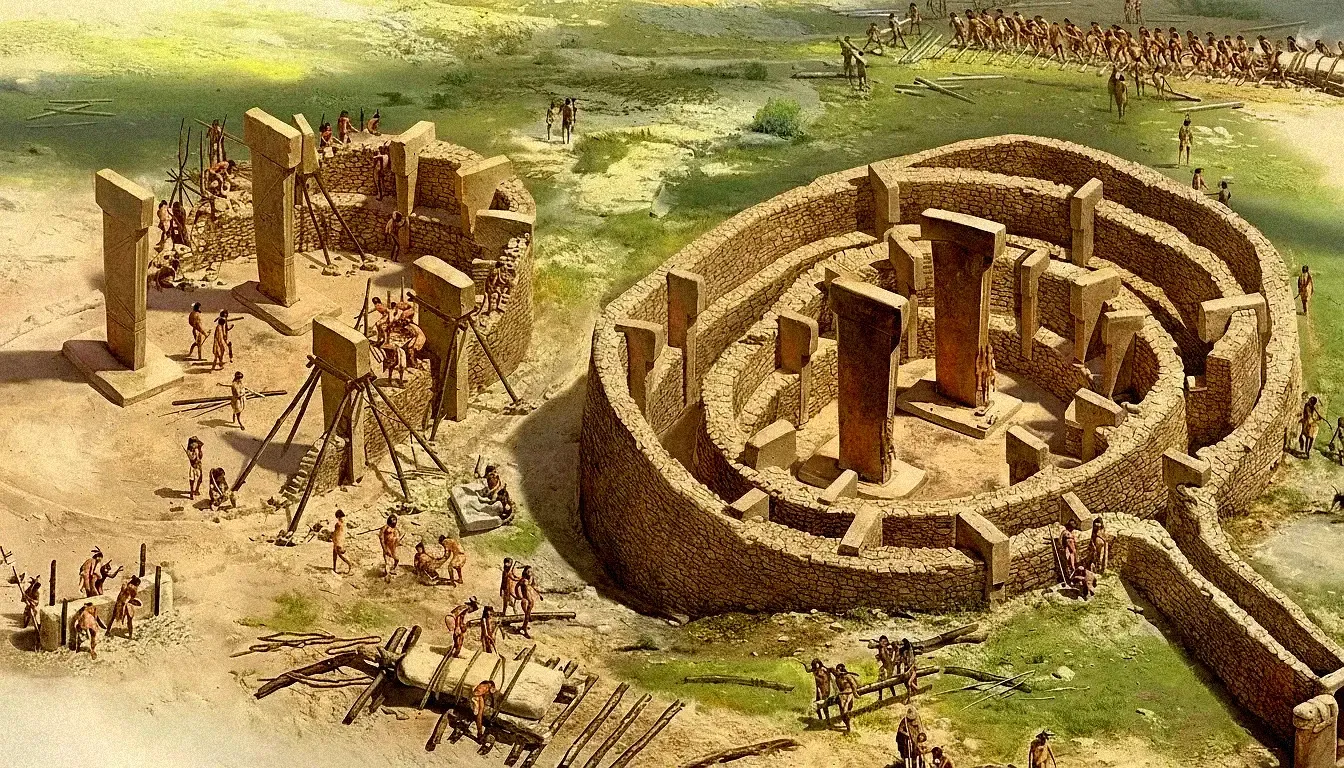
This is Göbekli Tepe. You can see that this is a T-pillar, and it's meant to represent a human. Inside the T-pillar is an animal. The T-pillar represents the manifestation of the animal spirit in us. We believe that this is a religious festival that they would have before they went hunting. The evidence for this is that at other sites, we found a lot of animal bones.
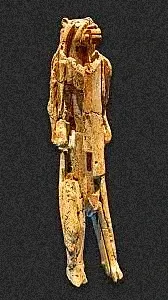
This religion goes back a long time. This is 40,000 years ago. We found this small figurine. It's a very small figurine in a cave in Germany, and this dates back to 40,000 years ago. Remember, 50,000 years ago, we started to leave Africa and venture into Europe and around the world. This goes back to the beginning, the dawn of humanity.
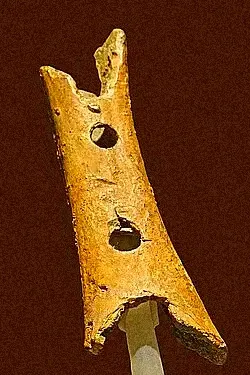
This is a flute that goes back to the same time. At the beginning of humanity, we were religious. We celebrated our religion through music and through art and through shamanism.
Yes, it's a figurine, it's a doll. They believe that these dolls have religious qualities. It's like paintings. They also have these cave paintings where they're celebrating the mother goddess, and they're celebrating the fact that life is a circle. After you kill the animals, their soul goes back into the spirit world, and then through proper tribute and worship, you can bring them back into this world.
This is a shaman dressed as an animal.
How Do We Know?
If we cannot go back in time and observe their religion, how do we know what their religion is? The answer is we have a field of study called anthropology. Anthropology is the study of other cultures. If our theory is right, then we should be able to find other cultures that are still alive today that practice this religion.
What we've discovered is that if you go to places in the jungle, in South America and in Africa, in Australia, they do practice this religion. Understanding the religion gives us tremendous insight into the thinking and religion of early humans. That's what we will do today: to truly understand what early humans thought and how they understood the world.
Evidence from Anthropology: The Wayfinders
The first passage we're going to look at is from a book called The Wayfinders by Wade Davis. This is a great book. If you guys ever have a chance, please read this book. It's extremely well written. Wade Davis is an anthropologist, Canadian, and this recently came out. He spent a lot of time traveling around the world to explore and to understand indigenous peoples, people who are native to the land and they've been there for a long, long time.
This is what he says about a tribe in the Amazon forest:
In the beginning, before the creation of seasons, before the ancestral mother, Romi Kumu, Woman Shaman, opened her womb, before her blood and breast milk gave rise to rivers and her ribs to the mountain ridges of the world, there was only chaos in the universe. Spirits and demons known as the He preyed on their own kindred, bred without thought, committed incest without consequence, devoured their own young. Romi Kumu responded by destroying the world with fire and floods. Then, just as a mother turns over a warm slab of manioc bread on the griddle, she turned the incinerated and charred world upside down, creating a flat and empty template from which life could emerge once again. As Woman Shaman, she then gave birth to a new world: land, water, forest and animals.
This is what we call a creation myth, and every single civilization, every single people, has a creation myth. Why do you need a creation myth? What's this creation myth doing? What does it explain?
How the world forms. But it does something much more important than that, which is what? Who are we? Where do we come from? Yes, it explains all that: who we are, where we come from. That's what all creation myths do.
What else is this myth doing which is very important for us? It's telling us how the universe was formed. What is in here that's very important, which is important for society to function well? The Woman Shaman is the mother goddess, but what's in this paragraph that's very important? In order for society to function, what do you need for society to function?
You need rules and laws. What this creation myth is doing, what all creation myths are doing, is explaining to you the legal structure of your society, why you can't do certain things. For example, you can't commit incest. You can't eat your young people. You can't kill the young people. Why? Because that's what evil people do.
What this creation myth is doing is explaining the legal system, the rules, and why we have them. We have these rules because they're evil. They represent the evil spirit.
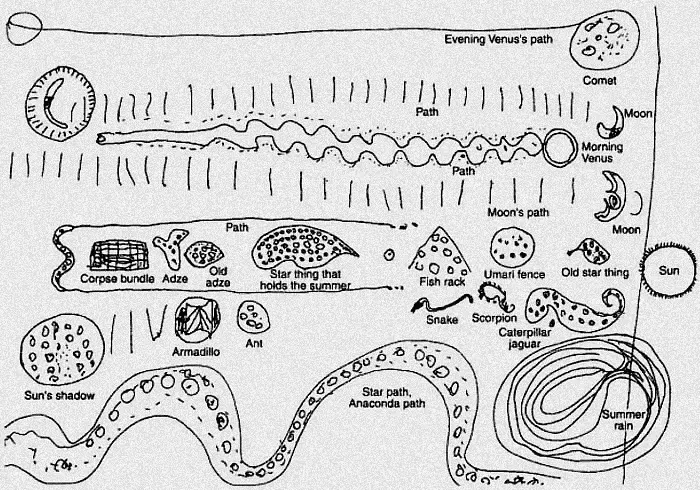
The other thing that you will notice about this creation myth is that it's very sophisticated and very elaborate. This is a visualization of their understanding of creation, and as you can understand, it's very complicated. Why is it complicated? Why is it complicated? Why is this so complicated? There are reasons for it. Why?
What's really important is for you to believe that your religion is correct. It is just as correct as science. What makes people believe that your religion is correct? You have to accomplish three things.
- The first is grandness, meaning that it is huge, it's vast. As you can see, this is a vast religion, a vast cosmology of how things started. Grandness is very important.
- Then you need completeness. The idea of completeness is that everything that you see in the world must be explained in this cosmology. What this is doing is explaining to you how everything started, where everything comes from. Completeness is important.
- The last thing is unity, meaning that there's a beginning and there's an end. As you can see, there's a beginning and then there's an end.
As we explore other religions, including Judaism and Christianity, for religion to be powerful, for it to be authoritative, you need these three ideas: grandness, completeness and unity.
The Spirit World and the Role of the Shaman
Thus, for the people living today in the forest of the Pirá-Paraná—
This is the Amazon forest.
—the entire natural world is saturated with meaning and cosmological significance.
They feel that everything around them has life, and it's all connected. It's one unified whole.
Every rock and waterfall embodies a story. Plants and animals are but distinct physical manifestations of the same essential spiritual essence.
We all come from the Woman Shaman. We all come from the mother goddess. Therefore, we all have the spark of life in us, and therefore we must be respected. The plants and the animals all must be respected as much as we are respected.
At the same time, everything is more than it appears, for the visible world is only one level of perception. Behind every tangible form—
Tangible means concrete, physical.
—every plant and animal, is a shadow dimension, a place invisible to ordinary people but visible to the shaman.
In other words, our world is a world we can see, but there are other worlds, the shadow dimension, which is more real, which captures our essence, where the soul resides. That's more real, and it's the job of the shaman to see and communicate with this world.
This is the realm of the He spirits, a world of deified ancestors, where rocks and rivers are alive, plants and animals are human beings, sap and blood the bodily fluids of the primordial river of the Anaconda. Hidden in cataracts, behind the physical veil of waterfalls, in the very center of stones, are the great malocas of the He spirits, where everything is beautiful: the shining feathers, the coca, the calabash of tobacco powder, which is in itself the skull and brain of the sun.
Reading this, what can we say about their religion that would be surprising to you? First of all, it's very imaginative. It's very imaginative. They have a vivid imagination. The other thing is that it's extremely sophisticated and complex. One major prejudice that we might have about these people is, "Well, they don't drive cars, they don't have cell phones, therefore they must be stupid." But clearly, from our understanding of their religious beliefs, they're actually extremely imaginative and extremely sophisticated.
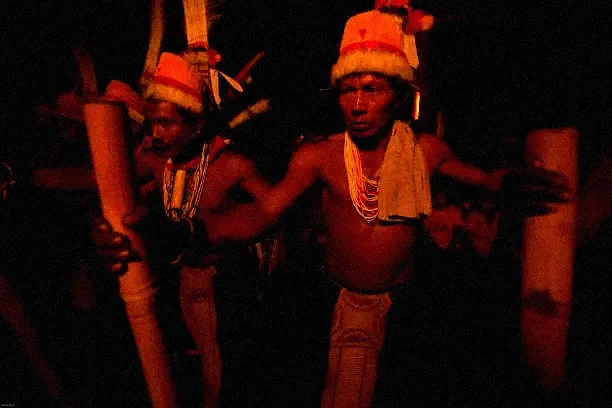
This is their shamans in religious practice. What can we say about this picture? What stands out about this picture? What surprises you, or what catches your eye about them? What can we say about their beliefs based on this picture?
There's a lot of thought put into what they wear. Again, sophistication. Their clothing, the way they dress, suggests that this is a very sophisticated religion. It's not like they just put on anything. It seems they put a lot of care and thought into what they wear. That's the first thing. What's the other thing? What's the other thing?
There are three of them, but what do you notice about the way they look and their bodies and the way they stand in relationship to each other? What do you notice? He probably has a higher status, and he stands in the middle. What else?
You're right in that if this is a tribe and all they're trying to do is hunt and eat food, none of this makes any sense. But the main argument that I've been trying to tell you is, no, their first priority is their religion. Everything they do has a religious significance to it. We don't know what it is. They don't really speak our language, but for them, everything that they do must have a religious meaning. It's the religion that centers their life.
The other thing I would say is you can see there's some organization and order to it. As you say, the person, the elder, stands in the middle. These two, can you see the symmetry? It's clear that they are doing a religious ceremony, and this religious ceremony requires their bodies to be a certain way in relation to each other. It requires them to dress a certain way. It requires them to say certain things. Clearly, they are in prayer of some sort.
We call this the idea of ritual. Ritual is just the expression of religion in everyday practice. In other words, their lives are extremely ritualized, meaning what they do every second has a religious meaning and religious significance.
For example, you come to school, and you think your life is very ordered because maybe at 8:00, you start class. Then when class starts, the teacher takes attendance. That's all ritual. Then at 8:45, the bell rings, and then you go off and get some water or something. If you want to go to the restroom, you have to raise your hand. This is all what we call ritual. Your lives are extremely ritualized.
The thing about ritual is behind the ritual, there has to be a belief system. For us, the school, we believe the system is set up so that you learn how to do well in life. You learn how to be on time. You learn how to respect authority. You learn how to read books. This society is in exactly the same way, where every minute of their lives, there's order and structure to what they do that has meaning and purpose.
It is to the realm of the He spirits that the shaman goes in ritual.
The shaman is responsible for entering the world of the demons and negotiating and communicating with them. That's his role. That's why he has his power and authority.
Contrary to popular lore in the West, the shaman of the Barasana never uses or manipulates medicinal plants. His duty and sacred task is to move in the timeless realm of the He, embrace the primordial powers, and harness and restore the energy of all creation. He is like a modern engineer who enters the depths of a nuclear reactor to renew the entire cosmic order.
If, for example, plants are dying outside, what does this mean? The animals and plants are dying. How can we fix a problem? Why are bad things happening? Bad things are happening because the spirits are unhappy. Therefore, you must go into the spirit world, understand why, and fix it. That's the role of the shaman.
What this is saying is that our world doesn't matter, guys. Our world is insignificant. What matters is the spirit world because the spirit world is what controls everything.
Among the Barasana, such renewal is a fundamental obligation of the living. In practice, this implies that the Barasana see the earth as potent, the forest as being alive with spiritual beings and ancestral powers. To live off the land is to embrace both its creative and destructive potential. Human beings, plants and animals share the same cosmic origin, and in a profound sense are seen as essentially identical, responsive to the same principles, obligated by the same duties, responsible for the collective well-being of creation. There is no separation between nature and culture. Without the forest and the rivers, humans would perish. Without people, the natural world would have no order or meaning. All would be chaos. The same norms that drive social behavior also define the manner in which human beings interact with the wild, the plants and animals, the multiple phenomena of the natural world: lightning and thunder, the sun and the moon, the scent of a blossom, the sour odor of death.
Everything is connected with each other. We're all equals. This is what we call animism.
The Ritual of the Hunt
If we are the same as animals and plants, what allows us, what gives us permission, to kill other animals? This passage explains it.
When men go to the forest to hunt or fish, it is never a trivial passage.
You cannot just go and hunt. You need permission first.
The shaman must travel in trance to negotiate with the masters of the animals, forging a mystical contract with the spirit guardians, an exchange based always on reciprocity.
Reciprocity means give and take. If I give you a present, you must give me a present.
The Barasana compared it to marriage, for hunting, too, is a form of courtship in which one seeks the blessings of a greater authority for the honor of taking into one's family a precious being. Meat is not the right of a hunter but a gift from the spirit world. To kill without permission is to risk death by a spirit guardian, be it in the form of a jaguar, an anaconda, tapir or harpy eagle.
This is something that we discussed in the cave paintings. Why did they spend so much time painting these animals? It's because they're trying to pay tribute to the animals. If I kill you, I must thank you for taking your meat to replenish myself, but I also must ask for your forgiveness. Otherwise, the animal's soul may seek vengeance.
This is the essence of the religion. If we hunt, we must first pay tribute. That's what explains Çatalhöyük: the bull and the people. Before they go hunting, they must pay tribute to all the animals.
You also look at the cave paintings. They have all these cave paintings, and what they celebrate is not themselves. What they celebrate are the animals because it's the animals that give them life, that give them nourishment and meat. You can see this in caves all around Europe and around the world.
As the ritual begins, time collapses. There are two series of dances, separated by the liminal moments of the day: dawn, dusk and midnight.
The shaman, during the ritual, needs to communicate with the animals in the spirit world. To do that:
He changes from fish to animal to human being and back again, transcending every form, becoming pure energy, flowing among every dimension of reality: past and present, here and there, mythic and mundane. His chants recall by name every point of geography met on the ancestral journey of the Anaconda.
As you can see, before the hunt, the ritual is extremely elaborate, sophisticated and complex. Its main purpose is to celebrate the unity of life and to ask permission and to ask for forgiveness as the hunters go kill the animals.
The shamans will change into animals in order to better communicate with the animals. This explains all the cave paintings and how, 40,000 years ago, they were creating dolls of shamans dressed as animals, because for them, this is what is true.
Insights from the Pygmies of Africa
Let's move to Africa. We were in South America, and they're still there today. If you want to go visit that tribe, you can do so. In Africa, there's a group of people called the Pygmies. There's a very famous book by a British anthropologist by the name of Colin Turnbull, and he discusses how the Pygmies practice the religious beliefs.
At the very center of the religion is something called the molimo, which is a trumpet-like instrument. The molimo allows them to communicate with the forest. It allows them to communicate with the spirit world, and that's how they resolve every issue. The molimo also captures the sound and spirit of the forest.
Even though we are in a different part of the world, we're in Africa, and even though the Pygmies have different religious beliefs than the people of the Amazon, what you will discover, what you will notice, is that it's essentially the same religion. The same idea that we are part of nature, and that our job is to help nature maintain balance and harmony.
A Different Worldview: Man as Part of Nature
What I want to do now is compare and contrast the way we think today and how they thought before.
I had no idea of how far we had come, or in what direction—
He's following the group of Pygmies around as they hunt.
—but I knew we had left the camp far behind. It was the first time I had known a group of Pygmies to be so silent. Normally, unless hunting, they are deliberately noisy. But now, just at the time that leopards would be prowling about in search of food, they seemed unwilling to disturb the forest or the animals it concealed. Just the opposite, in fact. It was as if they were a part of the silence and the darkness of the forest itself, and were only fearful lest any sound might betray their presence to some person or thing not of the forest. They stood there, quiet and still, and it struck me with a sudden shock that not one of them carried a spear or bow and arrow. As they peered into the dusk and cocked their heads, first on this side, then on that, satisfying themselves that we were really alone, it seemed that they felt themselves so much a part of the forest, and of all the living things in it, that they had no need to fear anything except that which was not of the forest. One of them said to me later, "When we are the children of the forest, what need have we to be afraid of it? We are only afraid of that which is outside the forest."
What I want to do now is, by analyzing this passage, explore how our minds are different from their minds. Our mind is what we consider modern, and their mind is what we consider pre-modern.
What's the first major difference between the British anthropologist, how we think, and how they think? What's the first difference you notice from this passage? First of all, what is the word that tells us that he doesn't really understand how these people think and behave? What's the word that tells us he doesn't really understand these people? This is actually a great SAT question if you guys plan on taking the SAT. There's a word in this passage that tells us he doesn't really understand how these people think and feel. What's the word?
Shock. He's surprised by their behavior. Why is he surprised? What confuses him? Yes, exactly. Why does that surprise him? Exactly. Why do we think that nature is dangerous? Why do they not think nature is dangerous?
Why, guys? That's exactly right. He thinks nature is dangerous because there are leopards, there are predators. They don't think nature is dangerous. What's the difference? The first major difference is this: our minds think that we are separate from nature. Man versus nature. Man versus nature. But they think they are part of nature.
Why do we fear nature? What makes us fear nature? If I put you in a forest, you're afraid. Why? Yes. Why are you afraid of the unknown? You don't know what you encounter, but why does that make you afraid? Why would the unknown make you afraid? What is it that we are obsessed with?
We're obsessed with control. We have to control everything. We want to know something because we want to control it. We like animals in the zoo. We do not like animals in the forest. We can control animals in the zoo; we cannot control animals in the forest. We're obsessed with control.
Why aren't they afraid of nature? What's their attitude? What's the Pygmies' attitude? We want to control nature, but they trust. They don't have to control nature because they trust nature. They believe the leopards know them, and they know the leopards.
That's the first major difference between our world and their world. We've been taught that nature is our enemy, or nature is outside us, whereas they believe that they are part of nature.
The Ultimate Crime: Disrespecting the Collective Belief
This is about their religious practice. They have a meal together, and then they sing, or they use the molimo to make noises, and they sing and dance.
Everyone ate his fill as and when he pleased. A couple of the older men said they would wait until the youngsters had finished before they ate, but they did not wait for long. I was told, however, that everyone had to eat, just as no adult male was allowed to sleep, but to sing, while the molimo singing was in progress. Apparently, one of the greatest crimes that the Pygmy can commit, if not the greatest, is to be found asleep when the molimo is singing. One of the men stood up, and miming, as all Pygmies love to do, he showed how they used to search for a sleeping man, a spear under each arm, and how, if they found one, they would spear him in the stomach and kill him completely and forever. I was told that then his body would be buried under the kamolu—
The kamolu is a great fire in which they practice their religion.
—and nobody would be allowed to mention his death, even to remark on his absence. The women would be told that the molimo itself, the great animal of the forest, had carried off one of their number. But like the men, they would ask no questions and would never again mention the missing man.
In this world, the greatest crime you can commit is not to kill someone but to sleep during the religion. Can someone explain why that's the case? In this world, the Pygmy world, the worst thing you can do is sleep. Why is that the case?
Let's just say that we're having a class, and one of you is sleeping. I get so angry that I want to kill that person. Why would I want to do that? What's my logic? It's disrespectful of what? It's disrespectful of my authority. That is true, but then I just ask a person to leave my class. I shout at that person. But I want to kill that person. Why? What's happened?
What is a classroom? A place to study. What else? What are we doing now? But what is class? What allows a classroom to exist? What is the ritual we're practicing?
A classroom you can understand as the collective experience. A classroom happens when everyone is participating in it. That's what makes a classroom alive. Why would I be angry if one of you is sleeping? Why does that matter? If you're sleeping, what are you telling me? It's not a classroom. It's not real. This discussion is not real. It's pointless.
That's what's happening here. The molimo singing, the ritual, is meant for everyone to recognize that the religion is real. It's more real than reality. But if you're sleeping, you're saying, "No, guys, this doesn't matter. What we're doing does not matter."
Therefore, what you're doing is you're not committing violence on one person. You're committing violence on the community. You're committing violence on the religion. You're insulting the forest. You're insulting the god. That's the worst crime because this religion is only possible if everyone believes that it is true.
If you're sleeping, it means you don't think it's true, and therefore you are, first of all, rejecting the community. You're telling everyone, "You're all idiots." The second thing is that you might endanger the community because you're insulting the forest.
For most of human history, people take their religion extremely seriously. So seriously that they think it's more real than reality. As long as everyone believes in it, it's true. But if someone doesn't believe in it, then we have to kill that person because if he doesn't believe in it, then it might cause our religion to die.
What I'm trying to show you is the power of religion, how once we have the religious imagination, we can create things that are actually, for us, more real than reality.
That's the second thing that's different about us from other human beings. For most of human history, we were spiritual. Spiritual meaning we believe the world of the spirits, our soul, exists. Today, the word we use is materialistic. The idea of materialistic is this: if we cannot see it, it's not real. God can't be real because we can't find it. The soul can't be real because we can't measure it. Imagination can't be real because we don't know where it comes from.
Obviously, this idea of materialism is wrong. How can you say the imagination doesn't exist? But unfortunately, we have structured our society around this idea. All science, when you go to science class, they teach you this: if it's real, you can measure it, you can see it, you can feel it. But for most of human history, we didn't believe that. We thought there is a spiritual world, and that matters just as much as reality. In fact, it probably matters more than reality.
"Pretending" vs. Reality
For a month, I sat every evening at the kamolu, listening, watching. If I still had little idea of what was going on, at least I felt that air of importance and expectancy. Every evening when the women shut themselves up, pretending that they were afraid to see the animal of the forest; every evening when the men gathered around the fire, pretending they thought that the women thought that the drainpipes were animals; every evening when the trumpet drainpipes imitated leopards and elephants and buffaloes; every evening when all this make-believe was going on, I felt that something very real and very great was going on beneath it, something that everyone else took for granted and about which only I was ignorant.
Clearly, he does not understand these people. What word tells us he doesn't understand these people? He doesn't know what's going on. Why? What word tells us this? Why is he ignorant? There's a word in here that tells us he doesn't understand these people at all. This word shows that there's a chasm, a huge difference between the Pygmies and us. What is this word? What word would the Pygmies not use here? They'd be insulted by this word. He uses it over and over again. There's a word here that's insulting.
What word here in this passage would the Pygmies find insulting? If another teacher comes into my class and he says, "Wow, your class is a lot of fun," I'd be insulted. Why? "You guys have so much fun in this class. You play a lot." I'd be insulted. Why?
This is not study. This is not serious academic work. This is playing. It has no significance, no meaning. What word implies that here? It repeats itself over and over: pretending.
We think they're playing. What do they think? We think they're pretending. We think they're playing. What do they think? They think it's all true. For them, their religion is more true than this world. That's a power of the human imagination. You can imagine a world, and this world, as long as many of you are imagining it together, is more true, more powerful, more real than this world. That's a power of religion, what we call the religious imagination. We'll see this over and over again in human history.
We've been taught that if you can't see it, it must be pretending, it must be make-believe. But for most of human history, for most people, this is not playing. This is not pretending. It's true. It's real. It's what allows us to be close to God. God is real. This world we live in, it's not real.
Maintaining Cosmic Harmony
He went on to tell me that the Pygmies called the molimo whenever things seem to be going wrong. "It may be that the hunting is bad," he said, "or that someone is ill, or, as now, that someone has died. These are not good things, and we like things to be good. So we call out the molimo, and it makes them good, as they should be."
This is very similar to the shaman going into the spirit world when things are bad.
"Normally, everything goes well in our world, in our forest. But at night, when we are sleeping, sometimes things go wrong because we are not awake to stop them from going wrong. Army ants invade the camp. Leopards may come in and steal a hunting dog, or even a child. If we were awake, these things would not happen. So when something big goes wrong, like illness or bad hunting or death, it must be because the forest is sleeping and not looking after its children. So what do we do? We wake it up. We wake it up by singing to it, and we do this because we want it to awaken happy. Then everything will be well and good again. So when our world is going well, then also we sing to the forest because we wanted it to share our happiness."
This is like them going to the spirit world and communicating with the spirits. It's almost the same religion. Maybe the details are different, but the idea is the same. The idea is that we're all interconnected: animals, plants, humans, all the same. This is not the real world. The spirit world, the forest, they're the real world.
For us to maintain our health and our happiness and our safety, we must always communicate with this other world and make sure they're happy. Because of this belief, it means we shouldn't go to war with other people because that causes mayhem and chaos in the spirit world. Our job is to maintain harmony and balance in this world. We're caretakers.
It means we should not be in conflict with each other. We should be equalitarian. We should be equal because we're all from the same mother goddess, we're all from the same forest, we're all from the same Woman Shaman. It means we have to be artistic because we have to celebrate and worship the spirit world.
For most of human history, we were like this. Even today, in a lot of cultures around the world, they're still like this. Now the question is: what changed? Why do we have war? Why do we have hierarchy? Why do we have patriarchy? Why are men superior to women? Why do some rich people have all the power? This clearly goes against this religion.
What I will show you is the beginning of a new religion and how this new religion that worships wealth, power and war conquered everyone.