Civilization #43: The Structure of Scientific Revolutions
As I mentioned in previous classes, it was really Dante who helped give birth to the idea of modernity. He really launched three major movements, which include the Renaissance, the Protestant Reformation, and the Scientific Revolution. We would not have modernity without Dante.
Let's see how the three connect together. We're going to review the previous two classes to connect to the Scientific Revolution. The Renaissance, what it was was a celebration of what makes us human. Before, we were focused on the divine, on the idea of God. Now we want to tell the story of what it means to be human. That's the Renaissance.
Protestantism believes that we have direct access to God. In the Catholic religion, the pope is the divine representative, and the clergy are the spokespersons for God. But Protestantism believes that we have direct access to God. We should be able to speak with God directly through the Bible. The Scientific Revolution, it's really about how can we know God? That's the idea of the Scientific Revolution.
Dante's Three Messages
Let's review why we have these ideas. It has to do with Dante. Remember last week we discussed the dialogue between Beatrice and Dante. Let's review it really quickly. Beatrice is saying, I just said that God is perfect. Whatever God touches, whatever God creates is perfect. If that's the case, why is it that there is decay, destruction, and death in this world? What are the forces that give rise to this decay?
Then she explains, whatever God creates is perfect. Angels are perfect. They're immortal. They're eternal. But the elements that are in this world, they are not created by God. What is created by God are the divine laws that underlie the universe. God created the atoms. God created the laws that allow these atoms to interact with each other.
The rays and motion of the holy light draw forth the soul of every animal and plant from matter able to take form.
It's these divine laws that create the animals and the plants. But these divine laws also necessitate that they die in order for new forms to come into being. This is the idea of evolution. We humans are special. Why? Because we are both divinely created and created by the laws of the universe. We have a dual nature. The main advantage of this dual nature is it gives us a capacity to imagine.
Remember, the issue with God is that God is perfect. If you're perfect, if you're eternal, if you're immutable, you lack imagination because there are no boundaries to you. But if you're human, you're forced to have an imagination because you'll make mistakes. You will fail. There are things that you do not know. The imagination gives you the capacity to know this world and to perfect this world. That's what it means to be fundamentally human.
Let's recap. These are the three main messages that Dante is relaying to us through his poetry.
- First of all, God is within us. How do we know? Because we are capable of loving others. God is the light of love within us. The more we love someone, the more this light grows in us. We must focus on loving someone who is dear to us.
- Second idea is we have the imagination and thus the responsibility to discover the universal laws underlying reality. God created the laws of the universe. God created us in order to know these laws. That's very fundamental to the idea of science.
- The last idea is we can master these laws to better our reality.
These are the three hidden messages of The Divine Comedy that will influence the development of science in the Western world.
Science in Ancient Societies
I want to talk briefly about science that has traditionally been practiced in ancient societies. In ancient societies, the major ancient civilizations are China, Egypt, and India. You will see a lot of similarities among these three civilizations in how they practice the idea of science. It's very intuitive. It's very imaginative. It will make sense to you.
Sacred Geometry
The first science that they focus a lot on is the idea of sacred geometry. I'm not sure if you've heard of this, but the idea of sacred geometry is that the underlying fundamental structure of the universe, of reality, is geometric shapes. From these geometric shapes, you can give rise to every possible reality.
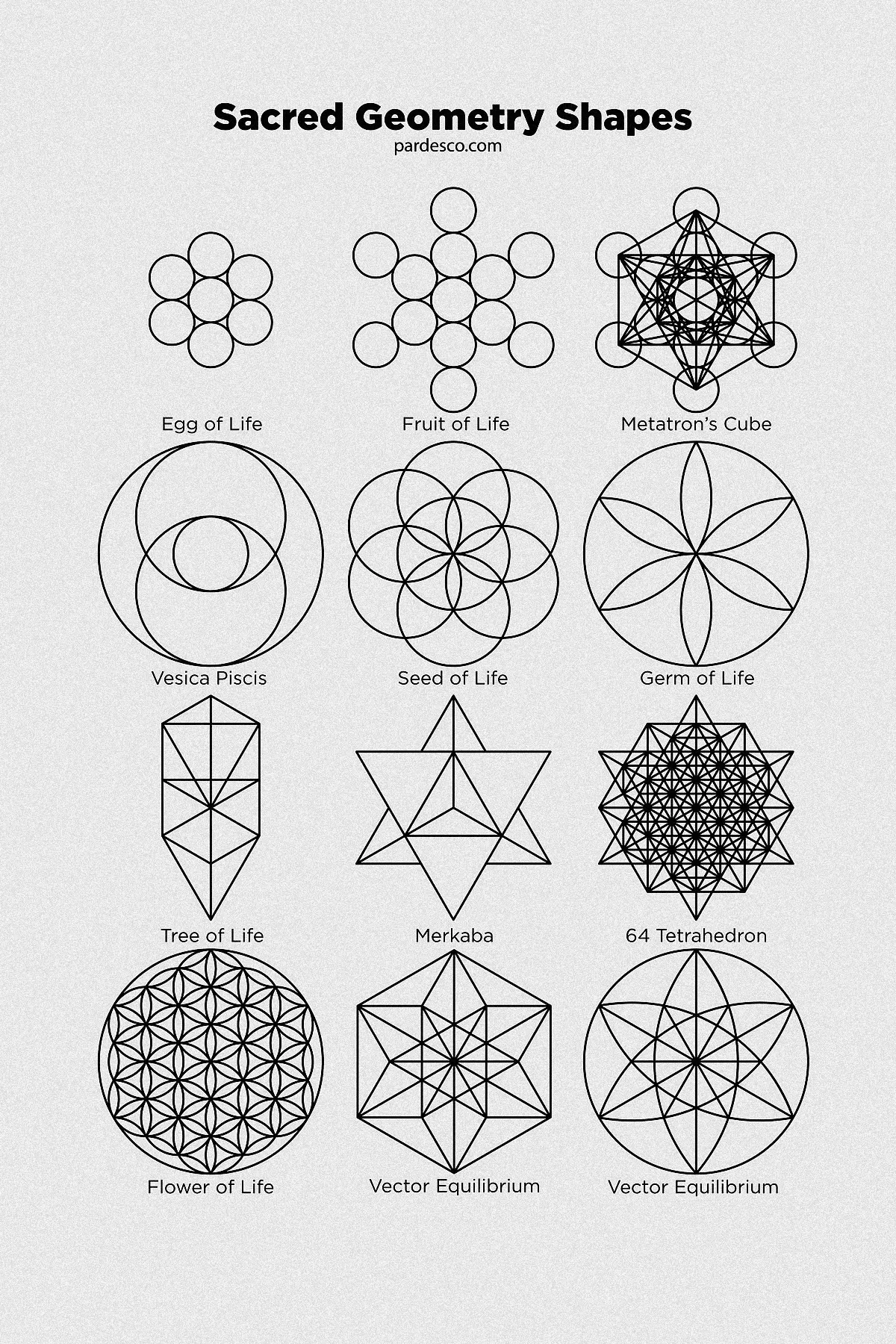
This is called the Egg of Life, and from the Egg of Life, you just keep on expanding it, you will get all of reality. These are actually 3D, 4D shapes. I can't illustrate them, but if you're curious, go online. These are beautiful ideas.
There are two possible ways to understand sacred geometry. The first possible way is to understand it as solids. The Egyptians understood them as solids, and Plato understood them as solids. Remember Plato, a lot of his philosophy is derived from the Egyptians. The idea of sacred geometry, it's very apparent in Plato's writings, and he got this from the Egyptians. Basically, the idea is that if you train yourself on how to understand sacred geometry and how to manipulate sacred geometry in your head, you can access God. The first idea is to understand it as solids.
But there's another way you can understand sacred geometry, and it's as vibrations, as energy, as a force. This is the way that the Chinese understand sacred geometry. As chi, as life force, as well as the Hindus. Imagine a monk who's breathing, who's meditating. What is he doing? He's breathing, and he's meditating, and he's focusing his energies in order to achieve the sacred geometry within him. The monk will often say things like, "Om. Om. Om." He's causing vibrations that try to mimic the sacred geometry.
Why is he doing this? Because the belief at this time is that if there is a God, if there's a creator God, the question is, how does it think? It's not going to think with words the way we do. It's going to think using mathematics, with sacred geometry. By thinking, he is going to create the underlying universe. How does he do that? He does it by breathing. Breathing in, emitting sacred geometry, and then breathing out, breathing back in. Inhaling, exhaling. This will give rise to the universe.
If you're a monk or a priest, you practice meditation in order to try to mimic the act of creation. If you are able to succeed, then what will happen is you harmonize yourself with the vibrations of the universe, and therefore you're able to access divine energy. That's the idea of sacred geometry. Again, it's a very complicated idea, but that's the general gist. This should make intuitive sense to you.
Astronomy, Astrology, and Alchemy
The second big field that the Egyptians, the Chinese, and the Indians were really passionate about is astronomy and astrology. The Egyptians basically created astrology. The idea is that you're trying to link the movement of the stars, the cosmos, with events in the world. By understanding the movement of the stars, you're able to divine or predict the future of humanity. Every major king had an astrologist in order to divine the future through the practice of astronomy and astrology.
The last thing is alchemy. What is alchemy? Alchemy is basically chemistry and sorcery combined together. This is a polytheistic world, and the idea is that because it's a polytheistic world, it's a chaotic world. Somehow, if you're clever enough, you're able to hack this world. Think of it as hacking. There are secrets to this world, and you are able to take elements in this world, combine them together, and create something called the philosopher's stone. The philosopher's stone is the power of God in order to give you the elixir of immortality in order to live forever, as well as to manipulate the environment. Basically, to turn lead into gold. Again, this was an extremely popular practice in ancient societies.
These are three major sciences in the primitive societies, China, Egypt, and India. They promulgated outwards and influenced other societies. We still have them today. There are still people who practice alchemy, sacred geometry, and astrology today.
Premodern and Modern Science
This is primitive science. The question then is, what's the difference? Let's focus on the three major differences between premodern science and modern science. The first major difference is it focuses on the spiritual world, on the otherworldly. The point of science was to create harmony between our world and the spiritual world. Because if you harmonize these two worlds, you can have a more prosperous, more peaceful future.
Today we are only focused on the material world, the world that we can see and know, in order to create progress. We have abandoned the spiritual world, and we focus on this material world in order to manipulate it in order to promote technological progress. Quite honestly, we have been extremely successful at that. In fact, I will argue we've been too successful at that. That's the first major difference between premodern and modern science.
Second major difference is that premodern science relies entirely on intuition and imagination. You don't do experiments. You don't have conferences. You don't debate. You just meditate. You just dream. You often fall into trances in order to communicate with the spiritual world. In this world, they use a lot of psychedelics, including magic mushrooms, a drink called Soma, which is very important in the Hindu religion, as well as the Zoroastrian religion. It's basically a psychedelic.
Today we don't rely on intuition and imagination. We think this is superstitious. We rely mainly on something called the scientific method. Later on, I will discuss the scientific method more in detail.
The last thing is in premodern science, people are relying on divine inspiration in order to discover the truth. The big question is, what is truth? Today we care about the question, how do we know truth? It's really the idea of the institutionalization of doubt. Our main priority is to question and doubt the truth. What will happen is because of this emphasis change, we've changed from what is truth to how do we know truth, it will launch a revolution in technological progress.
Theological Assumptions of the Scientific Revolution
Underlying the Scientific Revolution are three major theological assumptions. Without these theological assumptions, the Scientific Revolution would not be possible.
- The first and most important idea is the idea of monotheism. There is one God. Again, the very idea of monotheism is also revolutionary in human thought.
- Second idea is that God designed and willed the universe into being. There is an intelligent design to the universe, and it's up to us to discover this design.
- God endowed us with the capacity to discover his design and will.
These are the three major theological assumptions underlying the Scientific Revolution. That is why the Scientific Revolution happened in Western Europe and not, say, in China or the Islamic world or India. Because you need these three theological assumptions.
What do these assumptions bring us? Let's look at polytheism again. Throughout most of human history, most societies have been polytheistic. What is the difference between a polytheistic worldview of science and a monotheistic worldview of science? I need you to memorize this chart.
The first major difference is in the polytheistic system, there's really no design. There's really no progress. It's just chaos and struggle. But in the monotheistic worldview, there is an underlying truth to the universe. That's the first difference.
Second major difference is the idea of randomness. Things happen for no particular reason. If you win the lottery, that's great. But if you lose all your wealth, that's just random. It's just fate. It's just destiny. There's no purpose or no design to your fate. But in a monotheistic world, there's the idea of good and evil. Things happen to you that benefit you if you're doing good. But if you're doing evil, then bad things will happen to you. There's a deep sense that God is in our lives orchestrating events.
The last major difference is that between fate and progress. If there's truth in this world, if there's goodness in this world, then we have a responsibility to progress by doing good and by discovering this truth. That's why I keep on emphasizing this, but monotheism is really an intellectual revolution first and foremost.
The Forces Driving Science
The Scientific Revolution happens, and what drives it? There are three major forces that drive the Scientific Revolution. The first is the idea of the Protestant Reformation and the Counter-Reformation. The Protestants have come, and they're challenging the authority of the Church. The Church responds by something called the Counter-Reformation. There is this belief, or this prejudice, that the Church is anti-science. The Catholic Church is not anti-science. In fact, both the Protestants and the Catholic Church are trying to use science in order to promote their legitimacy and authority.
The Protestants are heavily devoted to science because they want to understand the will and mind of God. The Catholics themselves are also promoting science. The Catholics will create a new society called the Jesuits, who are renowned for being great scientists. In fact, a lot of universities in this world were founded by Jesuits. A lot of Jesuits came to China, and they promoted knowledge and science in China. This has been true for many centuries. Both the Catholic Church and the Protestant movement, they're all in a struggle to use science in order to promote their own authority and legitimacy. That's the first major force driving the Scientific Revolution.
Second is war. During this time, Europe is in a constant state of war. It's fighting amongst themselves, between the Catholics and the Protestants. It's also fighting with the Muslims. The Ottoman Empire, which is at this point the strongest empire in the world. The last idea that's driving science is the Age of Exploration and Conquest. As Europe is trying to expand outwards, if they're going to North America, they're going to South America, they need better navigation tools. They need compasses. They need astrolabes. Science solves all three problems.
How Do We Know Truth?
Again, the best way to remember the Scientific Revolution is it's a fundamental change from asking what is truth to how do we know truth? How can we know truth? Believe it or not, no one really bothered to ask this question before. How can we know truth? Because science is asking this question, how do we know truth, what it's really doing is it's separating itself from religion and putting itself above religion.
Because religion purports to be the truth. What science is saying is, how do you know if you're right? We know if you're right because we have methods to test you. Science is putting itself above religion. As you can imagine, this will create conflicts within the Catholic Church very, very soon. Mainly in the trial of Galileo.
Because science asks this question, how do we know truth, what it does is it creates the scientific method. The scientific method is composed of three main elements.
- The first is you ask questions, and you propose hypotheses. There are no questions now that are out of bounds. You have to think of solutions and ideas to solve these questions. That's the first step.
- Second step is there are these processes and protocols for testing hypotheses. Experimentation, basically. Only if you can experiment, only if your hypothesis matches experimental results can it be true.
- The last thing is it creates a system of doubt and criticism in order to test all experimental results. Today we call them academic societies and peer-review journals. If you're a scientist working today at a university, whatever results you have, you must first publish, and then you have to present your journal results to a conference of peers who will criticize you, and they will look for flaws in your argument.
This is an extremely effective system on how to know what is true. Again, because of this system, it's allowed for a remarkable explosion of wealth and technology and progress in the world today.
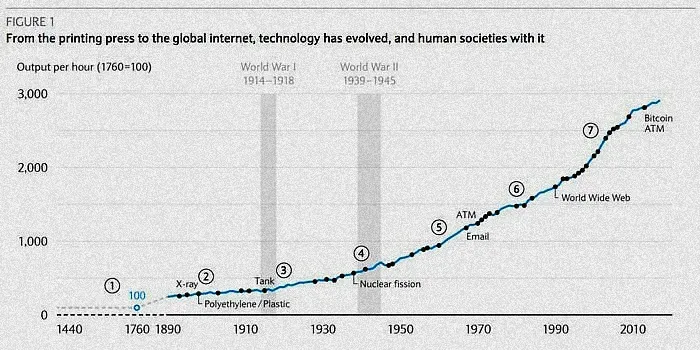
This is the chart that shows us. For most of human history, progress, meaning productivity, has been flat. Then starting around the year 1700, it starts to exponentially rise. This has meant that we are now able to feed more and more people. Before 1700, you really couldn't get above a few hundred million people, and now we are projected to reach nine billion people. You can ask, is this a good thing? I will argue it's not a good thing, but it shows us the remarkable power of science.
Geocentric and Heliocentric Models
Now the question then is, what caused the scientific method to arise? It really has to do with a major debate among scientists. It was the geocentric versus the heliocentric debate. What's interesting is that if you look at the Egyptians, they knew that the sun was the center of the universe. That's why their god was the sun god, Ra. But by the time you hit the Greeks, there was now all this divergence between those who believed that the universe revolved around the sun and those who believed it revolved around the Earth.
In about 150, a Greek scientist named Ptolemy, working in Egypt, he developed the first comprehensive cosmological system. In this cosmological system, which he wrote in a book called the Almagest, he made certain arguments. The first argument is that the Earth stands still. The Earth does not move. It doesn't revolve. Second is that all other celestial bodies, including the moon, including the stars, the planets, revolve around the Earth in a circular motion. Why? Because in the heavens it is assumed that everything is perfect.
For example, on planet Earth we breathe something called air. Oxygen is what gives us life. But up there in space, air becomes ether. Ether is the air that the gods breathe. Ether is what allows the heavens to be perfect. This is the Arabic edition of the Almagest. You can't read this, but there's a lot of mathematical detail in the book.
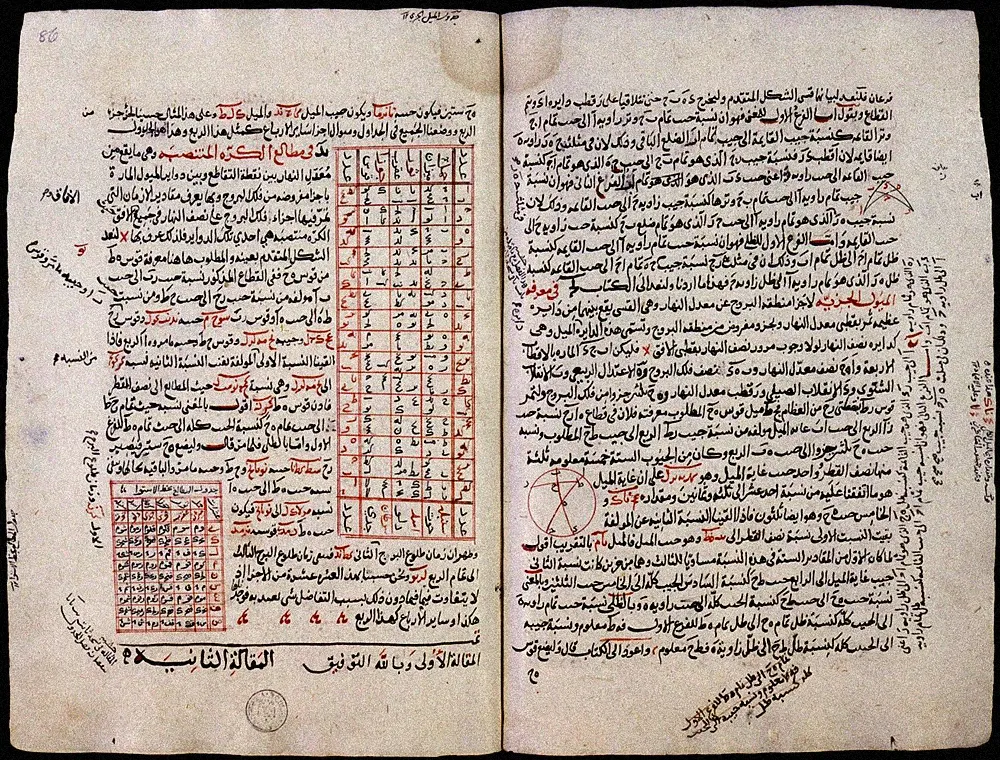
Because Ptolemy's perspective aligned with theology, the Bible, it was accepted truth for over a thousand years. The Islamic Golden Age relied heavily on Ptolemy's understanding of the cosmos.
Copernicus
But the first person to suggest that this model is wrong is Copernicus, who is a Polish polymath. He did many things. He did astrology. He also did astronomy. When he died in 1543, he proposed the heliocentric model. Now, what's really important for us to remember is that Copernicus was a devout Catholic, and many of his friends were major figures within the Catholic Church. Guess what? They were extremely supportive of his theory. In fact, they wanted him to publish his theory. Why? Because at this point, there is no conflict between science and religion.
The saying back then is it is the job of the Catholic Church to tell you how to go to heaven, not how the heavens go. The Catholic Church didn't really care about the geocentric model or the heliocentric model. Didn't care at all. Copernicus was heavily supported. The problem with Copernicus is that the mathematics didn't really make sense.
If I put two books in front of you, Copernicus' book called On the Revolutions of the Celestial Spheres or Ptolemy's book, most scientists would tell you that Ptolemy's book is better. There's more math. It's more well argued. The reason why is Copernicus, his idea is new, and so he didn't have that much time to refine it. People didn't really have time to work on it. Whereas Ptolemy, a thousand people have been working on it over the centuries. The geocentric model, it is much more refined, much more accepted at this point than the heliocentric model.
Tycho Brahe and Johannes Kepler
This man, his name is Tycho Brahe, and he is a Danish polymath as well. He comes from a very noble family, and he spent a lot of his time doing observations. He collected a lot of data. He observed how the planets revolve. His conclusion is that the geocentric and the heliocentric model are both correct. His proposal was that Earth was the center of the world, but the planets revolve around the sun. The sun revolved around the Earth, and every other system revolved around the sun. That's what he derived from his data.
Now, he had a protégé named Johannes Kepler. He's a German, and he looked at the data, and he discovered that the data actually supports the heliocentric model more than the geocentric model. But because he is not a member of the Catholic Church, he's a Lutheran, the Catholic Church couldn't really do anything about him. What's remarkable about Kepler is that just from this data, he was able to make certain predictions about the stars that we've confirmed over time.
The first is that everything revolves around the sun. His problem, though, is that he didn't put the sun at the center of the universe. He put something else at the center of the universe. The sun revolved around that, and the Earth revolved around the sun. Second major law of motion is that the orbit is actually not circular. It's elliptical. That's what the data was telling him. This goes against theology because remember, in theology, the heavens are perfect. That's where God lives. But Kepler is saying the orbit is elliptical. What else he did that was revolutionary is that he discovered that there was a correlation between this orbit and the mass of the planet. This will give rise to Newton. But Kepler made all these revolutionary discoveries.
The Trial of Galileo
Now comes Galileo. Galileo, he lives in Florence at this time, and so he's under the purview of the Catholic Church. He comes from a pretty normal background. When he grew up, he wanted to be a monk, but his dad wanted him to become a doctor instead. They made a compromise, and he said, I'll go study mathematics. But his dad was insistent that he go study medicine. Eventually, Galileo managed to do what he wanted and just do science.
At this point, they invented a telescope. This was not a great telescope. The telescope could give you three times the magnification of the human eye, but it's not that great. But with this telescope, this new invention, Galileo did amazing things. The first thing he did was he discovered that Jupiter had moons. This was revolutionary because it was assumed that everything revolved around the planet Earth. But now he showed that moons revolved around Jupiter. He also recognized that from the Earth, you're able to see Venus spin around us. That also was revolutionary because it was assumed that Earth stood still and all the planets stood still.
He wrote this book, and it was a sensation. He became the court scientist to the Medici family, and the Catholic Church thought this book was great. But the thing about Galileo, which is very important, is that he was a very arrogant man. Because he was promoting the heliocentric model, he was coming into conflict with a lot of academics that were extremely well established, who made their living off the geocentric model. They're having these arguments, and Galileo's arguments were very limited. Remember, this is a new idea. It's not really supported by mathematics. It's not really supported by a lot of data.
Galileo's entire logic was, "I speak to God. I know the truth, and you're all idiots." That was basically how he spoke to his enemies. As you can imagine, he had more and more enemies. As you can also imagine, his enemies were devising ways to get at Galileo.
One thing that Galileo was saying privately that he should not have been saying is that people were saying to him, "Listen, this heliocentric model, it's fine, but it goes against scripture. Let's look at scripture. Scripture says that the Earth, it's firm and immovable. That's what the Bible says. Also, if you look at Genesis, it's clear that God created the Earth first, and then he created the heavens, the sun and the moon and the stars. Logically, everything should revolve around Earth. Galileo, how do you explain this conflict between your theory of the heliocentric model and scripture?"
Galileo's response was, "It's my job to interpret scripture." This, as you remember from last week, is heresy. If you disagree with the Church, that's not heresy. That could just be ignorance. But if you believe that you are above the Church, if you refuse to accept the authority of the Church, if you believe that I interpret the Bible better than the Church, that is heresy.
Galileo was called before the Inquisition. He was asked to explain himself. Galileo was pretty confident. He had the support of the Medicis. He was a very famous author. He was extremely intelligent. He thought that God loved him. As you can imagine, it was a complete disaster. It was a disastrous meeting. The Inquisition told him to shut up. You can write anything you want privately, but do not promote your views anymore. Because if you were guilty of heresy, you could be burned at the stake, Galileo had no choice but to follow this order.
That is until 1632. What happened in 1632? The old pope died, and a new pope, Urban VIII, came into power. Who is Urban VIII? He was a very good friend of Galileo's, and Urban VIII was a huge admirer of Galileo's. Galileo felt he now had permission to get back at his enemies. He wrote a book called Dialogue Concerning the Two Chief World Systems. It was almost like a Platonic dialogue, where he presented his argument again for the heliocentric model. Not only that, but he made fun of his enemies. It's a dialogue, and the chief enemy of Galileo, his name was Simplicio. Simplicio. Not only that, but he put into the mouth of Simplicio a lot of the arguments from Pope Urban VIII. He was making fun of the pope even though they were very good friends.
As you can imagine, the pope was really pissed. At first, he banned this book. What happens when you ban a book? You make it into a national bestseller. Everyone was reading this book. Now Urban VIII was really angry, and so he called for the Inquisition. Galileo was hauled before the Inquisition, and Galileo now had to explain himself. Galileo was coming up with a lot of really silly excuses. He said, "Listen, this book, it's a satire. It's a thought experiment. I know that the heliocentric model is wrong. I wrote this book as an intellectual exercise to see how wrong it could be and to see if it could be right."
He's saying things like this. Didn't work. They basically put him under arrest. At this point, Galileo's friends pleaded with the pope, and the pope said, "Fine, I'm a generous person. I will commute his sentence to house arrest for the rest of his life." That is the story of Galileo.
You can make the argument that it was Galileo's personality that was responsible for his trial and downfall. Because it was his hubris. It's a very classic Greek tragedy. But historically, that's not how we remember the story. The reason why is again, remember, there's a major conflict between the Protestants and the Catholics. The Protestants will use this trial as propaganda against the Church. The Protestants will say, "You see how anti-science the Church is?" Galileo will be remembered now as the father of modern science because he put science above religion.
Even though Galileo was disgraced during his time, eventually what will happen is the Florentines, the people of Florence, they will dig up his grave and put his body beside Michelangelo and Dante. That's how much they revered the contribution of Galileo.
Newton
Again, even though the theory of heliocentrism is correct, the mathematics didn't make any sense. At this time in history, if you had a team of scientists go and look at the geocentric argument versus the heliocentric argument, they would say the geocentric argument makes more scientific sense. It was not until Newton when the mathematics came into being that allowed for the heliocentric model to be widely accepted. Newton, as you know, he's the person who created calculus. The calculus you're learning in school, guess what? He was responsible for the creation of calculus.
Now, what's really interesting for us to know about Newton is Newton didn't really see himself as a mathematician or scientist. These were side hobbies. What he really was was a theologian. He spent most of his time actually reading the Bible because he was convinced that within the Bible were the secrets of the universe. Specifically, he wanted to know when the world would end. He spent most of his life doing these calculations, and he told us that the world will probably end, I don't know, 2060. 2050, 2060, around there.
He spent most of his time doing theology. This is important for us because even at this time, even as the Scientific Revolution is gaining steam, there's no separation between religion and science. People understood faith as a very important cornerstone of science. Without faith, how could you have the energy and the inspiration to understand the mind of God?
Newton is also famous for being an alchemist. He spent most of his time also doing these science experiments where he was trying to combine different elements. Unfortunately, chemistry at this point, it's very primitive. He's taking mercury. He was convinced that mercury would lead to the philosopher's stone, and he was eating it. He was tasting it. As a result, he had a lot of mercury poisoning problems. He couldn't sleep. He had delusions. His hair was falling out. He had mercury poisoning. But at the same time, he had the inspiration to come up with the mathematics to prove the heliocentric model is correct.
The book he wrote is called the Principia. At this time, Latin is the universal language of scientists. Also, guys, at this time, they're not called scientists, they're called natural philosophers. Science is considered part of philosophy. In 1687, this debate ended with the publication of this book. Newton used mathematics to prove once and for all the heliocentric model. This is one page from the Principia. As you can see, there is a lot of mathematics. There are a lot of diagrams.
In this book you also find his laws of motion. Newton's great insight was that probably the laws of attraction, gravity, that govern this world probably govern the heavens as well. Before, it was assumed that the heavens and the Earth were separate. Now he's saying that, "No, these are combined together." He created laws of planetary motion. He figured out the mathematics that told us the relationship between the size of the planets, the mass, and how they orbited.
Now, the problem, though, he had a huge problem. The problem is he had a correlation. He had the mathematical correlation, but he didn't know why the correlation existed. He couldn't solve the causation problem. There's just no way that God would spend all his time moving the planets around. He was much too busy. There had to be an underlying cause. He didn't know what it was, though. Who figured it out? Einstein figured it out.
Einstein
At this point, in 1905, we knew that there was a correlation between the size of the planet and how it moved, and gravity. But we didn't know why. It was the genius of Einstein to figure it out. Now, you remember Einstein because of his famous equation, E = mc². What does E = mc² mean? It means that mass and energy are correlated. This is a revolution. We didn't understand this before. We just assumed that solids and vibrations are different. What Einstein is saying is that in order for a solid to exist, there had to be vibrations in the first place.
This formula tells us that within all objects, there is almost an infinite amount of energy, because c is the speed of light. Why is this important? Because this formula will allow us to develop the nuclear bomb. By splitting the atom, you can create almost an infinite amount of energy in this world. That's a major contribution of Einstein. But at his time, he was mainly known for figuring out the causation problem in space.
How Einstein figured it out is by developing a new idea called spacetime. He believed that in the heavens, there was a spacetime curvature. What was happening was this. A mass, a huge object, it would go into the spacetime curvature and warp it. Because it warped it, it drew things into its orbit. Then these things would have to move around this solid. Spacetime curvature now helps us understand the laws of planetary motion, first developed by Kepler and then refined by Newton.
What's amazing about Einstein is, and this will blow your mind, he did all this while sitting at a desk at a patent office in Switzerland. He was not at a university. He was just thinking by himself. He was daydreaming. This was just an incredible achievement.
The mathematics is very complicated. But all you need to understand is that he figured out that there's a mathematical relationship between the mass of the object and the spacetime curvature. This formula tells us what the relationship is. Why mathematics is important is it allows us to make predictions. These predictions will tell us if the science actually works or not. If the model, the theory makes sense or not.
Einstein's theory of relativity, spacetime curvature, it is one of the most successful models in history because it predicts the black hole. The black hole is almost a solid that is infinitely massive, and therefore it attracts everything into it and sucks everything into it, including light. It predicts the idea of the black hole. We discovered the black hole. This confirms the theory of relativity.
The theory of relativity also predicts the Big Bang because the idea of spacetime is that space is in motion. That's why you have time, because it's in motion. If it's in motion, then where did it start? It had to be a starting point. That's why scientists, not Einstein, Einstein was actually against the idea of the Big Bang, but lots of scientists believe that you need a Big Bang. We have a working model of the Big Bang.
The problem with this model is that there's actually a lot of evidence against this. There are two examples. The first example is using the Hubble telescope, the most advanced telescope in the world, which is now in outer space. We've discovered that there are actually galaxies that came before they were due. The idea of the Big Bang is that it is a massive energy explosion, and so the galaxies will develop later. But our data tells us the galaxies came before, much, much earlier than we expected. That's the first thing.
Second problem that we have with the Big Bang model is that this universal expansion, it is not constant. There are times when it actually speeds up, which makes no sense. Why would it speed up? This Big Bang model, a lot of scientists are now trying to reexamine it. The problem is, and this is a huge problem, we don't have a better theory. To get around the problem of these mathematical inconsistencies in the model, scientists created a new concept called dark energy.
Dark energy. Now, you think to yourself, dark energy means we can't see it. No, that's not what it means. You're like, "Dark energy means we can't measure it." No, that's not what it means. Dark energy means we don't know what it is. It doesn't mean it exists and we can't see it. It just means we have no idea what it is. We can't explain why the Big Bang is expanding really fast at certain points and really slow at other points. We just say it must be dark energy. Dark energy is not something that you can't see. It's just something we have no idea what it is.
Francis Bacon and the Scientific Method
These are the theories. But the person who was most responsible for the creation of the scientific method, his name is actually Francis Bacon. He spent his entire life promoting the idea of scientific processes and methods. He's most well known for his book The New Atlantis.
In The New Atlantis, which is like a novel, the protagonist, he ends up on an island where they have the most advanced science in the world. The reason why they have the most advanced science in the world is because they turned science into a bureaucracy, a very specialized bureaucracy. I'm not going to read all of it, but there are different offices, different bureaucracies for different functions. For example:
We have three that try new experiments such as themselves think good. These we call Pioneers or Miners.
You have an office, a bureaucracy, specifically to do experiments, which means that you have an office, a bureaucracy, specifically to come up with hypotheses, to ask questions. Also:
We have three that take care out of them to direct new experiments of a higher light, more penetrating into nature than the former. These we call Lamps.
You have a team to actually audit these experiments and figure out how to improve them.
Lastly, we have three that raise the former discoveries by experiments into great observations, axioms, and aphorisms. These we call Interpreters of Nature.
These are theoreticians. They're the ones who take this experimental data and combine it into a theory. Bacon is proposing a scientific bureaucracy. Guess what, guys? We have basically achieved his vision today. If you look at science today, it's essentially a bureaucracy.
Now, one of the foundations of this bureaucracy was the founding of the Royal Society of London in 1660. Why is this important? Because for the first time, scientists are allowed to present their findings before a group of peers who will question and doubt them. This will enhance their research process. The founding of the Royal Society was fundamental. As you can imagine, what will come next is publications, magazines that will showcase a lot of these new discoveries. The founding members of the Royal Society include Christopher Wren, who is a very famous architect, as well as Robert Hooke, who is a very famous chemist.
Science as an Imperial Bureaucracy
That's a basic background into the history of the Scientific Revolution. Today we are asking ourselves a very deep question. The Scientific Revolution separated science from religion, and there's a lot of concern that this has created a lot of ethical issues within science. Let's look at three major issues.
- The first major issue is the idea of artificial intelligence. Basically, we're trying to create God. That's a huge concern. What happens when the computers are much smarter than humans?
- Second is the idea of nanotechnology, where we're trying to go into the atomic level and change the laws of nature. We're trying to defy God.
- The third is the idea of genetics, where we are trying to change people's genetic blueprint so that we can have designer babies, so that babies will be free from cancer. Also, we're trying to develop immortality. We're looking for the elixir of immortality.
These are three massive ethical debates within science.
My argument to you today is that this is the wrong question to ask. This is the wrong question to ask. These are not possible within the current scientific framework that we have today. In fact, I would make the argument that these three are essentially illusions. Hocus pocus, magic. Or you can even go as far as to say they are deliberate scams. Artificial intelligence is the example that we're most familiar with. I'm sure you've all used ChatGPT. Is it any good? No, it's not. Will it get any better? No, it won't. But there's so much hype around it.
The real problem is this. The real problem is this. Science has become an imperial bureaucracy. That's the real issue. If you think about the world we live in today, the field that is most like the imperial bureaucracy of China is science today. Science is above nations. It is above government. It does things by itself. What's science doing? Science is promoting its own bureaucracy.
If there's no accountability, if there's no responsibility, if scientists actually have to tell us what they're doing, then it's not that they will become God. It's more like they'll become corrupt bureaucrats. It's more likely that they will take all these billions of dollars the government throws at them, and they'll just waste it all. Why? Because they can. It's much easier for people to be lazy, greedy, and corrupt than it is for them to become God.
I know this is a hard idea, but genius does not come from hard work. It does not come from scientific process or scientific method. It comes from intuition, imagination, and inspiration. Remember when Einstein, he was just daydreaming his theories. Remember when Newton, he was working on theology, he was working on alchemy, and then he developed the ideas of calculus. This is true consistently throughout history. This is a passage from the book The Cosmic Serpent by Jeremy Narby. I'll just read it to you.
Many of science's central ideas seem to come from beyond the limits of rationalism. People do not logically deduce these ideas. René Descartes dreams of an angel who explains the basic principles of materialist rationalism to him.
This is no different from Muhammad, who was meditating in a cave, and the angel Gabriel appeared before him. It's religious.
Albert Einstein daydreams in a tram approaching another and conceives the theory of relativity.
James Watson scribbles on a newspaper in a train, then rides his bicycle to reach the conviction that DNA has the form of a double helix.
What gives rise to great science, to great ideas? Imagination, intuition, and also faith that you are correct. That's Galileo. Galileo was actually convinced that he was right even though the science was very sloppy. In fact, there's this very famous story where Einstein, in the 1930s and '40s, he was having a huge argument with scientists who were arguing for quantum mechanics, specifically Niels Bohr.
Go and look back in the 1930s and '40s, and you look at their arguments. What you will find is that Einstein was very clear, was very logical, and was very scientifically sound. You will find that Niels Bohr was unclear, illogical, and very sloppy with science. But Einstein was wrong. Niels Bohr was right. Today quantum mechanics is the science that underlies all the technology that we have today, including the computer. The semiconductor, the transistor, computer. That's a really important thing that we have to remember about science. At first, it seems wrong, but because the people who believe in it have so much conviction, faith, they eventually triumph.
The Structure of Scientific Revolutions
That's how science develops. This is the argument of Thomas Kuhn in his book The Structure of Scientific Revolutions. This is a book that I highly recommend. If you ever study the history of science, this is the first book that you will read, because he goes into how science develops over the centuries. The central argument is that science does not develop piecemeal and slowly and methodically. It goes through revolutions and paradigm shifts. I know this is going to be a bit long, but it's really important that we read him.
Paradigms gain their status because they are more successful than their competitors in solving a few problems that the group of practitioners has come to recognize as acute.
Ptolemy, for his time, was considered revolutionary because he solved the problem of why the moon revolves around the Earth. He provided a cosmology that was simple and which fit into theology. > To be more successful is not, however, to be either completely successful with a single problem or not successful with any large number.
Ptolemy's solution only solved a few problems. It was not the complete solution.
The success of a paradigm is at the start largely a promise of success discoverable in selected and still incomplete examples.
A paradigm at first, it's actually promising, but it's not at all convincing.
Normal science,
The science that we practice today:
consists in the actualization of that promise, an actualization achieved by extending the knowledge of those facts that the paradigm displays as particularly revealing, by increasing the extent of the match between those facts and the paradigm's predictions, and by further articulation of the paradigm itself.
This is really important, guys. Science is not about discovery. It's about refinement. Science will not give us new ideas. Science will take existing ideas and fine-tune them into something that we can believe and that we can use to drive technological innovation.
Let's look at another passage.
Turn now to another, more difficult and more revealing aspect of the parallelism between puzzles and the problems of normal science. If it is to be classified as a puzzle, a problem must be characterized by more than an assured solution. There must also be rules that limit both the nature of acceptable solutions and the steps by which they are to be obtained. To solve a jigsaw puzzle is not, for example, merely to make a picture. Either a child or a contemporary artist could do that by scattering selected pieces as abstract shapes upon some neutral ground.
This is really important. What he's saying is this. Science today solves jigsaw puzzles. They're trying to take a larger model and fine-tune pieces that make the model much more elegant. It's not trying to reimagine the model. It's not trying to overturn the model. It's not trying to add new pieces to the model. All it's doing is fine-tuning existing pieces. It's like you take a jigsaw puzzle, and there's exactly one solution to the jigsaw puzzle. If you don't provide that solution, you're wrong. That's what science is.
Nevertheless, such a picture would not be a solution.
What he's saying is if you come up with a new picture to the jigsaw puzzle, you might be creative. You might be interesting. You might be imaginative, but you're wrong. Scientists cannot accept your solution.
To achieve that, all the pieces must be used, the plain sides must be turned out, and they must be interlocked without forcing until no holes remain. Those are among the rules that govern jigsaw puzzle solutions.
If you are a scientist working today, you're literally solving a jigsaw puzzle. Everyone knows the solution. If you provide something that goes against the accepted solution, you will not be accepted. He concludes:
But paradigm debates are not really about relative problem-solving ability, though for good reasons they are usually couched in those terms. Instead, the issue is which paradigm should in the future guide research on problems, many of which neither competitor can yet claim to resolve completely. A decision between alternate ways of practicing science is called for; in the circumstances that decision must be based less on past achievement than on future promise. The man who embraces a new paradigm at an early stage must often do so in defiance of the evidence provided by problem-solving.
This is hard for us to understand, but if you are to be a true innovator, it's not that you come up with a new solution to a problem. It's that you must defy the basic premises of bureaucratic science.
He must, that is, have faith that the new paradigm will succeed with the many large problems that confront it, knowing only that the older paradigm has failed with a few. A decision of that kind can only be made on faith.
This is why it's almost impossible to separate religion from science. If a new discovery is to be made, that person must believe that he is sent by God to tell us the truth. That's Galileo. Galileo, if you actually met the person—he's arrogant. He's obnoxious. All he does is make fun of you. But he's driven by a divine mission to spread the truth. Because he created this conflict with the Church, it became a national controversy and focused the attention of scientists, and they tried to resolve this issue. Scientific innovation, genius, it's not a tea party. It's a revolution.
Doubt and Bureaucracy
I want to summarize what we did so that you have a basic framework to understand what I'm talking about. I want to make sure that we understand the argument. Our argument is this. For most of history, science was part of religion. Science was about validating this religion. But this creates a problem we call confirmation bias. Confirmation bias. Meaning that we will only look at evidence that supports our claims. We do this every single day. We all want to be right. We all want to feel good.
There's a very famous experiment called the Dunning-Kruger experiment. Dunning and Kruger were two American psychologists, and they were teaching an undergraduate class of foreign students. They made these students do two things. The first thing is they made every student take an IQ test. The second thing is they asked each student how they think they did on that IQ test. Were you in the top 5%? Were you in the bottom 5%? Were you average?
It turned out that once they looked at all the results, not one student predicted his or her class ranking. Those who did really well, the top 5%, it was pretty easy for them, so they assumed it was easy for everyone. They underestimated their performance by about 10%. Those who did the worst didn't really know what was asked of them. They overestimated their performance. In fact, those who got the most wrong were the worst students. Maybe they were in the bottom 10%, but they thought they were average.
What this tells us is this. Doubt, self-doubt, it's really the mark of genius. If you're able to doubt yourself, if you're able to question yourself, if you're able to self-reflect, that's a sign of an excellent student. In fact, the best sign of an excellent student.
The question then is, how do you bring doubt into science? What you do is you separate science from religion, and you create a bureaucracy around science in order to instill doubt in the scientific process. That's the solution proposed by Francis Bacon. Again, it is the most successful solution in human history. The scientific process is hypothesis, experiment, data analysis, replication. You have a hypothesis. You then test it out. If it works according to data, you then have to replicate the experiment to make sure that you are correct.
Now, the beauty of this model is that you can actually make it into a bureaucracy. Each department does its own thing. What happens is that each department is inspecting and auditing the work of the previous department to make sure the results are accurate and correct. It turns out if you do it this way, it's revolutionary. It explains the world that we live in today. It explains why scientific progress has been so fast and so remarkable these past 300, 400 years.
But embedded in the system are lots and lots of other issues, which I will discuss.
- The first is the idea of political control. It takes a lot of resources to run this system, and as a result, you can allow politicians to come in and interfere with the science. That's the first problem.
- Second problem is that over time, each department will overspecialize. You have overspecialization, which means that these departments are now unable to communicate with each other because the underlying assumptions, the science of each department will be different. If you want experiments, we usually have instruments. All these instruments are so complicated that normal scientists don't really understand what you're doing. That's the second problem, overspecialization.
- The third problem is the idea of accountability. How do you know if each department is doing their job or not? You can't, because now they're overspecialized. The word we use is they are now aloof.
- There are many problems with this system. Another problem is insularity. Meaning that you have to spend like 20 years in school before you could even enter the system. Insularity creates gatekeeping, which means that only if you play by the rules, only if you're vetted, you enter the system. As a result, you no longer have any creativity.
This is the great irony of science. Science was initiated, inspired by the genius of Galileo, Newton, and Einstein. But today, science has developed to a point where it no longer welcomes Galileo, Newton, or Einstein. Why? Because Galileo doesn't get along with other people. They won't let him in. Newton is crazy. He's an alchemist. He believes that the Bible will reveal the end of the world. He's crazy. They won't let him in. Einstein is really bad at mathematics. He would fail all these mathematics tests in order to get into the system. He probably would not get into graduate school today.
This is the world we live in. Don't worry about artificial intelligence. Don't worry about billionaires living forever. Don't worry about nanotechnology. Worry about the fact that we've come to a point in our civilization where we are now incapable of innovation.
Questions and Discussion
Intuition, Faith, and Imagination
"Just a small observation, sir. When you set up this lecture, you talked about premodern science, and it relied on intuition and faith and imagination. I was really getting ready to push back on you and say, 'Hey, that's a lot of what makes modern science great.' You brought that in very nicely in the later stages of the lecture there. Kind of inspired."
Newton's Prediction
"I've got a light question. I didn't know about Newton's predictions about the end of the world. But if you're saying 2050, 2060, what do you think the chances are that he was right?"
Why do we know that Newton predicted the end of the world? The reason why is this. Newton didn't have any family. He didn't have a wife. He didn't have any children. His entire estate was left to his nephews and his nieces. Newton also left them a lot of money. These are aristocrats. Newton is actually the first commoner, the first non-royal in English history to receive a state funeral. He's the first commoner to be buried at Westminster Abbey. He was a very big deal back then.
His relatives, obviously, were aristocrats. But the thing about aristocrats is that over time, they become poor. What do you do when you become poor? You sell off what is valuable. Newton's papers, all his notes, were auctioned off in, I think, the 1930s. I don't remember. But 1930s.
You would imagine that everyone would want these notes, because they reveal genius to you. But for whatever reason, they didn't really sell very well. The auction was so bad that it was sold piecemeal. One person who bought the notes was John Keynes, the economist. John Keynes, the economist. He was so excited to read the papers of Newton. He was like, "Oh my God, there must be so much mathematics in these papers that will lead to new discoveries." When he actually read the papers, he was actually aghast at what he discovered. It was alchemy. It was theology.
What Newton was trying to do was he was trying to read the Bible and look for a secret code. I mean, he was crazy. Look for a secret code within the Bible that would tell him the future. He was actually convinced of something called the Second Coming. He was convinced that Jesus will return. I mean, these are all Christians at this point. He was actually convinced that Jesus will return. He wants to know when he would return and how he would return. I think he made the prediction 2060. But I can't be sure. But he made a prediction when the world would end.
What's more important for us is that he became what we call a Christian Zionist. The idea of a Christian Zionist, and this is really important, is that once you predict the future and you know when Jesus is returning, you want to know how he returns. Newton became actually convinced that for Jesus to return, certain conditions had to be met in order to facilitate his return. One major condition was the return of the Jews to Jerusalem, because at this point, Jerusalem was being controlled by the Ottomans. He was actually convinced that we had to get all the world's Jews and return them to Jerusalem. The only problem was Jews didn't want to go back.
I think Newton, and this is completely unknown about him, he's actually one of the founders of a movement called Christian Zionism. Let's figure out how to get all the Jews to go back to Jerusalem, and this was a process which will culminate with the return of Jesus.
What this tells us, and this is also something that is really important, is he was part of a secret society with John Locke and some other really important individuals. This secret society, they considered themselves the true Church. Newton, in his notes, he was very clear. He thought the Holy Trinity was nonsense. There's only one God. He was a representative of God on Earth. He was here on a divine mission. He's part of this secret society to try to achieve Christian Zionism and to discover when the Second Coming will happen. He makes this prediction, 2060.
Whether or not Newton is correct, that's not the issue. The issue is that with his power, with his influence, he was heavily promoting Christian Zionism in England. As we know, what will happen is these people will go to America. A lot of these people who are Christian Zionists, they will go to America believing that America is the New Jerusalem. What will happen later on is the Christian Zionists will link up, and they will plot to bring the Jews back to Jerusalem. This leads to something called the Balfour Declaration. Which is to say that after World War I, when the Ottoman Empire was defeated, the British Empire now gives permission to all the Jews in the world to return to Jerusalem, whether or not they want to.
This is why history is so important, because you cannot possibly understand what's happening in the Middle East today without first understanding all this history.
"Odds are he was right. 2060, things are going to happen."
"Again, I'm just kidding."
2060, again, that's not the issue. The issue is that there are very powerful people in this world who believe in this and who believe that it is their divine mission to make this come true. To use their power, to use their influence, to use their money to make this prediction come true. It's not really a prophecy. It's really a plan. This is what it is. It's a plan. It's like, how do we bring back Jesus? Because when Jesus returns, the world ends, and everyone's happy. Heaven comes on Earth. But how do we make it happen? Here's the plan. Christian Zionism.
That's my real concern. Whether or not the world ends in 2060, I don't know. But the fact that there are really powerful people of the stature of, I think, Newton, with almost unlimited resources and unlimited power, they actually believe in this, and they want to make this come true. That should be the major concern.