Civilization #45: The Gunpowder Revolution
Today we are doing the gunpowder revolution. Specifically, we are going to ask the question: how did Europe, starting about the year 1700, conquer the world? After the fall of the Roman Empire, Europe became divided, very poor, and very weak compared with the rest of the world. But then, starting in the year 1700, Europe very quickly, in only about 200 years' time, will go on to conquer the entire world. Today we are going to examine how this happened.
Before we begin, I want you guys to remember a very important concept that we have been developing throughout this course. And the concept is this: the nature of the military determines the nature of the political system in societies and nations. The four specific examples we've looked at are Sparta, Athens, Macedonia, and Rome.
- Because Sparta had a hoplite army, it became an oligarchy. Oligarchy means rule by the few, rule by the elite. And hoplites were farmers who could afford their own armor and weaponry.
- Athens had a navy, and so it was a democracy. And the idea here is that anyone and everyone can row a boat. And if you can row a boat, you can fight a war, you can help Athens win, and therefore you can participate in the political process. So Athens was a democracy.
- Macedonia, where Alexander the Great is from, had a cavalry-based army. And because only the nobility could afford horses, it was a monarchy.
- And the last example is Rome. Now, the thing about Rome that made it distinct from these societies is that it was willing to make tremendous sacrifices on the battlefield, because it could replenish its soldiers with allies from neighboring nations in the Italian peninsula. And as such, it was a republic. Now, the difference between a republic and a democracy is that in a democracy, everyone has the right to vote, so the decisions are based on majority rule. But in a republic, it is rule by laws and tradition and history. So people will do what has been traditionally accepted as the norm. And as such, you can bring immigrants into your society very quickly. This is important for us because Rome will become the model for America. America is not a democracy, it is a republic, a very important difference.
I want you guys to remember this idea: the nature of the military will determine the nature of your political system in your society.
Basic Military History
Let's go over some basic military history. In Greece, when the poleis were fighting each other, in very much the same way that the Warring States were fighting each other in China, the main soldier is called a hoplite. Hoplite means shield in Greek. And the thing about the hoplite that's very important is that it was a self-sufficient soldier, meaning that most of the time he was a farmer, but when there was a war, he would grab his armor and his shield and his spear, and he would go to war. You didn't need an economy to allow the hoplite to exist. This was a self-sufficient system.
Over time, the Macedonians will take the hoplite formation and turn it into the Macedonian phalanx. And the Romans will have their legion. Now, the difference between this system and the traditional Greek system is now you have a standing army. These are professional soldiers that must be supported by the economy.
This is cavalry, the Roman cavalry, and obviously these are nobility because only they can afford to have horses. These are the Vikings that we've studied before. Again, this is pretty self-sufficient. The Vikings are able to build their own ships very quickly and repair them. And they are able to go off in small bands.
The steppe people became archers. The Mongolians are the classic example. And again, the thing here is that these people, ever since they were born, could ride horses and shoot arrows. And that's why they were such effective soldiers, and that's why for the longest time, the steppe people were the dominant military force in the world. They could come in and conquer all the agricultural empires. This would include the Yamnaya, which we talked about, but it would also include the Turks and the Mongolians.
In medieval Europe, they develop a new system where the knight becomes the main military force in the army. Now, the knight, as you can see, requires armored horses and armor and weapons. And this is very expensive. And you have to train from an early age to become a knight. And that's why you now have a system called feudalism, where the entire economy revolves around maintaining knights for war purposes. This is where feudalism comes from.
What makes feudalism stick is the idea of castles. Feudalism is about decentralization, where the knights and the lords have control over the local territory, and there's nothing the king can do about it. Why? Because maybe if there's a fight between the lords and the king, and the king comes with his army, the lords can just hide in their castle. And as you can see, it's very hard to besiege and destroy a castle. First of all, there's a defensive perimeter, the moat, and then the high walls. And eventually, the king will have to give up.
So in the feudal system, the king is more like a figurehead who is appointed as maybe the chairman or the elected leader. But the king does not have that much power over the local areas.
Constantinople and Gunpowder
This changes in 1453, in the city of Constantinople. For close to a thousand years, Constantinople was the wealthiest, most powerful city in Europe. They are the heirs to the Roman Empire. They consider themselves the Eastern Roman Empire. And they are invincible because of their high walls. Remember, we talked about the Byzantine Empire before. And for about a thousand years, Constantinople was powerful because they were invincible. You cannot besiege the city.
But in 1453, this changes because the Ottoman Turks come in with cannons, and they laid siege to Constantinople, and they destroy the walls. And this was unimaginable before. And so it's gunpowder that allows the Ottomans to destroy the once-impenetrable Constantinople. And this marks a revolution now in Europe. Now, people understand that you need gunpowder if you are to win wars in the future. This is a revolution now in Europe.
Over the centuries, what will happen is this: gunpowder will radically remake the world in three fundamental ways.
- The first way that's important is the steppe people cease to be a threat. For thousands of years, the steppes, the Mongolians, the Turks, the Yamnaya, drove history because they could come in and conquer empires and establish new societies. Now, with gunpowder, the cities can defend themselves against the steppe people, and eventually, over time, the Russians will colonize the steppes. And they will cease to be a factor in the development of global history. So this is the end of the steppes. That's the first fundamental change.
- Second is this will mark the beginning of Europe as the dominant global power in the world. It is China that invents gunpowder, over a thousand years ago. But it is Europe that will perfect gunpowder as the ultimate military weapon. And it will allow Europe to defeat everyone, including Ottoman Turks, including the Chinese, everyone.
- The third and most important fundamental change is that gunpowder will usher in a whole-society revolution that will remake the fabric and structure of European society.
These are the three fundamental impacts of gunpowder.
The Borderlands and the Gunpowder Empires
Let's talk about the steppes. Before, we discussed why the steppe people, the Vikings, the borderland people, usually tend to win out against empires, even though empires have much more resources, much more people, much more technology. This is the chart that explains why the borderlands win out in the end.
Because the borderlands have energy. The people are much more courageous, they're much more hungry, they're much more determined. Openness: the borderlands people tend to be much more innovative. They're open to new ideas. They don't invent things, but they take inventions and they apply them to the society. The last is opportunistic, where they will only attack you if they think you're weak.
The empire has three advantages: mass, organization, and depth. Mass just means a lot of people. Organization means a centralized bureaucracy. And then depth just means that they can afford to lose a lot of battles. And for most of human history, the borderlands had advantages over the empire. But with the advent of gunpowder, the dynamic changes. So now the empire is able to control and crush the borderlands.
The main reason why is with gunpowder technology, you need organization. You need centralization. Remember, before armies were self-sufficient. You needed to go to war, you told everyone, "Let's go to war." And then the people who were soldiers would get their armor and they would rush to battle. That's what the Greeks did against the Persians. But with gunpowder, you need a professional army, you need engineers, you need the resources that allow you to make gunpowder. So you need specialization. With specialization, you need centralization, hierarchy, and bureaucracy. And that's what empires do very well. And the borderlands don't do this. And that's why eventually the empires will win out against the borderlands in the long term.
There are four major gunpowder empires, meaning these four societies are most equipped, most ready to take advantage of the gunpowder revolution.
- The first and most important gunpowder empire is the Ottoman Empire. They're the ones who took the cannons, the artillery, and they're the ones who destroyed Constantinople. And the Ottomans after that became the dominant power in Europe and the Middle East. The Ottoman Empire. What made the Ottoman Empire so fierce was their use of professional soldiers called Janissaries. Janissaries are young boys who are Christian and became slaves to the Ottomans. And they were educated to become professional soldiers. And because they're basically slaves, they owed their entire loyalty to the Sultan, the king of the Ottoman Empire. And these are professional soldiers who made very effective use of gunpowder in battle.
- That's the Ottoman Empire. But then you also have the Mughal Empire, which was the height of Indian civilization. They were also for the longest time a centralized bureaucracy, and they were also able to take advantage of gunpowder.
- Then you have the Safavid Empire, which is in modern-day Iran. They are the heirs to the Persian Empire. And remember what you learned last semester: it was really the Persians who created bureaucracy in the world.
- And of course, the last and arguably most powerful of these gunpowder empires is China. This is the Ming Empire. Remember, it was China who invented gunpowder.
But what's interesting is when China invented gunpowder, it was not used that effectively. The Chinese army used gunpowder mainly as bombs or as fireworks, as incendiaries to blow things up. But because of the Islamic Golden Age and because of Genghis Khan's conquests, globalization came into being. And this technology of paper and gunpowder spread all the way to Europe. It was the Europeans who innovated gunpowder and turned it into a propellant. It's something that you shoot people at, a projectile. And that's why we have cannons and muskets. And so it was the Europeans who actually invented gunpowder as a projectile. And then what would happen is the technology would come back to China and China would adapt this into their own army. So that was the process.
A Whole-Society Approach to Warfare
The paradox is this. It was China who invented gunpowder. And the four great gunpowder empires are the Ottomans, the Safavids, the Mughals, and the Chinese. But at the end of the day, it is Europe that conquers the entire world. That's the paradox. That's the mystery that we're looking at today. And so the thesis, the answer, is European nations would surpass the gunpowder empires because they would adopt a whole-society approach to warfare.
What does that mean? It means that if you are really to integrate gunpowder into your military effectively, you need to change the structure of your society. You have to change the status quo. You have to move from a society that is heavily centralized to one that is both centralized and open as well.
I'm going to explain to you what changes Europe had to make in order to become a modern military.
- The first change is it went from a feudal system to a nation-state system. Feudal is decentralized local powers. Nation-state is you have a centralized bureaucracy. You need that. And that's what Europe did.
- Second change is it went from a focus on villages, on agriculture, to a focus on towns and industry. Because with gunpowder, you need specialized workers, you need engineers, you need ironworkers, and that happens in towns and not in villages. Also, when you move to towns, you start to create proto-capitalism. So the merchants become much more important than the bureaucrats. Because it's the merchants who go and procure resources necessary for gunpowder.
- And the third major change that happened in Europe that really didn't happen anywhere else is a shift in focus from religion to science. Religion is asking a question: "What does God want from us? How can we best serve God?" Science is asking a question: "How can we win this war? How can we make gunpowder much more effective? How can we kill more people?"
These are the three major revolutions that happened in Europe that really didn't happen anywhere else. And when they happen in Europe, it will unleash these extremely violent and powerful revolutions as well, including the French Revolution, the American Revolution. And it's a bloody process that takes centuries to unfold and to develop. But it will make Europe into the dominant power in the world, and it will allow Europe to conquer the entire world and force nations like China to adopt European social frameworks.
The main advantage that Europe had over the rest of the world was also its main disadvantage, which was Europe, ever since the fall of the Roman Empire, was always divided and poor and always fighting each other. The concept we use for this in our class is open cooperative competition. This is the main driver of innovation in the world. When was China most creative? During the Warring States period.
This is consistently true throughout history. Whenever a society is fractured and the different constituent parts are forced to fight each other, this will lead to massive innovation not just in the military but also in society, in philosophy, in literature. We talked about the three revolutions in Europe that came about because of the gunpowder revolution.
Artillery and Fortification
One thing to keep in mind is in the beginning, it was not obvious to people gunpowder was a revolutionary force. It would take centuries before societies, the military, used gunpowder as the main weapon. And the reason why is in the beginning, gunpowder was very unstable. It was hard to store, it was hard to make, and the guns that you used were too heavy. So they were only a small part of your military.
Also, what's important for us to remember is that there's always been a battle between artillery and fortification. So even though the Ottomans used a cannon to destroy Constantinople, engineers would figure out ways to better defend the city. The first strategy against gunpowder was the idea of earthworks. Basically, it's very simple. You just dig trenches around your city. And therefore, the cannons cannot come into range of your city. So there are different strategies you can use to negate the advantage of gunpowder. Earthworks is one advantage.
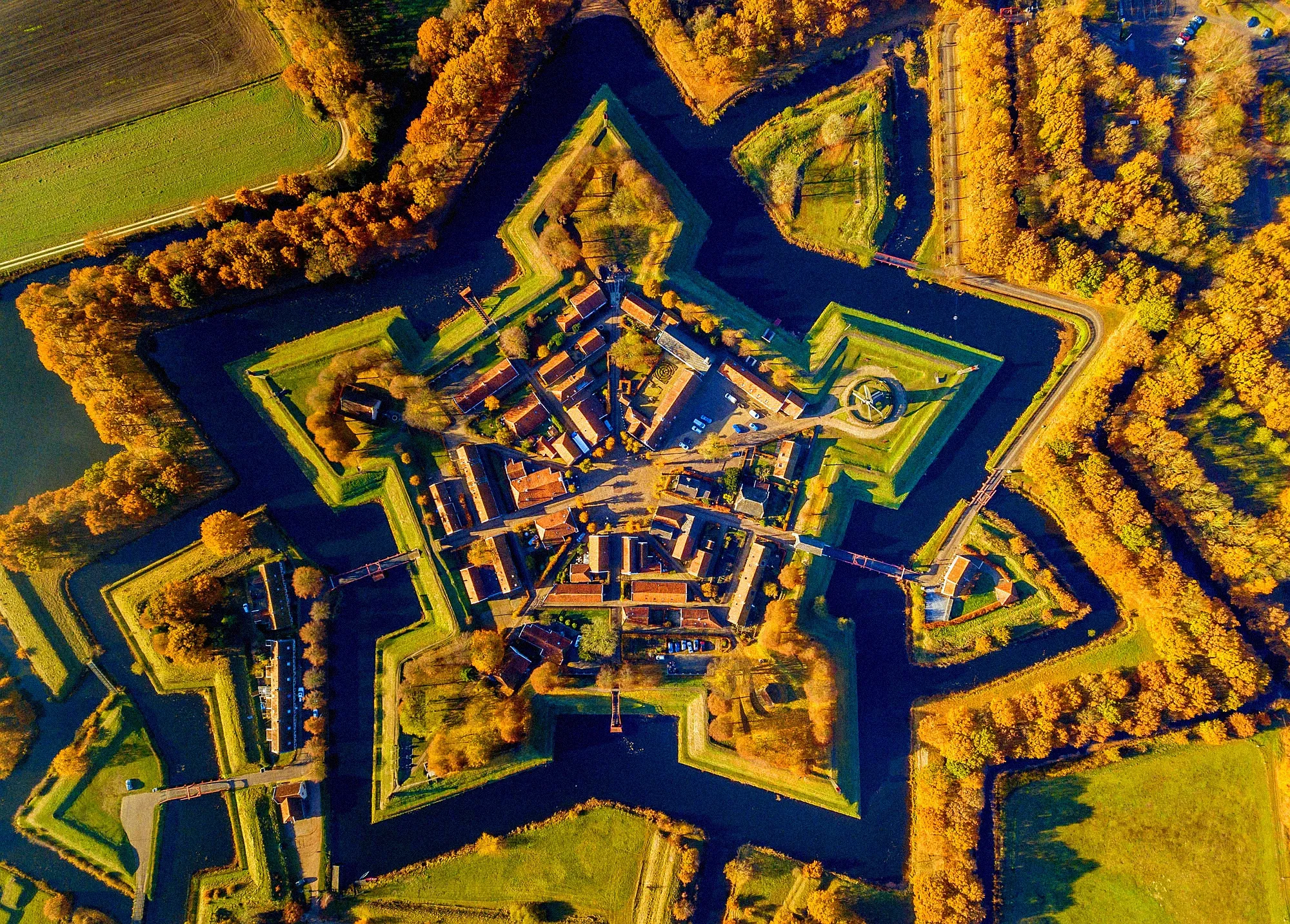
But then, what they figured out was something called a star fortress. And this is another revolution in the military. A star fortress is designed differently. Most fortresses before were rectangular because they were the most intuitive and the easiest to build. But with a star fortress, you have different points in the fortress so that even if one part gets destroyed, guess what? You can fill the gaps. This part gets destroyed, but then you fill the gaps here. That part gets destroyed, you fill the gaps here. So you basically have to attack the entire fortress at once. And most armies don't have these resources to destroy the entire fortress at once. You can only do it part by part.
You want to breach the fortress, but a star fortress allows you to be resilient, to be flexible. The word that we use for this is ductile. Ductile just means the resilience of materials.
The gunpowder revolution will also mark radical changes in military formation, organization, and hierarchy. Again, at this particular stage, gunpowder is only a small fraction of the entire army. Most people are using spears and pikes together. They also have cavalry as well. So the problem for Europeans is how do you best utilize all these resources in an efficient and effective manner?
This is one possibility where the pikes are at the back, the gunpowders are in the front, and the cavalry is to the wings. And this provides more flexibility in your army. And because Europeans are always fighting each other, they're always able to figure out new strategies. This is a picture of a European army in the 16th century.
The Resources and Technology of Gunpowder
Let's talk very quickly about the formation of gunpowder. How is gunpowder made? Gunpowder is made using three different resources. They are saltpeter, sulfur, and charcoal. Charcoal is pretty easy to get. Sulfur you get basically from volcanoes. And in Europe, the place where they had the most volcanoes was Italy, in the Italian peninsula. So if you look at the history of Europe, most wars, the vast majority of wars, were actually fought over the Italian peninsula. One, because you need sulfur for gunpowder, but also because the Italian peninsula controlled trade with the rest of the world, and also because the church was there, the pope was there.
Saltpeter, the technical name is potassium nitrate, and it comes from manure. Manure. It doesn't really grow naturally, so they have to farm it. They have to make it. They make it basically by taking horse manure, animal manure, and planting it in the ground and then farming it. So this became an industry unto itself. And saltpeter is important because as they chemically enhance gunpowder, they discovered that saltpeter should go from 41% to almost 70%. So saltpeter was the main ingredient in gunpowder. And the Europeans had to figure out ways to mass-produce saltpeter. And that's why they came up with these nitre farms. And this became a very important part of European society.
You also had chemists working in laboratories to better refine the technology of gunpowder. Because one huge issue with gunpowder is it's very hard to store. For example, if it rains, guess what? No more gunpowder. So they constantly have to refine the chemical composition of gunpowder to make it resilient against rain, to make it easier to store, to make it easier to transport. There's also a good possibility that along the way the gunpowder explodes on you. So this was an absolute necessity to figure out how to better make, store, and use gunpowder.
You also had ironworks. Because you need iron and metal to make cannons, which was the main use of gunpowder. These are foundries where they will make gunpowder. And again, this helps us explain why towns became much more important than villages. Because it's towns where you have the specialization going on and not the villages.
The thing to remember about the early guns called the arquebus is that they're very heavy. Now, these are metal. So the soldier basically needs something to stabilize the gun. But even once the gun is stabilized, it's not very accurate. You're better off actually with a bow and arrow, and that's what most people were using, bow and arrow.
The other thing about the arquebus and the musket is it's very, very slow. You have to aim it. Then you have to fire it, and then you have to reload it. That could take maybe 10 minutes, half an hour. The technology will get better and better over time, but it's very, very slow. So you have two issues with the guns, the musket, the arquebus. One is that it's not very accurate, and second of all, it's very slow.
So the only solution is to have a mass army, to have a lot of soldiers firing at once. So you don't even want to aim. You just want to shoot it directly at cavalry or soldiers. And that's the idea. And that's why these armies like the Ming and the Ottomans were most able to use gunpowder effectively because they could organize mass armies. So the Ming were one of the main innovators of gunpowder armies using something called a volley. What would happen is soldiers would stand in line, they would come up, shoot it, then walk to the back, and a new line would come up and shoot it again. They weren't aiming, they were just shooting it. And this is what we call volley fire. So this is the main tactic.
Soldiers, Schools and Synchronicity
But over time, gunpowder will become much more effective, much more accurate, much faster. And now, what you can do is conscript more soldiers. In other words, what is required now is more conscripts for your army. This is a picture of a battle. But not only that, you need your soldiers to be obedient. Because you're asking them to charge into gunpowder. And so you needed to change the nature of people from basically peace-loving, pretty simple individuals who were used to freedom to ones who were obedient, who were bloodthirsty, and who could kill other people. And that's why you now have the invention of something called schools.
You want to know where schools come from? It comes from the need to create as many soldiers as possible for your mass army. A concept that I want to introduce you to is the idea of synchronicity. Synchronicity is to structure your society so that people in society are able to follow the rules. They're able to follow the rules, then your society can become much more prosperous and can have more effective militaries. So the two classic examples in this world of synchronicity, the two societies that do synchronicity the best, are Germany and Japan.
Go to Germany, go to Japan. And go on the subway. Guess what, guys? Even though it's really, really crowded, everyone stands in line perfectly. Everyone knows his or her position in the line, and everyone's willing to wait in line. That's why in the 20th century, Japan and Germany had such effective militaries. And also why they have very effective industries. Schools, it's preparing people not just for the military, but also for the assembly line, the workplace. And again, societies that are most able to stand in line orderly will be the most effective in terms of industry and military. And that's usually the European societies and Japan as well.
Again, gunpowder marks a whole-society revolution, changing not just the military and how wars are fought, but changing the very nature of what it means to be human. If you want to know where schools come from, it comes from the need to fight wars. And again, China will adopt all these policies and social structures for itself.
Wars and Casualties
Let's go over some wars. What's really important about Europe at this time, and why Europe became the dominant power in the world, is it never stops fighting each other. It's always fighting wars internally and externally against the Ottomans. The wars between Europe and the Ottomans are called the Hungarian-Ottoman Wars, and this will last for about 300 years. And in the beginning, this is really important, the Ottomans destroy the Europeans. The Ottomans are able to destroy Constantinople, and they're able to take over most of Eastern Europe. So the Ottomans for many centuries up until the year 1700 are a dominant military power in Europe and around the world at this time.
There's also something called the Hundred Years' War that is fought between France and England.
Let's now go over some wars, and what I will do now is show you the casualty count, how many people are killed in action. Again, as I mentioned, a lot of wars are being fought on the Italian peninsula. The Second Italian War, there's maybe 200,000 killed during this war. These are soldiers killed, not civilians.
But when you get to a few years later, it's 31,000. And then it goes up to 30,000, and then 75,000. These numbers are going up. Why? Because the armies are getting larger, and the weapons are getting much more precise and effective. This is the reason why more people are dying.
The English-Spanish War is really important. 48,000 people died. This is important because, remember, we talked about how Spain is a dominant naval power in the world, and that's what allowed Spain to colonize South America. But in this war, England will destroy the Spanish Armada, the Spanish navy. And England now will become the dominant navy in Europe and around the world. And they will maintain this position until America in World War II. So this is a really pivotal point in history, the sinking of the Spanish Armada by the English.
The Thirty Years' War was a religious war between Protestant Europe and the Catholics. This will kill between 4.5 million and 8 million people over a span of 30 years. This is the worst war in Europe before World War I. So these wars are becoming much more violent, much more deadly.
Spanish-Portuguese War, 80,000. Franco-Spanish War, 108,000. You're seeing these numbers go up. Franco-Dutch War, 242,000. War of the Holy League, it's almost 400,000. This is important because this is when Europe is finally able to defeat the Ottoman Empire. This marks a radical turning point where Europe will now become the dominant military power in the world, and the Ottomans will now decline rapidly.
Now, you may be asking yourself, "Wait a minute here. Why are all these wars being fought?" And the answer is Europe is divided among different kingdoms. And the main policy of all these kingdoms is balance of power. So whenever a new power arises, the other powers get together and try to take down that empire. Before it was Spain, and then Spain was destroyed, then it was France, then it was Russia, then it was Germany. So that's the idea here.
Nine Years' War, almost 700,000. The Seven Years' War is really the first world war because it's a war fought between France and England for control of the entire world. It's being fought in North America, and it's being fought in Europe. And almost a million people get killed in this war over seven years.
French Revolutionary Wars, 663,000 killed. The French Revolutionary Wars are important historically because a lot of people who fought in this war are not professional soldiers. They're just citizens who have revolutionary devotion and fever. They love their country, they want freedom for the country, so they take up arms, and they're able to defeat more powerful European adversaries. Guys, so this is the beginning of what we call the nation-state, when a citizen is completely loyal to the nation. The French Revolutionary Wars.
And then, of course, the climax is World War I, and you count 20 million people. 20 million people die in this war. So you can see how the casualty rates just go up exponentially over the decades. And that just shows you how fast the Europeans are innovating. They're innovating in terms of bureaucracy, meaning that they're able to tax their citizens much more effectively. They're able to conscript more soldiers effectively. They're also innovating in terms of technology because of science. They now have machine guns. In World War I, they also have trenches.
Changing Powers and Growing Populations
As I said before, the thing about Europe is that it's always divided into different factions who are always fighting against each other. And what these maps will show you is two things. First is that the status quo is always switching back and forth between different nations. In the beginning, in 1448, the Holy Roman Empire is a dominant power in Europe with a population of 15 million people. That's the first thing I want you guys to notice about these maps. The dominant power is always changing over time.
The second thing that you will notice is that even though, this is really interesting, even though these wars are deadly, they're continuous, and they're becoming much more violent, the population of every nation in Europe goes up over time.
1554, the Ottomans now are in control, and they're at 24 million. The Holy Roman Empire goes down to 19 million, but France is rising, so is Russia. 1623, the Holy Roman Empire is still around. So the Holy Roman Empire and Ottomans are the dominant powers. But by the time of 1660, France actually becomes the dominant power in Europe. And because France becomes the dominant power in Europe, all the nations decide to go against France. And this leads to a series of wars.
1727, France has 23 million. That matches the population of the Ottomans. Russia is rising now. Right before the French Revolution, 1780, France is now the most populous country in Europe, 27 million. The Ottomans have 26 million. And this is right before the French Revolution.
1824, the Russians are now at 49 million. They become now the dominant military power in Europe. And this will bring them in conflict with the rest of Europe. So England and Russia will fight in what they call the Great Game. The rivalry between the United Kingdom and Russia, which still goes on today, by the way. It's still going on today, the Great Game.
Germany is now rising in 1890. This is right before World War I. And so Germany now is a dominant power in Europe. So guess what happens? All the nations in Europe combine together to attack Germany. And this leads to something called World War I.
That's the quick introduction to the history of the military revolution in Europe.
How Can Societies Recover from These Wars?
Every time in a war, they kill so many people, and especially the male labor in the society. How can they recover from such a hurt every time?
Great question. So the question is these wars are so deadly. And so how is it possible for these societies to be resilient and to recover? There are many, many factors going on. But what's important is the rise of something called the nation-state. So the nation-state replaces the role of religion in people's lives. Before, you had to sacrifice your life to the will of God. You had to serve God. Now, with the French Revolution, you now have to dedicate your life to the nation. The glory of the nation. And what does that mean? It means that you have to do whatever it takes in order for your nation to beat other nations in war, which includes working hard, making a lot of money, but also includes basically having a lot of children.
And this is facilitated by the scientific and agricultural revolution. Remember, we talked about how because of the Age of Exploration, the Europeans were able to bring back the potato, corn, tomatoes, squash. These are pretty easy to grow, and they provide a lot of nutrition for the European nations. But what's important is what's really driving the population growth is war and the necessity for having a large population. So the government will provide a lot of policies that promote population growth.
And I know it's hard for us to imagine, but war gives people meaning and purpose. It's like rooting for a sports team. You want your sports team to win, no matter what. You're going to go and cheer them on. That's what war does. War really galvanizes the energy of people. So people feel extremely patriotic during wars, even though their children are getting killed.
The other thing that's really important about war is that it gives people hope in the future. I know this is paradoxical. But let me explain. With war, a lot of people die. With death come opportunities that didn't exist before. That creates social mobility. So it's perfectly possible that you're a peasant, but because of war, the nobility dies off, and your son can go join the army, become a captain or lieutenant, come back and start his own business. And that wasn't available before. Because in peacetime, the social hierarchy stays stagnant.
And so if you think about it, it's because we live in a world of peace, something called the Pax Americana, the American peace. And that's why a lot of young people refuse to have children. Why are young people refusing to have children? They really don't see a future. It's like, "I'm not going to rise up in the social hierarchy. My kids aren't going to rise up in the social hierarchy. There are fewer economic opportunities." Your old people aren't dying. They're not dying. I know a lot of old people who are extremely successful, and they will live over 100. They are like 90, 80 right now, and they are extremely healthy. They're happy with their lives. They're very wealthy. They don't have any reason to die. And they won't die. So all that wealth becomes monopolized by old people, and so young people are like, "Why would I want to have children? Why would I want to work hard? Why do I even want to be ambitious? There's no point."
Feudalism, Centralization and the Whole-Society Approach
What I'm going to do now is summarize what we learned, just so you have a clear understanding of how everything fits together. Feudalism. What is feudalism? This is a system that was in Europe for 100 years, in something called the High Middle Ages or the Late Middle Ages, which was maybe about the year 1000 to 1400, 1500. So how does feudalism work? Feudalism works because each part of society is partitioned into different lands run by lords. Maybe Lord A, Lord B, Lord C, Lord D. And the king was more of a figurehead. And he really didn't have that much authority over the local regions because each region has its own army with castles. So it's very hard to invade every single part.
And so whenever there's a war, what happened is the king says, "Guys, we need to go to war." So A would come in with his army, B would come in with his army, then C, then D. And they would fight independently. And what often happened is that maybe C betrays the king. This would happen a lot in European history. But this is how most wars are fought in the feudal era.
Now, with gunpowder, you need centralization. Why? Because the thing about gunpowder, as I discussed, is you need a huge army in order to best effectively use this gunpowder. So you need two things: taxation and conscription. And therefore, you need a bureaucracy. You need to resolve these two issues. You have to tax people to create a central army, and you need to conscript people to fill the ranks of your army. And you can only do it through a centralized bureaucracy. Therefore, at this time, historians say that feudalism transitioned into an absolute monarchy, where the king now has absolute power. Because only the king can organize a centralized bureaucracy.
Now, what happened is that the king would ask for conscripts from all lands to create a centralized army. Why you need to do this is the nature of gunpowder. Remember, before, soldiers were self-sufficient. If there's a battle, they just went and got their armor and then their sword, and then they'd go off to battle. With gunpowder, you need different elements. First of all, you need material. The two main materials are sulfur and saltpeter. And therefore, you needed to do trade and production. You needed to create a gunpowder economy if you were to have a gunpowder army.
But you also need specialists. Specialists are just people who are able to make gunpowder and who are able to use gunpowder in battle. You need industry. Industry is people who manufacture gunpowder and manufacture cannons. You need research. And these are just scientists who help you refine gunpowder over time. You also need a bureaucracy to coordinate. And you also need a military hierarchy. Why? Because these soldiers need to be trained on how to use the guns. So you need a hierarchy to control the training of soldiers and the deployment of soldiers in battle.
This is very simple, what I'm doing. But as you can see, what this means is you need what I call a whole-society approach. You have to radically transform your society so that all resources are directed to the use of gunpowder in battle. And the society that is most able to do this will be the most effective in war. And who are the people who are most able to do this over time? The Prussians, which will become Germany, and the Japanese. And these are just two examples. Also the Americans as well. And they are the most effective in war. A whole-society approach.
Why Europe, Not China?
Now, the question then is, the logic here makes sense, but why is it that it's Europe that used a whole-society approach and not China? Not the Ottomans, not the Indians. And the reason why is a whole-society approach means a radical transformation of your social hierarchy and social order. That's the reason why.
The three major changes, as we discussed, are to go from feudalism, basically an aristocracy, to a bureaucracy, a national bureaucracy, bureaucrats. So the power shifts from the aristocrats to the bureaucrats. That's one radical social change. But then you have to go from agriculture to industry. The merchants. So now you have to give the merchants, the capitalists, tradespeople, more power in your society. And the bureaucrats don't want that.
And then you have to go from religion to science. So now the people with the most authority in your society are no longer priests, which has historically been true, but scientists. So this is a radical social transformation that overturns the entire social hierarchy. And that's why, this is really important, this is a process that will take centuries and which will lead to traumatic social revolution, including the French Revolution and American Revolutions.
That's what you have to do. And most societies are not willing to do this because the elite don't want to give up power. It's that simple. The elite do not want to give up power. Their power has to be taken away from them. Let me give you an example to illustrate how hard it is to transform society. Let's look at China. Let's look at Europe.
China is one of the first societies to centralize. And when you centralize, you accumulate a lot of resources, and these resources allow you to make great inventions. And so the four great inventions of China are the compass, paper, printmaking, and gunpowder. These are the four great inventions of China. China was the first to invent these by hundreds of years. So the printing press in China was maybe around the year 800. In Europe it'll be 1400. So this is a huge advantage over Europe.
But these four inventions did not really impact society in China. They had no impact on society.
- But in Europe, when they go over to Europe, the compass will bring in the Age of Exploration. It will allow Europe to conquer the entire world. The Age of Exploration.
- Paper and printmaking, what does it do? It creates universal literacy. Everyone in Europe is now able to read and write because of paper and printmaking. It radically transforms the entire fabric of European society. And because people are now able to read and write, it gives rise to the Renaissance, the Protestant Reformation, the Scientific Revolution.
- And gunpowder allows Europe to conquer the entire world. Conquest.
So think about that. China was the first to invent all four, and Europe was able to take all four and radically transform the society and make Europe into the dominant power in the entire world. So then the question is why is it China didn't make use of these four inventions? Let's look at paper and printmaking.
The problem in China is that you have these Confucian bureaucrats. And what is their source of power? It's the monopoly over literacy and knowledge production. So they didn't want to make it possible for everyone to read and write because that would reduce their power over the people.
Same with the compass. The compass would allow China to explore the world and bring in new ideas and new goods. The bureaucrats didn't want that. They want to protect the social hierarchy. With gunpowder, yes, it's fine, but the problem is if now everyone has a gun, they can revolt against you.
So for China, it was much more important to maintain the social hierarchy than it is to innovate and to dominate the world. In fact, what's important for us to remember is that if you give governments a choice, they would always choose to maintain the social hierarchy rather than to innovate because that's just the easiest thing to do.
But, and this is important, Europe didn't have a choice in the matter. It was a matter of life and death. You either innovate or you will get destroyed by your neighbor.
Why Did Europe Innovate?
Why did Europe innovate? Let's look at Europe. Let's just look at France. As a nation, you are under two types of pressure. External. External just means Britain, Russia, Germany, Holy Roman Empire. You have a lot of enemies. And so you're competing against them. At the same time, this is really important, you have internal pressure as well. Because remember, what they're doing now is they're recruiting more and more people to join your army. And the general rule is that if they fight for you, if they die for you, they also have a say in your society.
Also, you need to get people to have children to replenish your population. You need to get them to work hard. So you're always afraid of revolution, discontent, and also the idea of indifference. People don't care anymore. So you're under these two pressures. Because of these two pressures, it creates contradictions in your society. And these contradictions force you to balance these contradictions, which leads to innovation. This creates conflict and contradiction, which will then lead to innovation.
And if you don't innovate, then you have a revolution or defeat. If you don't innovate, your enemies will come and conquer you, or your people will rebel and overthrow you. Those are the two options. So you don't have a choice in the matter but to innovate.
But sometimes the innovation cannot keep up with the social change. And that's what happened in the French Revolution. The government was trying to make these changes, but you have too many social classes, the merchant class, the educated middle class, lawyers, basically. You have all these different social groups now who want a greater say in government, but then you have this hierarchy of clergy, nobility, and the bureaucrats who want to maintain their privileges. And if you can't resolve this conflict, then the only outcome is revolution. So it's either you choose to resolve it, or it will be resolved for you. This is a process of constant innovation and revolution.
Didn't China Have the Same Problem?
I understand. So didn't China have the same problem? Didn't they have enemies? I think they have revolutions. They always have revolutions that have different dynasties.
That's a good question. The first thing about China that's different from Europe is that China for the longest time has been much more united. And there are natural boundaries that protect China. The sea, the mountains, the desert to the north. So China has these natural boundaries that Europe doesn't have.
From the perspective of Chinese bureaucrats, they're not afraid of external enemies. Because Japan, Korea, they're not really threats to China at this time. They're more afraid of internal revolution. So that's where the focus is, on how do we maintain internal coherence? And the best way to do that is by co-opting the local elite, by bribing the local elite. And the best way to bribe the local elite is by helping them stamp out local discontent, ensuring that the people that are most loyal to you are always in power in local areas.
The example is this. Think back to the Japanese invasion of China, World War II. You look at the KMT, the Kuomintang, which is the dominant power in China. Japan is coming in, conquering most of China, controlling the industrial heartland. And what is Chiang Kai-shek doing? Does he care about the Japanese? Not at all. He cares about the Communist Party. These peasants in these caves in northwest China. Why? The Japanese are a much greater military threat, but they are not a threat to the social hierarchy. You can work with the Japanese. The Japanese are perfectly willing to work with you to control China. The Communists represent an overturning of the social hierarchy. Therefore, they are a much greater threat.
But that's the logic in China. Maintain the social hierarchy. If foreigners want to come and conquer China, that's fine because we can work with them to maintain the social hierarchy. But these peasant rebels are the real problem.
Why Don't Chinese Dynasties Last Very Long?
If the Chinese are already trying their best for stabilization, why are our dynasties still not lasting long or stable? If they only value the social hierarchy, but they are actually not minding which emperor it is exactly.
That's a good question. Why is it that Chinese dynasties don't last very long? I know this is hard to understand, but what Chinese civilization is, it's a bureaucracy. Bureaucracy. Because the bureaucracy represents a social hierarchy. Confucianism. If the Confucian culture lives on, China lives on. So what's important is to protect the Confucian culture, which puts scholar-officials or bureaucrats at the top of society.
So you can have the Mongols, you can have the Japanese, you can have, I don't know, Zhu Yuanzhang, who cares? The emperor doesn't matter. The emperor doesn't really matter in this system. What matters is the bureaucracy. And that has been consistent for 2,000 years. So the intention, the strategy, is to maintain the bureaucracy, even though you may need to put in a foreign leader. In fact, you're better off with a foreign leader because the foreign leader is much more dependent on the bureaucracy than maybe a local leader. So they actually don't care about who it is, the emperor. It doesn't matter. The emperor is just a figurehead. The emperor has no power. Because you think about it, the emperor is just one person. But the information that he gets is all from bureaucrats. And therefore, you can control and manipulate the emperor based on the information you provide him. So it's the bureaucracy that has all the power. And that's why China doesn't innovate, because the bureaucracy is too powerful.
Why Didn't the European Countries Think About Unification?
European countries were all kind of related with each other in some way. Their nobilities are intermarried or brothers or sisters. So why didn't they think about unification?
That's a great question. The thing about the European nations is that even though they're divided, they are basically one big family. For example, the Germans, the Russians, the English, they were just like one big family. They were cousins of each other, but they still went to war, and they still killed millions of people. So how do we explain this? And the answer is we can use game theory. Game theory. You can be related to each other, but you're all participants in a game in which there's going to be one winner.
So you still have to think about your own survival. And you can survive as long as you have authority and legitimacy among your people. Because if they think that you are representing a foreign interest, your soldiers won't be loyal to you. They'll kill you.
And also, look, there's a very common, very simple example where it's very common that a king dies. And guess what? The two sons start a civil war. They're brothers. But why are they fighting a civil war? And the reason why is, and this is really interesting, they represent different political factions who are all striving for power. And the sons are just figureheads for these political factions.
So civil wars are fought between different political factions, and they will appoint maybe son A to be the head. And son A, if he doesn't agree, they'll find someone else. So everyone's trying to be the top dog. There's a theory, but the theory is called status. What we really want is status. And so brothers hate each other the most because only one can have status. The other must obey. And that's why throughout history, so much violence has been between princes who are striving for this top position. So there are different theories.
The History of Schooling
You mentioned that in Europe, schools were institutions that create soldiers. And that's kind of not the case in China where Confucius and all that academy in China. And then you mentioned that later on, China also adopted the European ways.
Let's go over the history of schooling. The modern schooling model that we use today is from Prussia. Prussia. Schools. If you are in the military, you need soldiers. And what you discover is if you want soldiers to be obedient, you need to train them from an early age. But not only that, you need to separate them from their families at an early age. Because if they are separated from their families, they feel more anxious, they feel more stressed, they're less loved. Therefore, they're much more willing to accept authority. And they're much more willing to kill other people. So that's a basic theory of schooling.
Make them obedient from an early age, and separate them from their families from an early age, and then train them to be soldiers from an early age. And this is a model that we adopt for today's universal schooling. And every country uses the system because not only is it good for the military, it's also good for industry. Companies also want this system where you go in and you work hard because you're anxious. You want to make money. You want to prove yourself. Whereas if you feel loved by your family, you don't care. You're like, "I don't like this boss. I'm going to go home and be with my mother."
So that's why every nation adopted this system because it was invented for the military, but it really helps with industry. So the question then is why did China adopt this? Because of industry. Because China needs factory workers. And this system gives you the best factory workers.
The Enlightenment will pave the way for the American and the French Revolutions.