Civilization #46: The Revolution of Reason
The French Revolution is, I believe, the most significant event in human history. To understand its significance, we must first understand that it is the religious worldview that underpins society and civilization; it is what allows society to function. To oversimplify, there have been four major religious worldviews in human history.
The Four Major Worldviews
1. The Animistic Worldview
The first is what we call the animistic worldview, which existed during the Ice Age when we were hunter-gatherers roaming the earth. Three key words underlie this worldview: balance, harmony, and oneness. We did not believe that we were different from the plants and animals that lived on this planet. We were one with them, interconnected with them. We didn't fear death because life and death were part of the same continuous cycle.
2. The Polytheistic Worldview
From there, we moved on to the polytheistic worldview—many gods. The three main ideas that underpin the polytheistic worldview are action, ritual, and fate. No one, not even the gods, can escape their fate. Our fate has been pre-ordained. Courage is the willingness to embrace your fate with honor and with dignity. Think of Hector as he is about to battle Achilles. He knows he is going to get killed, and he's afraid. He shakes, but he still confronts his fate and he dies. That's what's expected of you in the Viking world, in the Greek world, in the Roman world: to face your death with honor and dignity, to live your life with courage and action, but in a ritualized manner—in a way that the community expects of you—and to embrace your fate no matter what it is.
3. The Monotheistic Worldview
This leads us to the monotheistic worldview of the Jews, Christians, and Muslims. The three major ideas that underpin the monotheistic worldview are faith, orthodoxy, and truth. There is an eternal truth called God. We must have faith in him, and faith and truth are expressed through orthodoxy. There is a set of beliefs that you cannot question, that you must believe, and you must live your life according to this orthodoxy.
4. The Modern Worldview (Deism)
Now we move to the modern period. Another word we can use for modern is Deism. You may not have heard of this, but the idea of Deism is that there is a god. God created the universe, but then he left us. He doesn't care about what happens anymore because the world he created was perfect. It is up to us to understand the perfect laws of the universe and then perfect our lives according to these laws. This is important because Deism is the founding religion of both the American and the French revolutions.
There are three major beliefs that underpin Deism.
- Reason. Rather than faith, we have to use our reason because that's the gift that God gave us before he left. We are able, using logic, intuition, and skepticism, to understand how the world works.
- Debate. Reason by itself is not enough. You have to engage in debate in order to fully use our reason. You may not be able to reason out the truth for yourself, but in a debate, you're able to hear out the truth.
- Progress. If we do this—if we continue to exercise our reason and engage in debate, what is often called the marketplace of ideas—this will lead to progress.
The modern period is responding to the Christian period by replacing faith with reason, orthodoxy with debate, and truth with progress. These three ideas—reason, debate, and progress—are the foundations of the period we live in today, the modern period. They are the foundations of our school system, our universities, and our scientific institutions.
The animistic period is the most natural; it's what makes the most sense. If animals had a religion, it would probably be an animistic religion. We transitioned from the animistic to the polytheistic because of civilization—because we chose to settle down, learn agriculture, and develop religious systems. With that came war, hierarchy, and inequality, and as such, we developed the polytheistic worldview.
From the polytheistic worldview, we then transitioned into the monotheistic worldview because of Christianity. You're usually taught that Christianity is, "Oh, Jesus dies and then everyone becomes a Christian." That's not what happened. Christianity was a mechanism developed by the Roman Empire in order to assimilate the Jews and, later on, to assimilate barbarians who were economic migrants into the Roman Empire. Basically, it was a tool of control.
Then you have this mass transition from monotheism into modernism. This turning point, which is the most radical turning point in human history, is what we call the French Revolution. Without the French Revolution, modernity could not happen. What's amazing about the French Revolution is that it is entirely unprecedented. We've never had anything like this before. It was entirely unpredictable and it was unique in human history. Without understanding the French Revolution, you cannot understand future events, especially the rise of communism and World War II. None of these things would have been possible without the French Revolution.
It's important to understand that all four worldviews still exist today. There are still people who believe in animism and polytheism, but they're the minority. The dominant people are still the monotheists, and they're in competition with the modernists, who are the educated elite. This conflict is still going on today.
The other thing that's really important for us to understand is that none of these beliefs is inherently superior to the other. You cannot make the argument, to me at least, that one is better than the other. But new systems believe they are superior to the previous ones. The polytheists believe they are superior to the animists. The monotheists think they are superior to the polytheists, and the Deists think they're superior to the monotheists. Because of this sense of superiority, they try to crush previous worldviews. These four worldviews are not just in competition with each other; the new ones seek to displace the old ones, and this has led to a lot of conflict throughout human history.
The Three Geniuses of the Revolution
My argument is that the French Revolution was ultimately a religious crusade. That is the main thesis. For a crusade to happen, you need three different types of geniuses.
- You need the poet to envision the future.
- You need the prophet who has the courage to take the people into this new land.
- You need the prince or the conqueror who has the conviction and the determination to physically conquer this new land and expand the revolution.
The poet is Jean-Jacques Rousseau. He wrote The Social Contract. He's the one who introduces the idea that it is possible to build a new world based entirely on reason itself.
The prophet is the one who has the courage to lead the people into the new land, even though it may cost him his life. This person is Maximilien Robespierre. In my opinion, he is one of the most misunderstood and underrated individuals in human history. Without Robespierre, the French Revolution could not have succeeded.
Finally, you need a prince who will take the ideas of the prophet and militarily expand into the world to conquer and build a new world. This person's name, of course, is Napoleon Bonaparte.
My argument is that without the active cooperation of all three—if they're not able to build on each other's work—the French Revolution would not have succeeded. The odds were so against the revolutionaries. They were not only against the aristocracy and their own people; they were up against the entire world. Britain, Prussia, Russia, Austria—everyone wanted to destroy the revolution before it threatened their nations. The odds were completely against the French Revolution, but they succeeded, and it was only because of the cooperation of these three particular types of geniuses: Rousseau the poet, Robespierre the prophet, and Napoleon the prince.
The Rise of the Middle Class
How do we get into the modern period where the ideas are now reason, debate, and progress? Let's go back to Dante. Dante's Divine Comedy is a prophecy, a new understanding of the world. What the Divine Comedy does is help people take all these new structural forces being unleashed onto the world and understand them in a new way that unleashes three major movements: the Renaissance, the Reformation, and the Scientific Revolution.
As these things are happening, the gunpowder revolution is also happening. These things combine to create massive structural changes within European society. There are three major changes happening throughout this period:
- The transition from feudalism to a nation. At first, it's an absolute monarchy, but then after revolution, it transitions into a nation-state. Basically, from decentralization into centralization.
- The transition from rural to urban. Basically, from agriculture into industry.
- The transition from religion into science.
With these structural changes come massive demographic, political, and economic changes. Essentially, new groups of people are being created, and these groups are who we collectively call the middle class.
Previously in Europe, there were just roughly speaking two major groups: the nobility and the clergy. There's almost no difference between the two because they intermarry and come from the same families. They are the leading elite of society. At the other end are the peasants and slaves. Of course, it's not that simple. You always have a middle class—tradespeople, people working in towns—but they're a minority. What's happening now, because of all these changes in society, is they become an increasingly powerful group of people. They're the ones who are driving economic change.
The middle class is an extremely complicated set of people, but roughly speaking, we can divide them into three major categories.
It's really important for us to understand that, first of all, these categories are not strict. There are lots of interchanges between the proletariat and the peasantry, and between the bourgeoisie and the nobility. These categories are not static. The other thing is that the loyalties of each group will change according to the circumstance. The petite bourgeoisie will not definitely rebel against the bourgeoisie; it depends on their economic interest. And it is not definite that the peasants will work with the petite bourgeoisie against the nobility.
In fact, during the French Revolution—this is really important—the nobility and the peasants were working together to suppress the revolution. Why? Because the French Revolution wanted to destroy the Catholic religion, and the peasants loved their religion. The peasants wanted to be Catholic and wanted to protect their priests. So there was a massive civil war going on in France between the peasants and the proletariat. That might be counterintuitive; you'd think, "Why would poor people be fighting against poor people?" Well, it's because they have different religious interests.
The Enlightenment and Middle-Class Identity
New groups have to establish group solidarity, and the way you do that is by establishing a group identity. How is it that the middle class is different from everyone else? The middle class will slowly adopt the Enlightenment principles of reason, debate, and progress. That's how the aspirational members of the middle class will try to differentiate themselves from everyone else: by embracing the Enlightenment.
Over time, these things will become much more concrete. What makes the middle-class identity?
- The idea of education.
- The idea of achievement.
- The idea of morality.
The middle class are those who embrace these three ideas. If you're in the middle class, you will be much more educated than the nobility and the peasantry. You will read books and newspapers. That's why we have newspapers—because the middle class wants information. The achievement ethos is, "I will always strive to be better. I want my children to be better than me." If you're a peasant, you don't believe your children will live a better life. If you're nobility, you don't really care if your children live a better life. But for the middle class, it's very important that their children live better lives.
The last is the idea of morality, especially when it comes to sexual morality. The idea is that if you're a poor person, you have no control over your body. During this time of industrialization, a lot of peasants are moving into the cities, and women are becoming prostitutes. There are tons and tons of prostitutes in these cities at this time in Europe. As a poor person, you have absolutely no control over your body. The way the middle class differentiates themselves is by saying that they have enough resources to protect their bodies. If you're part of the middle class, then you're expected to adhere to a very strict morality.
As a member of the middle class, you are much more sexually pure, but you also have a new idea called childhood. If you are a poor person, your child at age six starts to work. At age 10, he or she may be working in a factory, and by 12 may be dead. What the middle class can do is give his or her child a childhood. The modern concept of childhood comes from this period.
The Enlightenment was basically a movement in which a new group of people, the middle class—they've always existed, but now they exist in quantity and have more resources than they used to have, especially literacy, access to information, wealth, and technology—are the future leaders of the world. As such, they want to embrace a new identity. That's why we have the Enlightenment. The Enlightenment was basically a period when they tried to bring the ideas of science into society in order to create a new middle-class identity, and it still exists today.
Major Thinkers of the Enlightenment
It's really important for us to remember that there are major ideological differences between the British Enlightenment and the European Enlightenment (France, Germany, Netherlands). The ideas that develop in Europe will be different from the ideas that develop in Britain.
What is the Enlightenment? It is a movement to systemize and internalize Dante to create a new European middle-class identity. All these ideas are coming from Dante, but there is a major difference we must remember. For the Enlightenment thinkers, what God left us is the capacity to reason. Through reason, we can access the mind of God. Reason is the fundamental principle of the Enlightenment. That's not what Dante said, though. Dante said love is what God gave us. Love is the light in us.
You might think, "What's the difference between love and reason?" There's actually a huge difference. Specifically, reason is independent. You can, by yourself, reason things out. But love requires you to connect with someone else—your child, your wife, your mother. Because of that idea of interconnectedness, it puts a restraint on your reason. But if you're capable of reasoning by yourself, you can reason anything, including concentration camps, nuclear bombs, and genocide. It's really important that the Enlightenment thinkers see reason as the central organizing principle of human society and not love.
The Enlightenment happened mainly in salons, places organized by wealthy bourgeois women. These salons were not political; they were mainly designed to learn manners, speech, and refinement because they were trying to differentiate themselves from the nobility, the clergy, and the peasantry. One way they wanted to do this was through their education and expertise.
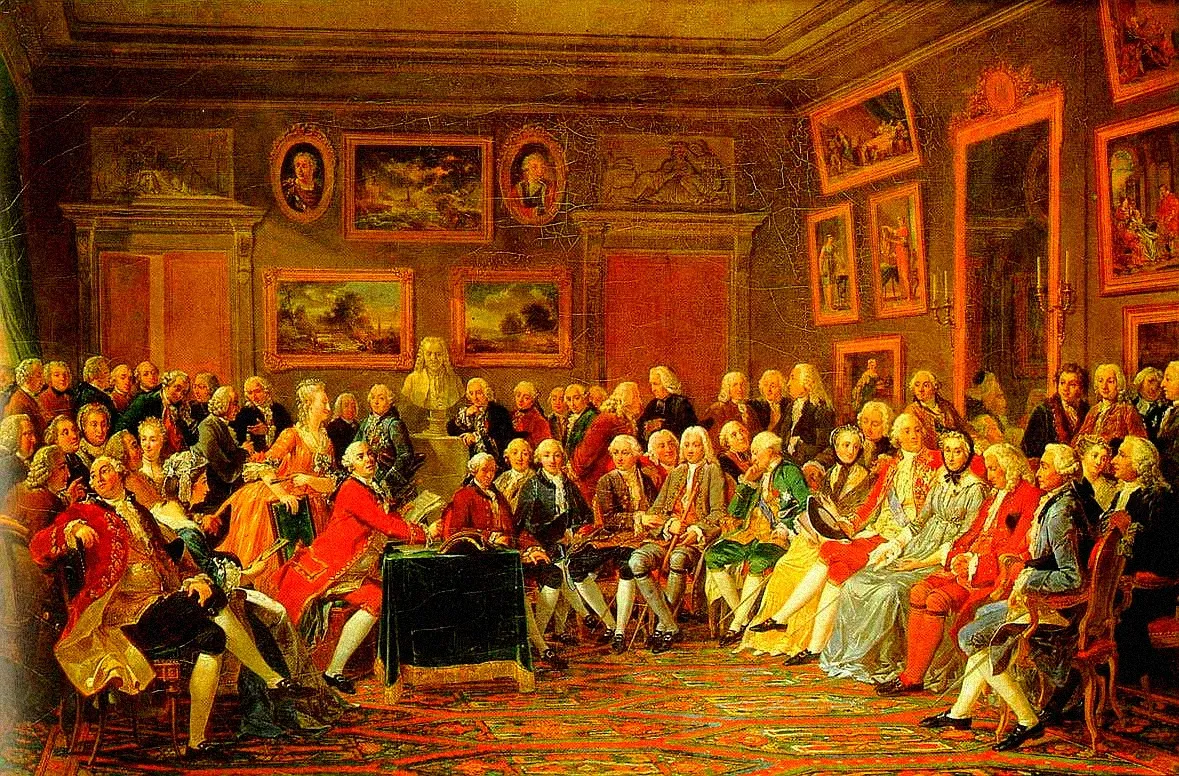
In Britain, they mainly spread ideas through coffee houses. The idea of meeting in a coffee house comes from this period in Britain.
René Descartes
The first major thinker of the Enlightenment is René Descartes. He is a mathematician and a philosopher. He wanted to ask two questions: How do we know that God exists, and how do we know the soul exists? He wrote a book called Meditations on First Philosophy. This is a really important book in the development of Western civilization.
It is some years now since I realized how many false opinions I had accepted as true from childhood onwards, and that whatever I had since built on such shaky foundations could only be highly doubtful. Hence I saw that at some stage in my life the whole structure would have to be utterly demolished, and that I would have to begin again from the bottom up if I wished to construct something lasting and unshakable in the sciences.
What he's saying here is that after I examine my own beliefs, I recognize that most of my beliefs are not true. This is a radical departure from previous traditions where you know something is true because someone really smart said it. You defer to authority. What Descartes is saying is that no, that's not true. I myself have the capacity to know if something is true, and I have a responsibility to reflect and question everything I know. Through that process of self-doubt and self-examination, I can construct something that is more truthful. This is the idea of enlightenment.
The moment has come, and so, today, I have discharged my mind of all its cares, and I have carved out a space of untroubled leisure. I have withdrawn into seclusion and shall at last be able to devote myself seriously and without encumbrance to the task of destroying all my former opinions.
What he's doing here is saying that for me to discover the truth, I just have to rely solely on my reason—not debate, not talking to others, not reading old books, but by self-examination. Through this self-examination, what he discovers is that everything is false. How do we know the sky is blue? How do we know the sky exists? We don't.
But then he recognizes that the only way he can actually engage in this process of self-examination is through doubt. So what do I know to be true? Doubt is true. I doubt, therefore I am. You may know the expression, "I think, therefore I am." It's actually, "I doubt, therefore I am." The Latin is Cogito, ergo sum. The thing that I know to be absolutely true is my capacity to doubt, and that is who I am. Therefore, I exist. The capacity to doubt is my soul.
Now, how do I know that God exists? Well, if God didn't exist, then I would not have the capacity to doubt. Someone must have given me the clue of doubt, and that must be God. But how do I know that God is good? Because God could be a trickster, the devil, deceiving me, and my capacity to doubt will only lead me into error. He says, well, because God is perfect, and if you are perfect, you're incapable of fault. Therefore, I know God is good. Obviously, this is not logical; it's what we call a tautology. But what's important is that Descartes is asking us to challenge our assumptions about the world, to doubt, to reason. He's saying that the idea of reason is the most powerful force in the world—more powerful than the church, than dogma, than society itself. Our individual capacity to reason is what matters.
Johann Wolfgang von Goethe
Johann Wolfgang von Goethe is considered the greatest German writer of all time, and he wrote a book called Faust. Faust is a very quintessential Enlightenment work of art. It's based on the Book of Job from the Bible, but what Goethe does that's really interesting is that he reimagines the story of Job and turns it into a much more confident, optimistic story that captures the spirit of the Enlightenment.
Faust is a professor who loves learning but recognizes that despite all his book learning, he doesn't really have access to the truth. One day, Satan (named Mephistopheles in Faust) talks to God. Mephistopheles says to God, "The worst thing you ever did was allow humans the capacity to reason because they're idiots. If you're stupid and you can reason, all it does is confuse you and make you unhappy."
Mephistopheles: Their life would be a little easier / If You had not let them glimpse the light of heaven; / They call it Reason and employ it only / To be more bestial than any beast.
Here, Goethe is invoking Dante. Remember, Dante in the Divine Comedy says that love is the light of heaven. Here, Goethe and the Enlightenment thinkers are saying that no, it's reason that is the light of heaven.
God says, "Have you met Faust? He is my favorite person in the whole world because he's curious. He loves learning. Eventually, through the process of self-exploration, he will discover the truth. I have faith in Faust." Mephistopheles says, "Fine, I'll make you a bet. I bet you I can make him complacent. I bet you that I can make him not want to learn anymore, to lose his curiosity. And if I win this bet, then Faust will become my servant."
God: Though now he only serves me blindly, ineptly, / I shall soon lead him into clarity. / The gardener knows, when the sapling turns green, / That blossoms and fruit will brighten future years.
Mephistopheles and Faust meet, and Mephistopheles says, "I will grant you the knowledge of the world. But if at any point you become complacent, you stop striving, you're happy with the way things are, then you will become my servant." Faust says, "Sure," because he does not believe that he can ever lose his curiosity.
After many adventures, Faust is old and about to die. He is an architect and an urban planner, and he takes pride in his work to make the city more livable for people.
Faust: A swamp lies there below the hill, / Infecting everything I have done; / My last and greatest act of will / Succeeds when that foul pool is gone. / Let me make room for many a million, / Not wholly secure, but free to work on.
He's taking pride in all that he's accomplished and that he will accomplish. But because he's taking pride in this moment, he has now lost the bet to Mephistopheles. He has become complacent.
Faust: Then to the moment I dare say: / Stay a while! You are so lovely! / Through eons, then, never to fade away, / This path of mine through all that's earthly. / Anticipating here its deep enjoyment, / Now I savor it, that highest moment.
The irony is that at this moment when he's most fulfilled, he should now be damned to hell. But as Mephistopheles is about to claim Faust's soul, angels appear and steal it. God has come to save Faust.
The main message is that God loves us. God wants us to be curious, to explore, to challenge ourselves, to grow. And if we do that, God will always protect us, no matter how many stupid things we do. God is ultimately about forgiveness, love, mercy, kindness, and generosity. That's a very optimistic and confident view of the world.
Immanuel Kant
Immanuel Kant is the greatest philosopher who ever lived. He wrote a very influential essay called "What is Enlightenment?"
Enlightenment is man's emergence from his self-imposed nonage. Nonage is the inability to use one's own understanding without another's guidance. This nonage is self-imposed if its cause lies not in lack of understanding but in indecision and lack of courage to use one's own mind without another's guidance. Sapere Aude! [Dare to know!] Have the courage to use your own understanding is therefore the motto of the enlightenment.
What he's saying here is that you're students and I'm the teacher. I'm enlightened because I'm using my reason, but you're not enlightened because you're relying on my reason. It's not because you lack the capacity to reason; it's because you guys are lazy. It's just easier for you to sit there and take notes rather than to actually read these texts for yourself and understand them yourself.
Laziness and cowardice are the reasons why such a large part of mankind gladly remain minors all their lives, long after nature has freed them from external guidance.
So, what's the solution to this problem? The solution is free and open debate. If you're able to access information and different points of view, then you're able to hear the truth for yourself.
This enlightenment requires nothing but freedom—and the most innocent of all that may be called "freedom": freedom to make public use of one's reason in all matters. Now I hear the cry from all sides: "Do not argue!" The officer says: "Do not argue, drill!" The tax collector: "Do not argue, pay!" The pastor: "Do not argue, believe!"... I reply: The public use of one's reason must be free at all times, and this alone can bring enlightenment to mankind.
He is arguing for absolute freedom of expression. Even if it's hate speech, even if you say racist things, you're still allowed to say it because people have reason and therefore the capacity to judge for themselves what is true. Whenever you censor something, you're denying freedom to people. This is an absolutist understanding of freedom, and this becomes the foundation for the American Revolution.
An epoch cannot conclude a pact that will commit succeeding ages, prevent them from increasing their significant insights, purging themselves of errors, and generally progressing in enlightenment. That would be a crime against human nature, whose proper destiny lies precisely in such progress.
This is a radical statement. What he's saying is that I'm of an older generation than you. I have absolutely no right to tell you what to think. I can show you possibilities, I can argue with you, but I must not enforce my ideas on you because that would limit human progress. Progress is determined by a new generation's capacity to question and negate a previous generation's ideas.
Voltaire
Voltaire is considered a celebrity of the Enlightenment. He was very famous at that time because he is what we would call today a "troll." He was always making fun of the nobility and the clergy, the powers that be. As such, the middle class basically worshipped him. But he himself was not a very deep thinker.
Jean-Jacques Rousseau
Jean-Jacques Rousseau is the most influential Enlightenment thinker in France. It is his ideas that will drive the French Revolution. He wrote a very influential book called Emile, his treatise on education.
If the infant sprang at one bound from its mother's breast to the age of reason, the present type of education would be quite suitable; but his natural growth calls for a quite different training. The mind should be left undisturbed till its faculties have developed; for while it is blind it cannot see the torch you offer it, nor can it follow through the vast expanse of ideas a path so faintly traced by reason that the best eyes can scarcely follow it.
What he's saying here is a very controversial idea: kindergarten and primary school make no sense. Kids come into school to learn math and language, but the problem is that their faculty for reason has not fully developed. It's like asking you to fly even though you don't have wings. Before the age of 12, let kids play. Because if you ask them to come to school, all that will do is screw up their minds.
Therefore the education of the earliest years should be merely negative. It consists, not in teaching virtue or truth, but in preserving the heart from vice and from the spirit of error... By doing nothing to begin with, you would end with a prodigy of education.
That's the secret of education. Before age 12, leave the kid alone. Make sure he or she is healthy and eating well, but do not teach mathematics. By leaving the child alone, you free the child from bad mental habits and allow the child to think for himself or herself. The very idea of childhood comes from Rousseau.
Rousseau also wrote a really famous book called Discourse on the Origin of Inequality, which will have a major impact on the French Revolution. It's about the idea of private property.
The first man who, having enclosed a piece of ground, bethought himself of saying This is mine, and found people simple enough to believe him, was the real founder of civil society. From how many crimes, wars, and murders, from how many horrors and misfortunes might not any one have saved mankind, by pulling up the stakes, or filling up the ditch, and crying to his fellows: Beware of listening to this impostor; you are undone if you once forget that the fruits of the earth belong to us all, and the earth itself to nobody.
What he's saying is this: because of the idea of private property, we now have inequality, patriarchy, and war.
Finally, The Social Contract is the bible of the French Revolution. The most famous sentence that begins the book is:
Man is born free, and everywhere he is in chains. He who believes himself the master of others is nonetheless a greater slave than they.
We were born free, but we choose to become slaves. But not only that, the people who have enslaved us think they're our masters, but in fact, they're more enslaved than us because they are trapped by the system. Slavery is a system that enslaves all.
Rousseau is trying to reason from general principles as to how to form a good society. He says there are two types of will: the general will and the particular will. The general will is what we can agree on if we are left to reason by ourselves. The particular will is what we believe if we are part of an interest group. For example, if the central government in China wants to spend $10 billion on new roads, the general will is that everyone agrees we should invest these roads where they're most needed in China, perhaps in the poorest parts. But because we are in Beijing, we would say, "No, you should put the money in Beijing." That's a particular will.
In other words, society, if it is to function well, must be based entirely on the general will and negate the particular will. It must be based on the common interest. That's why everything works, because if laws are based on the general will, then all the laws are acceptable to people. The problem with this, of course, is that that's not how the world works. There's actually no one in the world who thinks, "Oh, I should do this because of the general will." It's always a particular will. This is the major divergence between the French and American Revolutions. The French Revolution is fundamentally idealistic; it believes that people are capable of considering the common interest. The American Revolution denies this.
Other things being equal, the unquestionably best government is the one under which the population increases most without external help from naturalizing foreigners or establishing colonies. The government under which the population shrinks is the worst. Over to you, calculators: count, measure, compare.
What Rousseau is saying is that not only can we deduce good government from general principles, but good government can be measured. We can know how we are doing as a society through measurement, by counting things. That's what progress means. The French Revolution will embrace this, and that's why they will introduce the metric system. The metric system comes from the French Revolution and is now used by every country in the world except two: America and Britain.
I am wrong to speak of a Christian republic; the two terms are mutually exclusive. Christianity preaches only servitude and dependence. Its spirit is so favorable to tyranny that it always profits by such a regime. Genuine Christians are made to be slaves, and they know it and do not mind. This short life counts for too little in their eyes.
He is rejecting religion in government. This idea of separation of church and state becomes the basis for the French nation-state. This will lead to civil wars between the peasants who want to be Christians and the revolutionaries who want to establish a secular state.
The dogmas of the civil religion ought to be few, simple, and exactly worded, without explanation or commentary. Its positive dogmas are: the existence of a mighty, intelligent and beneficent Divinity, possessed of foresight and providence; the life to come; the happiness of the just; the punishment of the wicked; the sanctity of the social contract and the laws. And just one dogma of exclusion: the exclusion of intolerance, which is a feature of the cults we have rejected.
What Rousseau is saying here is that the new society should now have a new religion, a state religion that is based on reason. This new religion of reason must reject all other religions because these religions are intolerant of each other. That's why in France today, there's so much conflict between Islamic immigrants and the French state, because the French state insists on a secular religion, but the Islamists want to practice their own religion.
These ideas that we looked at will now become the basis of the French Revolution.
Why were peasants so loyal to their religion?
The Christian religion, over generations and centuries, becomes part of your tradition. What are people loyal to? People are loyal to their home, their land. They're loyal to their family, to tradition, to culture, to food. This is true for most people. This tells us that people are first and foremost people of habit. Why? Because it feels good. When you do something out of habit, you feel good about yourself. When you break this habit, you feel bad about yourself. The only way you know if something is good or bad is how you feel about it.
These ideas—land, family, tradition, food—are all encapsulated in religion. Religion is what determines your culture, your food; it's what your family practices. It is your connection to your family and your land. That's why people will die for their religion, because religion is really a metaphor or an encapsulation of all these things that people understand, know, and love.
People don't just die for religion; they also die for ideas, which include the nation. What the French Revolution will do is start a process where our ideas of religion become transplanted into the nation. People will also die for the nation. That's why you have these incredibly devastating wars like World War I and World War II, where people will die for the nation and won't even think about it. But it starts during the French Revolution.
How can a religion be based on reason?
Traditionally, religion is given to us by God. Every religion says, "We have this religion because God told us to believe in him," and you do that through priests who then tell you what to believe. What the Enlightenment thinkers, especially Rousseau, are saying is no, this system doesn't really work because you have reason and therefore you have the capacity to access God. You don't really need priests. We can just think reasonably what a religion should be like, and from principles, you can deduce the religion.
If you just reason from first principles about what a religion should be like, what are they?
- There is a God.
- There is heaven and hell. You do good things, you go to heaven. If you do bad things, you go to hell.
- Good people go to heaven. Therefore, you should do good.
- If you believe in these things, you are free to believe anything else that doesn't contradict them.
What Rousseau is saying is that just from general principles, if you're able to exercise reason by yourself, you should be able to deduce the basic principles of an organized state religion. That's what he does in The Social Contract, and it becomes a basis for the French Revolution.