Civilization #48: Napoleon's Empire of Myth
We are focusing on Napoleon. And my argument to you is that Napoleon would not have been possible without Robespierre. So to illustrate this point, let us do a thought experiment. I am going to present to you two individuals. And I want you to think about who is the greater genius. Who is the more rare leader? So let's look at person A.
- Person A has a perfect memory. That's the first characteristic. He is able to have instant recall. He or she is able to absorb all the information that comes his or her way and is able to retain it.
- Second thing is the ability to have priorities. So what's rare among really smart people is the capacity to prioritize what is important information and what is not important information, to filter things out. Because once you have the important information, you are much more capable of making the correct decisions.
- The third thing is the strategic imagination. So a general is able to take all the relevant information that he or she has obtained and then imagine the battlefield across multiple nations. He or she is able to imagine how the battle will progress.
- And the fourth is the idea of flexibility. So even though the general has a plan, he or she is still flexible during the battle. So if the battle is not going according to plan, then he or she will make adjustments to the battlefield because he or she has total battlefield awareness.
So these are the four characteristics of a great leader. Now let's look at B. And B only does one thing. B is, "I promote the talented." That's all B does. That's all B cares about. So who among these two individuals do you think is the more rare individual, the greater leader? The stronger genius. A or B?
So obviously it's a trick question. It's obviously B. What I'm going to do is explain why it's B. Because A is Napoleon. Napoleon, like Alexander the Great, like Julius Caesar, is a genius of war. He's able to completely imagine the battlefield and come up with strategies that are shocking, innovative, and unique. That's Napoleon.
B is Robespierre. All Robespierre cares about is promoting and rewarding those who are true and loyal to the revolution. So I want to make the argument that Robespierre is the greater man than Napoleon. To illustrate this point, I want to ask you a question. Let's just say that I'm a very rich man, maybe I'm Jack Ma. And I have a huge company. I employ thousands of workers. I'm extremely profitable. I have a son. He's 18 years old, and he's expected to inherit my company at 40, 50. But I sit him down, I have a very long dinner conversation with him. I explain to him:
"Son, it takes a particular type of person to run a great company. It takes dedication, it takes virtue, it takes selflessness. You're a great person. I love you because you're my son. But you're not qualified to run my company. I have a team of experts who will replace me after I'm dead. I'm sorry, son, but you have to go do something else. Because quite honestly, I don't think you would even enjoy running my company."
So that's a thought experiment. Now let me ask you this question. China has one billion people. Would there be anyone in China who would think I'm a good father? No one. That's why B is hard. Because B requires selflessness. But not only that, B requires the capacity to ignore social values and focus on what is good by itself. That's why B is harder than A. And quite frankly, in history we'll meet a lot of individuals like A. Julius Caesar, Napoleon, Hitler. Even today, there are quite a few individuals like A. But B is rare. So let me explain why B is so rare and why Robespierre was fundamental to the birth of Napoleon.
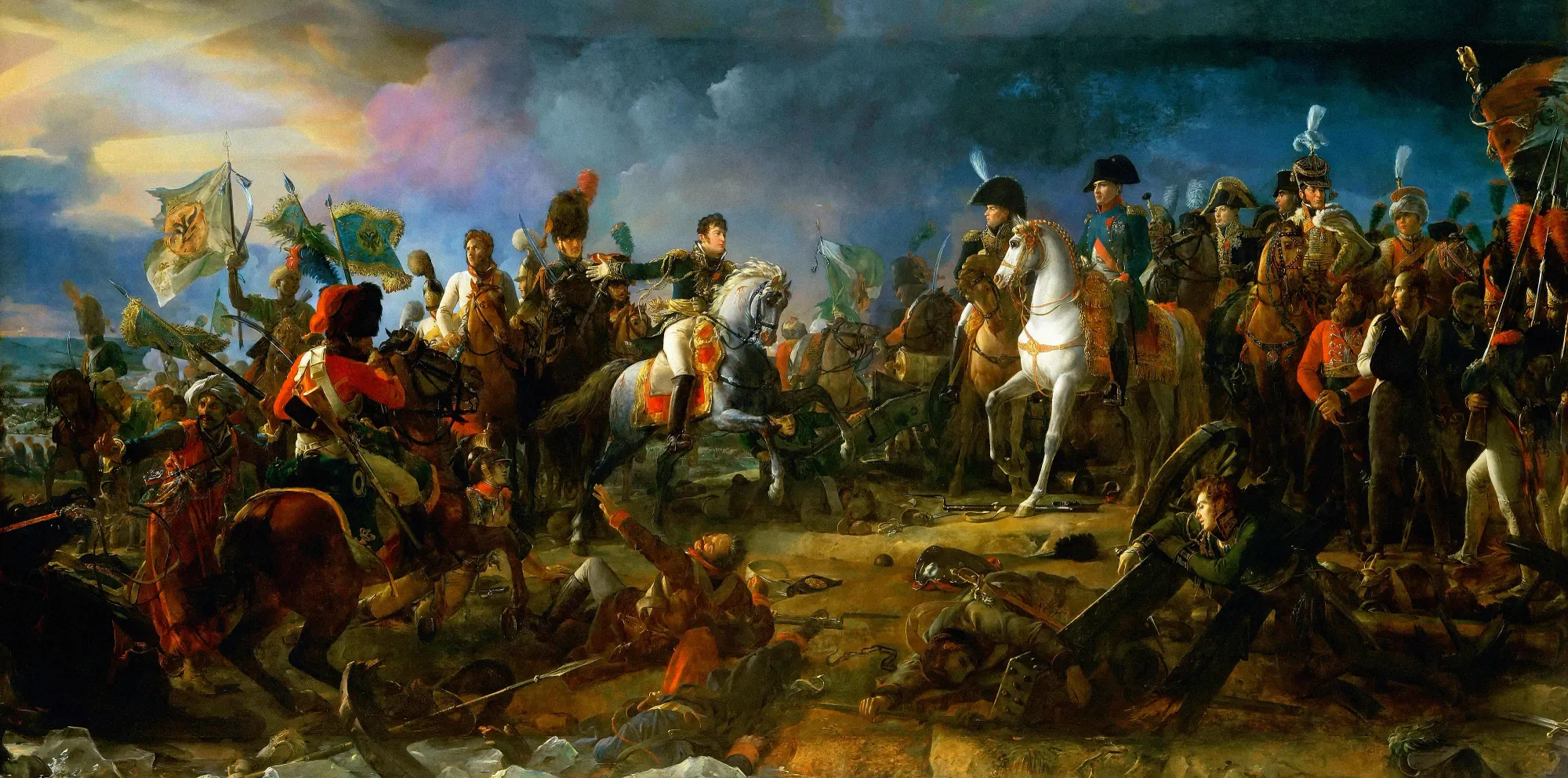
The Battle of Austerlitz
We're going to focus on a battle. And this is 1805, Austerlitz. This is considered Napoleon's greatest battle. The battle that made Napoleon into a legend. This is something called the War of the Third Coalition. So Napoleon, the French, are up against three major nations, the Austrians, the Russians, and the British. The Prussians will come in at some point to join the Third Coalition. So Napoleon needs to act first and knock out both Russia and Austria before the Prussians come in, because Prussia is considered at this point the greatest military in the world.
So this is Austerlitz, the battlefield. Let me first give you an overview of what the battlefield looks like. First of all, you have the coalition forces stationed on high ground. These are about 70,000 troops. Napoleon is scattered. He's got his forces here, he's got his forces here on the right. This is the right. And these are his main forces. This is Napoleon. He also has about 70,000 troops. So they look even, but actually the coalition forces have a huge advantage. One, because they're on high ground. Second is that more forces are coming in from behind to bolster the forces. So it looks in the beginning like the coalition forces will overwhelm Napoleon.
And so what the coalition forces are going to do is this. They see the right flank of Napoleon, it's weak. So what they will do is they will send a right attack and overwhelm the right, and then come behind Napoleon, and then the other forces will come down to envelop Napoleon. This is what we call a flanking attack. So that is the plan. And quite honestly, this is the most logical, the most reasonable strategy given the circumstances.
What they don't know is this. Napoleon anticipates that they will do this. It's a trap, actually. Because what's going to happen is that as they come and attack, Napoleon will now attack the coalition's right flank. And as the coalition tries to muster the right flank, the cavalry will come in and split the coalition into two, forcing them to retreat. That is the master plan.
The problem with this plan is the right flank. The right flank needs to hold against the coalition attack, otherwise the coalition will just sweep in and outflank Napoleon. Napoleon has this plan where coming in to bolster the right flank is his marshal Davout with 10,000 men. The problem though is that Davout is 100 kilometers away. So it has to be a really quick march to the right flank. Now, if he misses, the coalition will just wipe out this army.
But he does get here in time. He saves the right flank, and then the rest of the plan goes exactly according to Napoleon's vision, his strategy. It is perfect. Perfect timing, perfect attack, everything is perfect. And as a result, this is exactly what happens. Napoleon splits the coalition in two, they're forced to retreat, and then what will happen is that Napoleon will sweep in and capture this entire army. Once this happens, the war is over. The Russians and the Austrians are forced to retreat. The Austrians sue for peace, the Russians go home.
So this is considered one of the greatest battles in human history. It is up there with Alexander the Great's battles. This is considered the defining achievement of Napoleon. And there are certain characteristics about this battle that make it uniquely Napoleonic.
- The first is total battlefield awareness. That's the first thing. He is able to imagine the entire battlefield even before this battle starts. He knows exactly where each unit will be. So total battlefield awareness is what makes Napoleon unique.
- What also makes Napoleon unique at this time is the idea of speed. This all happens very, very fast. At this time in Europe, battles are fought slowly, and it's really like two forces banging against each other. But this is really fast.
- And what you have is a lot of maneuverability. Usually in the battlefield, the army fights as one unit. What's amazing about Napoleon is he's able to divide his forces into different smaller armies that operate independently, but as part of a larger vision.
So Austerlitz is the defining achievement of Napoleon's grand strategy of war. And if you go to military college, if you want to be a general, you will have to study this battle in great detail.
So the problem with this plan is that it should not have worked. It is a reckless and stupid way to fight a battle. Because there are about 10,000 ways that it could go wrong. First of all, you need this guy, Davout, to come in. He has to do about 110 kilometers in 48 hours. This was before considered impossible. A really strong army, really disciplined, really well-trained, will do at most 20 kilometers in one day. Think about that. This is the best army in the world. The Prussians will do 20 kilometers in one day. Davout is able to do 110 kilometers in two days.
And that just shows you how extremely disciplined the French are. Not only are they able to do 110 kilometers in 48 hours, but they come into the battlefield fresh for battle. They jump straight into battle, and they are pushing the coalition forces back. So it's an incredible achievement by Davout. In fact, if you study military history, you will see a lot of people argue that Davout was the far superior general to Napoleon. Because it takes a lot of skill to marshal your forces and organize them in a way that they will want to march that fast in that quick a time.
So the first thing that must have happened is Davout had to come in time. But you know what? There could have been rain. He could have gotten lost. An army could have come in and blocked his advance. So 10,000 things could have gone wrong. Napoleon was really lucky that these things didn't go wrong. Also, in this attack by the French, it was possible that the coalition could have overwhelmed the attack.
So in other words, the thing about Napoleon that's really important is, yes, his strategic genius is one thing, but what really matters is the officers under him. He had a really talented bench of officers who were committed to the battle, and they knew exactly what they had to do. Napoleon was the one with a vision. He was the one who had the courage and the boldness to attack, but it was they who executed the plan perfectly. And that's the defining characteristic of the Grand Army of Napoleon.
The Prussian Army and the French Revolutionary Army
So let me explain to you how this happened. How was it that the French were able to build Europe's greatest army during the French Revolution? Let's compare the Prussians and the French. And the Prussians again are considered at this time in European history the greatest army ever. So they are run by the nobility. The officers, the generals are nobility, and they are called the Junkers. This is very important. I want you guys to remember the term Junkers. They are the elite of Prussian society. They're the ones who will take Germany into World War I and World War II. They're the force behind Hitler. And they are considered the greatest warriors in European history at this time, the Junkers. They are landed nobility. They have their land, and so they can focus completely on warfare. And as time progresses, they become the greatest generals and officers of Europe at this time.
Let's look at the soldiers. The soldiers come from three sources. The first is conscription. Conscription just means that you draft people from your nation to join the war. Second is volunteers. Why do people volunteer? Because you're often treated better in the military than you are in the nation. If you're a soldier, the nobility can't beat the crap out of you for no reason. But if you're a peasant, the nobility can beat the crap out of you for no particular reason. And the third, which is the most controversial, are deserters.
So the Prussians have a nasty reputation for arresting people who they believe ran away from other armies like the French and British army, and they are forced into the Prussian army. It's basically prison. Now, they have a nasty reputation because a lot of these deserters are actually not deserters. They just happen to be people from neighboring nations that the Prussians kidnap into their army. So you have these three main sources.
Now, the thing that makes the Prussian army unique in Europe is it actually has very strict requirements for joining the military. You have to be tall, basically. You have to be like 5'8". The average height was like 5'6" at this time in Europe. Napoleon himself was 5'7". You have to be 5'8". So Napoleon would not have been able to join the Prussian army. You have to be 5'8". It's the tallest army in the world. The Prussian king Frederick the Great takes tremendous pride in how tall his warriors are.
So this is an extremely disciplined army. But with this army come three fundamental weaknesses.
- The first is they can't afford to lose that many men. These men are extremely well-trained. They're extremely well-disciplined. They cannot afford to lose that many soldiers in battle. That's the first problem.
- Second problem is they're extremely slow. Why are they slow? Because the officers like to live well. So wherever they go, there's maybe three or four different wagons that carry their food, carry their clothing, carry their servants. So this is a very slow army. But it's fine because every other army in Europe is slow as well.
- And so this creates a problem of inflexibility. The Prussians fight one way, and that's the only way they fight. They basically move up front, and because of the discipline of the soldiers, they overwhelm their enemy.
They don't have that much flexibility in their army. So these are the three fundamental weaknesses of a Prussian army. They cannot afford casualties, they're extremely slow, and their strategy is inflexible. But it's not a problem because every army in Europe suffers from the same problems.
Now comes the French Revolution. Robespierre takes charge of organization and personnel hiring, basically, for the new French revolutionary army. And he makes radical changes to the French military. The first is the idea of meritocracy. So before, like every army, most of the officers and generals of the French army were nobility that were appointed by the king. They were loyal to the king, and as such, Robespierre saw them as a threat. So he basically replaced the nobility with young men from the provinces who believed in the revolution. So at the beginning of the revolution, about 85% of all French officers were nobility. Five years later it's about 3%. That's a huge, huge change.
One of these men that's recruited into the French military and promoted really fast is Napoleon. Napoleon, by the age of 25, is a general. And that's unheard of in Europe at this time. But it's not just Napoleon, it's dozens and dozens of really talented young men who are given opportunities they would not have been given anywhere else. Also, what's important for us to remember is that Napoleon himself is not French. He's Corsican. He's a foreigner. But because of the French Revolution, he's given these tremendous opportunities. So that's the first thing, it's meritocracy.
Second thing is, it is total war. In other words, it is complete conscription. There are no volunteers, there are no deserters, everyone must now join the army. So now France has an almost endless supply of soldiers. And that gives the French three major advantages.
- The first is high casualties. They can actually afford now to lose a lot of men in battle. So the French are now willing to take risks that other armies are not able to take. For example, Austerlitz. Austerlitz was a huge, huge gamble that paid out for the French. But they're able to do so because they're able to replenish their forces if need be. High casualties.
- Second is the idea of mobility, speed. You can travel really fast. Also, your soldiers can just live off the land. You don't have to feed them great food. They can just go and find berries or chickens to cook for themselves. So they are able to travel at least three times as fast as their enemies. That's an incredible advantage because even before their enemies are able to set up camp, the French have surrounded them and overwhelmed them. And this happens a lot during these wars. So speed is the crucial factor.
- And the third advantage is flexibility. If you have an extremely dedicated army, what you're able to do is you're able to divide them into different units called corps. This is no different from the Roman legion. The Roman legion was the main tactic of the Roman army back in the old days. So what you do is you take a huge army, you divide it into smaller armies. And if they're able to travel really fast, what this army is able to do is really quickly surround the enemy. If you surround the enemy, the enemy is dead. The biggest problem in war is being encircled because you've cut off their supply routes. They don't know how to respond to encirclement.
So the French for many years were just destroying enemies because of these three factors. They're able to take high casualties, their speed, and their strategic flexibility in battle. And who created the system? Robespierre created the system. Robespierre. Not Napoleon, Robespierre.
The Revolution in Military Affairs
To give you an illustration of what the difference is, let's go to the year 1806. So the French have destroyed the Austrians, the Russians are in retreat, the Prussians come to battle now. And all of Europe is like, "Oh, wow, the Prussians now have taken the battlefield. The Prussians are going to overwhelm the French because the French are just peasant recruits, the Prussians are tall, they're strong, they're fearless, they're going to destroy the French." So for the first time since the revolution, the Prussians and the French meet in 1806.
It is a total and utter annihilation. Never before has Europe seen this. The French in 30 days wipe out the entire Prussian army. It is incredible to watch. Also, there's a very famous battle during this time where Davout, he's a corps leader, and he gets lost. And he ends up fighting the entire Prussian army. And he's outnumbered two to one. He wins the battle. Davout is able to win, outnumbered two to one, against the main Prussian army led by the king himself.
So this is a radical revolution in military affairs. The French, by using the system, are able to dominate Europe for most of Napoleon's reign. And what this does is, and this is really important, because the French are dominating the battlefield, it forces the other European powers to make fundamental changes to their society. Because of the French Revolution, these societies are forced to become more liberal and democratic and open and progressive in order to defeat Napoleon. So after 1806, the Prussians make a lot of major changes to their society. What they recognize is that our soldiers aren't enough. We need to change the fabric and structure of our society if we are to defeat Napoleon. So they make two major changes. There are other changes, but there are two major changes that are fundamental.
- The first is they abolish serfdom. Serfdom. Serfdom is basically like slavery, where the peasants are tied to the land. And that's the majority of people. When you abolish serfdom, the advantage of that is now you can have more conscription. These peasants are now able to become soldiers, because serfs are not allowed to be soldiers. So now your army's numbers have increased. And so all the armies at this time in Europe are increasing because they're allowing more people to join the military.
- And the second, which is most important, is the middle class. So before the French Revolution, all of Europe was an extremely stratified society. The nobility at the top. But because of Napoleon's victories, the Prussians allowed the middle class to join the civil service. That's fundamental. They're now activating the energy of the middle class. And this allows for innovation, it allows for more economic activity.
And so 1806, even though the Prussians are destroyed, it allows them to build a structure that will allow them to dominate all of Europe in about 50, 60 years' time. And eventually they become the dominant power in Europe and the world, basically, before the beginning of World War I. And this was all possible because the Prussians lost to the French and they learned lessons from the French Revolution. That's why I keep on saying the French Revolution was a turning point in human civilization. So that is my main argument.
What Does Abolishing Serfdom Change?
I'm a little bit confused about serfdom, or the concept. He means that the peasants can join the army?
So serfdom. The institution of serfdom, it's basically slavery where peasants are tied to the land. They cannot leave the land. And this is important because, again, most of these societies are agricultural-based. So you need people actually to work the land. And as such, the majority of your population is not eligible for the military. When you eliminate serfdom, now every man is eligible for the military. And as such, you can replenish your forces.
And a lot of men want to join the military because it's a lot better to be a soldier than it is to be a peasant. As a soldier, you are given rights by the military. Because the military is a very powerful institution. If you're a soldier, you can't be pulled around by anyone. Whereas if you're a peasant, you're a serf, you're like an animal. So if you give people a choice whether to join the military or be a serf, they would choose to be a soldier. Even though there's a risk of death. But with a soldier comes a possibility of social mobility and social respect, which is not available to you if you are a serf.
Are the Ideals of the French Revolution Still Part of the Army?
I got a question. Earlier on in the French Revolution, there were wars against Prussia that they also won. And one of the reasons that often come up is ideological reasons, that the French at that time were full of the spirit of the French.
That's right. That's right.
The ideology of it, nationalism and all that kind of stuff. But we move up 15 years into the Napoleonic period. Are those ideals of the French Revolution still part of the army, or is it more of an esprit de corps? We're just a bunch of young men moving up in the world, and this is our new identity as an imperial army?
Yeah, that's a good question. So at the beginning of the revolution, these revolutionaries were compelled by religious fever to die for the nation. And Robespierre became their role model because Robespierre sacrificed himself for France. But 1804, what happens is Napoleon becomes emperor. And once he becomes emperor, everything changes. Because now you're no longer fighting for your nation, you're fighting for your emperor. And there are a lot of French people who felt betrayed by Napoleon.
So after 1804, this is really important, France is still the greatest military in the world, but it's basically a military cabal. A military cabal who run France. Napoleon is just the head of a group of generals who love war, who benefit from war. And as such, France becomes a military nation where everyone's supporting the French military adventurism. And even though the French do win a lot of wars, eventually because you're an empire, you just exhaust everyone.
Why Robespierre Created a Meritocracy
One last point is why is Robespierre creating a meritocracy? The reason why he's creating a meritocracy is, remember, he's trying to create a new society. And there are a lot of threats to this new society. Obviously, the major threat is these foreign armies like the Prussians, the Austrians, the Spanish who want to restore the Bourbon monarchy. That's a major threat. Then you have these rebels, these peasants who want to restore the privileges of the Catholic Church. That's also another major threat.
But the main threat is actually the army itself. Because remember, 85% of the army is nobility. And there were actually a few times when the army wanted to march against the revolution and restore the monarchy. And the generals didn't do that, even though they wanted to, because they were afraid that the soldiers would mutiny against them. So this is a huge problem for Robespierre. And that's why Robespierre spearheaded the movement to replace nobles with ordinary men like Napoleon, which gave Napoleon the opportunity to rise within the ranks. That's the logic of the revolution.
Napoleon and Mythology
So the question we're looking at is how did a nobody, and this guy literally was a nobody, he was from an island called Corsica, which was not even French. It was part of the French Empire, but it's not actually French. He grew up speaking French, but in a very bad accent. So people made fun of him in school. His family was local nobility in Corsica, but they were poor. So this guy was literally a nobody. And in only, I don't know, a decade, he became emperor of France, the French Empire, which at that time was the main power in Europe. So how was this possible? How did a nobody, Napoleon, become emperor of France?
For us to understand this, remember what the French Revolution was. My argument to you is it was a religious crusade. The irony, of course, is the French Revolution was trying to remove religion from social life. But if you look at what actually happened in the French Revolution, it was the ultimate religious crusade where the people were willing to sacrifice their lives in order to build a new society based entirely on reason. Their new god was reason.
Another idea I want you to remember is that mythologies are prophecies, and prophecies are plans of action. So embedded in your subconscious are the mythologies of society. In France at this time, these mythologies included the stories of Jesus, but also the stories of Alexander the Great and Julius Caesar. Napoleon saw himself as the reincarnation of both Alexander the Great and Julius Caesar. And he wanted to create a mythology that he was in fact the Messiah. So these mythologies are there, and Napoleon saw this as an opportunity in order for him to amass power for himself. That was his main insight. He was not a great general. That is one of the major misconceptions out there. He was not a great general. He was not as good as Davout was. But he understood that the underlying framework for society is mythology. If you can control these mythologies, you can control people. You can become the emperor. That was his major revelation.
So three things to remember.
- Mythologies are part of the collective subconscious. We are all in society governed by the mythologies that we share together. That's the first idea.
- Second idea is that when collective authority breaks down, these mythologies begin to drive history. So when you remove your teachers, it doesn't mean no one's in charge. It just means that now these mythologies are in charge. So think of the Cultural Revolution in China. You could remove these authority figures, but then your subconscious takes charge.
- And the third idea is certain individuals will act out the leading roles in these mythologies and capture the imagination and attention of everyone else.
That's why Napoleon became emperor, because he saw that the French were looking for a Messiah. And he's like, "I will become your Messiah." And he did that by acting it out, by pretending to be Alexander the Great, by pretending to be Julius Caesar. And Napoleon himself said this. This is a very famous quote that he said while he was in exile in St. Helena. So he's basically writing his memoirs. He's reflecting on his life, and he's not that perceptive. He's not that bright. But in this quote we see his plan, how he became emperor. Let's read this:
I saw the way to achieve all my dreams. I would found a religion.
He's like, "I'm not a general. I am a religious leader."
I saw myself marching into Asia, mounted on an elephant, a turban on my head.
That is Alexander the Great. That's actually Caesar.
And in my hand, a new Quran that I would have composed to suit my needs.
A Quran, a Bible. So he understood what the French Revolution really was. It was a crusade to bring reason into the world. And he would become the Muhammad, the Julius Caesar, the Alexander the Great, the Jesus that would achieve this crusade. He understood this from the beginning, and that's why he was able to succeed. Whereas Robespierre, he may have understood this, but he refused to act out that role.
So even in the beginning of his career, he was focused on creating mythology of himself. This is when he was first a general and was part of the Italian campaign. And this is a mythology of him leading his warriors into battle. This didn't really happen this way. Doesn't matter. Because he understood that what matters is how people perceive you. The underlying reality doesn't really matter. So when he was emperor, he was focusing on a cult of personality. Paintings of himself, stories of himself that would become the official history. So a lot of stuff that we know about Napoleon, his victories, we have to be suspicious about. Because he was so focused on creating a myth of himself.
The Army, Carnot and the Directory
Let's go over some details that we discussed. When Louis XVI was in charge, the French army had a lot of problems. The first problem was you had too many generals. 480,000 men. That's a lot of generals. And the reason why they had these generals is they were friends of the king. They were incompetent, they weren't necessary, but the king liked them. And so the king promoted them. It's a way to ensure the nobility was loyal to you. But that made for a top-heavy bureaucracy that didn't allow for innovation and change. So that's the first problem.
Second problem is 85% are noble, harsh discipline, soldiers didn't want to fight, they were forced to fight. No conscription, volunteer army, basically deserters, one-third would desert every year. One-third of soldiers would run away every year. So that's why this army is problematic. And that's why the Prussians, the English would defeat the French in many battles before the revolution.
So this man is named Carnot. And he's actually a friend of Robespierre's. They became friends when Robespierre was in his provincial town of Arras. They've known each other for a long, long time. And when Robespierre became prominent in the revolution, he asked his friend Carnot to come up with a new system of reorganizing the military. He's a mathematician, a scientist. He came up with the idea of conscription. Let's call it a levée en masse. So let's get everyone to join the military so as to dilute the influence of nobility. And it worked spectacularly well. And because he's a mathematician, he was extremely well-organized.
He is one of the main conspirators against Robespierre because when he amassed power, he recognized that he couldn't really benefit from his power. Robespierre was too virtuous. He demanded everyone make sacrifices. And so these people that Robespierre promoted, that Robespierre favored, would eventually conspire against him. And one of these men is Carnot. And Carnot is also important because Carnot would make Napoleon a general. So the thing about Napoleon that makes him distinctive in the military is he's very good at becoming close with political patrons. He's very good at identifying political patrons and getting them to help him in his career.
So as you can see, because of conscription, the French army is increasing, and that forces the other armies of Europe to increase as well. So you can see the spike. During this time, because of all these reforms in the military, many young, great generals are emerging in the French military. So Napoleon is the most famous, but there are others who are actually just as good or even better than Napoleon. Dozens of them. And these generals will become the core of the French military. And all of them are driven by a republican idealism. They want France to become a republic. They want France to be free. They want to spread the revolution all across the world. And not only are they devoted and idealistic, but also their soldiers. Their soldiers are willing to die in battle, whereas other nations are not. Davout we talked about. Without Davout, there's no way Napoleon could have won his battles. Davout is probably the greatest general at this time.
So Carnot makes Napoleon a general. And why is Napoleon given the generalship? Because Napoleon does Carnot a favor. So after Robespierre's death, a Directory is set up to basically be the dictatorship of France. Five-man dictatorship, which includes Carnot and also Paul Barras, who is also another patron of Napoleon, as well as a friend of Robespierre. And at first, after Robespierre's downfall, both Paul Barras and Napoleon are under investigation because they are friends of Robespierre. But because they are extremely politically flexible (I mean, he's the opposite of Robespierre; Robespierre was virtuous; he's very cynical; he's your perfect political operator), he's able to become one of the leaders of the Directory, and he helps promote Napoleon's career.
Napoleon helps them because at this time there's a Paris mob that threatens the Directory. And what Napoleon does is he fires cannon at them. And as a general you're not supposed to do that. You're not supposed to actually go kill your own people. But Napoleon, he is ambitious. He's merciless. And so the Directory owes him a favor, and he asks for a generalship of the Italian peninsula. Why? Because that's where Julius Caesar is from.
And in the Italian peninsula, he wins a lot of battles. The record is mixed. It's not as great as people make it out to be. But after the Italian peninsula, what's interesting is he then goes to Egypt. Why? Because Alexander the Great went to Egypt and Julius Caesar went to Egypt. So even at this particular stage in his career he understands how to create a mythology of himself. "I am the new Julius Caesar. I'm the new Alexander the Great." And it works.
From the Coup to the Empire
Because in 1799, Paul Barras as well as Emmanuel Sieyès, who is now the head of the government, get sick of the Republic. The Republic, it's corrupt. It's ineffectual. They want to establish their own dictatorship. But for them to establish their dictatorship they need a general to help them out. So they need the army on their side. And they go to different individuals. They go first to General Moreau, who is right now considered the best general in France. He's the most respected. And if Moreau would side with them, they would have no issues with their coup d'état. But Moreau, he's a staunch republican. He refuses. He's like, "No, this goes against the revolution. This goes against the legacy of Robespierre. I refuse to join in your coup d'état."
So then they go to Macdonald. At this point Macdonald is like, "I don't want to do this, but have you talked to Napoleon?" And so they go talk to Napoleon. And of course Napoleon wants to do this. Napoleon's been dreaming about this. He wants to be the new Caesar who crosses the Rubicon and ends the Roman Republic.
And so what happens is Napoleon launches a coup d'état in Paris. And at this point the great fear is the mob of Paris will rise up against Napoleon. But they don't. Because Napoleon has done such a great job of creating mythology of himself as a Messiah. And at this point, after the death of Robespierre, people are looking for a Messiah. So Napoleon gets away with it.
And then what he does is he knows that now that he's dictator, he needs to fulfill people's mythology of him as Messiah. So rather than just sit and enjoy being emperor, he decides to go to Italy again. So the first thing he does, which is really interesting, is he crosses the Alps. He crossed the Alps. Why? Because Hannibal crossed the Alps.
And in Italy, he makes a lot of really stupid decisions. So for example, he had the Austrian army encircled. So he had different forces surrounding the Austrian army. And what Napoleon was afraid of is the Austrian army would run away. But if you're a general in the Austrian army, you recognize that the French are divided. So I just bulldoze them. So the Austrians launch this massive attack against the French, and the French are now being overwhelmed. But the French have incredible discipline, so they hold the line, but they're still being overwhelmed because they're outnumbered. Napoleon comes in with his elite soldiers. The elite soldiers hold their line, but 50% of them are killed. And so now the Austrians are just bulldozing the French. Napoleon is saved because another French army is able to come in and save them.
So Napoleon is taking all these stupid risks for no particular reason, and it's all to create a mythology of himself as this great conqueror. Because what he recognizes is, "I don't have to win this battle because I control the government. When I go back to France, I'll just tell everyone I won, and everyone will believe me." But what's important is action. "I need action in order to create my mythology." So after this Italian campaign, what he does next is create a legend of himself as the new Messiah who will lead the French people into the promised land. This is the Battle of Marengo, where Napoleon should have been destroyed, but he got lucky again.
And in 1804, he makes himself emperor of France, and this now destroys the revolution. Because the Messiah is not supposed to do this. The Messiah is not supposed to make himself emperor. The Messiah is supposed to be selfless, like Robespierre, and lead the people to victory, to free the entire world. You're not supposed to become emperor. Because once you become emperor, you have worldly needs. He makes now his brothers emperors as well. He makes his brother Joseph emperor of Italy as well as Spain. So this is Joseph. He then makes his other brother Louis king of Holland. So he's basically dividing up Europe among his family members. And obviously, if you are a French revolutionary who dedicated your entire life to promoting liberty around the world, you don't see this as a good thing.
Power and Napoleon's Wars
The other thing about Napoleon is he was an extremely selfish individual. He was narcissistic. He was selfish. The reason why we know this is one thing that he spent a lot of time on is writing letters to his wife, the Empress Josephine. So let's just read certain sections of these letters. So he writes to Josephine:
Since I left you.
He's on campaign right now in Italy.
I have been constantly depressed. My happiness is to be near you.
So he's obsessed with Josephine. He's a general. He's in charge of tens of thousands of soldiers, but every day he's thinking about, "Hey, is Josephine sleeping with another man?" It's literally what he's thinking. He's like, "I know Josephine's sleeping with another man, and I'm going to be really angry when I find out." That's what he's thinking every day. And we know because:
I don't love you anymore. On the contrary, I detest you. You are a vile, mean, beastly slut.
So this is what he's writing to his wife, who's sleeping with other men while he's away on campaign. Also:
My mistresses do not in the least engage my feelings. Power is my mistress.
So this is a megalomaniac. He's narcissistic. He's obsessed with obtaining as much power as possible. That's what drives him. And what he recognizes is this. In order for him to maintain his mythology, in order for him to maintain his image as a Messiah, France needs to be constantly at war. So even though Napoleon could at this time just enjoy being emperor, instead he's constantly at war with everyone in order to maintain his mythology. Because the mythology is what controls the French people. If you don't have the mythology, they won't let you become emperor anymore.
And so as a result, France becomes the largest empire in Europe. So the blue, the light blue, it's all part of the French Empire. He controlled France, but he controlled Spain, Italy, parts of Prussia, Germany. But the problem with Europe is, as I mentioned, the geography. It's very hard to control all of it. So Britain is still impossible to conquer. Right now Britain has the greatest navy in the world. France has the greatest land army in the world, but Great Britain has the greatest navy in the world, and therefore they can never be invaded. Russia is just too big to be invaded. There's still Austria around.
And so now the French army is overextended, and people have lost their revolutionary fever. They don't want to die anymore for Napoleon. So now the French army, they're fighting all these battles, they're losing a lot of men, and these men are being replaced with just common people who don't really care about fighting. So now the French army is in decline.
The turning point, of course, is in the year 1812. And that's the year when Napoleon decides to invade Russia. And even though the invasion is a failure, he's still able to escape. The problem though is that in Russia he's lost his cavalry. He no longer has cavalry in battle. So that's a huge disadvantage. Also, his soldiers are fighting guerrilla warfare in Spain. Because what's happened is because of Napoleon's conquest, nationalism is on the rise. Before, people fought against Napoleon in order to restore the French monarchy, in order to stop the revolution. Now people are fighting against Napoleon in order to secure their national independence from the French, in order to practice their religion, in order to protect their national values. And so the Spanish rise against Napoleon, but also the Germans as well. So now Napoleon is way overextended, and he no longer has the military that he once had during the revolution.
The Concert of Europe
Eventually Napoleon is defeated. This is called the Congress of Vienna, and it will lead to something called the Concert of Europe. And this peace is being masterminded by a man named Metternich. And Metternich argues for balance of power. "Let's just maintain our borders, and let's no longer fight any more wars, because Napoleon, his wars killed millions of people. We are sick and tired of war. The people are sick and tired of war." That's why Napoleon was defeated, because people wanted peace.
So this Concert of Europe, this peace agreement, we can think of this as actually like a proto-United Nations, an organization dedicated to maintaining balance of power in Europe. It worked extremely well. Napoleon is defeated in 1815 at the Battle of Waterloo, and after that there's no more wars in Europe, until maybe 1856 during the Crimean War. That's like 40, 50 years. So it's an incredibly successful formula.
The problem though is this. If you don't let people fight wars, what are they going to do? They're going to revolt against you. So because of inequality, you have all this massive tension in society. So your options are either you take people to war and kill off a lot of people, or these people will rise up against you. And that's what happened in 1848 during the revolutions when all of Europe was engulfed in revolutions. But I want you to remember this idea. 1815, the Congress of Vienna, Concert of Europe, Metternich establishes peace in Europe. And they think this is a great thing. But then you have the revolutions of 1848, which threaten and destroy a lot of these monarchies. And so after that, what happens? You have continuous wars.
So that's what the elite of Europe discovered because of the French Revolution. You can either have your soldiers go to war, or they will revolt against you. That's your choice. And so this will take us into World War I in the 20th century.
So the peace of Europe is one of the major legacies of the French Revolution. But as I mentioned, another major legacy that we must not forget is the increase of liberalism in Europe at this time. There are many nations that start to adopt French Revolution principles. But there are nations who are forced to adopt French Revolution principles like Prussia because they have no choice if they have to fight a war. There are other nations like Austria which will adopt these principles later on. So even though Napoleon will kill the French Revolution and Napoleon himself will be defeated by the Europeans, the French Revolution marks a radical turning point in history.
The French Revolution marks the beginning of liberalism, modernity, humanism, a lot of great things that now define our modern world. We would not be living in the world we live in today without the French Revolution. It is probably the most significant event in human history.
Robespierre, Napoleon and the Republic
Let me conclude now by talking about these great figures that have emerged in human history and compare them. As I mentioned, without Robespierre, Napoleon would not have been possible. This chart shows us how we compare Robespierre and Napoleon. Robespierre obtained his power through virtue and dedication. He worked 18 hours a day. He was completely dedicated to the revolution. He had no girlfriend. He had no money. He was not being paid for his work. All he was doing was to ensure the revolution would succeed. And because of his dedication and virtue, the revolution was saved and it succeeded. So without Robespierre, the French Revolution would not have been possible.
He was a prophet of reason. He believed that everyone had the capacity to reason. So if you present a logical argument, people would understand it. And that was both the source of his virtue, but it's also the source of his downfall, because he could not imagine that his friends would conspire against him because they wanted to protect their own self-interest. And the third thing about Robespierre that's important is he saved the French Revolution.
Now let's compare him with Napoleon, who's completely opposite. Napoleon got to where he was because of political maneuvering. He was able to identify political patrons early in his career, and he did whatever they asked of him. And then together they launched a coup d'état against the French Republic. And after the coup d'état succeeded, he betrayed his political allies. He amassed power for himself. That's how he became emperor. So with Napoleon, he's a great politician. We think of him as a general, but he's really a politician.
The thing about Napoleon that made him so successful is his myth-making genius. He understood that people are looking for myths, and he knew how to present himself as a mythic figure, like the Messiah. And as a result, he destroyed the French Republic. Now what's interesting is that if you look at human history, figures like Napoleon appear always at the end of a republic. So Napoleon killed the French Republic, but then you have Julius Caesar, who is of the same personality. Julius Caesar was able to identify local patrons very early on and outmaneuver them as they amassed power. Julius Caesar was focused on creating a myth of himself as this unbeatable general. And as a result he destroyed the Roman Republic.
Guess what, guys? Hitler follows the same pattern. Hitler was able to amass power because he outmaneuvered his local patrons and allies. Remember, the Nazis did not come out of nowhere. The Nazis were a force incubated by the German army in order to destroy the communist movement. And Hitler took advantage of this. Hitler got to where he was because he created a myth of himself as a savior of the German people.
Why is this important? Because it's entirely possible we are living at another inflection point in history where the American Republic may be destroyed. Trump. How did Trump get to where he is? Political maneuvering. Why is he president? Because he has a myth-making genius. That's really important to understand about Trump. Everyone's like, "Trump is a terrible businessperson. He's lost a lot of money. Trump doesn't understand the economy." He doesn't care. He understands mythology. He understands how to capture people's attention. He knows how to instill an image of himself as a Messiah in people's minds. That's what he cares about.
He doesn't need to succeed. He needs to act. And then he needs to present himself in a way that captures people's imagination. What does Trump spend all his time on? He spends all his time talking to the press. That's his job. His job is not to think about economics or military matters. His job is to talk to the press and create an image of himself as a messiah to the American people.
So the question then is, listen, if we see this pattern, Napoleon, Caesar, Hitler are the same person, the results are the same, and Trump is similar to Napoleon, Caesar, and Hitler, what's going to happen? I don't know. But, and this is really important, if in fact in the next 10 years, and it will probably take 10 years, if Trump actually destroys the American Republic, then a pattern emerges in history. And if this pattern is consistent, now we're able to control history because we're able to foresee and predict history. So that's the idea.
Why Did Napoleon Succeed Where Robespierre Failed?
That's a great question. Why did Napoleon succeed where Robespierre failed? So the difference is this. If I'm Robespierre, I believe everyone is capable of reason. Therefore you have a responsibility to reason for yourself. I will give you ideas, but you must come to your own conclusions. You must act independently of me.
And Napoleon's like, "No, no, no. People don't want to think. People want to believe. People want to obey. If I present myself as Messiah, and I tell people, 'Follow me, and I will lead you to paradise,' people will want to follow me." And people love this confidence. This charisma, this confidence of Napoleon. Think of Trump. Maybe you and I think Trump's an idiot, but if you're a person, you believe that Trump is a genius because he's so confident. People are attracted to confidence. People are not attracted to logic or reason. They're attracted to confidence and charisma.
Trump tells everyone, "Follow me, and the world will be fine. We will make America great again." And you're like, "That doesn't make any sense." Doesn't matter. What Trump has done is created a mythology that has captured people's imagination, and as such people are willing to die for this. That's what made Napoleon such a great military leader, because he had this confidence and people would just have to follow him.
Why Is Trump a Myth-Making Genius?
Why is Trump a myth-making genius? There's reality. These are things that you and I see every day. And then there are myths. These are ideas that we have about how society works, about how the world works.
Now, objectively speaking, Trump is a failed businessperson. His father was a great businessperson, Fred Trump, who built a real estate empire. And then Trump came along and took this empire over, and he almost bankrupted this empire. And so Fred Trump was spending a lot of his time thinking about how to make money. "How do I make a great business? How do I hire good people? How do I motivate them? How do I steal more money from the government?" So he was focused on the very specifics of running a business.
Trump is like, "No! People don't want that. People want to see a successful billionaire. And what's a successful billionaire? He sleeps with beautiful women. I'm going to find beautiful women and I'm going to sleep with them, and the press is going to report it." And then people will be like, "Oh my God, this guy is a god! Because all these beautiful women want to sleep with him, therefore I should give him my money to spend, to invest, because he's a genius." What people want is mythology of success.
That doesn't make sense. So what made Trump actually really famous is a show called The Apprentice. The Apprentice is a TV show, and the show presents Trump as this extremely wise and forward-looking businessperson. And he's the opposite in reality. But what Trump understands that's really important is people don't care about reality. People want to watch a TV show that's exciting, that's interesting, that's fun. So if I turn politics into a TV show, and everyone's watching all the time, they will always want me to be president.
So they only care about the way he looks?
Yeah. So is perception more important than reality? And the answer is yes. And the reason why is reality is very hard. It's very difficult. People prefer simple ideas, simple myths that allow them to better navigate reality. That's why religion is important. So what Trump's doing is he's creating a religion about himself. And it's really the same idea as Napoleon. Napoleon says this:
I saw the way to achieve my dreams. I would found a religion. I saw myself marching into Asia, mounted on an elephant, a turban on my head, and in my hand, a new Quran that I would have composed to suit my needs.
MAGA is a new religion. Make America Great Again. Don't think of it as a political movement, think of it as a new religion. Now I'll explain to you why Trump is so powerful. I think Trump will be president of the United States for the next 10 years. It is very hard to remove him because once you remove him, the TV show ends. Now you have to go back to reality. People don't want that. People want to live in a TV show.
Exactly. Exactly. That's exactly right. People want to live in a dream. It's perfect. Thank you. People want to live in a dream. Because that's what makes life bearable.
The Argument About Economic Policies
That's a great question. So the argument against this is Trump is a terrible economic leader. And so with his tariff war against China, with all of these policies, it's just going to make the American person poorer. So less money spent, the American won't be able to afford a house. So this is really important, but you have to think about people's psychology. It's a very important idea. You have to understand people's psychology.
People are not capable of thinking in absolute terms. If I give you a bottle of wine, this bottle of wine, and I give you another bottle of wine, and I ask you to tell me which is better, you're not able to do it. But if I told you this one is $50, this one is $10, you know this has to be better. So people's psychology is very interesting, but people cannot think objectively. People can only compare and contrast.
So let's just say trade war. The American consumer is losing purchasing power. So the person is getting poorer. But if China's getting poorer in this time, so the U.S. goes down, but China goes down even more, people are happy. I know this is terrible, but this is true. I don't have to make you rich. I just make everyone else poorer, and then you're happy. Make America Great Again. Make America Great Again.
Being great is a perception. I'm better than everyone else, and then I'm great. I don't have to be wealthy, I just have to be better off than everyone else. So the entire world is poorer, America is happier. So that's the logic here. Trump doesn't want to make America wealthy again. He needs to make America a myth again. He wants to create the myth of a great America because the rest of the world is either at war or it's bankrupt or people feel hopeless. And honestly, he's right. He's absolutely correct in this matter. And that explains why he's doing what he's doing.