Civilization #51: Shakespeare's Language of Empire
We are focusing on William Shakespeare. But before I do that, I want to give you an overview. We will focus on the four great modern civilizations that have fought for global dominance these past 200 years. These four great civilizations are the Russians, the Germans, the British and the Americans.
Now what's interesting about all four civilizations is that they all claim to be the ultimate Christian civilizations that are heirs to Rome. But because of the differences in their geography and their culture, they have different interpretations of Christianity and Romanness. So let's compare and contrast these four great civilizations.
Geography and Religion
The Russians, as you know, Russia is the largest landmass in the world. It is huge. It is also really cold and dark. So the geography transformed the Russian character.
Germany, in contrast, is within Europe, and it does not have natural boundaries that the other nations have. It has always been attacked and threatened by adversaries. The British, it's an island fortress. The Americans are the most interesting because it is a continental fortress. It is not only invincible, it cannot be invaded, but also has all the resources it needs in order to have a thriving modern economy. Therefore America can choose to isolate itself from the rest of the world.
Now because of the differences in geography, you have differences in Christianity and in its Romanness. So the Russians believe that they are heirs to the Byzantine Empire. And as such they are the protectors of something called Eastern Orthodoxy. So to understand what Eastern Orthodoxy is, think of Augustine. We read Augustine, City of God. So it is a very mystical, metaphorical, collectivist attitude towards religion.
In contrast, the Germans believe that they are heirs to the Holy Roman Empire, first initiated by Charlemagne. And as such they are more Catholic than the Russians. Then you have the British who believe they are heirs to the real Roman Empire. And their religion is Anglicanism. Remember, Anglicanism, there's really, really little difference between Catholicism and Anglicanism. In Anglicanism you swear allegiance to the king of England. In Catholicism you swear allegiance to the pope of the Vatican.
And then you have the Americans who believe that they are the heirs to the Roman Republic. Not the Empire, the Republic before the time of Julius Caesar, the best form of government in the world. Their religion, for the elite, is something we call deism. So they believe in God, but God as someone who is removed from the world. You also have many different sects of Protestantism. So the religion in America is very diffuse, very diverse.
Cultural Identities
The different cultural outlooks will also determine their cultural identities. So for example, the thing that differentiates the Russians is they have a very dark imagination. So some of the greatest literature, some of the greatest music, philosophy actually comes from Russia. So think of Tolstoy, Dostoevsky. In terms of music you have Tchaikovsky and Stravinsky. I will also show you that the Russians produce the greatest geopolitical leaders in history. So in the 20th century the greatest geopolitical leader was actually Joseph Stalin. Today the greatest geopolitical leader in the world is Vladimir Putin. So there's something about the Russian dark imagination that produces men of genius to lead their countries.
The Russian cultural identity is the idea of Mother Russia, the land itself, the nation, the people. It is divine. And so the main objective of all Russian geopolitical leaders is to protect its borders from enemies. Because Russia is so huge, it encompasses two continents, it has a lot of geopolitical enemies. So that's the Russian civilization.
We move to the Germans. The Germans are really interesting because the Germans also have one of the great human civilizations in history. So rather than a dark imagination, the Germans believe in the idea of will to power, especially Nietzsche. But the idea is this, that we have the capacity to impose our will on reality. That's the idea of will to power. We are not subject to culture. We're not subject to reality. There are great men among us who can impose their will on all of us. And that's why you have Hitler and the Nazis.
What the Germans believe in is the idea of Lebensraum. Lebensraum. I know this is a hard word, it's a German word, but it's actually a pretty easy concept. The concept is called living space. So throughout its history the German people have always been invaded, attacked by their adversaries. So to protect itself it needs living space. It needs to move out and colonize its surrounding territories, Poland, Russia, Austria, and make it more German so that the German nation can thrive. Very simple concept. But this is the concept that drives the German military strategy in World War I and World War II. Lebensraum.
You have the British, and the British, as we discussed, are a very practical people. Their philosophy is empiricism and utilitarianism. It's not a question of what is right or what is ideal. It's a question of what works now. The British are extremely practical. The British Empire is based on the concept of white man's burden, meaning that the British culture is inherently superior to all other cultures. And as such the British have a responsibility to go out and civilize and educate and enlighten all others. So this is the philosophy that drives the British Empire.
The Americans are interesting because they are a new civilization, and they try to base their culture on the ideas of the Enlightenment—Rousseau, Kant, especially John Locke. Their driving ideology is the idea of Manifest Destiny. So the idea of Manifest Destiny is that it is the obvious will of God for America to control the entire Western Hemisphere. That's why Trump today is saying we should take over Canada, we should take over Greenland, because that's always been part of the American understanding of the world. It is God's will that America will eventually control the entire Western Hemisphere. And Canada will eventually come into America as well, and eventually America will drive out all European powers, including Denmark and Britain, from the Western Hemisphere.
We will focus on the British Empire, which is founded by William Shakespeare. But these are the four great civilizations that will drive history from the 19th century up to today. And it is actually the conflict between these four great civilizations that will drive human creativity, science, technology, philosophy. And that's why from about 1800 up until 2000 you had a tremendous flowering of ideas and culture.
But understand the overall framework is there are four different civilizations that will drive human modernity, and they are in conflict with each other. And it's because of this conflict that drives human innovation.
English as the Language of Empire
So the question we're looking at is how did Shakespeare transform English into the language of empire? So for the longest time English is what they spoke on the British Isles. I mean, the British Isles, primarily in England. So how did Shakespeare transform that into the language that everyone speaks today? English really is the language of empire. When you learn English, you're not just learning grammar and vocabulary. You are really learning a culture, a philosophy, an identity.
And what's amazing about English is that it has really, through soft power, convinced everyone to believe that Anglo-American culture is really the best in the world, when objectively speaking it is not. You can make the argument that Russian and German culture is far superior to Anglo-American culture. But everyone, especially young people in the world today, believes that Anglo-American culture is just vastly superior. And the reason why is because most people speak English, and we absorb our understanding of the world through language. So that's the question we're looking at.
Art, Language and Imagination
So before we talk about Shakespeare, I want you to understand some basic principles about language, art, culture and civilization. The first major principle is great art. Dante, Homer, Vermeer, Shakespeare. It lifts the soul of civilization and changes the neurological structure of societies, creating a new way of being and seeing.
So this is a really important idea where you have to understand that civilization has a collective consciousness. And what great art does is it seeps into this collective consciousness and rewires the brain to make the civilization see the world in a new way, which causes people to behave differently. So we discussed this about Homer and Dante. Especially Homer and Dante. I'll show you how Shakespeare radically transformed the English imagination.
Another idea I need you to understand is how poets transform civilization is they innovate in imagery, grammar and vocabulary. And when they do that, poets expand a civilization's capacity to imagine, feel and think.
William Shakespeare did not live very long. He died at 52. So he was not alive for a very long time, but his accomplishments are amazing. In his brief life he wrote anywhere between 38 to 41 plays, and he established the English cultural identity. Shakespeare is really the founder of English culture, and he established the English historical memory. And he did this by writing a lot of plays. So tragedies, histories, comedies. You've read some of them in school. So his accomplishments are tremendous.
The reason why we don't know how many plays he actually wrote is he never published in his lifetime. All his plays were published after his death by his friends who were working with his notes as well as recollections from actors who participated in Shakespeare's plays. So we don't actually have anything written specifically by Shakespeare. So keep that in mind.
In his plays he used anywhere between 20,000 to 30,000 different words. So his range of vocabulary was just vast. What's really unique about Shakespeare is he introduced anywhere between 1,700 to 3,500 new uses of words, what we call diction. To put this in context, between the years 1500 and 1650, around 10,000 new words are being introduced into England because of revolutions in agriculture, in trade, in communication, in technology. So at this point in history England is going out into the world, and it's transforming its society, and therefore it needs to bring in new words. What Shakespeare does that's really important is he transforms the British imagination in order to better absorb these new ideas. And he does so through new uses of words, what we call diction.
Dagger, Daggered and Daggerly
So let's examine how he does this. Let me give you an example. Let's look at the word dagger. Dagger means just a short sword, and it's a very common English word. But what Shakespeare does is he uses it in a really imaginative, metaphorical way that forces you to reimagine the world around you. So let's look at some examples. And these are my examples, by the way. They're not Shakespeare's examples.
- So the first example is, "Here's a dagger, fat and short." This is interesting because we see a dagger, we think of something that is thin. And this is saying this is fat. So this forces you to think about what dagger is as a metaphor. And this makes your mind think, "Oh, here's a dagger, fat and short." So is it possible that on the surface he looks fat and short, but actually as a person he is lean and mean? He's very, very clever. He pretends he's stupid, but he has very precise cleverness. So that's what Shakespeare does. He takes a traditional metaphor, and he radically reverses or inverts it to force you to reimagine things in a new way. That's the first example.
- Second example is, "I daggered him with questions." Now the word dagger actually exists in the English language, but it means you carry a dagger with you. So if I say, "I am daggered," it means there's a dagger in my pocket. And that's the traditional use of dagger. But there's no reason why you can't do what Shakespeare does and say, "I daggered him with questions," which means, "I stab him with questions." I'm stabbing him with questions. I ask a lot of questions. And this is very visual, it's very imaginative.
- Now the third example is, "His voice is daggerly." Daggerly as a word does not exist, but because you know what the word dagger means, you can imagine what daggerly could mean. A voice that is like mine, very high, high, high, and which you feel is stabbing at you. So that's the genius of Shakespeare. He takes words that we use every day, and he finds new ways of using them in his plays that force us to reimagine the world in a different way. That's the power of Shakespeare.
Now what this is saying is this. What Shakespeare understands is that language can be a portal into the neurological framework of our minds. So you might have studied some neuroscience or psychology. Our brain is structured by these things called synapses, these pathways in our brain. And what Shakespeare understands is that by manipulating language in a new way, you can also perform a sort of surgery on the synapses.
Shakespeare as Music
The thing to remember about Shakespeare is his plays were meant to be performed as musicals. Today in school we have you read Shakespeare. But remember, during the time of Shakespeare, no one read him. You experienced Shakespeare by going to his plays, and his plays were musicals. When people spoke Shakespeare it was as though they were singing. And also there were lots of dance routines within the plays as well. Remember, these are people who are extremely ordinary, who are going to Shakespeare as a form of mass entertainment. It's almost like the equivalent of going to movies today.
And the way that Shakespeare creates music in his plays is through a device called iambic pentameter. Iambus is just the arrangement of syllables where you have one that is deep and then another that's high. So deep, high, deep, high, deep, high, deep, high, deep, high. When you have 10 syllables, it's called pentameter. So an example, of course, is:
To be or not to be. That is the question.
So you understand how this works. Low, high, low, high, low, high. And Shakespeare does that throughout his plays. That's why it comes across as musical. But if it's musical then it's easy to remember because it becomes like a song. It's really easy for us to remember songs. So through iambic pentameter, Shakespeare's plays are memorable, beautiful and resonant, meaning they touch our souls. And again, these are ordinary people. So through iambic pentameter Shakespeare's performing a surgery on the imagination of civilization.
The Theater
During the time of Shakespeare, theater is extremely popular around the country. And theater is primarily the means of mass entertainment, but it's also the means of mass education. If you want to know about history, if you want to know about culture, you go to the theater. The problem with this is that during the time of Shakespeare, around the 16th century, there's a major conflict going on between the Protestant religion and the Catholic religion. And so the queen, Queen Elizabeth, is concerned about theater as a means of creating dissent in society. So what they do is they force all the theater productions to be placed in a suburb of London. And that's where Shakespeare is going to work. By doing that, Shakespeare is being introduced to all the major theater of that time.
So Shakespeare never actually wrote anything that is unique. So Hamlet, Julius Caesar, Othello, King Lear, these are all plays that are part of the British theatrical imagination. But what he does that's different is he reimagines the characters and introduces new diction into the plays to make them beautiful. So this is the Globe, which is where Shakespeare performed much of his productions. The Globe Theatre.
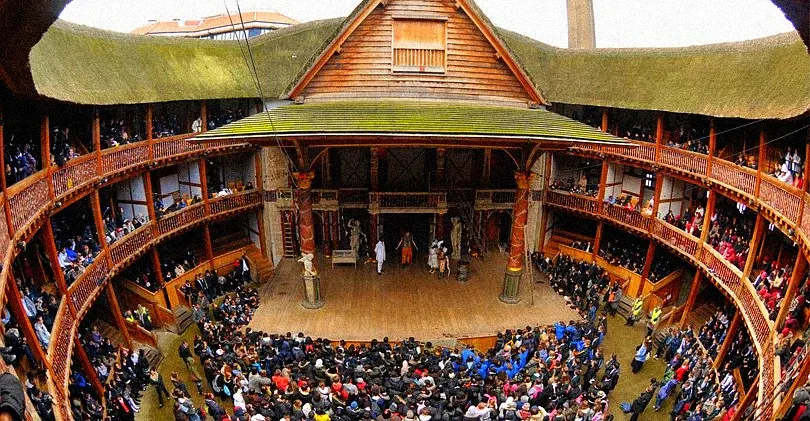
The thing also to remember about this time is theater is low-class. So in this district there are lots of brothels. People go to theater and they get drunk. They're drinking, they're spitting, they're eating stuff. They also participate in an illegal activity called bear-baiting. Bear-baiting is really strange, but the idea is you take a bear, you chain him up, you blind him. And then you have dogs attack him. And then you bet who wins, the bear or the dogs. And this is a really popular thing to do at this time. So it just shows you that we think of Shakespeare as very high-class, and we teach Shakespeare as high-class, but at this time Shakespeare is very, very low-class. And Shakespeare's plays are performed right beside bear-baiting venues as well as brothels.
But this is important because if Shakespeare is reaching the masses, he's educating the masses into a global imagination. Shakespeare and theater are so detested by the upper class that from 1642 to 1660 the Puritans banned them from England. Remember, the Puritans, how they're obsessed with control. They hate alcohol, they hate fun, they hate theater, especially theater. They hate Shakespeare. So they banned it. So during this time Shakespeare is extremely controversial.
Hamlet
Having gone into the history, let's discuss the genius of Shakespeare. You do Shakespeare in school, you've read quite a few of his plays, so I'm not going to go too deeply. But I'm going to focus on one example that distinguishes Shakespeare from all other playwrights. So the example I want to use is Hamlet. Hamlet, the story, it's a very simple story. It's about this prince of Denmark called Hamlet. He's going to university in Germany, I believe Wittenberg, which is where Martin Luther went. He comes home, and he's visited by the ghost of his dead father. And the ghost of his dead father tells Hamlet:
"I was killed by your uncle Claudius, who now has stolen the throne from me, as well as married my wife Gertrude, your mother. It is your responsibility as my son to seek vengeance against Claudius."
So that's the mission of Hamlet. The problem is that Hamlet is a very analytical person. He thinks too much. Paralysis by analysis. So he spends the whole play thinking about how to kill Claudius, but also whether or not to kill Claudius. And this is why we believe that Hamlet is Shakespeare's best play, because it is a very deep philosophical work. And in many ways Hamlet is really the expression of Shakespeare. You may not know this, but Shakespeare had a son called Hamnet, and Hamnet actually died when he was young. So a lot of scholars of Shakespeare, and there are like thousands of scholars on Shakespeare, believe Hamlet is Shakespeare's most personal play.
So we're going to go into a bit of Shakespeare and look at the most famous soliloquy in Shakespeare to understand how he thinks, how he writes. This again is iambic pentameter:
To be or not to be, that is the question. Whether 'tis nobler in the mind to suffer the slings and arrows of outrageous fortune, or to take arms against a sea of troubles, and by opposing end them. To die, to sleep, no more. And by a sleep to say we end the heartache and the thousand natural shocks that flesh is heir to. 'Tis a consummation devoutly to be wished. To die, to sleep. To sleep, perchance to dream. Ay, there's the rub. For in that sleep of death what dreams may come when we have shuffled off this mortal coil must give us pause. There's the respect that makes calamity of so long life. Thus conscience doth make cowards of us all, and thus the native hue of resolution is sicklied o'er with the pale cast of thought, and enterprises of great pith and moment with this regard their currents turn awry and lose the name of action.
So some brief comments about the soliloquy. First of all, as you can understand, it's beautiful. It's also, if you think about it, pretty easy to read. There are lots of really complicated words in the speech, but it's really smooth. If you read it for yourself, it's really smooth. And that's the power of iambic pentameter. If you really want to be fluent in English, just read Shakespeare aloud for a few months, and your English will be perfect.
The British really are the best practitioners of English. If you read magazines like The Economist, it's really the best-written magazine in the world. And you think to yourself, "Well, duh, the British invented English." No. Just because you invent something doesn't mean you're good at it. So the Chinese invented gunpowder, compass, printing, paper, didn't really get us anywhere. The fact of the matter is that in England you're expected to read and know Shakespeare. So it's Shakespeare that allows the British to have amazing English.
So this is very complicated, but it's actually not that deep. It's not like Dante. Dante is very, very deep, but Shakespeare is actually not that deep. So let's look at what he actually means with these words:
To be or not to be, that is the question.
Against the misfortune in our lives, is it more brave and good to bear it or to stand against it? I no longer want to bear this pain. Let me sleep. I no longer want to feel my heartache and my body become weak and injured. That is my wish. I want to sleep and to dream, but that is a danger, isn't it? When we are dead, we cannot control what we dream, and that is what frightens me. That's why I continue to bear more misfortunes around me. It is my own mind that has made me a coward, and why each time when I become determined, my resolve breaks apart and I cannot act.
That's what he's saying. That's literally what he's saying. No difference. But of course when you do this, when you simplify Shakespeare, you lose the beauty and richness of Shakespeare. So now the question then is why is Shakespeare so complicated? What's he trying to do with his language?
Layers of Meaning
So the first thing that he's trying to do is he's trying to use language as a mechanism to convey different realities, different meanings. So with each of his plays there are many different layers of meaning that can be true at the same time. So let me show you an example of this.
- Let's look at the first possible interpretation of to be or not to be. You can say it means to die or to live. "I cannot decide. I do not know if it's more brave to live a painful life or to run away from it and escape into death." So this is saying that Hamlet is overwhelmed by the moral dilemma he's put in. He cannot escape. He has to avenge his father or he cannot sleep. But avenging his father means killing his uncle, who his mother loves. It's an impossible moral dilemma, and he doesn't want to deal with it. So he wants to kill himself. That's one possible interpretation.
- Another possible interpretation is to kill or not to kill. "I do not know. Is it more good to let those who do evil suffer their own fate, or should I stop their evil and end their lives?" So you can interpret this as saying he's asking himself, "How should he kill Claudius? Should he kill Claudius?" That's a different interpretation.
- Yet another interpretation is should I follow my fate or should I defy it? "Is it more brave and good to do as I am told or to fight against my fate and in so doing perhaps die?" So this is a deeper and richer meaning where he's talking about fate and life in general. He's making the argument that we have no free will. We are forced into a situation where we must do what fate tells us. And in this situation, what does it mean to be human? What does it mean to have free will where you're controlled by the forces of fate around you? So that's a much deeper meaning.
- And then the last deep meaning is what is the point of existence? "I do not know. When we exist, we must face pointless questions in our lives. Should we suffer or should we fight?" So this is the deepest meaning, where he's actually asking, "What is existence? What is the point of all this? How do we get here? What is the purpose of existence?"
So there are four possible interpretations of the speech, and they're all correct. You can interpret them any way you want. So that's the first power of Shakespeare, where he's forcing you to interpret his speech in different ways.
Words as Images
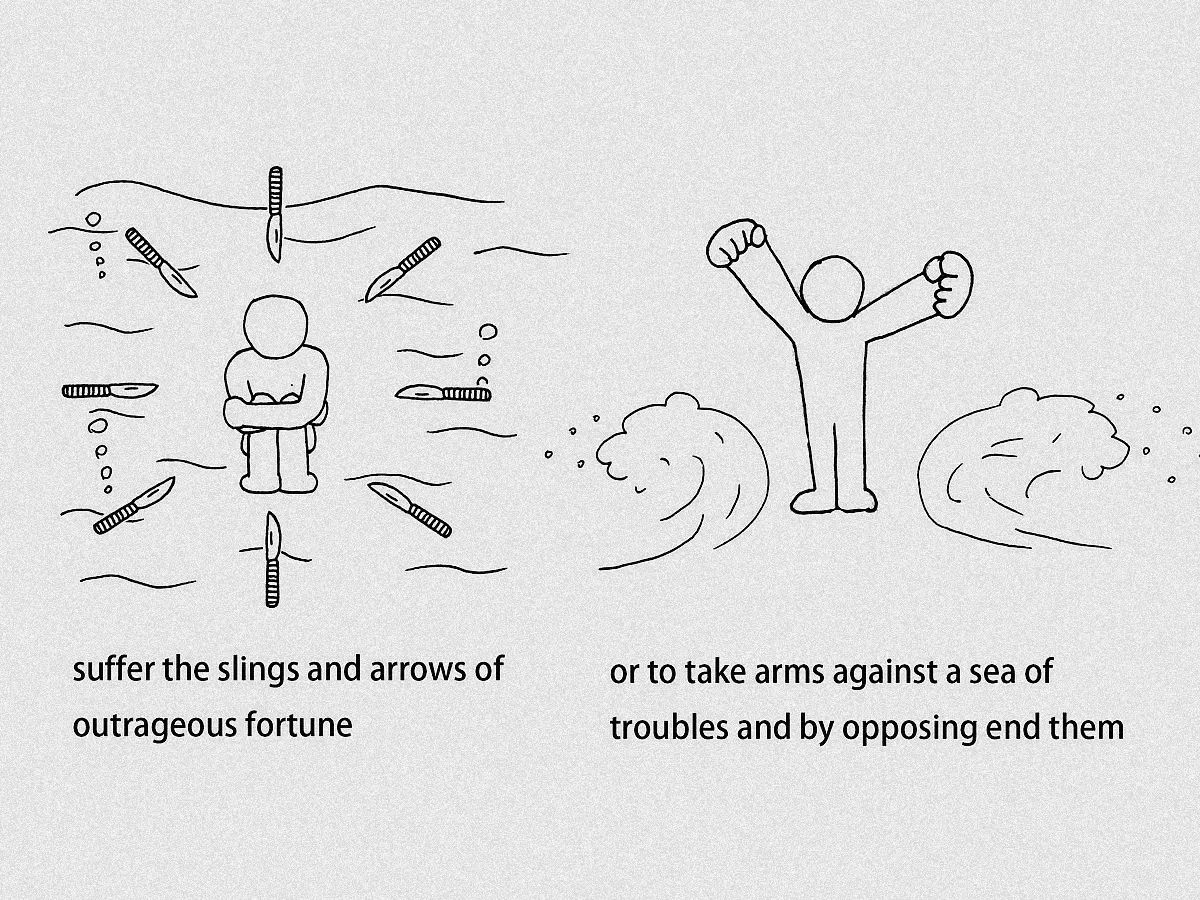
The second power of Shakespeare is it's visual. In this oral culture where most people don't read and write, most people are accessing the information through words. And in this tradition words are images. So let's go over the soliloquy and see how they use images. So when Hamlet says:
Suffer the slings and arrows of outrageous fortune or take arms against a sea of troubles and by opposing end them.
The audience is seeing these pictures. They're seeing a movie in their heads. That's the attraction of Shakespeare. And because you're seeing pictures, they remember all this. If you talk to an English person, it's amazing how much Shakespeare that person knows subconsciously.
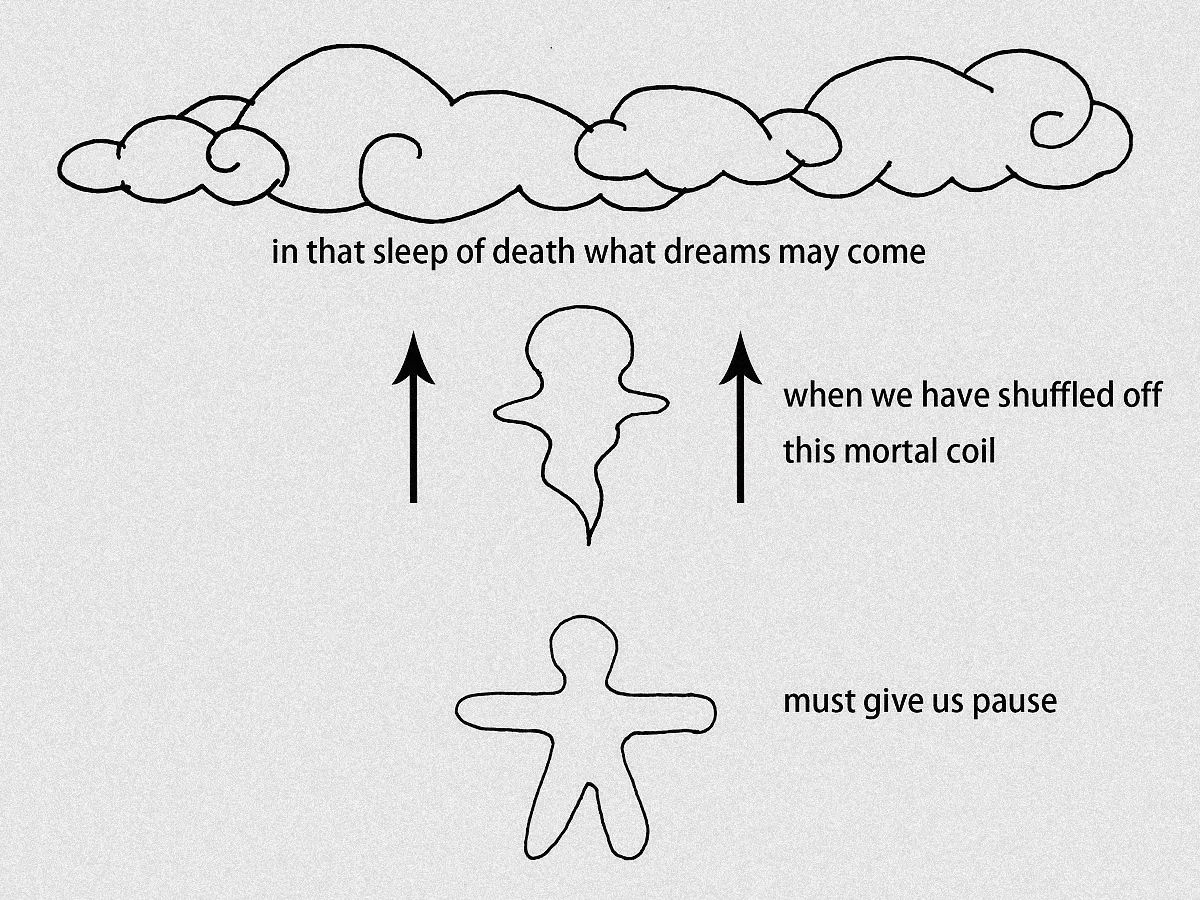
Another image:
In that sleep of death, what dreams may come when we have shuffled off this mortal coil must give us pause.
So this is an image of a person who's dead. So his soul goes up to heaven. But what's in heaven? What's in that sleep of death? No one knows.
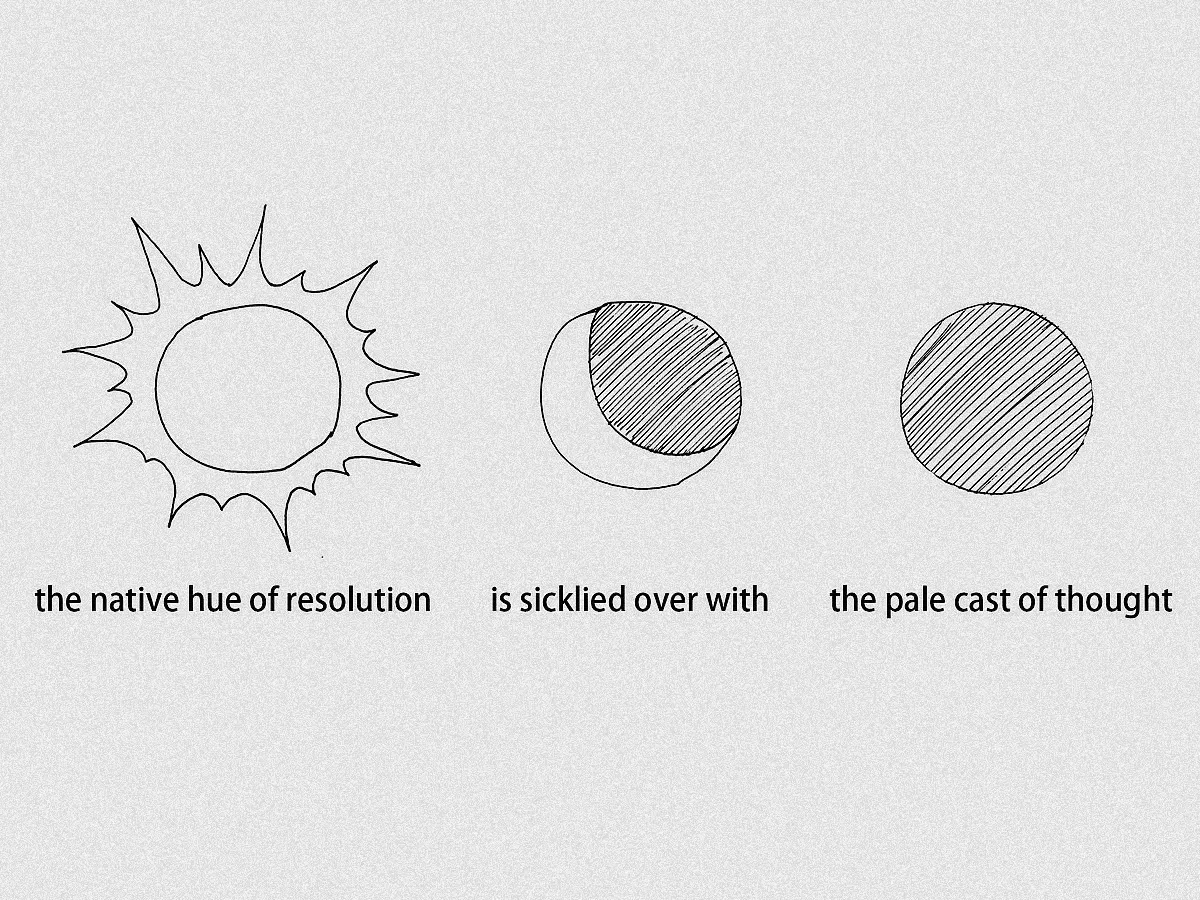
Another image:
The native hue of resolution is sicklied over with a pale cast of thought.
So this is a complicated sentence, but it's really about how something that is clear to us, once we think about it, becomes very dark and unclear. So that's the power of Shakespeare. It's a visual language.
Another example:
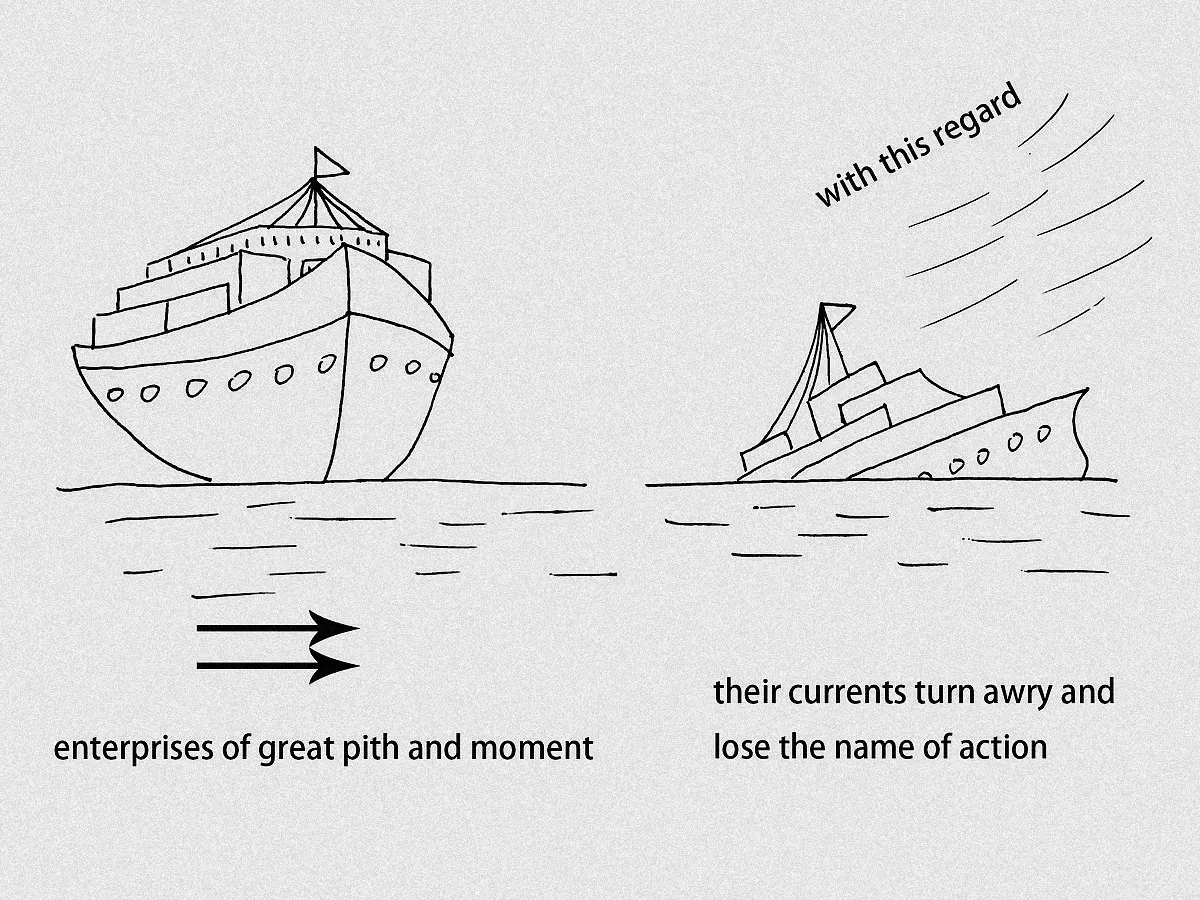
And enterprises of great pith and moment their currents turn awry and lose the name of action.
So imagine a ship. It's going in the direction you're set on that path. But the moment you think deeply about what you're doing, the ship collapses. You don't know where you're going anymore.
Rhetorical Surgery: The Power of Language in Julius Caesar
So another example of the power of Shakespeare is Julius Caesar. I'm not sure if you read Julius Caesar in school, but the plot is very simple. Julius Caesar has defeated all his enemies in the Roman Civil War, and his friends Brutus, Cassius, they're worried that he'll become a dictator. They're worried that he'll become king. So they plot to kill him. And Brutus and Cassius and all the conspirators kill Julius Caesar. And then Brutus and Cassius think this is over. But Mark Antony, who is Caesar's lieutenant, swears vengeance. And Mark Antony and Octavian will combine forces to destroy and kill Brutus and Cassius. And that's the plot of Julius Caesar. Not very complicated.
But in Julius Caesar you will find some of the greatest speeches in the English language. Stunning speeches. And in the speeches you will find examples of how Shakespeare understands language as a surgery on the brain. How through speechmaking, how through language, you can actually transform the neurological structure of the human brain. So let's look at an example of this.
Mark Antony and Brutus are going to engage in a speech competition. They're going to debate each other. Brutus will be the first to give a speech, and then he'll be followed by Mark Antony. So the strategy of Brutus is to use a rhetorical strategy called the antithesis. The antithesis is basically very simple. You have two opposing ideas, and they are opposed to each other. So the idea is:
"I am Brutus. I am honorable. You know me as honorable because my name is Brutus, which is also the name of Lucius Brutus, who founded the Roman Republic. You know me as an honorable person. Now who is Caesar? Caesar is ambitious. Honor and ambition cannot go together. So I love Caesar, but because he was ambitious, he wanted to enslave us. I want to free us. Therefore I had to kill him."
So that's the idea of Brutus. He's trying to create a dichotomy between Caesar and himself. If you know me, Brutus, as honorable, then you must believe that Caesar is ambitious. This rhetorical strategy is what is called antithesis. In the human mind you just see these two things as separate from each other.
Mark Antony then responds to Brutus using something called the chiasmus. The chiasmus is really interesting. The chiasmus tries to take these two opposing principles and combine them together. So what Mark Antony will say is that Caesar was ambitious and honorable, as honorable and ambitious as Brutus. This is what we call chiasmus. It's an A-B-B-A structure. When you do that, when you have a chiasmus, you collapse the antithesis. Remember, the antithesis is two separate ideas that cannot meet together. Exclusionary. The chiasmus shows you these are mirrors of each other. When you do that in the Roman imagination, the Roman mind, you then collapse the dichotomy between Brutus and Caesar, and you see them as one and the same. But if it was Brutus that killed Caesar, then Brutus must be the less honorable and more ambitious one. Julius Caesar.
So let's see an example of this. This is Brutus talking to the Roman crowd after the death of Julius Caesar. He's trying to explain his actions before the Roman crowd. He says:
If then that friend demand why Brutus rose against Caesar, this is my answer.
You want to know why I killed Caesar? I'm going to tell you why I killed Caesar.
Not that I loved Caesar less, but I loved Rome more. Had you rather Caesar were living and all die as slaves than that Caesar were dead to live all free men?
This is an antithesis. "I loved Caesar, but I loved Rome more." This is an antithesis. This is also antithesis. "Caesar, if he were living, he would make us into slaves. If Caesar is dead, we will continue to live as free men." Two exclusionary ideas developed by Brutus. Now what Mark Antony's going to do is he's going to collapse this. He's going to change your neurological structure. He's going to change your synapses within you through his speechmaking. Let's look at Mark Antony:
Yet Brutus says he was ambitious and sure he's an honorable man.
So he's summarizing the argument made by Brutus.
I speak not to disprove what Brutus spoke, but here I am to speak what I do know. You all did love him once, not without cause. What cause withholds you then to mourn for him?
This is a chiasmus. Cause, cause. Love, mourn. He continues with the chiasmus:
But yesterday, the word of Caesar might have stood against the world. Now lies he there and none so poor to do him reverence. O masters, if I were disposed to stir your hearts and minds to mutiny and rage, I should do Brutus wrong and Cassius wrong who you all know are honorable men. I will not do them wrong. I rather choose to wrong the dead, to wrong myself and you than I will wrong such honorable men.
These are two examples of chiasmus where word of Caesar and reverence match. Stood and lies match. Through the chiasmus he's collapsing this dichotomy. Another example is here. The red match, the green match. This is what we call chiasmus.
So that's the power of Shakespeare. Through his language, through his rhetoric, he's transforming the British imagination so that they are more open, more fluid. They can absorb new ideas and they can be more innovative.
Homer and Shakespeare
Homer did the same thing. So let's compare and contrast Homer and Shakespeare. How were they both able to be founders of great civilizations?
- First of all, they came at a time when there's a cultural tabula rasa. Tabula rasa just means blank slate. So Homer came at a time after the Bronze Age Collapse of Greece. The Mycenaean civilization collapsed, and now you have the polis system. So it's a tabula rasa. Same thing with Shakespeare, where Britain at this time is not as advanced a culture as the French and the Spanish.
- Second is rapid cultural change, where Britain is undergoing all these revolutions. When it's undergoing all these revolutions, people are anxious and they're looking for new ideas.
- Oral culture. We talked about this, where if you live in an oral culture people have a stronger memory and have a greater imagination. That's why they're able to sit through three hours of Shakespeare at one go and visualize his language. And this is the most common person in Britain. These are not the elite. These are just commoners. And so with an oral culture you have a stronger memory, imagery, vibrancy and flexibility. Look, guys, I hate to say this, but back then they were smarter than we are today. We have Google and ChatGPT, but if you think about it all these things are just making us stupid.
- Open cooperative competition just means that in their times Homer was just one of thousands of bards that are traveling around Greece and singing legends of the Trojan War and the Golden Fleece. So what they were doing was they were stealing from each other. Shakespeare was stealing from everyone else. And that allows for rapid innovation when you have an open cooperative competition.
- Democratic sensibilities. This is really important. Homer was talking to ordinary people. Shakespeare was talking to ordinary people. The problem with today's culture is there's a lot of market differentiation, where if you feel that you are high-class, you're a university professor, you don't want to talk to common people. You want to talk to other university professors. That leads to stagnation and segmentation.
- Free market. Really important idea. How do you know if you're good or not? Well, in a university you know if you're good or not if your professor tells you you're good or not. But how do you know the professor knows what he's talking about? The free market provides an objective feedback loop which forces you to constantly innovate and improve. How do you know you're good? Because people come and listen to you. They pay attention to your plays. They want to pay for your plays. And it turned out that because of the free market, cooperative competition, Shakespeare proved to be the best.
- And the last idea is poet as prophet. This is a really important idea. Yes, Shakespeare became very wealthy because of the plays he was producing. He came from a very common background. He was not very wealthy. He didn't even go to university. That's why today there are scholars who believe Shakespeare did not write Shakespeare because he didn't go to Oxford or Cambridge. Christopher Marlowe went to Oxford or Cambridge, but not Shakespeare. So you have a lot of scholars who actually believe because he was not well-educated he could not have written the plays he wrote. But what drove Shakespeare and what drove Homer is the idea that you have a divine mission to spread the truth. So Shakespeare and Homer, they were rich, they were popular, they were famous, but they were not driven by money. They were driven by a divine, messianic mission to transform the world.
This is really important to understand. Great artists are driven by a messianic mission to change the world for the better. They're not driven by money or power or fame.
Homer, Dante and Shakespeare
So having done that, let's recap and summarize the three great poets that have impacted Western civilization, and compare and contrast the three. You have Homer, who founded the Greek civilization. You have Dante, who we discussed in great detail. He's the founder of modernity. And you have Shakespeare, who is the founder of the British Empire.
Again, Homer, Dante and Shakespeare were all democrats in their heart. Homer was a roaming bard who went around the different poleis to sing and entertain the masses. Dante was revolutionary because he wrote the Divine Comedy not in Latin, which was the language of the educated elite, but in the vernacular, in Tuscan, so that ordinary people could access it. And by doing so he transformed Tuscan into the official Italian language that is spoken today. Shakespeare again was a playwright. He wrote and entertained the masses. That's why in Shakespeare some of his language is very offensive.
They have different conceptions of language though. And this is very key for us to remember. For Homer language is a window into the human soul. So go back to the Iliad and the Odyssey. It was really about what drove us humans. Achilles was driven by the thirst for fame. Odysseus was driven by his love of Penelope and his son Telemachus. So both the Iliad and the Odyssey were tremendous psychological studies of what it means to be human.
Then you have Dante. Dante uses language as a portal into the mind of God. What is the universe? How did God create the universe? What does God want from us? That's the Divine Comedy.
Shakespeare is very different. Shakespeare creates a new idea of language as a reality onto itself. A reality onto itself. So what I mean by that is with Shakespeare it's not really a deep meaning. It's very hard to find deep truths in Shakespeare. But the language is beautiful. And this is the culture we live in today where people write novels, they use beautiful language, beautiful description, great imagery, but there's really not great truths, deep truths, grand truths in the novels that are written and produced today.
John Keats and To Autumn
So let me give you an example of what it means to have language as reality onto itself. And to do so I'm going to use a different poet. His name is John Keats. John Keats. And this is from his most famous poem, To Autumn, which is considered the greatest English poem of all time. So let's read it together, and then I'll show you how this is a reality onto itself:
Where are the songs of spring? Ay, where are they? Think not of them. Thou hast thy music too. While barred clouds bloom the soft dying day and touch the stubble plains with rosy hue. Then in a wailful choir the small gnats mourn among the river shallows borne aloft or sinking as the wind lives or dies. And full-grown lambs loud bleat from hilly bourn. Hedge-crickets sing and now with treble soft the redbreast whistles from my garden-croft and gathering swallows twitter in the skies.
So it's beautiful. What does it mean? This is language as a reality onto itself. It is language visualizing a new world. So you see how the words match:
While barred clouds bloom the soft dying day and touch the stubble plains with rosy hue.
It's a painting, guys. This one sentence is a painting of a new world that you can see in your heart. Also:
Then in a wailful choir the small gnats mourn among the river shallows borne aloft or sinking as the light wind lives or dies.
You can see the music within this picture. This is not just a picture, but it's a world that you can access because it's moving. It's alive. It's the power of language. Next sentence:
And full-grown lambs loud bleat from hilly bourn. Hedge-crickets sing and now with treble soft the redbreast whistles from my garden-croft.
So you see what's happening, where this poetry is entering your soul. It is activating all your emotions, all your senses. There's the visual. There's the sound. There's the smell. There's the touch.
And gathering swallows twitter in the skies.
That's what poetry is. Poetry is the expression of a new world that you can access. And when you access it, when you enter it, it transforms your soul and your imagination, your capacity to think, feel and imagine.
English and Anglo-American Culture
So let's summarize what we learned. Shakespeare turns English into the world's linguistic internet, a platform in which all cultures, ideas and worldviews can meet and crossbreed. So Shakespeare is transforming English into this extremely flexible, beautiful, memorable language, which allows everyone to learn English well. You want to learn English well, just read Shakespeare. That's all you have to do. And then you can master English. So it's a linguistic internet. For the first time all cultures are able to meet together within the English language and communicate with each other.
There's a problem with this. There's a problem with this. The problem is this. This exchange is mediated through Anglo-American civilization, which is at its heart utilitarian, skeptical and empirical. So when you embrace English, when you experience English, you're also experiencing British culture, history and philosophy. And as we discussed, the three main philosophies of British culture are utilitarian, skeptical and empirical.
- Utilitarian, it just means that we should do things that work as opposed to what is right.
- Skeptical is to be skeptical of our capacity to reason and to think. If you think you know something, you probably don't know it.
- And then empirical just means the only thing you can know is things you experience.
So in other words Anglo-American culture, even though it dominates the world, is pretty lackluster. It's very narrow-minded. It's very practical. It's pretty mediocre. And if you want to know what I mean by that, think to yourself. What was the last great American novel you read? I mean, there are lots of great Russian, German novels. So the Russians, you have Anna Karenina, War and Peace, Crime and Punishment. The Germans have great philosophy, Kant, Nietzsche, Hegel. But I struggle to think about what great art the Americans have produced, even though they are the most wealthy, most powerful country that has ever existed in human history.
And I mean, Shakespeare's great. I love Shakespeare. King Lear is one of the greatest plays ever written. But Shakespeare compared with Dante, I don't know. Dante is like you are in the mind of God. You can feel this is divine. But with Shakespeare you're like, "This is beautiful, but is it a pretty nothingness?" That's the question I have.
And again, to be fair, it's been a long time since I actually read Shakespeare. I've read most of his plays, but it's been a long time since I've read Shakespeare. So what I want to do later on, maybe a few years from now, is actually teach Shakespeare and see if I'm wrong. But right now I have to say Shakespeare is not as impressive as Homer and Dante. I think Homer and Dante are the two greatest poets who ever lived.
So let me give an example of what I mean by how British culture is kind of narrow-minded. So this is considered the greatest epic in the English tradition, called Paradise Lost by John Milton. And it's really about Adam and Eve. Why did Adam and Eve eat that forbidden fruit? And why were we banished from the Garden of Eden? And look, it's 12 books, which is modeled off the great epics of antiquity, Homer and Virgil. And there are some parts of Paradise Lost which are beautiful. I mean, I love Paradise Lost. I've taught Paradise Lost before. But the reality is this. As an epic, as a grand vision of the world, it doesn't really work.
I don't really think the plot, the vision of Paradise Lost, is as fully formed and as grand as Homer and as Virgil and as Dante. And so Paradise Lost, you might have a chance to read it in college one day, but it's a very limited and narrow-minded epic.
So let's conclude. I hope you understand British culture. It's an island fortress. It sees itself as heir to the Roman Empire. It is an Anglican religion. It's driven by the empiricist and utilitarian philosophies. And Shakespeare is really the founder of this great civilization.
Where Do We Get Shakespeare's Plays From?
So I think you mentioned that all of Shakespeare's plays were published after he had died. So is it that those plays were held in theaters, but the textual versions hadn't been published for years?
So Shakespeare is performed all the time, and you are forced to read Shakespeare in school. So where do we get these plays from? So let me explain to you what's happening.
When Shakespeare was alive, he didn't really publish his plays. He didn't publish his plays. And there were many reasons why he didn't publish his plays. First of all, in this culture at this time there's no copyright. So if you publish your play and someone steals it, too bad. So you're not incentivized to publish your play. Second of all, people don't really read it. So there's really no market for his plays. So even if he were to publish his plays, he would not make any money off it. So what he did was he wrote his plays down primarily for his actors to memorize. But the benefit of iambic pentameter is that actually the speeches are pretty easy to memorize.
And when he was alive, Shakespeare was a national celebrity. He performed his plays in front of the king and queen. He was very, very, very well-known, extremely famous. He was looked down upon by the nobles, but he was very, very wealthy. And he himself will go on to purchase a noble title for himself. So he was extremely successful. When he was alive, people didn't really fully understand his genius. It's only afterwards when people really appreciate his genius. And his plays spread throughout Europe, especially to Germany. The Germans love Shakespeare. And it was only after his death that people realized what a unique genius Shakespeare was.
So after his death his friends, and I don't remember their names, but his friends want to remember him. They want to memorialize him. So they start to publish his plays. It's something called the First Folio. So basically what they did was they took the notes from Shakespeare. So some of the surviving manuscripts, not complete, but some of his notes. They also got the actors to basically write down what they remember. And they remember a lot because these actors have extremely good memories. So they were able to remember exactly the speeches. And then they'll make edits. And this is the First Folio. First Folio. But as you can imagine, over time there'll be lots of additions and mistakes.
But today there are thousands of Shakespeare scholars, and they argue over certain words. Did Shakespeare really have this word or was it a later addition? And it's a really silly thing to do, because as I explained to you, the genius of Shakespeare was to imagine language as this very fluid, flexible, imaginative tool for you to experience reality onto itself. So to argue, was it dagger or datter or dasher? And people argue this. Does it really matter? A lot of Shakespeare is just wordplay. There's really no deep truth in Shakespeare. And quite honestly these words are not going to change the deeper meaning of Shakespeare.
So it's just something that I think overpaid English professors do, just because they have nothing better to do. They argue about what was in the First Folio, what was edited out, what was added to. They try to figure out what was Shakespeare's original intention. And Shakespeare, think of him as a musician. He's trying to sing beauty and truth. But a lot of it is not intentional. A lot of it is not conscious. A lot of it is just being driven by inspiration and intuition and imagination. So when we go back to Hamlet, the soliloquy, if we change a few words it doesn't really change the meaning of the soliloquy.
White Man's Burden and Shakespeare
White man's burden. This is a concept that was introduced during the age of imperialism, towards the end of the 19th century, by Kipling. The white man's burden. The responsibility as white people to go and civilize the dark people, in Africa and in China and other places. What's the connection to Shakespeare?
First of all, Shakespeare was not interested in the world. He was very provincial. He was interested in London, and that was about it. I'm not even sure if he traveled. There's a debate whether or not he actually speaks French and Latin. He knows a bit of Latin, but there's a debate whether or not he speaks French. So Shakespeare was not an imperialist. He was not a globalist. He didn't really care about the world.
But within Shakespeare is British culture. He wrote histories, tragedies and comedies. There's like 38 to 41 plays, and together they are the encapsulation of British culture. So as Britain was going out into the world and conquering people and colonizing nations, they needed to explain why this was happening. Why are you going and killing people for no particular reason? And this is why Shakespeare is important, because Shakespeare allows them to say:
"Well, do you have a Shakespeare? Do you have like 38 to 41 plays that are really written? Well, if you don't, then that means you're not civilized. We have Shakespeare, you don't have Shakespeare, that means we're superior to you, and therefore we will teach you Shakespeare. We will educate you in Shakespeare. We will civilize you."
So this is not just Shakespeare. There are other individuals as well, but primarily Shakespeare. Shakespeare is really the greatest cultural product of the British. So Shakespeare himself was not an imperialist. He didn't really care about that sort of thing. But his legacy will be co-opted by British imperialists in order to justify and explain why they're going out and killing so many people around the world and stealing their resources. And then this will lead us into the great wars, World War I and World War II.
Othello, Psychology and Cultural Readings
You're doing Othello in class, and you're looking at Othello from the perspective of race and identity and culture. So let's discuss how Shakespeare wrote his plays.
So he wrote around 40 plays before he died at 52, which meant that he was basically producing one, two, three plays a year. That's a lot, guys. If you read Shakespeare, the themes are extremely diverse. You have Othello, who is a Moor, who kills his wife Desdemona. But you also have Merchant of Venice, Julius Caesar. So there's a wide range of his plays. And so the question is how did he do it? Well, he was stealing it from everyone. Remember, there's a huge market for theater, and there are dozens and dozens of really talented playwrights in London, in England, who are producing wonderful works. So he's just stealing these plots from different playwrights.
But what makes Shakespeare unique and special and superior to these other playwrights is first of all his characters. He has a deep empathy for his characters. He goes into the mind of his characters and he says, "If I'm this person, how would I behave?" So that's one thing that makes him unique. Second, as we discussed, is his use of language. Just the fluidity and the beauty and the flexibility of his language. And the last thing is the realism, which is he's trying to make the plot as realistic as possible. He's trying to remove the supernatural elements. He's interested in psychology.
So when you look at Othello, he's asking himself, "Why is it that a man who loves his wife, what could drive him to kill his wife?" That's the question he's asking. He doesn't see Othello as a black person in a foreign culture. He doesn't see it that way. He just sees, "I want to ask myself a question. If you truly love a person, what would drive him to kill her?" But because the theme is so universal, it allows you to impose cultural readings.
So he himself was not interested in the issue of race, culture and identity. Quite honestly at this time in history there's no such thing as race or identity. Remember, I keep on saying this, but for most of human history we did not differentiate ourselves according to race. We differentiated ourselves according to community. So within England people didn't care about the French or the Germans. But you know what? They cared about each other, and they hated each other. Remember, the main conflict in England at this point is the conflict between the Catholics and the Protestants. So they weren't focused on the world, they were focused on each other.
So these cultural readings come later. They come from today. Shakespeare himself was only interested in psychology. What drives us humans? And you can see that manifests itself in Othello and in Hamlet. And quite honestly, I'll be honest with you, I think it's really unfair to Shakespeare that we're doing this. Wouldn't it be a much more interesting class if we stopped asking ourselves, "Othello was a black person, so how are black people persecuted?" And ask yourself:
"Othello is a man of great achievement. He's a man of tremendous pride and honor. But is it possible that in certain circumstances this can be used against him?"
And that's the plot of Othello, which makes it a Greek tragedy. The Greeks were concerned about hubris, arrogance, fate. These are the questions that the Greeks were concerned about. So in many ways Shakespeare saw himself as continuing the Greek legacy. And the fact that we're focusing on questions like race, culture and identity, it sort of degrades the play. Because it's saying, "If you're a black person, then you may always be manipulated and persecuted." And quite honestly it's also reinforcing certain racial stereotypes about black people as very violent and emotional. So if I were to teach Othello, it's a great play, and I've never taught Othello, but I would focus more on the human aspect of Othello as opposed to the racial aspect of Othello.
Education and Shakespeare's Genius
Are there any explanations for how Shakespeare is able to produce such genius plays, since he's not very well-educated, as you mentioned?
That's a great question. How is Shakespeare able to focus on human psychology given the fact that he's not well-educated? I will make the argument it is precisely because he's not well-educated that he focused on human psychology. When you are educated, you're educated into cultural attitudes, norms and values of the elite. But if you're not educated, then what you do is you observe humans as they are without prejudice. You want to know how are we as humans? And you have not been indoctrinated to believe certain things.
If you go to school and you do well in school and you go to university, the first thing you're taught is only well-educated people are capable of deep psychological insights. And that's a prejudice. That's a failing. Because Shakespeare never went to school, he's able to see himself as equal to other people, and therefore he's able to have tremendous empathy for the people, and therefore he's able to understand their psychology and his own psychology. He's able to see people as a reflection of his own psychology, and that's what drives his genius. And quite honestly that's also what drove Homer.
I hate to say this, but I did go to Yale University. I studied English literature there, so I spent a year studying Shakespeare. And I was not impressed with the education I got at Yale, because again the problem with one of these elite universities is you're taught to think in a very rigid way that inhibits your empathy, your curiosity and your own psychological understanding.
In fact, I'll be honest with you, I watch a lot of YouTube videos to do research for these talks. I'm always impressed by how these self-taught historians know much more about history than these academics at Yale, Cambridge, Oxford, Harvard. That's something that I've observed. You're much better off talking to an individual who has a passion for history and who's spent his entire life asking himself, "What is history?" but never really got a formal education, never got a doctorate in history, as opposed to a Harvard PhD in history. That's a hard lesson I learned in my life. It was very hard for me to accept because I am an elite graduate of an elite university.
But what Shakespeare understood intuitively is, no, it's the common people, the ordinary people, that's where the truth lies. Not in books, but in people. That's what makes Shakespeare so great. He is first and foremost an anthropologist, a psychologist of people. He wants to understand how people think and behave. When you read his plays, that's what you experience for yourself. He's really interested in the psychology of Iago, Desdemona and Othello. That's what he's curious about. He's not interested in these structural forces that drive conflict and persecution among these people. That comes later. That's what we do to Shakespeare today. But back then he was only interested in what it meant to be a human being.
How Shakespeare Develops His Themes
You want to ask more about Othello? I'd be happy to answer, even though my reading of Othello might be different from what you've been taught in class.
I've only read Act One, so I'm having some trouble reading it.
Back then in England, I don't really see much literature about race.
So the question is how does Shakespeare develop his themes? So Othello, Hamlet, King Lear, all these plays are well-known stories. They're actually well, well-known stories. But Shakespeare is curious about people. Because every day if you work in a theater you deal with people all the time. Your customers are people, your actors are people. And what he discovered over time is people are very complicated. People are very emotional. People have their own psychology. There's diversity among people.
And so what he does that's really interesting is he takes these legends and combines them together. He takes these legends and he takes his observations of human individuals and combines them together to create Shakespeare. In other words, what he does that's unique is he takes these characters, King Lear, Hamlet, and turns them into people he's observed. When you do that, you get a lot of interesting psychology.
So let's imagine you become Hamlet, and you're in the circumstance where your father's come and given you a mission to go kill your uncle because he's sleeping with your mother. And how would you behave? Well, you'd probably react like Hamlet, and you'd be very confused. You'd be very distraught. Same thing with Othello, where let's just say that you're this great champion, you're this great hero. Well, other people are going to be jealous of you. If other people are going to be jealous of you, what they're going to do is figure out how to get back at you. So it's not a racial issue, it's a human issue.
If you're the top student in the school and every day the teachers are praising you, I'm pretty sure that teacher's going to hate your guts. That's Othello. That's a human thing. It's not a racial thing. It's not because he's black. It's because he's such an accomplished individual.