Civilization #50: Rule, Britannia!
The question we are looking at is: how did England become the greatest empire in human history? This is about the 19th century when the British Empire is at its peak. As you can see, it really controls most of the world. So the question then is how did this happen? Why is it that England was able to surpass Spain, France, Germany, the Holy Roman Empire, Russia, to become the dominant hegemon in the world?
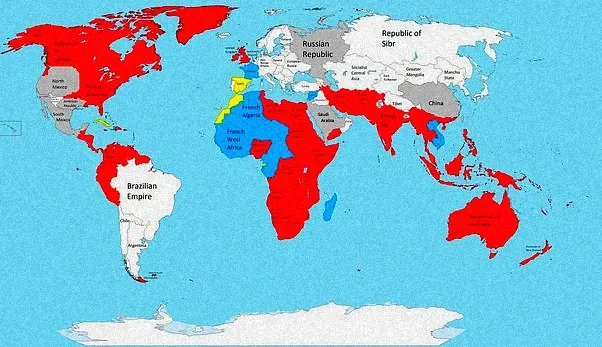
So my argument to you is it has to do with the fact that throughout its history England was forced to innovate in a more rigorous and relentless way than other nations. And a lot has to do with its geography.
Geography, Population and Expansion
So as you can see from its geography, Great Britain, this is Ireland, this is England, Wales, Scotland, it is an extremely mountainous region. They have a lot of rivers, but there are no major rivers, which meant that for most of its history Britain never had a major population center that could grow and grow until it overwhelmed the entire geographic area. This meant that for most of its history Britain was engaged in a process, what we call open competitive cooperation.
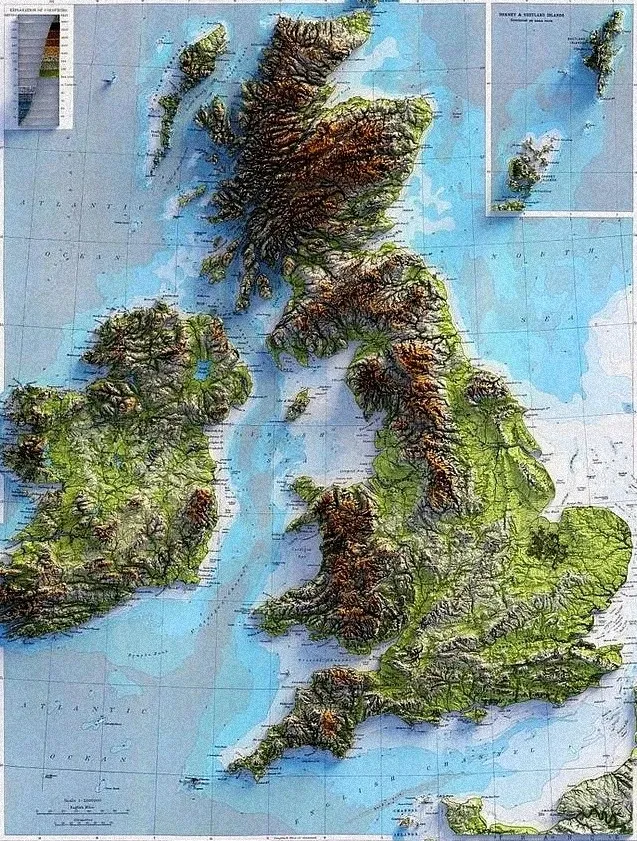
Not only that, but because this area is very mountainous, and because these tribes are divided heavily amongst themselves, throughout most of its history Britain is actually pretty easy to invade. They have no centralized authority, so it's possible for other groups of people to come and create settlements in Britain, which is what the Vikings did, which is also what the Romans, the Yamnaya did. So throughout its history Britain underwent a series of great destructions, where the elites were constantly replaced by new elites.
And because Britain is poor, because there's so much conflict within Britain, eventually the English people were forced to migrate overseas to create new opportunities. And this process of colonial expansion led to the British Empire. So there's a famous saying that the British Empire was founded by accident. There was no intention to create this empire, but because of these historical, geographic, demographic forces, Britain became the world's largest empire.
Let's very quickly look at Britain's demographic history. So for most of its history, because of its geography, because of the fact that it was poor and divided, the population of Britain stayed very flat, up until the year 1000. What happened in the year 1000? Well, Europe became wealthier and wealthier, and engaged in a proto-industrial and agricultural revolution, which caused the demographics to increase.
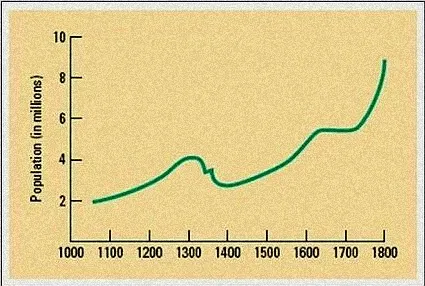
But unfortunately, if your demographics increase, but you don't have improvements in sanitation, in health and nutrition, well, what happens? You have something called the Black Death, which causes the entire population of Europe, including Britain, to collapse. After the Black Death, the Europeans start to engage in the gunpowder revolution. And with that, you have industrialization, urbanization, and that causes population increase.
But if you see about the middle of the 17th century up until about 1800, the population is flat. This is what we call the Industrial Revolution in Britain. Britain is the first European nation to undergo the Industrial Revolution. And what that meant is you have this mass migration from the rural areas into the urban areas, especially London.
So why would this demographic shift cause the population to stay flat?
- Well, the first reason is it's really, really unsafe in the cities. Diseases, malnutrition, a lack of sanitation cause people to die really, really young.
- Also, during this time, because of the massive inequality in Britain, people are forced to migrate overseas in order to seek better opportunities, mainly America. But they will also go to Australia and New Zealand. So even though the Dutch were the first to discover and settle Australia and New Zealand, it is really the British who, because of pressure back home, will settle in Australia and New Zealand. And today, Australia and New Zealand, of course, are British. They have a British culture instead of a Dutch culture.
Starting in about the year 1800, because of improvements in nutrition, sanitation, the population explodes. And this is true throughout Europe. And this is really why Europe will eventually conquer the world.
Settlement, Conquest and Language
So let's go briefly into the history of the British Isles. So at first, we believe that the British Isles were settled by an agricultural people. These are the people who built Stonehenge. Göbekli Tepe is a temple in Anatolia, in what is modern-day Turkey, that shows the desire for humans to settle down and found religious societies. Well, Göbekli Tepe is very similar to Stonehenge. They are both astronomical calendars that measure the stars, measure time, and try to bring divine energy onto the Earth in order to feed agriculture. So you can argue that what's happening is the Göbekli Tepe culture is spreading all throughout Europe, and it gets into the British Isles.
But eventually these people are conquered by the Yamnaya. And if you look at the DNA evidence, a lot of these people were eventually wiped out by the Yamnaya and replaced. This is a process of creative destruction that will happen throughout British history.
The next major development is the Roman conquest of Britain. When the Romans conquer Britain, they bring Roman technology, which is aqueducts, irrigation, urbanization. They will also bring Roman customs, especially law. So now you have a legal tradition in Britain that continues on to today. They will found a city called Londinium, which is now modern-day London, on the River Thames. And this city will eventually become the largest city in Europe.
After the Romans will come a new group of people who are Germanic. So these are people who used to live in Denmark and northern Germany. And because of population pressure, they're all forced to migrate overseas, and they settle in Britain. There are three different tribes of people that settle in Britain. They are the Angles, the Saxons and the Jutes. And together we will collectively call them the Anglo-Saxons. And at this point in history, this culture, this language, it's no different from that of Germany. So if you were to go to this place in about the year 800, they're speaking the same language, which is West Germanic, and today we call it Old English.
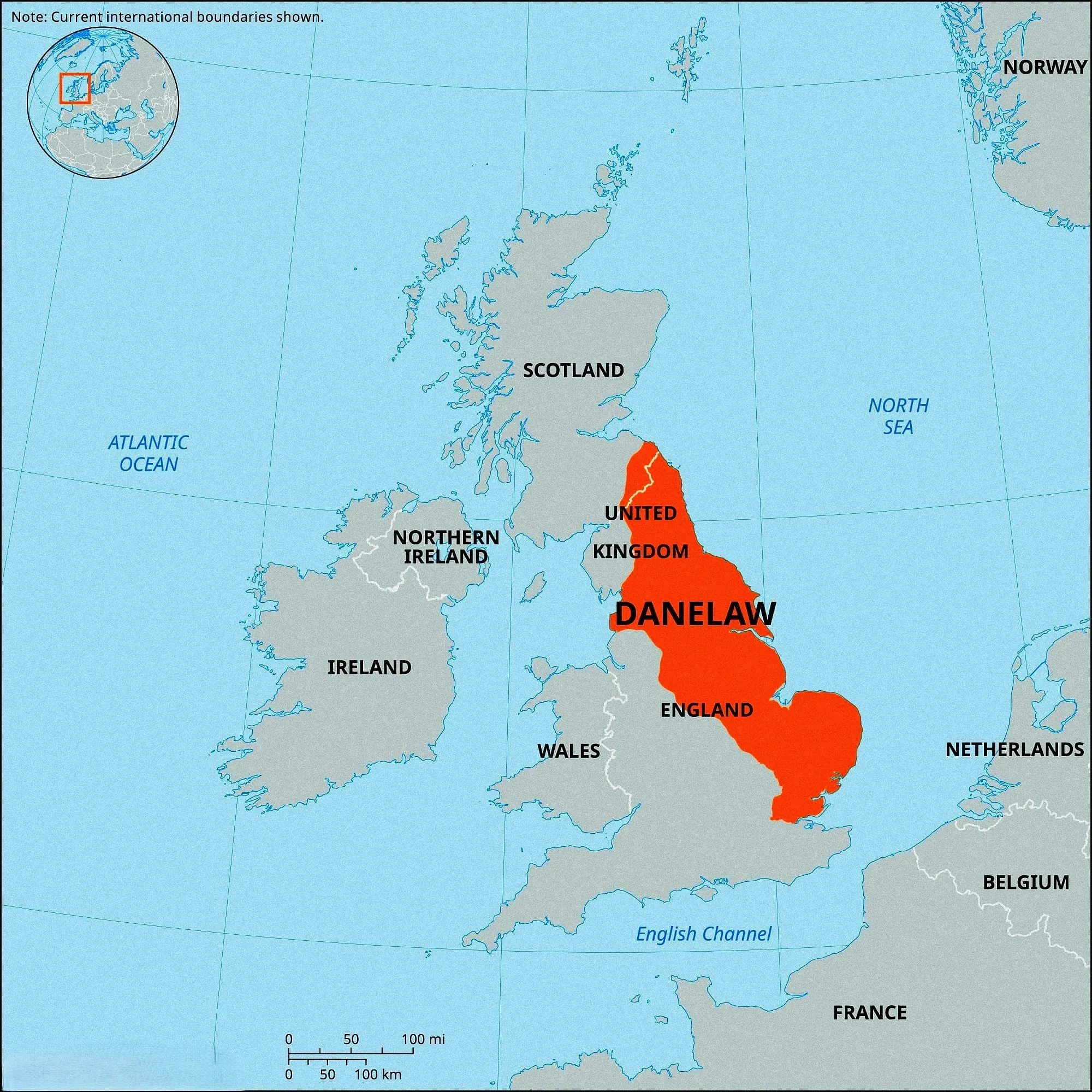
Again, what's really important to remember is it's fairly easy to settle down in Britain because there's no centralized authority. So after the Anglo-Saxons come the Vikings from Denmark. And even though England has no major rivers, it still has rivers. So it's fairly easy for the Vikings with their very fast longships to come and make settlements. So as you can see, the Danelaw is territory that is ceded by the Anglo-Saxons to the Vikings. And now you have this merger of the Viking culture with the Anglo-Saxon culture.
This process of creative destruction continues with the Norman Conquest of England. This is the year 1066. This battle is called the Battle of Hastings, in which William the Conqueror of Normandy in France comes and conquers Britain. This is significant for two reasons.
The first reason is that the Normans are Vikings who settled down in France in an area called Normandy that's off the British coast. And remember, before, the Anglo-Saxons were Germanic people, so their focus was on northern Europe. Because the Normans conquer Britain, Britain now is united with parts of France. So Britain is drawn into the politics of France, which will lead to something called the Hundred Years' War, in which the English are trying to maintain their territory in France. So that's the first major geopolitical consequence of the Norman Conquest.
The second consequence, which is also relatively significant, is a radical change in the English language. So before, the Anglo-Saxons spoke a Germanic language we call Old English. Now you have a merger of the Germanic language with French and Latin. So French is the language that the Normans spoke, but Latin is the official language of the educated elite of Europe. So now you have Latin and French elements blend into Old English, and this creates a new language we call Middle English. And Middle English, of course, will give rise to Modern English.
This is significant because what makes Middle English different from Old English is Middle English is a lot easier to learn. Because remember, now you have a very cosmopolitan nature to Britain. You have Vikings, you have Anglo-Saxons, you have French, you have Normans. They all need to speak one language. So the best elements of these different languages are blended into Middle English. And this tradition continues today because if you think about it, English is the most widely spoken language in the world. Why? Because it's the easiest to learn.
Now you may argue that it's because we live in the Anglo-American Empire, and therefore people are incentivized to learn English. But at the same time, the reason why they were able to establish the Anglo-American Empire, a lot has to do with the fact that English is easy to learn, and therefore it's easier to spread soft power. Because when you learn a language, you're not just learning a language, you're also learning a culture. You're learning a history. And this is what we call soft power. And the British did this better than anyone else. Now the Americans do this better than anyone else. But it starts with the Norman Conquest, 1066.
The Magna Carta
As I mentioned, what's really important about Britain is it really never had centralized authority. Maybe now and then you had a great king like Alfred the Great. But it was never centralized because the king could never assert authority over the different fiefdoms. So whenever a king does that, the nobles get together and they rebel. So in 1215, King John tries to impose taxes on the nobles in order to finance wars in France. Because again the English are trying to maintain their territory in France, and that creates a lot of conflict with the French themselves.
So they fought a lot of wars, and you need money to pay for these wars. So King John was trying to make the nobles pay taxes. So what the nobles do, and this is going to be a consistent pattern throughout British history, is they rebel and they force King John to sign a document called the Magna Carta, the Great Charter. And the Great Charter is significant because it severely limits the power of the king.
Now this has happened throughout human history before, when the nobles rebel and they force a compromise with the king. This has happened throughout human history. But this is actually the first time that this has been written down and become part of the British tradition. This will become part of what we call the British constitution. What makes the British constitution unique is it's not written down. It's not a document like the U.S. Constitution is. It is a set of traditions and norms. So this begins the British constitution, the Magna Carta.
It's a very old document, so most of the clauses don't really apply, but there are three that do apply. So I want us to look very closely at certain clauses within the Magna Carta. Clause 10:
If anyone who has borrowed a sum of money from Jews dies before the debt has been repaid, his heir shall pay no interest on the debt.
This is really interesting. This is the year 1215. There are Jews in England. Why are there Jews in England? So let me explain the history of Europe at this time. So Europe is entirely Catholic. The Catholic religion does not allow for something called usury. And the idea of usury is you charge interest on debt. Because that goes against the teachings of the Catholic Church. That goes against the teaching of God. Also, it's socially destructive, because if you're on a debt, you're actually stuck there for all eternity. So the Catholic Church explicitly forbids charging interest on debt.
But, this is really important, debt is extremely profitable. So the way that the king and the nobility get around this taboo is they get Jews to lend out money and to charge debt. And then the king gets part of that. Also, because Jews are heavily disliked anyway because they engage in moneylending and usury, the king also gets them to go collect taxes. So the Jews throughout European history have been the scapegoats for the elite. They're the ones who charge usury. They're the ones who collect taxes. They're also the ones who will engage in businesses for the nobles. So they basically subcontract businesses from the nobles, and they're very good at that. And why do Jews agree to do this? Because the king and nobles provide protection to the Jews.
So over time you have this huge problem where even nobles owe money to the Jews. And the problem of debt creates a lot of social tension within England. So in the Magna Carta it says very explicitly that yes, you still owe money to Jews, but if you die, your heir does not have to pay interest. Because the problem of debt, again, is not the debt itself, the principal, but the interest. This is really important because if you want to understand World War II, if you want to understand the Holocaust, it starts way back here.
So the two most important clauses in the Magna Carta that still apply today are 39 and 40. So let's look at 39:
No free man shall be seized or imprisoned except by the lawful judgment of his equals or by the law of the land.
This creates a new principle in British history called due process. This means that if you commit a crime, you are still guaranteed a jury, a trial before you are punished. There's a process in which you are found guilty for your crime. This is what we call due process. Number 40:
To no one will we sell, to no one deny or delay right or justice.
This means that no one is above the law. So number 30 establishes the idea of due process. Number 40 establishes the idea of rule of law. Everyone is guaranteed due process. Not even the king has the power and authority to take away due process from someone. And this establishes the British common law tradition. And this becomes the basis for the American Constitution.
The Hundred Years' War and the Tudors
So as I mentioned, because of the Norman Conquest, Britain now is forced to defend its territory in France, and this leads to a series of disastrous wars in France called the Hundred Years' War. Obviously there are certain very important figures that emerge from the Hundred Years' War, the most famous being Joan of Arc. Joan of Arc, who is this French mystic, a teenager girl who leads the French armies to victory against the British and their allies.
During this time there's also a civil war fought in Britain called the War of the Roses between the House of York and the House of Lancaster. You may like the Game of Thrones television series. I'm not sure if you watched it, but that series is actually based on the civil war between the House of York and the House of Lancaster. This goes on for a long time. It's very, very deadly. It almost destroys Britain. But eventually a man named Richard of York, Richard III, emerges victorious from this civil war. But he has a problem.
His problem is his family, the House of York, had to borrow a lot of money from overseas, the Florentines, the Medicis, in order to finance the war. Once he became king, he thought, "Well, I'm king and I don't have to pay you back." So now the bankers are angry at him. And if bankers are angry at you, you have a problem. Because what bankers will do in this circumstance is finance an invasion of your country. So the Medicis, the Florentine bankers, sponsored a man named Henry Tudor, Henry Tudor, who is of the House of Lancaster. But he grew up in France. And they sponsored him to invade England and defeat Richard III. And this is obviously the House of Tudor.
And so Henry Tudor becomes Henry VII, and his son becomes Henry VIII, who is one of the most famous kings in British history. He's famous because he decides to negate the authority of the pope. He decides, "I'm the king. I don't have to listen to anyone, even the pope." And this came to pass because Henry VIII was trying to divorce Catherine of Aragon, and the pope would not agree. So Henry VIII decided to set up his own church called the Church of England and separate himself from the Vatican.
Now what's really important for us to remember is there's only one difference, only one difference between the Church of England and the Catholic Church. The Catholic Church swears loyalty to the pope. The Church of England swears loyalty to the king of England. That's it, guys. There's no other difference. The customs, the doctrine, the rituals are all the same. There's only one difference.
Elizabeth and the Navy
He will have a very famous daughter called Queen Elizabeth. So because of the Reformation, there's a huge religious civil war going on between the Catholics and the Protestants. So Elizabeth, why she is so consequential is she's on the throne for 40-plus years. And what makes her extremely significant is she brings stability to England by sympathizing with the Protestants, but also by working with the Catholics. So even though there are all these Catholic conspiracies against Elizabeth in order to install a Catholic monarch, she's still able to resist these conspiracies, these rebellions, and establish a pretty stable nation.
At the same time, during her reign, Shakespeare will write his plays. Because of Shakespeare, there would be no English language. If there's no English language, you can also argue there'd be no British Empire. Shakespeare created the English language and created the possibility of the British Empire.
Francis Drake is the most famous pirate at this time. And he is a trusted deputy of Elizabeth. Elizabeth has a policy of piracy. England is poor, Spain is rich, so what do you do? You steal from the rich and you give to the poor. And that's what Sir Francis Drake did.
So at this time England is emerging as a naval power, and it's going to surpass both Spain and France to become the dominant navy in the world. And as you know, it's really the navy that allows the British Empire to control the world. The major innovation of the English is how they fight at sea. Traditionally, the way you fight naval battles is by ramming the enemy and then boarding the ship and then killing everyone. That's what the Romans did. That's what everyone did.
The English decided that's silly because we're always outnumbered. We're always outmanned. So they pioneered long-range cannon warfare, where from a distance, maybe a few hundred meters, you will blast your enemy with cannons. There are lots and lots of problems with this. The first problem is you could possibly sink your ship because the cannons are very heavy. Also, you could blow up your own ship because the cannons are very explosive. Also, the cannons aren't very accurate.
But the English persisted, even though you can make the argument that this type of warfare is unsustainable. And in the beginning, for the first few decades, the way they fought was terrible. But the thing about the British that made them very similar to the Romans is they were relentless. They were willing to suffer heavy casualties, major setbacks, major failures, and still persist until they eventually won. That's the mentality of the British. That's very Roman.
So this is 1588, the Battle of the Spanish Armada. And this is something that's heavily celebrated in England, because for the English it marks the day when the British Navy reigned supreme over the seas. This is the day that the Spanish Armada was conquered and destroyed by the English. Something that's really important for us to remember is that a year later, in 1589, the Spanish will defeat the English, and the English will suffer tens of thousands of casualties. So what's important for us to remember is that these wars go back and forth. There's no one time when, now the British are dominant. What matters is persistence, what matters is resilience. And in that respect the English are far superior to their European adversaries.
King James and the Pilgrims
So Queen Elizabeth dies, and King James of Scotland inherits the English throne. So now Scotland and England are united. What's significant about King James is he produces something called the King James Holy Bible. This is something that the Protestants have been demanding for a long, long time. Remember, the difference between the Protestants and Catholics is the Catholics are not allowed to read the Bible. The priests tell the parishioners what to believe, what the orthodoxy is. The Protestants believe that everyone must read the Bible. So the King James Bible, it's the first time that the Bible has been mass-produced for everyone. So this spreads Protestantism very quickly throughout the British Isles.
Also, what's really significant is, with the Bible, now you've standardized the language. Now you can make a transition from Middle English to Modern English, the language we speak today.
1620 is significant because it's the year when the Pilgrims on the Mayflower moved to America to found a new colony, a new civilization, a new empire that will take over the world. Why are the Pilgrims moving to America? Well, the Protestants are divided into two major factions at this time. You have the Puritans. Who are the Puritans? The Puritans believe that the Church of England is too Catholic. And so therefore we must purge the Church of England of Catholic tendencies, like rituals, like priests.
The Pilgrims are what we call Separatists. The Pilgrims are Separatists who believe the Church of England is too corrupt, it's too evil, it's too much like the Vatican. Therefore we should abolish it or we should just separate from it. And so of course they were persecuted by the king, and as a compromise the Pilgrims were allowed to go to America to build a new civilization based on their beliefs. And this civilization of course will be called America. So that's something that you must remember, that America was founded by Pilgrims who want to build a kingdom of heaven on Earth.
The Commonwealth and the Glorious Revolution
Back in England there is a civil war now raging. And it starts again when the king tries to impose too much authority over the nobles. But there's also a religious dimension to it because the Puritans want to impose a religious state on everyone. So the fanatics at this stage are the Puritans. And what will happen is the Puritans will emerge triumphant under the leadership of Oliver Cromwell. And he will establish something called the Commonwealth of England. And this is a disaster. It doesn't really work out well because it goes against British tradition. Remember, the idea of the Puritans is they want to establish a religious, centralized theocracy on England, but England has always been pretty independent and autonomous.
So what will happen is after Cromwell dies, the Commonwealth goes away, and the nobles reinstate a new king, who is Charles II. After he dies, James II will take the throne. The problem with James II is he's a Catholic. He's a Catholic. And so there are a lot of English who are afraid that he will move too close to France, Spain and the Vatican. And these are British enemies. So what will happen is this. The nobles will invite a Dutch king, William of Orange, who is of British blood, to come to England in the year 1688. And William of Orange will bring about 10,000 soldiers to Britain. This is an invasion. This is the very last invasion that succeeds in Britain.
King James has a larger army, but what happened is King James is not very decisive. He's not very effective. So a lot of his army will desert him. So basically his army sort of dissipates, and he's allowed to go to France. And William of Orange, not bloodlessly, but he's very quickly able to assume the throne. And this is called the Glorious Revolution. This is significant because it establishes for the first time officially the sovereignty of Parliament over the king. This is really important. Now it's official. Parliament is the ultimate authority, ultimate sovereignty in Britain. And the king is a figurehead.
And this is significant because it will now allow Britain to energize the middle class. If you're middle class, you now have an incentive to work hard because now there are patents, there are trademarks. There's incentive for you to get rich. And this will lead to, of course, the Industrial Revolution. So the Glorious Revolution is one of the main contributing factors to the Industrial Revolution in Britain.
The Bank of England
This is also significant because in 1694 the Bank of England is established. Now I can't emphasize enough what a huge deal this is. So let me slowly explain why this is a big deal.
Now we're going into finance and economics, and I really haven't taught finance and economics before. I want to make sure that you understand the idea here.
So before, you're king and you want to fight a war. What you do is you borrow money from the rich. And these are usually cartels. So Charles II borrowed a lot of money to fight wars from the goldsmiths of London, including a group of Jews. And then he refused to pay it back. Now you have a problem because now you have a credit crisis. You have a trust crisis. If the king refuses to pay back the rich for their loan, why would the king ever be able to raise funds ever again?
So Parliament solves this problem, because now if Parliament is the central authority, the central sovereignty in the land, then you are not lending money to the king. You are lending money to the nation. If a king dies or a king is deposed, you're screwed. You're not getting your money back. But if you lend money to the nation, the people through the Parliament, then you are always guaranteed to get your money back unless England gets conquered. But we know because of the navy England cannot be conquered.
And so not only are the rich willing to lend money to the nation now to finance wars, but also foreigners, especially the Dutch. Because the Dutch were very wealthy, and they needed a safe place to put their money. So where's the safest place in the world to put your money now? England. Because if you are in the Netherlands, you could be conquered by the French or the Germans, which happens a lot. But if your gold, and this is gold, goes to London, no one's going to be able to touch that.
So now the Bank of England allows Britain to borrow money from its people, from foreigners and from the future by printing money, by issuing war bonds. And therefore Britain has infinite financing. And this is the main reason why Britain was able to defeat Napoleon. It took seven wars, seven coalitions to defeat Napoleon. Each of these coalitions was financed by Britain. And once Napoleon was defeated, Britain became the hegemon of the world. It became the British Empire. No one could now challenge the might of Britain.
So central banking allows you to mortgage your nation's future in the pursuit of total war. It allows you to weaponize the trust and confidence of your people. But there's a problem. This is really important. There's a problem with this innovation. The problem is this. Once you commit to a war, once you raise debt and commit to a war, you're forced to fight the war until the very bitter end. Because if you lose the war, your nation goes bankrupt.
That's why Britain refused to ever compromise with Napoleon. And Napoleon said to Britain, "Hey, guys, I control all of Europe. Let's talk peace. Let's just trade peacefully." And Britain says, "No, we can't do that because we lent a lot of money to the Austrians, the Prussians and the Germans and the Russians in order to defeat you. If we sign a deal of peace, all this money is now gone. And we, the Bank of England, we, the British nation, are completely wiped out. We are completely wiped out."
This is really important for the future history of Europe. If Britain fights a war, it does so through financing. It does so through debt. But because it does so through debt, it has to fight the war until it wins. It can never, ever compromise. It can never, ever surrender. And this is important because this explains what happened in World War I, World War II. And this also explains American foreign policy.
Hobbes and Locke
Now I want to talk about the political philosophy of the British. Because again, you can have new ideas, but now you have to justify these new ideas. You have to explain the innovation through philosophy to the people. So Britain at this time is really famous for its political philosophers. At this time Thomas Hobbes is one of the most dominant political philosophers. He lived through the English Civil War. He saw all the chaos, all the destruction. And he wrote a book called Leviathan. Leviathan is to justify why Britain returned to monarchy instead of maintaining a commonwealth. And this is the most famous passage from his book Leviathan, which you'll probably read in university:
There is no place for industry because the fruit thereof is uncertain and consequently no culture of the earth, no navigation, nor use of commodities that may be imported by sea, no commodious building, no arts, no letters, no society, and which is worst of all, continual fear and danger of violent death. The life of man, solitary, poor, nasty, brutish, and short.
So he's trying to explain why there's government. And so he gives the idea that we are born in a state of nature. And we're free to do whatever we want. We can kill, we can love, we can steal. We can do what we want. So why would we give up this freedom in order to have government? And the answer is because the state of nature sucks. Because you can be killed, because things will be stolen from you, because there will be no innovation. So no matter how bad government is, it's absolutely necessary.
Now this is John Locke. And John Locke is writing during the time of the Glorious Revolution. He is a supporter of Parliament. He's a supporter of the Glorious Revolution. So 1688 is the Glorious Revolution. In 1689 he will publish the Second Treatise on Government. And this is his most famous work. Again, when you go to university you will have to study the Second Treatise. But in it he basically explains that, "Hobbes is right. We are born in a state of nature, and we do need government. But let's remember this. When we're born in a state of nature, we are born with certain inalienable rights. And these three rights are the right to life, liberty and the pursuit of property. Now the proper function of government is to maintain our rights. If the government does not do that, then we have the flexibility, we have the freedom to rebel against the government."
So Hobbes is saying, "Government is necessary. You can never, ever challenge it because if you do, things will get much worse." Locke is saying, "Government is only legitimate if it guarantees us our inalienable rights." So Locke is considered the founder of liberalism. And his ideas will become the basis for the U.S. Constitution.
British and European Enlightenment
Now what I'm doing, and this is really important, is compare and contrast the British Enlightenment with the European Enlightenment. We studied Rousseau, we studied Kant, Voltaire. And I told you the British Enlightenment is very different from the European Enlightenment in three major ways. So now what I will do is explain what the differences are. So let's compare Rousseau and Locke. Locke published his theories at the end of the 17th century. Rousseau comes about 50 years later. And Rousseau will give us the French Revolution. So there are three major differences I want you to remember between British political philosophy and European political philosophy.
The first is this. Locke believes that we are born tabula rasa, the blank slate. Which means that we are influenced by the environment. If our parents are nice to us, we'll be good people. If our parents are mean to us, we'll become bad people. Tabula rasa. We are controlled, nurtured by the environment.
Rousseau, the Europeans believe, "No. We are born inherently good." Not only that, we were born with a capacity to reason if we are given the freedom to reason. Remember, when we discussed Rousseau, he said, "Do not educate your child before the age of 12." Because if you do, you will just screw up the child. And the idea is there's a natural capacity in us that will grow over time that allows us to reason naturally. So Rousseau believed this, but also Kant believed this as well. So that's a huge difference.
Second major difference is this. Locke believes the purpose of society is liberty. Liberty just means you are free to do whatever you want. You want to eat ice cream? Go ahead and do it. Yes, ice cream will make you fat. Ice cream will maybe increase your cholesterol. But you should have the freedom, the liberty to make that choice. That's the purpose of society, to give you the liberty to make bad choices.
For Rousseau, the purpose of society is reason. Society, if it's good, should enable you to reason properly. So the Europeans believe that society should be much more interventionist. It should help you become more reasonable, because reason is what allows for freedom.
And the last major difference, and this is key, guys. I need you guys to remember these three differences. The last major difference is this. How do you base laws? On what basis do you have laws? And so for Locke the answer is very simple. Tradition, guys. It's just what we've been doing all this time. British common law. If the Romans did it and we're still doing it, it's probably for a reason. It's probably because it works.
But for Rousseau and the Europeans, it's general will. General will is what is in the best interest of people. This is really important. It's not what people want. It's not what the majority says. It's what is in the best interest of people. So Rousseau talked about this a lot. If you let people vote, there's a danger that they'll be influenced by a minority who manipulates them. The idea of the general will is think about this using your reason. Think about what is in the best interest of everyone.
So if everyone's like, "I want free ice cream," this entire school says, "I want free ice cream," then we should give you free ice cream according to Locke. But according to Rousseau, no, we cannot give you ice cream, because if you sit down independently and think about what is in your best interest, you would know that ice cream is bad for you. Therefore we should not give you ice cream. The general will is what is in the best interest of everyone involved. Not necessarily what you vote for, not necessarily what you believe, but what is in your best interest, if you have reason, if you have the capacity to reason.
Now let's just summarize what the difference is. The Europeans are always asking, "What is good? What is right?" The British, and then later on the Americans, only ask, "What works?" What works? What is the least worst world we can live in? So the British are practical. You can also say the British are utilitarian. Whereas the Europeans are romantic and they are idealistic.
Also, and this is really important, Rousseau's line of thinking will give us the philosophies of communism and Nazism. And of course Locke's ideas will give us the U.S. Constitution. So this is part of the Anglo-American political tradition. This will not become the European tradition, which will give us Marxism and communism.
Bentham and Mill
So one of the most important political philosophers in Britain is Jeremy Bentham. And he's the founder of something called utilitarianism. So Bentham agrees with Locke in that we need a more liberal society. We need a more progressive society. But for him it's really a question of, "How do you mathematically and logically come to the point where you have a tolerant, liberal, progressive society?" And so he develops the idea of utilitarianism.
The idea of utilitarianism is there are two principles that govern the universe, that motivate us. There's the pleasure principle and there's the pain principle. And so what he says is if something makes us happy, it's inherently good. If something makes us feel pain, it's inherently bad. So we should structure a society that mathematically calculates the amount of pain and pleasure we produce, and then we should maximize the pleasure and reduce the pain. And if you do that, then you get to the same point as Locke, where people should be guaranteed liberty. People should be allowed to do whatever they want as long as it doesn't really harm other people. You want to eat ice cream? Go eat ice cream. You're not harming anyone.
Obviously there are lots of issues with this theory of utilitarianism. So along comes his disciple, John Stuart Mill. And John Stuart Mill is considered the most significant political philosopher of the past 200 years. He is the founder of what we call classical liberalism. The very basis of classical liberalism is people should be free to do whatever they want as long as it doesn't hurt anyone. Also, people should be allowed to say whatever they want because free debate, free, open debate is what allows for society to progress.
So what John Stuart Mill does is he takes the principles of utilitarianism and refines them in order to explain why classical liberalism is the best philosophy out there. And classical liberalism will include women's rights. It will include prison reform. It will include a more egalitarian society.
Another thing that John Stuart Mill does that's very important is he explains pleasure is not what you think it is. Pleasure isn't whatever makes me happy, because there are different types of pleasure. There's short-term pleasure and there's long-term pleasure. Short-term pleasure is eating ice cream every day.
Long-term pleasure is having a healthy body, which allows you to climb mountains, which allows you to enjoy life more.
Short-term pleasure is just watching TikTok videos.
Long-term pleasure is being able to read Shakespeare, being able to read Dante, and being able to enjoy life more.
So that is a major refinement of Bentham. Just because you enjoy something today doesn't mean it's good for you. So we have the capacity to understand there's short-term pleasure and there's long-term pleasure. Long-term pleasure is what he refers to as happiness. The purpose of life is to be happy. It's not necessarily to seek pleasure. The purpose is to seek happiness.
So this is a very rough introduction. You will learn all this stuff when you get to university. So these are the reasons why the British Empire came to conquer the world. Its history, its geography, its demographics force it to engage in a continuous series of innovations. This innovation will allow it to eventually dominate the entire world. And even though the British Empire is gone, we still have the British Commonwealth. So these are nations that speak English, that believe British culture is the best in the world, and who believe that working together in a community will be beneficial for all. The British Commonwealth. And that's the legacy we still have of the British Empire.
Navy, Bank and Language
So there are many, many reasons why the British Empire came to dominate the world. But the three things I want to highlight are:
- The Royal Navy.
So the thing to remember about the Royal Navy is its main purpose is actually not to engage in war and conquest. Its main purpose is actually to maintain global trade. Why? Because remember, Britain is the first nation to industrialize. Therefore it's producing a lot of finished goods. If you have finished goods, you need markets. So the British Navy, its main purpose is to open up new markets and then to maintain safe trade routes against pirates, to facilitate global trade. And this, of course, made Britain extremely wealthy. - Second major reason is the Bank of England. I cannot stress enough how important this innovation was. Also, what's really important for us to remember is the Bank of England was private. Private. So it had the powers of a central bank, the power to print money, issue currency, the power to issue debt, sell bonds. But it was private, meaning it was controlled by rich stockholders. And the reason why they did this is it was just the easiest way in order to raise money quickly. Because if you're a public person, you may not want to give your money to the government. But you're a rich person, where are you going to put your money? You're going to put your money into a central bank that's supported by the government.
- And the third major reason is English. So the development of English, which again is the world's easiest language to learn. So most languages, in order to speak them well, you actually have to grow up in a place. So you want to speak Chinese very well, then the best solution is to be born in China. But English is different. English you can learn at any age and still have a pretty good command of the language. That's a huge innovation in human history.
Competition, Destruction and Expansion
So now let's try to figure out why England was able to achieve these three major innovations, and not other places.
- The first principle is the idea of open cooperative competition.
- Secondly is the idea of creative destruction, meaning the elite is being constantly replaced by a new elite that brings in new ideas.
- And the third is expansion. So colonial expansion, where the English are forced to migrate overseas and settle Canada, the United States, Australia, New Zealand and other places as well, but primarily these places.
So these are the three major factors that drive innovation. And because of all this constant process of innovation, you have Britain develop a navy, a bank and a new language that is fairly easy to learn.
Really quickly, I'm going to discuss the idea of open cooperative competition. So historically civilizations develop on a major river. So if you look at China, China developed on the Yangtze. Egypt developed on the Nile. Mesopotamia developed on the Tigris and Euphrates. India developed on the Indus Valley and the Ganges. Why? Because if you have a major river you can build a settlement, and then for irrigation you can expand your population. And once your population expands, it will allow you to colonize other areas. And then your population keeps on growing before it becomes the dominant civilization in an area.
Britain is different. And Europe is different. Why? Because there are no major rivers. And therefore the population is constant. You never have a need to go conquer new territory. You just want to protect your own territory. But because the population is so diffuse and limited, it allows for foreign conquest, which allows for creative destruction. And that's the main factor driving innovation in Britain. So that's the history of the British Empire.
And remember, this is being influenced by the Dutch, and these ideas will then go on to influence America. So America basically just takes all the ideas of the British Empire for itself. So it's really important you understand what's driving the British Empire.
The Puritans and the Pilgrims
You mentioned there are two factions of Protestants, the Pilgrims and the Puritans. So they're both Protestants?
So the question is what's the difference between the Puritans and the Pilgrims? Let's go into the problem of religion in England at this time. So when you have diversity in England, even though England is a small place, as I keep on saying, a lot of control is localized. So if you cross from one village to the next, the culture can be very different. So this is a feudal system. So you have a lot of diversity. So this diversity is going to impact your religious outlook.
So what's going to happen is this. So England's Catholic. And then Henry VIII is going to turn this into the Church of England. But then what's going to happen is you will have new ideas, basically Calvinism, come in from Europe. Why is Calvinism important? It's because England is the first to industrialize. It's the first to have a middle class. It's the first to have merchants. Merchants prefer Calvinism to Catholicism. In the Catholic religion you have to give all your money to the church. But in a Calvinist religion you have to keep your money for yourself. So Calvinism is a much more popular religion in Britain than the Catholic religion in England as England begins to industrialize. And so the middle class is rising in power.
And the problem is the response to the Church of England. The Church of England, it's not Catholic, but it's using a lot of Catholic principles. And the Calvinists, the thing with the Calvinists is they're fanatics. They believe everyone should be a Calvinist. Everyone should believe in hard work. Everyone should be like us. And the pope is evil. So the Calvinists are not very tolerant. So there are two major responses to the Church of England. There's the idea of reform, and then there's the idea of dissolution.
- So the idea of reform is, "Look, the Church of England is fine, but there are certain things within the Church of England which are much like the Catholic Church. So if we get rid of these things, we'll be good." But within the reform movement you have different factions as well. So there are some who want to replace the governance structure of the Church of England because the Church of England is controlled by the king. And they believe, "No, we should all be obedient to God, not the king." So they want to destroy the hierarchy, the governance. There are some who want everyone to read the Bible. There are some who want to change the nature of the priesthood. So there are different theories of change. And this group of people we call the Puritans. The Puritans.
- But then you have a minority who are extremely violent and fanatical, and they believe, "No, let's just get rid of the Church of England, period, because there should be no earthly authority before God." And these people we call Separatists. And they will become the Pilgrims, because obviously the king will persecute these people. The king sees them as a threat, and they will be persecuted. They'll be outlawed. A lot of them will be executed. So a lot of them will flee to America in order to practice their religion, in order to found a new religion. So the Pilgrims are the ones who flee. The Puritans are the ones who will stay and eventually engage in a civil war and overthrow the king.
But remember this. While this is happening, and this is really important, there's also a counter-reaction. So there are these Catholics who want to return England into the Catholic fold. So Scotland is very Catholic. You also have other people called the Arminians, who want to maintain the Church of England as it is. So you have all these massive factions emerging, and they're all in conflict over religion. And religion is a proxy for economic class as well. So it's obviously the middle class who support reform. There are a lot of nobles who support the Catholic religion, and the king is primarily a sympathizer of the Catholic religion.
So during the Glorious Revolution they will make a stipulation that no king can ever be a Catholic. And that's a way to limit the power of the king, because if you're a Catholic king, you can draw on the French, the Vatican, the Spanish as allies in your suppression of the nobles and then of the middle class or Parliament. So there's a fear that the king will ally with the Catholics in order to destroy the authority of Parliament. And so after the Glorious Revolution, a major reform is the king cannot be Catholic. And in fact if you're the heir to the throne, but if the Parliament suspects you have Catholic sympathies, they will replace you with someone else. Parliament has that power, and they did that actually during its history. So there's a deep fear of the Catholic religion among English people.
But as you can see, this is a very complicated process that will take about 200 years to fully play out. What's really important for us to remember is this conflict, through the Pilgrims, is now migrating to America. And these people will make America into the most religious, fanatical, intolerant place on Earth, in certain places in America. And it's a tradition that still continues today. There are certain parts of America that are extremely tolerant, like New York City and Los Angeles. But hey, go to, I don't know, Alabama, Mississippi, Arkansas. They're not very tolerant people. And you can make the argument that they are the most fanatical people in the whole world, much more so than the Jews, much more so than the Muslims.
How Much Power Does the King Have?
So does the British king actually have any power? Because it seems like a figurehead.
That's a great question. So how much power does a king have? So the thing about the British is because it's a system based on tradition, there's a lot of flexibility built into the system. So depending on the personality of the king, the king can have a lot of power. So for example, Henry VIII was a very powerful king. He can be considered one of the most powerful kings in the world. Why? First of all because he was a huge guy. He was extremely charismatic. He was a huge guy that was very good at winning friends with the nobles. So he was very good at building alliances.
Also, he was in power for a long, long time, over 50 years. So he was able to slowly insert his protégés, his minions into positions of authority. And also he was very popular because he took England away from the Catholic Church. So the power of the king, it's not written down. And a lot of his power has to do with his personality, his longevity, his alliances, his charisma. So there are a lot of different factors in place. And that's why the British think their constitution is the most perfect in the world, because it's not written down. So they're not actually constrained by words. But there are traditions that allow the constitution to be living, to be flexible and to be pertinent to the present. And so the English are extremely proud of their constitution.
America and the British Inheritance
If America learned this set of mindsets from the British, why are they doing better in modern society?
So if these Pilgrims went over to America, how was America able to become this multicultural empire? Because that goes against a lot of puritanical teachings. And the answer is America is a coalition of conflicts. It is a melting pot of differences. There are two dominant strands in the founding of America. There's the Pilgrim strand, which is puritanical, which is, "Let's create a theocracy." But there's also an Enlightenment strand, where they believe that they're founding a new empire based on reason. And so the religion we use for them is deism. These are Deists. And most of the Founding Fathers, Thomas Jefferson, Alexander Hamilton, George Washington, were Deists. They wanted to found a tolerant, multicultural empire.
So these are two dominant strands in America. And quite honestly what's really important is if you understand what's happening in America today, Donald Trump, you need to understand that it's these two strands that have always been present in America that are coming into conflict with each other. Because you have on the left these multiculturalists, like Barack Obama, who believe that America is great because America welcomes immigrants. And you have people like J.D. Vance, and there are lots of others as well on the conservative side, who say, "No, America is great because we are Christian. Because we have this tradition of Christianity. That's what makes us great. And right now we're losing our Christianity due to multiculturalism, and therefore we must close our borders. Therefore we must reassert the Christian faith in our nation."
I will show you how complicated America is, and show you that because of this conflict, America is probably headed towards a civil war.