Civilization #57: How Modernism Ruined Everything
Freud in the Western Tradition
First, what I will do is I will put Freud in the context of the Western religious, intellectual and literary tradition. In the beginning, the main religion for us humans during the Ice Age was animism. The idea of animism is that we humans are no different from every other living, conscious being in the world. We are like the trees. We are like the animals. We're all interconnected together. Life is just a cycle of life and death, birth and rebirth. This religion is still around today in many primitive societies, for example, in the Amazon.
Then we transition to the mother goddess. As we became more agricultural, fertility was more important. We needed to have more children, and we needed to grow more crops. So we began to worship the mother goddess, and women were of very high status at this stage in history. But as populations grew and towns came into being, they came into competition with each other. They started to war against each other, and this created polytheism.
Polytheism is the idea that each place has its own god. That's its patron. When these places come into conflict and war, the way they settle disputes is the losing party's god becomes servant to the winning god. This creates the idea of the pantheon that we see in Greek, Roman mythologies as well as Norse mythologies.
The radical break from this tradition was the birth of monotheism. There's going to be a lot of scholarly debate about which was the first monotheistic religion. Some say there are certain Egyptian cults that were monotheistic. Some say the Jews were. Some say the Zoroastrians were. What you learn is actually it was the Christians who were the first true monotheistic religion. The reason why is the Christians introduced the idea of the Holy Trinity. The Holy Trinity. The idea is God, Jesus and the Holy Spirit. These are different entities, but they are co-equal to each other. They are separate but unified. They are different but equal.
This idea is very hard for us to logically reconcile. The only way for us to understand this is if God is both nothing and everything. Therefore, it excludes everything. There can be no other God with our God. This is the idea of monotheism. The power of monotheism is that, for the first time in human history, it creates the idea of the individual, because when God is everything, you have a direct connection with God, and it removes you from the community.
Now this will create a lot of problems in the future. But at this point in history, remember, monotheism is being promoted by the Roman Empire as a way to consolidate its rule over its vast territory. At this stage in history, this is not a problem. The reason why is, mediating you and God is the Catholic Church. But not only that, the Catholic Church mediates God for everyone. So in this way the church creates its own community. At this stage in history, this is not a problem.
But the church becomes corrupt, and there are many religious reformers who believe that you don't really need the church in order to access God. In fact, you have a moral imperative to access God directly through the Bible. You have to read the Bible by yourself, and you have to interpret it properly. Obviously the most seminal reformer is Martin Luther. This is important because what will happen is, by limiting the church, you create direct access to God, and this creates the idea of crisis in faith.
The Crisis in Faith
The idea of crisis in faith is, how do you truly know as a person whether or not you love God, and how do you know God loves you? Think about your mother. You know your mother loves you, and you know you love your mother, but there are many days when you really hate your mother and you fight with your mother. It's hard for us not to doubt ourselves. So this creates the crisis in faith because in Protestantism you are required to show absolute faith and devotion in God. If you doubt, if you hesitate, you will be condemned to hell. This creates the idea of crisis in faith.
Historically there have been many solutions to this problem. Different prophets have proposed different solutions. Let's look at three different solutions.
- The first solution is the idea of wealth accumulation. These are the Calvinists. They argue that to show your true faith in God and for you to prove to yourself God truly loves you, you make a lot of money. That is a testament to the power of your faith. Wealth accumulation. That's one solution. It's a very popular solution. It's what gives us capitalism today.
- The second solution is that of jihad. You will die for your faith. You'll sacrifice yourself to promote the truth of God. That's also a solution.
- Then there's one more solution, and it's hard for us to truly understand. This is the idea of transgression. The idea is this. You must demonstrate complete and absolute faith in God to be one of the elect to go to heaven. To do so, you must demonstrate courage. You must demonstrate fanaticism. The best way to do that is to prove yourself to God by rejecting the laws of men, by rejecting human morality, by rejecting social taboos, by breaking social taboos as you demonstrate your faith in God.
I know this sounds like a strange idea, but let me give you an example to show you what this means. Let's just say that in school I decide to start a new class, and this new class is called Individual Empowerment. My very first assignment to all my students is, I want you guys to go shoplift. I want you guys to go steal a piece of candy from a small store. Of course you are disgusted and you are appalled by this suggestion. What if you get caught? Well, you might get expelled from school. You might be jailed. Your parents may punish you. You may be outcast from society.
Then I tell you, have faith. Trust me, when you do this and you break the social taboo that's preventing you from realizing your full potential, you will feel an extreme sense of exhilaration, liberation, excitement, and this will motivate you to do greater things in life. By breaking taboos, by transgressing against society and showing your true faith in God, you will master your destiny. So you guys go and you go steal something from the store. You get away with it, and guess what? You feel excited. You feel exhilarated. You feel energized. That's the idea of transgression. This has been around for us for like hundreds of years as well.
These are the three main ways that historically the religious practitioners have tried to resolve the issue of the crisis of faith. Wealth accumulation, that's Calvinist, jihad, but you also have transgression. Remember transgression. It's very important for discussion.
Philosophical Responses to the Crisis of Faith
Another way to resolve the crisis in faith is through philosophy. Epistemology. Epistemology really just means the theory of knowledge. How do ideas come together? Where does knowledge come from? How do we know what we know? Because the question of crisis of faith is essentially, how do we know? So epistemology is really philosophy's attempt to resolve this crisis in faith.
Kant proposed the idea of active subjectivity. Active subjectivity is the idea that we are not just passive consumers of information. We actively participate in reality. We imagine reality in a way that allows us to understand it. What Kant tells us is, we imagine space and time onto reality, which creates a world of appearance for us to understand. The problem with Kant is, what is reality? Kant doesn't know. In fact, he tells us it is impossible to truly understand reality. This creates a problem because if that's the case, then how do we know if reality exists or not? It's entirely possible that we are in a computer simulation.
Hegel comes along and resolves this issue by introducing the idea of the Geist. The Geist, the spirit, the mind. He argues that this is the manifestation of God that is the underlying basis of all reality, and from this reality comes the material world. What will then happen is that Marx will come along, and he will argue that Geist is really history. Hegel believes that the Geist is in a process of reconciling itself with the world. It's becoming the world. It's bringing us along with it so that one day everyone will achieve full enlightenment.
Marx inverts Hegel and puts the material world before the world of ideas, and he argues that history is a movement of class struggle. The end of history is when all class struggle ceases, and we all become equal in a workers' paradise. Why? Because as capitalism becomes worse and worse, as the proletariat increase in number but are oppressed by the capitalists, eventually the proletariat, you and me, will develop class consciousness, and we will unite. We will overthrow the capitalist class through collective action. This is Marx.
Freud's Radical Break: The Unconscious
Freud will come along and he will present a completely different conception of the movement of history and of the individual. He argues that the individual is really just unconscious forces embedded within the brain. These three forces are the superego, the ego and the id.
- The ego is who we think we are.
- The superego is these social forces that act upon us.
- The id is these hidden sexual urges.
What he will argue is actually these hidden sexual urges are the true foundations of who we are as well as of civilization.
He names two of them. The first is what is called the Oedipal complex. The second is Electra complex. Remember that Oedipus is a character from Greek mythology, a king who killed his father and married his mother. Electra is also a character from Greek mythology, a woman who wanted to kill her mother and marry her father. Electra is from the Aeschylus play the Oresteia. Freud was remarkably well-read in Greek mythology as well as world literature. He argues these are the two fundamental bases of who we are. If you're a man, you have the Oedipal complex. If you're a woman, you have the Electra complex.
Now this is all strange because Kant makes sense. Hegel makes sense. Marx makes sense. They all seem to flow from each other. And then you have Freud. So the question then is, where did he get this idea? Where's this from? How did he develop this idea?
The Jungian Revision
Everyone sort of knew that Freud's theory of the unconscious is problematic. He had a very famous student, his best student, his heir apparent, named Carl Jung. Carl Jung really saw Freud as a father, and he worshipped Freud, and he wanted to improve on Freud's theory of the unconscious. Over time what Carl Jung will do is he will systemize this idea.
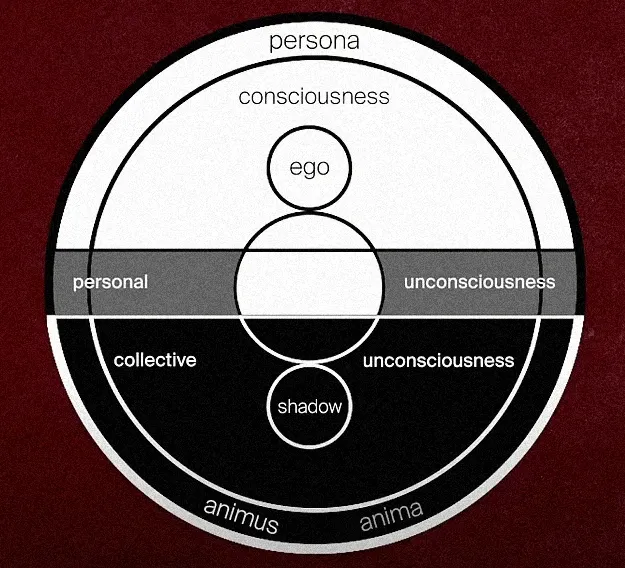
For Carl Jung we have the ego, and the ego is made up of two forces, the conscious force and the unconscious. The unconscious is also divided into the personal as well as the collective. The personal unconscious are just our memories or experiences. The collective unconscious is the collection of all society's memories and experiences. They are captured and expressed whenever we engage in society, when we eat the food, when we talk to people, when we watch movies, when we read books. The collective unconscious is embedded through society. You breathe it like you would breathe air.
Jung also says that we have the animus and the anima. In other words, we are made up of two opposing forces, the male and the female. There's a duality to us. When we meet people, the ego projects a persona. The persona is just basically our best self in a certain social context. In school you're a student, and you try to be the best student. At home you're a daughter. At McDonald's you're a friend. So you are different personas in different social contexts.
Now we try to protect our best self, but we are made up of a lot of bad memories, bad thoughts. So the ego suppresses the worst aspects of us in a shadow form. The shadow is really the alter ego of the ego, and this, Jung argues, is what is called the self. What he tells us is life is a constant process of self-discovery. If you truly want to master yourself, you must discover who you are. That will take a lifetime of self-exploration guided by a psychotherapist. This sounds much more logical, and it's become really the standard model for modern-day psychology.
Now you would think that Freud would be happy that Carl Jung came up with this new idea on how to improve his theory, but Freud was infuriated that Jung would question his theory. In fact, Freud was notorious for being a control freak. He excluded Jung, refused to have anything to do with him. In fact, everyone in the community around Freud would now distance themselves from Carl Jung, and there would be no reconciliation between the two ever. That's why Carl Jung had to go and develop this theory. It's strange because all Carl Jung is trying to do is improve Freud. So that gives us the second question. Why was Freud so afraid of criticism? Why was he so secretive?
Then the third question is, why did this idea become so popular? In fact, the ideas of Freud and Carl Jung will become the basis of a major cultural movement called modernism. Modernism is the cultural movement that we still live in today. Now there are many different definitions of modernism, but for us the easiest definition is cult of the self. We live in a world, in a society, in a culture that's obsessed with ourselves, with self-improvement, with self-empowerment.
The three questions are:
- First of all, where did Freud get this idea for the Oedipal complex?
- Second is why was Freud so secretive?
- The third question is what explains Freud's popularity? Why was he so influential, and why was his influence able to spread so quickly?
What I will show you is Freud became so influential and so famous not because his psychoanalytic system was designed to help his patients. Ultimately, his system was designed to protect the interests of powerful interests, powerful men. That's my argument to you.
Having made the general argument, what I want to do now is look at the evidence to support the argument. This is a chart that summarizes the different perspectives of these four major thinkers, Kant, Hegel, Marx and Freud. To summarize the main ideas, Freud believes that our sexual urges are what underpin our identity as well as civilization. It's because we cannot control our sexual urges that gives rise to religion, which helps us cope with our guilt. He also believes that truth lies in our suppressed memories, and in his framework God has abandoned us. There's really no God in his system. We are left to fend for ourselves. We are left to deal with the trauma of being alone.
Uncovering the Truth: Why Did Freud Change His Theory?
Let's put Freud in his historical context. Freud lived and worked at the end of the 19th century, primarily in Vienna, and at this time Europe was going through fundamental social, cultural, economic, political change. We were transitioning from the pre-modern era to the modern era. Before we lived primarily in towns and villages where we dealt with each other emotionally, and we had a purpose in our community. But when we moved to the cities, it is money and the clock that regulate our life, and it's still true today. When you come to school, what controls your behavior? It's your grades as well as the clock. If you are late for class, if you're absent, then your grades get deducted. It's the same concept as we have today.
Because of these social changes, two new fields, sociology and psychology, are developed in order to try to understand what these changes mean for us as humans. In the field of sociology there are three major thinkers, pioneers of this time, Max Weber, Émile Durkheim and this man Georg Simmel. Georg Simmel wrote a wonderful essay called The Metropolis and Mental Life, in which he describes what the impact of moving to the city has on people. We'll just read a couple sentences.
Instead of reacting emotionally, the metropolitan type reacts primarily in a rational manner, thus creating a mental predominance through the intensification of consciousness which in turn is caused by it. Thus, the reaction of the metropolitan person to those events is moved to a sphere of mental activity which is least sensitive and which is furthest removed from the depths of the personality.
Let's use a metaphor. Let's think about food. When you're in the village, you grow your own food, and then you make the food, you eat it, and that's it. You know exactly where the food comes from. You know how it's made, and you're not really curious about the food. But the one wonderful thing about the city is you get exposed to all different types of cuisine, all different types of flavors, and that excites your imagination. You're much more curious about it. You want to know where this food is made. The problem though, of course, is this is all an abstraction. You have absolutely no idea where the food comes from. You have absolutely no idea where the food is made, and quite honestly you don't even know if the food is healthy for you or not. The city life is a higher abstraction, and of course today we have the internet, which is even a higher abstraction. You go from the village to the city, now to the internet.
Of course this creates a lot of problems for people because this transition causes psychological issues, and the three major psychological issues are:
- Anomie. What this means is, before, in the village, you know exactly what to do. But you move to a city, there are different rules, and it confuses you. For example, in the village, if someone punches you, you punch back, and then afterwards you become friends. In a city, if someone punches you and you punch back, you both go to jail. It's confusing for people.
- Alienation means that you have actually no freedom in the city. You work from nine to five. You get up at six in the morning, get on at seven, then get to work at nine. Then you get off work at five and get home at ten. Every day is the same regulated life, and you lack freedom. That causes alienation.
- The last idea is disenchantment, where you feel as though you are just a machine, and you have lost human agency. This creates lots of psychological issues, and that's why at this time psychology is becoming much more popular.
This is Sigmund Freud, and he was a very ambitious medical student who became a psychologist. He started to see patients, and these patients were often young women who were hysterical. Hysterical is not a word we use anymore, but back then it just meant that they couldn't control their emotions. They were prone to outbursts, crying. When they saw a man, when they were touched by a man, they screamed, they cried. They couldn't form healthy relationships. So Freud was tasked with figuring out why this was happening and trying to help these women. He spent a lot of time with these women. He did something pretty novel at the time, which is he just won their trust and asked them directly, why are you like this?
The women, after many sessions, after becoming friends with Freud, they started to confide in Freud, and they told him the truth, which is, I'm hysterical, I'm afraid of men touching me because when I was young my father abused me. Freud at first was shocked. I think everyone would be shocked. But over time he would hear this story from so many different patients with the same symptoms that he concluded that they must be telling him the truth. He wrote a very famous paper in 1896 called The Aetiology of Hysteria. Aetiology means origins. In it he says:
My previously communicated assumption that trauma, specifically sexual trauma, cannot be stressed enough as a pathogenic agent, was confirmed anew. Even children of respected, high-minded parental families fall victim to real rape much more frequently than one had dared to suspect. Either the parents themselves seek substitution for their lack of satisfaction in this pathological manner or else trusted persons such as relatives abuse the ignorance and innocence of children.
He's arguing that abuse is much more common than we are led to believe. Even those that we think are pillars of society engage in this sort of abuse. What he's doing is that he's becoming an advocate for these women. He's telling the world they're not crazy. They're not being hysterical. They were traumatized, and that's why they're behaving like this. If you got hit by a car, you wouldn't be able to walk. Well, these women are the same way. They were traumatized physically when they were young, and that's why they are behaving like this. That's why they have problems forming these emotional bonds with others.
The symptoms of hysteria are determined by certain experiences of the patients which have operated in a traumatic fashion and which are being reproduced in psychological life in the form of mnemic symbols.
What he's saying is this is not made up in the mind. This happened physically, and then it gets represented in the mind. That's Freud arguing for his patients.
The Assault on Truth
Now let me introduce you to a man named Jeffrey Masson, and he wrote a book called The Assault on Truth. His story is this. He went to Harvard, and he became very interested in psychoanalysis, and he began to study it, and he became friends with Anna Freud, who is Sigmund Freud's daughter. Anna Freud thought very highly of him, and she trusted him with the letters of Sigmund Freud. Before, this was not open to the public, and no one knew about these letters. But Jeffrey Masson spent years going over the letters, and what he discovered shocked him. The early Freud and the later Freud are two different people. They have two different theories about trauma and abuse. In his book, he presents the evidence, which are Freud's letters to friends. Let's just read a couple. This is early Freud.
I therefore put forward the thesis that at the bottom of every case of hysteria, there are one or more occurrences of premature experience, occurrences which belong to the earliest years of childhood.
There are a whole number of other things that vouch for the reality of infantile sexual scenes. In the first place, there's a uniformity which they exhibit in certain details.
What he's saying is, I know that people don't believe me, but the evidence is clear. I've talked to different people. They don't know each other. They're telling the same story. They're bringing the same details. So either there's this giant conspiracy, or they're telling the truth.
It is less easy to refute the idea that the doctor forces reminiscences of this sort on the patient, that he influences him by suggesting to him to imagine and reproduce them. Nevertheless, it appears to me equally untenable. I've never yet succeeded in forcing on a patient a scene I was expecting to find in such a way that he seemed to be living through it with all the appropriate feelings. Perhaps others may be more successful in this.
When you read Freud, you see him as a very clear, as a very nuanced, as a very balanced thinker. He accepts there are different possibilities. It's possible that he himself is suggesting false memories to his patients. He says this is possible, but I have failed to achieve this goal. There are others who may be better at this than I, but I haven't been able to do it. So based on this evidence he argues that these patients must be telling the truth. This is the early Freud.
This is Sándor. For the longest time they were colleagues. They were best friends. They were both advocates for patients, and then they had a falling out. They basically refused to talk to each other anymore. The reason why is Sándor Ferenczi continued to advocate for patient rights, whereas Sigmund Freud completely changed his attitude. So let's look at the new Freud.
Since child masturbation is such a general occurrence and is at the same time so poorly remembered, it must have an equivalent in psychic life and in fact it is found in the fantasy encountered in most female patients. Namely that the father seduced her in childhood. This is a later reworking which is designed to cover up the recollection of infantile sexual activity and represents an exculpation thereof. The grain of truth contained in this fantasy lies in the fact that the father by way of his innocent caresses in earlier childhood has actually awakened the little girl's sexuality. It is these same affectionate fathers that are the ones who then endeavor to break the child of the habit of masturbation.
What Freud is trying to say is, young girls from a very early age, they are sexual animals. They have these urges, and they have this longing for the father. It's compounded by the fact that the father in his innocence hugs and caresses his little girl. It's made worse when the father notices that the girl is masturbating and tries to stop her. This creates a sense of both resentment, hatred and more longing. So now what Freud is saying is, it's not the father. The father did nothing. He's innocent. The girl is the one who because of these sexual urges has all these sexual fantasies that she is no longer able to differentiate between fantasy and reality.
This is from the essay Fragments of Analysis of Hysteria.
The love-hungry little girl, unhappy at having to share her parents' affection with her brothers and sisters, realizes that all that tenderness comes flowing back when her parents are made anxious by her illness. The girl now knows a way of calling forth her parents' love.
Now he's explaining why hysteria is so common in society, and the answer is very simple. Women are desperate for attention. It's that simple. They're fine. They have no issues. They just want attention. That's why they are hysterical, because they know that illness attracts attention from caregiving males.
This is Sigmund Freud's book Civilization and Its Discontents, and in it he expresses his contempt for women in society. Let's read it.
Furthermore, women should soon come into opposition to civilization and display their retarding and restraining influence. Those very women who in the beginning laid the foundations of civilization for the claims of their love. Women represent the interests of the family and of sexual life. The work of civilization has become increasingly the business of men. It confronts them with ever more difficult tasks and compels them to carry out instinctual sublimations of which women are little capable.
Freud's saying this. We must thank women because without women there'd be no civilization. They give birth. They raise families. But men are smarter than women. So men are tasked with the responsibility of building civilization, of creating science, of creating literature, of creating philosophy, of politics, of administration. But what all women want is attention, to be doted on. That's why women hate civilization. First of all, because they're not smart and they can't really contribute to civilization, but also because it takes men away from them.
Now the question then is, this is really strange because the Freud that we encountered earlier was a scientist, very clear, very nuanced, very subtle in his thinking. This Freud, he's like a mythmaker. He's almost like a priest. So what explains the transition? Well, there's a very simple explanation. He may be treating his patients who are young women, but who's paying the bills? The father. It's the father who's paying Freud. So if Freud went to the father and said, "Oh, I talked to your daughter. It's your fault that she's like this," well, they wouldn't be very happy. So we can understand why at the end of the day Freud decided that he needed to change his story if he wanted to maintain his clientele.
The Historical Context of Abuse in Vienna
The question then is, is there evidence to suggest that sexual trauma and abuse was common in Vienna at this time in history, the late 19th century? The answer is yes. There is some piece of evidence. Not complete. But there's some piece of evidence that suggests this was actually a thing in Vienna in the late 19th century. Vienna is part of the Austria-Hungary Empire, and there are lots of secret societies and religious cults at this time. One of them is called Frankism, and Frankism rejected Jewish norms and believed they were obligated to transgress moral boundaries.
Remember the crisis of faith. How do you demonstrate your faith in God? How do you know God loves you? How do you know you're faithful? Well, you break taboos, and they were breaking a lot of taboos. The Frankists engaged in sexually promiscuous rites such as the infamous 1756 incident where they were allegedly caught dancing around a half-naked woman. At its height Frankism claimed perhaps 50,000 followers. That's a lot. 50,000 followers is a lot, and a lot of them were powerful people, primarily Jews living in the Polish-Lithuanian Commonwealth as well as Central and Eastern Europe. Later Frankists were encouraged to convert en masse to Catholicism.
Who are these people? Well, they are followers of a man named Sabbatai Zevi, who was a Jewish rabbi who lived in the 19th-century Ottoman Empire. For many he was extremely charismatic, and he was basically their messiah. He was the Jewish messiah, and he preached a religion of transgression because transgression meant courage. It meant empowerment. It meant true faith. He had a lot of followers, and that's why the sultan called him and then said, "I'll give you a choice. You can either continue doing what you do and I'll kill you, or you convert to Islam." So he converted to Islam. But when he did so, he told his followers, I did so because God doesn't care about what you do. God cares about what's in your heart. As long as you're true to God, what you do in life does not matter. The religion he started is still around today. This is from Wikipedia. All this is from Wikipedia, and you can look at it online to make sure that I'm just making this up.
As part of this movement sexual abuse was actually pretty common. So we have evidence that suggests that yes, these women were probably telling the truth, and Freud knew so. But Freud ultimately had to change his story in order to protect his livelihood.
There's also another reason why Freud had to change his story. This has to do with a man named Ignaz Semmelweis. Ignaz Semmelweis lived in 1840s Vienna. He was a doctor who worked at Vienna General Hospital, and he was in charge of two maternity clinics, places where women gave birth. Same hospital, same staff, but the mortality rate at the second clinic was much higher than the first clinic. Women could die giving birth because of fever. 10% of women were dying in the second clinic, and only about 3% were dying in the first clinic.
Semmelweis was appalled by this, and so he launched an investigation as to what was happening. He spent seven months, a long, long time, trying to figure out what was happening, and he looked at all different possibilities, including weather, including treatment, including personnel, everything. Then he had a radical breakthrough. He had an insight, which is this. In the second clinic it was a teaching hospital. So doctors would in the morning work with cadavers. They would show students how to dissect cadavers, and then in the afternoon they'd go and deliver babies. Semmelweis didn't know why, because at this time germs were not a thing. People didn't know about the existence of germs. He didn't know why, but he theorized that there could be a connection.
So he created a protocol. He basically had everyone wash their hands using a formula of water, chlorine and lime, and we still use it today. Exactly the same formula today. So he tried this protocol, and it was a miracle because after people started to wash their hands, no one died in childbirth anymore. Semmelweis, being a rigorous scientist, collected all this data, conducted a lot of experiments to prove this had to be true, that washing your hands could save lives. Then he presented his findings to the staff, the doctors of Vienna General Hospital, believing that they would praise him and then promote this all throughout Europe in order to save as many lives as possible.
Instead the doctors told him they had to keep this quiet. They'll promote Semmelweis, they respect him, and he did amazing work. But if word came out that this was true, then people would know that they were responsible for the deaths of these women before, and their reputation would be in tatters. Then Semmelweis of course responded by, yes, I understand that, but if we don't publish our findings, if we don't let the world know about this, more women are going to die in childbirth. They fought for a long time, years and years, and then eventually Semmelweis was blacklisted. He was not allowed to work ever in a hospital again, and then ultimately he was confined to an insane asylum where he was killed by the guards. He died leaving a young family. So that's what happens to you when you defy powerful people in Vienna in the 19th century, and Freud didn't want the same fate. He also had a young family.
This story is horrible, but if you don't believe me, you can go on Wikipedia. He was institutionalized in an insane asylum by his colleagues, and in the asylum he was beaten by the guards. He died 14 days later. So this is a fate that will happen to you in Vienna if you defy powerful people. Now we have an explanation for why Freud made the transition, why he changed his story.
The Interpretation of Dreams
But now there's another problem, which is, how does Freud convince his patients to go along? Before he told his patients, I believe you, and they trusted him, and now he's changing his story. So how can he convince them that they in fact do suffer from sexual fantasies, and these experiences of sexual abuse, it's all just made up in the head? That's a very hard job to do. So the solution is the interpretation of dreams.
Freud pioneered a new way of hypnotizing his patients. Together they would analyze their dreams. Because if you talk about their memories and their past, they're going to fight back and say, "I remember very clearly." You talk about your dreams, that allows you to suggest subtly new ideas and new memories, to basically implant new memories and basically gaslight that person. The interpretation of dreams. That is the story of Freud.
The Spread of an Idea: Modernism and the Cult of the Self
But this leaves a question, why did this spread throughout the world? A lot of the influence of Freud has to do with Carl Jung, who will take his ideas of the unconscious and systemize it for popular consumption. His framework where we are all dualities. We have an ego, but we also have a shadow. We have a conscious but also an unconscious, a personal as well as collective, an animus and an anima. Jung popularized ideas of personality types, introvert, extrovert, which is what we still use today.
The main influence is in modernism, a transformative art movement beginning around the early 20th century. Arguably the first great modern artist is James Joyce, who in 1922 published Ulysses. James Joyce was Irish. He was an Irish expatriate, and he actually studied Dante in university. So he wrote Ulysses as a way to imitate, almost surpass Dante. Of course Ulysses refers to Homer's Odyssey. Now we're going to read a passage from Ulysses to understand the poet's writing.
Ineluctable modality of the visible at least that if no more thought through my eyes signatures of all things I'm here to read seaspawn and seawrack the nearing tide that rusty boot snotgreen, bluesilver rust: coloured signs limits of the diaphane but he adds in bodies.
What does this mean? I have no idea. I have no idea. I can explain to you Dante. I can explain to you Homer and Shakespeare, but I struggle with James Joyce. There are two reasons why. The first reason is he was a singer. So you have to read what he writes as though it's music. It's meant to be read out loud. It's musical, and that's really the power of his writing. He's more focusing on the style rather than the substance. That's the first thing.
Second thing is that he was extremely well-read, and everything that he writes, in every sentence there are multiple allusions and references to other books. So you must have read what he read. You must have experienced what he experienced in order to understand him. There are those who argue that Ulysses is the greatest book in the world. In fact, if you go online, you just Google the best book ever written in human history, James Joyce is up there. Ulysses is either number one or number two on these lists of 50 best books in human history. There are many who tell me, "Yeah, James Joyce is hard, but if you spend the time to go over what he's writing and connect the references, you will have a transformative intellectual experience." It's almost like doing a jigsaw puzzle, and that's all true.
But think about what they're saying. What they're really saying is that James Joyce believes that he is God. He has the mind of God. If you spend the time to understand what he writes, and it might take you years, decades, you will access the mind of God. That's very different from Dante, who is trying to use poetry to bring people into the mind of God, which is the truth of the world. Dante is a lot more accessible than James Joyce.
Let's look at the differences. Modern literature as represented by Ulysses, it is elitist. It's self-referential. It just has a lot of allusions and references, but you actually don't know what the meaning is. What is the bigger story here? It's usually something called stream-of-consciousness writing, which is trying to capture the mind as it thinks and works. That's different from Homer, who was very democratic. He was trying to bring beauty and truth to the people through epic poetry. So starting with modern literature, we have this abrupt change in the nature of literature. Before it was about empowering people to seek the truth for themselves. Now modern literature, it's really just this very elite club of very arrogant, haughty people.
James Joyce was good friends with Virginia Woolf. In fact, Virginia Woolf actually published James Joyce. In 1927 Woolf published a book called To the Lighthouse, and it's probably her most famous work. In it she's also trying to respond to Joyce. To the Lighthouse, it's very much based on Homer's Odyssey, and it's extremely well-written. Let's just look at what she writes.
There were the eternal problems, suffering, death, the poor. There was always a woman dying of cancer even here. And yet she had said to all these children, "You shall go through with it." To eight people she had said relentlessly that and the bill for the greenhouse would be 50 pounds.
What she's doing is she's reading a book and she's thinking about the issues raised by the book. But she's also thinking about life, like, "Oh, I have to go and do something." That's really how our minds work. So this captures really well stream-of-consciousness thinking, and she's heavily influenced by Freud. She's trying to go into the unconscious and trying to figure out how the unconscious works. To the Lighthouse is really about memory, about perception, about remembering. But again, it's extremely self-indulgent, and it's inward-looking, and again it's a radical departure from traditional literature.
Let's compare modern literature with Dostoevsky. For Dostoevsky the heart, it's a deep, impenetrable ocean, and our psychology responds to external events. We live in the world and respond to the world. We must surrender ourselves to others to seek salvation and redemption. We cannot rely on ourselves to forgive ourselves, to love ourselves. We must rely on others. We are in a community of people. These are the truths of Dostoevsky.
When we get to modern literature, self-discovery will allow for self-mastery. Our psychology responds to suppressed memories. We can be our own salvation and redemption. It's too optimistic. It's too positive. It's saying that, hey, if you're poor, don't worry about it. As long as you think happy thoughts, you'll be good. This idea of positive psychology that we have today.
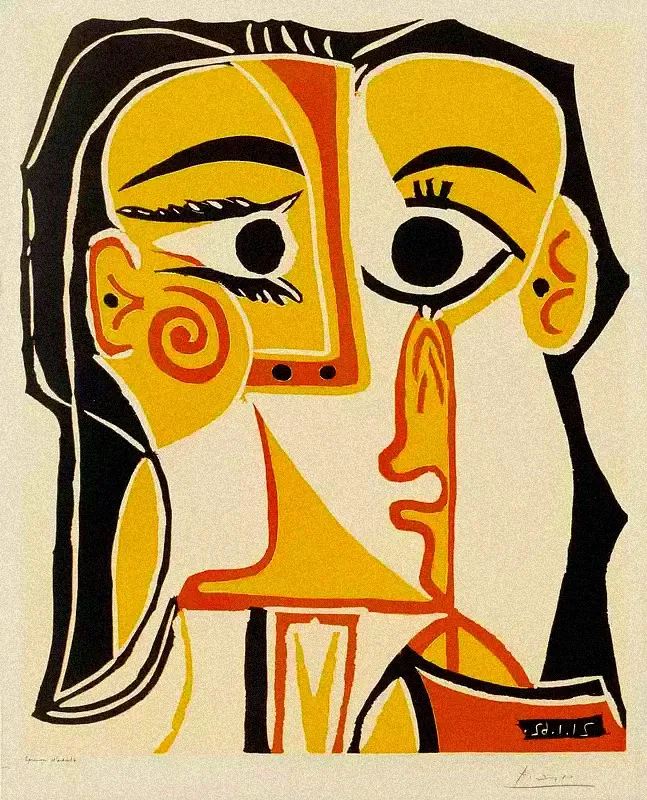
Carl Jung and Freud also had a major influence on Pablo Picasso, and you can see it from his painting Head of a Woman. Now what you will notice is it's a Cubist portrait of a woman, but if you look further it's actually two people as well. So what this is doing is it's visually representing the theory of the self as presented by Jung.
Why Did Modernism Spread?
Why is this art spreading throughout the world? Well, I mean, not to be conspiracy theorists, but let's look at an article. Was Modern Art Really a CIA Psyop? This article is from JSTOR, which is an academic journal, very mainstream. Let's read what it writes.
In the mid-20th century modern art and design represented the liberalism individualism dynamic activity and creative risk possible in a free society.
In other words, right now the capitalist West is at war with communism. 1920s, 1930s, 1940s, communism is spreading all around the world. It's very popular among people. It calls for collective action. So the capitalist West, the powers that be, they're spreading Freud, they're spreading Joyce, they're spreading Woolf, they're spreading Pablo, they're spreading all this art, this modernist art, in order to create a cult of the self. Because if you believe in the cult of the self, if you believe that you are the source of everything, then you're not capable of collective action. So in many ways this is a response to the problem posed by communism. This will be most obvious during the Cold War.
Why would that be bad? Why would the cult of the self be bad? Well, this is Mikhail Bakunin, and he explains it very well in his writings. Let's read really quickly what he wrote.
Freedom above all is a product of a social collective labor. To be free in absolute isolation is an absurdity invented by theologians, metaphysicians who have replaced the society of humans by that of God, their phantom. To say that each person feels free in the presence of God that is the presence of absolute emptiness nothingness. Freedom in isolation then is a freedom of nothingness or indeed the nothingness of freedom slavery. God the figment of God has been historically the moral source or rather the immoral source of all slaveries.
What he's saying is the radical turning point in human history is the invention of Christianity because it gives us the idea of individualism. We think that's a good thing because we're taught that individualism means free choice. It means freedom. What he's saying is that's an absurdity. We only have freedom from our community. We only have freedom if others are free around us. If we are free but no one else is free, then we are slaves as well. So because individuality prevents us from working with others, from loving others, then that makes us slaves to ourselves, and that allows for the powers that be in society to better control us. So what he's saying is Christianity is a slave religion. It was designed to make us all into slaves. Bakunin lived in the 19th century, but if he read Freud, then he would also argue that the cult of psychoanalysis, it's really about entrapping yourself in your own emotions.
As for us, we want neither phantoms nor nothingness, but living human reality. And we recognize that man can feel free, be free and therefore can achieve freedom. In order to be free I need to see myself surrounded by free men and be recognized as such by them. I am free only when my individuality reflected in the mirror of the equally free consciousness of every individual around me comes back to me strengthened by everyone's recognition.
What he's saying is this. If you want to be happy, if you want to be free, care about others, be kind to others, work with other people, sacrifice your own self-interest for the greater good. That is what will make you really happy. That's generally true because think about this. If you're by yourself, will you be happy? Probably not. But if you have a family, you have kids, you don't have any freedom, but you're a happier person in many, many ways. You're a more free person because you have better control of your emotions. You have more purpose in life.
The Cult of the Self Today
Let's bring this to the present day. Social media. What is social media? It is the democratization of the cult of the self. Before only the wealthy could enjoy the cult. Only the wealthy could take the time to self-indulge. But now with social media everyone can participate in the cult of the self, and that has led to a global epidemic of depression.

Look at year 2015. You see this huge spike in depressive symptoms because 2015 is the year when we had access to smartphones. So now young people feel they can't do anything right. Life is not useful, and I do not enjoy life. This huge spike, which has led to a huge spike in suicide. This is happening throughout the world, not only in North America and Europe but also in Latin America and East Asia as well. So the cult of the self, which originated in Europe, has now conquered the world through technology.
The answer to the three questions. The first question is where did Freud get his idea? Second question, why did Freud break with Jung? The third question, why is Freud's idea so popular today? Well, it's all to serve the interests of the powerful, and that's the world we live in today. The only solution moving forward is if we rediscover our humanity. If we are able to find the courage to care about others and put the interests of others before our own interests, we ourselves must choose to kill the cult of the self.