Civilization #56: What Marx Got Wrong
Two Scenarios
Karl Marx is one of the most influential thinkers in human history. His contribution to intellectual thought cannot be overstated. What I'm going to do first is a thought experiment. It's just going to be a fun experiment. Let's pretend there are two scenarios.
In scenario one, you get into a really good college, and you decide to become a lawyer. You go to law school, you do extremely well, you become a lawyer, and you make a lot of money. You make a lot of money, you can buy a big house, go on vacations to Bali, you can have a BMW. That's situation one. You're a super lawyer, basically.
Situation two is different. You're on a plane with strangers, and there's about 100 of you. You crash on an island. This island is very poor, very scarce resources, and you have to work together in order to just get by. You're not eating well, you're not living well, every day is a struggle. You're not really sure if you'll get to the second day. Those are the two scenarios. You're on an island, and you're basically starving.
The thought experiment is, do you think you'd be a happier person in the first situation or the second situation?
Of course, one.
You would think obviously the answer is number one, but what I will show you is that's not necessarily true. Maybe for some of us the answer is number one, but for many of us the answer is actually number two. Because as humans, we want to feel as though we have a purpose in life, and that we are part of a larger mission to change the world for the better. That's the underlying thesis of Karl Marx.
The Philosophical Roots: From Kant to Hegel
For us to understand Marx, we first need to review Kant and Hegel. Immanuel Kant's theory of the world is this. We're all endowed with the capacity to reason, and it's born in us. We don't learn it. It is just part of who we are. Then this reason interacts with reality, the things-in-themselves. Then what we see is the appearance. The crucial argument that Kant is making is we imagine reality around us by bringing space and time. We don't see reality objectively or away from us. We see reality as part of us. With our minds, we create our own universe. This is confirmed by neuroscience, by artificial intelligence and by quantum mechanics. It's really the dominant understanding of human psychology we have today. But there are three major issues with Immanuel Kant.
- The first major issue is, if we can never know reality, then how do we know what's real and what's fake? How do we know we don't live in a computer simulation? The answer is we don't know. That's the first issue with Immanuel Kant. He does not give us proof of an objective reality. That's the first problem.
- Second problem is the source for our reason. If we are born with the capacity to imagine space and time and shape our reality, who gives it to us? Where does it come from? He doesn't really answer that question.
- The third question is the problem of uniformity, which is to say, how do I know that you and I and others see the world in the same way? Why aren't we seeing a different reality? Immanuel Kant says, "Well, we don't know either." These are the three major problems created by Immanuel Kant's philosophy of the world.
Friedrich Hegel comes along and resolves all three issues. What he says is this. He says that the underlying source of reality is called the Geist. The Geist is the spirit of the world. Think of it as a god that's coming into reality. It's growing. It's almost like the internet, a collective consciousness. As a result, the Geist is giving us the capacity to reason and to see itself and then to imagine our own reality. The idea of the Geist solves all three problems at once. An underlying reality that creates the material reality. Hegel's an idealist, meaning for him what matters is ideas and spirit, and the material world is created from these ideas and from spirit.
What Karl Marx will do is build on Hegel to create something called dialectical materialism, which is the idea of class struggle. He will create his philosophy based on his reading of Hegel.
Marx's Reinterpretation of Hegel
Let's go over how Marx interprets Hegel. Hegel has three major ideas.
- The first is the idea of the Geist, the underlying superstructure of reality.
- Second is the idea of the dialectic. How does this Geist become what it is? How does this Geist learn and think? The answer is the dialectic. The dialectic is thesis, antithesis and synthesis. The concept is just a debate within itself. For it to know itself, it must create its opposite. Then when it creates its opposite, it debates itself and creates a synthesis. It's the idea of a debate where you might have a viewpoint and you engage with someone with another viewpoint that's opposite of yours. You debate, and through this debate you create a synthesis of your different viewpoints. For Hegel, this is the underlying logic of history, of how we learn, of how we progress.
- The third idea that Hegel proposes is the idea of the master-slave dialectic. Hegel thinks that relationships can be broken into a master and slave. Basically, I command you, you do as I say, you obey me. But then what Hegel says is, over time, this thesis-antithesis also becomes a synthesis. Why? Because as your master I become dependent on you as my slave. In fact, you're the one doing all the work, so without you, I can't exist. In this way, the relationship inverts itself, and the master becomes slave to the slave because the master is now dependent on the slave for his livelihood.
These are the three big ideas of Hegel, and Marx is going to take these three ideas and develop his own theory of the world. Marx is from Prussia. A lot of these major philosophers are from Prussia. Hegel himself was also Prussian. He was very proud to be Prussian. Marx, when he was in university, was part of a group called the Young Hegelians. These are individuals, a group of them, who worship Hegel, but they misinterpreted Hegel. They thought of Hegel as an atheist because he said, "God is dead." But when Hegel said, "God is dead," what he really meant is, I am now going to reinterpret God not as this separate entity from us, but as part of us in the form of the Geist.
The Young Hegelians will reinterpret Hegel and basically misinterpret him. The first thing they do is they take the Geist and they turn it into a material thing. Economics. Hegel thinks it's ideas that come first, then materiality. But these guys, the Young Hegelians, will invert this and say, it's materiality that creates ideas. It's economics, it's wealth that creates culture, which gives rise to ideas. It's the complete opposite.
The second thing they'll do is, if this is true, the dialectic and the master-slave relationship, then history is a history of oppression and a struggle for liberation against this oppression. The idea of the material world in struggle with itself creates the idea of dialectical materialism. We call this class struggle. The rich and the poor fighting each other, and the poor are looking for liberation. This is class struggle. This is the main contribution that Marx will make, and by creating this idea he will lay the foundation for what we today refer to as communism. The underlying reality of history is class struggle.
The Marxist Theory of History: An Inevitable Path to Communism
The other thing that Marx will take from Hegel is an understanding that all of history is teleological. Teleological. This is a big word, but all it means is there is an inevitability to history. There's a purpose. There's a progress to history. Everything is being done for a reason. Let's go over the teleology that Marx creates.
We were born as hunter-gatherers. We all know this. We're out in the forest hunting food in small tribes, and we're happy. But there's not enough food to feed everyone. So, we develop agriculture. Then because of agriculture we have something called surplus value. We're able to create more wealth, which allows a few of us to settle down and do other stuff. For example, create literacy. This gives rise to civilization. Then to justify the civilization, to justify this hierarchy, the fact that you have a few people who are essentially parasites of society, we create the idea of religion because the elite now are priests. That's the second stage.
Then as we develop more and more technology and the societies become larger and larger, we have to go to war against each other to fight for resources. This gives rise to a master-slave relationship, which then gives us feudalism, which then allows for the rise of industrial capitalism. This is the stage Marx finds himself at. What Marx says is this is all linear progress driven by technological advancement. Agriculture is an advancement, and then you have tools, and you have weapons, then you have castles, knights, and now you have steamships. It's all part of a technological plan to liberate humanity. Technology.
He's writing in the year 1848, and industrial capitalism will naturally lead to communism. He says this is not something that we can hope for or work towards. It's something that's going to happen because of history. History is God. God is history. Our world is being developed through the mind of God. The first thing he does is he uses the Hegelian dialectic. Feudalism is the thesis, industrial capitalism is the antithesis, and then together they will create communism. Why? For Marx, embedded in capitalism are the seeds of its demise. There are three reasons why.
- First is industrial capitalism is imperial. It's all-consuming. It expands. As a result, it's going to create a global proletariat. All are oppressed. They're going to come into consciousness together and recognize that only through collective action can we liberate ourselves from the capitalist class. Because the proletariat is the majority of people, 99%, then the 1% have no chance. That's number one.
- Number two is the idea of technology. Capitalism gives rise to new technology, which creates surplus value and surplus labor. It basically makes our jobs easier, in which case we don't have to work as hard as before in order to create value. That's technology. For example, AI.
- The third is the idea of crisis in capitalism. Crisis in capitalism. What this means is, for Marx, capitalism is fundamentally unsustainable. It will collapse at a certain point. Why? There are many reasons why. For Marx, the main problem is overproduction. You're producing all these goods, but because you're impoverishing everyone, no one's going to buy these goods, in which case the economy's going to collapse. That's one possibility.
Another possibility is presented by a man named Thomas Piketty. He wrote a famous book called Capital in the 21st Century, and he's working off Marx. What he believes the fundamental paradox of capitalism is, is a problem of financialization. All this is saying is this. At first, we have to build a factory to generate wealth. But once we have generated enough wealth, we want to take this wealth and go and invest it somewhere because it's easier for us and we can make more money that way. But over time, as capitalism grows and grows, everyone wants to invest, no one wants to manufacture. What happens then is the financial economy is growing faster than the manufacturing economy.
In fact, for Piketty, the financial economy will go up 5%, whereas the manufacturing economy will go up 2%. This means that if you put your money in the stock market, you'll make 5% a year. If you open a restaurant or you create a factory or you do something useful, you make 2% a year. So, no one wants to work anymore. For Piketty, capitalism will have to end at some point.
Then you have a man named Carroll Quigley, and he's a historian. He's a historian at Georgetown. He's dead. But he wrote a very famous book called Tragedy and Hope. He argues that capitalism goes in phases. The first phase is consumer capitalism, where companies are trying to create products that consumers want to buy. Then that leads to financial capitalism, where now companies just want to invest their wealth. But over time, the final stage is the idea of monopoly capitalism, where a few companies control all the resources, in which case we pay a lot of money for crappy stuff. Then we don't want to buy anything anymore.
For Marx and for Piketty and for Carroll Quigley, capitalism can only lead to crisis. Then because of the crisis, the proletariat will organize and then rebel and then create a workers' paradise, which leads to communism. That's the logic of Marx. That is Marx's understanding of history.
The Human Cost of Capitalism: A Diagnosis of Misery
What I'm going to explain now is, why would this be popular? Why would this history be popular for people? Because communism was one of the most popular movements throughout the 20th century. The problem that Marx diagnoses is capitalism makes people miserable for three reasons. The issues of capitalism.
It Is All-Consuming
The first issue is that it is all-encompassing, all-consuming. In other words, it just grows and grows. Because it has to grow and grow to create value, it starts wars. So, you have imperialism. Because as a factory owner, you want to create new markets, you want access to cheaper goods, you want access to cheaper labor. Therefore, you force your government to go invade other countries like China, India, Africa. Capitalism creates wars and human misery all around the world. It's all-consuming. It's always expanding.
It Is Consolidating
The second problem with capitalism is that it is consolidating. The idea here is this. Capitalism can only lead to extreme inequality. Why? Because the point of capitalism is to generate as much wealth as possible. To do that, we want to consolidate our wealth. Maybe there's 10 of us with a million dollars each. We're better off just putting our money together and then investing it together, which creates massive inequality.
Over time, Marx believes that because capitalism is all-consuming and consolidating, it would destroy the middle class. Unless you're super wealthy, you won't have any money. If you are just a small factory owner, you'll be bought up by a large factory owner. Quite honestly, this is what's happening in the world today. If you are a small house owner in America, you're going to be bought up by a company. Then the company's going to use your house to rent to other people. This is a pattern that's happening throughout the world today. That's why Marx is seeing a massive resurgence in our world today.
It Is Alienating
The third problem is alienating. Here Marx explains that there are four types of alienation.
- The first type of alienation is the alienation of labor. What this means is this. As humans, we want to create stuff. We are fundamentally creative. We want to create art, products. We want to cook. We want to teach. We want to express our individuality. When we express our individuality, when we create things, we support the community. When I teach you guys, you guys learn. When you learn, you feel good, you thank me, and that confirms my humanity. That confirms my individuality. Society is a mechanism for each of us to exchange our creativity in a way that affirms our own individuality.
The problem with capitalism is it takes use value, what this thing is used for, and replaces it with exchange value, which is how much this thing is worth. These are two different concepts. Use value is, I cook an apple pie, and then I give it to you and you eat it, and you're like, "Wow, this is a really awesome apple pie. Thank you so much." Then you feel good, I feel good. That's use value.
Exchange value is, I cook this apple pie and I give it to someone who then goes and sells it to someone. I never meet that person, and I don't know what happens to the pie, but I'm paid like $5 for it. That's the idea of exchange value. As such, what Marx says is this exchange of goods does not affirm our individuality. Therefore, it makes us miserable because we don't know why we're doing anything anymore. Before, we're doing things in order to support our community, in order to please other people, in order to affirm our humanity. Now we're just making stuff because of wage labor. Wages. To get paid. That's alienating for us. - Second is that it alienates us from ourselves. Why? Because as human beings, we are very complex, we are multifaceted and we're always evolving. But for capitalism, what matters is division of labor. Specialization. Because that's what allows for the most rapid industrial growth. In other words, you cease to be you, and you become a hand, or maybe a finger, or maybe an eye, or maybe an ear. But you cease to be complete. You're just like a cog in the machine. You're just a piece of the puzzle. That alienates you from who you really are. It prevents you from achieving your full potential as a creative, vibrant human being. That's the second issue.
- The third issue is it alienates us from nature. Why? Because capitalism grows by exploiting humans and by exploiting nature. It cuts down trees. It destroys the environment. It creates air pollution. We can no longer drink clean water. It destroys nature, and it makes us feel like we must destroy nature if we are to feed our families. It alienates us from our nature, whereas historically, we have been in a symbiotic relationship with nature where we thank nature for feeding us, but we're always replenishing, we're always protecting nature.
- The fourth type of alienation is the alienation from humanity. For most of history we were cooperating with each other. We were helping each other out because that's the only way you could survive. But capitalism forces us to compete against each other. The example of course is school, where because of grades you see your classmates as competitors. But if there were no grades, then you might help each other learn. You might tutor each other in homework and help each other with homework and tests.
The idea here is, let's just say that maybe five people have to carry some goods to a store. That's your job. One person falls down, breaks his leg and cries out for help. We should go help that person. But the logic of capitalism is you can't do that because the manager will fine you for being late. That's why Marx thinks that this will alienate us from our humanity.
This part of Marx, where Marx diagnoses the problems of capitalism, is considered brilliant. This is a perfect encapsulation of all the issues with capitalism that was true in the 1850s, in the 19th century, but it's also true today. If you look at the world today, then we also have these issues. If you analyze Marx's diagnosis of capitalism, then it helps explain why the world is the way it is. Because of these pressing issues, because people are suffering so much, they see Marxism, they see communism as salvation and redemption. That's the appeal. Because capitalism has made life so miserable for a majority of people.
Why the Prophecy Failed: Deconstructing Marx's History
But the problem is we know that this prophecy of Marx, that we will naturally evolve into communism, has not panned out. In fact, communism has caused a lot of human misery as well. Why is that the case? What I'm going to show you now is even though Marx has this beautiful theory, it's also wrong, for a variety of reasons. Let's analyze his understanding of history and show how it's wrong.
The first thing is, let's go over to the hunter-gatherer agricultural transition. The first class I ever taught, a long, long time ago, was this: the transition from hunter-gatherer to agriculture didn't make any sense. As a hunter-gatherer, you didn't have a scarcity problem. In fact, you ate really well. You worked less, you ate more, and we know because if you dig up skeletons of hunter-gatherers, they're taller than farmers. In fact, they're a lot taller. Hunter-gatherers were on average like six feet, which is really, really tall. Farmers were on average maybe five feet. That's a huge difference. Using the economic argument of Marx, this makes no sense.
It's not economics that drives human history, it's religion that drives human history. We settle down in order to practice a cult, to practice a religion, because maybe one place was considered divine for whatever reason. As a result, we develop our culture, which led to civilization. The Marx formulation that religion comes last is wrong. It's religion that comes first. It's religion that leads to agriculture, which leads to civilization. That's what Marx gets wrong.
Also, the transition from feudalism to capitalism was not driven by technology, it was driven by religion. In feudalism, the dominant religion at the time was the Catholic religion. When we go into industrial capitalism, the dominant religion is Protestantism. The Catholic religion was an imperial bureaucracy led by the Pope. There were many religious reformers who thought this was abhorrent. This went against the will of God. What they proposed was this. They proposed a religion which was democratic, in which everyone had access to God. Before you had to listen to the priest. You couldn't read the Bible by yourself. Now you had to read the Bible by yourself in order to access God by yourself.
There were two major transitions. The first is, before, in order to get to heaven, you had to use justification by works. All this means is you do good things. You give money to the church. You probably give money to the church. But because the Protestants want to reduce the power of the Catholic Church, they said, "No, what matters is justification by faith." It doesn't matter how much money you give to the church. What matters is, do you truly believe in God? That's what matters. That's the first major difference.
Then the Protestants, in order to reduce the power of the church, because the church said, "Only if you listen to us can we guarantee you access to heaven," said, "No. Access to heaven is predestined." They have predestination. In other words, at the beginning of time God has already decided who will go to heaven and who will go to hell. He already decided. So, it doesn't matter what the church tells you. It doesn't matter how much money you give to the church. You're all going to hell if you don't truly believe in God. The Protestant religion was a direct response to the Catholic religion.
Now this creates a new problem. The problem is this. How do you know you truly believe in God? How do you know that you are one of the elect? How do you know that you were chosen by God to go to heaven? This creates anxiety. Anxiety, as you know, leads to OCD, obsessive-compulsive disorder. How do you compensate for OCD? You make a lot of money. But not only do you make a lot of money, but you don't spend it because that wealth now is an indicator to you and to others that you are truly one of the elect, that you are saved by God, that you were chosen by God to go to heaven. That's the birth of capitalism.
It was not technology-driven because the technology at that time was everywhere. But it was only in Europe that you had industrial capitalism. It was because of the Protestant faith. That's what drove it.
Wealth and Faith
You're generating this wealth not to appease God, but to appease your anxiety. You won't give money to God because God doesn't need your money. But having this money is confirmation to yourself that you will go to heaven because this money can only be made because of your faith in God. How do you know you believe in God? Because you worked hard and God made you wealthy. That's the logic driving capitalism. Marx missed this.
The Three Fundamental Mistakes of Marx
Let's summarize and say, look, Marx made three fundamental mistakes.
- The first is people care about religion, not economics. It's religion that drives human history, not economics. That's the first mistake he made.
- The second mistake that he made is people care about God, not heaven. In other words, we're going to heaven not because we think it's a five-star hotel with lots and lots of, I don't know, lobsters and steaks and all-you-can-eat buffets. That's not the reason we're going to heaven. We're going to heaven to be with God because God represents eternal truth, eternal salvation. We want to be with God.
- The third is people care about status, not class. Throughout most of human history, we didn't have a concept of money. For example, the Vikings, when they went off to steal, stole lots of gold. But when they got back to the village, they would hold a big feast for everyone. They would waste all this money. Because there's actually no point in having money. You couldn't spend it. If you died, you couldn't keep it. You made money, you generated wealth in order to raise your status within the community. That's why you wore gold, because the gold signified that you have high status within the community. Throughout most of human history and still even today, we seek status, not class. The concept of class is created because of industrial capitalism, because of the free market, because now people were mobile. But before, it was about status.
Because Marx interpreted history incorrectly and he didn't really understand human psychology, what he could not predict is, when we did achieve communism, it would become bureaucratic hierarchies with cults of personality. In the Soviet Union, you had Stalin. He was in charge of a bureaucracy. In China, you had Mao Zedong, who was in charge of a bureaucracy. North Korea, the same situation. Why? Because of these three factors. Mao, Stalin all understood that people want a religion. They want to feel close to God. So, they made themselves God. People want status, and that's why it's important to have a bureaucracy. That's why communism became the way it became in the 20th century.
Even though the Marx philosophy is very appealing, it's very clear, it's very direct, it's very sexy, he got the history wrong. Because he got the history wrong, the consequences were huge, because communism created a lot of wars and it led to a lot of disasters like famines and stuff.
Why Is Communism Still Appealing?
Some of the faults of Marx are very obvious. For example, the emphasis on religion instead of economics. Why can communism still be so appealing to the world? Why especially for China and the Soviet Union, such cultures?
That's a really good question. The question is, the role of religion should be obvious to people. Why do they believe in economics? That's a great question, and you know what? I don't have an answer. But I think a clue is this. Capitalism and communism are the same religion. As capitalism grows, it reinforces communism. As communism grows, it reinforces capitalism. Why? Because both believe that economics, materialism, is the underlying reality. Religion doesn't matter.
Capitalism spreads by making everyone uniform, by turning everyone into an economic animal. Because today we don't ask you to believe in God. We ask you to go buy things. Communism is the same way. Communism believes that as long as there's equality, as long as there's no property, everyone will be happy. It's ironic that these two ideas, capitalism and communism, even though they were mortal enemies in the 20th century, the underlying basis of the religion is the same. As they develop, they reinforce each other.
We instantly understand that religion is more important than economics. But because capitalism and communism were able to spread so fast, we've been brainwashed into thinking that only economics matters. For example, when you read the newspaper, it's always what's the GDP this year? What's the employment rate this year? What's the inflation rate this year? What's the price of eggs this year? It's never how do people feel spiritually? How are people religiously? It's never about your psychology. It's never about your spirituality. It's always about how much money do you have? Communism and capitalism together conquer the world.
Why China and the Soviet Union?
Why especially is this kind of strategy fit for China or, say, the Soviet Union, but not accepted by the Western world?
This is a great question. Marx himself believed the revolution will happen in Germany first because Germany had the most advanced proletariat. But it never happened in Germany. It didn't happen in France. It didn't happen in Britain. It happened in China and in Russia. In fact, if Marx were alive today, he'd be appalled by the fact it happened in Russia and China because it wasn't supposed to happen in Russia and China. You needed a proletariat in order for the revolution to happen, but Russia and China were peasant nations.
Why did it happen in Russia and China? The main reason is this. Because the communist revolution was not a communist revolution. It was a peasant revolution with the veneer of communism. Communism was the ideology, the religion that they practiced, but it was essentially a peasant rebellion. That's no different from previous peasant rebellions in Chinese history.
It's very important because it really helps you understand the world we live in today, because even though Marx's theory of history is wrong, his understanding of capitalism is perfect. It really helps you think about why things are happening the way they are today, especially the concentration of wealth.
Marx as a Prophet
Why are we doing these four thinkers? Because they're the ones, each of them, who created an intellectual revolution that finally changed the way we see ourselves and society. Remember, Kant made us subjective. He taught us that the world does not exist outside us. Hegel taught us that there's a Geist that compels us. We're just a manifestation of this Geist, but the Geist is everything. Marx teaches us it's class struggle that's the underlying force of history. What he also believes is the class struggle can only end in communism. Why? Because that is the will of God, because God manifests itself in our history. Marx is really building on top of Hegel.
Freud's going to work on all three to build a new theory of the world. The theory is amazing because he takes all these theories and teaches us that we are our own universe. Everything that happens is because of our memories.
The entire lecture is about why was Marx wrong? The writings of Marx, he was like a prophet. He comes from a Jewish family. He himself was an atheist, but he came from a long line of Jewish rabbis. When I say that, you're like, that doesn't sound that impressive. But it's basically the equivalent of saying he came from 10 generations of Harvard professors. That's really impressive. He was a genius. His entire family were geniuses. Remember, the Jews are very intellectual people. They were the people of the book. The rabbis are the most intellectual members of the community. They're the leaders of the community. Marx is basically an aristocrat. He's almost like a prophet. I mean, he is a prophet. He's a poet prophet who's preaching of a new world to come. He's very certain. He's very clear, and he's very optimistic. That's his appeal. But that was also his downfall. He was too simple in his understanding of human history.
The Communist Manifesto: A Prophecy of a New World
Industrial capitalism is coming to Europe, and it makes everyone miserable. It's destroying society because it's taking all these people from the villages and transporting them into the cities without adequate housing, without adequate health care, work safety. They're in the slums. They don't have access to clean water. A lot of them are dying. Their children are being forced to work from age five or six. It's all polluted. People are living in misery, especially children. This is causing a lot of anger.
What really does it is, in the 1840s there's a massive potato famine all across Europe. Remember, in the 16th century the Europeans, the Spanish discovered the New World, and they brought back the potato. Why is that important? Because the potato will allow Europe to grow its population very, very fast in order to feed its economic needs. The problem, though, is when you rely on a single crop, the potato, it's prone to disease. The potato, because of its lack of genetic diversity, created a famine throughout Europe. Tens of millions of people died in this famine. A lot of them immigrated over to the New World, America and South America. The worst-hit part of Europe of course was Ireland.
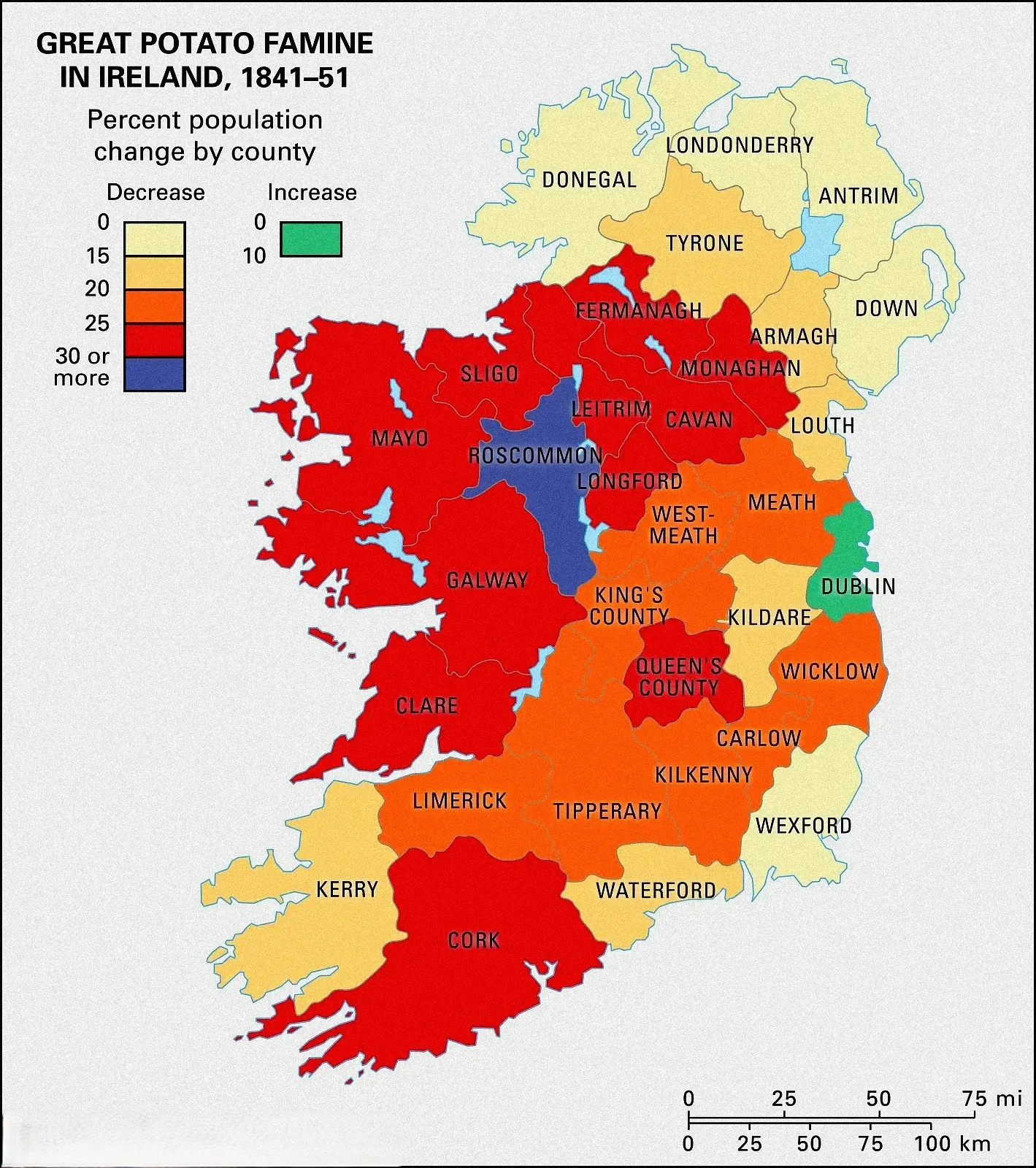
As you can see, only Dublin managed to maintain or increase its population. Everywhere else saw a massive decrease in its population. The red represents a population decrease of 30% or more in the span of a few years. From 1841 to 1851, 10 years. This was a massive traumatic event in Europe, and this led to massive uprisings throughout Europe. This is what inspired Marx and Engels to write the Communist Manifesto because they believed a new world was coming, and we have to prepare for it.
The 1848 revolutions are calling for three things. They're calling for nationalism, nation-states based on France. They're calling for liberalism, more political rights, and socialism, more worker rights. It's all happening throughout Europe, and Marx and Engels are convinced paradise is coming. But ultimately the authorities cracked down. But Marx and Engels are still convinced paradise is coming at any point. They dedicate their entire lives to imagining this new world.
The Communist Manifesto was published in 1848 in anticipation of this proletarian victory over the capitalist class. It is an amazing document. It's beautifully written. I don't think they get enough credit for how wonderfully this is written. Let's read the beginning.
A specter is haunting Europe, the specter of communism.
The specter is important because remember, it's the Geist. Hegel said that the underlying force of the world is the Geist, and what they're saying is the Geist is communism. Communism is the future. It is what will happen.
All the powers of old Europe have entered into a holy alliance to exorcise the specter, Pope and Tsar.
All the authorities of the world are afraid of this Geist, but this Geist is God, so it will triumph eventually. Let's read the end.
To this end, communists of various nationalities have assembled in London and sketch the following manifesto to be published in the English, French, German, Italian, Flemish, and Danish languages.
This is really important because this is one of the first international revolutions. It's going to sweep all around the world. It will replace capitalism. Capitalism is only the building block for communism. The Communist Manifesto is powerful. It's wonderfully written. It's poetry. I think that over the next few years as the economic crisis worsens around the world, people are going to refer back to the Communist Manifesto. But this is really the best part of the Communist Manifesto, where Marx and Engels diagnose the problems of capitalism.
The bourgeoisie, wherever it has got the upper hand, has put an end to all feudal, patriarchal, idyllic relations. It has pitilessly torn asunder the motley feudal ties that bound man to his natural superiors and has left remaining no other nexus between man and man than naked self-interest, than callous cash payment.
The capitalist class.
Remember, capitalism is an all-expanding, all-encompassing, all-consuming, alienating force, and it's destroying the world. But for Marx and Engels, this is good because it will lead to the rise of communism. This is part of the thesis, antithesis, synthesis part of history. The bourgeoisie are engaged in imperialism. It's destroying all that we've known before to create a new man, an economic man, only based on self-interest. It's even destroying the family. You no longer see yourself as a son or father or as a husband. You see yourself as a man who makes $10,000 a year or $50,000 a year, and you're able to buy, I don't know, a car or whatever. That's the power of capitalism. But again, for Marx and Engels, this is good because now it will lead to communism where this new consciousness will transform into class solidarity.
Marx's Writing and Christianity
Marx's most famous work is Das Kapital, and he spent decades writing this. The problem with Marx is that he's a brilliant man, he's one of the most brilliant men who ever lived, but he's extremely undisciplined. He procrastinates all the time. He actually never finished this book in his life. It's Friedrich Engels who was his best friend, his collaborator. But Friedrich Engels was a very disciplined individual. It's Friedrich Engels who put this book together.
What's really important for us to understand is that Marx is a prophet. He doesn't think of himself as a prophet. He doesn't know he's a prophet, but he's really a prophet. As such, what he's really doing is he's just building on top of Christianity. He's just extending the logic of Christianity. Let's see what he does.
Christianity is a passive religion. You don't really have to do anything. Just don't commit any sins, and then you're going to heaven. But for Marx, what's important is that we participate in the revolution, that we are responsible for our lives.
Second difference is Christianity argues that only a few can go to heaven. They argue about who will go to heaven, but only a few. Only a minority of the people. That's why you have hell, purgatory and heaven. Three different places. But for Marx, he believes that a workers' paradise can be achieved for everyone.
The third difference is Christianity offers a heaven of God. Marx offers a utopia without God. The problem is this. Nobody wants a utopia without God. We discussed this, where if heaven was just a five-star hotel where you can eat all the best food in the world, nobody would want to go. People are going to heaven for God. This is why Marx cannot anticipate the rise of people like Stalin and Mao Zedong.
Human Production and Private Property
This is a letter that Marx wrote in his early years, and it is probably, in my opinion, his best piece of writing because it really shows you his thinking, his optimism, his idealism. Let's read it together.
Supposing that we have produced in human manner, in this production each of us would have doubly affirmed himself and his fellow man. I would objectify in my production my individuality and its peculiarity and would thus have enjoyed in my activity an individual expression of my life and would have also had, in looking at the object, the individual pleasure of realizing that my personality was objective.
You're creating something, and this thing is the perfect expression of your individuality, of your personality, of your creativity. Then you share with other people, and they enjoy it. Because they enjoy it, that process affirms your individuality and your creativity. Your validation, basically.
I would have been for you the mediator between you and the species and thus have been felt by you and acknowledged as a completion of your own essence and a necessary part of yourself and I would then thereby have realized that I was confirmed both in your thought and in your love.
When I cook a meal and you enjoy the meal, you're not only affirming my individuality, but you're affirming my connection to all of humanity because you're telling me that I contribute positively to the species. The problem is this.
Presupposing private property, my individuality is so far externalized that I hate my activity. It is a torment to me and only appearance of an activity and thus also merely a forced activity that is laid upon me through an external, arbitrary need, not an inner, necessary one.
This is complicated, but all he's saying is this. I cook you a meal. I spend days preparing this meal. It's a labor of love. I cook the best food in the world. I give it to you. You are blown away. You're in love with this food. Then you're like, here's a thousand dollars. That's disgusting. All you have to do is say thank you, but instead you give me a thousand dollars. You think, "Wow, I'm getting a thousand dollars. That's a lot of money, man. I don't pay this much at the restaurant."
That's what Marx is saying. The moment you put money into the equation, it destroys all human relations. He's talking about extrinsic motivation versus intrinsic motivation. Intrinsic motivation is what makes us fundamentally human. Extrinsic motivation is what makes us slaves. That's what Marx is saying. Capitalism makes us slaves because it deprives us of our humanity. That's what money does.
Let's just summarize what the failings of capitalism are. It creates inequality, it exploits and it alienates. For Marx and Engels, the synthesis will be class solidarity. This will lead to a classless workers' paradise. That's the very logic of Marxism. Marx will invert Hegel. For Hegel, it's the ideas that come first. Then this will lead to the material reality. For Marx, it's the material reality that gives rise to ideas. The ideas are the superstructure. The base is the economics. This is a very important idea of Marx.
Policy Changes and Compromise
Marx diagnoses the problems of capitalism really, really well, and he offers solutions. What's really important is one reason why communism has failed is capitalism has actually adopted a lot of these policy changes, including universal child education, including the universal right to work, including abolition of child factory labor. In many ways communism has won out. Marx didn't really predict this because he thought that capitalists are idiots. Capitalists, all they care about is money, so they're like servants to capital. They're not really in control.
If you're a capitalist and you have any empathy for the working class, guess what? You're bought out or you're pushed out of the capitalist class. It's only the worst people who can thrive within the capitalist system. But because communism was such a huge threat to the ruling elite, they had no choice but to make compromises. That's why after World War II most countries in the world became socialist, even though in name they were still capitalist.
The Unforeseen Consequences: Bureaucracy and the Vanguard Problem
Let's summarize, and this is really important for us. What are the four things Marx got wrong?
The first thing is Marx believed that history is linear progress. It's a straight line of inevitability of progress. But that's not true. History repeats itself. That's the first issue.
Second issue is Marx believed in the inevitability of history. But there's always randomness built into history. Things happen, and we don't expect these things to happen.
Third is Marx believed class struggle was everything, but people care actually a lot more about religion than they care about economics. This is a huge issue in America because with the rise of Donald Trump, the Democratic Party don't know what to do about this. Because they're like, Trump says that he will lower the price of eggs, but he hasn't lowered the price of eggs. So, stop voting for him. What the Democrats don't understand is people want to believe in God. People want a leader. People want a religion. Trump, for all his failings, understands that and gives people what they really want, which is emotional solidarity, a belief in a better world.
Last thing, Marx believed a vanguard needed to lead the proletariat into paradise. Marx really believed that you need an elite of intellectuals, scientists, technocrats to create the perfect society. But then the question is, why would they give up power? Once they have this power, why would they give it up? The answer is they wouldn't give it up. That's why communism ultimately fails in the Soviet Union and in China.
Elite Overproduction, Rat Utopia, and Financialization
Let's go into specifics. What you learn is it's not class struggle by itself that causes discontent. It's three other things.
The first is elite overproduction. A really important principle is history is not fought over between the poor and the rich. It's fought over between the very rich and the not so rich. The upper nobility and the lower nobility. Because Marx came from Jewish aristocracy. Engels, his father was a very wealthy capitalist. These are people with a lot, and they wanted more. When you have too many people seeking too much wealth and status, it creates conflict. That's the first thing.
Second thing is the idea of a rat utopia, where people live too long. They live too long, they refuse to give up power, they refuse to innovate. They refuse to cede status to the young.
The third is the idea of financialization. Thomas Piketty and Carroll Quigley provide this idea where over time, to make more money, all capitalists will do is force everyone into more debt. These are the three factors that cause society to ultimately destabilize.
Let's look at three examples. You look at the Soviet Union, you look at China, you look at France. How was it possible for the Soviet Union to defeat Germany? Germany was at that time the most advanced military in the world. How did the Chinese economy boom after the Cultural Revolution? How did Napoleonic France defeat all of Europe? What we need to understand is these were not communist revolutions. These were just revolutions that destroyed the old elite.
All this is saying is this. People are playing a game in society. Over time, you have a few winners who monopolize this game, and this causes discontent. What revolutions do is they reset the game, and that creates a lot of energy because people now want to work hard to win the game. Because of this energy, they're able to defeat their opponents. It's the same thing with the Cultural Revolution, where the Cultural Revolution removed the old elite, the bureaucrats. In the 1980s, when China opened up, you had the young people with entrepreneurial drive to start companies. But without the Cultural Revolution this entrepreneurial drive could not have succeeded.
The Origins of Industrial Capitalism
This is really complicated. But for Marx, what gives rise to industrial capitalism and the bourgeoisie is just technology and the progress of history. But it's actually much more complicated than that. This is really important. We're going to review what we learned previously and put them together to explain what gave rise to industrial capitalism.
First thing is the monotheistic revolution. Remember, before, societies were paganistic or polytheistic. Then with Constantine, God became the Holy Trinity. The Holy Trinity is the worst idea in human history. The Holy Trinity is this. God is nothing and everything. What this means is God is both real and not real. God is a symbol and reality itself. Because of this idea, people are now forced to think abstractly about the world. This gives rise to money, nation-state and science. People are now forced to think abstractly about the world, whereas people before could think very concretely about the world.
Second thing is the gunpowder revolution, where nation-states, countries were forced to compete against each other, which led to more industry, more population growth and more centralization. This paved the way for the bourgeoisie because now you need the bourgeoisie to produce industry.
The third is the Protestant Reformation, where you now have anxiety created by this new religion, and they needed to force themselves to believe they are the elect.
Then the Age of Exploration, where the Old World, Europe, could go and create new markets and steal gold and bring the corn and tomato back into Europe, which allows for population growth. In other words, history is a very complicated process with a lot of randomness built in. This is something that Marx didn't really understand.
Status, Religion, and Cults of Personality
To summarize, what people want is status, not class. People want to feel distinguished, feel superior, feel that they've achieved a great deal. The money doesn't really matter. The money is just a symbol of this. People want religion, not economics. People want God, not heaven. The proof again is what happens when communism wins. Both the Soviet Union and China became theocracies with cults of personality. They were not communist societies, they were theocracies. They were religious. They were no different in many ways than Catholic Europe during the Middle Ages. The Soviet Union fell apart because the party elite no longer believed in the system and chose to monetize their status and power.
The third example is North Korea has a fertility rate of 1.79, while South Korea has a fertility rate of 0.78. North Korea is a theocratic society. South Korea is a capitalistic society.
What Do You Mean by a Cult of Personality?
What do you mean by the cult of personality?
A cult of personality is you believe this person is the manifestation of God. All your hope, all your emotions are invested in this one person. Stalin, his pictures were everywhere. In school, you learn about how great he was. You worshipped him. He was God to you. The same thing with China during the Mao Zedong era. We call this a cult of personality, like a new religion based on one person.
North Korea, which is poorer than South Korea, has more children. Why? Because people in South Korea are miserable. They have money, but they don't have religion. They don't have a purpose. They don't have any meaning. It's all competition. This is capitalism run amok. Then you go to North Korea, and he's president. He's dead, but he's still present. Why? Because he's divine. He's God. He is the forever president. Kim Il-sung.
I have to say this, but if you go to North Korea, they're probably happier than they are in South Korea. The other thing about North Korea is they're not fighting Ukraine. These are people who are willing to die for what they believe in. I would say if I had to bet which nation had the best future, I would bet North Korea over South Korea.
Bakunin and the Vanguard
Let's talk about the vanguard idea. For Marx, a really important idea is you need an intellectual elite to lead the proletariat into paradise. This is a man named Mikhail Bakunin. Bakunin. He was an anarchist. He was not a communist, he was an anarchist. The difference is this, they both believe in the same thing, Marx and Bakunin. But Marx said you need a vanguard, whereas Bakunin said, "No, a vanguard would destroy everything." It has to be spontaneous. It has to be from the people.
Bakunin is also lower nobility. His father was a Russian aristocrat. Marx and Bakunin were colleagues, but they hated each other. Bakunin believes a lot of things that Marx believes.
The freedom of every other individual does not limit my own as the individualists claim.
On the contrary, it is the confirmation and realization of human dignity of all persons. To see and feel my freedom confirmed, sanctioned, and honestly expanded by universal agreement is happiness. It is human paradise on Earth.
For freedom to be fully achieved, everyone must be free. Everyone must be equal. Otherwise, no one can be truly free. Bakunin will explain why a bureaucratic elite will destroy communism. This is a very important passage from Bakunin.
Available to everyone will be a general scientific education, especially the learning of a scientific method, the habit of correct thinking, the ability to generalize from facts and make more or less correct deductions. But of encyclopedic minds and advanced sociologists, there will be very few. It would be sad for mankind if at any time theoretic speculation became the only source of guidance for society. If science alone were in charge of all social administration, life would wither and human society would turn into a voiceless and servile herd. The domination of life by science can have no other result than the brutalization of mankind.
This is a very important passage. All he's saying is this. Before, we were intellectuals. We were curious about the world. Now we are technocrats, we're engineers. We're taught a very specific skill, and we're taught to see the world in a very specific way. We're run by technocrats. This has led to the brutalization of mankind because it has led to the alienation of mankind. We are now just parts of a machine.
The example of course is AI. These people in charge now want to make AI the dominant religion of the world. They want to make humans slaves to AI. That's what Bakunin is warning against. Anytime you let a bureaucratic elite take over, they will think of ways of how to reinforce their power through technology. This has led to the rise of AI. This is describing China very well. The bureaucrats in charge, they have no imagination. They have no empathy. All they care about is, are we checking off the boxes? Do you have enough food to eat? Do you have a job? If you have a house, if you have a job, you have health insurance, why are you complaining? That's what we kind of say.
Capitalism and Communism
The last thing I want to talk about is this. You brought this up earlier. This is a good question. The question we're looking at is, why is China so similar to America? America is a capitalist nation, China is a communist nation. But if you talk to Chinese people today, they all want to go to America to study and possibly even to live. Chinese want to become American. In many ways America has conquered China. Why is that the case?
The answer, and I mentioned this before, is it's because communism and capitalism reinforce each other. They share similar ideology. They share similar background. They're all actually a branch of Christianity, really, if you think about it. They have a similar worldview. A belief in progress, a belief in class struggle, a belief that you need a technocratic elite to run the world. In other words, communism in China paved the way for American capitalism.
That's why today you have this going on. What China is doing to children is unconscionable because we make kids sit in school for like 10 hours a day. They have no childhood. They have no freedom. They have no happiness. Most of these kids will have depression by age 14. The vast majority. Last week there was huge news that a nine-year-old kid in Beijing killed himself. Nine years old. Jumped off a building. Nine years old. That's incredible because my oldest son, he's like seven turning eight. I mean, how miserable did he have to be to want to kill himself?
Even if the kid succeeds and goes to Beida or Tsinghua, he'll develop depression because he'll never achieve what he wants in life. All that's happening is we're forcing our kids into depression, into suicide. Why? Because this has become an evil religion, almost. The belief that through education you can make more money, and even though everyone else will probably develop suicidal depression, you won't. That's, I'm betting you won't. It's insane. What's happening in education today, it's just unconscionable and evil what we're doing to our children in China. Why we're doing this is because in China we've combined communism and capitalism to create the worst possible society.
Why Is North Korea So Poor?
I'm talking about North Korea. If they really have such kind of power, even somehow like Nazis, they also have a kind of will of unity, why are they still suffering from poverty? Why are they still so backward?
Why is North Korea so poor? That's part of the capitalist brainwashing, where you measure the success of a society based on its wealth. But wealth is really just the willingness to exploit your resources, and also your capacity to engage in global trade. First of all, North Korea is heavily sanctioned. They're not allowed to trade with the world. That's the first problem. Second problem is they focus on their religion, which is called self-reliance. They want to be independent of the world. They purposely choose not to engage in the world in order to maintain the unity of their people. That's why we call them the hermit kingdom. For them, what's important is to maintain their independence and sovereignty from the world.
But that does not mean people are not happy where they are. I would argue that even though China was a lot poorer during the Cultural Revolution, people were a lot happier during the Cultural Revolution than they are today. Maybe not us, but for most ordinary Chinese they were a lot happier during the Cultural Revolution than they are today because for them life was simple and clear and certain. Today you have globalization, you have the internet, you have noise. It's very confusing for people. One piece of evidence is young people don't want to have any children today, whereas during the Cultural Revolution people did want to have children because they felt that regardless of poverty, people were into a certain life. They had health care. They had a job guaranteed for them. They had a sense of community. There was solidarity going on. That really is the trick of capitalism, to make everyone think the same way, which is money's everything.
Was Marx Too Idealistic?
Was Marx too idealistic? Marx didn't think it was idealistic. He thought it was extremely realistic. Why? Because he was studying all this history. He was studying all this economics, and he was coming up with a scientific understanding of the world. Marx saw himself as a scientist first and foremost. He saw himself as unveiling the truth to people. For him, it was science. It was certain. It had to happen.
But the thing about Marx is this. Marx is also a person that if you were to jump forward today and he saw the world created by communism and capitalism, he'd be utterly disgusted. He wouldn't be like, "Oh, wow, I'm famous now. I'm one of the most famous people, or I'm like Jesus." He wouldn't be like that. He'd be like, "What have we done to humanity? This is far worse than the Industrial Revolution, what's happening where everyone now is a slave as a consumer. In your mind, all that matters is I go to school, I make a lot of money, I buy a lot of things. That's it."
This would have been unimaginable to Marx and anyone actually 100 years ago. It's a fact that humanity has chosen to enslave themselves for no particular good reason. The question then is, why does this happen? Sigmund Freud had a lot to do with this. Psychology had a lot to do with this. Because before we were focused on the collective consciousness, the world as it is, the community. But with the coming of Freud and psychology, we now shift our focus to ourselves. We come to believe that through our own internal struggle we can be happy. Others don't matter. We ourselves, if we're happy, we're good.
What Bakunin and Marx have taught us is, if everyone is unhappy, you must be unhappy as well. It's only if people are free and happy together that they can be free and happy by themselves. That's the thing that we've forgotten, and that's what's led to the world we live in today.