Civilization #59: The Man of Steel
I want to make the argument to you that Joseph Stalin is probably the greatest man who ever lived, for three reasons.
The first reason is that Joseph Stalin, he is a poor high school dropout from Georgia, which is on the fringes of the Russian Empire, and he leads an extreme, fringe and despised political party called the Bolsheviks into absolute power in Russia. That's the first reason.
Second reason is that among the Bolsheviks Stalin is the least impressive. Everyone else is an intellectual with many books, many speeches, many achievements to his resume. But Stalin defeats them all and becomes the ultimate ruler of Soviet Russia. That's the second reason.
The third reason is during World War II the Soviet Union was up against Germany. Stalin took a poor, divided, isolated nation and defeated Germany and turned it into a global hegemon. These are the three main reasons why I consider Stalin to be certainly the greatest man of the 20th century, and quite possibly you can make the argument that he was the greatest man who ever lived.
Let me reframe what I just said in a different way so it's clearer to you. The Bolsheviks should not have triumphed. If you just looked at what's going on in the early 20th century in Russia, you would not have predicted that the Soviets would have won. Stalin should not have become Soviet leader, and the Soviets should not have won World War II. All these three things happen because Stalin willed this reality into being. He is what Friedrich Nietzsche would call the Übermensch. The Übermensch is someone who steps outside of history and warps it to his will. That is Joseph Stalin. That is the argument I will make to you.
The Contradictions of Imperial Russia
Some basic history about Russia. Russia is very much a nation with a split personality. It is both Asian as well as European, both Christian and pagan, both enlightened as well as reactionary. Because of these contradictions, it leads to many rebellions and revolutions throughout Russian history. One of the most famous being in 1825, a group of military officers called the Decembrists tried to overthrow the Tsar and install a military dictatorship. Ever since this event revolutionary discussion becomes sort of a national pastime in Russia. Both Dostoevsky and Tolstoy were sympathetic to revolutions.
1853 to 1856 is a pivotal moment in Russian history because that's when Russia loses the Crimean War to the Ottoman Empire, backed by the French and the British, and this marks a limit to the expansion of Russia. One way that Russia resolves its internal contradictions and its internal conflicts is by expanding eastwards and allowing the nobles to accumulate more land, more slaves, and that mollifies a lot of these nobles. But after Russia loses the Crimean War of 1853 to 1856, Russia understands that it is backward and agricultural compared with Europe.
So Alexander II, who is Tsar of Russia at this time, embarks on a series of radical liberal reforms. The most major being in 1861 he emancipates the serfs. The serfs are slaves who are tied down to the land. By liberating them, he hopes to further industrialize Russia as well as create a more vibrant market economy, which is what you need to be a modern nation-state. But as you can imagine, this creates a lot of pushback from the nobles who lose a lot of wealth and property because of these reforms.
A fun fact about Alexander II was he was very good friends with Abraham Lincoln. In fact Alexander II was a huge admirer of the American Republic. So much so that when in 1861 the American Civil War started, Tsar Alexander II was worried that the French and the British would intervene on behalf of the Confederacy. The reason why is that first of all the American Confederacy provides a lot of cotton to the British and the French for their textile industry. As well the French and the British see America as a growing threat. So by supporting the Confederacy they believe that they can divide and weaken America.
In response the Tsar publicly stated that if the French and the British ever declare an alliance with the Confederacy, then Russia would intervene on behalf of the Union. To show that he was serious, he sent warships to New York and San Francisco to show that Russia would defend America. This is forgotten, but this is a really fun fact about Russian history, that Alexander II was a huge admirer of Abraham Lincoln. They wrote letters to each other, and he did much to save the American Union in a time of crisis.
Now in 1881 his liberal reforms stopped when he was assassinated. He was assassinated on the day that he returned from a meeting where basically he was going to promote constitutional monarchy in Russia, and then he was assassinated by a terrorist group called the People's Will. There's a very good reason why the People's Will assassinate Alexander II. At this time in Russian history there were a lot of revolutionaries who believed that to liberate Russia you need to liberate the mindset of the peasants. The problem is the peasants loved the Tsar. So the intellectuals felt that the idea of the Tsar enslaved the peasants from seeking enlightenment and freedom. Therefore, to send a signal to liberate the peasantry, you needed to kill the Tsar in an act of violence. That's what happened in 1881.
This is the People's Will, and what you will see is that they're a very small group of people. There were at most 2,000, and they were founded in 1879, right before they assassinated Alexander II. After the assassination all the major members were quickly arrested by the secret police and executed, and they confessed to their crimes. That's why we know so much about them. But this creates a problem. The problem is this. If the secret police were so effective in capturing all the assassins right after the assassination, why weren't they effective in stopping the assassination? That's a curious question.
In fact if you think about it some more, you have some other problems. For example, the People's Will, it is a terrorist organization, but where do they get the funding? This is always a problem when you are an underground organization. Where do you get your financing from? Another problem is if these are religious fanatics, they really believe that their mission is to liberate the peasantry, they're probably very opinionated, and it's probably very hard to organize them into a hierarchy. These are two major problems that the People's Will and other terrorist organizations throughout Russian history will face, including the Bolsheviks.
The Secret Police and the Cultivation of Extremism
Now to answer both questions, let's do a thought experiment. Let's just say you're secret police, and you're tasked with monitoring and capturing these terrorists. Now is it to your benefit to capture them, or is it to your benefit to assist them? This sounds like a silly question, but let's think about it deeply. Why don't you want to support political extremists? Well, there are some very good reasons. It's risky. It's violent. It's unethical. It doesn't really help anyone. So we should not help political extremists. But if you're secret police and you ask yourself what are the benefits of helping them, it turns out there's quite a lot. Let's go over them.
- Number one, by helping extremists you defame the entire political opposition. You make all the people who oppose the Tsar look bad because look, these are fanatical. They're violent. That's one really good reason why you want to support extremists.
- Second is you want to foment internal dissent among political opponents. The classic example is the Marxist group at this time in history are the Mensheviks, and they are intellectuals, and they believe heavily in Marx. The Bolsheviks are led by Lenin, and they are an extreme group. The main conflict is the Mensheviks believe that for the revolution to happen you have to follow Marxist prescription, which is you go from an autocracy to a bourgeois democracy because that is what's going to help Russia industrialize. Once industrialization happens, capitalism will automatically make the proletariat class-conscious, and when they're class-conscious they will unite and overthrow the bourgeois democracy to create the dictatorship of the proletariat. That is the classical Marx theory of evolution towards a communist society.
Lenin believed, no, we don't need this. Because the Menshevik worldview is we have to be patient. We have to wait for Russia to industrialize. Right now the industrial workers in Russia are about 3% of the population. The peasantry is 80%. Lenin's argument is, we'd have to wait for the proletariat to become 80% of the population. What we can do is create a vanguard party and lead the peasants into communist paradise. The Mensheviks say when you do that all you're doing is creating a peasant revolution, which will lead to a dictatorship of the peasantry. You'll be no different from the Tsar. So eventually Lenin and the Bolsheviks will split apart from the Mensheviks. It would be to the benefit of the secret police to support the Bolsheviks. We'll see evidence for this. - By supporting political extremism you also induce political violence to justify more state control.
- You collect intelligence by implanting spies within these extremist groups.
- You can also arrest extremists to score political points within the bureaucracy, because the secret police is getting paid a lot of money. How do they justify their salaries? Well, they arrest extremists that they support.
- Also you can use these extremists to assassinate political enemies. So you make the argument that within the secret police there's a faction of nobles who were outraged at the reforms of Alexander II, especially the thought of creating a constitutional monarchy which would limit the powers of the aristocracy, and therefore they had the People's Will kill Alexander II.
- You also have false flag operations, where you have extremists on behalf of your enemy create terrorist events within the country which will justify a war against an enemy.
- Also the best reason of course is because it's fun and exciting. The people in the secret police, they're all psychopaths, and they enjoy this process.
In fact you can make the argument that one of the main functions of the secret police is to create problems for society so that they can justify their power. So again this sounds pretty extreme to you, but let's look at some evidence that this was the case in Russia in the late 19th century. This is Vladimir Lenin, and he was a revolutionary who had to escape to Europe in order not to be captured by the secret police. Again he was a fanatic. Let's read from Wikipedia about his time in London.
Lenin's factionalism began to alienate increasing numbers of Bolsheviks, including his former close supporters.
He was a fanatic. He was extreme. He was violent. No one liked this guy. Normally what would happen is he becomes ostracized. He becomes alienated. He is thrown aside, and he is left to write his own books, which would happen in a normal course of events. But at this time in history the secret police intervene.
The Okhrana, which is the Russian imperial secret police, exploit his factional attitude by sending a spy, Roman Malinovsky, to act as a vocal Lenin supporter within the party.
Various Bolsheviks expressed their suspicions about Malinovsky to Lenin. Although it's unclear if the latter was aware of the spy's duplicity, it's possible that he used Malinovsky to feed false information to the Okhrana.
The secret police was an active supporter of Vladimir Lenin. Now Wikipedia tells us that they sent a spy to support Lenin, but we can also guess that the secret police were also sending money to Lenin, which is very important, because Lenin can support his faction within the larger socialist movement. In fact they probably have more money than the other groups. So the secret police is incubating the Bolsheviks.
Let's use an example. Have you ever asked yourself where Islamic extremism comes from? When we did the Islamic Golden Age, what I said and I still believe today is the Islamic Golden Age was a period of openness and tolerance. So what changed? Well, after World War II the Americans and the British start to sponsor Islamic extremism. This is pretty well-known historically. Why? There are three main reasons why.
- The first reason is at this time in history the Soviet Union and America were fighting a Cold War. There were no Islamic minorities within America, but guess what? There are lots and lots of Islamic minorities within the Soviet Union. In fact it was maybe like a third of the population. That's a lot. They hated the communists because the communists were atheists, and they want to celebrate their religion. So by sponsoring Islamic extremism you are destabilizing the Soviet Union. That's the first really good reason.
- Second reason is at this time the Middle East is growing in importance because of its oil resources. At this time in history, the 50s, 60s, 70s, nationalism, terrorism and socialism are the major ideologies of these nations at this time, and these are all threats to American and British commercial interests within the Middle East, because all these ideologies are saying we shouldn't give our oil for free to America and Britain. We should protect our resources. So by supporting Islamic extremism you're undermining these ideologies, which is exactly what happened in Iran.
- The last reason is the Americans and the British heavily support the Saudi regime, which is extremely unpopular. A long time ago the Saudis made a pact with Wahhabism, which is a fanatical ideology within Islam. So by supporting Islamic extremism you support Wahhabism, which supports the Saudi regime.
I want you guys to remember this. The secret police throughout history, they've been supporting local extremists in order to achieve short-term political objectives.
The Fall of the Tsar and the Rise of Lenin
After the death of Alexander II his son Alexander III comes into power, and he is a reactionary. But he dies fairly young, which leaves his son Nicholas II to take the throne. Nicholas II, he's very young, and he's very inexperienced. He's a nice guy. He loves his family, but he's not really equipped to lead Russia in a time of tremendous political and social tumult. In 1904 the Russians lose a war against the Japanese, and at this time not only do they lose the war, but there's famine going on throughout Russia. So this is a time of tremendous discontent and revolution in Russia, which leads to something called Bloody Sunday in 1905, where worker protesters were killed by soldiers.
Also at this time what's happening is that the royal family start to ally themselves with a priest named Grigori Rasputin. If he looks scary it's because this is a very scary man. He styles himself as a mystic, and the royal family have exactly one heir to the throne, and his name is Alexei, the young son. The problem with Alexei is he has something called hemophilia, which means that if he bleeds he could die. Rasputin was very good at calming down Alexei, so Rasputin became a member of the royal family essentially. But the Russian people hated Rasputin because there are rumors that he was a sex maniac and he was organizing all these satanic rituals. Also there was a very popular rumor that Rasputin was sleeping with Alexandra, the Tsarina. Eventually the nobles will organize and assassinate Rasputin, but not before this entire affair does tremendous damage to the reputation and prestige of the royal family.
World War I breaks out, and even though Rasputin pleaded with the Tsar not to intervene, the Tsar did declare war against Germany. Now Russia is up against Germany, the Austria-Hungary Empire as well as the Ottoman Empire, and this war is devastating for Russia. In 1917 there's a huge spontaneous protest against the Tsar. At this point his generals tell him he should abdicate, which is what he does. So now the parliament called the Duma becomes the provisional government, and they declare a republic. But they're still at war with Germany. So what Germany does is it organizes for Lenin to be smuggled back into Russia so that he can foment discontent and rebellion and revolution. So Lenin was not just a useful idiot to the Russian secret police, but he was also a useful idiot to the Germans who wanted to knock Russia out of the war.
When Lenin returned to Russia, he tried to organize a rebellion against the provisional government because the provisional government still wanted to stay in the war, and Lenin wanted to take Russia out of the war. Lenin called for three things, land, peace and bread. This was very popular among the people. Eventually the provisional government tried to arrest Lenin. He escaped, but then what happened was the military tried to overthrow the government, and now the provisional government under Kerensky requires Lenin to help out and defend the republic against the military. Lenin is not in any way a politician. He's a theoretician, and he's fanatical. Let's read a passage from his book State and Revolution, which he wrote in the summer of 1917, to understand his thinking. He says:
The petty-bourgeois democrats, those sham socialists who replace the class struggle by dreams of class harmony, even picture the socialist transformation in a dreamy fashion—not as the overthrow of the rule of the exploiting class but as the peaceful submission of the minority to the majority which has become aware of its aims.
He's talking about the provisional government.
The Mensheviks.
So Lenin has absolute contempt for all of his enemies, a violent, vitriolic contempt. In October 1917 Lenin orders a coup d'état against the provisional government, and this will eventually lead to something called the Russian Civil War. At this time in history the Bolsheviks are controlling only some small cities, primarily Petrograd. But their enemies called the Whites, the Whites are former remnants of the Russian Empire, the aristocrats, the military. They control most of Russia, and it seems like they're making a huge advance against the Bolsheviks. But there are three things that will conspire to ensure the Bolsheviks win.
- The first thing is the Whites don't actually have a policy for reform. They want things to stay the way they are, and peasants are hungry. They're landless. They want peace. So they lose the support of the peasants. That's the first problem.
- Second thing is the Bolsheviks will enact a reign of terror. They have the secret police called the Cheka, which goes around and kills all enemies of the revolution. So they are fanatically installing fear and terror among the Russian people.
- The last reason, most important reason, is Leon Trotsky. Leon Trotsky organizes the Red Army, and Leon Trotsky is an incredible orator as well as organizer. He is absolutely ruthless. He organizes something called blocking divisions. The idea is when you go into battle you're supposed to run ahead. If you change your mind, you run back, someone back, a blocker, will shoot you to death. So it is brutal, but it works very effectively. Also Leon Trotsky reorganizes the Red Army into a meritocracy. He doesn't care about your political affiliation. He doesn't care whether or not you support the Bolsheviks. If you're capable, you'll be promoted within the Red Army. So he turns the Red Army into a very effective fighting force, and this was what allows the Bolsheviks to eventually triumph.
The Poet, The Prophet, and The Messiah
In many ways the French Revolution and the Russian Revolution are very similar. Let's go over the similarities. In both you have a poet. Rousseau said freedom is general will. Marx said freedom is classlessness. Then you have a prophet who leads everyone into the promised land through his pure faith as well as fanaticism. In the French Revolution you had Robespierre, who said reason will set us free. Within the Russian Revolution you have Lenin, who said violence will set us free. The last thing is then you have a messiah figure who comes and conquers the world to ensure the revolution succeeds. In the French Revolution you have Napoleon, who said, "I'm the expanding empire." His theory to ensure the revolution will survive is to expand outwards and conquer Europe, which is what he did. But then you have Stalin, who is, "I'm the continuous revolution." The way that he maintains the stability and the vitality of the revolution is by constantly purging his enemies, very much along the lines of the Cultural Revolution in China.
Let's look at the similarities between Lenin and Robespierre. Both are from the lower nobility. They're both poets in many ways, and their families face downward mobility. Lenin's father was an educator and member of the low nobility, but Lenin's father died when he was young. Then Lenin's brother, whom Lenin really admired, was arrested while he was at university for plotting against the empire, and he was executed. But both are idealists. They sought to create justice in a world of injustice.
Now the similarities between Napoleon and Stalin are also really interesting. They're both from marginalized minorities. Napoleon was Corsican. Stalin was Georgian, and they felt persecution, inadequacy. So they became obsessed with obtaining power to escape their insecurities. The similarities between these characters are very, very enlightening for us.
The Spy Who Became a Messiah
The background of Stalin is this. His father owned a small shoe factory when Stalin was born. But then the father lost the factory and became an abusive alcoholic. Stalin was born poor, and he did well in school. He had a very loving Christian mother. He did well in school, but in high school he came in contact with Marxism, and then he dropped out. So the fact that Stalin was a young man who suffered racial discrimination, downward mobility and an alcoholic father made him the perfect recruit for three types of organizations, criminal networks, revolutionaries and the secret police. Guess what, guys? He was part of all three networks, and he was a nexus of these three networks within Georgia. This is Stalin, and he came from a very poor family, and eventually he will rise to the very top.
Some Wikipedia background about Stalin. We won't read all of it, but I want to point out certain sentences. Let's look at this sentence. He goes to Batumi, and there:
His militant rhetoric proved divisive among the city's Marxists, some of whom suspected he was an agent provocateur.
He was a spy. His mission was to promote violence and organization within the locality so the secret police can swoop in and arrest everyone. This makes a lot more sense than a poor man discovering Marxism and then being totally committed to the cause. It makes more sense that he was recruited as a spy by the secret police in order to sow discontent and violence among the Marxists. Let's continue.
Stalin began working at the Rothschild refining storehouse where he co-organized two worker strikes. After the strike, leaders were arrested.
Really important. The moment he organized the strikes all these leaders were arrested.
He co-organized a mass demonstration which led to the storming of the prison.
Stalin was arrested in April 1902 and sentenced to three years' exile in Siberia, arriving in November 1903. After one failed attempt, Stalin escaped from his exile in January 1904.
So throughout this time he is getting arrested by the secret police. But for some reason he escapes only after like a month. The benefit of being arrested by the secret police is what? He has credentials now. You can only be a revolutionary if you've been sent to Siberia by the secret police. So this is all very suspicious. Let's continue.
In 1905 government troops massacred protesters. Stalin was in Baku in February when ethnic riots broke out between Armenians and Azeris and he formed Bolshevik battle squads which he used to keep the city's warring ethnic factions apart.
So of all the Bolsheviks, because at this point in history Lenin, Trotsky, they're basically writing books, Stalin is the one who's out there organizing people, committing violence, creating organizations. In fact he's the one funding the Bolsheviks. Why?
Because he assembles his gang, a criminal network, which attacks the Black Hundreds and raises money through racketeering, counterfeiting, robberies, and kidnapping children of wealthy figures for ransom.
He's the main financier of the Bolshevik party. Without him there would be no Bolsheviks. I would make the argument to you that he's doing this on behalf of the secret police, because why would you do this? If you're stealing money, why not keep it for yourself and spread it to your friends and bribe the police? Why are you taking all this money and giving it to Lenin? Ultimately Stalin will triumph. Why? Because Lenin and Trotsky, his two main competitors, were egomaniacs who wanted to be proved right. They're intellectuals. They're theorists. Stalin just wants power for himself.
Stalin's Path to Absolute Power
Vladimir Lenin, he is the one pushing for the revolution. He's the theorist. As the Soviets develop power, by the 1920s he's starting to have strokes. He's always been in bad health, but now he's really in bad health. So now he has to figure out who will succeed him. Ultimately he decides the best person to succeed him is Leon Trotsky, because Leon Trotsky, he's a hero of the revolution. He, like Lenin, believes in an international movement of communism. They both believe that if communism is to survive in the Soviet Union, they have to spread it to Europe. They both believe very strongly that with one push because of World War I all of Europe will fall to communism.
Stalin disagrees with them though. Stalin believes in maintaining communism within the boundaries of the Soviet Union and being a nationalist. Ultimately it is Stalin who will triumph over Leon Trotsky and Vladimir Lenin and create his cult of personality in the Soviet Union.
Most people assume that Stalin and Lenin were best friends because really without Stalin there would be no Lenin. But you also make the argument without Lenin there'd be no Stalin. So they were codependent on each other. It's always assumed that they were best friends. But before his death Lenin wrote a secret memo to the party leaders, and he said this.
Comrade Stalin who's now General Secretary.
So he's head of the organization department of the Communist Party, which is a very important position.
Having become Secretary General, he has unlimited authority concentrated in his hands and I'm not sure whether he will always be capable of using that authority with sufficient caution. Stalin is too coarse.
What Lenin is saying is this. If you let Stalin continue to amass power, he will become a dictator. Lenin is head of the Bolsheviks, but he's not a dictator. There's committee rule. So at this point in history you would think that Lenin is now leader, and he's going to make it his mission to ensure Stalin is removed from the General Secretary position, and Stalin is removed as a possible contender for power over the Soviet Union. But then something happens, which is Lenin has a stroke, convulsions, and he dies.
We will never know what really happened, but if you talk to medical practitioners who've looked at this case, they say, "Look, these convulsions are more indicative of poisoning than they are of a stroke." So there are certain people, and this is not a mainstream view, there are certain people who believe that Stalin poisoned Lenin because Lenin was about to remove Stalin from his position of power.
Now you're like, "Okay, that makes no sense." But at this time in history there are three individuals that are in the way of Stalin amassing complete power. Lenin we talked about, but then there's a man named Yakov Sverdlov, and he was Lenin's right-hand man. In fact he was the General Secretary of the Bolsheviks before Stalin. He was extremely competent, and then at a very young age, only in his 30s, he dies of an illness. That's really convenient for Stalin because now Stalin can become head of the organization department of the Bolshevik party and install all his cronies into positions of power. That's really convenient for Stalin.
But guess what? In 1926 the head of the Cheka, Felix Dzerzhinsky, head of the secret police, he dies as well under mysterious circumstances. He has a heart attack, and he's also really young. Remember, the secret police is where the center of power in government is. After he dies, Stalin is now able to implant his cronies, his loyal subordinates, into the secret police. So all this is really convenient for Stalin, even though we have no evidence that he in fact poisoned all three. It's just really convenient for him. This is really weird how this really worked out for him. We'll never know why, but you have to be suspicious. Either he's the luckiest man ever in the world, or he basically killed everyone in order to amass power.
In fact he continues this from 1936 to 1938. There's something called the Great Purge, which is continuous revolution. At this point in history what Stalin will do is kill at least one million party members. He destroys the old guard, and he does so by having the secret police purge the army and the bureaucracy, and then secret units within the secret police purge those guys, and then new units purge those secret units, and so on. There are those show trials where the Bolshevik leaders, the old guard, confess to being traitors to the regime. They confess to being secret capitalists. Let's look at the purges of the Red Army. This is from Wikipedia.
The purges of the Red Army and military maritime fleet removed three of five marshals, 13 of 15 army commanders, eight of nine admirals, 50 of 57 army corps commanders, 154 out of 186 division commanders.
So what he did was he completely wiped out the entire leadership of the Soviet military. Actually this piece of fact is what sort of convinced the Germans to invade in 1941 because they're like, well, Stalin killed off all the experienced officers, and so let's attack them because they won't know what to do. But in fact you can make the argument, and I think a lot of people have made the argument, that this was ultimately beneficial to the war effort in World War II. Why? Because you've removed all the dead weight. You remove the conservative generals who are not experienced with innovative warfare. So by doing this what Stalin did was make the Soviet military more innovative and more open and more flexible.
I know this is a hard idea to understand. Let's just do a thought experiment to understand this idea. Let's say there's a hundred of you students, and you're shipped off to a desert island, and you're forced to survive by yourself. Well, maybe in the beginning you would struggle. You fight, but eventually I think over a couple weeks you would learn to get along, and you would learn to survive on this desert island. That's what I think would happen. I don't know, but I think, I hope that's what happens. Now let's imagine 20 teachers go with you guys. I'm pretty sure you're worse off because those 20 teachers would be more intent on maintaining a hierarchy of things than actually solving a problem. So you can make the argument that by purging the army in the late 30s Stalin made the Red Army more innovative and better prepared for the German invasion in 1941.
Now the show trials. Basically all the leading Bolsheviks, anyone who could have possibly challenged Stalin, were arrested, and they confess to being criminals, to being traitors, to being spies. All of them were of course innocent. These are loyal Bolsheviks who sacrificed their entire lives, their families, in order to ensure the revolution would succeed. So why did they confess? Well, this is Arthur Koestler, and he wrote a book called Darkness at Noon, which is really one of the best books ever written. Just brilliant.
In it he profiles an old Bolshevik leader, and he tries to go into the mind of this person as he is about to be executed, and he's remembering his life where for the revolution he killed everyone basically. He sacrificed everyone. He betrayed everyone. He is guilty as sin. But the moment that he's about to be executed he confesses to everything. The argument here is if you spend your entire life doing bad things, you're not going to admit this is all for nothing. He's going to do everything possible to save the revolution. If that meant killing himself in order to save the revolution, he would do so.
So think of the original sin. The original sin of the revolution is all this violence committed against civilians. Well, now this Bolshevik, he is like Jesus who is sacrificed. He will cleanse the people of their sins and allow for the revolution to continue. What was brilliant about this is Stalin put these people on trial, and he knew that ultimately they would confess, and this would cement his power.
How Stalin Won It All
Let's summarize what we've discussed and think about how Stalin won it all. There are five reasons.
- From an early age, powerful patrons, criminal mafia bosses, secret police heads, revolutionaries. Then he was actually loyal to them until it was no longer expedient. What's amazing about Stalin is he made everyone believe that he was loyal to them personally and absolutely. That's his absolute power.
- Second is he always was able to identify capable subordinates, and he promoted them selflessly. That's really important.
- Third reason is he understood silence can be more powerful than great speechmaking. Do not become too wedded to ideas and positions, and let others despise you. Lenin and Leon Trotsky were tremendous orators. They were brilliant. The problem though is that by making these speeches it increases their hubris. It increases their ego, and it makes them more wedded to ideas. Stalin refused to give speeches, so you can never understand, you can never know how Stalin thought about things. That was his secret weapon. Also no one took him seriously. At this point in history everyone thought Stalin was an intellectual lightweight, because at this point the Bolsheviks thought that whoever had the best theories were the most righteous leaders, and Stalin didn't have any ideas of his own.
- Strategic retreats are most effective in times of internal conflict. So disappearing, hiding offends no one and offers no risk. Another way of saying this is the secret police always arrested Stalin at a time of tremendous conflict within the socialist movement. So the split between the Bolsheviks and the Mensheviks, Stalin wasn't there. He was arrested. So that's really convenient for Stalin.
- Then last is let your enemies destroy themselves. Accept who they are and help them become their worst selves. Trotsky lost out because Trotsky was a tremendous egomaniac. He pissed everyone off, and Stalin encouraged that. So just let your enemies destroy themselves. This is what he will do with Hitler as well, and that's how he won World War II.
There's no way we can understand how Stalin was able to defeat the Bolshevik leadership without a very simple formulation. Lenin, Trotsky were all priests, but Stalin was a spy. So let's look at the differences. Priests have faith and conviction. You're trying to bring God to the world, whereas a spy has multiple personalities. Stalin could be a different person to two different people. In fact no one really thought Stalin was a serious threat, and no one really took Stalin seriously.
Second is the priests have something called analytical intelligence. That's why they're able to write books. That's why they're able to give great speeches. A spy has emotional intelligence. A spy is able to make you trust him. The last is priests are concerned with the pursuit of truth in God. Spies only want power. So if you think about this way, if you look at this formulation, then the Bolsheviks didn't really have a chance against Stalin.
World War II: The Ultimate Gambit
Now let's go on to World War II. There's tremendous debate as to what happened in World War II. It was a cataclysmic struggle between the Soviet Union and the Germans. Tens of millions of people died in this war. It was a tragedy. So there's always going to be debate as to what happened. Why did the Germans lose? Let me give you my interpretation.
Basically what happened was this. The Germans had a certain doctrine of war, a certain belief system, going into the war, and they executed this belief system, this plan, perfectly in the blitzkrieg. But when the doctrine of war failed they couldn't adapt. The German doctrine of war is called blitzkrieg, and the idea of blitzkrieg is you very quickly cut off the head, and the body collapses. You basically go in, and you destroy the command and control center of the military. That's what happened throughout Europe in the late 30s. That's what happened to France. In only about a few weeks Germany was able to cut off the command center of the French military and cause the French military to collapse.
But the problem with the Soviet Union is that it's huge, and there's really no command and control center. So what was happening was even though the Germans were destroying the Soviets, they were wandering around Russia pointlessly for many, many months. They really didn't have a plan because the plan was always to destroy the head of the snake. But if you can't find the head you're going to run around aimlessly. The Soviets are really good at fighting a war of attrition, something called a scorched-earth policy, which is how they defeated Charles II of Sweden as well as Napoleon of France before. That's how they also defeated the Germans.
The Germans are known for their organizational supremacy, but they're not known for their battle flexibility. The Soviets, even though they were losing many battles in the beginning of the war, eventually adapted themselves to German warfare, and eventually they were able to overwhelm the Germans. I think a lot of this flexibility had to do with the fact that they lost a lot of their major leadership in the purges. Another way of saying this is the difference between the Germans and the Russians is Hitler did not purge his military. Stalin did purge his military, and that's why the Soviets were much more innovative than the Germans in the war.
Also the Germans were fighting for something called Lebensraum. Lebensraum means living space in German. It's basically if we are to survive as a German people, as a German nation, we need more resources. We need more land, and so we need Ukraine, especially for the oil. But the Soviets were fighting for their motherland, Mother Russia, so they were much more motivated to fight than the Germans.
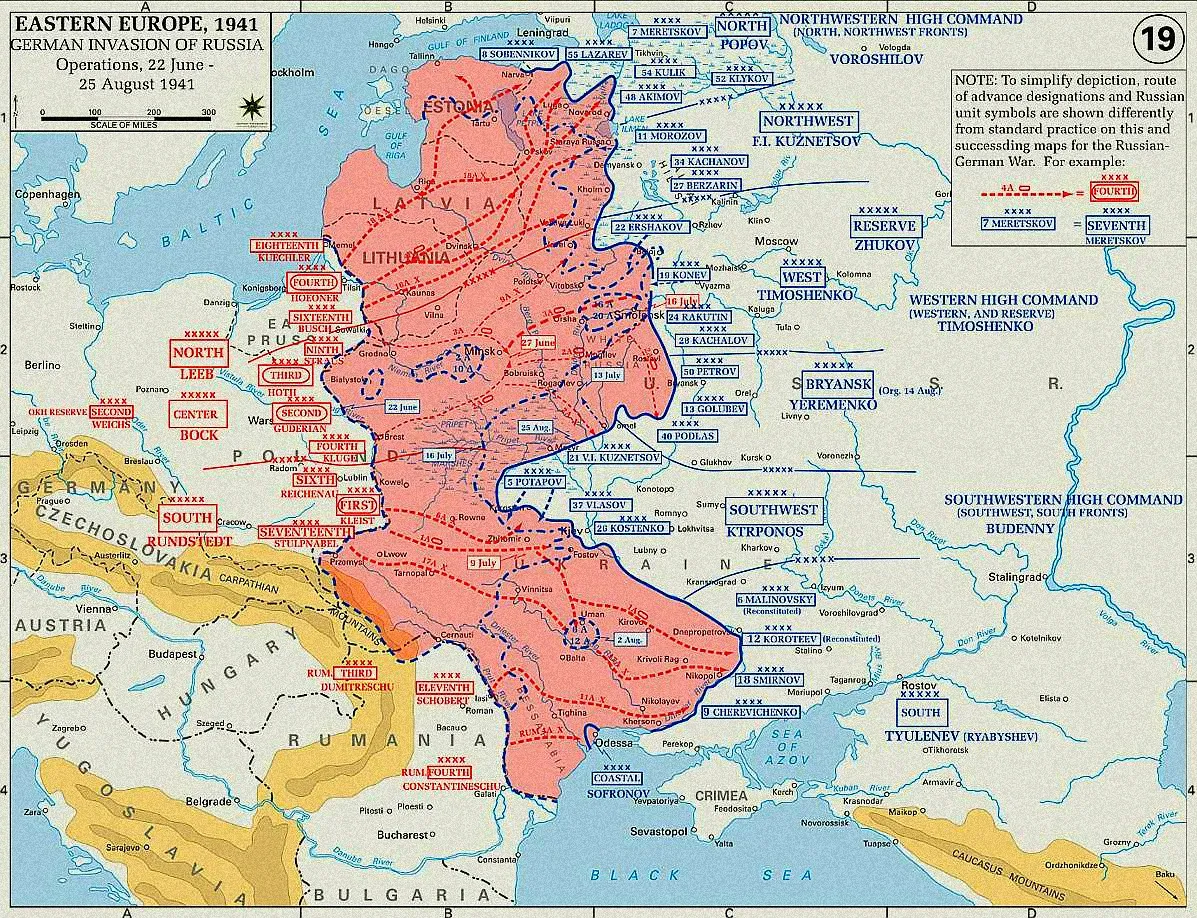
Looking at this map you'll see two things. The first thing is the Germans were really spread out throughout the front. That allows for encirclement. That allows for the Soviets to attack them from different angles and encirclement. That's the first thing. Second thing is you will also notice that the Germans didn't get that far in this war. They at most got to the outskirts of Moscow, but not beyond. The Soviet Union, if you just look at a map, it is huge.
This is the deadliest war in human history. The Germans sent in almost four million personnel, and they overwhelmed the Soviets in the beginning, but it was not enough. Four million men was not enough to conquer the Soviet Union. You needed 40 million, and the Germans didn't have that.
The World in 1935
What's the big deal? The Soviets had unlimited resources. They defeated the Germans. This is a big deal because let's go back to the year 1935. In the year 1935 if we were to have this class and we were to discuss what will happen ten years from now, we could probably guess that the Soviet Union would collapse. Why? Because Stalin was purging all the major leadership of the Soviet Union, creating a lot of discontent, a lot of civil conflict as well. If you look at a map of the world in 1935 most of the world was capitalist. Japan, which controlled the East, was capitalist. Then you had the Germans, the Nazis rising. You had the English. Then you had the Americans.
All four of these nations were under threat from communism. There were communist subversives in all these countries, and they were considered a major threat. In fact in the 1930s there's a real threat that in America there would be a communist rebellion. In Germany there's a failed communist revolution. In France, in England, the communists were everywhere. So these four nations, Japan, the Americans, the English, the Germans, they all see communism as a major threat to them. So we could imagine that they would unite against the Soviet Union at some point to destroy communism once and for all. That's the first thing.
Second thing is that at this point in history race science is very popular. Eugenics is very popular. Guess what? The Americans, the British and the Germans, all of them saw themselves as one people, the Nordic people, the Aryan race. In fact Hitler was a tremendous admirer of the English people. He saw the English as brave, as brilliant, as the master race. So you can make the argument that the Nordic people would eventually unite together to destroy the Slavs, which was a major threat to them in Europe.
The third major reason is at this time, as Germany is industrializing, the Americans are helping Hitler industrialize. This is from ChatGPT.
American industrialists invested heavily in Nazi Germany particularly before and during World War II.
This is important.
Major companies like General Motors, ITT, Eastman Kodak, Standard Oil and others had substantial assets and investments in German subsidiaries.
So these American companies, the major American companies of the time, were helping Hitler to industrialize his war machine. Given all this you could imagine that America would eventually come to support Germany in a conflict with the Soviet Union. At this point in history it was unlikely the Soviet Union would survive.
Operation Barbarossa: The Greatest Mystery
But then in 1941 Hitler launches Operation Barbarossa. Now this is one of the greatest mysteries among historians. The mystery is this. Hitler had organized four million soldiers, a multinational force, to invade the Soviet Union. Spies, the Americans, the British told Stalin, listen, Hitler's going to invade you. Stalin refused to believe them. Stalin said, "Listen, first of all, I have a non-aggression pact with Hitler. We're friends. He's not going to invade me. Number one. Number two is Hitler is being blockaded by the British. We, the Soviet Union, are providing all these resources, oil, food to the Germans. Why would they invade us? It's suicidal. Third of all, Germany doesn't have the resources to invade us."
So Stalin refused to believe that the Germans would invade. He believed it was a nefarious British plot to undermine the friendship between Germany and the Soviet Union. Also there were some German soldiers who were sympathizers to communism. They would run away and go to the Soviets and tell them, "Listen, I have all these secret plans of this invasion called Operation Barbarossa. They're going to come. The Germans are coming. Be ready." What did the Soviets do? They shot them to death for being spies.
So the Germans invade, and the Soviets aren't prepared. But not only that, Stalin seems to be purposefully sabotaging the Soviet war effort. As the Germans are advancing the Soviets should push back. But Stalin orders the army to stay where they are, so they get encircled by the Germans. At this point the Germans have more prisoners of war than they could possibly imagine. Millions and millions of Soviets captured in the first months of the war. It is a complete disaster for the Soviet Union. So everyone's like, Stalin has gone out of his mind. First of all, why wasn't he ready for Hitler's invasion? He refused to believe that Hitler would invade. Second of all, why didn't he give his generals authority to run the war in the way that it should have been run? Why did Stalin interfere and destroy the Soviet army in the first few months? These are the two major mysteries of Operation Barbarossa.
I know this is going to be controversial, but I'm going to make you this argument. Stalin purposefully did both things. Stalin purposely let Hitler invade, and Stalin purposely let millions of soldiers be captured by the Nazis. You're like, that's insane. Well, guess what happens at this point? Because the Nazis are destroying the Soviet Union, the Americans come in on behalf of the Soviet Union. Remember, at this point in history the Americans think they're going to go to war against the Soviet Union. The Americans want to ally with Germany. But because the Germans are about to destroy the Soviet Union, the Americans can't let this happen. If Germany destroyed the Soviet Union, German science, technology and organization would have access to Soviet manpower, oil and food. Germany would be invincible. So the Americans step in.
But look, let's look at what the American contribution to the war is.
In total, US deliveries to the USSR via Lend-Lease amount to 11 billion, equivalent to $250 billion. Over 400,000 jeeps and trucks, 12,000 armored vehicles, 7,000 tanks, 14,000 aircraft, 1.75 million tons of food.
The Americans basically industrialized the Soviet Union, giving the Soviet Union unlimited resources, unlimited technology. Why? Because they're afraid of a German conquest. From Wikipedia:
Roughly 17.5 million tons of military equipment, vehicles, industrial supplies, and food were shipped from the Western Hemisphere to the USSR.
So the Americans gave about 17.5 million tons of equipment to the Russians. But guess what? When the Americans enter the war they used a total of 22 million tons. That's incredible. The American army used the same amount of supplies that they gave to the Soviets. That's incredible to think about.
There are millions of soldiers captured by the Germans, and it's a travesty what happens to them because most of them will starve to death. They starve to death not because the Nazis are barbarians, but because the Nazis had a doctrine of war where they would go in, and after three months the country would collapse. It didn't happen. Now they're stuck with these millions of soldiers. Now they're in trouble because they can't actually deal with all these soldiers, and they don't have enough food and supplies to continue the war. So these prisoners of war are a huge problem for the Nazi war machine. Because a lot of these soldiers are dying in prisoner camps, guess what? It motivates the Russians to fight to the bitter end.
World War II deaths. The Soviet Union lost anywhere between 26 to 27 million people. It is one of the greatest tragedies to befall a nation in human history. That is true, but let's look at something called game theory counterfactual. What I'm going to do is I'm going to show you different possibilities, different outcomes. Everyone knows the Soviet Union and Germany are going to go to war at some point. It's entirely obvious to everyone, and there are four possibilities.
- The first possibility is the Soviet Union invades Germany and threatens Berlin. What happens here? Well, I guarantee you the Americans come in on behalf of Germany. The Americans send their military to defend Germany because they cannot afford for Europe to turn communist. So in this situation guess what? Stalin loses the war. The Soviet Union is destroyed in scenario one.
- Scenario two, the Soviet Union invades Germany and is stopped at the border by the German war machine. Guess what? The Americans still come in because they cannot afford for Germany to lose this war against the Soviet Union. The Americans still come in. Stalin loses. Scenario two.
- Scenario three, Germany invades the Soviet Union and is stopped at the border. In this scenario the Americans are laughing their heads off because, fine, fight it out. We don't care. The Americans are probably going to sell supplies to both the Germans and the Soviet Union to destroy both, and eventually they'll come in to destroy both Germany and the Soviet Union.
- So in all three situations the Soviet Union loses. There's only one situation in which the Soviet Union wins. Germany invades the Soviet Union and threatens Moscow.
This is the only situation. There are 10,000 different scenarios. There's only one scenario in which Stalin wins the war, and he found it, and he implemented it. But it required the sacrifice of 27 million Soviet people, soldiers and civilians. Only in this situation does the Soviet Union win World War II. Only in this situation. In every other situation, every other thing that Stalin does, he loses the war because the Americans will come in on behalf of Germany.
Of course this war is fundamental, and it changes the course of history because without this war, without Stalin winning, there'll be no Mao Zedong. There will be no communist China. There will be no new China. There'll be no today's China. You have to understand this. Communism was not inevitable. It did not have to happen. In fact you can make the argument that in the 1940s it was going to get destroyed by the capitalists. It was only the start of World War II that China was able to turn communist. So Stalin changed the course of human history. None of these things should have happened. Stalin made them happen.
Of course we today have Vladimir Putin. Vladimir Putin, I will argue to you, is also going to change the course of human history. Stalin was the Übermensch of the 20th century. I will argue to you that Putin is really the Übermensch of the 21st century. He sees where history is going, and he controls history to his benefit. He's going to warp reality to the benefit of Russia.
Questions and Answers
We have four great questions about the lecture. The first question is how do the Americans feel about communism and fascism?
Second question is the Americans and the British were very close allies, and we know this through Lend-Lease, where the Americans are shipping billions of supplies to Britain for the war effort. So why did the British hate the Germans so much?
The third question is what was Stalin's strategy vis-à-vis the Americans?
The last question is, in the first few months the Soviets were getting destroyed, so what was Stalin's response, and what did he promise the people to get them to fight to the bitter end? Great questions. Let's go over them one by one.
American Views of Communism and Fascism
Americans at this time in history, the 1930s, the elite, they were heavy Nazi sympathizers. There was an American named Charles Lindbergh, and he founded something called the America First party. He was very popular, and there's a very good chance that he would have won the elections in America. So American isolationism is the major dominant political trend, and it was only when the Japanese attacked Pearl Harbor that the Americans entered World War II. If the Japanese didn't attack Pearl Harbor, it would have been almost impossible to convince the American people to enter into the war.
So the Americans were either, well, I'm talking about the elite, they were either neutral, like we don't care, we're isolationists, or pro-Nazi. That was just the general attitude of Americans in the 1930s. Communism was a real threat to America. Communism, anarchism were real threats to the American political system in the 1930s, especially with the Great Depression.
Why Did the British Hate the Germans So Much?
Why were the British so intent on destroying the Germans? In fact you guys don't know this, but Hitler made numerous peace overtures to the British, especially Winston Churchill. Again the Germans had tremendous respect for the British. It's basically the same people. So why was Churchill so intent on destroying Germany?
There are different historical arguments. One argument is Churchill just hated Hitler personally. He had a visceral dislike of Hitler. That's number one. Number two is the Germans embarrassed the British in the war because the British sent this expeditionary force against the Germans, and the Germans wiped them out. The British were forced to retreat at Dunkirk.
I think for me the best reason is just geopolitical. Let me explain what I mean by this. This is something called the Mackinder thesis. This was developed after World War I. The idea is this. Britain is a naval power, and as long as it's able to dominate the seas it controls the world, because at this time in history most people are trading through the sea. So as long as Britain is able to control the waterways it controls the world. But there's a problem here. Let's just say that a power arises within the Heartland, and it could be Germany, and it could be Russia, but it's going to be one of these two. If they're able to unite or conquer each other, then they unite the entire Eurasian continent, in which case all they do is build railways. Then Britain ceases to exist as an empire.
So the great threat is a great power emerging within Eurasia to unite the entire Heartland. The British believe this, but also the Americans believe this as well, because the Americans would eventually inherit the British Empire. So at this point in history Germany was conquering all of Europe and was about to conquer Russia. So Britain's geopolitical interest was to ensure that Germany would be hindered.
I know in the history books that you're taught that World War II was a great conflict between Britain and Germany for democracy and human freedom. That's nonsense. World War II was fought primarily between Germany and Russia. Three-quarters of German forces were directed at Russia. Most casualties were happening between Germany and Russia. What Britain was doing that was vital was blockading Germany. As Germany was running out of food and fuel, it had no choice but to invade the Soviet Union, especially Ukraine, in order to access the resources of Russia. So this idea that the British and the Germans always had to fight, it's something that became mythology after World War II. During World War II Hitler wanted peace. Britain wanted to ensure Germany could not expand to the east and create the Heartland. That's what's driving British interest at this time.
What Was Stalin's Strategy vis-à-vis the Americans?
Stalin's strategy for the Americans. If you're Churchill you're thinking in terms of Europe. If you are Hitler you're thinking in terms of Europe. They're all Eurocentric. What Stalin was able to do that made him different was he was able to see the world as it is. He was able to see the Americans. He knew the Americans would eventually come into the war. He was able to see Japan. The reason why is at this time communism is an international movement, so he had spies everywhere. He basically had the best intelligence in the world, so he's able to figure out exactly how these pieces were going to move about.
So for him it was like, okay, I go conquer Germany, but then the Americans come in, and the Americans destroy us. The main problem was the Americans, because the Americans at this point, remember, had the greatest industrial capacity in the world. Whichever side the Americans support would win the war. So Stalin had to figure out a way to neutralize the Americans. The best way to neutralize the Americans is let's be friends, because America's a democracy. If Roosevelt is saying, "Uncle Joe is our friend," and he has all these photos in the press of Stalin and Roosevelt shaking hands, having these conferences, then the Americans cannot go around and backstab the Soviet Union.
Guess what? After World War II ended, after the Germans were defeated handily by the Allies, there were many Americans, especially General Patton, who was one of the main generals in World War II. He recognized that, oops, we made a mistake. The real enemy is not the Germans. The real enemy is the Russians. This would eventually give us the Cold War. So it was after World War II the Americans realized we were duped. We should not have come into this war on behalf of the Soviet Union. We should have stayed neutral, or we should have supported Germany to maintain the balance of power.
Stalin just tricked everyone. That's why I say he's the overman. It should not have happened this way. If you just think logically about what each player in the game should have done, then the Soviet Union should have collapsed. So Stalin was able to trick Hitler. He convinced Hitler to invade him. He tricked Roosevelt. Roosevelt became his supporter. He even tricked Churchill. I know this is not what you're taught in history class usually, but just look at it analytically. Using game theory analysis, then you have to conclude that Stalin was the only one who saw the world globally and was able to manipulate people to his benefit.
By the way, this is what's happening today with Putin. Putin is the only one who's able to think globally, and he's the only one able to think strategically. Everyone else, like Trump, he's only responding to domestic issues.
What Did Stalin Promise the Soviet People?
Stalin, what did he promise the Soviet people? He didn't have to promise them anything. He was God. He could do what he did because he was God. Any other leader who pulled this crap would have been arrested and executed for incompetence. Only Stalin, who because of the Great Purge consolidated power only in his hands, his authority was unquestionable. He had spies spying on spies, and he had other spies spying on these spies. So he created this divide-and-conquer system within the Soviet Union, which made his power absolute. In fact you can make the argument that he was the most powerful person ever in human history because no one could question his authority. So he could afford to do this. He could afford to make mistakes and look like a buffoon because no one could challenge him.
Ultimately the Soviet people rallied around him because they didn't want to be conquered by the Germans. They wanted to save their nation, and Stalin knew this. This is a very famous quotation attributed to Stalin. It's not true. He actually didn't say this, but he could have said this. "One million people die in a gulag, that's a statistic. No one cares. One man gets run over by a tractor, that's a national tragedy." So he understands intimately how people think. He understands the psychology of both individuals and of nations, and as such he's able to manipulate people, control people to his will.
Russian Patriotism
I think we could add one thing to that, to your question, what could he actually promise people during the time of war. And one was that for the first time since he had power, he kind of turned on the tap of Russian patriotism because just with the Soviet ideology there wasn't really a space for an old Russian identity. It was a new Soviet identity that was being created. So what that meant was that you close all the churches you kind of get rid of traditional culture and all that kind of stuff. And during the war, the churches opened up again and it was able to create a certain amount of unity amongst the population that was otherwise kind of divided by ideology.
That's a great point. His major contribution to communist theory is the idea of nationalism, because what made him different from Trotsky and Lenin was he was only concerned about the Soviet Union. He wanted to maintain the integrity of the Soviet Union, whereas Trotsky and Lenin were concerned about international communism. They saw the Soviet Union as the little brother in the movement. Germany would be the big brother because Germany had the most proletariat. It was the most urbanized, and maybe the French as well. But the Soviet Union would be the little brother to the Germans when the Germans eventually rebelled and established communism.
So Lenin and Trotsky were fundamentally internationalists, whereas Stalin understood people don't want that crap. People want to feel part of a community. People want to feel part of a place. So he heavily promoted nationalism, which galvanized the people, as Doug says, into making tremendous sacrifices during World War II. So people die not for ideas. People die for each other, and that's what Stalin understood fundamentally. Mother Russia was his promise to the people.