Game Theory #1: The Dating Game
How do societies behave? Why do we do what we do? What motivates us? What drives us? There have been different theories as to what drives human behavior.
Five Theories of Human Behavior
Let's go over some of the major theories.
- Religion: The first theory comes to us from religion. The idea is that we are all driven by a war between good and evil. There's a good side to us and an evil side to us. There's Satan and there's God, and we are constantly in a battle within ourselves. Do we move towards Satan or do we move towards God? That's the core of human civilization. Religion is meant to give us the strength to show us the path towards goodness.
- Biology: Another theory comes to us from biology, and the idea is sex. We want to pass on our genes because that's the point of our existence. If we cannot have children, we all die. The point of existence is to have children and have them pass on their genes to others. For males and females, life is different. As a man, you have a penis, and all you have to do is stick your penis into a woman, and you're good. You want to stick your penis in as many women as possible, and that's the point of your existence. But as a woman, your life is different because it's hard to give birth. It takes nine months to incubate the child in your womb, and childbirth is the most painful experience anyone will have ever experienced. Then, it will take 16 to 18 years to raise that child to maturity. It's a huge investment on your part. So as a female, you have to be very cautious and very careful about who you marry or have sex with. Life is a struggle between men who want to put their penis into anything and women who want to be careful about who they marry.
- Race and Culture: Then you have the idea of race and culture: that the world is a struggle between different races and cultures for dominance, and each race and culture has its own characteristics. Maybe the yellow race is very clever but very weak. And then the white race is brave but kind of stupid. And the black people... anyway, that's another theory. I'm not saying it's correct; I'm just saying it's a theory that people believe.
- Economics: Then you have economics. What they believe is that we are driven by money or self-interest. We want to make as much money as possible, and that's what drives us. That's pretty simple.
- Liberalism: The last big theory is the idea of liberalism that comes from the Enlightenment. Here, the theory is that history is a progress towards enlightenment, rationality, truth, and justice. The inevitability of human development is towards paradise, towards heaven. Maybe we go off track now and then, but inevitably we move towards God. This comes to us from the Enlightenment, and we call this liberalism.
These are five theories that show you the diversity and variety of ideas out there. I will present another theory, which I call game theory. My argument is that game theory is the best way to understand how humans behave, what drives nations, what drives societies, and what drives humans.
What is Game Theory?
Game theory is very simple. The idea is that there are three components to a game:
- The Players: The participants.
- The Rules: The constraints. In mathematics, we would call this the boundary conditions—the limits to the game.
- The Incentives: Basically, how do you win this game? What do you get from this game?
My argument is that if you study all three—if you figure out who the players are, understand the rules, and understand the incentives—then you understand how the game works. Therefore, you can predict how the game will turn out.
If you learn game theory, there will be three major benefits to you.
- You become a better person. The point of education is not to get good grades, get into a university, or get a good job. I believe the point of education is to make you into a better person, which means you are a much more thoughtful person who can better analyze yourself and the world around you. This allows you to make better decisions. This makes you a much more curious, much more moral, and much more imaginative person. One benefit of learning game theory is you become smarter and therefore you become a better person.
- You'll be able to understand the world that we live in. This world is kind of stupid. You may have heard that Donald Trump and the American military went into Venezuela for no good reason, kidnapped the president of Venezuela—which is against international law—and then brought him back to New York City where he will stand trial. It's really stupid what happened. But we're not meant to say this is stupid or this is wrong, because we all know it's stupid and wrong. We're trying to figure out why this happened and what this will lead to. We will be studying and analyzing current events to understand how the world really works, why people behave the way they do, and understand how the game of the world works. This requires you to actually follow the news. We'll be looking at the war in Ukraine. We'll be looking at a new war between Israel and Iran. We'll be looking at what's happening in South America. We'll be looking at the conflict between China and Japan. We'll be looking at the relationship between the United States and China. This is relevant to your lives because you will eventually have to work and live in this really screwed-up world.
- You will have predictive powers. Once you understand the game, you'll be able to understand how the world will develop. You'll be able to analyze your own life and understand how you will develop, and that gives you control and sovereignty over your own destiny.
This is my promise to you. If you actually spend the time to listen carefully, to participate fully, and to follow the news, then these three benefits will start to accrue in you. This is a lifelong struggle to learn game theory. I'm a lot older than you are and have a lot more experience, but I want to show you how to look at the world through game theory. Another phrase you learn in school is, "I'm going to teach you how to think critically about the world," or I'll just teach you how to think.
A Practical Example: The Marriage Game
This is all very abstract, so I'm going to use an example of a game to show you how game theory works. Let's use a really simple game. Imagine there are five boys and five girls, and they want to get married. These are the players, and we're going to divide them up into male and female.
Then, we will rank the males and the females from five to one, where five is the best and one is the worst. How do we rank them? We rank them according to their attractiveness using three criteria:
- Genes: This is very simple. It means you're good-looking, tall, and healthy. You will live a long time.
- Wealth: This just means that you or your family have a lot of money.
- Status: This means that you have a lot of friends, a high-status job, or you come from a really powerful family.
We can rank all ten players according to these metrics.
Initial Strategies: Biology vs. Economics
According to evolutionary biology or evolutionary psychology, we're always trying to find the best genes to procreate with because this ensures that our genes pass on. Remember that men have a penis which they can stick into anything, while women have to give birth, so the strategies are different.
Basically, the male ranked number five is trying to have sex with all five women. That's his strategy. But the female ranked number five wants to ensure that she only gets the male ranked number five. According to evolutionary psychology, all five of these females should try to procreate with number five. But we know you can't do this. It's suicidal. Why? Because the human race couldn't survive. It'd be idiotic to do something like this where all five women are just trying to marry this one guy. Your society would collapse. You couldn't have that many children, so this can't possibly be true.
So let's figure out what should rationally happen from an economics perspective. Again, number five is trying to maximize the game, so he's trying to sleep with all five women. The problem if he does that is these five women know they're all being played and they recognize that this guy is probably an asshole. So the best woman, number five, is like, "You know what? There's not much of a difference between four and five, so I'll just go marry this guy." So number four is gone. And number four is like, "You know what? Five is probably making a good decision, so I'll just go marry number three." What happens now is that number five, by trying to marry all the women, is stuck with the worst choice. He's stuck with number one.
That's kind of stupid for him. If any of these other guys try this crap, the same thing happens. If four tries to get four and three together, then three is like, "Screw you, I'm going to go and marry two," and four is going to marry three. Then he's stuck with one as well, or he's just alone.
If they try to individually maximize their outcome, they all get screwed in the end.
The Nash Equilibrium: A Rational But Unrealistic Solution
The only way out of this is if they cooperate. The best way to cooperate is for five to say, "You know what? Screw this. I'm not going to go after four or three. I'll just have my five." Four is like, "Yeah, I'll just go marry four. No dating, no games." And three marries three, two marries two, and one marries one. The world now is perfect. Everyone has a husband and a wife, and they can now just have children.
This is actually the best strategy for all the players. In game theory, we call this the Nash equilibrium. A Nash equilibrium just means that you always reach a state in which all the players maximize their outcome.
The problem with this, though, is that in real life, no one does this. In real life, no one actually follows this rule. The Nash equilibrium is just a theory we made up. What happens in real life is we choose to be suicidal.
The Real-World Game: The Suicidal Pursuit of Status
Last year, I was teaching this class and I asked the boys and girls: "Pretend you're now 30 years old. Your parents are pestering you to get married, and you've been on the dating market for 10 years. There's really no one that you think is perfect for you. You've basically given up on love. Imagine that you want to get married now and tell me, what is the minimum requirement you need in order to agree to marry someone else?"
The boys were pretty simple: "Well, as long as she likes me and as long as I can put my penis into her, I'm good." It's that simple. Guys are like, "Yeah, I'll settle for anything."
The girls were different. The girls were like, "Okay, if I don't love him, if I'm not even attracted to him, I need about a million dollars a month."
This makes no sense, right? In theory, we should follow the Nash equilibrium. But in real life, what happens is this: all the girls want this one guy, number five, and maybe number four. But three, two, and one, they don't want. We know this because just look at the world around you. Look at these billionaires, like Elon Musk. How many wives does he have? How many children does he have? Many women in the world just want to marry actors like Brad Pitt or billionaires like Elon Musk.
And what do three, two, and one do? Well, they watch Netflix, they watch porn, they play video games. They've given up on life. They're like, "We don't care." We call these people incels—involuntary celibates—because they have given up on life, and life has given up on them. This entire competition is between number five and four for all the women in the world. And this is, again, suicidal. This will lead to the death of humanity.
The question now is, why are we suicidal? Let's look at the game theory analysis: the players, the rules, and the incentives. We know who the players are and what stupid things they're doing. We know the rules. But the incentives are something we have to think about. Why are they behaving like this?
The answer is because they're not interested in sex or procreation. What they're interested in is status. That's the game they're playing.
I don't want to marry someone to have children. I want to marry someone so I can take a picture of her and post it on Instagram so I can get a lot of likes. I want to marry someone so I can walk with her in the mall and all the guys are jealous. I want to marry someone who I can brag about.
It's a game about status, not a game about sex or procreation. People are not being rational in the economic sense; people are trying to maximize their status in life. That's why everyone's behaving like this. The woman ranked number one may be the ugliest woman in the world, but she's still like, "You know what? It's still my choice whether or not to have kids. And having kids is a pain in the ass. So, if I'm going to make the sacrifice, this guy better be good-looking, or this guy better be rich. Otherwise, why would I want to have kids?"
If you think about it this way, you recognize that people are rational. But to understand why they're rational, you have to figure out what the game is.
The Superstructure: How the Big Picture Changes the Game
This leads us to a question: clearly, this is wrong, because if we behaved like this throughout human history, we wouldn't be here today. How is it that we have this game today and we're going to die, but we must have come from somewhere? How is it that humans have survived for so long doing these stupid things?
The answer is the game changes over time according to the superstructure of society. The superstructure is what determines the nature of the game. Think about the big picture: How many people are there? Is a society wealthy or poor? Are there enemies to this society? This is the superstructure—the big picture of demographics, economics, culture, politics, and religion. These things together determine the nature of the game.
Let's look at three examples of superstructures.
- Low Population Society: This is a village of maybe 200 people. They are poor and have low technology, meaning they don't have access to clean water, don't know what hygiene is, and don't understand what germs are. It's very easy for a woman to die in childbirth. There is also low competition, meaning there are no competing villages against them.
- Growing Population Society: Here we're talking about maybe 10,000 to 20,000 people. They are now growing in wealth, have some technology (like access to clean water), and have high competition, meaning they're competing against different villages and societies around them.
- Overpopulation Society: This is the world we live in today, where in China you have a billion people. There is too much wealth, but with wealth, you have inequality. You have high technology, which means that every woman who gives birth will not die and every child born will live. And then you have an equilibrium, which means that while there's competition, nations are not going to go to war against each other. The world is basically peaceful.
According to the superstructure, the game is going to change. In a low-population, poor society, they're not going to date. They might get married, but they're going to have sex with each other. Why? Because as a woman, the only way to ensure that your child survives is if all the men in the village want to protect and nurture the child. They will do that if they believe that the child could be theirs. So the woman will maybe have a husband, but she will also choose to sleep with other men to disguise paternity. There's no dating, just lots and lots of sex in order to maintain social cohesion.
In superstructure number two, there's no dating either. Why? Because this society is in competition with other societies and they need to have as many children as possible. The solution here is arranged marriages. Who cares who you marry? Just have lots and lots of kids. You marry who your parents tell you to marry. You marry your childhood best friend. Who cares? But you marry someone and have lots of kids.
Superstructure number three is the one we live in. Here, you have a dating game. Why? Because the odds of you obtaining status are really, really low. The only way that you can change your status is by marrying up. That's why you have a dating game—it's an opportunity for you to find someone better than your social demographic circumstance would suggest. And that's why you have a decreasing fertility rate. Over time, because of the dating game, society will collapse.
The Life Cycle of a Civilization
All around the world, women who are wealthy and well-educated are refusing to have children, especially in East Asia. Right now, the fertility rate in China is about 1.0. The replacement rate that you need is 2.1. Just to maintain current population levels, every woman in China needs to give birth to at least two kids. But on average, women are choosing to have one kid only. The worst thing is that this trend is accelerating. Five years ago, the fertility rate was maybe 1.7. Now it's 1.0.
Governments all around the world are trying to figure out what to do. How do you convince women to have more kids? What we've discovered is it's impossible. We can pay you more money, like they do in South Korea. Guess what? It doesn't work, because people don't want money. They want status.
Money is infinite. But status and power are a zero-sum game.
When you have overpopulation, when you have too many people competing for too few status positions, you have decreasing fertility rates, and there's nothing you can do about it. The moment you give women choice, they choose to improve their lives by marrying someone better. Not all, but most. And so over time, your society collapses.
If you look at history, the best indicator that a society is about to collapse is if the wealthy and well-educated women refuse to have children. This is what happened to the Romans who collapsed. This is what happened to many empires. This is what's happening around the world today in America, in Britain, in Europe, and in China.
In other words, these superstructures tell us the life cycle of a civilization. This is when a civilization is young, then it matures and grows, and then it collapses. If you look at history, all civilizations go through this process of birth, maturation, and then collapse. There's no way around it.
The power of game theory is that just by studying one aspect—if I just study this game, figure out who the players are, the rules, and the incentives—I can figure out what the superstructure of the civilization is. Once I have these two, I can now figure out where it came from and where it's going.
Applying the Theory: Global Fertility Rates
Let's look at some basic facts. This is a map of the world.
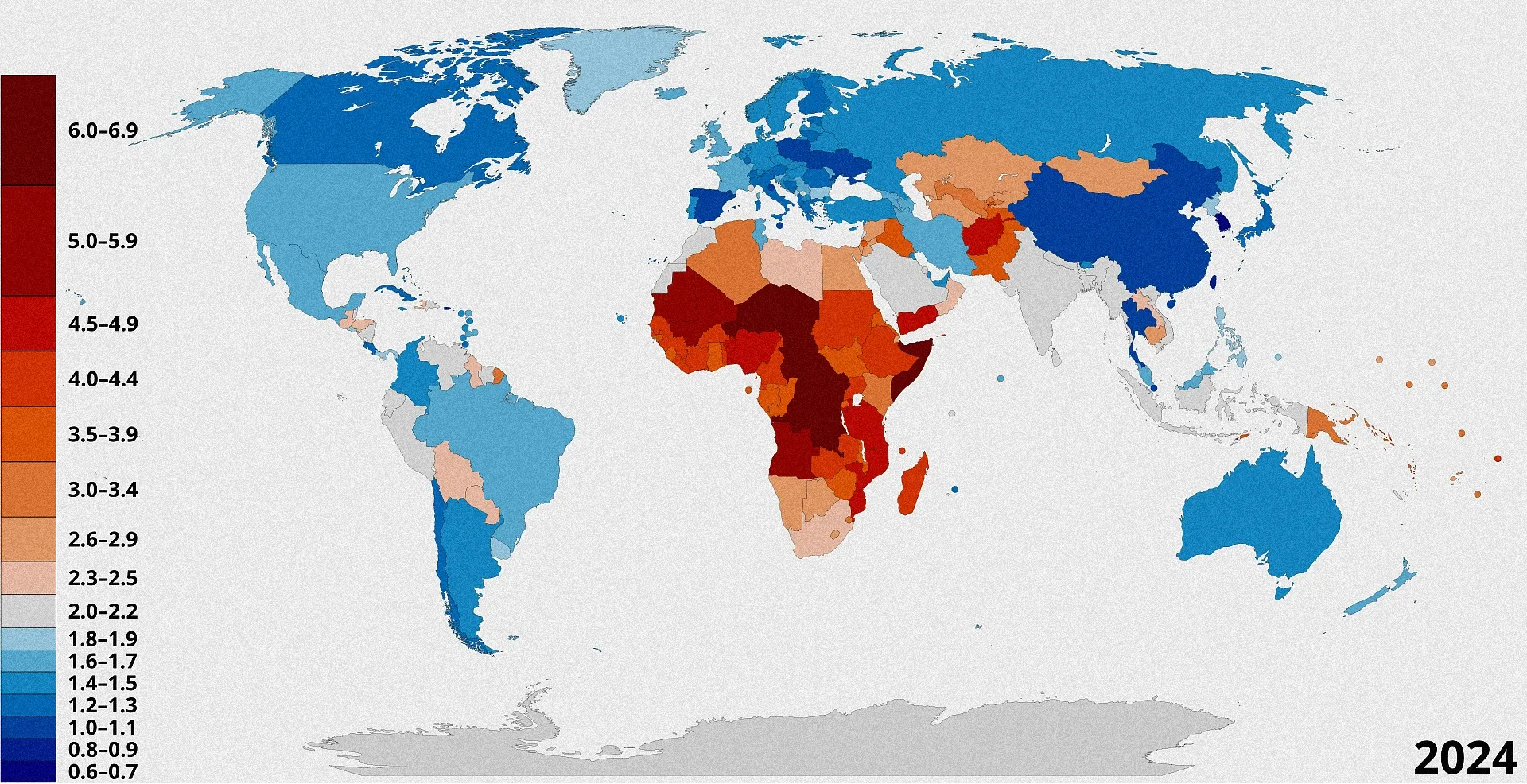
The color scheme is this: red is where the society has an above-replacement fertility rate (above 2.1). If it's dark red, like here in the middle of Africa, it's six or above. Why is that the case? Because Africa is in a situation where it is a growing society with middling tech. A lot of people die, and there's lots of competition, so to survive, families have to give birth to a lot of kids. They have no choice in the matter.
But then you move to the rest of the world: North America, Europe, and East Asia, the three wealthiest parts of the world. The fertility rate is collapsing because now we've entered the endgame where it is overpopulation and too much wealth, which means too much inequality. Women are forced to pick the best possible mate or not have children at all.
North America and Europe are kind of okay. Why? Because of immigration. Even though their women are not having children, they can choose to import people for their labor force. But East Asia is really, really screwed. China is at 1.0, but the worst is South Korea. South Korea has the lowest fertility rate in the world, between 0.6 to 0.8. They're probably gone in 50 years. It's so bad that when you go to South Korea, they have signs outside restaurants that say, "No dogs and no kids." They think that kids are a problem.
The solution governments are choosing right now is to import immigrants. This is causing a lot of disruption in society because people don't like outsiders, but they don't have a choice. Along with the fertility crisis is the aging crisis, where your population is getting older and older.
If you want to know who will rule the world in 100 years, just figure out in which society wealthy, educated women choose to have children. That society will rule the world. It's that simple. Unfortunately, if you do it that way, you get a really, really disturbing answer.
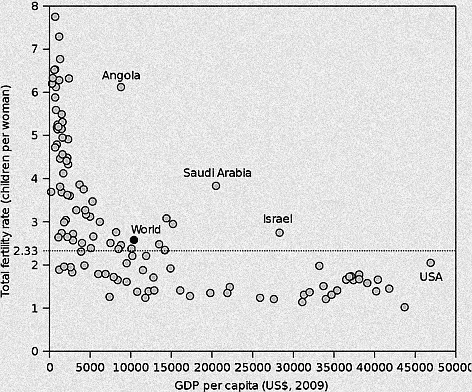
This chart shows per capita GDP versus the fertility rate. The United States is the wealthiest society in the world, but it is below the 2.1 replacement rate. It doesn't really care because it can import immigrants. China is probably around here somewhere. Angola is up here, but it's poor.
What this map tells us is the country that is most likely to be dominant for the next 50 years is Israel. It is the only wealthy, Western, high-tech society in which women choose to have more than two kids.
I know there are people like, "Yeah, but Israel has 9 million people, it's in the middle of a desert, and everyone hates Israel." I understand that. But if you just analyze how the game works, if you just look at it objectively from a game theory perspective, you are forced to conclude that Israel right now has the major advantage over everyone else.
The question then is, why is it that Israel is different from everyone else? The answer is because the world hates them. Because they think they are different from everyone else, they must unite together to survive. So in Israel, fertility is status. If you are a woman and you give birth to a lot of kids, that means that you love Israel. That means that you are doing what you can in this war for survival. It means you are a patriot.
This has to do with religion. What the West has done is not only create a dating game where women can choose to have kids, but the Western world has also given up on religion and embraced materialism. What is valued in our world in the West? It's not patriotism or love of family or religious duty. It's just how many Instagram followers you have, how many YouTube subscribers you have, how much money you have. That's all that matters.
What About Outliers Like Saudi Arabia?
Looking at the chart, Saudi Arabia is a very wealthy society, and families have about four kids on average, so it is also an outlier. The reason why is that it gets all its money from oil revenues. It creates a welfare state using this oil. You're incentivized to have as many children as possible because the government will pay for it: free schooling, free healthcare, free housing, and then a guaranteed job. It's basically like socialism. It's also a Muslim country, so you have this religious, duty-based imperative to have as many children as possible.
The problem with Saudi Arabia is the idea of human capital. It is not really a meritocratic society in which people are well-educated and contributing to the economy. Saudi Arabia just gets all its money from oil, and that's it. It's trying to grow tourism and develop its human capital, but it doesn't really work. So you're right in that Saudi Arabia seems to be doing well, but it's not really.
People will argue about Israel as well, saying it gets all its money from the United States and the American military supports it. That's true to a certain extent, but if you actually go to Israel, you will see that it's an open, dynamic society in which you're allowed to ask questions, criticize the government, and are given lots of opportunities for social mobility. Israel has democracy, innovation, and technology. Saudi Arabia doesn't have these things. If you want to be a really strong nation, then you need innovation, openness, and technology.
Game theory doesn't give us the answers. It just gives us a guide to ask questions and do research.
The Dire Outlook for Some Nations
You might ask about the age of this data. While some charts may be from a few years ago, the trend holds. Here is a map from 2024, and Israel is right here. If it's red, it's above replacement. If you just Google "Israel population fertility rate," Israel is the only wealthy nation in the world that has an above-replacement fertility rate.
Now let's look at South Korea, which is the worst-case scenario.
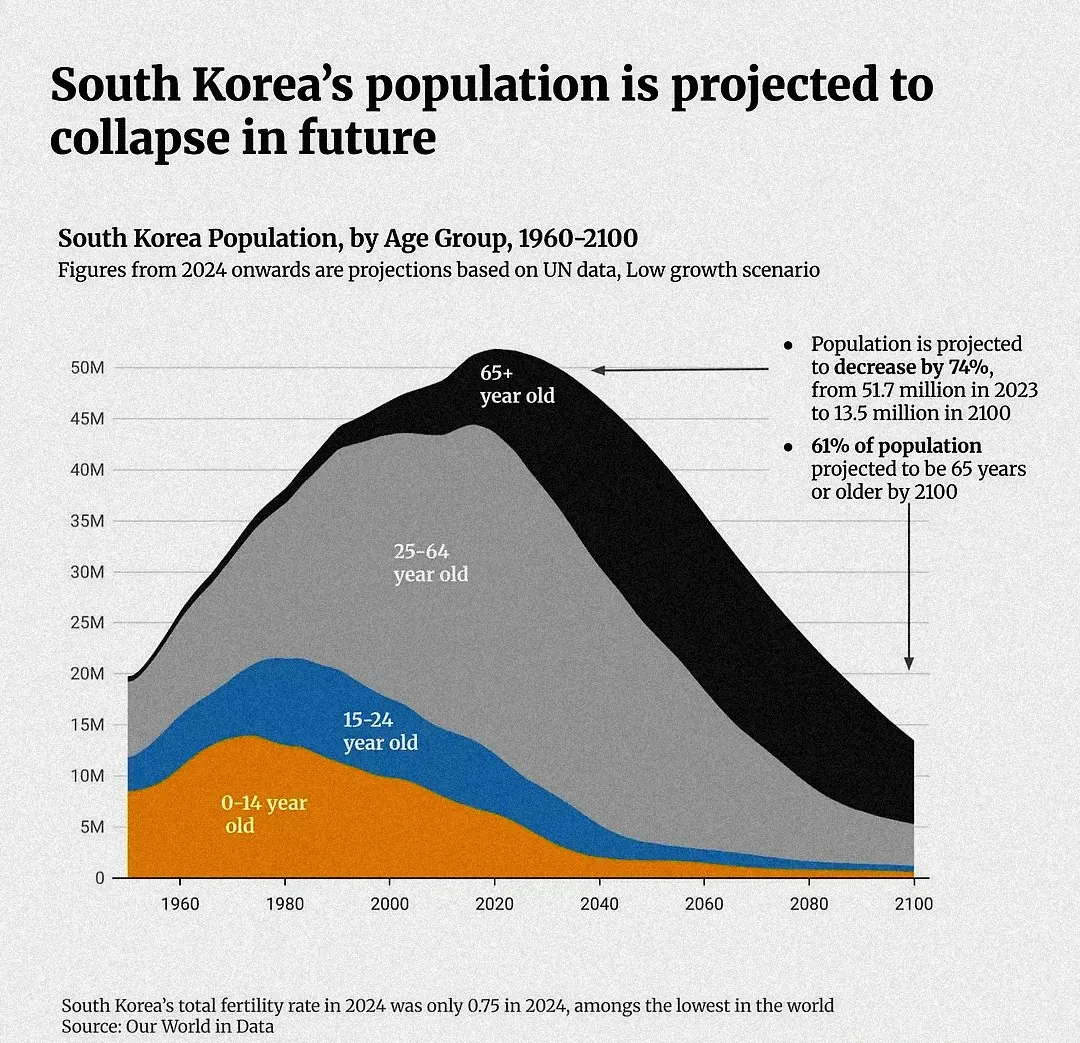
This is actually the best-case scenario for South Korea. Given current trends, and let's just pretend that nothing bad happens, by the year 2100 you have a situation like this where the vast majority of people are over 65 and you have no kids. That is a zombie society where no one works and everyone just walks around the park every day. The economy has collapsed.
Look at this trend. We are now here, where the majority is still a working population, which is good. But by the time you hit 2040, you've got this huge dependency and a cratering population. By the time you hit 2060, your working population has decreased by half.
If things stay the same, South Korea will be dead by 2150, best-case scenario. But what we know from history is that societies will not die naturally. Eventually, South Korea will be forced into wars and new economic crises, so this trend will just increase. I would be surprised if South Korea got past 2080. I would be surprised if by 2040, South Korea were not to face collapse as a nation-state.
You need these people to work, but you also need them to fight wars. If North Korea ever threatens South Korea, most of your adult population will be dead. South Korea cannot fight a war. The prospects for South Korea are utterly hopeless. There's nothing South Korea can do about this because it is an extremely materialistic society where the only way to get ahead is by making a lot of money. If you're a middle-class person in South Korea, it makes no sense for you to have three kids. It makes sense for you to have one kid and put all your resources into this one kid in the hopes that he passes the college examination, gets into a good university, and then gets a good job at Samsung, which is the only company in South Korea. The situation is pretty dire.