Game Theory #27: Putin Enters the Chat
President Putin arrived in Beijing on Tuesday evening. He had a full day of meetings yesterday and left last night. They went to a conference hall where they unveiled a photo of the two being very close. President Putin and President Xi are very good friends. This is Putin's 25th visit to China, and in November he's coming back to Shenzhen to attend APEC — that'll be his 26th. He's a very good friend of China's and the two are very close.
The two leaders also attended an education conference together, where they announced a year of education exchange between Russia and China. The goal is to enhance people-to-people connections between the two countries.
Two Visions of a Multipolar World
The major output of the meeting was their different perspectives on the multipolar world. Both leaders gave speeches on the subject, though the translation available was AI-generated and quite rough. Even so, certain things are worth pointing out.
Both are committed to a multipolar world. What President Xi and President Putin both want are more exchanges — bilateral student exchanges, deeper interactions in universities, more research together. Xi is also very afraid of the turbulence in the world and very much afraid of a return to the law of the jungle, where might is right. So it's very important for the world to work together in order to maintain the rules-based international order.
What President Xi says is that as prudent members of the UN Security Council, China and Russia will work together to uphold the authority of the UN, international justice, and oppose all manifestations of unilateralism and hegemonism — resurrecting signs of fascism and militarism. This specifically refers to Germany and Japan. He sees the possibility of a resurgence of nationalism in Japan as a threat to the peace in East Asia and to the world in general. China is most resolutely opposed to the remilitarization of Japan.
Putin says the same things almost, but the tone is very different. Putin is actually much more specific than President Xi about areas of cooperation — for example, the Russia-China Summer Games and cooperation between different media outlets. He also talks about how it's important to maintain independent, autonomous foreign policies, while at the same time working together to stabilize the global stage and working together for peace and universal prosperity. This is the logic behind Moscow and Beijing's joint defense of international law and the provisions of the UN Charter in their entirety.
It sounds like they're saying the same thing, but the emphasis is different. China is very, very much focused on maintaining a status quo, a rules-based international order, at the very top of which is the UN. For President Putin, what's important is that China and Russia take the lead in leading the multipolar world. So these are two very different conceptions of how the world should be run. The Chinese system is: let's just maintain the way things are and we'll play a supportive role. Whereas Putin is like: no, Russia and China should be the leaders of this new multipolar world. China can be the leader and Russia will be a junior partner, but we need to take the initiative in promoting global stability.
Russia and China's Joint Statement: Basic Principles
Russia and China also released a joint statement advocating a multipolar world, calling on the international community to adhere to the following basic principles in their relations with one another:
- Maintaining open trade
- Maintaining sovereignty of different nations
- Making decisions through consensus, with the United Nations as the primary authority
- Maintaining the authority of the UN
- Respecting the civilizations of each different nation-state — refusing to prioritize one civilization over another
This is something that both Russia and China agree to.
President Xi's Words on the Multipolar World
Here is a much better translation of President Xi's words about the multipolar world:
The world today is far from tranquil. Unilateralism and hegemonism are doing grave harm and the world faces the danger of sliding back to the law of the jungle. As permanent members of the UN Security Council, China and Russia must firmly carry out the mission and responsibility of major countries, defend the authority of their nations, international fairness and justice, oppose all unilateral bullying and acts that turn the will of history backward, and especially oppose all provocations that negate the victorious outcomes of World War II or that seek to reverse the verdict on and summon back the spirits of fascism and militarism, jointly pushing for the building of a more just and reasonable global governance system.
— President Xi Jinping
This is a lot of words, but there are certain takeaways worth emphasizing. First of all, what President Xi is saying is that there were three major winners of World War II: the United States, Russia, and China. And we must ensure that these three nations who won World War II are still in charge. This is really important to understand. The US, Russia, and China are allies, not enemies. Right now a lot of people think that China and the United States are in competition to rule the world. President Xi says: "No, that's not true. We're allies because we won World War II together."
Second, he sees the real enemies as those who are trying to overturn the World War II order — and those nations are of course Japan, Germany, and Israel.
The last thing to point out is that all unilateralism and hegemonism are bad. If you act by yourself and you declare war against other nations, that's bad. Obviously the United States attacking Venezuela is bad. Obviously the United States attacking Iran is bad. But what about Russia attacking Ukraine? Well, according to this framework, this is also bad. According to the logic of what Xi said specifically, this is also bad.
So it seems as though China and Russia are best friends and they will unify against the United States together. But this statement reveals that things aren't as simple as they seem.
The Limits of Cooperation
There are many areas where China and Russia can work together, but the cooperation is not going as smoothly as one would imagine. Let's look at some examples.
The Power of Siberia 2 Pipeline
China needs a lot of energy and resources from Russia. So you would think that they would build infrastructure as soon as possible to make this trade as smooth as possible, right? Especially with the war going on in the Middle East blocking China's access to Middle Eastern energy. The main pillar of this cooperation is something called the Power of Siberia 2 pipeline.
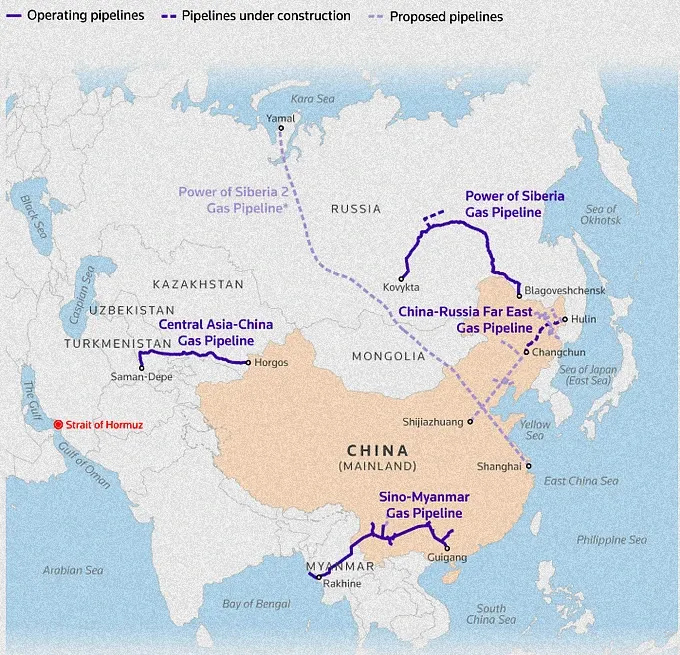
It extends all the way from the north of Russia to Shanghai. It's a huge project.
Everyone assumed that at this meeting the first thing they would accomplish is signing an agreement to build this pipeline — and they have not done so. A lot of it is because China does not want to become too dependent on Russia. Obviously, if you build this pipeline you must buy a lot of energy from Russia. But they want to still negotiate over the price as well as the volume.
Iran: Two Very Different Responses
The second area is Iran. The Russians are absolutely supportive of the Iranians. What Vladimir Putin says is: this absolute unprovoked aggression of U.S. bombing against Iran has no basis or justification whatsoever. For our part, we are making our efforts to assist the Iranian people.
The Chinese, on the other hand, are much more nuanced and much more diplomatic. President Xi says: Israel's military operation against Iran has caused a sudden escalation of tensions in the Middle East. Military conflicts are not the solution to problems.
So the Chinese are much more muted. This shows us that whereas the Russians are much more clear about their regional alliances, China does not want to participate in disputes among different nations.
Trade Routes and the Malacca Dilemma
One area of cooperation between Russia and China is trade routes. What the Americans want to do is block China from accessing global trade, and they can do that by closing off the Strait of Malacca. There's something called the Malacca Dilemma for China — if the Americans were to close off the Strait of Malacca, Chinese trade would collapse. So the solution is for China to build another route to the north, called the Northern Sea Route, with Russia.
But the problem is that now you're completely dependent on the Russians, because you're going through Russian territory. So it's not an advantage for China to say, "Screw you, America, we're going to work with the Russians." They're actually better off balancing Russia and America. That way they keep both of these routes open. This is the most economical and the most strategic way of accessing global trade.
The Trade Relationship Clearly Favors China
The further you look, there are certain tension points in the relationship between Russia and China. First of all, this relationship clearly favors China.
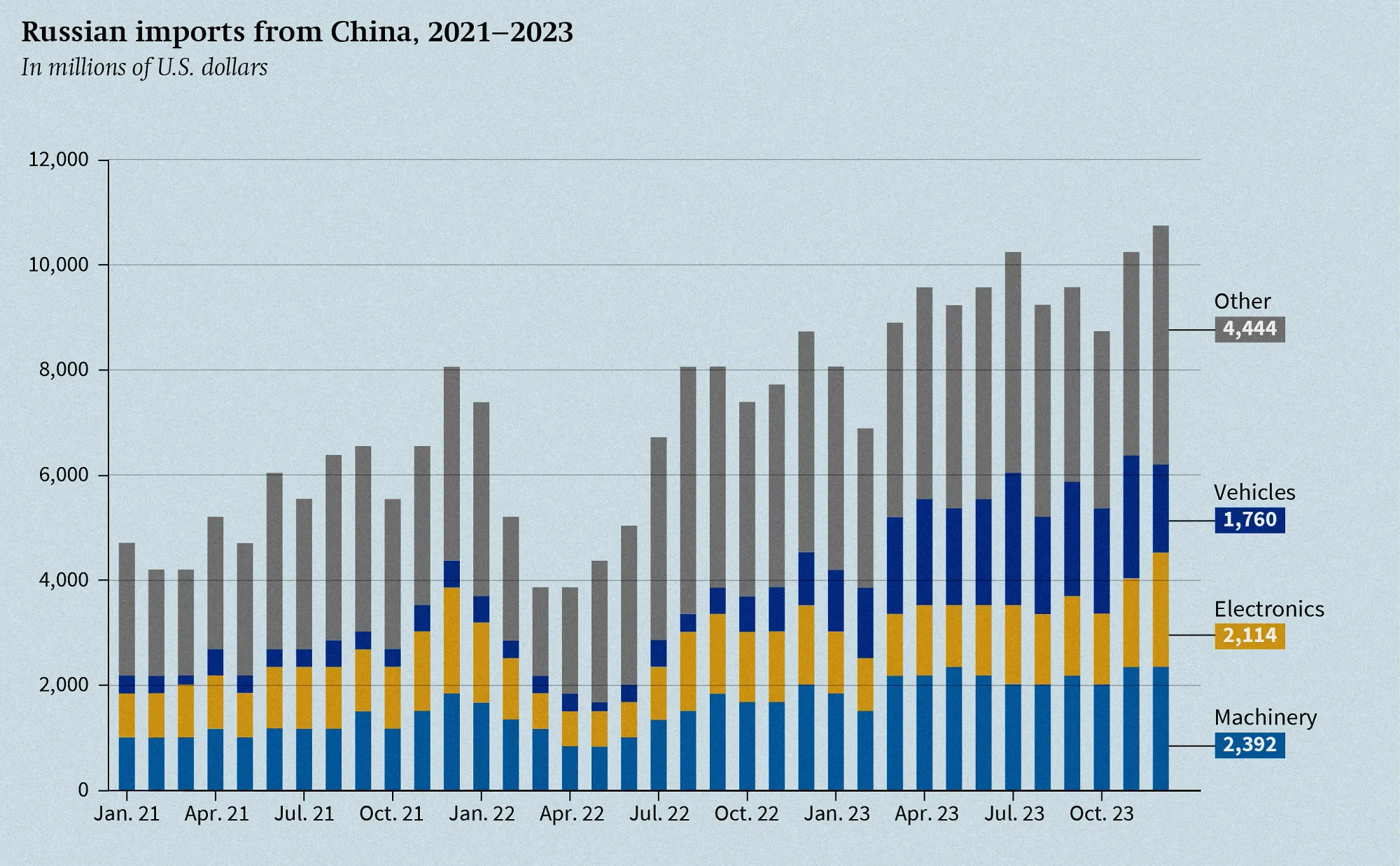
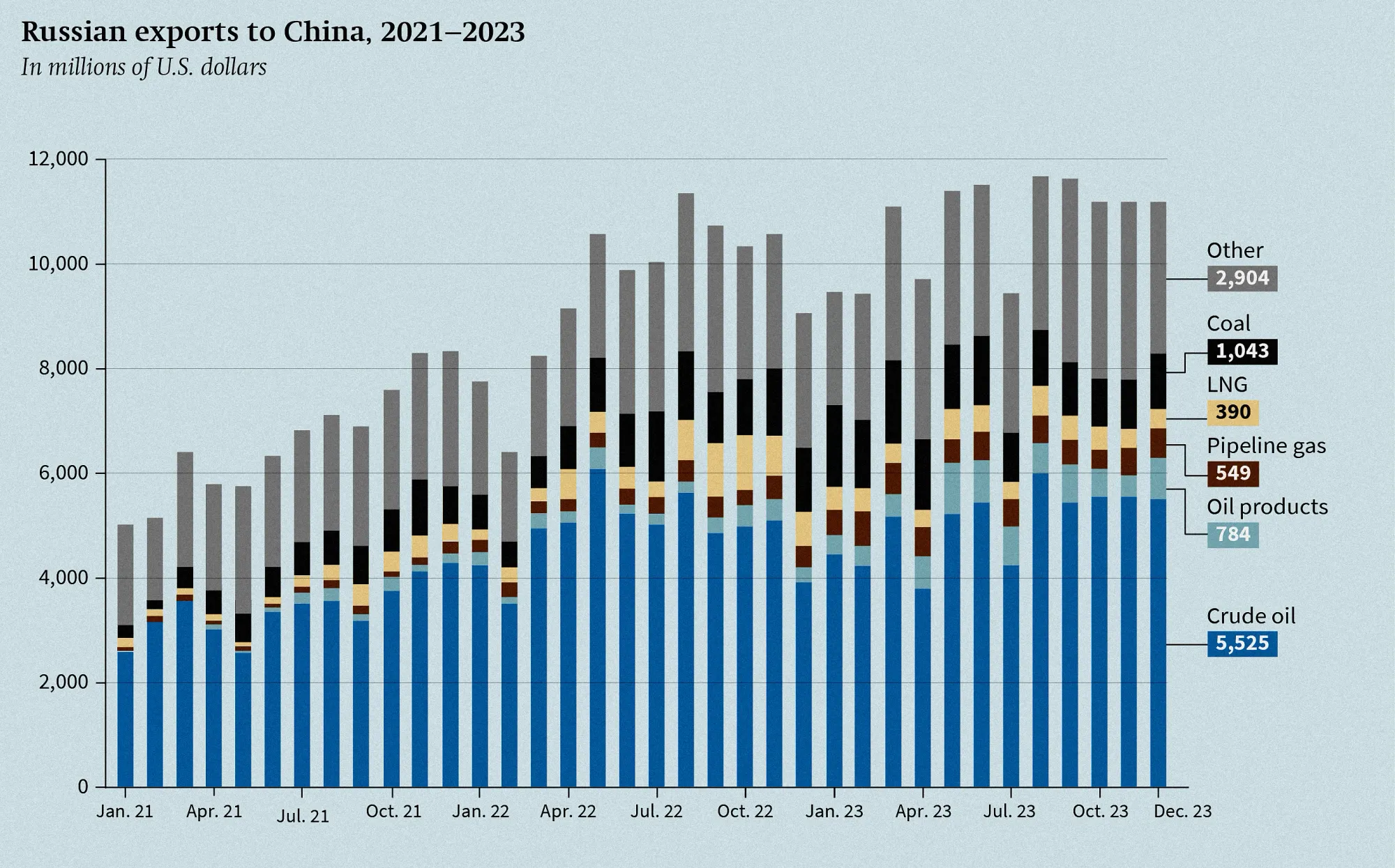
Russia's exports to China are mainly just energy — coal, LNG, crude oil. What does China export to Russia? Mainly vehicles, electronics, and machinery. So basically what China does is it takes Russian resources, converts them into manufactured goods and machinery in its factories, and then exports them back to Russia. This is a very bad deal for Russia. It's a good deal for China, but it's a bad deal for Russia.
Another point of tension is dependence. Russia's share in Chinese imports is only 5%. Russia's share in Chinese exports is only 3%. So economically, Russia and China are not that close. The problem, though, is that Russia is highly dependent on its relationship with China because of all the economic sanctions imposed on it by the West. After February 2022, when Putin invaded Ukraine and the West sanctioned Russia, the economic dependence on China has increased a lot. In the beginning of the war, Russia didn't use that much renminbi, but now the renminbi accounts for over 40% of Russian imports.
Why Chinese Investors Aren't Interested in Russia
Chinese investors aren't that interested in going to Russia and investing there. Before the war there was some investment, but after the war it dropped precipitously. And the Chinese who do invest are mostly in the Russian Far East — that makes sense because it's close to China — but the further you go out, there's really no real investment.
Why is that? There are different reasons we can speculate about.
The first reason — and this is really important — is that the Chinese are respecting Western sanctions on Russia. If you do business with the Russians, then the West can choose to de-bank you, remove you from the global financial system. And Chinese investors care more about their relationship with the West than they care about Russia.
Point two is that Russia is not that friendly to foreign investors. Russia is very much a closed system and it's very hard to do business there. If you put your money in the United States, you'll be protected legally and contractually. If the person screws you over, you can go sue them in a court of law and you can probably win. Whereas in Russia, if you get screwed over — too bad. Russia is still very much a mafia system.
The third reason — and this is actually really problematic — is that Chinese are much more interested in USD than they are in the ruble. They're much more interested in accumulating U.S. dollars than rubles. This is the central dilemma of the Russia-China relationship: yes, you can get Chinese people to go visit Russia, you can announce a lot of cooperation, but at the end of the day, Chinese investors want USD and not rubles.
The People-to-People Gap
Right now you have about 50,000 Chinese studying in Russia. But this does not compare at all to the Americans — when Chinese had enough money to go study in America starting in 2008, there was a huge boom. There are maybe 60,000 Chinese learning Russian in China while everyone else is learning English.
So at the end of the day, Chinese people are much more interested in the West than they are in Russia. The relationship between Russia and China seems to be top-down — mandated from the government. But the relationship between the United States and China seems to be bottom-up — where people are choosing to work with the Americans. So this is not really an equal relationship.
Why Do the Chinese Want to Go to America? The History of the Dollar
To answer this, we need to go back to World War II.
The Bretton Woods System (1944)
The war has ended and America has won. America has a problem: it's got all these factories that produce tanks, machine guns, and airplanes, and now the war is over. What are you going to do with these factories? You can't just tell everyone to go home and not work.
So they make a deal with the Europeans and the East Asians — basically Japan, Taiwan, and Korea. The deal is this: the Europeans will agree to buy manufactured goods from the Americans — television sets, radios, bicycles, cars. But then the Europeans and the Japanese say, "We don't have any money." And the Americans say, "Don't worry, we'll lend you the money. Not only will we give you the goods, but we'll lend you the money to buy the goods."
And of course the money is the U.S. dollar. So the U.S. dollar is basically a contract. And because the Americans are lending U.S. dollars to the Europeans, the Japanese, and the East Asians, they want the U.S. dollar to actually be worth something. So the U.S. dollar is pegged to gold — the gold standard — meaning the Americans can at any time force the Japanese and Europeans to give their gold in exchange for U.S. dollars.
This is a really good deal for the Americans. This is what we call the Bretton Woods System — 1944 — where the Americans would facilitate global trade in order to maintain their manufacturing power, lend other nations the U.S. dollars to participate in this trade, and the U.S. dollar would be backed by gold.
From 1950 to 1970, this was a great deal for America. It led to probably the greatest wealth creation in the world — if you were just an average American, you had the best life possible. It led to tremendous prosperity in America.
But with prosperity comes corruption and complacency.
The Nixon Shock (1971) and the Petrodollar
What happened was that the Americans started to get comfortable. The Europeans and the Japanese, meanwhile, needed to work harder because they needed to rebuild themselves and pay off their American debt. Europe worked really hard. Japan worked really hard. And then what happened was that the Europeans and the Japanese started to make products that were not only cheaper than the Americans could make, but also better.
So instead of America lending money to the Europeans and the Japanese to buy things from America, America started to borrow money in order to purchase European and Japanese manufactured goods. This relationship went backwards. The USA went from a creditor nation to a debtor nation.
Not only that, but the Americans recognized: "You know what, we can print as much money as we want, so we can spend as much money as we want." And so the Americans started to do stupid things — like start a war in Vietnam that they could not win, or send a man to the moon for no particular reason. The Americans started to spend way too much money. By 1970, the entire world recognized that America owed them a lot of money but probably couldn't pay it off in gold.
Then in 1971, Richard Nixon said: "You're absolutely right. We can't pay you off with gold. So we're going to move off the gold standard."
This creates a problem, because now everyone's sitting on this U.S. dollar and it's actually worth nothing. So to solve this problem, what Nixon did was bring into the system the GCC — Saudi Arabia basically — as well as China, to create more demand for the U.S. dollar. This created the petrodollar, because from now on Saudi Arabia would only sell its oil in U.S. dollars. And so this kept the system going.
The thing to appreciate about this is the Americans did not do this because it was strategic, not because it showed long-term thinking. They did it because by now they had become addicted to the U.S. dollar. This is really important to understand: at this point in history, the U.S. dollar was the global reserve currency.
What Does It Mean to Be the Global Reserve Currency?
The global reserve currency is unique in human history. We've never had the idea of a global reserve currency — where one currency could be the basis for the value of all other currencies. This never happened before. It happened because of an accident of World War II, when the Americans won and could impose their system on everyone else. And before that, it was tied to gold, and then they went off the gold standard. So this is a complete accident of history — and it's terrible for America for many reasons.
The first reason is that America is now the guarantor of global trade. What does it mean to be the guarantor of global trade? First of all, it means you have to print a lot of U.S. dollars — you need excess liquidity — so people can use U.S. dollars, and this causes inflation in your system and it's hard to manage.
The second problem is something called an open capital account. An open capital account means money can come into the country, but it can also flee the country. And that's really problematic if you're trying to control a nation's currency.
The third thing is financialization — because there's so much demand for U.S. dollars and the U.S. dollar is so complex to manage, your economy shifts from manufacturing to financialization. Financialization just means gambling. So this has been terrible for America and the American economy.
The problem is that once you have easy money, it becomes addictive. And the way to protect the system is through expansion and war. You don't care if expanding your system makes any sense. You don't care if expanding your system is good for your nation. All you want to do is expand it in order to create more demand for the U.S. dollar because you're so addicted to it. And you have to go fight wars in order to protect the U.S. dollar.
So this is what leads us to China. To create China, what America did was destroy its middle class and transfer its manufacturing sector to China. It gave China technology, capital, and market access. The entire intention was to create more demand for the U.S. dollar. This also explains the war in Iran — Iran is not part of the system, so America wants to destroy Iran in order to make everyone else more dependent on the system.
Why Did China Agree to Participate in the System?
Because the U.S. dollar solved for China a huge problem. The U.S. dollar monetized power.
Think about it: I'm the elite in China and I control millions of people. But so what? Who cares? What the dollar did was it enabled me to monetize my power — meaning I could take this power, store its value in the U.S. dollar, and then export it to the United States where it would be safe. This is what it did: it monetized power in China. Now the elite could use their power over the people and get rich in America.
So there were two major beneficiaries of this system — even though this system doesn't really make any sense. The first is the American financial elite. The second is the Chinese political elite. And this explains why it's so hard for Putin and for Russia to form an alliance with China — because the elite mentality is to use their power and monetize it through the U.S. dollar. So what matters is the U.S. dollar, not the relationship with Russia.
If you think about it, the entire point of society in China right now is to generate as much U.S. dollars as possible. Sending a child to the United States to learn English, to get an American degree, to acculturate to American society — that's part of the strategy. The renminbi by itself has no value. If you convert renminbi into U.S. dollars, that has value.
So that's what explains the relationship between the United States and China and why it's so hard for Russia to break into it. There's actually nothing the Russians can offer the Chinese elite. In fact, the Chinese elite think Russia is a problem because of its militarism throughout the world.
Putin's Grand Strategy: Destroying the U.S. Dollar
So if Putin wants to establish a new world order, what he needs to do is ultimately destroy the U.S. dollar as the global reserve currency. That is his mission. That is his game. If he really wants to destroy the American empire, he needs to destroy the value of the U.S. dollar. And the way he does that is by destroying demand for the U.S. dollar.
Before going over Putin's grand plan, one thing worth making clear is that not all Americans think it's a good thing that the United States has the world reserve currency. In fact, most Americans, if you explain the system to them, will say: "Yeah, we don't want to be the world reserve currency" — because it causes corruption, it causes all these corrupt people to come to the country, it causes illegal immigration, it causes wars in Iran, it causes the U.S. to support Israel. The problem, though, is that they're addicted to it because it's such easy money. So this is a contradiction: on one hand, Americans know that the world reserve currency is bad for them, but on the other hand, they're addicted to it.
America is basically a drug addict. And so what do you do? The only thing you can do is a forced withdrawal — which means you deny America's capacity to print money. And the way you do that is by destroying global demand for the dollar. This will cause a lot of pain in America in the short term — basically economic depression, civil war. In the long term, this may be the only solution to save America.
It is also worth pointing out that of all the world leaders in the world, only Vladimir Putin seems to be truly strategic. The guy is actually able to think long-term and execute with perfect timing. He's a chess player. He's really the only world leader who is able to think so far ahead and plan so strategically.
The Coalition of the Sanctioned
Putin's strategy is actually very simple. There are lots of different nations that have been sanctioned by the Americans. How can he form relationships with these nation-states in order to create volatility in the world, destabilize global trade, and therefore destabilize the U.S. dollar? There are also some nation-states that participate in the system but who are not happy about it. How can he actually break them away from dependence on America?
The sanctioned nations include Russia, Iran, North Korea, Venezuela, Syria, and Belarus. Myanmar is in a civil war — forget about them. Venezuela has been conquered by the Americans. Syria is destroyed. So basically there are four countries left: Russia, Belarus, Iran, and North Korea. These four are going to work together in order to destabilize the global order and destroy the American empire.
The key players are Iran and North Korea.
North Korea and the East Asian Theater
Right now Russia and North Korea have become very, very close. In June 2024, Putin visited North Korea and signed a mutual defense pact with Kim Jong-un. This is a very, very big deal. What a mutual defense pact means is that in the case that North Korea is attacked, Russia must militarily come to the defense of North Korea. If Russia is attacked, North Korea must come to the defense of Russia.
This is a big deal because previously North Korea had a mutual defense pact with China, signed in 1961 after the Korean War. So you would think that North Korea doesn't really need Russia because North Korea already has China to protect it. Why is Vladimir Putin signing a mutual defense pact with Kim Jong-un? This is very strange. If we wait a couple of years, we'll probably know the answer.
Kim Jong-un has also been very supportive of Russia's war in Ukraine. In fact, he sent 10,000 troops to Ukraine. The thing about the North Koreans is that at first they're not very well trained and not very disciplined. But the thing about the North Koreans is they fight to the end. They have a policy of not surrendering to the enemy. If you do surrender to the enemy, guess what happens to your family back in North Korea? So the North Koreans — yes, they're poor, they're not technologically sophisticated — but their soldiers are willing to fight to the bitter end. And that's actually the key to winning a war.
Everyone makes fun of North Korea because it's a very poor place. If you compare North Korea to South Korea, the GDP per person is only $771. That's it. Whereas in South Korea, it's over $33,000 — one of the highest in the world. And look at a satellite image of the Korean Peninsula at night:
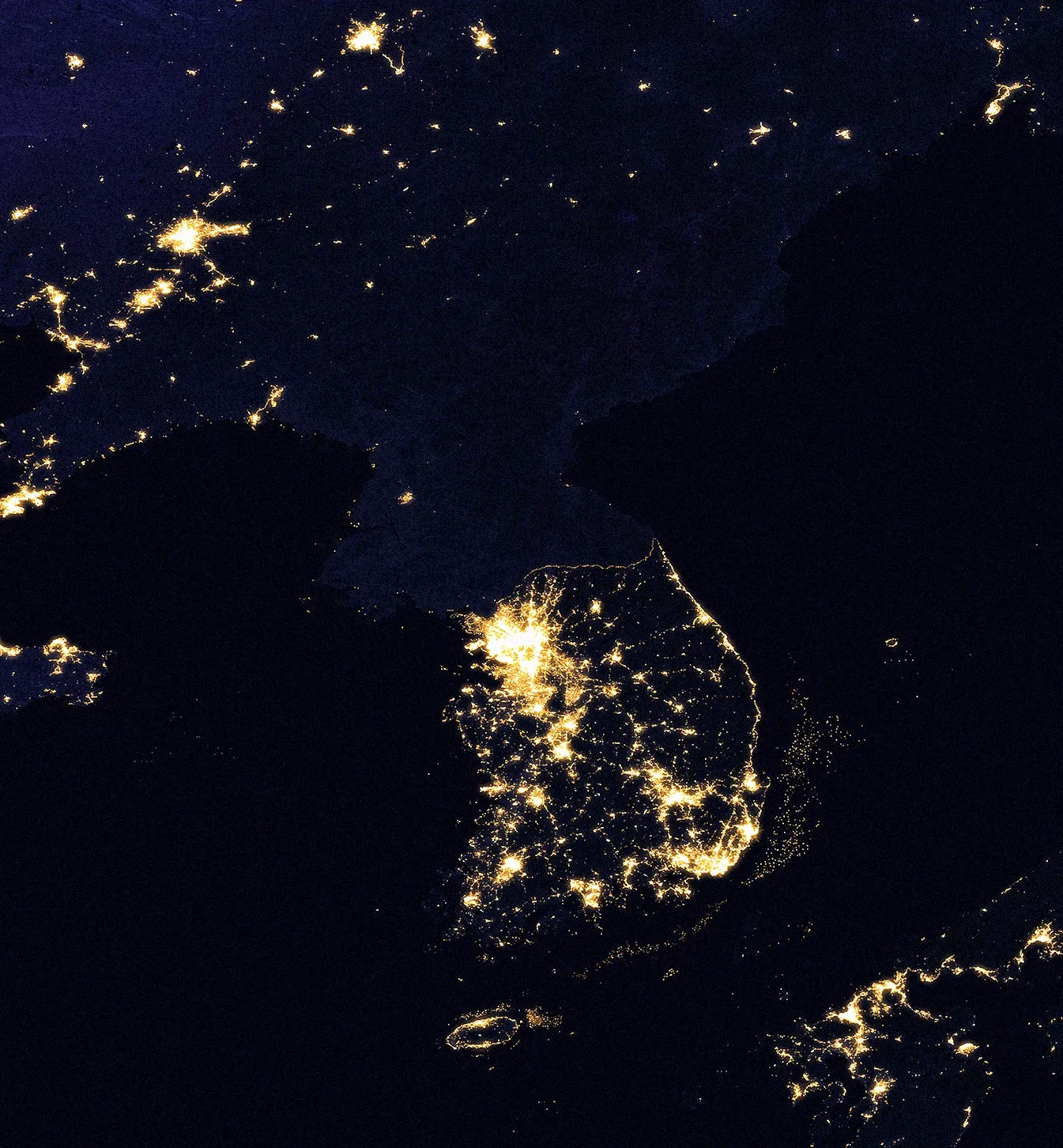
The difference between the two countries at night is pretty striking. Huge difference.
But in a war, North Korea would defeat South Korea. Why? Because in game theory, if you look at how wars are fought and who wins wars, societies that win wars have three characteristics: they have energy, they're open, and they have cohesion. The poorer you are, the more likely you are to be energetic, open, and cohesive.
South Korea is wealthy, it has technology, it has a lot of weaponry, and it has American support. The problem with Western capitalistic societies is that they tend to be very individualistic as well as complacent and unequal. You can tell this from the birth rate: North Korea's fertility rate is still 1.81 — not great, but manageable. South Korea's fertility rate is 0.81. In 50 years' time, South Korea will lose 80% of its people. North Korea will also lose people, but if we just keep on going, eventually South Korea will go to zero and North Korea will still be around.
The other difference is that when you're poor, you're not afraid to die. You have nothing to lose. Whereas if you're rich, well, you want to live.
So all North Korea has to do is basically say: "We have artillery"
Seoul sits dangerously close to the border. All North Korea has to do is tell the South Koreans: "You either pay us a lot of money or we'll attack you." And the South Koreans will say, "We'll give you money, just please don't attack us."
What this is going to do is create a lot of tension in East Asia, bringing in Japan as well as the United States. And remember, the United States is already distracted in Iran. It doesn't have the forces to defend South Korea. So Putin's defense pact with North Korea makes a lot of sense: if North Korea creates a problem in the Korean Peninsula, this is going to be a huge problem for Japan and the United States.
Germany and the European Theater
After Russia invaded Ukraine, Europe and the United States responded by imposing sanctions on Russia. The problem is that Germany was dependent on cheap Russian energy to fuel its economy. Because Germany lost this Russian energy, it had no choice but to buy American LNG at a 50% markup. In 2019 they weren't buying that much from the Americans, but by 2025 they're buying a lot. This has been terrible especially for the German economy. The decline in the German economy has been steeper than that of the French, the Italians, the Spanish, and the British. The Germans are really hurting from this war.
The other thing is that there's been a lot of immigration to Europe. In certain places — especially Scandinavia and Germany — the population of immigrants has gone as high as 20%. So there are two trends: more immigrants coming to Europe, which is threatening local identity, as well as this war in Ukraine. As a result, the AfD — which opposes immigration and opposes the war in Ukraine — has seen a surge in popularity. Honestly, if there were fair elections in Germany, at some point the AfD is going to win.
What this means is that the Germans are choosing, instead, to fight a war. In 2016, German military expenditure wasn't that great, but now they're going to invest a lot more in the military. The plan is for Germany to have troops in Ukraine by 2029. Europe is moving towards total war — stretching the entire society for war against Russia.
Some analysts say that Russia is now under a lot of economic pressure. It's true that the Russians have spent a great deal more money on the military.
But the thing to keep in mind is that it's still pretty low as a share of GDP. Saudi Arabia spends over 10% of its GDP on the military. China spends about 2 to 3%. The United States spends around 4 to 5%. The Russians spend about the same.
In other words, the Russians still have a long way to go. In fact, Putin still maintains that the war in Ukraine is a special military operation — not a full-scale war. The moment Putin declares war, the entire economy shifts to total war. We can expect a complete surge in military spending. Russia hasn't reached that point yet.
What is Russia's plan for Europe? Putin doesn't actually want to fight Europe — it would be disastrous for both sides. But he understands that there's a civil war brewing in Europe, where right-wing parties like the AfD are surging in popularity because they oppose the war and oppose immigration. So all Putin has to do is force Germany into a war and drag it out — create a war of attrition. As this war drags on, it's going to create a lot of political tension back at home, especially if you're drafting young men to fight. Eventually, right-wing political parties like the AfD will come into power.
How does Putin know this? Because it has historically been true. This is what happened in Russia during World War I, when the Bolsheviks came into power. It almost happened in Germany too — the Communists almost came to power in Germany. War creates political tensions, and the longer the war drags on, the greater the tension.
So basically what Putin wants to do is create a civil war in Europe, allow these right-wing pro-Russia parties to come into power, and then form an alliance between Germany and Russia.
Part one of the plan: create as much political tension in East Asia as possible by using North Korea.
Part two of the plan: go to war with Europe in order to destabilize it politically, allow these right-wing parties to come to power, and then form an alliance with them.
The Global South
Russia has been very supportive of the Global South, especially countries in Africa. After Russia invaded Ukraine, support for Putin in the Global South increased dramatically.
The question is: Russia invaded Ukraine — so why would people around the world support Russia?
The answer is narrative. From a Western perspective, Ukraine is this innocent country and Russia is the aggressor. But if you are not part of the West, if you're part of the South, what you will appreciate is that the West is the imperial bully and Russia is standing up for itself. NATO was expanding too far. Ukraine was being co-opted by the West. So Russia was trying to defend itself — and thank God that Putin and Russia can stand up against the Americans, because people in the South have been bullied by the Americans all this time. Support for the Russians is particularly high in Africa, which has been subject to Western imperialism for a very long time.
There is a lot of trade going on between Russia and African countries, but at the same time there's also military cooperation, nuclear power plant construction, oil exploration, and nickel production. There are also a lot of Russian mercenaries in Africa, usually fighting against U.S.-backed groups in order to control the continent.
China is also heavily active in Africa, but it's very much focused on economic development as opposed to military intervention. The Russians use a full-spectrum strategy in Africa — they're trying to win hearts and minds. We know this because the Russians spend a lot of effort on propaganda. China is not that heavily invested in propaganda in Africa.
So what Putin is trying to do is create a narrative that Russia is liberating the world from Western imperialism — and this has particular strength in places like Africa, which have been a victim of Western imperialism for a very long time.
India
India, for the longest time, has been neutral. What's been happening is that India and Russia are becoming very, very close. The impetus for this close relationship is the war in Ukraine — after Russian oil became sanctioned, the way to evade sanctions was for Russia to sell its oil to India, which would then sell it around the world.
What Russia wants from India is laborers. Because of the war, Russia is now short of manpower. It needs people to run its factories, and eventually — once it wins this war in Ukraine — it's going to need people to go rebuild Ukraine. So what we can expect is that Russia and India will become very, very close over the next 10 to 20 years.
Iran: The Key to Russia's New World Order
Iran is the key to Russia creating a new world order. Why? Because Iran is really the center of global trade — if Russia wants to access Africa, India, and Central Asia, Iran is very important strategically. It's also very easy for Russia to trade with Iran because of the Caspian Sea.
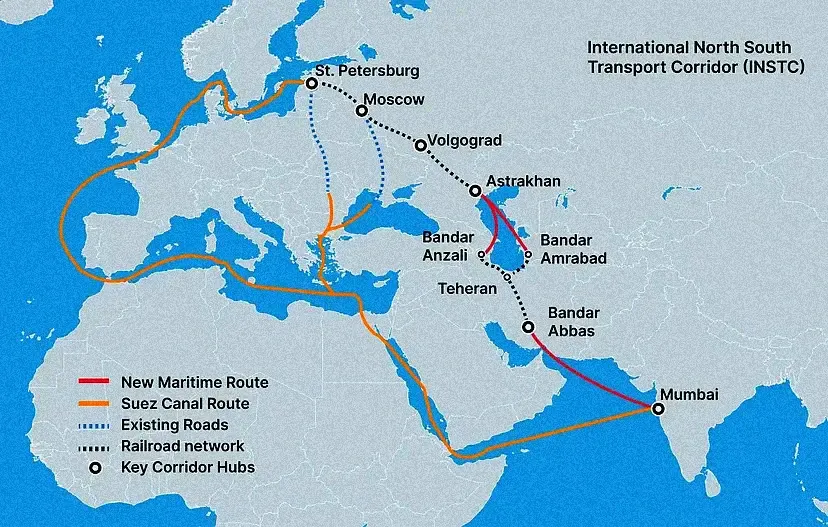
Russia understands that Iran is the key to its global trade with the world. And that's why the Americans are attacking Iran — because by attacking Iran, the Americans can block Russia from global trade, or at least destabilize it.
This is probably one of the two major battlefronts in the world right now. The first is obviously Ukraine, which is being fought between Europe and Russia. The second major battlefront is Iran, fought between Iran and the United States.
This is also why Israel is so important. Israel is the American fortress in this area. It's very possible that if Putin plays these cards right, all these regions will fall into the Russian sphere of influence. So America's guarantee against Russian influence in the Middle East is Israel — and that's why the Americans support Israel so much. Israel is the key to keeping Russia in check.
Japan
The grand strategy of the Americans is to use Japan to balance China. The Japanese don't like this idea. For the longest time, the Japanese have been a vassal to the Americans — they made a lot of sacrifices to be the vassal state of America. But now you've created a situation where Japan has no choice but to remilitarize and rethink its national priorities. The war in Iran is forcing Japan to rethink the global map.
Japan is heavily dependent on energy imports and for most of its recent history it was getting its energy from the Middle East. But obviously most of that energy is now gone. So now Japan has two options: depend on Russia or depend on the United States.
You would think Japan will just buy all its oil from the United States. But the last time this happened was before World War II. Japan before World War II was getting 90% of its oil from the United States. But Japan was becoming too powerful, so the United States started to embargo Japan. Then Japan had no choice but to go invade Southeast Asia for oil and attack the United States. Japan does not want to be put in a situation where it's completely dependent on Americans for oil, because the last time this happened, it didn't really work out well for Japan.
So Japan has no choice but to yes, buy American LNG, but also try to smooth things over with Russia and start buying more oil from Russia.
The other problem for the Japanese is that for the longest time they've been buying U.S. Treasuries. China recognizes that the Americans aren't that dependable — they're printing too much money, they're too deep in debt — so the Chinese have been selling U.S. Treasuries. But the Japanese have been increasing their purchases. Why? Because it's almost like a subsidy or a bribe to the Americans. The Americans have a lot of soldiers in Japan. Japan is essentially a colony, so what Japan does is bribe the Americans to protect it and to leave it alone.
And the way they do this is something called the yen carry trade. This is the silliest thing ever. Here's how it works: Japanese banks lend money to Japanese corporations at 0% interest — basically free money. So if you're a big Japanese corporation and you want yen, you just go to the bank and they'll give you money at 0% interest. What this means is you can take this money and go buy U.S. Treasuries at 5%. Free money. And that's what has led to the surge of Japanese buying of U.S. Treasuries.
But as you can imagine, this is causing huge problems for the Japanese economy. And as the geopolitical situation gets worse and worse, Japan has no choice but to repatriate its money back from the United States — basically selling U.S. Treasuries.
The War Being Fought Right Now
So what America needs to do is force countries like Japan and China to continually buy U.S. Treasuries. And that's why we have the war in Iran — to really control the world's energy supply. But time is running out for America.
The reason why is that as more and more people sell U.S. dollars and refuse to buy U.S. Treasuries, certain problems arise.
First is the debt interest. Right now the debt is at $39 trillion. Assume the interest rate is 5%. That means the Americans have to pay $2 trillion in interest payments alone. That's a huge problem.
The second problem is that as people refuse to buy U.S. Treasuries, you need to offer them a higher interest rate to attract buyers. If it moves up from 5% to 6%, this is a disaster for America.
So America needs to act now. It needs to push the treasury rate down. The way you push the treasury rate down is by forcing people to buy U.S. Treasuries from you. And so this is a war between Russia and America, between Putin and Trump — where Putin is trying to get people to stop buying U.S. Treasuries and Trump is trying to force people to buy U.S. Treasuries. This is the war being fought right now.
What Happens If These Trends Continue?
If these trends continue, certain problems arise. First, America will print more money and the debt of $39 trillion will continue to increase. Then the world is going to think: "You can't actually pay this off." So people stop buying U.S. Treasuries. Then the interest rate goes up in order to get people to buy more U.S. Treasuries — because if people don't buy U.S. Treasuries, you go into default.
What does default mean? The Federal Reserve is the biggest buyer of U.S. Treasuries. Where does that money come from? It comes from private banks. And who puts their money in the banks? The people put their money in the banks. In other words, the American government has borrowed its money from the American people. So if the American government were to default on its debt, the American people would lose all the money in the bank — and a revolution would happen.
In other words, it is impossible for the U.S. government to default on this debt. It would create a revolution in America. The government would collapse.
So you're just forced to go overseas and force people to buy U.S. dollars from you. And you do that through war. Putin understands that all he has to do is stop foreign countries from buying U.S. dollars, and America will collapse in on itself — because the economics don't make any more sense. It's impossible to pay all that interest. That's the stark crisis America is facing right now.
Will Russia Lead the New World Order?
Here's the thing: the reality is that it's actually stupid to be the world reserve currency. It's silly to be the world leader, because now you're just forced to spend all your resources on defending your position in the world.
It's like being a high school bully. Being a high school bully sounds cool, but now you have to go fight everyone in the school. No one actually wants to be the world leader. America doesn't even want to be the world leader — it's just stuck being the world leader because of these historical accidents.
So all Russia is trying to do is get rid of the school bully. Once you get rid of the school bully, there are no more bullies — which means Russia can do whatever it wants. More freedom for Russia. Now, that doesn't mean Russia will be peaceful. Russia is going to exert its power where it can. But it will have more freedom of movement. It sees America as its greatest threat, and so Russia wants to get rid of America.
China's different. China appreciates that historically its neighbors have been very aggressive. Who are China's neighbors? The Japanese, the Russians, the Vietnamese — very aggressive people. So if I'm China, I would prefer America to be the global policeman, to be the high school bully. Because honestly, if America's not the high school bully, someone else is going to be the bully — and China would much rather deal with America than with Russia.
So that's why the relationship between Russia and China is much more tenuous and much more unstable than people believe it is. It is in the mutual benefit of the two to get along right now, but in the long term there's eventually going to be a divorce — because their interests don't actually converge together.
Putin's plan is to remain good friends with China. He knows that in the long term, China is going to side more with America than with Russia. But in the short term, Putin can do as much as he can to make China his friend. He needs China to be neutral. The worst thing that can happen is that China sees Russia as a threat and China and the United States come together to defend the system. That doesn't make sense for Putin.
What Happens to America's Military If the System Collapses?
Your military comes from your nation-state — it's the nation-state that provides the weapons, the manufacturing of weapons, the people who become soldiers, and the financing. So let's just say this nation-state is in a revolution where the people are fighting a war against the government. The military has no choice but to retreat and try to crush this revolution. America doesn't have the interest in defending the world if its entire nation is falling apart. That's just silly. It has to retreat.
It's possible that America is so committed to its overseas positions that its military stays abroad even as the nation collapses. But if that were to happen, the military would still need a nation-state. It would need to move from America to different nation-states. In that case, the military would likely split off and find support from three other nation-states: Japan, Germany, and Israel. The American forces in East Asia would go and support Japan. In Europe, they'd go support Germany. In the Middle East, they'd go support Israel. But they need a nation-state as their host.