Great Books #10: Dante's Hierarchy of Hell
We finished Dante's Inferno today. I'm going to give you an overview of how Dante constructs Hell and explain his reasoning for the structure. First, I will explain Dante's cosmology—how he understands God and our relationship with God.
Dante's Cosmology: God, Love, and Imagination
In Dante, God is really the monad of Plato. For Plato, God, or the monad, is eternal, perfect, and immutable. It has always been there, it will always be there, it is perfect, and it will never, ever change.
This creates a problem for the universe, though. If something is perfect, it cannot be creative. It lacks an imagination. If it knows everything, there's nothing for it to learn, so it lacks an imagination. But without an imagination, the universe cannot expand, renew itself, or rejuvenate. To solve this problem, God creates us: humans.
The issue with humans is that we exist on three different planes:
- The ethereal
- The spiritual
- The material
We exist in multiple dimensions. When we exist on the material plane, we have bodies, and these bodies create pain and pleasure. We can also die. As a result, we can sin. What allows us to sin is free will.
Why is it important to sin? Because now you can be creative. You can take risks. You can be imaginative. What's important in this process is to redeem yourself, to forgive yourself. The problem then is, if we can sin and do whatever we want, how do we know what is good and what is evil?
The solution is this: when God created us, he breathed life into us, as it says in the Bible. Therefore, there is a spark in us that is divine. We're humans, and there's a divine spark in us called love. God is love. When we love, the spark in us awakens and grows.
How does this spark grow and glow? The answer is we love someone else. The thing about the spark is that it wants to return to the source. It wants to return to God, and that's what drives us—this eternal compulsion to return to the source of who we are, even though we've forgotten who we are. We cannot return to the source in our world, but we can love someone else. Not money, not our pet, not a computer, but another person. It has to be someone else because only in someone else is another spark. We're drawn to that spark.
This is really important: when you love someone else, that person doesn't have to love you back. Love is about giving. Someone gives, and someone else should receive. When a mother loves a child, it doesn't matter if the child loves her back. All that matters is that she loves him or her unconditionally. When that happens, the spark in us glows. When it glows, it reconnects back to the source. The moment we choose to love someone unconditionally, this spark glows, grows, and returns us to the source.
What happens now is really powerful: our understanding of the universe expands. Our view becomes more cosmic, more global than before. We leave ourselves and we enter into the universe. This is what empowers the imagination. This is how Dante understands our purpose: why we're here, where we came from, and where we're going. Our compulsion, our will and desire, is always to return to the source. To do so, we have to love someone else, and in the process, this expands our imagination.
Parallels in Homer's Epics
This might sound a bit confusing, so let's go back and talk about the Odyssey. The Odyssey is an epic poem about a family: Odysseus, Penelope, and Telemachus. Odysseus has left Penelope, and they're heartbroken. They long to return to each other. During the Trojan War, Odysseus becomes traumatized by the horrors of war. Remember how he constructs the Trojan horse? He constructs it in order to return to Penelope. It's his love for Penelope that expands his imagination and allows him to conceive of the Trojan horse.
The Trojan horse allows the Greeks to destroy Troy, but it traumatizes Odysseus because he sees how terrible war is. He came to Troy to restore a family—Menelaus and Helen—but with the Trojan horse, he sees that he is destroying families, because the Trojans are being killed and their wives are being enslaved. This traumatizes him, breaks him apart, and splits him from Penelope. But he longs to return to her, and their love for each other, once they reunite, expands his imagination. By expanding his imagination, it allows him to heal himself. This is the dynamic at work.
What's amazing is that the Odyssey was written by Homer, and the Inferno was written by Dante. Dante never read Homer. He read Virgil. Because Dante could read Latin but not Greek, he didn't have access to the Iliad and the Odyssey. He didn't actually know what Homer wrote. But working independently, they were able to come to the same framework for understanding how the universe works. That's pretty amazing.
The Role of Sin and Free Will
This is the cosmology of Dante. Now, there are certain problems with this. The spark seeks to love another spark so that it can return to the source, which is God, the monad. In this process, once you truly love someone, your imagination expands, and when your imagination expands, the universe itself expands. This is how and why we were created: to expand the universe, because God cannot imagine. Only we can imagine, because we can feel pain, sin, and forgive each other.
But there's a problem with this framework. Sometimes we cannot love someone else. Sometimes our soul cannot expand outwards; it's trapped inside of us. Why? The answer is because we've sinned so much that we cannot forgive ourselves or each other. We become trapped in who we are. We cannot expand outwards. Therefore, we become distant from the source. Rather than moving upwards to the source, which is Heaven, we move downwards into our own Hell.
In other words, Heaven and Hell are constructions of our own imaginations. They are the consequences of our emotional state.
We have free will, and we should choose to love someone else because that's what brings us back to the source. But sometimes we don't know that, and we commit so much sin that we don't think we're worthy of the source. We're not worthy of God, and therefore we create Hell to imprison ourselves in.
Again, this sounds confusing, but let's use the example of the Iliad. The Iliad is about Achilles. He wants to be a hero, but he gets into a fight with Agamemnon. He says, "Screw you. You need me because I'm the best warrior, and if you don't beg me to return, I'll let the Trojans kill you." Agamemnon refuses to beg. Achilles is in a lot of trouble, so he sends Patroclus to die. Then Achilles jumps into the battle, kills Hector, and is now trapped in his own guilt. Rather than feeling elation and joy in being the best warrior in the world, he instead descends into his own Hell. He's trapped. It's only when Priam forgives him that he's able to forgive himself and restore himself.
So, there are two dimensions at work. When you love someone and do good, you ascend to the source, your imagination expands, and the universe expands. But when you commit a sin so bad that you're not able to forgive yourself, you trap yourself in Hell for all of eternity.
What's really important to understand is that space and time are constructs of our imagination. In other words, even as we're speaking now, our souls are also living in eternity. The moment we commit a sin, we imagine ourselves in a certain place in Hell. And we could be there for all eternity unless, in our life, we choose to redeem ourselves. No one can redeem us. Only we can redeem ourselves through our imagination and our love.
The Structure of Hell
In Inferno, Dante constructs the structure of Hell. In Hell, there are different layers, or circles. Obviously, the lower you go, the greater the punishment and the greater the sin. At the very bottom, the center of Hell, is Dis—Dante's word for Satan or Lucifer.
The sin is greater the lower you go because you are less capable of engaging in self-forgiveness. It's not that others refuse to forgive us; it's that we refuse to forgive ourselves. Why? Because we become distant from God. The lower you go in Hell, it's because not only are you moving away from God, but you're forcing others to move away from God as well.
Here at the upper levels, it's really about trapping yourself in Hell. But the lower you go, the more people you trap in Hell and the longer you trap them there. So, the worst sin in Dante's world is treachery. Why? Think of Achilles and Patroclus. In many ways, Achilles betrays Patroclus. As a result, Achilles feels guilt for it. If you remember the Iliad, Patroclus's ghost haunts him. Treachery is the worst sin because you trap yourself in Hell as well as others.
Then you have sins like fraud and deception. What you're doing is reducing the capacity of others to love. If I lie to you, you'll want to lie to other people as well. That's just human nature. When you lie to other people, you cannot engage in love or in giving yourself to others. You become insecure and broken. It's the same with fraud. When you cheat others, others are going to want to cheat others as well. It's almost like a virus.
Those who are in Hell are there because they're spreading a virus of deception, hatred, and betrayal, which diminishes people's connection to God and their capacity to love. In Heaven, we'll find the opposite, where people are there because they choose to love unconditionally, which spreads God all around the world.
The Circles of Hell
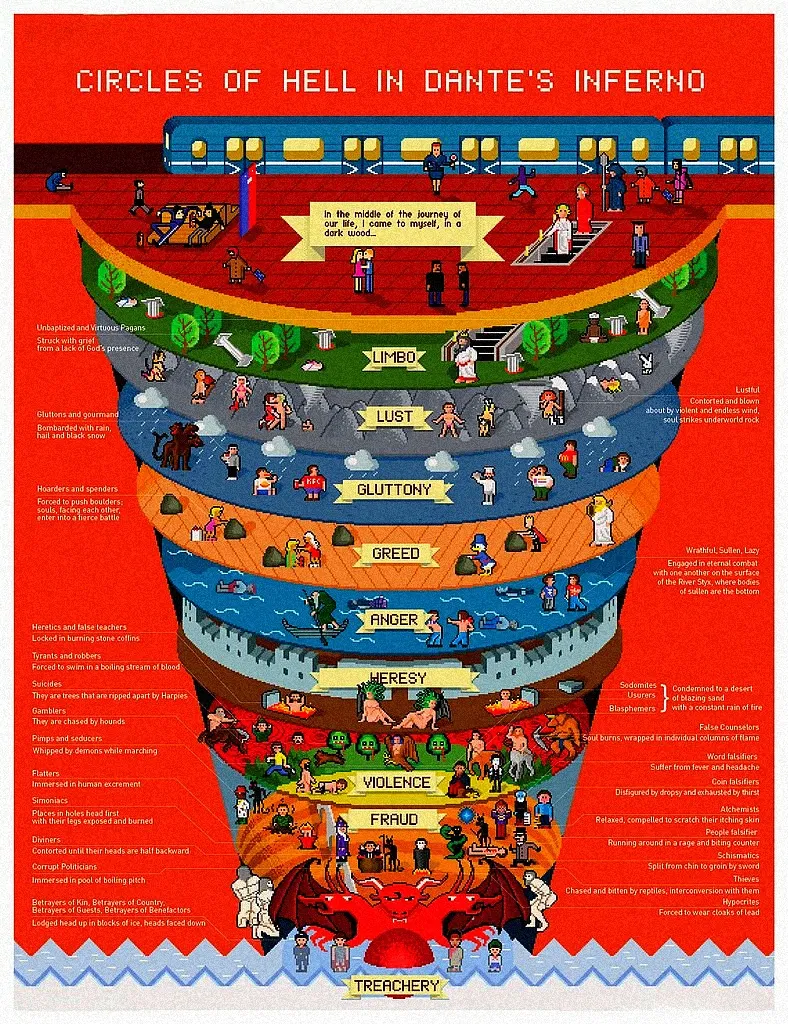
This is a schematic of how Hell is constructed. As we said, the first circle of Hell is called Limbo. In Limbo, it's kind of nice. It's like here, but people live forever. These people did nothing wrong, but they were born before the time of Jesus, and therefore, people were not aware of God. These people include Julius Caesar and other great historical figures.
Then we go to people who have committed sin, including lust. People who committed lust, like Dido and Cleopatra, are stuck in a whirlwind, swept by the wind. This is a very appropriate punishment for lust, because lust means you are swept away by emotions. You cannot control your emotions. Their punishment in Hell is just being whipped around in a whirlwind. The purpose of Hell is to force you to engage in reflection.
Remember, the universe is governed by free will. People are in Hell not because they did something wrong, but because they choose to be there, because they thought they deserved to be there. Every punishment is constructed in a way that forces people to see the errors of their ways and to want to reform. But you don't have to.
Then you have gluttony, which is basically overindulgence. You want too much. The punishment for gluttony is a rain that never stops. That's a pretty fitting punishment for gluttony, where you like food and don't want to stop. It's almost like rain falling on you that can never stop. Again, the purpose is to force you to see the error of your ways, to see the limitations of your sin, and to want to reform.
These are sins that only impact you. Now, we get to the sins that impact others. Here it's violence, then you go to fraud, and the very worst is treachery.
The Worst Sin: Treachery
I want to talk about the two bottom circles of Hell: traitors to guests and friends, and traitors to God. Treachery is a really important concept in The Divine Comedy because it is the worst way to condemn people away from God. Dante says that there are four different types of treachery, and each is worse than the other.
The first type of betrayal is when you betray your family. For Dante, this is actually the least problematic of all betrayals because you're born into a family. You don't actually choose to be part of a family; it's involuntary. As such, when we betray someone in our family, it's bad, but it's not as bad as if you choose to go into a bond with someone and then betray that person.
That's why traitors to guests and friends are worse, because these are bonds created by free will and trust. You're destroying the person's capacity to trust other people, which destroys that person's capacity to love other people.
The example that Dante uses is Count Ugolino. He's a real person. Remember how Dante was participating in political wars in Italy? From his perspective, the worst culprit was Count Ugolino, who was the head of Pisa. He comes from a prominent family and is power-crazy. He betrays everyone to obtain power. Finally, he was betrayed by one of his friends, an archbishop. This archbishop betrays Count Ugolino and throws him in prison along with his children. He throws away the key so that they starve to death together.
When Dante and Virgil encounter Count Ugolino, he is biting the head of the archbishop. They're stuck in a frozen lake, which represents all of eternity and the incapacity to change. This happens over and over. If you think about it, this is an analogy to Achilles mutilating the body of Hector. In the Iliad, Achilles kills Hector and then, instead of returning the body for ransom, spends all his time mutilating it. Achilles feels guilt and sorrow for the loss of his friend Patroclus and takes it out on Hector.
The same dynamic is happening here, where Count Ugolino blames the archbishop for the death of his family. But in his heart, he knows it's not the archbishop who killed his children. It was he himself who condemned his children because he constantly engaged in the pursuit of power. When you engage in the pursuit of power, you move away from love. You lose the capacity to love your children, and so you condemn your children to Hell and to death. It's this self-hatred that drives his hatred of the archbishop. It's a very similar dynamic as the Iliad. What Homer and Dante both say is that betraying others condemns you to betraying everyone, including your own children. That makes you hate yourself so much that you burn with self-hatred for all of eternity. You are now the most imprisoned in Hell because of your self-hatred.
The Story of Count Ugolino
The story is told by Count Ugolino to Dante, who asks him, "Why are you here?" He's stuck in prison with his four young sons, and they've thrown away the key.
They were awake by now, and the hour drew near
at which our food was usually brought,
and each, because of what he’d dreamed, was anxious.
Below, I heard them nailing up the door
of that appalling tower; without a word,
I looked into the faces of my sons.
I did not weep; within, I turned to stone.
They wept; and my poor little Anselm said:
“Father, you look so…What is wrong with you?”
At that I shed no tears and, all day long
and through the night that followed, did not answer
until another sun had touched the world.
As soon as a thin ray had made its way
into that sorry prison, and I saw,
reflected in four faces, my own gaze,
out of my grief, I bit at both my hands;
and they, who thought I’d done that out of hunger,
immediately rose and told me: “Father,
it would be far less painful for us if
you ate of us; for you clothed us in this
sad flesh—it is for you to strip it off.”
The count is hungry and knows he's at fault for condemning his entire family to death, but he cannot bring himself to admit this. He becomes anxious and starts biting himself. His sons see this, feel pity for him, and say, "Are you hungry?" He can't answer. So they basically say to him, "It's better for you to eat us than for us to see you starve."
The sons are demonstrating a last act of love for their father. But because the man has betrayed so many people, he can only see the world in terms of betrayal. He doesn't recognize this act of love. He's confused by it and desperate to feed himself, so he actually eats his sons. It is implied that this is a metaphor for what betrayal is. When you betray someone, you're cannibalizing that person's soul and the souls of everyone around you.
That's why treachery is so devastating: it blinds you to the possibility of love. It denies you the possibility of love and lets you commit the most evil acts because you refuse to believe that love exists.
The Center of Hell
Now we are at the very bottom, the very center of Hell. This is the place for the worst people. There are four people here: Satan (Lucifer), the angel who betrayed God, and three individuals he is biting and chewing on. One is Judas Iscariot, who betrayed Jesus. That makes sense. The other two don't actually make any sense: they are Cassius and Brutus.
“The king of Hell’s domain is closing on us,”
my master said, “and therefore, keep your eyes
ahead, to see if you can make him out.”
Just as, when night falls on our hemisphere
or when a heavy fog is blowing thick,
a windmill seems to wheel when seen far off,
so then I seemed to see that sort of structure;
and next, because the wind was strong, I shrank
behind my guide: there was no other shelter.
And now—with fear I set it down in meter—
I was where all the shades were fully covered,
but visible as wisps of straw in glass.
Some lie flat and others stand erect,
one on his head and one upon his soles;
and some bend face to feet, just like a bow.
But after we had made our way ahead,
my master felt that he should have me see
that creature who was once a handsome presence.
He stepped aside and made me stop and said:
“Look, here is Dis, and this is the place where you
will have to arm yourself with fortitude.”
When they meet Dis, they discover that he is mechanical. He's a machine. He doesn't have ideas, words, free will, or desire. This is what happens when you fully remove yourself from God: you lose the capacity to be organic. You become a machine. He is always flapping his wings, and these wings kick up the winds of the frozen lake, basically making Hell cooler. But this lacks agency, ideas—everything. It's just a machine.
This Satan has three heads, and in each mouth, he is biting a person. The first is, of course, Judas Iscariot. But you also have Brutus and Cassius, the ones who betrayed Julius Caesar. If we extend the logic, you would say, "Okay, if Jesus was betrayed by Judas Iscariot and Jesus is God, and Brutus and Cassius betrayed Julius Caesar, therefore Julius Caesar should be God as well." Therefore, Julius Caesar should be in Heaven. But he's not in Heaven; he's in Limbo. This makes no sense.
This is a paradox. Dante does this a lot, creating these paradoxes for you to think that maybe everything you're seeing is not real. Maybe this reality is being created for you by a stronger power. The question then is, who would think of putting Brutus and Cassius into Hell? That person, of course, would be Virgil. This gives us another clue that maybe it's Virgil who's the master of Hell and not Lucifer. Lucifer has no agency or imagination; he's just a machine. Virgil is the one navigating and negotiating Hell, and maybe he wants to put Brutus and Cassius there because Virgil's master was Augustus Caesar. Augustus Caesar's father was Julius Caesar, and in fact, Augustus made Julius Caesar a god of his time. If you just assume this logically, it doesn't make any sense if we think that everything is as it seems.
The Paradox of Purgatory
They're going to climb Lucifer and escape Hell. Now they're in Purgatory. Purgatory is a mountain, and they're going to climb it so that they can ultimately ascend to Heaven. But on the shores of Purgatory, they meet its guardian. This guardian is named Cato.
Who is Cato? Cato, along with Brutus and Cassius, opposed Julius Caesar when he was amassing power for himself in Rome. Cato chose to kill himself rather than submit to Julius Caesar. But this makes no sense for several reasons.
First, Cato was born before Jesus. Virgil told us that if you're born before Jesus, the best place you can hope for is Limbo. But Cato is in Purgatory, which is better than Hell. Not only that, but he's the master and guardian of Purgatory.
Second, he killed himself. This is a sin. He should be in Hell for that. Why is he in Purgatory?
Third, he opposed Caesar. Cassius and Brutus also opposed Caesar, and they are in the center of Hell.
Again, this is a paradox, and it forces us to think about what's really going on here.
I saw a solitary patriarch near me,
his aspect worthy of such reverence
that even son to father owes no more.
His beard was long and mixed with white, as were
the hairs upon his head; and his hair spread
down to his chest in a divided tress.
The rays of the four holy stars so framed
his face with light that, in my sight, he seemed
like one who is confronted by the sun.
“Who are you two who, counter to the blind
stream, have escaped the eternal prison?” he said,
moving those venerable plumes. “Who was
your guide? What served you both as lantern when,
from the deep night that will always keep
the hellish valley dark, you were set free?
The laws of the abyss—have they been broken?
Or has a new decree been changed in Heaven,
that you, though damned, may touch my rocky slopes?”
This is Cato. He sees Dante and Virgil and says, "What are you guys doing here? This goes against the laws of the universe. You should not be able to break free of Hell."
My guide then took a firm hold of me and,
by way of words and hands and other signs,
he made my knees and brow show reverence.
Then he replied: “I do not come through my
own self. There was a lady sent from Heaven;
her pleas led me to help and guide this man.
But since your will would have a far more full
and accurate account of our condition,
my will cannot withhold what you request.
This man has yet to see his final evening;
but, through his folly, little time was left
before he did—he was so close to it.
As I have told you, I was sent to him
for his deliverance; the only road
I could have taken was the road I took.
I showed him all the people of perdition;
now I intend to show to him those spirits
who, in your care, are bent on expiation.
To tell you how I led him would take long;
it is a power descending from above
that helped me guide him here to see and hear you.
What's happening here is Virgil steps up to explain. What's interesting is that Cato and Virgil know each other. They were born and lived around the same time in Rome, and they were in Limbo together. They know each other really well, but Virgil is being very polite, almost afraid of Cato.
Now may it please you to approve his coming:
he goes in search of liberty—so precious,
as he who gives his life for it must know.
You know it—who, in Utica, found death
for freedom was not bitter, when you left
the garb that will be bright on the great day.
Eternal edicts are not broken for us;
this man’s alive, and I’m not bound by Minos;
but I am from the circle where the chaste
eyes of your Marcia are; and she still prays
to you, o holy breast, to keep her as
your own. For her love, then, incline to us.
Allow our journey through your seven realms.
I shall give thanks for you to her—if you
would let your name be mentioned there below.”
This is really interesting. Virgil is being very subtle. He's saying to Cato, "Listen, your wife Marcia is still in Limbo with me. If you treat us well here, I'll go back to Limbo and treat Marcia really nice." It's almost like a bribe, a small threat to Cato.
“While I was there, within the other world,
Marcia so pleased my eyes,” he then replied,
“each kindness she required, I satisfied.
Now that she dwells beyond the evil river,
she has no power to move me any longer;
such was the law decreed when I was freed.
But if a lady come from Heaven urges
and helps you, as you say, there is no need
of flattery; it is enough, indeed,
to ask me for her sake. Go, then; but first,
wind a smooth rush around his waist and bathe
his face, to wash away all of Hell’s stains;
for it would not be seemly to approach,
with eyes still dimmed by any mists, the first
custodian angel, one from Paradise.
This solitary island, all around
its very base—there where the breakers pound—
bears rushes on the soft and muddy ground.
There is no other plant that lives below—
no plant with leaves or plant that, as it grows,
hardens—it breaks beneath the waves’ harsh blows.
That done, do not return by this same path;
the sun, which rises now, will show you how
this hillside can be climbed more easily.”
With that, he vanished; and without a word,
I rose and drew in closer to my guide,
and it was on him that I set my eyes.
Cato is saying that before, he was in Limbo with Virgil and his wife Marcia. But remember, Virgil told us that if you're born before the time of Jesus, you're stuck in Limbo. The only exceptions were glorious figures from the biblical tradition, like Abraham and David, whom Jesus took to Heaven. But Cato is saying that while he's not a Christian and he killed himself, he was with them in Limbo but was able to ascend to Purgatory while his wife Marcia was left behind. This is a paradox.
He says, "Before, I loved Marcia. But after I was freed and escaped Limbo, I no longer love her." This is strange, because I already told you that love is about giving to other people. If Cato really loved Marcia, he should be scheming how to bring her to Purgatory.
But this is where Dante is different, because the most important thing is free will. If you truly love someone, you let that person choose. You don't force that person to do anything against his or her free will. Cato is saying, "I chose to come to Purgatory because I willed it. I desired it. Therefore, God let me come. I was able to find the will and desire to self-reflect, to forgive myself, and to come to Purgatory. Marcia did not, but I cannot make her self-reflect. She has to choose to do so on her own. As long as she's there, I have to let her be there. My love for her won't change anything, so I choose to focus on other things." It does you no good to force anyone to do anything. That's not what love is.
So, they are now in Purgatory. Cato says that Purgatory is a mountain they have to climb to reach Heaven.
This is a journey undertaken by Dante into the cosmos, and he's taking us with him. What's really interesting about Dante is that he appreciates that for us to understand, we first have to misunderstand. It's misunderstanding that leads to understanding. We have to correct ourselves to fully understand the truth. He also believes that for us to be virtuous, we first must sin. It's okay to sin because it allows us to recognize our limitations and then makes us much more virtuous. It's this process that drives the imagination.
If you want to understand, you first have to misunderstand. If you want to be virtuous, you must first sin.