Game Theory #22: Twilight of the Nation-State
There is a ceasefire now between Iran and the United States, but most analysts expect that this war will resume in a week, two weeks, or a month. It will resume because it is impossible for the United States and Iran to come to a mutually beneficial and satisfying arrangement. Today, I want to look at how this war will evolve. My argument is that this US-Iran war is really the first war of the 21st century.
To explain, I want to look at how warfare has evolved these past few hundred years. The simplest way to fight a war was to destroy a state's capacity to fight by killing as many soldiers as possible. You would arrange to fight the enemy on a battlefield; whoever won this battle would win the war. That was how wars were traditionally fought for hundreds of years.
But in the 20th century, something happened: the nation-state developed the capacity to field millions of people. The state could always replenish its forces on the battlefield. So, you now had to destroy the state's capacity to produce and manufacture. The point shifted from killing as many soldiers as possible to killing as many civilians as possible, which was the strategy in 20th-century warfare, mainly World War II.
In the 21st century, it's different. We have nuclear weapons, and there are too many people. It is impossible for you to kill everyone, and if you use nuclear weapons, others will use them on you. So now, in the 21st century, the goal is to use the population against the state—to turn civilians against their government by sowing as much discord and dissent as possible within society. You do that through economic sabotage and economic strangulation. That's the argument I will make today.
The Nation-State and the Population Explosion
The first thing I want to look at is why we have 8 billion people living on this planet. For most of us, we think this is a tremendous achievement. But if you think about it, it's not that nice because there aren't that many resources or that much space to share. In fact, if it were not for fertilizers, we would only be able to support one to two billion people. So, how did we get to a stage where there are 8 billion people in this world, and most of us are not very happy with the state of affairs?
Scientists will tell you it's because of the scientific revolution—this revolution in technology and understanding that allowed us to progress. That's not true. The real reason is because of the nation-state, a revolution in politics that came to us from the French Revolution.
The main architect of the French Revolution was Jean-Jacques Rousseau. He was not French; he was actually Swiss. But he's important because he developed a theory that underpinned the French Revolution called social contract theory.
Before Rousseau, we didn't really think about the individual's relationship with the state. You were born into a community and just did what tradition, custom, and family asked you to do. But Rousseau was the first to say, "No, we are born free because God gave us freedom. So why do we choose to surrender our freedom to join a community?" His theory is that we join society to become more free.
By ourselves, we are limited. But together, all of us create something called a common will. Think of this as simple democracy. Democracy is basically the idea that to make a decision, we just vote, and whatever the majority is, wins. For example, if three of us are debating whether to go to McDonald's or Pizza Hut, and two of you say Pizza Hut, we go to Pizza Hut. For Rousseau, this is not a good system because we should strive to be higher than we are; we should strive for total freedom.
That's the idea of the general will. The common will is who we are. The general will is who we could be if we came together as a people. The best way to understand the general will is through Kant's theory of the categorical imperative, which for him is the highest moral law.
What makes us truly human and allows us to achieve our ideal state are three principles:
- The Principle of Universality: Imagine that all your actions will be reflected throughout the universe. If you smile, everyone smiles at once. If you get angry, everyone gets angry at once. You ask yourself, "What sort of society do I want to live in? One where everyone is smiling or angry?" That's how you should behave.
- The Idea of Free Will: No one can compel you to smile. You must smile out of your own free choice. Even though smiling makes you feel happy, if I make you smile, that goes against the good of humanity.
- The Idea of Humans as an End: I can never sacrifice another human being to achieve a better society because we are the ultimate end.
Together, the categorical imperative gives us the theory of the general will. So, even though we all vote to eat ice cream, we shouldn't, because that's not how we achieve enlightenment or the ideal state. We should think about Kant's categorical imperative.
From the general will, which is the sovereign—this is the highest law, this is God, basically—we derive the state and the government. The state makes us into citizens, and then we have laws, culture, and education. For Rousseau, this is the social contract, the ideal state. The French Revolution started because many intellectuals and revolutionaries wanted to achieve this social contract.
As you can appreciate, many disagreed with this theory, especially monarchs. The idea here is that the general will—the people—are the sovereign. But in a monarchy, the monarch is sovereign. It's a debate over who is sovereign. At this time in history, most countries in Europe were monarchies, so they saw the French Revolution as a direct threat and invaded France many times.
But then something really weird happened. These professional armies would go into France and fight against citizens—people with no military experience, who were not professional soldiers—and they were losing to these citizen armies. The question is, why was this happening?
The reason is that this theory is so powerful that it makes people willing to fight and die for it. During the French Revolution, you had the monarchies with their professional armies, which were basically mercenaries. The thing about mercenaries is they don't want to die; they're collecting a paycheck. Their point is to intimidate and scare, not to die. But then you had the French Revolution, and they were citizens who were willing to fight and die.
That's why France became the most powerful nation in Europe at this time. They could call on an almost unlimited number of their citizens to fight and die. In contrast, other countries like Prussia, Russia, and Austria had professional soldiers who were afraid to die; all they wanted was their paycheck. Over time, the French were overwhelming the other Europeans, and this created the French Empire.
Once these places were conquered, they developed their own theory of how to defeat the French. They recognized that they also needed a theory of nationalism, a theory of the nation-state. But they didn't like the social contract theory, so they came up with a new theory based on the nation, which was defined by language, culture, and race. This becomes Germany, or what we call iron and blood.
Now you have these theories of nationalism spreading into Europe, and these nations become invincible because they can call on their citizens to fight and die. This is why Europe became the most powerful region of the world starting in the 19th century. But of course, the problem with nationalism—the problem with populations that want to fight and die—is that they keep on fighting wars. To solve this, all these nations focused on trying to grow their population as fast and as much as possible. This is what led to the massive population growth.
But with more people, these wars became deadlier and deadlier, culminating in World War II. By the end of World War II, Europe had exhausted itself. Too many people had died, and their civilization was destroyed. This allowed America to come into power.
The American Model: The Nation-State as a Game
America had a different theory of the nation-state. The French theory was the social contract. The German theory was iron and blood—race. The Americans had a different theory because America was a multicultural nation of immigrants trying to colonize North America. For them, their theory was to create a game. The nation-state becomes a game.
The Constitution and the government are the game masters. They will allow anyone to come to America and get rich as long as they work hard. This will create the greatest nation in the world. This becomes a game where anyone can play. In fact, the more players you have, the wealthier America becomes.
After World War II, America spread this game throughout the world as much as they could, to Europe and Japan. But there were still communist countries like China and the Soviet Union that did not want to participate in this game; they had their own. After the collapse of the Soviet Union, this game conquered the world. You had globalization.
The problem is this: once this game keeps on going, eventually what happens is that only a few players achieve all the wealth. You have massive inequality, and everyone else falls into debt. That's the world we live in today. America created this game, it was very successful in creating tremendous wealth, and they tried to have as many players as possible—that's why you have the population boom. But now, only a few people have all the wealth, and everyone else is in debt. In other words, these people are useless, and therefore we need to reset the game.
The way to reset the game, of course, is to destroy the game in the first place. Therefore, have World War III, burn everything down, and start the game over again. That's why we are in the situation we are in today.
Now, I'm going to go over some of the major ideas that allowed for this system to come into being. First, I want to look at the social contract by Jean-Jacques Rousseau. This is from his book, The Social Contract. Rousseau is arguing against slavery. Before, it was understood that slavery was a good system as long as the master was nice to the slave. Rousseau says no, that cannot be true. Under no circumstance can a slave ever be happy. He explains why:
To renounce liberty is to renounce being a man, to surrender the rights of humanity and even its duties. For him who renounces everything no indemnity is possible. Such a renunciation is incompatible with man’s nature; to remove all liberty from his will is to remove all morality from his acts. Finally, it is an empty and contradictory convention that sets up, on the one side, absolute authority, and, on the other, unlimited obedience. Is it not clear that there is no binding obligation on us towards a person from whom we have the right to exact everything? And does not this single condition, without equivalent or exchange, in itself involve the nullity of the act? For what right can my slave have against me, when all that he has belongs to me, and, his right being mine, this right of mine against myself is a phrase devoid of meaning?
The argument is this: Our freedom is given to us by God. Our freedom is what connects us to God, so it cannot be surrendered. If we surrender our freedom, or if someone takes it away from us, that is surrendering our humanity and breaking our connection to God. Therefore, it is better to die than be a slave. That was their thinking during the French Revolution. You have all these citizens with absolutely no experience with firearms, but they were running into cannon fire against professional soldiers because they believed, "Give me liberty or give me death." Without liberty, they were nothing. This is a really important concept.
I am continually astonished that such a simple sign of good government isn't recognized—or perhaps men do recognize it but aren't honest enough to say so. What is the purpose of any political association? The preservation and prosperity of its members. And what is the surest sign of their preservation and prosperity? Their number and their population growth. That's the sign you're looking for. Other things being equal, the unquestionably best government is the one under which the population increases most without external help from naturalizing foreigners or establishing colonies. The government under which the population shrinks is the worst. Over to you, calculators: count, measure, compare.
This is a really important idea. The first is that liberty is the most important value. The second is that a good government and a good society should focus on population growth, on having as many people as possible, because that's the best sign that you're thriving as a society. Because of these two ideas—population growth and liberty—the French would become the greatest empire in Europe at this time.
Of course, as I mentioned, the Germans who were being conquered by the French got upset, and their intellectuals came up with a new theory of nationalism. This is Johann Gottlieb Fichte, who is considered the father of German nationalism. His argument is that it is language that binds us as humans. For Rousseau, it's liberty that we should strive for. But for Fichte, it's language that binds us to the past and binds us together. It's language that's worth fighting for. It's race, nation, blood.
This becomes the philosophy of the German state. At this time in history, Germany was divided into many hundreds of different kingdoms. It is Otto von Bismarck of Prussia who will unify the German people into one Germany, often called the Second Reich. This is from his famous "Iron and Blood" speech:
The position of Prussia in Germany will not be determined by its liberalism but by its power... Prussia must concentrate its strength and hold it for the favorable moment, which has already come and gone several times. Since the treaties of Vienna, our frontiers have been ill-designed for a healthy body politic. Not through speeches and majority decisions will the great questions of the day be decided—that was the great mistake of 1848 and 1849—but by iron and blood.
The idea here is that as a nation-state, as a people, we must protect our freedom by going to war. It's only through war that we can survive and thrive. But how do you fight wars? You fight wars by making sure your population is taken care of.
The real grievance of the worker is the insecurity of his existence; he is not sure that he will always have work, he is not sure that he will always be healthy, and he foresees that he will one day be old and unfit to work. If he falls into poverty, even if only through a prolonged illness, he is then completely helpless, left to his own devices, and society does not currently recognize any real obligation toward him beyond the usual help for the poor, even if he has been working all the time ever so faithfully and diligently. The usual help for the poor, however, leaves a lot to be desired, especially in large cities, where it is very much worse than in the country.
Bismarck would turn Germany into the most powerful nation in the world by recognizing that it's not just soldiers who contribute to the war effort; it's your people as well. It's your people who make the machines of war—the machine guns, the artillery, the ammunition. Therefore, you have to make sure they are healthy. You don't want to send sick soldiers to a battlefield, and you don't want sick workers either. That's why he passed a lot of progressive worker reforms, including health insurance, accident insurance, old-age pensions, and protections for workers and children. He recognized that a nation-state is first and foremost about making warriors. If you want to win, you have to make sure you have as many people as possible and that everyone is contributing to the war effort. To do that, you need to make sure everyone is taken care of, including your soldiers and your workers.
It was Mussolini who basically understood that the real purpose of a nation-state is to fight wars. In fact, it is wars that give people meaning in their lives. If you create a nation-state around war, you create a mythology around the beauty of war, and then people will happily fight and die.
We have created our myth. The myth is a faith, a passion. It is not necessary for it to be a reality. It is a reality in the sense that it is a stimulus, is hope, is faith, is courage. Our myth is the nation, our myth is the greatness of the nation! And to this myth, this greatness, which we want to translate into a total reality, we subordinate everything else.
This is the peak of the nation-state. During World War II, they had to fight a war to destroy the entire society because the soldiers were not a mercenary army like in the past. The soldiers were coming from the population itself. So in World War II, the Allies won not because they were democratic or morally superior or had better strategy. It was because they could destroy the productive capacity of their enemies, but their enemies could not destroy the productive capacity of their nation-states.
America's factories were fine. The Soviet Union's factories were removed into Siberia, far away from the Germans. The Germans and the Japanese, however, could be firebombed.
From 1940 to 1945, the British and Americans firebombed Germany. The entire city of Dresden was destroyed. In World War II, they recognized there was no point in killing soldiers on the battlefield because they'll just send in more soldiers with more weapons. You need to destroy the civilian population. That's how you win the war.
Japan was much worse. At least half of Japan was destroyed by the American firebombing. That's why Japan lost the war; otherwise, they would have kept on going.
- Nagoya: A city the size of Los Angeles, 40% destroyed.
- Tokyo: A city the size of New York City, 40% destroyed.
- Yokohama: 60% destroyed.
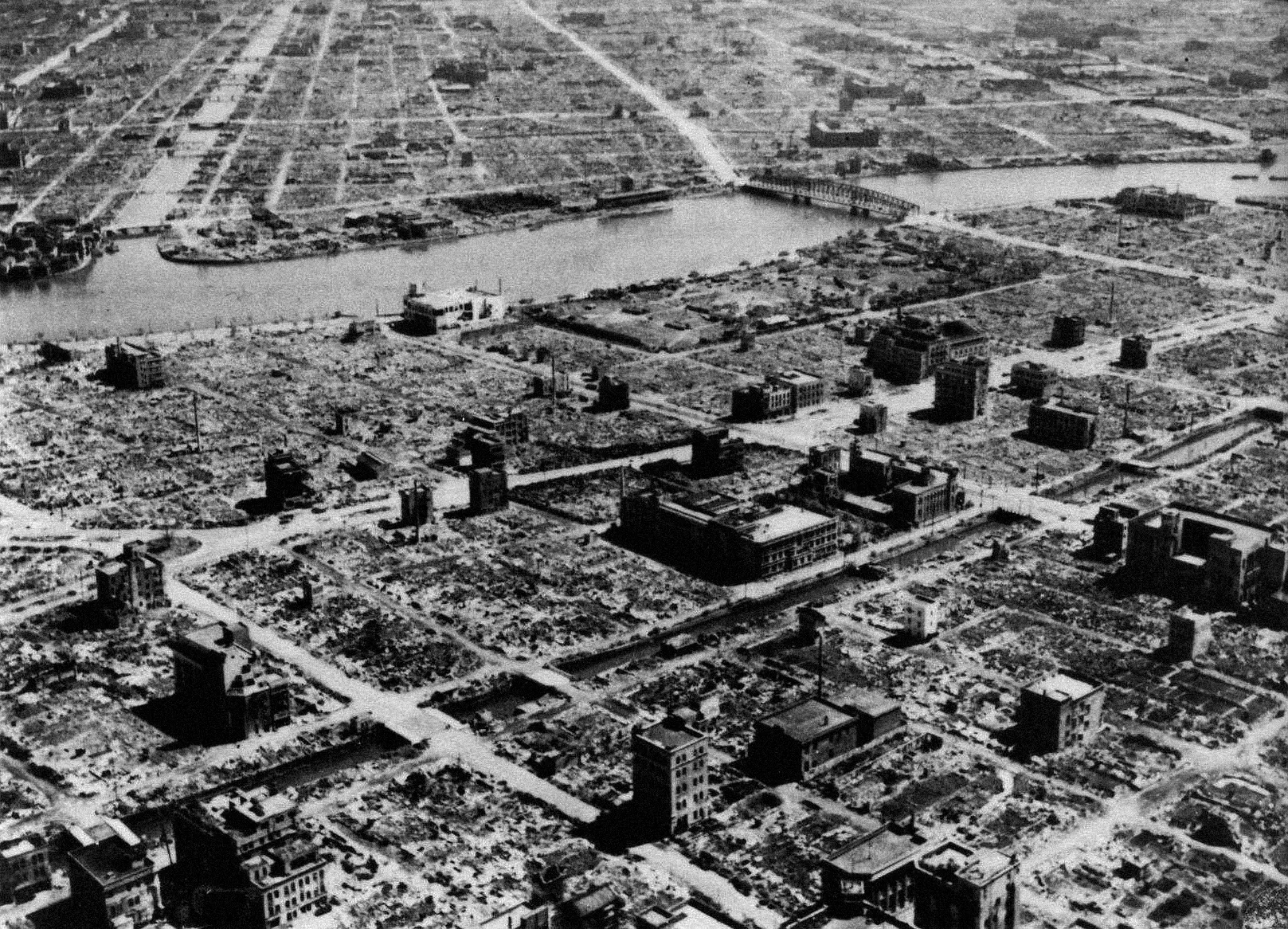
The idea of the nation was so powerful that in order to win a war, you needed to destroy the civilian population.
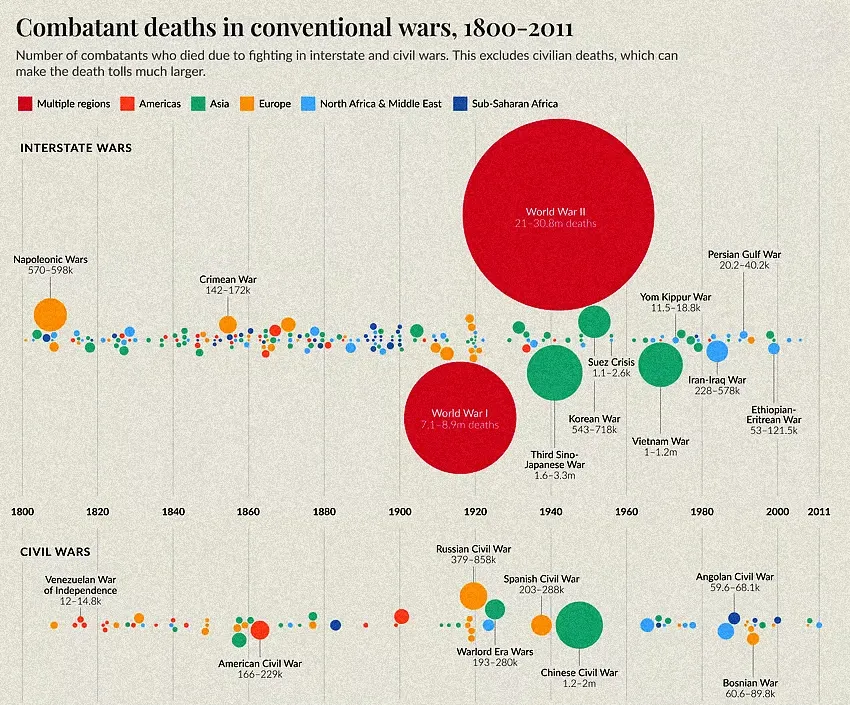
As you can see, because of the rise of the nation-state, we have to kill more and more people to fight wars. In World War II, at least 20 to 30 million more people were killed than in World War I. Depending on how you calculate, probably a lot more than that died. But what's interesting is that even though World War II was a calamity, with tens of millions dead, look at population growth. It never stopped.
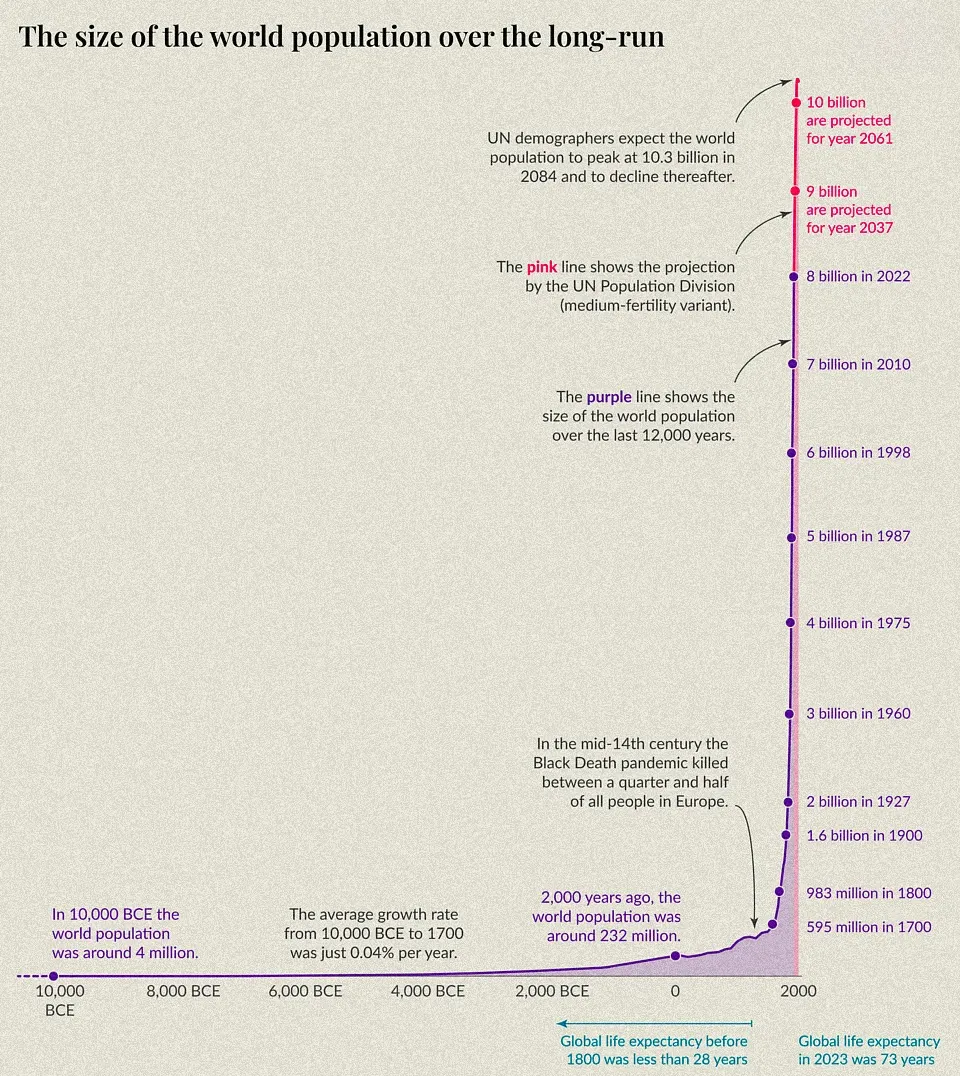
For most of human history, population growth was steady. But then starting around the year 1600, it boomed. Again, scientists will tell you this coincided with the rise of science and technology. But we've always had science and technology. What made this different was the rise of the nation-state and the recognition that to fight wars, you need more people who are willing to kill themselves for the nation. And to get them to do that, you have to treat them well. The nation-state wanted science and technology to grow the population. That's why we had medicine and sanitation. These innovations happened because the nation-state willed these things to happen.
The First 21st Century War
After the travesty and destruction of World War II, the world got together and said, "Okay, America, you're in charge now. Let's build a world in which we don't have to fight and kill each other anymore." And so, America created this game called consumer capitalism, in which we live today. This system is unique in human history, and for most of its history, it was extremely successful. It grew the population from about 2 billion to about 8 billion today. It made a lot of people more wealthy. Think of the tremendous wealth that China has generated in the past 30-40 years because of its participation in consumer capitalism.
But unfortunately, we've now reached a point where the system is off-balance. It's unstable and unsustainable. So now we're going back to war. And because there are so many people, this means that when we go back to war, at least 50% of humanity will die off in World War III.
The war in Ukraine is essentially a 19th-century war. It's almost like World War I, where you are trying to kill as many soldiers as possible.
What I will show you is that Iran will be the first 21st-century war.
In round one, America tried to use shock and awe. Shock and awe is basically where you decapitate the leadership, destroy the military, and destroy production. The idea is to come in, kill the leadership, kill the military, kill the war factories, and do it as soon as possible. But this is not working against Iran because they have prepared for this war for 20 years. Their system is decentralized.
You've killed their leaders, but they don't care because they have new leaders coming into place. The military is hidden in mountains, and the factories are also hidden in mountains. So even though the Americans have destroyed much of Iran's war-fighting capacity, Iran is still in this fight.
What's going to happen is that over the next few months, America is going to shift its strategy into a 21st-century war strategy, which will have three components:
- Economic Strangulation: I will destroy your entire economy.
- Ethnic Tension: I will try to create as much conflict as possible between the different peoples in Iran.
- Destroy Civilian Infrastructure: I want to destroy people's capacity to access water, electricity, and food—the basic necessities of life.
Why do I want to do that? Because if people cannot access these things, they get angry. If they get angry, I can channel that anger against the government because it's easier for them to attack their government than it is to attack the US military, which is the one destroying all this infrastructure.
This is what a 21st-century war strategy looks like, and this is what the Americans will deploy in Iran over the next few months. Why haven't they done this before? Because these are war crimes. There are lots of treaties, like the Geneva Convention, that prohibit you from fighting wars this way. But as the Americans become more desperate and as they continue to lose this war, they'll be like, "Screw this. I'm going to win this war no matter what it takes."
Let me show you how this war will be fought. Right now, they're trying to target weapons and military bases. That doesn't get you anywhere. You need to better use your weapon systems because you don't have enough munitions to destroy the entire Iranian military. So, you have to be strategic. You target things that have a huge impact on the civilian population as well as the economy.
The most basic thing is water, the dams and reservoirs around Iran. I don't destroy all of them, but I strategically destroy some of them. This is going to create a lot of pressure on the civilian population. They'll be very angry and might protest against the government.
Also, transportation networks, the roads and railways. This is important because Tehran is a city of 10 million people, and they do not grow their own food. They require food to come from the countryside. If I attack the roads leading to Tehran, if I attack strategic hubs, then it's very hard for food to move from place to place. I don't have to destroy the entire food supply—I can't do that, I don't have the weapons—but I'm being strategic about it. I'm putting a strain on Tehran's capacity to feed its own population.
Then there are power plants and it's really easy to destroy them.
The rules of engagement require me to only attack soldiers and weapons, but eventually, I'm going to run out of munitions if I keep doing that, and it's not going to destroy Iran's capacity to fight. They won't surrender. So now I need to be more strategic with how I use my bombs. I want to create as much damage as possible. The best way to do that is by targeting key infrastructure: power plants, desalination plants, roads, railway networks. I can't destroy all of them, but I can create as much havoc as possible over time, so the civilian population gets very angry.
My best weapon in this war is no longer my planes and my aircraft carriers. My best weapon is the Iranian people themselves. And that's what a 21st-century war looks like. It's very slow. It's very methodical. It's pretty evil.
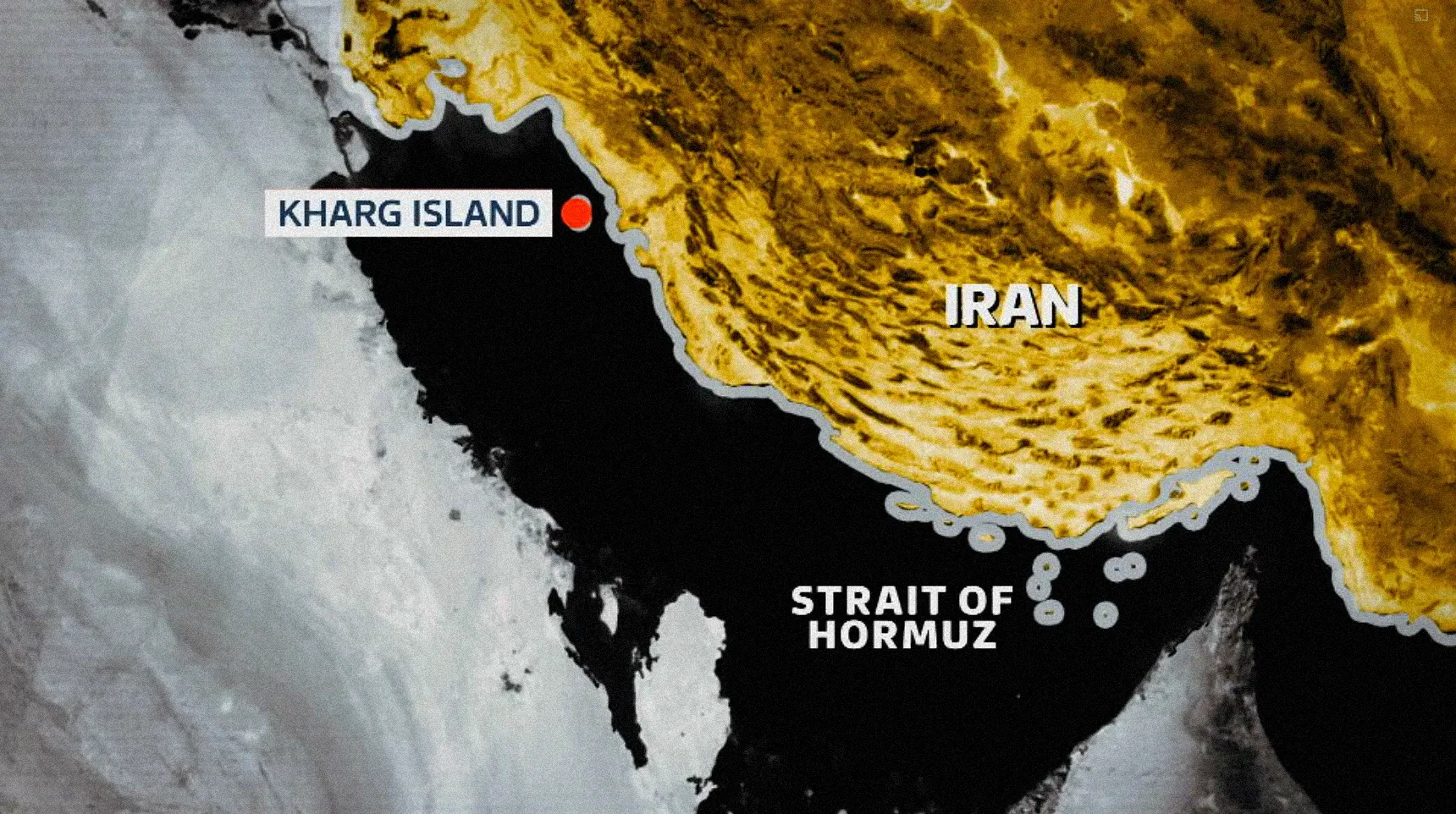
The other thing is economic strangulation. There are two ways for Iran to generate income to finance this war. The first is to sell oil. This is Kharg Island, which is their main oil depot. 90% of Iranian oil goes from Kharg Island elsewhere, primarily to China. So what the Americans have done is impose a blockade, stopping oil exports.
The other thing is that right now, Iran controls the Strait of Hormuz and they collect tolls on it. So I basically need to destroy Iran's control over the Strait. The way I do that is I use ground forces. I can seize Qeshm Island, seize Kharg Island, seize the coastline, and force the Iranians to respond to my attacks.
I can also position forces in the northwest and southeast of Iran. Why? Because these areas are home to minorities. When I put my soldiers here, this is going to encourage the local population to rise up against the Iranian state. Now, Iran will have to send forces to respond to all these ethnic insurgencies around the country. Before, Iran could just focus its resources on controlling the Strait. Now, I'm going to expand the battlefield so that Iran is forced to deal with multiple threats at the same time. I'm going to collapse their economy.
This is what a 21st-century war looks like. It's slow. You focus on strangulation as opposed to a knockout punch.
Weather Warfare and Color Revolutions
The Americans have been doing this for a long time, but more subtly. In 2012, the Iranian president, Mahmoud Ahmadinejad, accused the Americans of conducting weather warfare against Iran, mainly by creating droughts. How do you do that? It's cloud seeding. The idea is that you shoot up a chemical called silver iodide into clouds, forcing it to rain. When you do that, the clouds dissipate the rain elsewhere, and they don't go to Iran. In 2019, there was a real fear that Iran would suffer from a long-term drought, while regions like Dubai—which Iranians claim to be the source of this weather warfare—experienced floods. I don't know how the science works, and this is all rumors, but it does make sense that the Americans would use weather warfare against Iran, forcing rain to come down in Dubai to deny rain to the Iranians.
There's a conspiracy theory that world governments are conducting weather warfare using something called HAARP. Now, HAARP was originally designed to study the atmosphere, but some conspiracy theorists claim that HAARP can be used to create extreme weather, including hurricanes, cyclones, flooding, and droughts. I don't know. I'm just pointing this out. What we do know is that in 1962, Lyndon Johnson, who became president of the United States, had a very famous quote in a speech: "He who controls the weather will control the world." The future of warfare is not about weapons; it's about weather.
We know that from 1967 to 1972, the Americans created Operation Popeye. This was during the Vietnam War. What the Americans did was they seeded the clouds so that the monsoon season would be a lot longer in Vietnam. Why? Because then it's harder for the Vietnamese to resupply themselves. It makes it harder for them to fight because the Vietnamese were living in tunnels, whereas the Americans were attacking from the air. This is pretty well known. The debate is how effective the technology is, how powerful it is, and how scalable it is.
We're already seeing elements of 21st-century warfare being implemented around the world. Look at Cuba. There's now an oil embargo on Cuba, and so they're having blackouts. The intention is not to kill civilians or to fight a war. The intention is to strangle a nation so that eventually the population wants to overthrow the government. And already, we're seeing lots of accidents around the world that are destroying the world's oil supply. But there's one region in the world that doesn't really care about the loss of refineries and oil supply, and that's North America, because it is extremely wealthy. If the rest of the world is facing energy and food scarcity, it's going to have to beg North America for resources. This allows the Americans to better control the world.
Another thing I will point out is that the Americans are very good at overthrowing governments. There's something called the color revolution playbook. What the Americans do is they invite young people from different nations to come to America to learn about democracy, how to organize protest movements, and how to overthrow their government to promote democracy. The Americans will also finance NGOs in different countries to create youth movements. The Americans will also control social media to galvanize a population and foment unrest.
We saw this play out most recently last year in Nepal when young people overthrew the government. In Nepal, most people don't speak or read English. So, why are these young people holding up signs in English that say, "OK, Boomer, Time's Up"? "OK, Boomer" is an American phrase, not a Nepalese phrase. They're doing this not to have an impact locally in Nepal; they're doing this because someone's paying them to do this. It's being funded by Washington. Washington is like, "Okay, I'll pay you this amount of money if you hold up a slogan so I can show my boss that this protest is working." Here's another sign: "We Pay You Flex Enough." Another English sign. They're doing it for Washington, not for their own country.
This is very common in the world today, where these protests are being orchestrated by Washington for Washington, as opposed to being organic. In 2010-2012, you had the Arab Spring protests happen all around the Middle East. We know that social media—basically Twitter and Facebook—were instrumental in organizing people and promoting unrest in these places. These are all called color revolutions.
So not only does America have the capacity to strangle a nation's economy and force the population to beg for mercy, but they also have strategies on how to overthrow the government using the local population. Basically by controlling social media, organizing young people, paying them to protest, and bribing security services to not intervene. It's a very successful playbook.
America can use this playbook against every country that opposes it. The main reason is because America controls the world's choke points, including the Strait of Malacca, the Panama Canal, and the Strait of Gibraltar. Even though the Iranians control the Strait of Hormuz, the Americans can have aircraft carriers in the Indian Ocean and blockade the Iranians. This is important because a lot of people believe that what America really wants to do is destroy China. Right now, a lot of the Chinese economy depends on exports. If you can't export, your economy can suffer a great deal. When your economy suffers, you lose GDP, you have unemployment, and it's possible that you have protests happening in China because of the collapse of the economy.
That is what a 21st-century war looks like. You don't send troops, you don't destroy. You strangle a people to death and force them to rise up against their own nation-state.
The concluding message is this: to fight a 21st-century war, it's really about population management. Your enemy is trying to provoke your population into unrest to destroy you. So you have to respond by managing your population better. That can often mean culling your population, which just means killing them. Killing them could mean you deny them food and create a famine. It could mean you spread diseases. It could mean you actually go and shoot them. This forces you to use an AI surveillance state, because the best way to control your population is with an AI surveillance state. That's the future we're looking at. It is just the inevitability of history. We have too many people, we want to fight wars, and so a lot of people have to die.
How Can a Nation Respond to 21st Century Warfare?
When the Americans destroy your economy, destroy your infrastructure, and divide and conquer, according to game theory, there's only one proper response. This idea is eschatology.
You need to create fanaticism among your people. Your people are suffering. They don't have enough to eat. They don't have any hope for the future. So what you say to them is, "This is all part of God's plan. We're meant to suffer because when we suffer, God will make us invincible. Through our suffering, we'll find the courage to commit martyrdom. When we commit martyrdom, we go to heaven."
The problem with this is that most people don't want to do this. They're like, "No, I don't want to kill myself. I don't want to die for God. I just want to live a normal life." But unfortunately, what history tells us is that you really don't need that many people to commit to eschatology to win a war—maybe at most 10 to 20 percent. If 10 to 20% of your population commits to this, you will survive.
We have an example of this: the Iran-Iraq War in the 1980s, an eight-year war. It was a crazy war. The Iraqis were supported by both the Americans and the Soviet Union. They had tanks, helicopters, and a professional army. The Iranians in the 1980s didn't have an army, tanks, or helicopters. So what they said to people is, "The greatest glory is to be a martyr. The greatest glory is to die for your nation and for God." So all these young people went into battle with just a rifle. Imagine this: you have a 16-year-old boy running into battle against a tank and a helicopter, and he's screaming at them, "I will kill you!"
Most of them got blown up, but some of them got through and threw a grenade into the tank. You think about this, and you're like, "Oh my god, that's crazy." But first of all, it galvanized the Iranian population into resisting, and eventually, they turned the tide of the war so that they were actually winning. It was only because the Americans started to use chemical weapons against them that the Iranians were forced back. But if left alone, the Iranians would have defeated the Iraqis.
Think about how it galvanized the population into resistance. The other thing is that it scared the hell out of the Iraqis. You're in a tank, and a guy is coming at you with a rifle and a grenade. He's not afraid of you. His fearlessness makes you afraid.
So even though 21st-century warfare seems invincible, eschatology is the counter to this approach. That's why we should see a huge surge in eschatology and religious extremism throughout the world over the next few years, because it's really the only counter to this type of warfare.