Secret History #13: Mandate of Heaven
Today we discuss the idea of civilization. First, I want to present the general understanding of how we get civilization, and then I will present an alternative.
The Traditional (Marxist) Understanding
The traditional understanding is the Marxist understanding. This is an idea proposed by Karl Marx, and it's the dominant idea. In the beginning, we were hunter-gatherers, and it was a difficult life because you could not consistently find food. Then, we discovered agriculture and farming, which allowed for a surplus of food.
Surplus just means that you have more food than you can eat. And so now you have people who don't have to work: an elite. As such, they can engage in activities that improve the well-being of everyone and which create the basis for civilization. These things include:
- Religion, which is just myths and stories.
- Arts, such as dance, music, songs, and paintings.
- Science and technology.
With these three things in place, you can now grow as a society. You can build cities. Why? Because now you can have irrigation and farming. You can direct the river flow, so you can use more farmland. You can now have a hereditary elite, so that these people can focus their entire time on innovation, on science, on progress.
Then you have writing, because only a hereditary elite has the time and the resources to learn how to write. Remember, back then writing was a very difficult activity; you had to spend your entire life learning and practicing it. And then you have the idea of money and property.
Together, these things are what we refer to as civilization.
Now, there are good things that come from civilization—religion, arts, and science. But there are also bad things as well, which include war, slavery, and debt. That is the story of civilization that you are taught in school and that most mainstream academics understand.
An Alternative Theory: Religion Before Surplus
Today, I want to propose an alternative, and I think this is a much more compelling one. The idea is this: from the very beginning, we were religious, artistic, and capable of science. We did not need an elite to do this for us; we are all capable of doing this by ourselves. The examples, of course, are the cave paintings that we discussed, as well as religious settlements like Göbekli Tepe.
As we discussed before, people come together to practice their religion, building temples and monuments. Slowly, around these temples, you have the development of farming in order to sustain these temples and practice the religion. But over time, the temple people become corrupt. Rather than being elected by the people, rather than serving the people, they become hereditary. They engage in rent-seeking, and so what people do is they just leave and build a temple somewhere else.
Throughout this time, all these temples are being built. But in certain locations, the temples can also engage in trade. Why? Because they're the meeting place of many other communities. As such, their real estate is the most valuable in the world, and it's hard for people to leave. The place just grows and grows.
As this civilization grows, the people in charge create something called a temple economy. This is just a primal form of taxation. Basically, everyone brings food to the temple, and the priest then redistributes the food amongst everyone else. That allows for public works projects, mainly irrigation, but also more temples. Because of this economy, now you need writing. You need to record how much food you have. You have to record who gets what food—the rations. You also need to record trade: how much grain you're getting from here, how many cows you're giving to over there. Then you have money.
But as this civilization develops, a strict hierarchy emerges, and the hierarchy goes against the natural order. Also, remember that people at any time can just choose to leave. So how do you make people stay where they are and just follow this order? Well, now you have to create mythology, which you then encode or write down so that it seems as though it's coming from the gods themselves.
In other words, civilization did not give us religion, arts, and science. We already had these things. We could, at any time in our history, do all these things.
Civilization is a device meant to gaslight or fool people into believing that a hierarchy is legitimate when it is not. It is meant to fool people into thinking that this hierarchical system is divinely ordained.
The problem with the traditional framework is that it assumes that we're all stupid. And if we're all stupid, it's hard to explain how we did the cave paintings or how we built Göbekli Tepe. This new understanding is that we're all capable of creativity, but eventually, because of social development, we have these large cities, and now the people in charge need to create civilization in order to justify the hierarchy.
The Four Cradles of Civilization
Having said that, let's look at the four earliest major civilizations in our history: Egypt, Mesopotamia (modern-day Iraq), the Indus Valley civilization (also referred to as the Harappan civilization, because their capital was Harappa), and of course, China.
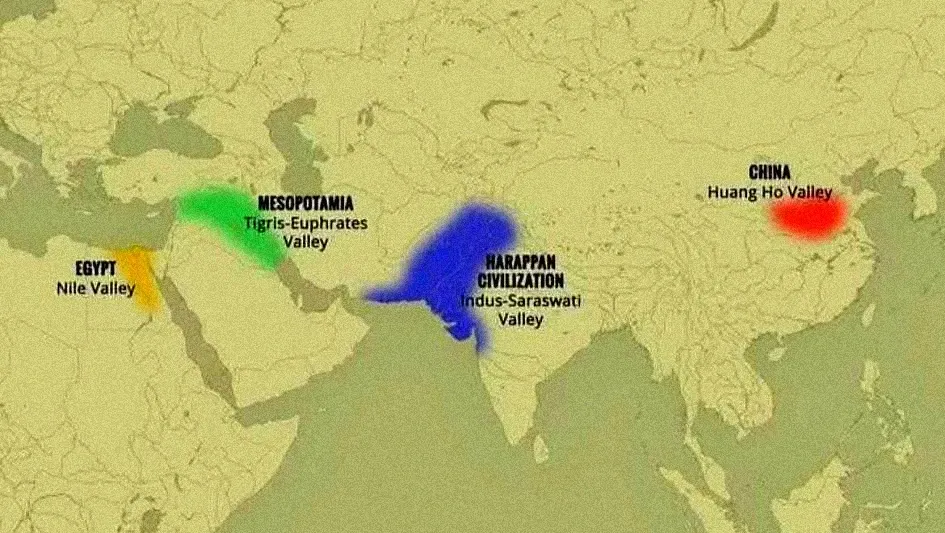
The question is, why are these four the early civilizations? They have three unique characteristics.
- Their latitude. They're actually in the same latitude. They're not too hot and they're not too cold, which makes them perfect for agriculture.
- They are by major rivers. Egypt is by the Nile. Mesopotamia has the Tigris and the Euphrates. The Indus Valley has the Indus River, and China has the Yellow River. This allows you to build a fairly large city because you can solve the water, transportation, and agriculture problems.
- They're by the sea or the ocean. This is the most important characteristic, as it allows for them to engage in trade—transportation, bringing in new goods, new people, and new ideas. Egypt has the Mediterranean as well as the Red Sea. Mesopotamia goes into the Arabian Sea, which goes into the Indian Ocean, and the Indus Valley is in the same situation. China, of course, goes into the Pacific.
Over time, because of their trade location, they're able to build very large cities. As a city becomes larger and larger, it will develop colonies upstream and downstream of the river to expand its trade reach. The priority is trade. As you can see, these areas are able to connect the entire world. Egypt is able to connect Europe, the Levant, and Africa. Mesopotamia is able to connect Anatolia and Central Asia, and the Indus Valley is able to do the same thing.
China is a special case because of the Himalayas. There was trade between China and these other parts, but not as much. So these three places—Egypt, Mesopotamia, and the Indus Valley—are what we collectively call Western civilization. You may have thought that Western civilization is just Europe and America, but that's not true. If you look at the history, these places have always been in contact with each other, and collectively they built the foundation for Western civilization.
Looking at this map, where is the most strategically located place? It's here, right in the center of global trade. This place is where human civilization began. This place is what we call Sumer. This is where writing was invented, and this is where a lot of trade happened because Sumer connects everyone to everyone else. If you're in the Indus Valley civilization and you want to get to Egypt, you have to first transport your goods to Sumer, which then takes it overland to Egypt. That's why Sumer was the first major civilization. They invented writing, irrigation, and a lot of technology.
There's been a lot of debate about Sumer because one thing that puzzles scholars is that the language the Sumerians spoke is not the same as in the surrounding areas. That's why a lot of historians believe the people in Sumer came from somewhere else, and that may be true. Because this is the major trade route, it's possible that different people came together in this area to trade and formed their own language.
Scholars have also been amazed at the rapid development of Sumer. There are some people on the internet who believe that aliens came to Sumer and created humans. These aliens are called the Anunnaki, and it's a really stupid idea. What you learn is that if you put humans together and they need to do something, they will do it very quickly. Necessity is the mother of creativity. It's because they had to come together to trade that they created their own writing system. If I were to take different people from around the world and just dump them on an island, you would very quickly be able to develop your own language, your own writing system, your own civilization, because again, necessity is the mother of invention.
Mythology as a Tool of Power
By studying mythology properly, you can actually decode or reveal the history of a civilization, even though it may be lost to us.
One principle I want you to learn about human history is that it's a constant process of inversion. As human society grows, they need to constantly re-innovate their system, and they do it through inversion.
- During the cave painting era, it was an egalitarian, fluid, dynamic, and animistic society, which meant they believed that everything had God in it.
- With agriculture, you had the Mother Goddess civilization because you needed fertility. The Mother Goddess is able to give you more children and help you grow crops.
- But over time, as societies became larger, they started to go to war with each other. Now, the male overtakes the female. Rather than worship the Mother Goddess, they now worship the Sky God. Before, it was assumed that the Mother Goddess serves us because she's kind and compassionate. But now, with the Sky God, we have to serve the gods.
- As society becomes more hereditary, what often happens are civil wars where the prince kills the king—the son kills the father in an inversion.
- Finally, as society becomes more populated, you need a bureaucracy. What will happen is that the bureaucrats will collude together to steal power from the king. The servant rules the king.
This is a major pattern of historical development. History is a constant process of inversion, where the old order is being dethroned by the new order.
Before, we saw the Mother Goddess, where women were in control and they focused on balance, harmony, and fertility. Their understanding of the Mother Goddess is that she's kind and compassionate. You don't really have to work that much; you just have to respect her, and she will provide you with a lot of babies and a lot of good food.
Now we go to the Sky God. Different societies have different sky gods, but they're basically the same concept. In Egypt, they have Ra. In Babylon, they have Marduk. In Greece, they have Zeus. In Rome, they have Jupiter. The Sky God demands struggle and toil: to rape, exploit, and control the earth—to take the Mother Goddess and control her. You do that by building canals, by building farms. It's a constant process of exploitation, not only of nature but also of each other. You go to war, you conquer other people, you enslave them. It's a constant process of sacrifice and discipline. This is the major transition.
The critical civilization is in the Middle East because of the Fertile Crescent. Sumer is where we can sort the cradle of civilization because, as I mentioned, it is the center of all global trade. It's where all civilizations meet, but as you can also see, it's also extremely fertile. This has historically been the wealthiest and most strategically important part of the world, and it's still true even today.
Sumer is impressive. They're known for their canals and their irrigation. Again, scholars are mesmerized by how they were able to do this. But when humans come together for religious purposes, they're capable of doing amazing things. These are ziggurats—they're temples. And these ziggurats were the center of their civilization. Remember that they start off with a temple that then builds outwards. These ziggurats are important because they are literally considered the home of their gods. These places are sacred, so only priests are allowed to go inside. People can deliver gifts to the gods through the priest, but the people themselves are not allowed to interact with the gods. That's how the priests are able to keep control over the cities. The priests themselves are considered servants of the gods.
This is cuneiform, the first writing system ever invented. What's interesting is how they did this. They just took clay from the riverbeds, and before it hardened, they took a reed and wrote down some marks in the clay. Then, you just put it out in the sun, and it hardens. It's there forever. That's why we still have them today, because rock does not decay, and that's why we know more about Sumer than we know about other places.
For most of agricultural history, we celebrated the Mother Goddess. But then, as society became larger, the men started to take control, and so they inverted the mythology of the Mother Goddess. Now the Sky God, who is Marduk here, kills the Mother Goddess to create the world—a process of inversion.
Case Study: The Enuma Elish and the Rise of the Sky God
To understand this process, we will read the most famous epic from Mesopotamia, called the Enuma Elish. Elish means "when on high." It's a bible, basically; it's like what God told us, and this is the story of the creation of the world. What's really important to understand is that all the stories are written down in stone.
They didn't have to do this, because everyone was able to memorize the story line for line. So why did they write this in stone? For propaganda purposes. It's the same as in today's world when you go see a film. You're mesmerized, hypnotized by the beauty of it, and you must think that this film must be the gods speaking themselves. You don't think about how they put it together. Your mind is like, "Oh my god, this is an image before me. Therefore, it must be true." That's why they wrote stuff down.
In the beginning, there are two major gods: Apsu (freshwater, the river) and Tiamat (saltwater, the ocean). When they come together, they create all possible life, including their children, the new gods. Tiamat and Apsu create these new gods, but they're children, so they're really loud. Apsu says, "You know what? These children are really annoying. I want to kill them." Tiamat overhears this and tells her children, who rebel and kill Apsu. But then Tiamat is like, "You know what? They killed my husband." So now she's pissed. She decides she's going to go kill her children too. She has a general and a huge army, and they start to attack their children.
These children are thrown back by Tiamat, so they elect a new champion called Marduk, the thunder god, the sky god, to lead them into battle against Tiamat. In the final battle, Marduk (who is also called Bel) kills Tiamat.
Now, what happens afterward is really interesting. After he kills Tiamat, the Mother Goddess, he takes her body, and from her body, he builds the entire world. He builds both the sky and the planet Earth.
The Lord rested, and inspected her corpse.
He divided the monstrous shape and created marvels from it.
He sliced her in half like a fish for drying.
One half of her he set up and stretched out as the heavens.
He stretched the skin and appointed a watch
With the instruction not to let her waters escape.
He crossed over the heavens, surveyed the celestial parts,
And adjusted them to match the Apsu, Nudimmud’s abode.
Bel measured the shape of the Apsu
And set up Esharra, a replica of the Eshgalla.
In Eshgalla, Esharra which he had built, and the heavens,
He settled in their shrines Anu, Enlil, and Ea.
He's doing this to the Mother Goddess. So not only is Marduk proclaiming a new order, but he's also proclaiming new values: values of struggle, exploitation, and toil. Before, the Mother Goddess was a religion of balance and harmony. Don't destroy things. Worship the animals as your friends. If you kill them, make sacrifices to them. Now, this new religion is: no, destroy the world and make it yours. This is a civilization that practiced irrigation, because irrigation really is about controlling the earth.
After Marduk creates the world, he has to establish a bureaucratic order, a hierarchical order.
He fashioned stands for the great gods.
He set up constellations, the patterns of the stars.
He appointed the year, marked off divisions,
And set up three stars each for the twelve months.
The idea here is that all these were bureaucratic inventions in Sumer in order to better govern the people. What this myth, the Enuma Elish, is doing is proclaiming that the bureaucratic world is divinely ordained. This didn't come from the priests; it came from the gods. The priests are just the messengers.
Now that Marduk has built this world, he's like, "You know what? I'm tired, and I want a place to rest. So what I'm going to do now is build a house, which is my temple, and then I'm going to make slaves in order to serve me." And these slaves are called humans. That's why we were invented: to serve the gods. Before, we understood that the gods served us, helped us, or loved us. Now, we must become slaves to the gods.
"Beneath the celestial parts, whose floor I have made firm,
I will build a house to be my luxurious abode.
Within it, I will establish my shrine,
I will found my chamber and establish my kingship."
...
"I will bring together blood to form bone.
I will bring into being Lullu, whose name shall be 'man'."
The gods, by the way, are called the Anunnaki. That's why there are conspiracy theorists on the internet who say that we were invented by the Anunnaki.
What Marduk does is take his enemy, Kingu, kill him, and from his blood, he will create mankind.
They bound him, holding him before Ea.
They inflicted the penalty on him and severed his blood vessels.
From his blood, he created mankind,
On whom he imposed the service of the gods, and set the gods free.
Now, he's going to create this hierarchy. So yes, all humans are slaves, but there are some humans who are better slaves than other humans. That's what explains the hierarchy. As you can see, the Enuma Elish was written in order to justify the existing power structure. And honestly, this is a concept that's still true today. Why do we have schools, media, and entertainment? It's to justify the existing power structure and social order.
Now we get towards the end, and this is to establish that Babylon is the divine city. If it's divine, it means you can't leave it. You all want to be here, even though being in Babylon means your enslavement.
"Let us make a shrine of great renown.
Your chamber will be our resting-place wherein we may repose.
Let us erect a shrine to house a pedestal
Wherein we may repose when we finish the work."
When Marduk heard this, he beamed as brightly as the light of day.
"Build Babylon, the task you have sought.
Let bricks for it be moulded, and raise a shrine."
The Anunnaki wielded the pick.
For one year they made the needed bricks.
So Babylon, the capital, is a city made by the gods for the gods, and humans are there to serve the gods. This is the divine order. This is the mandate of heaven.
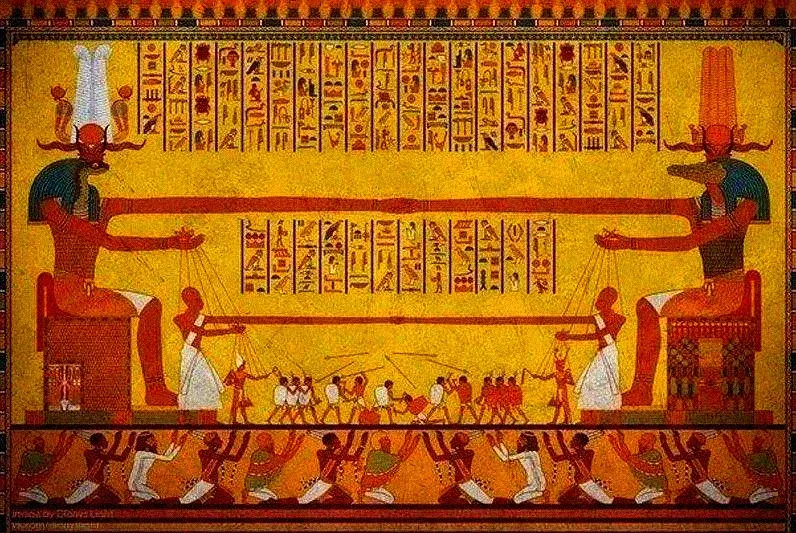
As you will see, this is not just true for Mesopotamia but also for all major civilizations, including Egypt. As you can see in this tapestry from Egypt, the gods are in control. The gods are the puppet masters, the kings are just being controlled by the gods, and humans just do what the gods demand of them. This is just the natural order.
The Epic of Gilgamesh: Crafting the Ideal King
There are two major literary achievements of Mesopotamia. The first is the Enuma Elish. The second is something called the Epic of Gilgamesh. As you can see, Gilgamesh is a giant human. He's a king, considered the first king of Uruk. He's so big that a lion is his pet.
What happens is that Gilgamesh is a king, but he's a tyrant. He takes the men to war and sleeps with all the women. So the people cry to the gods for relief. The gods create Enkidu from clay, very similar to the story of Adam in the Bible. Enkidu is like an animal, but Gilgamesh sends a prostitute to seduce him and make him civilized.
Now, Enkidu and Gilgamesh fight. When they fight, they realize they can't beat each other, so they decide to become best friends. They embark on all these adventures together. They kill divine beings, they kill the protector of the forest, they kill a divine bull. The gods are now kind of pissed at them because they're disrupting the natural order. So, the gods have a meeting and decide that one of them must die. They kill Enkidu.
When Enkidu dies, Gilgamesh is heartbroken. And he's scared because he's afraid that he will die as well. So, he sets on a quest for immortality. He goes and tries to figure out how to live forever. He ultimately fails. It ends with Gilgamesh actually returning home, and he sees happiness in the walled cities and his people being happy.
The moral of the story is that immortality is not about living forever. Immortality is about doing great things for your people so that you'll be remembered and celebrated forever. The irony is that even though Gilgamesh failed in his quest, he ultimately succeeded in his mission because we have his epic and are able to celebrate him even today.
The question now is, why is this story being told? One theory is that this is a concept of kingship. Being a king means not doing whatever you want. Being a king means serving the people so that people will celebrate you, remember you forever, and immortalize you in writing.
How an Epic is Made
Ultimately, Gilgamesh is a bureaucratic creation. Through this creation process, we can understand how human society develops over time.
- Local Legends: In the beginning, each region has local legends and local heroes celebrated through stories, like demigods such as Hercules. They have these stories because each region has a local king, and this local king says, "Well, I'm a descendant of Hercules, and therefore I should rule over you." These stories become a test for the king. If Hercules can fight a lion, then you, his descendant, shall fight a lion. That's how you justify your kingship.
- Consolidation: As these different areas become consolidated into a much larger area, these stories themselves become consolidated. Gilgamesh was basically different heroes combined. One king comes to dominate a region.
- Bureaucratic Takeover: As the region becomes larger, you need a bureaucracy. So, bureaucratic priests come into power. They add morality and messaging to control the people and the king. The major message is that the king must serve the people, and then the priests control the king. Different bureaucratic factions will fight each other and will have different versions of the story. As different bureaucratic priests take power, the morality and messaging change. The king must learn humility.
This is a process that we see throughout human history. Think of Chinese classics like Romance of the Three Kingdoms, Journey to the West, or Water Margin. If you read them, they're not that interesting. But you can imagine that before, they were interesting, but the bureaucrats took them and changed them into boring stories that they can now teach schoolchildren to brainwash them.
Mythology as a Template for Power
Another example is Hesiod's Theogony, which talks about Greek mythology. The process goes like this:At first, Gaia (the Mother Goddess) and Chaos give birth to the gods. Gaia marries one of these gods, Uranus. They give birth to 12 Titans. But Uranus doesn't really like his children, so he beats them up. These children, with help from their mother, decide to rebel. The youngest son, Cronus, kills Uranus.
Then Cronus marries Rhea. Now Cronus is king, but he's afraid that his children will eventually rebel against him, just like he rebelled against his father. Therefore, he eats all his children. Rhea is upset about this, so she decides to give birth to Zeus in secret. She runs off to an island, gives birth to him, and leaves Zeus there to grow up. Eventually, he grows up, goes back to Cronus, becomes his cupbearer, and then poisons him. That's how Zeus becomes the ultimate king.
What's really interesting is that this myth influences the origin story of major historical figures. If you look at these figures, you will find a very similar story: Sargon of Akkad who founded the Akkadian Empire, Romulus and Remus who founded Rome, King David who founded Israel, and Genghis Khan of the Mongols. They all share a similar origin story.
This follows the dynastic cycle. Usually, when you're king, you need a general. The king often likes to hire a foreign mercenary to be his general. Why? First, he's of low birth and has no legitimacy. Second, he's a foreigner and doesn't have any local factions behind him. But often, this foreign mercenary is so talented that he's able to build a faction to overthrow the king and become king himself. This is true for Genghis Khan, King David, and Sargon of Akkad.
The problem is that once he becomes king, he has a legitimacy problem. He's of low birth and a foreigner. So what do you do? You create a myth of Zeus—that Zeus himself was of low birth and a foreigner, but not really, because he's the secret son of the king. That's why you have these stories: to legitimize the king.
Propaganda in Ancient Sumer: The Debate Between Sheep and Grain
Myths and stories are like house renovations. When you renovate a house, you're adding different layers to it. That's literally what's happening.
Let's look at one last story to show you how this writing process works. Remember, they invented writing to basically gaslight the people. Even though Mesopotamia was developing really quickly, it was still a very diverse place. They had different forms of industry and economy. In the green areas, you have agriculture, but in the red, it's pastoral, meaning you're raising animals like sheep and goats, moving all over the place.
There are two different types of lifestyles: the first is sedentary, where you stay in one place and grow your crops. The second is pastoral, where you're going around feeding your sheep and goats. If you're a king, a priest, or a bureaucrat, do you prefer agricultural people or pastoral people? Obviously, agricultural people. Why? Because it's easier to control them.
So, what they do now is create mythologies to convince people to give up the free, happy lifestyle of a pastoralist and become an enslaved farmer. This is called The Debate Between the Sheep and the Grain.
The Sheep and the Grain have a debate and appear before the gods for judgment. The Sheep says, "I am the better one." The Grain says, "No, I'm the better one."
The Sheep argues its value:
"The splendor of kingship belongs to me... The watch over the elite troops is mine. Sustenance of the workers in the field is mine... Sweet oil, the fragrance of the gods... are mine... In the gown, my clothes are white wool. The king rejoices on his throne... My body glistens on the flesh of the great gods."
The Sheep provides clothing for kings, oil for fragrance, and food for soldiers. Priests sacrifice sheep, not grain.
The Grain replies:
"When the beer-dough has been carefully prepared... your big bully-goats and rams are dispatched for my banquet... Your shepherd on the high plain eyes my produce endlessly... My farmer chases away your herdsman with his cudgel... Fanged snakes and bandits, the creatures of the desert, want your life on the high plain... I am Grain. I am born for the warrior."
What Grain says is, first of all, you don't need to protect me. I can protect myself. There are no animals that want to eat me. And I'm bountiful. You do less work, and you get more of me.
Of course, the gods say that Grain is better. Even though people who raise sheep and goats are stronger, more free, and more independent, kings don't want that. So they create these stories, these mythologies, in order to brainwash people out of their freedom and their independence.
And that's why we have writing. That's why they invented writing.
Questions and Answers
What is the connection between the myths of these neighboring civilizations?
It's almost impossible for us to answer how much they influenced each other. Even if they were not in contact, they would still come up with the myths they had in order to justify their hierarchy. Myth-making is just a natural part of the human process.
So, do they share these stories together? Probably. But what's important to understand is that these elites are also interested in differentiation. If I'm in Egypt, I need to prove to my people that I'm superior to the people in Mesopotamia and the Indus Valley. That's why I create the pyramids. If I'm in Mesopotamia, I need to prove that I'm superior. That's why I create the ziggurats and the Epic of Gilgamesh.
We just have to assume that there is influence, that these cultures aren't cut off from each other. But ultimately, at the end of the day, what they come up with has to be unique to their own culture. They want to prove that their culture is superior, and they have to address local needs as well.
Why do some cultures have male creator gods while others have female ones?
It's hard for us to say what the original myth was. The process is this: in the very beginning, all gods should be asexual. They are either non-sexual—not male or female—or they are both male and female. In all traditions, the god has to be a balance of forces, like the male force and the female force. That's why we have yin and yang.
But over time, they will change certain characteristics to better reflect the hierarchy. For example, in Chinese culture, there is the god Pangu who created the earth. Pangu is a male who sacrificed himself. Maybe in the beginning, when females were in charge, Pangu was a female character, but over time, they changed it to a male character. It's almost impossible for us to go back and rebuild or reimagine what it was like originally.