Secret History #19: Dawn of the Jews
I will show you how the American Empire will fall. And I will show you that what will replace the American Empire is Israel—what we call Pax Judeica. We will do an overview of history and show you why history will lead ultimately to the Pax Judeica.
How can you understand history without bias?
First of all, it's impossible to be unbiased. We're all subjective. One suggestion is that you have to look at documents and try to be really critical when you analyze them, and that's correct. The problem is that often we don't have documentation, or we have documentation from only one source, so it's very hard to do.
What I'm trying to do is propose a new theory of how to understand history. If you adopt this model, I guarantee you that your understanding of history will improve, and also your understanding of how the world works will improve as well. There are three components to this new history model, which I call predictive history.
- Understand historical patterns. When you try to look at history and an event, you ask yourself, "Does this fit into a larger pattern or model of history?" If it does, it's probably correct. If it doesn't, then there's something wrong here.
- Use game theory. The idea of game theory is to understand that all historical actors are motivated by their interests or worldview. Are you looking at all different historical actors and trying to figure out what their best strategy is?
- Consider the religious eschatological. This means that all cultures and all individuals have a certain religious outlook or worldview. You can often find this worldview within their sacred text, for example, the Bible or the Quran. These texts will give you insight as to how they perceive history but also how they want history to eventually develop. You can understand their strategies moving forward.
Why are Jews so dominant in various industries, given this is a relatively new phenomenon?
This is a really good criticism, the idea is that maybe there are certain aspects of Jewish culture that make them dominant in an industrial, capitalistic, globalized world. There is some truth to that, but I often think about Chinese people, because Chinese people are extremely materialistic. Chinese love money, but we're not as creative as Jewish people. So I think that being materialistic and capitalistic is not enough. You also need to have an element of creativity within your culture. That's why I think that the Bible helps us better understand the success of Jews.
This is a really good point, and what's really important to understand is that this is intellectual speculation. We're trying to figure out theories and play with ideas. There's no truth there. Take everything I say with a grain of salt. Doubt whatever I say. This is really meant to be a platform or jumping board for you to undertake your own intellectual journey.
We're going to look more closely at this question today: Why is it that Jews are so dominant? I'm going to make the argument to you that Israel and the Jewish identity are constructs of the imperial imagination.
This is hard to understand, so I'm going to explain it slowly. The idea is that because of its geographic location, Israel has always been historically important. As a result, different empires have tried to manipulate the identity of Israel to best promote their own agenda or policies.
How History Works: Three Geopolitical Patterns
Last week, we looked at the cultures that emerged out of the Bronze Age Collapse and which are now going to dominate history: the Greeks, the Persians, and the Israelites. Now we're going to look at how these ideas play out in history. But for us to do that, we first need to understand how history works. I've identified three different patterns of geopolitics.
- Competition Competition between nation-states doesn't really matter, or it's not as significant. The idea we have here is elite overproduction. What drives a lot of conflict is the fact that domestically, you have these different competing factions, and they're all competing for power. You have too many elites and too few status positions, so they're competing against each other, and this drives a lot of conflict.
- The elite have shifting loyalties. Think of Game of Thrones. Everyone wants to be king, and they're going to kill their brother, their father, or their mother to be king. The elite don't really have loyalties except to themselves. The world is just a game of thrones.
- War can be a mechanism to protect the status quo. This is the idea of equilibrium. Sometimes the conflict is really bad, so you start a war so you can send people off to get killed. That way, you can maintain equilibrium within your system. We'll see this pattern throughout human history.
Let's use an example for us to understand: the Warring States period of China before the emergence of the first empire, the Qin empire.
China is divided into different warring states that are all powerful. At this time in history, the Qin state is the poorest, most isolated, and least advanced.Chu and Zhao are more powerful, and you can argue that eventually one of them would emerge to unite all of China. But they did not. It was the Qin—the isolated, marginalized, backward state—that came to conquer. The question is why this happened.
If we use our three principles, we can understand that these different states are not competing against each other; it's the elites within these states that are competing against each other due to elite overproduction. The way they manage this is to use warfare in order to maintain a status quo and create equilibrium. We know this because from this time emerges the idea of Chinese chess. What is Chinese chess? It is the idea of warfare that is regulated and ritualized. When we go to war, we have to respect the rules of warfare. That's stupid. War should be about killing the other guy. It shouldn't be about following the rules.
Also, another piece of evidence is that at this time in history, Sun Tzu wrote the book The Art of War. This is one of the stupidest books ever written. I guarantee you if you follow this book, you're going to lose the war badly because this is really about how to cheat in a heavily regulated game. It has all these rules, like using spies and maintaining a high guard. Guess what? In actual war, none of these things actually work.
If you look at history, I'm going to tell you exactly how to win a war.
- You have to be completely committed to winning this war: total warfare.
- You have to make sure that talent rises. You have to be open and meritocratic. If an officer or a general is winning the war, you promote him. That sounds easy, but not if you're a status quo power, because what's important to you is to maintain that your family is always on top. So if a general arises who is very innovative and talented, you kill him because he's a threat to you.
- Make sure your soldiers are happy. I know it sounds really simple, but again, if you're a status quo power, you don't really care.
- Destroy enemy civil centers through siege warfare. Go and destroy the city because that's how they produce their war capacity: the food, the soldiers.
- Kill civilians.
- Overstretch your enemy's supply lines.
- Divide and conquer.
- Strike fear in your enemy.
- Kill their gods.
If you really want to win a war, this is what you have to do. And we know this because this is what the Romans did, what the Persians did, what the Aztecs did, what the conquistadors did, and what the Mongols did. Every single power that has conquered everyone else has done all these things. So, when they don't do these things, it's because these different warring states aren't actually at war with each other. They're actually friends. They're all intermarried with each other, all trying to maintain a status quo. They use war as a game in order to maintain that status quo and create equilibrium.
The Mesopotamian Pattern: Outsiders and Empire
This is true for Mesopotamia. Mesopotamia is important because this is the cradle of civilization, where the first empires will emerge, where most technological innovation happens. This was, for the longest time, the wealthiest part of the world.
The first city-state is Uruk, and they developed colonies throughout the Tigris and Euphrates. Then these colonies came into war with each other. They're all friends with each other, all intermarried, and the elite create these highly ritualized warfares. One really important rule is that you don't kill each other's gods. In their religion, the god lives in their temple, so you don't attack their temple. But guess what? All their money, all their gold, is in the temple. So you're not allowed to steal each other's gold. That's stupid, because now you don't really accomplish that much with warfare.
For the longest time, this was the status quo. Then what happened is a man named Lugal-Zage-si emerged. You can think of him as lower nobility. What we'll see in history is that within a city-state, there will always be a conflict between the upper nobility and the lower nobility. The upper nobility is in charge and wants to maintain the status quo. The lower nobility wants to steal that power. This will happen in Rome, where Julius Caesar is of the lower nobility and will steal power from the upper nobility, the people called the Optimates.
So Lugal-Zage-si is from Umma, and he's like, "You know what, screw this. These rules are stupid. I want to conquer everyone. I want to be the top dog." What he does that's very different from previous times is he goes and ransacks each city's temple. So now he has the capacity to build an empire. But by doing that, the other city-states recognize him as a threat, and so they invite mercenaries from a place called Akkad to come and help them.
This leads us to the first world empire, called the Akkadian Empire, founded by Sargon of Akkad. His name is interesting; it means "legitimate ruler," which probably tells us he's not a legitimate ruler. He's probably a mercenary, like David, who stole the throne. He saw an opportunity and he stole the throne.
But this is a pattern in history: if there's competition among different city-states, the competition is not resolved amongst themselves because they have an equilibrium. So what happens is that an outsider, a mercenary usually, comes in who doesn't respect the rules, and he's able to unite everyone through innovations. This is why the Qin dynasty, and not the Zhao or the Chu or the Wei, was able to unite all of China—because the Qin dynasty was committed to total warfare. They didn't care about the rules. They wanted to win.
The Akkadian Empire stretches throughout the Fertile Crescent. It conquers Mesopotamia (modern Iraq), extends over to Anatolia, and captures a lot of the Levant. This area, the Levant, is historically the most strategic location in the world. Why? Because it gives you access to Egypt, Mesopotamia, and Anatolia—historically the three wealthiest parts of the world. Whoever controls the Levant is able to always threaten Egypt. For most of history, the Levant was an Egyptian colony, but after the Bronze Age Collapse, Egypt was not able to project power there. And so, different empires fought for the Levant in order to threaten Egypt. Jerusalem is literally the center of the world, and we will see that throughout history, people have considered Jerusalem the center of the world, both for religious reasons but also mainly for geopolitical and trade reasons.
The other thing to remember about this area is that it's highly competitive because it's hard to protect Mesopotamia. It is very, very wealthy, but as you can see, there are these mountain tribes over here that can always threaten Mesopotamia. This is a pattern in history where whoever establishes an empire in Mesopotamia is always being threatened by the borderlands. That's why these empires change all the time.
You have the Babylonian Empire, which gives us Hammurabi. Then you have the Assyrian Empire, famous for their brutality. If you rebelled against them, they would kill everyone. Remember, at this time in history, an empire is not the empire of today where you can exert authority everywhere. An empire at this time is mainly controlling certain choke points of trade, and everyone else just sort of goes along because it benefits them. An empire is more like a loose confederation as opposed to a nation-state. Then you have the Neo-Babylonian Empire. You have these empires that constantly change over time.
The Persian Revolution: A New Model of Empire
History changes when a man emerges called Cyrus the Great. Cyrus the Great is the founder of something called the Persian Achaemenid Empire. We previously discussed Zoroastrianism, which is really the first great world religion because it provides a simple but powerful model of how the world works. Zoroastrianism is powerful because it encourages everyone to be their best, to seek Asha. For most people, what Asha means is "don't ever lie." It is actually a really useful thing if you're trying to run an empire, because when you run an empire, you need soldiers, generals, and administrators. If people don't lie, if people are honest and moral, well, you can expand really quickly.
That's what Cyrus the Great did. Cyrus the Great is also known for his mercy and his generosity. When he conquers a place, he will identify the best people, maybe the king himself, and make them advisers to his regime. He's known for his tolerance and his openness. What happens is that the Babylonian Empire basically surrenders to him without a fight. Why? Because of elite overproduction. You have this war going on between the upper nobility and the lower nobility, and they're like, "You know what? Let's just invite Cyrus the Great, and then we don't have to fight each other anymore." And that's how Cyrus the Great was able to build the first world empire. There are different stories about the fall of Babylon, but one story is that they basically invited him in in order to resolve their inner conflicts.
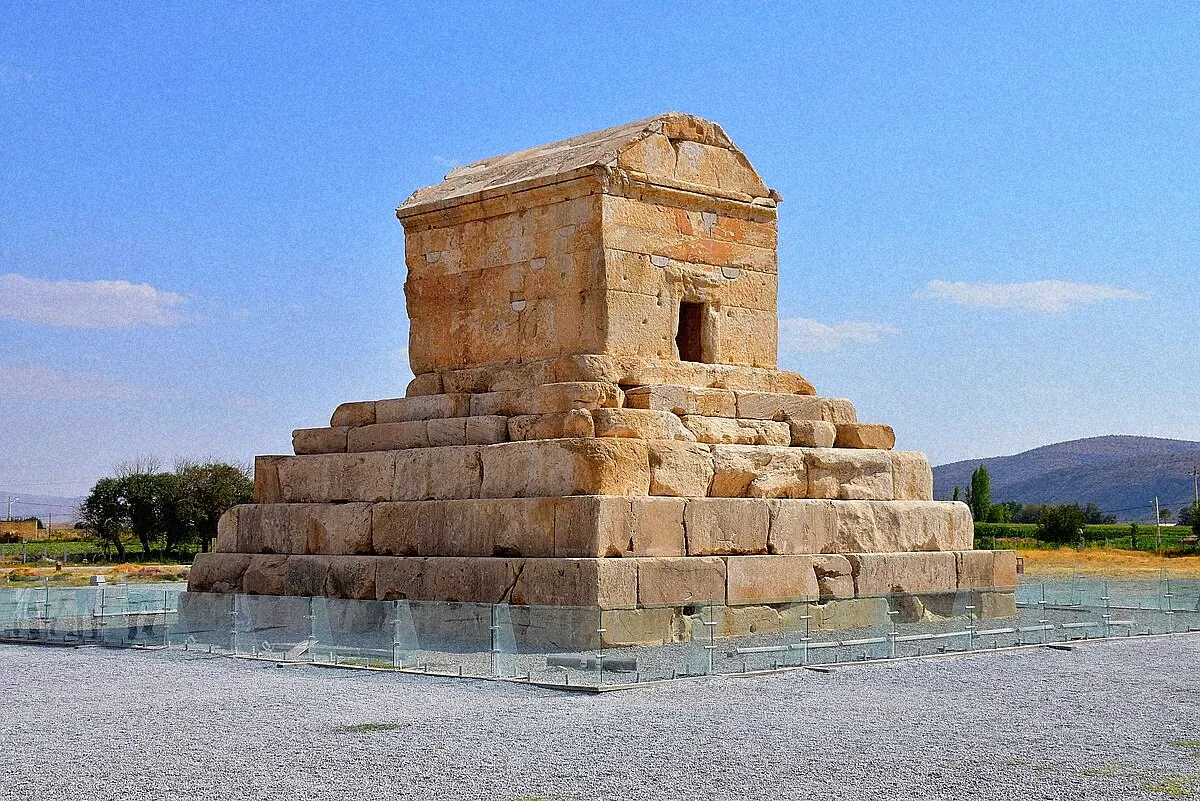
This is the tomb of Cyrus the Great. It's still in Iran today. There's a story that when Alexander the Great, who was Macedonian, went to conquer the Persian Empire, he discovered that Cyrus the Great's tomb was in bad repair. So, he ordered for it to be properly maintained. That story is probably false, but it shows you that at this time in history, about 300-400 BC, everyone was respectful of Cyrus. Cyrus the Great is considered the world's greatest king or emperor.
The Persian Empire was huge. It encompasses most of West Asia. It goes from Iran all the way to Mesopotamia, to Anatolia, to parts of Greece, and basically all of Egypt and Libya. It's a huge area, and they were able to do this because of their innovations in religion as well as administration.
How do you rule empires usually? The traditional way is you control trade routes and access, so people have to pay you a tax. You can also use fear and conquest, which is what the Assyrians were known for. You took hostages, which was a very common thing. You used intermarriage and religion. But what the Persians did really well that allowed for their empire to be so huge and well-managed are four things:
- Effective administration. When you have a religion like Zoroastrianism where people can't lie, that's really good because these bureaucrats will now report real facts to the emperor, which allows him to make better decisions.
- Elite co-optation and meritocracy. If you have a very effective administration, that allows for local elites to focus their energies on trying to join this administration as opposed to rebelling against you.
- Communication networks. Things like roads and postal networks. The Persians created the first global postage system, and it was really effective. If you wanted to send mail from Egypt over to Mesopotamia, you would have these royal roads where people would ride on horses and could stop at a hostel to rest and then keep on going. That way, you could very quickly move information from one part of the empire to the other.
- Divide and rule. This is really important. What they did was they basically had different power centers within a region. You had the satraps, which were the local governors, but then you also had the bureaucrats and the royal representatives. These were different factions within a region. Divide and rule is probably the most effective way to control an empire.
The Imperial Invention of the Jews
Now let's move on to Israel. We read the Bible, and it came about because David needed to legitimize his rule. After the Bronze Age Collapse, David created a Davidic kingdom in the Levant because Egypt, Anatolia, and Mesopotamia were preoccupied. But because the Levant is so important, this kingdom doesn't last that long—maybe 80 to 100 years. After Solomon, David's son, dies, Israel is divided into two parts: the northern kingdom, which gets conquered by Assyria, and Judah in the south.
At this time in history, the Israelites are being pulled in different directions by the Anatolians, the Assyrians, the Babylonians, and the Egyptians because they are strategically very important. What's really hard for these empires is how to maintain control over Jerusalem. They try different techniques. They try burning down their city centers; the northern kingdom was destroyed (you might have heard of the 10 lost tribes of Israel). They tried taking hostages. But because this region is so volatile, nothing really works, and the Israelites in Jerusalem keep on rebelling.
The Babylonians try to deal with the Israelites for the longest time. They take thousands of them as hostages and move them to Babylon, where they become scribes, farmers, and merchants. But again, the region is so strategically important that the Israelites switch loyalties all the time. Eventually, the Babylonians are so pissed off that they decide to burn down their temple.
At this point in history, the Israelites are now gone. Sometime around 587 BC, Babylon destroyed Jerusalem. They tried many techniques to control Jerusalem, but they couldn't do it. The Israelites were too rebellious, but the location was too strategically important. So they decided, "You know what, screw this. We'll just destroy the city." When this happens, it's really important for you to understand: the Israelites are gone. The people are still around, but the identity of the Israelites is now gone.
In 539 BC, Cyrus the Great conquers Babylon. And he says, "I want the Israelites to return to Jerusalem." This is called the Edict of Cyrus. This is celebrated in the Bible. What is controversial is why he would do such a thing. Because again, the Israelites are now gone. The Israelites who went to Babylonia may still keep their religion a bit, but they no longer have their land. They have changed as a people. As an Israelite, you pray in the temple, but the temple is now destroyed. So now you pray in a synagogue. The people have changed a great deal.
The question now is, why would Cyrus the Great go to Babylon and say, "You know what? I want you Israelites to return to Jerusalem. I want you to reconstitute the nation of Israel." Why would he do that? This is a debate that will never, ever end.
- The Bible tells us that Cyrus the Great did this because God told him to.
- Maybe Cyrus wanted to show the entire Persian Empire that he was religiously tolerant.
- It's also true that Cyrus thought of himself as a righteous and merciful king.
- It's possible that a faction within the Israelites supported his Babylonian takeover.
- Another possibility is that when Cyrus conquered Babylon, he discovered that these Israelites were really good administrators. This is true throughout history; because the Israelites have their Bible and their religion requires them to study it, they are very literate intellectuals and rise very high in administrations.
I think the best reason for what happened is divide and rule. The idea is that you need to control the Levant because it gives you access to Egypt, which is historically the wealthiest part of the world. Whoever controls Egypt controls the world. So what you do is you set up a group of people in the Levant that are only loyal to you. You set up people in the Levant that only exist because you, the empire, allow them to exist. If you, the empire, did not support them, then the locals would get rid of them right away.
And that's why we have the Jews. The Jews were invented by the Persians to control the Levant.
"Jew" is actually a Persian term. Before, they were the Israelites. Now we have the Jews.
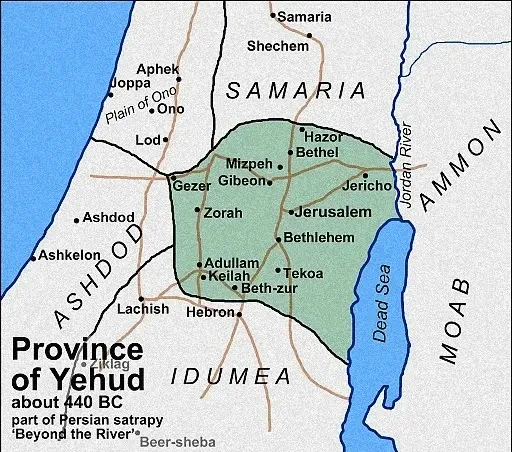
This is Jerusalem. It's actually only a really small part of the Levant, but this part is specifically for the Jews. It's part of this Persian province called "Beyond the River," and they call it the province of Yehud. That's why we have the term "Jews." They are part of the province of Yehud.
What's really important to understand is they're surrounded by enemies. The Samaritans are Israelites who have stayed in the Levant. Most people around them are in fact Israelites who adapted to local circumstances, which means they practiced different religions and married foreign women, but they still considered themselves Israelites.
But what happens is that these exiles from Babylon, they come back and they say, "No, we're the true Israelites. You guys are the false Israelites. The reason why we're true is we have stayed loyal to our religion." What's going to happen over the next few decades is almost a civil war between Israelites who've stayed and Israelites who left but came back. This is what the Persian Empire wants in order to maintain stability in the Levant. You have this small minority of exiles from Babylon who've come back, and they're in conflict with everyone else. This is divide and rule.
The Bible as an Imperial Script: Ezra and Nehemiah
We're going to read two books of the Bible, Ezra and Nehemiah. These two books show us how Persia helped the Jews to reconstitute their nation. By studying these two books, it will give us insight into how current people in the nation of Israel think, and then we can analyze how they will behave moving forward.
This is the beginning of the book of Ezra.
In the first year of King Cyrus of Persia, in order that the word of the Lord by the mouth of Jeremiah might be accomplished, the Lord stirred up the spirit of King Cyrus of Persia so that he sent a herald throughout all his kingdom and also in a written edict declared:
“Thus says King Cyrus of Persia: The Lord, the God of heaven, has given me all the kingdoms of the earth, and he has charged me to build him a house at Jerusalem in Judah. Any of those among you who are of his people—may their God be with them!—are now permitted to go up to Jerusalem in Judah and rebuild the house of the Lord, the God of Israel—he is the God who is in Jerusalem; and let all survivors, in whatever place they reside, be assisted by the people of their place with silver and gold, with goods and with animals, besides freewill offerings for the house of God in Jerusalem.”(Ezra 1:1-4, NRSV)
According to the Bible, Cyrus is doing this because God told him to, not because of imperial ambitions or strategy. Cyrus the Great is considered the Messiah by the Jews. They are extremely thankful for Cyrus because not only does he allow them to go back to Jerusalem, but he also finances the rebuilding of the temple. But when this happens, the locals get pissed off. They're like, "Who are you people? You're stealing our religion. What's going on here?" This creates a lot of conflict, which is good for the Persian Empire because they want this conflict as part of their divide and rule strategy.
When the builders laid the foundation of the temple of the Lord, the priests in their vestments were stationed to praise the Lord with trumpets, and the Levites, the sons of Asaph, with cymbals, according to the direction of King David of Israel. They sang responsively, praising and giving thanks to the Lord, “For he is good, for his steadfast love endures forever toward Israel.” And all the people responded with a great shout when they praised the Lord, because the foundation of the house of the Lord was laid. But many of the priests and Levites and heads of families, old people who had seen the first house on its foundations, wept with a loud voice when they saw this house, though many shouted aloud for joy, so that the people could not distinguish the sound of the joyful shout from the sound of the people’s weeping, for the people shouted so loudly that the sound was heard far away.(Ezra 3:10-13, NRSV)
This is the happiest moment in Jewish history: when they rebuild the temple, what they call the Second Temple. This is important because the Second Temple was destroyed, and what they want to do now in Israel is build the Third Temple. This is important because the Third Temple sits on the Al-Aqsa Mosque, which is the third holiest site in the Islamic world. What this Bible is telling us is that eventually, the Israelis will destroy the Al-Aqsa Mosque so that they can build the Third Temple, or what they call the Temple of Solomon.
When the adversaries of Judah and Benjamin heard that the returned exiles were building a temple to the Lord, the God of Israel, they approached Zerubbabel and the heads of families and said to them, “Let us build with you, for we worship your God as you do, and we have been sacrificing to him ever since the days of King Esar-haddon of Assyria, who brought us here.” But Zerubbabel, Jeshua, and the rest of the heads of families in Israel said to them, “You shall have no part with us in building a house to our God, but we alone will build to the Lord, the God of Israel, as King Cyrus of Persia has commanded us.”(Ezra 4:1-3, NRSV)
This is really weird. They're all Israelites. Why is it, "No, we are the true Israelites. You guys are the false Israelites, so you can't help us"? Why is this conflict going on? The only way to understand this is that the conflict is part of the imperial strategy: divide and rule.
Then the people of the land discouraged the people of Judah and made them afraid to build and they bribed officials to frustrate their plan throughout the reign of King Cyrus of Persia and until the reign of King Darius of Persia.(Ezra 4:4-5, NRSV)
They try to build the temple, but it doesn't really work out because there's so much opposition. The Jews who come back from Babylon are like, "We're the real Israelites, so only we can touch the temple." And the others are like, "This is wrong. We should all participate." It seems as though these Jews from Babylon are actually imperial agents who are trying to sow discontent within the region.
This is a letter from King Artaxerxes authorizing Ezra to build the Second Temple.
“Artaxerxes, king of kings, to the priest Ezra, the scribe of the law of the God of heaven: Peace. And now I decree that any of the people of Israel or their priests or Levites in my kingdom who freely offer to go to Jerusalem may go with you. For you are sent by the king and his seven counselors to make inquiries about Judah and Jerusalem according to the law of your God, which is in your hand, and also to convey the silver and gold that the king and his counselors have freely offered to the God of Israel, whose dwelling is in Jerusalem, with all the silver and gold that you shall find in the whole province of Babylonia, and with the freewill offerings of the people and the priests, given willingly for the house of their God in Jerusalem. With this money, then, you shall with all diligence buy bulls, rams, and lambs, and their grain offerings and their drink offerings, and you shall offer them on the altar of the house of your God in Jerusalem.”(Ezra 7:12-17, NRSV)
Why is this important? Because this is like the Balfour Declaration of 1917. The British government, through Lord Balfour, writes to Lord Rothschild, a Jewish financier, and says:
"His Majesty's Government view with favour the establishment in Palestine of a national home for the Jewish people, and will use their best endeavours to facilitate the achievement of this object, it being clearly understood that nothing shall be done which may prejudice the civil and religious rights of existing non-Jewish communities in Palestine, or the rights and political status enjoyed by Jews in any other country."
This is almost like the Artaxerxes declaration. What's happening is that they're using the Bible as a script in order to facilitate their geopolitical ambitions. This is why reading the Bible is important. Once you read the Bible, understand it, and compare it to historical development, you're able to see the connections. And if you're able to see connections, you can also predict how they will develop over time. This Balfour Declaration creates the current nation of Israel, which was founded in 1948. The nation of Israel was created by the British as part of their geopolitical strategy of dividing and conquering the Middle East.
Ezra returns to Jerusalem and reflects on why God exiled them to Babylon, why God has allowed them to return, and what God wants them to do.
“O my God, I am too ashamed and embarrassed to lift my face to you, my God, for our iniquities have risen higher than our heads, and our guilt has mounted up to the heavens. From the days of our ancestors to this day we have been deep in guilt, and for our iniquities we, our kings, and our priests have been handed over to the kings of the lands, to the sword, to captivity, to plundering, and to utter shame, as is now the case. But now for a brief moment favor has been shown by the Lord our God, who has left us a remnant and given us a stake in his holy place, in order that he may brighten our eyes and grant us a little sustenance in our slavery. For we are slaves; yet our God has not forsaken us in our slavery, but has extended to us his steadfast love before the kings of Persia, to give us new life to set up the house of our God, to repair its ruins, and to give us a wall in Judah and Jerusalem.”(Ezra 9:6-9, NRSV)
Ezra is saying, "Okay, yeah, we screwed up, but God is forgiving, and now we have a second chance to prove ourselves to God." How do we prove ourselves? By making sure that we only worship him. This is the beginning of Jewish monotheism, which was heavily influenced by Zoroastrianism. The religion that the Jews will practice from now on is not the polytheistic religion of the Israelites. They will now practice a new religion.
“And now, our God, what shall we say after this? For we have forsaken your commandments, which you commanded by your servants the prophets, saying, ‘The land that you are entering to possess is a land unclean with the pollutions of the peoples of the lands, with their abominations. They have filled it from end to end with their uncleanness. Therefore do not give your daughters to their sons, neither take their daughters for your sons, and never seek their peace or prosperity, so that you may be strong and eat the good of the land and leave it for an inheritance to your children forever.’”(Ezra 9:10-12, NRSV)
What Ezra is saying is that these Israelites who've stayed are traitors. They are now unclean. Why? Because now they worship foreign gods; they're polytheistic. As a result, we have to clean the land. This is a fanatical understanding of Judaism.
“After all that has come upon us for our evil deeds and for our great guilt, seeing that you, our God, have punished us less than our iniquities deserved and have given us such a remnant as this, shall we break your commandments again and intermarry with the peoples who practice these abominations? Would you not be angry with us until you destroy us without remnant or survivor? O Lord, God of Israel, you are just, but we have escaped as a remnant, as is now the case. Here we are before you in our guilt, though no one can face you because of this.”(Ezra 9:13-15, NRSV)
Now that God has forgiven them, they can't screw this up again. How do they prove their loyalty to God? By making sure that they are pure. They're not going to marry people of other religions. Herodotus, in his Histories, says the Jewish people are known for two things: giving Sabbath on Saturday, and that they don't marry outside their religion. Jewish women will refuse to marry foreign men.
Now we have the concept of blood purity. That is new. It's really important for us to understand that the Jews and the Israelites are not the same people. What Ezra is doing is rejecting the Israelite heritage and establishing a new heritage based on blood purity and a monotheistic devotion to Yahweh. This is new. The Jews of Persia are not the same as the Israelites of David.
The Jews are in this area, a very small part of the Levant, but it's a part of the Levant that's completely loyal to Persia because they see everyone else as unclean, as the enemy. If you're an empire, having the Jews around is really good for you.
The Jews are an invention of the Persians, but guess what? The nation of Israel is also an invention of the British Empire.
Nehemiah: Building Walls and a New Identity
We move on to the second book, Nehemiah. Ezra is the priest who will create the Bible. Nehemiah is the governor sent by the Persians to reestablish the Jewish nation. He was cupbearer to the king, a really powerful position.
In the month of Nisan, in the twentieth year of King Artaxerxes, when wine was served him, I carried the wine and gave it to the king. Now, I had never been sad in his presence before. So the king said to me, “Why is your face sad, since you are not sick? This can only be sadness of the heart.” Then I was very much afraid. I said to the king, “May the king live forever! Why should my face not be sad, when the city, the place of my ancestors’ graves, lies waste, and its gates have been destroyed by fire?” Then the king said to me, “What do you request?” So I prayed to the God of heaven. Then I said to the king, “If it pleases the king, and if your servant has found favor with you, I ask that you send me to Judah, to the city of my ancestors’ graves, so that I may rebuild it.” The king said to me (the queen also was sitting beside him), “How long will you be gone, and when will you return?” So it pleased the king to send me, and I set him a date. Then I said to the king, “If it pleases the king, let letters be given me to the governors of the province Beyond the River, that they may grant me passage until I arrive in Judah, and a letter to Asaph, the keeper of the king’s forest, directing him to give me timber to make beams for the gates of the temple fortress, and for the wall of the city, and for the house that I shall occupy.” And the king granted me what I asked, for the gracious hand of my God was upon me.(Nehemiah 2:1-8, NRSV)
The Bible says that Nehemiah begs the king for permission to go back. This is not how empires work. You do not ask the king or the emperor for anything, because he will just cut your head off. How empires work is that you have to read the king's intentions. You have to figure out what he really wants, and then you have to say, "Please, I want to do this, not because you asked me to, but because I want to do this myself." That's how empires work. The king does not tell you what he wants; you have to guess.
This is important because when we move on to the modern nation of Israel, most people believe that it started with the Zionist movement. But we will discover that it's actually part of British imperial policy. The British themselves cannot be seen as the ones promoting the creation of the state of Israel because it makes them look bad. So what they have to do is create a situation in which the Jews themselves want to create their own nation. The problem, though, is that 100 years ago, Jews did not want to go to Jerusalem because they were happy where they were.
When Nehemiah goes back, he's going to build the temple and the walls. This is going to piss everyone off. They're like, "Why would you do that? We're all living happily together, one big family. And now you're building these walls, which means that you think you're better than us, or you're afraid of us, or you want to conquer us." This creates all these conflicts with the locals, which is again what the Persian Empire wants to happen.
Nehemiah goes back and discovers massive corruption and inequality among the Jews. This is a problem because they're a minority in a very hostile region.
I was very angry when I heard their outcry and these complaints. After thinking it over, I brought charges against the nobles and the officials. I said to them, “You are all taking interest from your own people.” And I called a great assembly to deal with them and said to them, “As far as we were able, we have bought back our Jewish kindred who had been sold to other nations, but now you are selling your own kin, who must then be bought back by us.” They were silent and could not find a word to say. So I said, “The thing that you are doing is not good. Should you not walk in the fear of our God to prevent the taunts of the nations our enemies? Moreover, I and my brothers and my servants are lending them money and grain. Let us stop this taking of interest. Restore to them, this very day, their fields, their vineyards, their olive orchards, and their houses, and the interest on money, grain, new wine, and oil that you have been exacting from them.” Then they said, “We will restore everything and demand nothing more from them. We will do as you say.” And I called the priests and made them take an oath to do as they had promised.(Nehemiah 5:6-12, NRSV)
This is a really important aspect of the Jews that people don't really understand: how unified they are. An example is that if you're a Jewish person, you can always get an interest-free loan if you want to buy a house or start a business. That's pretty amazing. If you're a Jewish person, it doesn't matter how poor you are; there will always be Jewish organizations that can offer you interest-free loans because Jews are not allowed to collect interest from each other. That's how unified they are as a people.
This is the last step of creating the Jewish identity.
all the people gathered together into the square before the Water Gate. They told the scribe Ezra to bring the book of the law of Moses, which the Lord had given to Israel. Accordingly, the priest Ezra brought the law before the assembly, both men and women and all who could hear with understanding. This was on the first day of the seventh month. He read from it facing the square before the Water Gate from early morning until midday, in the presence of the men and the women and those who could understand; and the ears of all the people were attentive to the book of the law.(Nehemiah 8:1-3, NRSV)
The idea of the Jewish identity is that they follow the laws of God, they do not marry outside their religion, and they do not charge each other interest or exploit each other. The last thing is this: their historical memory is the Bible. Who are we as Jewish people? What are our memories? It's whatever is written in the Bible. Ezra is taking all these historical documents and combining them together in what today we call the Bible. This makes the Jewish people extremely resilient because no matter where they are, their memory and historical identity are always stored in one Bible. That makes them the world's most resilient, flexible, and open people.
Nehemiah enforces two major laws. The first is that you shall not work on the Sabbath. The second is that if you marry a foreign woman, you must divorce her. He's breaking up families. Why? Because he believes that religious purity requires blood purity.
In those days also I saw Jews who had married women of Ashdod, Ammon, and Moab; and half of their children spoke the language of Ashdod, and they could not speak the language of Judah, but spoke the language of various peoples. And I contended with them and cursed them and beat some of them and pulled out their hair; and I made them take an oath in the name of God, saying, “You shall not give your daughters to their sons, or take their daughters for your sons or for yourselves. Did not King Solomon of Israel sin on account of such women? Among the many nations there was no king like him, and he was beloved by his God, and God made him king over all Israel; nevertheless, foreign women made even him to sin. Shall we then listen to you and do all this great evil and act treacherously against our God by marrying foreign women?”(Nehemiah 13:23-27, NRSV)
As you can see, there are certain traditions about the Jews that were created during the Persian Empire in order to facilitate Persia's control of the Levant. But these traditions, because they are encoded in the Bible, stay with us even today. By reading the Bible carefully and understanding how to connect it to historical development, you can now figure out how Israel will develop over the next 10 to 20 years.
Three Predictions for Israel's Future
- They're going to rebuild the Temple of Solomon. They're going to build the Third Temple by destroying the Al-Aqsa Mosque. They're going to do that sooner or later. When we read the Bible, you can see how happy they were when the Second Temple was built because they felt completed, as though God was with them. Building the Third Temple is crucial to the identity of Israel today. It's going to cause a lot of problems, but do they care? Not really.
- Israel will become a theocracy. When the Jews returned, they were convinced that they were forced out of Jerusalem because they offended God. In other words, if Jews want to maintain control over Israel, they need to obey the laws of God, which means they have to become a theocracy. If you go to a place like Tel Aviv, it's a very open, liberal, cosmopolitan, forward-looking place. That's gone. As Israel develops over time, it's becoming more and more of a theocracy where the Bible is the law.
- More and more Jews will return to Israel as Pax Judeica expands. If you look at the Middle East, Israel is the greatest power. There's no force in the Middle East that can prevent Israel from expanding and expanding, including the Pax Judeica, which is their ambition.
The Jewish identity is fluid, flexible, and open. It was created by an empire for the purpose of maintaining an empire. We're going to see this throughout history as well.
How does Persian control of Jerusalem transfer to modern-day society and its conflicts?
Persia wanted to divide and conquer the Levant. They were afraid that if the Levant became too stable, it might side with Egypt or another power, and they would lose control, which directly impacts their capacity to trade and control the world. The way you control the Levant is you create this entity that has conflict with everyone else. Now what happens is that both this entity, Jerusalem, and its enemies rely on you, Persia, to manage the conflict.
This is what's happening today in Israel. Who's the empire? America's the empire. Israel has all these conflicts with nations in the Middle East. So, who does everyone need to manage this conflict? America. Saudi Arabia, Israel, Turkey, and Egypt all require the United States to come in and say, "Hey guys, let's just get along." This is all intentional in order for America to maintain dominance over the Middle East.
Who's very unhappy about this? Israel. We can expect that over time, what's going to happen is a major, major conflict between America and Israel. There's going to be a divorce, basically. My argument to you is that Israel will win this conflict, and as a result, Israel will become the dominant power in the Middle East. The Jews know their own history. They read the Bible every day. They know what the Persians did, what the British did, and what the Americans are doing today. They don't want to become a servant or a slave to an empire. They are servants and slaves to their God, but not to an empire. So they need to get rid of the empire and establish their sovereignty. That's why there's so much conflict in the Middle East today—because Israel needs to figure out how to get rid of the American Empire so that they can be independent and fully achieve their sovereignty.