Secret History #24: Empire of Church
We begin with a review of the Roman Republic, which was essentially an oligarchy—a rule by the few. In this way, it was very much like Sparta: a war society. At this point in its history, the fact that the Roman Republic was an oligarchy, commanded by about 100 families called the Patricians, was actually to its advantage. Rome was small, poor, and constantly at war. Even though there was a nobility, they were not that much better off than other people, and everyone knew each other. They were a very open, energetic, and cohesive society.
Over time, they became the most dominant society in the Mediterranean, defeating Carthage and the Greeks. But now that they were an empire, the fact that Rome was an oligarchy became a huge problem. The ruling class was now corrupt, unequal, and stagnant. One way we know this is that Roman women began to refuse to have children; they were dying as a society.
At this point, what should have happened is the creation of an imperial bureaucracy—a centralized system to better manage the empire. They couldn't do that because the oligarchy, the families, which now numbered about 50, refused to give up power. Rather than a centralized bureaucracy, the Roman Empire was, in many ways, a system in which different families controlled different territories. This led to constant civil war.
This started with Sulla, then went on to Julius Caesar. After Julius Caesar, Augustus Caesar became the "first among equals," but he still failed to set up the bureaucracy. The civil wars continued. Eventually, Constantine decided this system didn't work. He concluded that he needed to reinvent the Roman people, and he did that by moving the capital from Rome to a new place he called Constantinople, which would become the center of the Byzantine Empire.
Because it was a new culture, the Byzantine Empire could now become a bureaucracy. In fact, their official language became Greek; it was a Greek bureaucracy. This is what we call the Second Rome.
Migrations, Mercenaries, and the Rise of the Catholic Church
While this was happening, there was a massive migration of steppe peoples coming into Europe from many different locations. This was happening because, in China, the Han dynasty was waging a war against the steppe nomadic people, the people they called the Xiongnu. They were forced westwards, which in turn forced other steppe peoples to migrate into Europe and Central Asia. These peoples included the Goths.
This was a huge problem for Rome because its own people were not having children, and they faced massive migrations coming in from the steppes. The Romans decided on a strategy of "divide and rule." This meant that many of these migrants were absorbed into the army as mercenaries and soldiers to defend the border and fight in the civil wars.
At the same time, the Catholic Church was on the rise, supported by some of these noble families. Not all of them supported the Catholic Church, but those that did had a huge advantage. They could absorb these new migrants into the society with themselves at the top and the migrants at the bottom.
Why would the migrants agree to this? In their own societies, they were very egalitarian. For war purposes, they would elect a war leader. But with the Catholic Church system, this war leader could now become a part of the nobility. They could join the 50 families to form a new nobility.
The Great Divide: The Fates of the Western and Eastern Empires
When Constantine set up the Byzantine Empire, the Roman Empire divided into two: a western part and an eastern part. These two parts would have very different fates.
The Eastern Empire: The Wealthy, Centralized Byzantines
The eastern part was still part of the Middle East—the Levant, Anatolia, and Egypt—and was the wealthiest part of the empire. As such, it engaged in wars with the Persian Empire, which would define most of its history. Its capital, Constantinople, was designed to be invincible; you could not lay siege to it or conquer it. As such, the Byzantine Empire was stable. In fact, it lasted for about a thousand years, which is very impressive.
Because it was very wealthy, it was able to dominate the world mainly through trade and diplomacy. It became an imperial bureaucracy. It fought wars, but it usually used a lot of mercenaries because it had a lot of wealth. In many ways, the Byzantine Empire was very similar to China in how it organized its society.
The Western Empire: The Diverse, Fractured Rise of the Church
The Western Empire was very different. It was the poorest part of Europe and was characterized by numerous natural barriers. Competing societies emerged with different cultures, protected by mountains, forests, and rivers. There was a lot of diversity within the Western Empire.
The power that emerged here was actually the Catholic Church. As Western Europe increased in power and the Eastern Empire decreased in power, the Catholic Church would increase in power as well. How did the Catholic Church come to dominate Western Europe? It was because the Catholic Church believed it was out of history.
You kings, you compete for who rules the earth. But we, the Catholic Church, we decide who goes to heaven.
The Catholic Church became the dominant power in Western Europe. You could say that they were the empire now—a spiritual, divine empire that was out of history and which spoke for God. This led to tremendous conflicts throughout Western Europe.
However, there was a problem with the Catholic Church. It was trying to control the divine spark. Jesus came to tell us that there's a divine spark in us, and as long as we try to grow this divine spark, we can be with God. The Catholic Church said, "No, no, no. This divine spark is that of the devil, and we must imprison it." This worked most of the time, but now and then, religious leaders would arise and say, "No, the divine spark is within us." This led to a lot of conflict.
Ultimately, the solution the Catholic Church proposed was the idea of Crusades, where warriors would go and kill those who believed in the divine spark. They then set up a secret police called the Inquisition to search for those who opposed the Catholic Church. The major idea was this: if you believe in the divine spark, you're not an evil person, you're a stupid person because you don't know better. The idea of the Inquisition was to educate you in the truth, which is that the divine spark is that of Satan, and therefore you must obey the Catholic Church. But if you insisted on defying the Catholic Church, then you were a heretic and must burn at the stake before you could pollute other people.
Eventually, as the conflict in Western Europe worsened, certain states would break away from the control of the Catholic Church and embrace a new religion called Protestantism.
Constantine and the Forging of Christian Orthodoxy
Constantine did something very important: he made Christianity the official religion of Rome. Before Constantine, there had been Christian emperors, but they had not made Christianity the official religion. The problem, however, was that Christianity operated on a franchise model; different churches taught different things. Constantine decided that if this was to be the official religion, they needed one orthodoxy—a unified ideology.
At this time, there were two major debates.
1. Christology: The Nature of Jesus
The first was Christology, which addressed the question of the nature of Jesus. The story is that Jesus is in heaven, then he comes to earth. Mary gives birth to Jesus, who preaches his message, the gospel. Then he is killed, resurrected, and returns to heaven. But there are lots of problems with this story.
- If Jesus is divine, how did Mary, a human woman, give birth to him? If you give birth to a god, that means you're a god yourself. So, who is Mary and what is her power?
- Is Jesus divine or is he human? If he's human, he dies, and that's a sacrifice. But if you're divine, you can't die, so his death and resurrection don't make any sense.
There were different interpretations. One was that Jesus is divine in heaven but human in the world. Mary gave birth to the human Jesus, not the divine Jesus. That's why his death makes sense. Another explanation is that Jesus is simply divine, so his death doesn't really matter.
The official position of the church is that Jesus is human and divine at the same time. This makes no sense, but that's what you're taught. Of course, many people thought this was a stupid idea. These people were called the Nestorians. They were persecuted by the Catholic Church and fled to Persia and Arabia, where they spread the message of Jesus as a human messenger, not a god.
2. The Trinity: The Nature of God
The second debate is even more confusing and has to do with the nature of the three powerful forces: God, Jesus, and the Holy Spirit. The Holy Spirit is God expressed in the world. The question is, what is the relationship between these three? There were several explanations:
- Modalism: The idea that God, Jesus, and the Holy Spirit are just different modes of the same thing. When Jesus is in heaven, he's God. When he comes to earth, he's Jesus. When he wants to communicate with us, he's the Holy Spirit.
- Partialism: The idea that God, Jesus, and the Holy Spirit are all part of the same divine force, like different parts of a vast ocean.
- Arianism: The idea that God came first and then created Jesus. In other words, Jesus is God, but he's second to the real God.
There are problems with all three. In the Bible, Jesus talks to God and the Holy Spirit, which is confusing if they are all just modes of himself. Partialism doesn't quite work because if they are all part of a larger divine aspect, then that aspect should be God, not these three. Arianism is problematic because the entire point of Christianity is to say that Jesus is God; if God is superior, why shouldn't we worship God instead of Jesus?
Constantine organized all the bishops to come to Nicaea for the Council of Nicaea to come up with a solution. Their solution is even more problematic than the others: the Holy Trinity.
The Holy Trinity says that God, Jesus, and the Holy Spirit are separate but equal. They are separate, but they are part of the same thing. This makes no sense whatsoever. The only way to understand this is to accept it as a reality unto itself.
Think of the idea of money. Money is both nothing and everything. It's nothing, but it can be everything at the same time because it symbolizes wealth. None of this actually makes any sense, and the only way it makes sense is if you force it to make sense—if you just memorize it.
The Purpose of Illogic: A Tool for Control
Think of math class. The entire point of math class is to make you stupid. Why? Because it is impossible for you to reason using mathematics, as mathematics doesn't really apply to the world. The only thing you can do is memorize the formulas and apply them to each other. This requires massive memorization and regurgitation. That's why the best mathematicians are always in their 20s or 30s; your brain has to be really energetic to process this information. The older you get, the less capable you are in mathematics. The more math you learn, the stupider you become.
This goes against philosophy or teaching, where the older you get, the wiser you become. Why? Because the information you're learning can be applied to reality, and you can figure out what makes sense as you test it against reality.
So why would they do this? The answer is very simple: to make you stupid.
Let's do a thought experiment. The sky is blue. We know the sky is blue. From this principle, you can start to ask more questions: Why is the sky blue? Is it always blue? Why are certain things blue? You can reason out more things. But let's say I tell you, "The sky is red." You'd say, "No, the sky is blue." I'd insist, "No, the sky is red. If you do not say the sky is red, you are a heretic, and I will burn you at the stake."
You might try to reason, "Okay, so what you're saying is that blue is red, and red is blue." And I'd say, "No, no, no. Blue is blue. Red is red. The sky is red." It makes no sense. But I don't care, because if you don't say the sky is red, I will burn you.
Your brain processes information using logic. Think about building with blocks; you stack them on top of each other. It makes sense. But what if I tell you the building looks like this, with an empty space in the middle? It makes no sense. By forcing the idea of the Holy Trinity onto you, I've basically taken a part of your brain's logical system and emptied it out. It becomes impossible for you to connect things. If a core principle is unseen or unknowable, you can't build on top of it. Your brain ceases to be able to process and be creative.
The Rise of Islam: A Revolution Born from Imperial Conflict
Because people were forced to learn this illogical doctrine, they didn't want to. This started a series of wars within the Roman Empire, as Constantine and the Byzantine Empire tried to enforce this orthodoxy onto every Christian church.
At the same time, the Byzantines were fighting Sassanian Persia. This was a time in history, from about 500 to 600 AD, with a lot of conflict. The first major conflict was between the Byzantines and the Sassanian Persians. The second was the church orthodoxy against the independent church franchises. The Byzantine Empire was trying to enforce the Holy Trinity on all the different churches who refused it because it was such a silly idea.
This forced Christians—the Nestorians—over to the Sassanians and into Arabia. Again, they believed that Jesus was a divine messenger as opposed to God on earth. We also have the Jews, who kept resisting the Romans because the Romans forced them to obey Christianity. The Jews escaped into Arabia and, at the same time, wanted to return to Jerusalem.
What's interesting is that Arabia at this point was the most energetic, open, and cohesive society in the Middle East. It was open because it had always been a point of trade between the Levant, Egypt, and the Indus Valley civilization. The Arabians were also great fighters because they served as mercenaries. As the Sassanians and Romans fought more and more, Arabians were recruited into their armies, learning the most innovative warfare techniques.
Now, the Arabs were being exposed to new religions: Nestorian Christianity and Judaism. Both preached the coming of the Messiah.
So, Arabia was rising in energy, while the Byzantine and Sassanian Persian empires were decreasing in energy. The Byzantines were fighting too many wars and imposing too much orthodoxy, which was turning people into slaves. As the Sassanians fought the Byzantines, and as the Byzantines became more orthodox and bureaucratic, the Sassanians were forced to become more bureaucratic and orthodox as well. The Nestorians were also being persecuted by the Sassanians.
The Jews wanted to return to Jerusalem, and the Sassanians told them, "Hey, if you fight for us, we'll return Jerusalem to you." The Jews went back to Jerusalem, which angered the Byzantines, who came and killed a lot of Jews. The Jewish tradition holds that when they are most persecuted, when all hope is lost, their Messiah will come to save them. So the Jews were saying, "Oh my god, the Messiah is coming." The Nestorians also believed the Messiah was coming; they believed Jesus was going to return.
All it would take was for one charismatic leader to emerge in the Arabian desert and say, "I am the Messiah. Follow me."
I promise you that you will have the right to believe in whatever religion you want because the divine spark is in you, and you know how to best celebrate God by yourself. I promise religious tolerance for the Jews, for the Christians, for the Arabs, for everyone.
This leader would emerge, and his name was Muhammad.
Muhammad would unite Arabia, the Nestorians, and the Jews. Together, they would fight to get Jerusalem back and to fight against Persia. They basically won without much resistance because there was so much anger and opposition towards the Sassanian and Byzantine Empires. Plus, both empires were exhausted. This gave rise to the Islamic revolution.
The Arabs were able to sweep through and conquer most of the world very, very quickly. But when they did so, Muhammad died. Now, with many different factions—Nestorians, Jews, Arabs—they would fight a civil war amongst themselves. From this civil war would emerge a new religion that we call Islam.
It's really important to remember that Muhammad himself did not preach Islam. All he preached was, "I am the Messiah. I am the messenger of God, like Jesus, and I will promote religious tolerance. We will have a community of believers and followers of Jesus. It doesn't matter if you're a Jew, a Christian, or what type of Christian you are. You're free to believe whatever you want because that's what God wants."
The Messenger and the Empire
I think it worked on the... although Muhammad said that you have the right to believe in your divine spark, I think they all walk on the same road as Paul because they all formed a religion. They follow Muhammad but not themselves.
This is a really important idea. The messenger of God, the leader, the messiah, never says, "I'm God, follow me." He always says, "I'm a messenger of God, and the message of God is, 'You are divine children. That divine spark is in you. You should not be slaves. I will free you from slavery, from tyranny, from poverty.'" That's always the message.
What happens later on is that a figure like Paul emerges who thinks, "I can turn this into my own empire," and then religion becomes organized. That's always the process. Think of Zoroaster; when he first came, he was a poet-prophet. So was Jesus, so was Homer, so was Muhammad. But later on, people will turn their words into an empire.
At this point in history, the Roman Empire was huge, but it was not a bureaucracy. Each region was controlled by a certain noble family, the Patricians. There were about 50 top families in Rome. Certain families adapted well to the changes in the Roman Empire, mainly by embracing the Catholic religion and being early investors in the Catholic Church. They would continue on to today; we call these people the Black Nobility.
Different migrants were coming in from the steppes: the Huns, the Germanics, the Slavs. They were all steppe people, but they came into different regions and were absorbed into Europe differently. In the north, they were much more independent—this is where the Vikings and the Germans were. But as they approached the Roman Empire, they were assimilated and absorbed by the Roman nobility using the Catholic religion. The people at the very bottom became Christians, but different types of Christians, and they would eventually fight the Byzantines, who wanted to enforce an Orthodox Christianity onto them. There were different societies. What made this possible was the fact that Western Europe has a lot of mountains, so it's pretty easy to defend your territory.
Constantine would make Christianity the official religion of the Roman Empire when he became emperor. Even after Julius Caesar, the Romans could not stop fighting civil wars. Constantine won one of them, became emperor, and moved the capital from Rome all the way to Constantinople. This was really important because now he could establish a new culture, the Byzantine Empire. They called themselves Romans, but they were not really Romans; they were more like Greeks.
Another major difference is that Rome is in Western Europe, while Constantinople is in Eastern Europe. Now, the empire was able to defend its wealthy provinces of Anatolia and Egypt much more effectively. The other thing about Constantinople that's really important is that it's pretty easy to defend because it's by the sea. If you build high walls, it's almost impossible for people to invade.
Hagia Sophia was the official church of the new religion. Today we call it Eastern Orthodox, but back then it was just the Catholic Church.
Constantinople was very wealthy, and it's surrounded by these sea walls, which made it nearly impossible to conquer. That's why it was able to stand for about a thousand years.
The Council of Nicaea is where they made the Holy Trinity the official doctrine of the Catholic Church. Even today, if you're a Christian, you still recite it. It's called the Nicene Creed.
We believe in one God, the Father Almighty, maker of heaven and earth, and of all things visible and invisible.
And in one Lord Jesus Christ, the Son of God, the only-begotten, begotten of the Father before all ages; Light of Light, true God of true God, begotten, not made, of one essence with the Father, by whom all things were made.
Who for us men and for our salvation came down from heaven, and was incarnate of the Holy Spirit and the Virgin Mary, and became man.
And He was crucified for us under Pontius Pilate, and suffered and was buried.
And the third day He rose again, according to the Scriptures; and ascended into heaven, and sits at the right hand of the Father.
And He shall come again with glory to judge the living and the dead; whose kingdom shall have no end.
And in the Holy Spirit.
This establishes the idea that Jesus, God, and the Holy Spirit are separate but one and the same; they are different but co-equal. If you actually study the Nicene Creed, you'll find a lot of inconsistencies. Jesus Christ is the Son of God, but he is also one with God. It doesn't really make much sense. But again, the Nicene Creed is something you don't argue over. If you argue over it, you're a heretic and will be burned at the stake. It's something that you must memorize, like a math formula.
Migrants were being settled throughout Europe. Once they were settled, the conflict between the noble families in Rome became a conflict amongst these different groups.
After the Council of Nicaea announced the Holy Trinity, there was still a lot of resistance to it. Even by the year 500, which is about 180 years after the council, most of Europe did not really believe in the Holy Trinity. Arianism meant you didn't believe in the Holy Trinity; Catholic meant you did. As you can see, the part controlled by the Byzantine Empire was able to enforce the Holy Trinity, but most other parts were not. The idea of the Holy Trinity only took hold a few hundred years after it was announced. In the beginning, there was a lot of resistance, and the Byzantine Empire had to fight wars to enforce it.
As the Byzantine Empire became stronger, it fought wars to expand the idea of the Holy Trinity. Constantinople could do this because it was very wealthy and didn't really fear any enemies because of its high walls. It's almost impossible to attack Constantinople by sea. The Byzantine Empire under Justinian would expand and enforce the Holy Trinity on all churches. By 565, it was at the peak of its power. But as we discussed, when an empire reaches its peak, it's probably going to fall really quickly, and that's what happened.
Because of resistance to the Holy Trinity, Christians were forced into the Persian Empire and the Arabian desert. At first, they were welcomed by the Persians because these tended to be very well-educated Christians who contributed a lot to the empire. But over time, the Zoroastrians saw the Christians as a threat, and conflict arose. The Christians also went into the Arabian desert to promote their faith.Nestorian Christianity also spread to China and Japan.
Even though we don't discuss Arabia a lot, it's a very important part of the world throughout history because it's a trade center. If you were in India and wanted to bring goods into Egypt, the best way was to sell them in Muscat and then have Arabian nomads carry the goods to Mecca and then into Egypt. The Arabian desert was a crossroads of empire and culture. There were also Jews in the Arabian desert because as the Romans persecuted them, they escaped into Arabia. The Romans were really good at besieging cities, but they hated fighting in the sand. That's why the Romans could never conquer Persia.
The Arabian desert connected the world. India was able to connect to Europe, the Mediterranean, and Egypt through the Arabian desert.
Once Muhammad came and united the Arabian desert into a new community of followers, they spread really quickly throughout the world.There are now over a billion Muslims in the world.
There was a lot of conflict between the Roman Empire (the Byzantines) and the Sassanians. These wars were exhausting both empires, which enabled the Arabs to rise in power. As these two empires fought and their energy decreased, this energy was transferred to the Arabs. A lot of wealth was transferred to the Arabs, and their mercenaries were learning how to fight from both the Byzantines and the Persians.
The major event that sparked the Arab revolution was the persecution of the Jews.
The Persian army, reinforced by Jewish forces led by Nehemiah ben Hushiel and Benjamin of Tiberias, would capture Jerusalem without resistance.
The Jews wanted to return to Jerusalem after the Romans had kicked them out. They made a deal with the Persians, saying, "If you support us, we'll support you in the fight against the Romans." That's what happened. But once that happened, the many Christians within Jerusalem called the Byzantines for help. The Byzantines came and took back the city with the help of the Christians, and they started massacring a lot of Jews.
The capture of Jerusalem was interpreted by Jewish writers in a messianic context. Sacrifices may even have been renewed on the Temple Mount. Control of the city was handed to Nehemiah ben Hushiel and Benjamin of Tiberias. Nehemiah was then appointed the ruler of Jerusalem. He began making arrangements for the building of the Third Temple and sorting out genealogies to establish a new high priesthood.
This was almost like the biblical story where the Jews were kicked out of Jerusalem by the Babylonians and the temple was burned down. The Jews believed that now the new Messiah would return, and they had to rebuild the Third Temple, because in their religion, the Messiah will return all Jews to Jerusalem and build the Third Temple.
After only a few months, a Christian revolt occurred. Nehemiah ben Hushiel and his council of sixteen righteous were killed along with many other Jews, some throwing themselves off the city walls. Following the outburst of violence in Jerusalem, the surviving Jews fled to Shahrbaraz's encampment at Caesarea. The Christians were able to briefly retake the city before the walls were breached by Shahrbaraz's forces who laid siege to the city. Sources vary on how long the siege lasted; depending on the source, it lasted 19, 20, or 21 days.
The Jews took over Jerusalem and wanted to rebuild their temple. The Christians were angry, thinking, "This is my city." The Christians rebelled, the Byzantines helped them, and the Jews were massacred. A lot of them escaped. Where did they go? They went to the Arabian desert. Why? Because they believed the Messiah was going to come, and they preached that the Messiah was coming. And in the Arabian desert, there was a man who believed he was the Messiah: Muhammad.
Jews were expelled from Jerusalem and were not allowed to settle within a three-mile radius. A general massacre of the Jewish population ensued. The massacre devastated the Jewish communities of the Galilee and Jerusalem. Only those Jews who could flee to the mountains or Egypt are said to have been spared.
The first thing Muhammad did was announce the Constitution of Medina, which said, "I am the prophet, I am the Messiah, but what I promise you is religious openness and tolerance. It doesn't matter if you're a Jew, a Christian, or an Arab. You can practice whatever religion you want." That was the promise Muhammad made to all his followers. We know this from the Quran.
The legend is that when Muhammad was 40, he went into the desert to meditate and had a revelation. The angel Gabriel visited him and spoke the truth of the universe. The Quran is just a writing down of all these revelations. One major revelation Gabriel tells Muhammad is that you are all children of God, all descendants of Abraham. Therefore, why are you fighting? You should be working together. All these differences don't matter. What's important is for you all to remember that you believe in the one true God.
Here are some passages from the Quran:
O People of the Book! Why do you argue about Abraham, when the Torah and the Gospel were not revealed until after him? Do you not reason? Here you are—you argue about things you know. But why do you argue about things you do not know? Allah knows, and you do not know. Abraham was neither a Jew nor a Christian, but he was a monotheist, a Muslim. And he was not of the polytheists. The people most deserving of Abraham are those who follow him, and this prophet, and those who believe. Allah is the guardian of the believers.
The Quran is saying that Jesus is not God. God is God (Allah). Jesus is a messenger. And the messenger, Jesus himself, said, "Worship God, don't worship me." This is the Nestorian position: Jesus is human on earth, though divine in heaven.
They disbelieve, those who say, "Allah is the Messiah, the son of Mary." But the Messiah himself said, "O Children of Israel, worship Allah, my Lord and your Lord." Whoever assigns others with Allah, Allah has forbidden him Paradise, and his dwelling is the Fire. The wrongdoers have no saviors.
This is saying that the Holy Trinity is sacrilege; it's blasphemy. It makes no sense. God is God; God isn't one of three.
They disbelieve, those who say, "Allah is the third of three." But there is no deity except the One God. If they do not refrain from what they say, a painful torment will befall those among them who disbelieve. Why do they not repent to Allah and ask His forgiveness? Allah is Forgiving and Merciful. The Messiah, son of Mary, was only a messenger, before whom other messengers had passed away. And his mother was a woman of truth. They both used to eat food. Note how We make clear the revelations to them, then note how deluded they are.
To say that Mary is divine or that Jesus is divine is all superstition. They were all just messengers of the one true God, like Moses before them, and now Muhammad today. Moses, Jesus, and Muhammad are all messengers of God. Jesus was the penultimate, and Muhammad is the last, the final messenger.
With Him are the keys of the unseen; none knows them except He. And He knows everything on land and in the sea. Not a leaf falls but He knows it. And there is not a single grain in the darkness of the earth, nor is there anything wet or dry, but is in a clear record. It is He who takes you by night, and He knows what you earn by day. Then He raises you up in it, until a fixed term is fulfilled. Then to Him is your return; then He will inform you of what you used to do. He is the Conqueror over His servants, and He sends guardians over you. Until, when death overtakes one of you, Our envoys take him away, and they never fail. Then they are brought back to Allah, their true Master. Unquestionably, His is the judgment, and He is the swiftest of reckoners.
This is establishing the Monad as God. The Monad is the universe; it is everything; it is divine. Stop saying Jesus is God; that makes no sense.
The Arabian desert was energized by people's thirst for religious liberation. The Christians and the Jews all united behind Muhammad. Once he united the Arabs, they were able to expand outwards very quickly. They retook Jerusalem and conquered the Persian Empire because both the Byzantine and Sassanian empires were exhausted. The main advantage of the Byzantines was that they still had Constantinople, which was impossible to conquer, so it was safe, but everything else fell to the Arabs.
Their conquest was incredibly fast; in only about 100 years, they were able to conquer most of the Roman Empire, taking Spain, Northern Africa, and Persia. At this point in history, people were just sick of empires and were looking for religious liberation.
Over time, after Muhammad died, the Muslims would fight amongst themselves and establish different empires called caliphates, which would also break up. This gave time for the Byzantines to re-establish themselves, and Western Europe would become more and more powerful.
The Arabs established something called the Islamic Golden Age. This marked a time of tremendous peace and prosperity for the world because the Muslims were able to establish trade networks throughout the world. The biggest problem in trade is one of trust. How can I trust you to take my money somewhere else? But if you're a Muslim, you must swear to Allah. Religion requires you to be trustworthy, which allowed Muslims to work together and establish trade routes. You couldn't really trust someone who wasn't a Muslim, but you could trust someone who was. These Muslims went all around the world, including into China, and the Islamic Empire was able to establish trade that brought tremendous prosperity to most of the world.
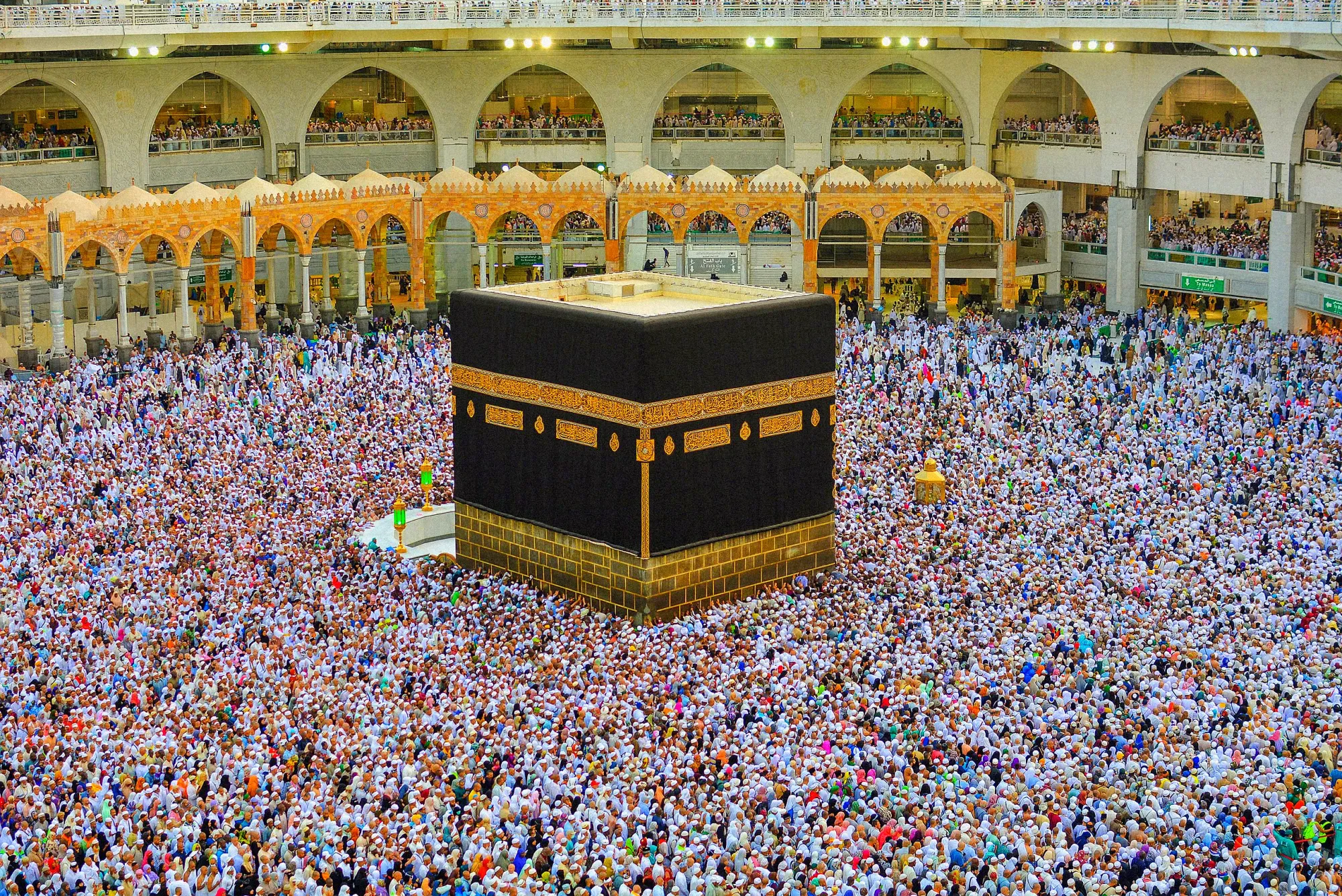
Islam is a beautiful, simple religion that builds trust and community. This is Mecca and the Hajj, where Muslims come from all over the world and circle around the Kaaba. Islam considers itself the ultimate religion because it improves on both Judaism and Christianity.
The Western Empire: The Rise of a Divine Bureaucracy
Now let's focus on the Western Empire. In 476, the Goths destroyed Rome. Why? Because power was now shifting from the empire to the Catholic Church. The empire didn't really have that much power, so it recruited mercenaries to fight for it but couldn't really pay them. In response, the mercenaries went and sacked Rome. By this time, Rome was no longer a power; it didn't really matter anymore.
Augustine, the main architect of the Catholic Church, took Paul's ideas and systematized them. He taught in The City of God that the Catholic Church is out of history; it is beyond history; it is divine. The kings can fight over the land, but it's the church that will decide who goes to heaven and who burns in hell. That's the power of the church.
One thing to remember about Europe is that there are lots of geographic barriers, which allows for diversity. That's why Europe has so many countries; historically, it's been very hard to unify because of the geography. This allows for tremendous diversity and also creates a lot of conflict, which drives innovation.
When the Roman Empire fell in the west, lots of different groups were fighting for the remains. It's important to understand that when we say the Roman Empire rose and fell, that is our understanding. From their perspective, the empire never fell; these warlords thought, "I'm the empire now." They would compete for the legacy of Rome.
Eventually, this led to the rise of a new power: the Franks. The Franks expanded throughout Europe and saw themselves as the heirs to the Roman Empire. But how do you prove that? How do you legitimize yourself? You need to get the Catholic Church on your side.
In about 800, Charlemagne, the king of the Franks, was crowned Holy Roman Emperor by the Pope. From now on, it was the Catholic Church, the Pope, who decided who would be the Holy Roman Emperor. There was negotiation going on, but for the public, the Holy Roman Emperor was always anointed by God.
The Catholic Church, because of its power to anoint the Holy Roman Emperor, became wealthy.
Then Jesus said to His disciples, “Assuredly, I say to you that it is hard for a rich man to enter the kingdom of heaven. And again I say to you, it is easier for a camel to go through the eye of a needle than for a rich man to enter the kingdom of God.”
As I keep telling you, Jesus himself was very anti-rich. He believed that rich people, because they were too focused on material acquisitions, could never go to heaven. But the paradox is that the Catholic Church became extremely wealthy.
If you go to the Vatican and visit St. Peter's Basilica, it is one of the most beautiful buildings in the world. It's extremely wealthy; inside, it's all gold. The Vatican has historically been the wealthiest organization in the world. It was able to do this because Western Europe started to become very wealthy over time.
From about 1000 to 1300, the population of Europe doubled because of technological innovation, a warming climate allowing for better agriculture, the rise of cities, and trade. As Europe became more wealthy, the Catholic Church became really, really wealthy.
The church became a much more powerful idea than the empire. Why?
That's why the Catholic Church became the most powerful organization ever in human history, and it's still true today.
What made the Catholic Church so powerful was that it became a divine bureaucracy. It established a very strict hierarchy. The idea of the church is that God is distant and demands your obedience.
- When you went to church, the priest didn't speak in your language (the vernacular); he spoke in Latin, which you didn't understand.
- You were not allowed to read the Bible, as most people were illiterate.
- The Holy Trinity made no sense, but you weren't asked to debate or question it; you just had to memorize it.
- There were lots of rituals, some of which were very weird, like the Eucharist, where you believe you're actually eating the body and blood of Jesus through the idea of transubstantiation.
- The church could determine who went to heaven and hell and for how long.
- Ultimately, if you were a king and didn't obey the church, the pope could excommunicate you, which meant removing you from the Christian community. Then, any other king could come and kill you, and it would be good in the eyes of God.
This is why the church was so powerful, but it also helps explain why it was so corrupt. They had too much power and ultimately used it to enrich themselves. The people who controlled the Catholic Church were descendants of the Roman nobility. They sold something called indulgences. The idea was, let's say you're a rich person who did a lot of bad things and now you're afraid you'll burn in hell. Jesus would say, "Too bad." But the Catholic Church said, "Give us a lot of money, and we'll give you an indulgence," basically a ticket to purgatory.
There was a lot of corruption:
- Simony: Buying and selling positions in the church, similar to the imperial bureaucracy of China.
- Selling holy relics.
- Priests getting married and selling their positions to nobles.
- Kings appointing leaders of the church.
- Parishioners, no matter how poor, were forced to pay a tax to the Catholic Church, not to the king. As you can imagine, the king was not happy about this.
- The church controlled one-third of all land in Europe, tax-free. This led to feudalism.
The Church's Legitimacy Crisis
Even though the Catholic Church was so powerful, it still had a legitimacy problem. How could it prove it was truly divine?
- The Muslims occupied the Holy Land. If you truly represent God, why is Jerusalem in the hands of the Muslims?
- Muslim Spain was part of Europe but was much more wealthy and innovative than the rest of Europe.
- In 1054, the Eastern Orthodox Church, led by the Byzantines, broke with the Catholic Church because both wanted to be the ultimate center of the world.
- There was widespread corruption.
- Religious leaders were rebelling against the church because they wanted to unleash the divine spark.
There were different solutions. One was that the Catholic Church persecuted Jews. The church allowed Jews to exist just so that it could scapegoat them.Throughout this time, Jews were being persecuted, mainly by being forced out of their homes where they had lived for hundreds of years. A lot of them were forced to go east into the Muslim Empire and to Spain.
It was a source of embarrassment for Christians that their holy land was occupied by Muslims and that they had to pay a tax to Muslims to go there. The Holy Land was being controlled by the Seljuk Turks.
That's why Pope Urban II would eventually call for the Crusades to liberate the Holy Land from the Muslims.
All who die by the way, whether by land or by sea, or in battle against the pagans, shall have immediate remission of sins... O what a disgrace if such a despised and base race, which worships demons, should conquer a people which has the faith of omnipotent God and is made glorious with the name of Christ!
Let those who have been accustomed unjustly to wage private warfare against the faithful now go against the infidels and end with victory this war which should have been begun long ago. Let those who for a long time have been robbers now become knights. Let those who have been fighting against their brothers and relatives now fight in a proper way against the barbarians. Let those who have been serving as mercenaries for small pay now obtain the eternal reward.
This was Pope Urban saying that the Crusades were a chance to go and fight demons. If you fought a demon, it didn't matter who you were—poor, rich, a sinner, a nobody—it was your opportunity to go to heaven. You would all be guaranteed access to heaven, no matter what you did. A lot of people joined the Crusades for different reasons, especially those who had committed crimes before. A lot of the people who joined were criminals because here was their opportunity to get good with the church. That's why we see a lot of abuse during the Crusades.
Lots of people joined the Crusades to liberate the Holy Land, and eventually, they succeeded. Even though many were criminals, they were still very good fighters because they had religious devotion. They were very energetic. Unfortunately, they were too energetic and had a tendency to massacre people when they succeeded because they literally saw the Muslims and the Jews as demons, as the pope had taught them.
One organization that developed during the Crusades was the Knights Templar. This is very important. The Knights Templar was really the first multinational bank. Pilgrims going to the Holy Land needed to bring money with them, but if they carried a lot of money, they'd get robbed. So they would give the money to the Knights Templar, and when they got to Jerusalem, the Templars would give the money back to them. They were a bank, and they used this money to start investing throughout Europe, becoming a very wealthy organization.
The problem was that, being in Jerusalem and away from the authority of the Catholic Church, they started to embrace new ideas. They started to discover the true nature of Jesus from the Muslims and other Christians in that area. The church thought they had become corrupt. That's why their leader, Jacques de Molay, was burned at the stake. In 1307, the organization was banned by the Catholic Church. But many of the survivors went to other places and formed the basis of a secret society we call the Freemasons.
There was also the Albigensian Crusade. There were still individuals who believed in the divine spark, people called Cathars. The church saw them as a threat and launched a crusade against them.
Simon and many of his soldiers made a determined effort to convert the Cathar perfect, but failed.
Again, the Catholic Church's position was that if you disagree with us, it doesn't mean you're a heretic; it just means you're stupid. So first, we want to educate you. But the Cathars believed, "No, the divine spark is in me. I know the truth for myself. You can never convince me."
Ultimately, only three women recanted. The 140 who refused were burned at the stake. Some entered the flames voluntarily, not awaiting their executioners.
If you believe in the divine spark, you've discovered the truth and you're not afraid of death.
In August, the crusade proceeded to besiege the stronghold of Termes... The occupants of Termes suffered from a shortage of water, and Raymond-Roger de Trencavel agreed to a temporary truce. The Cathars were briefly relieved by an intense rainstorm, and so Raymond refused to surrender. Ultimately, the defenders were not able to break the siege, and on 22 November the Cathars managed to abandon the city and escape. By the time operations resumed in 1211, the actions of Arnaud Amalric and Simon de Montfort had alienated several important lords, including Raymond VI of Toulouse, who had been excommunicated again.
What's really important to understand is that the crusade against the Cathars was not just a religious crusade; it was also one of geopolitics, where local lords resented the power of the Catholic Church and so they supported the Cathars.
The response of the church was to establish a new society led by Francis of Assisi called the Dominicans, which went around and basically tried to figure out who the Cathars were by interrogating everyone. This led, of course, to the Inquisition. The idea was that if you disagreed with church orthodoxy, they would figure it out. And if you refused to recant, they would burn you at the stake. At this time, because of the Inquisition and the power of the Catholic Church, Western Europe was one of the least innovative places in the world.
At first, this was fine, but eventually, bad things started to happen in Europe. The Little Ice Age began, then you had the Great Famine, more wars, and then, of course, the Black Death. If the Catholic Church represents the will of God, and all this is happening, then is God really happy with the Catholic Church?
The Black Death killed about a third of the European population. Because people were religious, they thought this was the will of God. It was because the Catholic Church was corrupt, evil, and stagnant that God was punishing them.
This led to conflict within Europe, where the Catholic Church actually broke into different parts. Some believed that Rome was the true center, while others believed that Avignon was the true center. This created even more legitimacy problems.
Then, individuals emerged to challenge the orthodoxy of the Catholic Church. There was Fra Dolcino. There was John Wycliffe, a British person who was not punished when he was alive, but after he died, they decided he was a heretic, so they dug up his body and burned him at the stake to make sure he burned in hell. Jan Hus would lead a revolution, leading to the Hussite Wars.
None of them succeeded. But then another man would emerge, Martin Luther, who would eventually lead a successful revolution against the Catholic Church. This is called Protestantism.