Civilization #41: Dante's Quiet Revolution
The Renaissance was an intellectual revolution in Europe that would ultimately change the fate of the continent. It was a re-imagining of classical Greece in a Christian European context. The Renaissance combined classical Greece with Christian Europe to create modernity. The ideas and values that underpin modernity—the world we live in today—start with the Renaissance.
So, how did the Renaissance start? Scholars today believe it was a perfect storm of cultural, historical, and economic trends. However, I will argue that one factor is often missed, and it is the main factor in the creation of the Renaissance: Dante Alighieri. I believe that Dante's The Divine Comedy is what ultimately sparked the Renaissance. Without Dante, this revolution would not have been possible.
First, let's review the scholarly mainstream argument before I present my own.
The Perfect Storm: Mainstream Theories on the Renaissance
The mainstream scholarly view is that several key factors coalesced to create the conditions for the Renaissance.
- The Decline of Constantinople: For hundreds of years, Constantinople was the epicenter of European culture and the heir to the Roman legacy. But as the Ottoman Turks began to encroach on Byzantine territory, many scholars and major thinkers of the Byzantine Empire started to shift back to Europe. They brought with them the works of Plato and Aristotle.
- The Crusades: The Crusades were a time when Europeans encountered the Muslim world en masse. As a result, they absorbed a lot of the culture and politics of the Islamic Golden Age.
- Italian City-States: In Italy, many different city-states were in competition with each other. This created something called open cooperative competition, which leads to innovation. Because these city-states were always at war, everyone was a participant in history. If you are a bureaucrat in an imperial bureaucracy, you can stand outside of history and observe it. But if you are a participant, you are fighting wars and engaging in politics, always thinking about the relevance of your theory to reality. The three major city-states that gave rise to the Renaissance were Florence, Venice, and Genoa.
- Trade and Commerce: Venice and Genoa were known for their slave trade with the Muslim world. Through this trade, they brought back the books, ideas, and values of the Islamic world into Europe. These three city-states became extremely wealthy, which allowed them to patronize the arts.
- The Rise of a Merchant Elite: In Florence, a merchant elite emerged, most famously the Medici family. This was important because previous elites were either from the warrior class or the priest class. A warrior wins legitimacy on the battlefield; a priest's legitimacy comes from God. But if you're a merchant elite, where does your legitimacy come from? Because of this question, the Medici were forced to patronize the arts on a massive scale.
- Crisis in the Catholic Church: From 1305 to 1378, there were actually two popes in Europe. The papacy moved to Avignon, creating a crisis of legitimacy and authority in the Catholic Church. As a result, the pope didn't have significant authority over Italy.
- Universities and Monasteries: These institutions were places of theological debate and discussion. They stored the classics, and this is where many new ideas would come from.
- The Printing Press: Around 1440, a man named Gutenberg invented the printing press, which allowed for the rapid dissemination of literacy and knowledge.
These various factors coalesced to mark an intellectual revolution in Europe. However, if you look at all the major figures of the Renaissance—Raphael, Galileo, Boccaccio, Michelangelo—the person who was born the earliest is Dante, in 1265. This is a good clue that perhaps it was Dante who sparked the Renaissance, that he's the secret sauce that made it possible.
The Medici: Patrons of a New Age
By the year 1000, Europe was becoming prosperous and engaging in commercial trade. The problem was how to facilitate it. If England has a lot of cotton and France has a lot of bananas, but England doesn't want bananas, they cannot trade. The only way around this is by creating a currency that everyone wants: gold.
In Florence, they created the gold florin. Because it was mainly gold and so prestigious, everyone wanted it, and the florin became the currency of European trade. The family that most benefited from the status of the florin was the Medici family. Cosimo de' Medici, the founding patriarch of the family, pooled the resources of rich people in Florence to create a bank. Merchants could borrow from this bank, and he set up branches throughout Europe to facilitate and underwrite European trade. He got a cut of all this trade, and as a result, the Medici family became tremendously wealthy and created the Medici dynasty. From this family, four popes would emerge.
As a merchant family, they had a legitimacy problem. They didn't win their wealth on the battlefield and didn't represent God; they just had a lot of money. To legitimize themselves, they went on a massive spending spree to make Florence the cultural capital of Europe. They funded massive architectural projects, like the Santa Maria del Fiore, which is still the fourth largest church in the world.
They also patronized artists. The most famous artists of this time were patronized by the Medici family. Michelangelo lived with the Medici family for a while. Leonardo da Vinci is considered the archetypal Renaissance man. You also have Botticelli and Donatello. The Medici patronized every single one of them.
The Printing Press and the Spread of Ideas
As the Medici were patronizing art and culture in Florence, the printing press was being invented by Gutenberg in Germany. The printing press marked a revolution of literacy in Europe. The press first arrived in Venice in 1469. Only 30 years later, there were 417 printing presses in the city—think of these as publishing houses. In the first 50 years, 20 million volumes of books were printed in Europe. The printing press democratized knowledge. Everyone now had access to Plato, Aristotle, and the Bible.
They were reading some of the major thinkers of the Renaissance. In poetry, there were three major poets: Dante, Petrarch, and Boccaccio. You also have Niccolò Machiavelli, whose most famous work, The Prince, is one of the first political treatises in the world. It asks, how do you best govern a state? We remember The Prince for its almost amoral strategy on how to rule, but we need to remember that Machiavelli himself was a staunch democrat. He believed the people needed to have a say over the affairs of Florence and, as a result, came into conflict with the Medici, who tortured him. He wrote The Prince to raise awareness about politics, believing that for a well-functioning republic, everyone needs to understand how politics works.
From Florence, you also have Galileo, the father of science.
The Philosophy of Humanism
The value system that underpins all this artistic production is the idea of humanism. How is humanism different from Christianity?
Humanism represents a radical reorientation of focus from the afterworld to the here and now. Christians care about what happens in heaven; humanists care about what happens today. How do we make the most out of today? How do we make the world a better place? Humanism was a return to the values and belief systems of classical Greece.
From Idea to Story: The Revolution in Art
This transition happened mainly through art, specifically through a transition from a focus on ideas to a focus on stories.
If you look at classical Greek sculptures, the thing that stands out is the motion, the tension, the emotion. There's a story being told. You can almost feel that the person is alive and thinking. Your mind, in conversation with the sculpture, imagines what happens before and after. You are making the sculpture alive with your imagination.
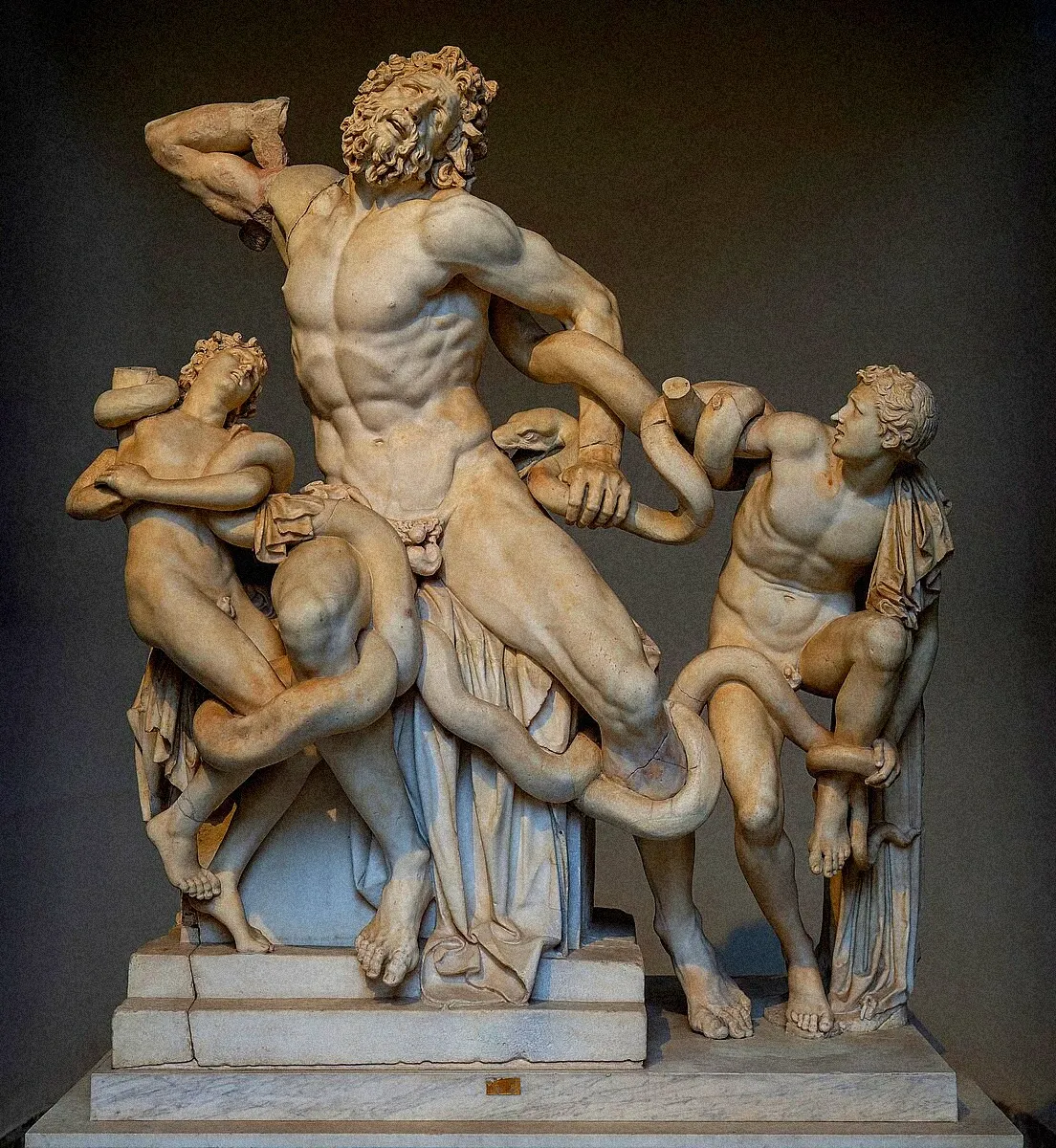
By the time we hit medieval Christianity, the very concept of art changes. It becomes more of an idea. Artwork from the Carolingian Renaissance, for example, is much more static. There's not really a story here; what's being conveyed is an idea. There's no space for you to imagine what's going on.
The main artwork during the medieval Christian period was stained glass windows. When a priest talked about the stories of the Bible, he used these pictures to illustrate his point, as most people were illiterate. The effect created in the observer is blinding and awesome. The light coming through the windows makes the pictures holy, illuminated. You're forced to stand back. It's blinding because it's hard for you to imagine what's going on. The purpose of this artwork is to make you submit before the power of God. You're not here to participate; you're here to submit. The idea is to represent the eternity, the awesomeness, the mystery that is God.
By the time we hit the Renaissance, the attitude is completely different. We go from blinding and awesome to compelling and curious.
Leonardo da Vinci's The Last Supper
Leonardo da Vinci's The Last Supper is a work of genius. It is compelling because you are drawn into the picture due to its depth. The picture moves backward and forwards, and because of this motion, you are drawn in. The table is too small for 13 people and much too thin. Your eye believes the table is expanding outwards, so you feel like you are part of the picture.
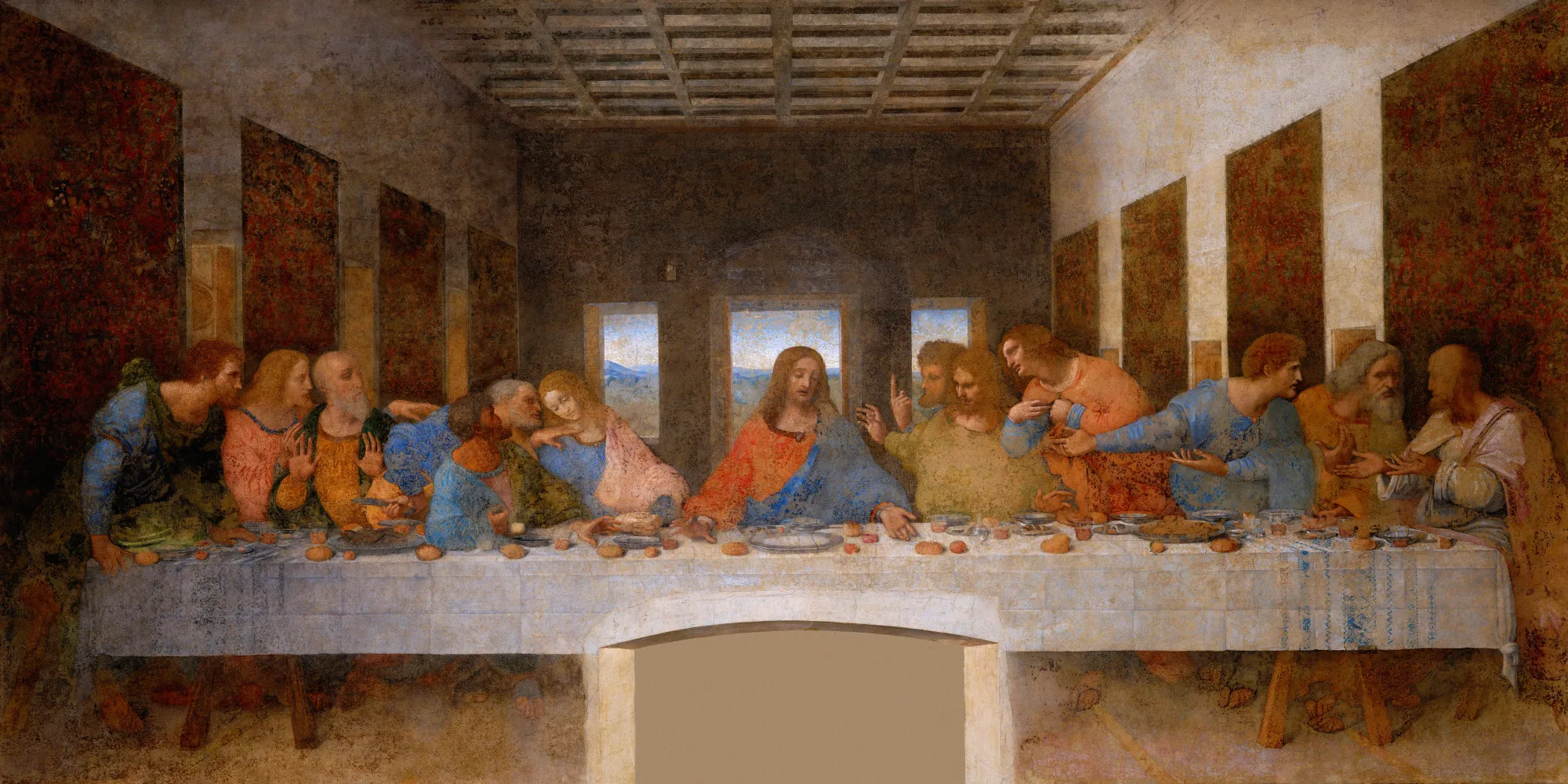
It's also curious because there's a lot of tension. In the story, Jesus reveals that someone, Judas Iscariot, has betrayed him. The next day, Jesus will be arrested and crucified. Once Jesus announces this, everyone becomes anxious: "Is it me? Am I the betrayer?"
This painting is a radical departure from medieval Christian art. If you look at previous depictions, they are much more static and organized. Most importantly, they emphasize the idea of holiness with a halo surrounding each person. What Leonardo has done is taken out the divine and left the humanity. There are no halos. These are first and foremost humans, not divine figures.
In da Vinci's work, it's not obvious who the betrayer is. Everyone is afraid that he or she is the betrayer. This forces you, the observer, to investigate the details to figure out who is who. The focus is on human anatomy and facial expressions. Da Vinci believed that hand motions are a window into the soul of a person. You can see how the hands are all in different motions, signifying different personalities and thoughts.
The man who is ultimately responsible for the betrayal is Judas Iscariot, and you can see how da Vinci, with subtlety, emphasizes his betrayal. He's darker than the other individuals, turning away from the light. In his hand, he's clutching some silver coins. His neck is emphasized because of the tension; he can't breathe. Everyone else is talking anxiously, but he cannot bring himself to talk.
What's amazing is the mathematics behind the painting. If you look at where the hands and the bread are and map it onto a music sheet, you can actually play the music. The configuration of the apostles is 3-3-1-3-3. If you look for the passage 3:31-33 in the book of Lamentations in the Bible, you get this quotation:
For no one is cast off by the Lord forever. Though he brings grief, he will show compassion, so great is his unfailing love. For he does not willingly bring affliction or grief to anyone.
The idea here is that God will always love you. God is love, incapable of hating you. He will always find a way to forgive you. This is the very idea of The Divine Comedy. Leonardo da Vinci is getting this idea from Dante, and it is the backbone of The Last Supper. Jesus knows he's been betrayed by Judas, but look at him: he's calm, reassured. He's already forgiven Judas. There's no hatred or anger in him. The anger and hatred belong to everyone else.
Raphael's School of Athens
The actual name for Raphael's painting is not School of Athens; it's called Philosophy. It was commissioned by Pope Julius II to decorate his papal apartments in the Vatican. If you go inside his apartments today, there are four major fresco paintings. The first is Philosophy, and right beside it is Religion. Religion and philosophy balance each other out. Across the wall are two more paintings: Poetry and Law. This represents the very ideal of the Renaissance: open-mindedness, exploration, and holistic learning.
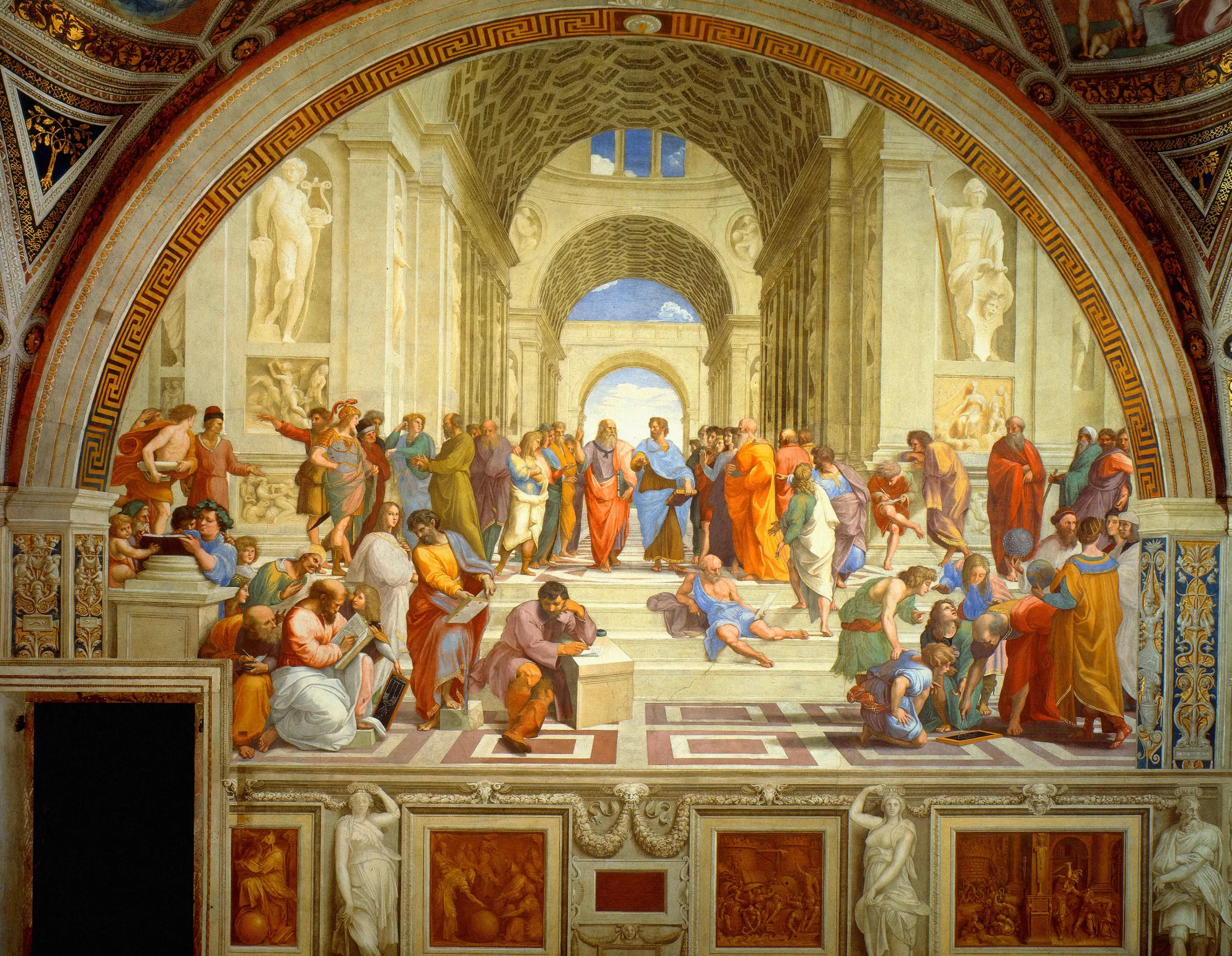
At the very center are two figures: Plato and Aristotle. We know this because they are holding two books. Plato holds the Timaeus, where he discusses the realm of the forms. Aristotle holds his Ethics, about how to lead a good life. You can see they are having a debate. Plato is pointing upwards, saying what matters is heaven. Aristotle gestures downwards, saying no, what matters is here on earth. Their colors also reflect this: Plato wears white (air) and red (fire), which are spiritual colors. Aristotle wears blue (water) and brown (earth). This debate underpins Western philosophy even today.
As they walk, they are splitting the world in two. There are philosophers who support Aristotle and focus on earthly matters, and there are those who support Plato and focus on spiritual matters. You see Pythagoras, a spiritualist concerned with mysticism. You see Euclid, one of the inventors of geometry, focused on using science and logic. You have Zoroaster, the founder of Zoroastrianism, concerned with the heavens, and Ptolemy, who investigated how the planets move, concerned with the earth. Raphael is acknowledging that there are two different realities—the material and the spiritual—and they're both important.
What's amazing is that Raphael includes a self-portrait. He inserts himself into the painting, listening in on the conversation. Remember that Christianity focuses on humility and self-negation. But Raphael is reinserting himself into the world, celebrating his curiosity and his humanity. Where does he get this idea from? From Dante, who makes himself the hero and focus of The Divine Comedy.
The conversation between Plato and Aristotle is a visual representation of The Divine Comedy. In the poem, Virgil and Dante are engaged in a vigorous debate about the nature of love and sin as they walk and talk to other historical figures. This painting is directly inspired by Dante.
Raphael also inserts his friend, Michelangelo, who is known for being reclusive. Michelangelo is conflated with another historical figure, the philosopher Heraclitus, who was also known for not enjoying the company of others. This picture is a celebration of the immense diversity of human thought and personality—a celebration of what it means to be human.
Dante's Theological Revolution
These paintings leave us with a fundamental question: how did Dante spark the confident self-exploration and triumphant self-expression of the Renaissance? He did so by re-imagining our relationship with God, which was a fundamental question in Europe at this time. Intellectuals were grappling with three major questions:
- What is God?
- What is the nature of the relationship between God and humans?
- How can we best worship God?
These can be distilled into one question: Why did Jesus have to die?
Why Did Jesus Have to Die?
The first idea was put forth by Paul. God created us and gave us paradise, but because we were arrogant and proud, we wanted to become like God by eating from the Tree of Knowledge. Because we disobeyed God, He had no choice but to banish us from the Garden of Eden. Jesus had to come to earth and sacrifice himself because, without God, we humans can only commit more sin. To redeem us and beg for forgiveness, Jesus sacrificed himself. This sacrifice made God relent and forgive us, cleansing us of our sins.
The problem, however, is that as Christianity grew, the divinity of Jesus expanded. By the time of Tertullian in the second century, he argued for the Holy Trinity: that God, Jesus, and the Holy Spirit are separate but equal. Jesus is God. Now you have a problem. If Jesus is truly God, why did God have to kill himself?
Another Christian theologian, Origen, proposed the ransom theory. When we were cast from the Garden of Eden, we became subject to Satan. We became his slaves, his property. The only way for God to redeem us was by ransoming us from Satan, by offering something so valuable that Satan would be willing to make a trade. God offered his life. The trick, though, is that God cannot be killed because He is eternal and perfect. So, God tricked Satan. But what's really important is this: before, we were slaves to Satan; now, we are slaves to God.
This very idea was expanded upon by Augustine to create the intellectual blueprint for the Catholic Church. The main idea is that because God ransomed us, we are now his slaves and must obey and submit.
[W]hen man lives by the standard of man and not by the standard of God, he is like the devil.— Augustine, City of God
When we use our imagination or intuition, we are like Satan. At our core is the essence of Satan. It is only by submitting ourselves to God that we are freed from Satan's influence.
Could anything but pride have been the start of the evil will?— Augustine, City of God
Why did we disobey God? Because of pride. There's an arrogance to us that is the essence of Satan.
[Adam's] was a venial transgression when he refused to desert his life's companion, even though the refusal to entail companionship in sin.— Augustine, City of God
Adam ate the fruit because of his love for Eve. Therefore, love can only misguide you, trick you, and lead you down an evil path. Do not trust your intuition, your imagination, or your love of others, especially women.
The will derives its existence as a nature from its creation by God; its falling away from its true being is due to its creation out of nothing.— Augustine, City of God
Why are we like the devil? Because we were created out of dust, out of nothing. We are inherently flawed. We must deny who we are and submit ourselves to the glory that is God.
We see then that the two cities were created by two kinds of love: the earthly city was created by self-love reaching the point of contempt for God, the Heavenly City by the love of God carried as far as contempt of self.— Augustine, City of God
This is the core idea of the Catholic Church: self-denial, self-negation. You can understand now why the Islamic world raced ahead of Europe. In Europe, people were paralyzed, afraid to do anything because they couldn't trust themselves. Eventually, the contrast was so great that even the Catholic Church had to admit there were problems with Augustine's theology. It led to corruption, stagnation, and inequality.
The man who would ultimately free Europe from the grasp of Augustine was Dante. Through his poetry, he would reimagine the human relationship with God.
The Divine Comedy: A New Theology
In The Divine Comedy, Dante makes a major assertion.
The greatest gift the magnanimity of God, creating, gave, the gift most suited to His goodness, gift that He most prizes, was the freedom of the will.— Dante, Paradiso, Canto V
When God created us, to show his generosity and goodness, he gave us the gift that He most prizes: freedom from Him. You are of God, but now you are free of God. You can do whatever you want. The central idea is that what makes us fundamentally human is the freedom of the will—that we can choose the life we lead.
In Canto 7 of Paradiso, Beatrice and Dante are in heaven, engaged in an intellectual discussion. They are trying to figure out why Jesus had to kill himself. Dante is going to propose a new theory that will radically reimagine our relationship with God.
Beatrice explains that God wants to save us, but why did He have to kill himself? She says this can only be understood if you truly love someone. It's only through love that you can acquire wisdom, empathy, and imagination.
The godly goodness that has banished every envy from its own self, burns in itself and, sparkling, so it shows eternal beauties. All that derives directly from this goodness is everlasting, since the seal of goodness impresses an imprint that never alters.— Dante, Paradiso, Canto VII
God is love itself. When God creates, what He creates is also perfect.
Only man's sin, man's liberty, makes him unlike the highest good, so that in him the brightness of His light is dimmed.— Dante, Paradiso, Canto VII
God is the light that burns in us and allows us to love others. When we love others, the light burns brighter. That's how we celebrate God. But we also have the freedom of the will. When we choose to commit sin, we are turning away from God and dampening the brightness in us.
And man cannot regain his dignity unless, where sin left emptiness, man fills that void with just amends for evil pleasure.— Dante, Paradiso, Canto VII
When you commit a sin, you must make amends. But sometimes you can commit a sin so terrible that the light leaves you. That's what happened in the Garden of Eden. The original sin was so terrible that Adam doomed all his progeny to darkness. How can we be forgiven? There are two possibilities. Either God simply had to pardon man through His mercy, or man had to offer payment for his folly.
If God just forgives us, we learn nothing. We haven't grown. But if we try to redeem ourselves, our crime was so great—we denied the love of God—that there is nothing we could give God that would redeem us. That's the paradox.
[M]an, in his limits, could not recompensate; for no obedience, no humility he offered later could have been so deep that it could match the heights he meant to reach through disobedience. Thus, man lacked the power to offer satisfaction by himself.— Dante, Paradiso, Canto VII
We wanted to become God and then kill God. That was the original sin. How can you ask for forgiveness if the crime is to kill God?
For God showed greater generosity in giving His own self that man might be able to rise than if He simply had pardoned... For every other means fell short of justice, except the way whereby the Son of God humbled Himself when He became incarnate.— Dante, Paradiso, Canto VII
For thousands of years, God had to think of a way to forgive us but also ensure we would not do anything like this ever again. The path He chose was to sacrifice Himself.
Imagine I have a daughter named Eve and a favorite dog named Johnny. I love them both. Eve, because she's young, decides she only wants my love, so she purposefully kills my dog. What do I do? If I just say, "Don't worry about it," she will probably go on to hurt someone else. I have to teach her a lesson. But if I punish her, that might suggest I don't truly love her. So, after much thought, I choose to punish myself on behalf of Eve. I take a whip and hit myself. My hand is bleeding. When Eve sees this, she has to cry and feel remorse for what she did. She also cries because she knows I truly love her.
That's what Beatrice is saying. God loves us so much that He is willing to do everything to teach us to be better human beings.
The conversation continues. If God created us and loves us, why are we making mistakes? Why are we dying and in pain? Beatrice explains that God did not directly create animals and plants; He created the laws of the universe—the atoms, the essence—that would give rise to them. And so, they are not perfect. They were meant to die so that new creations could emerge.
But your life is breathed forth immediately by the chief Good, who so enamors it of His own self that it desires Him always.— Dante, Paradiso, Canto VII
What about humans? We have a dual nature. We are both created from the laws of the universe and created by God Himself. When God created Adam, He created him out of dust, but then He breathed life into him. The essence of God is within us. Our bodies are mortal, but our souls are immortal. Our souls have the essence of God, which is love. The more we love, the more the light burns in us, and that light will allow for our resurrection.
The best way to celebrate God is by loving others. When you love others, you are activating your imagination, learning wisdom, and gaining experience. That will only cause the light to grow. The purpose of life is to celebrate God by celebrating the God in you—by loving someone else so wholeheartedly that your imagination and wisdom grow, and your soul becomes eternal.
The Spark of Modernity
The Italian Renaissance was a reimagining of Greek civilization. Let's look at the similarities to understand how creativity happens.
- Open Cooperative Competition: Classical Greece had competing city-states where ideas could flow freely, just like Renaissance Italy.
- Literacy and Egalitarianism: In classical Greece, they transitioned from Linear B, a complicated script, to the alphabet. This allowed for massive literacy and the transfusion of knowledge. A creative society must be egalitarian, allowing anyone to learn and express their ideas. The Italian Renaissance did this by transitioning from Latin to the vernacular. It was Dante who allowed this to happen. He purposefully chose to write in Tuscan, a local language, not Latin. Because he did that, he made Tuscan the official language of Italy and made The Divine Comedy accessible to common people.
- The Great Poet: The perfect storm of factors doesn't matter unless you have a great thinker to create the spark. In Greece, they had Homer, the father of Western civilization. In the Italian Renaissance, you had Dante, the father of modernity. The values he expresses in The Divine Comedy—especially the idea of individuality and humanism—became the basis for modernity. An individual is someone who celebrates himself and pursues his curiosity to explore the world, and in this process, creates goodness, truth, and beauty.
The ultimate secret of the universe, which both Homer and Dante express, is this: Love is the unifying force of the universe. The imagination is the animating force. What gives life to the world is not God, but our imagination. By imagining the world, the world becomes alive.
This idea is most visually expressed in Michelangelo's The Creation of Adam.
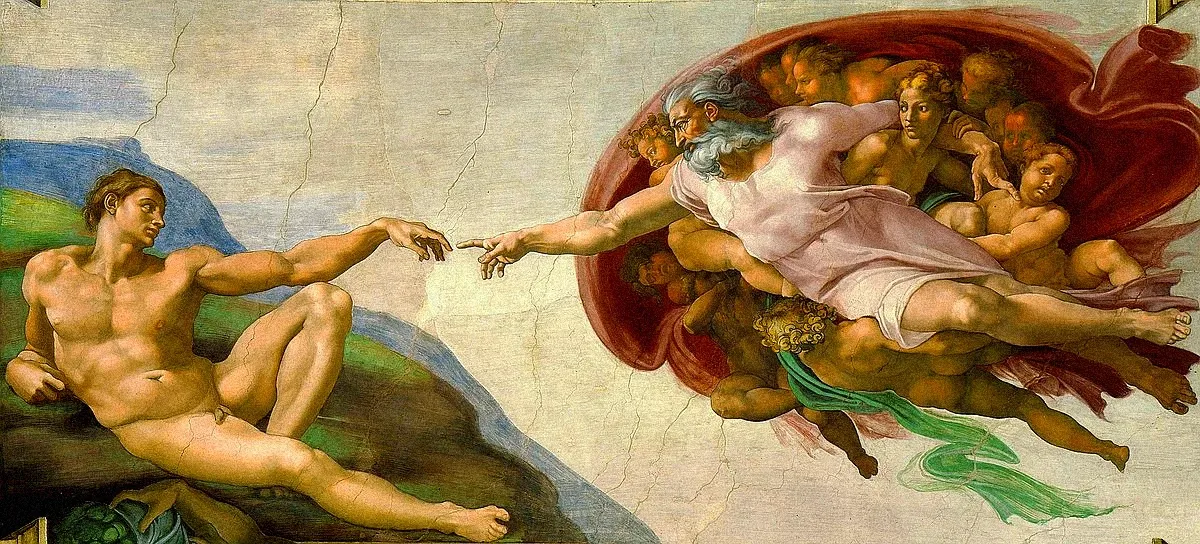
There are two ways of understanding the title. The first is the typical way: God created Adam, and they are equals. You can see their two worlds are almost equal. But you can change your perspective and say the title really means God is Adam's creation. God is what we created from our imagination.
Look at God, surrounded by his angels. If you take them away, what do you have behind them? It is a picture of the human brain. The stem, the shape—it's the human brain. This means that God is an emanation from our imagination. Not the true God, which is like light itself, love itself. But this God has given us the capacity to imagine, so we've imagined another god to take the place of the real God. The real God is the human imagination, the human mind. That's what gives life to the universe.
If you think about it, this is a radical revolution in human intellectual history. And where is this painting? It's on the ceiling of the Sistine Chapel in the Vatican, at the very heart of the Catholic Church. What Dante was able to do was destroy an empire peacefully through the power of poetry, subtlety, and love. Dante influenced Michelangelo, who took his ideas and planted them within the very heart of the Catholic Church, and thus reinvented it. That is the power of love. That is the power of the imagination.