Civilization #54: The German Will to Power
The Unity of Will
We will do Germany and thus conclude our discussion of the four great civilizations that are fighting for global dominance.
Russian civilization is very distinct from Anglo-American civilization, and German civilization is also distinct as well. We're going to focus on the idea of unity of will in German civilization. We don't know much about German civilization because they were defeated in World War II. Because the Anglo-Americans control the history of the world, we tend to think Anglo-American civilization is superior to German and Russian civilization. But what I will show you is that in many respects the most advanced civilization that humans have ever created is actually the German civilization.
The Paradox of Prussia
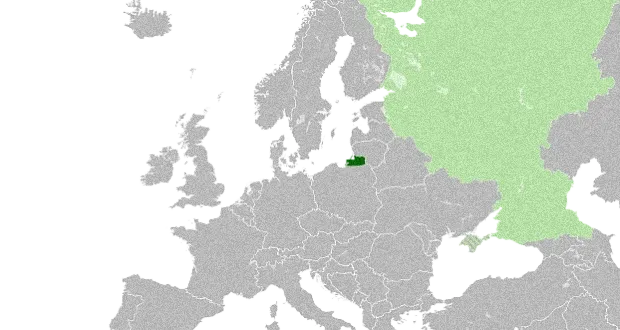
If you look at a map in Europe, there's a really interesting fact that may surprise you. The green is Russia. It's the largest country in the world. Over here are the Baltic nations. Over here is a place called Kaliningrad. It's actually Russian. The question then is: how did this come to pass? How was it that you've got this colony of Russians far away from the motherland?
The answer is this, because historically this was not Russian. Historically, this was a place called Königsberg, which was part of a nation that no longer exists called Prussia. For a couple hundred years Prussia was the strongest military, the most advanced civilization in the world. Now it's disappeared. It's been replaced by Poland and parts of Belarus, and West Prussia has all become part of Germany. But Prussia is extinct.
The reason why is that in World War II the Allies who won the war, the Soviet Union, the British and Americans, decided to destroy Prussia. The rationale was that Prussia is a militaristic society that is hell-bent on world domination. By eliminating Prussia, we can now bring peace to the world. The problem, though, is that Königsberg, which is now Kaliningrad, was really the center of civilization for a few decades.
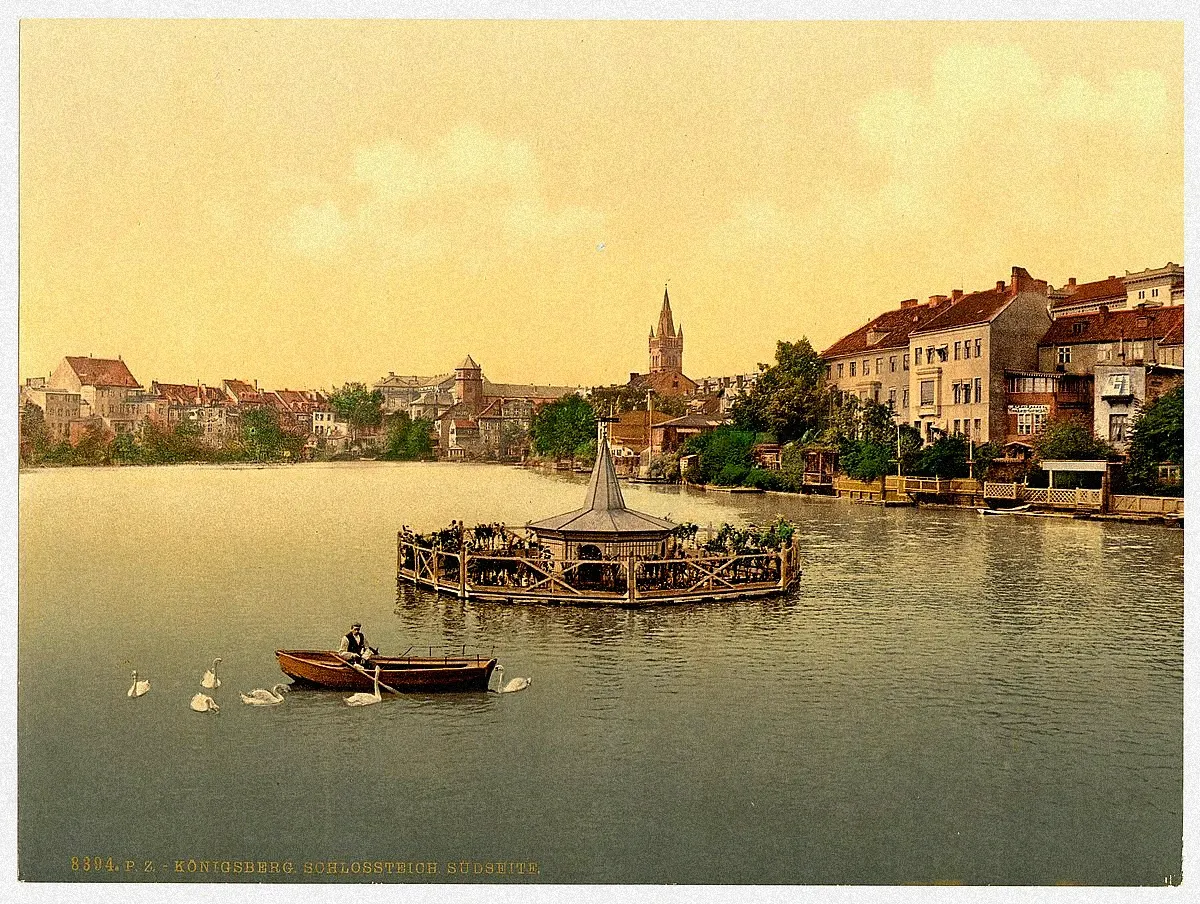
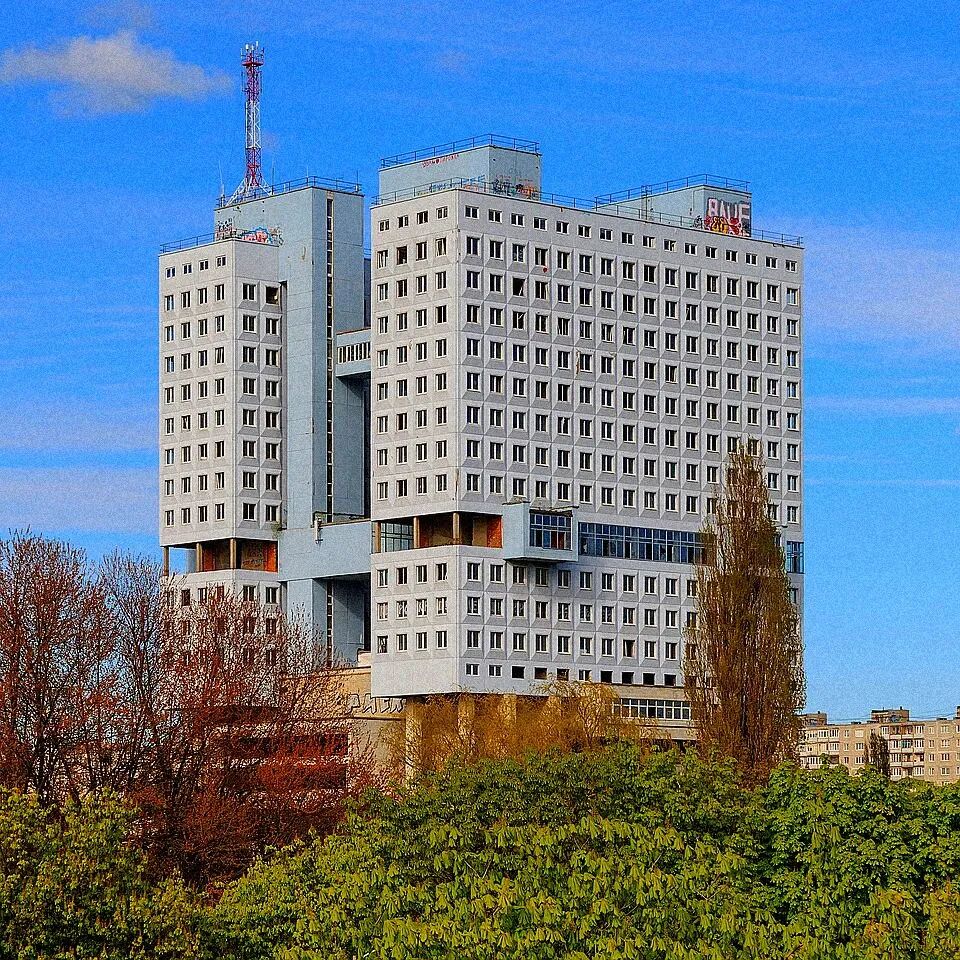
This is Königsberg in the 1800s. As you can see, it's a beautiful port city by the Baltic Sea, and it was really the apex of human civilization. Then of course World War II happened, and then after World War II Königsberg was destroyed. It was turned into rubble. Today it's like this, Kaliningrad. A very Soviet, stale city with no character, with no culture, with no civilization. That's the intent, to destroy Königsberg, which was for the longest time the heart and soul of German civilization.
It is true that Königsberg and Prussia were an extremely powerful military nation. This is from Wikipedia, by the way. As you can see, there are many great generals and officers who are from Königsberg. We're talking about the city. We're not talking about the nation Prussia. We're talking about the city of Königsberg. But you will also see that there are many intellectuals, writers, who come from Königsberg. The most famous of these intellectuals is Immanuel Kant. He basically changed the course of Western history with his philosophy. Königsberg was the birthplace of Immanuel Kant.
How is it that the man who is most responsible for the Enlightenment happens to be born in a militaristic nation? That's a question. But not only Immanuel Kant, but you have also many other great thinkers, including Hannah Arendt, who is a Jewish philosopher and who is considered one of the greatest political philosophers of the 20th century. She's also from Königsberg. Just an amazing group of scientists as well as mathematicians. Then of course you have musicians and artists. The contribution of Königsberg towards civilization cannot be overstated.
There are quite a few Jews who lived in Königsberg. Königsberg for the longest time was considered one of the most tolerant cities in Germany for Jews. Let's now look at Nobel Prize winners in the sciences, physics, chemistry, and medicine.
- In 1925 the majority were actually from Germany. Germany had the best scientists in the world.
- 1933, same thing.
- You go to 1950, same thing.
- In fact, by 1975 Germany is still dominant. The United States is catching up. It's only by about 2000 when the United States starts to overtake Germany.
Again, the question then is: how is it possible for a militaristic nation hell-bent on world domination, how are they able to produce so many great scientists, so many great philosophers? This is a very famous quote from Voltaire that captures the prejudice of the West against Prussia:
Where some states have an army, the Prussian army has a state.
This is pretty insulting to Prussian culture. We've looked at many civilizations that are militaristic, including the Romans, Spartans, Aztecs, Macedonians, and Qing Chinese, among others. They're extremely successful militarily, but guess what? They were not creative. In fact, they were anti-creative. So, how is it possible for the Prussians to be both creative and militaristic?
The answer is because the Western prejudice against Prussia is wrong. They were not a militaristic nation bent on world domination. They were first and foremost a creative, humanistic society that was forced into military confrontation with neighbors because of its geographical location.
The Rise of Prussia
Let's go back to the history of the Holy Roman Empire. The Holy Roman Empire was a confederation of German city-states. There were like thousands and thousands of them that were in competition with each other. Over time, because of competition from the more powerful states like France, Poland, Lithuania, Russia, Sweden, these city-states were now forced to gel together. The most successful of these city-states is Prussia.
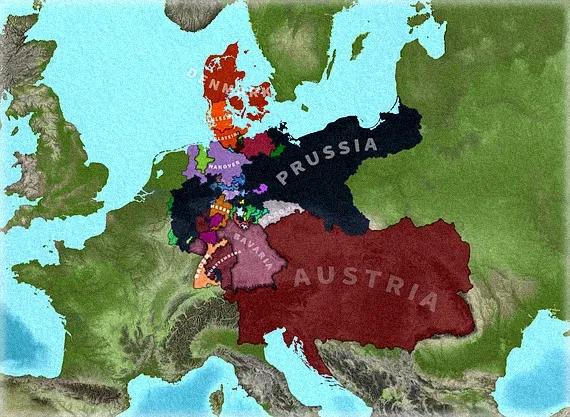
For the longest time Prussia was a vassal state of the Polish-Lithuanian Commonwealth or the Swedes. But by about year 1700 it started to come into its own through great military leadership. It started to spread out. As you can see, it's spreading out really quickly because of its military victories and because of its high culture. By the 19th century Prussia has dedicated itself to uniting all of Germany. It starts a series of wars that allow for the unification of all the German people.
- The first is something called the Danish-Prussian War.
- Then they fight against the Austro-Hungarian Empire, which is a successor to the Holy Roman Empire. They defeat the Austrians really quickly.
- Then they move on to France, which is the dominant power of this time. They defeat France, thus allowing for the complete unification of Germany under Prussian leadership.
How was Prussia able to be so successful? There are certain characteristics about these city-states that go on to unify a nation. The three major ones that Moscow and Prussia share are:
- Open cooperative competition. They're surrounded by enemies and they're forced to be innovative, open, and tolerant in order to succeed. They're forced to be unified.
- Advantaged by disadvantage. Prussia and Moscow have limited resources, which forces them to focus on human capital, on making sure the citizens were well educated and the citizens were hardworking.
- Vassalage. Moscow was under the vassalage of the Mongols, and Prussia for the longest time was under the vassalage of the Swedes, the Poles, Lithuanians. As a result, they're always engaged in a process of reflection and resilience. That's really the secret to the success of Prussia.
At the same time, the thing to remember about the Prussians that differentiates them from the Muscovites is, because Prussia is situated within Europe, it has a very different attitude towards humans than the Muscovites. The Muscovites, because of their Mongolian heritage, tend to oppress their subjects, whereas the Prussians are much more democratic, they're much more progressive, they're much more open.
Frederick the Great and the Enlightened State
This is Frederick the Great, who is considered the great nation-builder of Prussia through his military victories. What is often ignored is his social, economic, political reforms. He really is the first enlightened despot. He's heavily influenced by Immanuel Kant. They thought very highly of each other. He was very intent on making Prussia the first enlightened state of Europe. Let's look at the few things he did.
- He radically reformed the Prussian judicial system so that you had rule of law, so that everyone had recourse to justice. Even if you were poor, you could still sue.
- He abolished torture in the military. This is revolutionary at this time because it was always assumed that you kept your soldiers in check by scaring them.
- He established religious tolerance. Remember, at this time in Europe, there's a huge war going on between Catholics and the Protestants. He was tolerant towards both the Catholics and the Protestants, and even to a certain extent to the Jews as well. Over time, Königsberg, which is the heart and center of the Prussian nation, has one of the largest Jewish settlements in Europe. About 5,000 at that point.
- He grants a basic form of freedom of speech.
- The most important thing is that in 1763, he establishes a public school system that becomes a source for Prussia's future greatness. To put this in context, it's only over 100 years later when Britain and France do this. Japan and America will copy, just basically steal the Prussian education system.
Reform and Resilience After Napoleon
In 1806, Prussia is defeated by Napoleon. As a result, Prussia becomes a vassal state to Napoleon. At this point, what the Prussians do is what they've always done, which is engage in a deep process of reflection. They decide that in order to defeat France, they must be like France. Remember, this is the French Revolution, and there's a spread of liberalism throughout France because of the revolution. The Prussians decide to copy the most important reforms of the French Revolution, which include:
- The abolishment of serfdom. Now peasants can become landowners.
- They destroy monopolies to encourage free market competition.
- They open the civil service to the middle class. Before it was only available to the nobility.
The most important thing is the reforms of a man named William von Humboldt. He creates the modern research university. He founded something called the Berlin University. He conceptualized the research university where before you sat in class and you listened to lectures and you memorized what the professor told you, but now you're encouraged to do your own research, to write a thesis, which is what we do today. The most important reform he did was to conceptualize public education as a meritocracy, as an opportunity for the middle class to grow. To grow the middle class and to give the middle class a greater economic role in society. These reforms in only a few years will allow Prussia to defeat Napoleon and establish itself as a great power again.
This is Carl von Clausewitz, and he's considered the greatest military strategist of all time. He's Prussian. He was an officer in the Prussian military, and he thought very deeply about the wars of Napoleon. Why is it that Napoleon and the French were so great? His conclusion is because they were able to mobilize the resources of society for total war. His conclusion is that in the future, as a nation, if you want to win militarily, then you must engage your citizens. You must increase the morale of your citizens. You must make them want to die for your nation.
The 1848 Revolutions and the Prussian Response
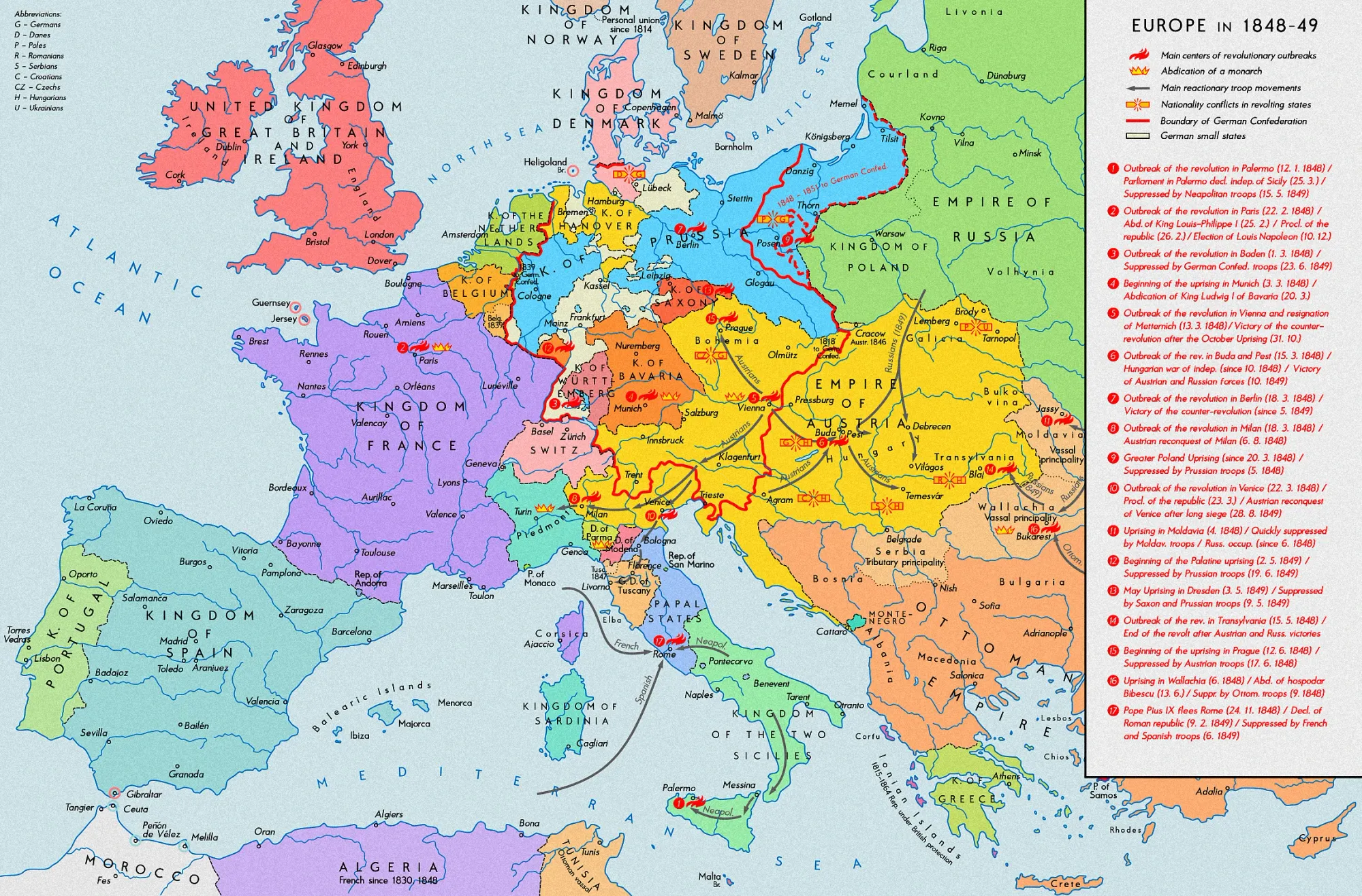
1848 is one of the most important years in human history. The reason why is, in 1848 these red spots, these are all revolutionary hot spots. After Napoleon was defeated in 1815, the European powers led by Metternich of the Austro-Hungarian Empire sit everyone down and decide, first of all, how to ensure no wars like that of Napoleon arise again in Europe, how to create peace, but also, most important, how to maintain the feudal structure of Europe. They were very successful at that until 1848 when the middle class, when the workers rebelled in 17 different places.
You will notice that in Britain there was no revolution, there were no rebellions. The reason why is because Britain at this point had colonies overseas, Canada, New Zealand, Australia. These people who were upset about their status in Britain could migrate elsewhere. But these other places didn't have any colonies. There was no pressure valve for social discontent, and so these revolutions start to take place. A lot of these revolutions were suppressed violently. You would think that Prussia, because it is a military dictatorship, would suppress the middle-class liberals violently. But that's not what happened. Let's see what happened. This is from Wikipedia.
What happened was that there were public demonstrations because people wanted more political reforms. The army killed certain people, and now people are really, really angry. They erect barricades. They're getting ready for civil war. This is another French Revolution. At this point, the emperor Frederick William goes and reassures the public that they will negotiate a peace. What he does to calm the public is the king also approved arming the citizens. He gives guns to the citizens to ensure that the citizens will feel safe negotiating with the army.
But not only that, but when the crowds of people went to the king, the king basically agreed to all their demands, including parliamentary elections, a constitution, and freedom of the press. Also, he promised everyone that Prussia was to be merged forthwith into Germany. Because not only is there liberal socialist sentiment at this point, there's also nationalist sentiment. People want to feel united as a German people.
What calms people down is the king attends a funeral for those citizens who died during the rebellion. He and his ministers wore the revolutionary tricolor, black, red, and gold, which is, by the way, the flag of Germany right now. He's showing tremendous respect to his people. That's just the Prussian attitude. Again, the historical image of Prussians is very stern, very austere, very dictatorial. But if you look at their behavior, they're very respectful of their people because they understand that in this world where they're surrounded by enemies, they're a central power with France, Russia, all around them, they need to stay united as a people.
Bismarck and the Unification of Germany
This is Otto von Bismarck, the most famous Prussian in world history. He is the founder of something called the Second Reich. The Holy Roman Empire was the First Reich, and the unified Germany is the Second Reich. He's really the founder of modern-day Germany. He's known as the Iron Chancellor because he gave a speech in which he said that the position of Prussia in Germany will not be determined by its liberalism, but by its power. He's rejecting the idea of liberalism, of free speech, of openness, of negotiation, of institutions, and he's focusing on the military.
Prussia must concentrate its strength and hold it for the favorable moment, which has already come and gone several times. Since the treaties of Vienna, our frontiers have been ill-designed for a healthy body politic. Not through speeches and majority decisions will the great questions of the day be decided. That was the great mistake of 1848 and 1849, but by iron and blood.
Through violence and sacrifice. When you read the speech, you understand that he's repudiating the liberalism of King Frederick Wilhelm. He's saying that, "Nope, the army should have gone in and killed all the demonstrators." That's what he's saying, and that's why he has a reputation for being the Iron Chancellor, a man of violence, a man of sternness.
But he was an extremely pragmatic man. His ambition was to have a unified Germany in which people were content. This is another speech he made. Same man, but completely different tone. He says:
The real grievance of the worker is the insecurity of his existence. He's not sure that he will always have work. He is not sure that he will always be healthy. And he perceives that he will one day be old and unfit to work.
He's sympathizing with the plight of the factory worker. He understands that it's wrong for workers to lose their hand at work and not be compensated. It's wrong for workers to get sick and their entire family to go into poverty. It's wrong for kids who are six years old to go to factories to work. It's wrong for managers to beat the crap out of other factory workers. What they will do is institute the first welfare state, the first socialist state in the world.
- They have health insurance.
- They have accident insurance. If you get injured at work, then the state will come in and give you money.
- They have a pension.
- They protect workers from abuse.
- They have a child protection act, which means children are not allowed to go work in factories.
In other words, in the year 1800 to 1900, if you could be a citizen of anywhere in the world, you would definitely want to be a citizen of Germany. At this point, in Britain, in France, in America, workers are being exploited everywhere. But in Germany, workers are being given rights. Because they're being given rights, they want to fight for their country. They want to die for their country. This makes Germany the most powerful nation in the world at this time. When that happens in Europe, when you become a hegemon, guess who gets scared at you. Guess who's now going to plot to get rid of you. Britain.
Challenges to German Unity
At the same time, I don't want to say that Germany is a liberal democracy at this point. It's not. Why? Because as these industrial reforms are happening, there are more groups that are discontent. They pose a problem to German unity.
- These groups are obviously the Catholics. A third of Germany now is Catholic because Prussia has united all of Germany. For the longest time, the Holy Roman Empire was Catholic, so a third of all the people are Catholic. Bismarck, his biggest failure, his biggest mistake was his attempt to suppress the Catholics. He basically said, "Listen, we're not going to fund you anymore, and if you insist on swearing loyalty to the Pope, then we will put you in prison. You now have to swear loyalty to Germany." The priests all went to prison. This was a disaster for Bismarck, and ultimately he had to compromise and relent. The Catholics were a huge problem.
- Then you have the liberals. You may have heard the term liberalism, socialism, communism. There's a huge difference between these three terms, guys. Let me explain what the differences are. Liberalism means more political rights for the middle class. Freedom of speech, freedom of assembly, voting power. Why? Because the middle class have economic power, and they want to transform that into political power.
The socialists want democracy for all. They understand that for democracy to really happen, you need to provide worker protection. You need to create class consciousness. You need to let workers have unions. That's socialism.
Then you have communism, which is more radical. Basically, communists believe wealth should be redistributed. We should get rid of private property and redistribute wealth for more equality in society. Also, communism is an international movement. - You also have Polish nationalists. A lot of people in Germany at this time are Poles. They're Slavic people who have their own language, have their own ethnic identity. Ultimately, they will form Poland. At this time, they're a huge problem for the German state, and they are suppressed as well.
- Then you have people called the anarchists. The anarchists are people who believe that we don't need government. We don't need authority. People should just be allowed to do whatever they want to do. People are self-organizing, and as a result, government is bad.
You have all these different political groups, and all are very powerful, and they all pose a problem to German unity, and as a result, they are persecuted one by one. This is important because at the end of World War I, when Germany has surrendered, they will reflect on why they lost. One conclusion that they had was because of all these political divisions. There are too many divisions within society. Therefore, we need to suppress this division and create one political entity. This is what allows for the rise, of course, of Hitler and the Nazis. This is important to understand.
World War I and Its Aftermath
If Germany is too powerful, Britain is forced into action. Britain cannot allow for a hegemon to be dominant in Europe. Britain went into action against Napoleon when Napoleon was a hegemon. Now, they're going into action against Germany because Germany is too powerful. World War I, no one expected this, but World War I was a catastrophe. Millions of people died. It was an alliance of Britain, France, and Russia, basically against Germany. Germany did have the Ottoman Empire and the Austro-Hungarian Empire as allies, but they were not effective. It was really Germany versus the world. What's amazing is Germany was able to create a stalemate, or even, actually, sometimes Germany was about to win.
Of course, when that happens, if Germany is going to win this war, it forces the Americans into action. Why? First of all, the Americans think like the British. The Americans and British do not want a European power to emerge, to unite the heartland, to unite Asia and Europe, because then it negates naval trade. Second reason is the Americans actually lent a lot of money to the British. Something called a Lend-Lease policy. If Britain lost the war, then all that money is gone. So, America comes in to save Britain.
But even at this point, this is really important, even at this point, it was not clear Germany was going to lose the war. Russia was knocked out of the war, France was divided, Britain was not that effectual. It was not clear at this point Germany was going to lose. Chances are Germany was going to lose, but Germany had not lost yet. If Germany could mobilize all its resources, then Germany could withstand this onslaught.
But then, something happened that was very important that changed the mind, the calculus of these German generals. The 1917 Russian Revolution. Why did the revolution happen? Because Tsar Nicholas was too focused on the war, and he neglected the political divisions at home. This allowed for a revolution to happen. The German generals who are controlling Germany at this point are scared to death of this happening in Germany. Because remember, at this point in history, the nation with the strongest working class, the proletariat, is actually Germany, not Russia.
This man's name is Paul von Hindenburg. He's very important. He's now head of the German military as well as head of the German nation. He forced the German government to surrender to the Allies. This led to the 1919 Treaty of Versailles. The Treaty of Versailles had many stipulations that were unfair to the Germans. The Germans had to pay a lot of debt. They could no longer rearm. They had to reduce their military. They lost a lot of land to France. But the worst thing that the Allies did in this negotiation was it forced Germany to admit complete guilt for starting the war. That was completely unfair. This war happened for many reasons. Everyone was involved. Everyone had a certain blame. But Germany had to take all the blame.
As a result, the government did not want to sign this treaty because obviously, this is going to piss off all your people. But the army forced the government to sign the treaty. The thinking of the army at this point is, listen, we've been in this situation before. We lost to Napoleon, so we just paid off a lot of debt to Napoleon, and then we rebuilt. When we rebuilt, we made the nation stronger. We're resilient. So, we'll do the same thing here. We'll just surrender, accept all the terms, then we'll start to rebuild and unify the nation and take revenge against everyone. That was the thinking of the military. Very simple strategy.
The Weimar Republic is what follows after the war. The Weimar Republic is 10 years of hyperinflation, social discontent, complete chaos. When a nation suffers economically, politically, socially, what it often does is it engages in a deep process of reflection. It goes back into the past and thinks about how to rebuild itself.
Arthur Schopenhauer and the Will
Some philosophers that are very important for thinkers of how to unify Germany are like Arthur Schopenhauer. Arthur Schopenhauer is a very, very important philosopher. His conception of the world is that the underlying force of the world is the will. Desire. The will manifests itself physically in us, in bodies. The underlying force of the universe is the will, desire. Then the will will physically manifest itself in our bodies. Then our bodies will seek to do what the will wants, which is to procreate, to have sex, to have children, to eat food.
The great paradox of this situation is, before the manifestation in our bodies, the will was just one. There was no differentiation. But once the will manifests itself in our bodies, there's now differentiation. There's multiplicity, and as such, we see the world through our own selfish perspective, which leads to conflict. It is because we've forgotten that we are just one. That leads to conflict and suffering.
His great solution to this is compassion. As humans, we must first and foremost be compassionate towards each other and remind ourselves that we are just one people. We can do that through the appreciation of art because art is a great unifier. Art is the thing that allows us to contemplate the wholeness and the harmony of the world. Then he says that there's some of us who should engage in self-denial, who should become like monks, who should deny the world, because the world is inherently evil. When you refuse to have children, when you refuse to struggle, to suffer, then you achieve enlightenment. This isn't easy for us to understand because this is a very Buddhist ideology. He's basically taking Buddhism and Hinduism from India and he's making it more secular. He's trying to remove the religious aspects of it and make it into a logical system. He says:
Life has no intrinsic worth, but is kept in motion merely by desire and illusion.
As such, if you can remove the desire from your life, you achieve nirvana, you achieve enlightenment. This is a really important passage:
Music is thus by no means like the other arts, the copy of the ideas, but the copy of the will itself, whose objectivity the ideas are. This is why the effect of music is so much more powerful and penetrating than that of the other arts. For they speak only of shadows, but it speaks of the thing itself.
This is really important. How do we know the will? How can we access the will? It's through music. Because music is a perfect encapsulation of desire. It is the perfect expression of emotions. Through music, we can rediscover the unity of the world, the unity of the will.
Richard Wagner and the Total Work of Art
Why is this important? Because it inspires Richard Wagner. Richard Wagner is the most famous musician in Germany. He's really the national poet of Germany. He's a genius, and his great insight is that all art can be combined into one. This is before movies. This is before cinema. You can put in music, paintings, theater, poetry, philosophy, everything together to create one total art that will inspire and unite the people.
This is why he spends 30 years to create something called the Ring trilogy. This is held every year at the Bayreuth Festival. He creates his own opera house in order to stage a play, and it's 15 hours. It's four parts, 15 hours, and it's the inspiration for The Lord of the Rings movies. It's a very similar plot. It's not a simple plot, but I'll put it in very simple terms. It's 15 hours, four parts.
There are people called the Rhinemaidens. These are river goddesses who control the river Rhine, and they have a lot of gold. There's a dwarf, an evil dwarf, who steals all this gold, and with all this gold he crafts a ring to control the world, to rule the world. This is important because it's actually taking Schopenhauer's philosophy, desire is the source of evil in the world, and turning it into a metaphor. The ring is desire. The ring is what represents evil and suffering in the world. Because we all seek the ring, we cause misery.
This is how it starts. Up in the sky, there's a god named Wotan. Wagner's using a lot of Norse mythology that we learned before from the Vikings. Wotan is another name for Odin. Wotan and the gods want to create a palace for themselves called Valhalla. They hire a giant to build this Valhalla, and they sign a contract with him. But the giants want payment first. So, Wotan and the gods steal this ring from the dwarf, and they give it to the giant.
But then the dwarf places a curse on this ring. The curse is that the gods will see their end, the end of days, Ragnarök, every day. The gods are haunted, and the gods are like, "We need to destroy this ring. Otherwise, we're always going to be haunted. We won't be able to sleep." So, they need to kill the giant and get the ring back. But they have a contract with this giant. So, Odin or Wotan conspires to give birth to a great hero who's half human, half god, but he's not fully god, who will now go kill the giant and get the ring back. That's his great idea.
He gives birth to twins, Sieglinde and Siegmund. They're separated at birth. They're twins, and then they run into each other and they fall in love with each other. Remember, they're twins. Sieglinde is already married, and so Siegmund is determined to kill her husband, Hunding, and marry Sieglinde. This is all part of Wotan's plan. He's really happy. But then his wife, Fricka, says to him, "No, no, no, no, no. They've broken the incest law. They're not allowed to have sex with each other. So, you have to kill Siegmund." Wotan doesn't really have a choice in the matter. He has to agree to the death of Siegmund.
He sends his daughter, a Valkyrie named Brünnhilde, to go make sure that Siegmund is killed by Hunding. But Brünnhilde, when she arrives, sees the love between Sieglinde and Siegmund, and she wants to save Siegmund and defy Wotan's orders. Wotan hears about this and punishes Brünnhilde and kills Siegmund. What he does by punishing Brünnhilde is he sentences her to eternal sleep, surrounded by a wall of flames. Only the greatest hero in the world, the hero who is capable of killing the giant and retrieving the ring, can save her. This hero is named Siegfried, who's the son of Siegmund.
This is Act Three now. Siegfried saves her, kills the giant, and now has retrieved the ring. But because he has the ring now, everyone around him is now conspiring to kill him and get the ring for themselves. The problem of desire, which causes misery. In the end, Siegfried is killed. Brünnhilde learns of this treachery, and then she kills those who killed him, and then she sacrifices herself in the flames and throws the ring back to the river maidens.
This is the ending: the river maidens destroy the ring. But when they destroy the ring, they destroy everything. They destroy Valhalla as well. The gods are destroyed. Valhalla is destroyed. The entire world is destroyed. This goes back to the Schopenhauer idea that the source of the world is desire. When you destroy desire, you destroy the world. But when you do that, you allow for a new beginning. That's the national epic of Germany, the Ring Cycle.
Again, this is put on every year at Bayreuth. It's four nights, and it's 15 hours in total. There are some theaters that put it on 15 hours straight. The Germans love this. The most famous part is called the Ride of the Valkyries. As you can see, it's very powerful. It represents the unity of the will. As people are watching this, they become united as one. Time, space collapse. Past, present collapse. This is meant to depict the will, the unity of the will.
Friedrich Nietzsche and the Will to Power
Building on top of Wagner and Schopenhauer is Friedrich Nietzsche, who's considered one of the greatest German philosophers of all time. He makes some corrections to the philosophy of Schopenhauer and the music of Wagner. Here are the three major differences between Schopenhauer and Nietzsche. You can see that Schopenhauer, he's a pessimistic Plato, whereas Nietzsche, he's an optimistic Aristotle.
Nietzsche's main complaint is this. Schopenhauer's conception is the source of everything is desire. Desire manifests itself in physical bodies in order to obtain what it wants. That's true. That makes sense. Then Schopenhauer's solution is that we must deny this desire. We must negate this desire, and then we'll bring peace to the world. For Nietzsche, this is confusing because, wait a minute here. The desire, the will manifests itself in physical bodies. Why would it do that? What's the logic of that?
Schopenhauer would say, "Well, because God is evil. Because God wants us to suffer." Then Nietzsche is like, "First of all, if God is evil, what's the point of resisting him? If it brings us enjoyment to seek desire, then what's wrong with it? Is it possible that God is good and that God lets desire manifest itself in us in order for us to pursue our desire?" This is one of the major differences.
For Schopenhauer, we are just biological beings that have a will to life. We want to procreate. But for Nietzsche, it's the will to power. This is a very, very famous phrase from Nietzsche, the will to power, the will to expand ourselves, the will to achieve our fullest desires. Not just to procreate, but to impose our will on reality itself. That's the true purpose of life. That's why God created us, to become gods ourselves. Because otherwise, this makes no sense. How do we go from desire to bodies? It only makes sense if the bodies can amplify our desire and help us achieve our desire. The will to power. This is a really important concept.
Schopenhauer believes that multiplicity is conflict. The fact that this will manifests itself in our bodies can only lead to conflict because we're all fighting for scarce resources. For example, the ability to procreate. But for Nietzsche, multiplicity is creativity. It's because there's conflict that you have action, and action leads to innovation. Innovation by itself is progress.
For Schopenhauer, the ideal person, the superman, is the compassionate monk, the person who feels sympathy for the world and as such engages in a process of self-denial, self-negation. He refuses to procreate. He refuses to struggle. He refuses to eat. The monk. But for Nietzsche, the ideal is the Übermensch. The Übermensch is hard to translate. We usually translate it as superman, but you can also translate it as overman. The person above humanity, the person above history.
The paragon, the example that Nietzsche uses is Napoleon. Who is Napoleon? Napoleon is an individual who can step outside of history to control history, to manipulate history. That's what the Übermensch is. We ourselves are always controlled by social forces. We don't want to piss off our classmates. We want to please our teachers and our parents. Therefore, we are slaves to public opinion. But Nietzsche says to be an Übermensch, you have to ignore public opinion. You have to ignore community consensus and just focus on what is right to you, to look deep into yourself and figure out what is right for you and only you. That's the Übermensch. For him, the ideal example, of course, is Napoleon.
Why is this important? Because his ideas in the context of the Weimar Republic will lead to the rise of the Nazis and Hitler, because Hitler is promising himself to be the next Napoleon. That's Hitler's promise to the German people. I will be your Napoleon. I will unite you. I will lead you to victory against all enemies.
Let's look at a couple passages from Nietzsche. Nietzsche is a very brilliant philosopher, so he's very complicated. He's very complex, and he has a tendency to be very contradictory. Let's read a passage from the Genealogy of Morals, which is his most famous book.
We can no longer conceal from ourselves precisely what this will under the direction of the ascetic ideal expresses, which is hatred of anything human, animal, or material, abhorrence of the senses, of reason itself, fear of happiness and beauty, the desire to escape from all illusion, change, growth, death, wishing even from desire itself. All this means, let us have the courage to confront it, a wish for oblivion, an aversion to life, a repudiation of everything vital to existence, but it is and remains a will. Let us say at the end that which I said at the beginning, men will desire oblivion rather than not desire at all.
We are desire. It's really a question of how we manifest our desire. In today's society, in the Christian-Buddhist worldview, it's important to negate our desire. But when we negate our desire, we negate what our desire could lead us to, which is truth and beauty and creativity and progress and innovation. When we negate ourselves, we're not returning back to unity, we are only embracing oblivion. That's the problem with Christianity. It's turning us into slaves. That's the problem with modernity. That's the problem with society. We are all being forced to become slaves.
To call the tamed animal improved sounds to the ears almost like a joke. He who knows what goes on in menageries doubts very much whether an animal is improved in such places. It is certainly weakened. It is made less dangerous and by means of the depressing influence of fear, pain, wounds, and hunger, it is converted into a sick animal. And the same holds good of the tamed man whom the priest has improved.
This is a great metaphor. How can we understand the impact of society on people? Society is a zoo. We're all caged animals. If you think about it, what is school then? School is a zoo. Before, you were allowed to run around and explore the world and learn things for yourself. As such, you mastered the world around you. You could hunt. You could farm. You could kill people. You could build alliances. You could write plays.
But in school, what do we ask you to do? We ask you to come to school. We ask you to come to class on time. Take notes. Take tests. Then we give you a piece of paper. We turn you into caged animals, so you lose the capacity to think for yourself. That's what school is. There's nothing wrong with what Nietzsche is saying. This is a really good metaphor to capture the essence of modernity. Society, education, it's all meant to degrade your capacity to think for yourself in order to make you more obedient to power.
Christianity and Paganism
If you take Schopenhauer, Wagner, and Nietzsche together, and you combine them, what you get is a rejection of Christianity and return to paganism. Let's go to the differences. In the Christian worldview, there is a God. If there's a God, there is a framework of good and evil. You must do good and you must avoid evil. But in the pagan worldview, there is no God. There's many gods, but the gods themselves have no power over fate. As a result, it is up to you to define good and evil. It's up to you to act and to find meaning in the world.
Going back to school, the metaphor, today we have grades, and therefore you're focused on getting grades. But if we had no grades, we had no teachers, then you have to go learn for yourself. You would have to go through your own education. What's amazing about this idea is you would want to, because Nietzsche says we are first and foremost desire. We desire to grow. So, if we left you alone and said, "No grades, no school, no test," it does not mean that you will stop learning. It just means that you will learn what you want to learn.
Second difference. Christianity demands faith, obedience to God. Paganism demands action. You seek meaning for yourself through action. The last difference is Christianity focuses on individual free will, which just means you are free to obey the powerful. But in the pagan mindset, it's about unity of will. If we want to act, we can only do so by working together. We will find a leader to lead us, but the leader only represents the unity of will.
During the Weimar Republic, with the rise of Nazism, you now have a rejection of Christianity and return to paganism as a solution to the national humiliation of Germany.
The Rise of Hitler and the Nazi Party
This is what leads to the rise of Adolf Hitler. This man is Paul von Hindenburg, the same man who ordered the surrender of Germany. In 1933, he is president of Germany, the leader, and he appoints Adolf Hitler the chancellor of Germany. The question then is: why would he do that? Why would the head of the army, the head of the nation, make Adolf Hitler chancellor?
The reason is this. He was a spy for the German army. This is really important. Let me explain this. This is from Wikipedia, guys. I'm not making this up. It says very clearly, as an intelligence agent of the army, Hitler's job was to influence other soldiers and to infiltrate the German Workers' Party. The Nazi Party, National Socialists.
Why is this happening? Remember, the German army surrendered because they were afraid of revolution back at home. Who's leading the revolution? The extreme left and extreme right. What's the difference between extreme left and extreme right? Both are populists. They all believe in workers' rights. The left believe in international solidarity, specifically with Russia, the Soviet Union, and other workers in the world. The right are nationalists. They believe in German unity.
The army is like, "Right now, the most powerful group in Germany are the socialists, the left. We need to support the right." So, Hitler goes into the Nazi Party, the German Workers' Party, and he helps to finance it. Hitler's giving money to these guys. Because he's such a charismatic speaker, he eventually becomes their leader. By this point in history, this is really important, this is a really small group of people. They're extreme, they're violent, but they are a minority. The majority are the socialists. This is something that you're not taught in school, but this is very important to remember. It is the army that finances the building of the Nazi Party in order to get rid of the influence of the socialists. Because remember, the army now is still dedicated to avenging the national humiliation of World War I.
This is Carroll Quigley, and he wrote a long book called Tragedy and Hope. Carroll Quigley was a professor at Georgetown University in Washington, D.C. He was Bill Clinton's teacher. He was Bill Clinton's teacher. He's a widely respected scholar. In his book, he explains how Hitler was able to rise and take over the leadership of Germany. He explains at this point in history that Germany is threatened by two opposing forces. The first force, of course, is communism, the Soviet Union. That's a huge menace to Germany. But another menace that's actually even more menacing is capitalism. Because at this point in history, what's happening is the international capitalists are trying to create a central banking system in order to control the entire global economy. He writes about this. This is the 1920s.
The powers of financial capitalism had another far-reaching aim, nothing less than to create a world system of financial control in private hands able to dominate the political system of each country and the economy of the world as a whole.
This is really important to understand. The 1920s, all these bankers in the world, America, Britain, France, Germany, they're getting together, and they're conspiring on how to create a global financial system that can control the world and create a feudal system. Guess what, guys? You don't know this, but they succeeded. The system we have today is the one they created. But this is something that the Germans, nationalists like Hitler, didn't want.
Hitler is allowed to rise, and the Nazi Party is becoming more and more popular. But again, even though they are popular, they're not as popular as the socialists. What happens now is the army and the Nazi Party get together and assume power. The first step for Hitler in order to assume power is something called the Night of the Long Knives. This is really important because the Nazi Party is an extreme right-wing workers' party. The army orders Hitler to kill all their leaders. That's what happened. This is called the Night of the Long Knives, of the Brownshirts. The extreme right-wing was eliminated by the army.
Now the Nazi Party and the army are symbiotic. They rely on each other. From now on, the Nazi Party will ensure total unity of will at home through suppression of people. The army will now go march and conquer the world. That's the plan.
Adolf Hitler is the perfect man for the job assigned him by the army because he is a fantastic speaker. He's very charismatic. You can appreciate how powerful his voice is. What his speeches do is they create unity of will in Germany. Again, the goal is to rejuvenate the nation and reunite the German people. The unity of will creates the idea of synchronicity. Remember, synchronicity is a secret to modern warfare. Synchronicity means the organization and mobilization of your people into one task. This is represented by the picture.
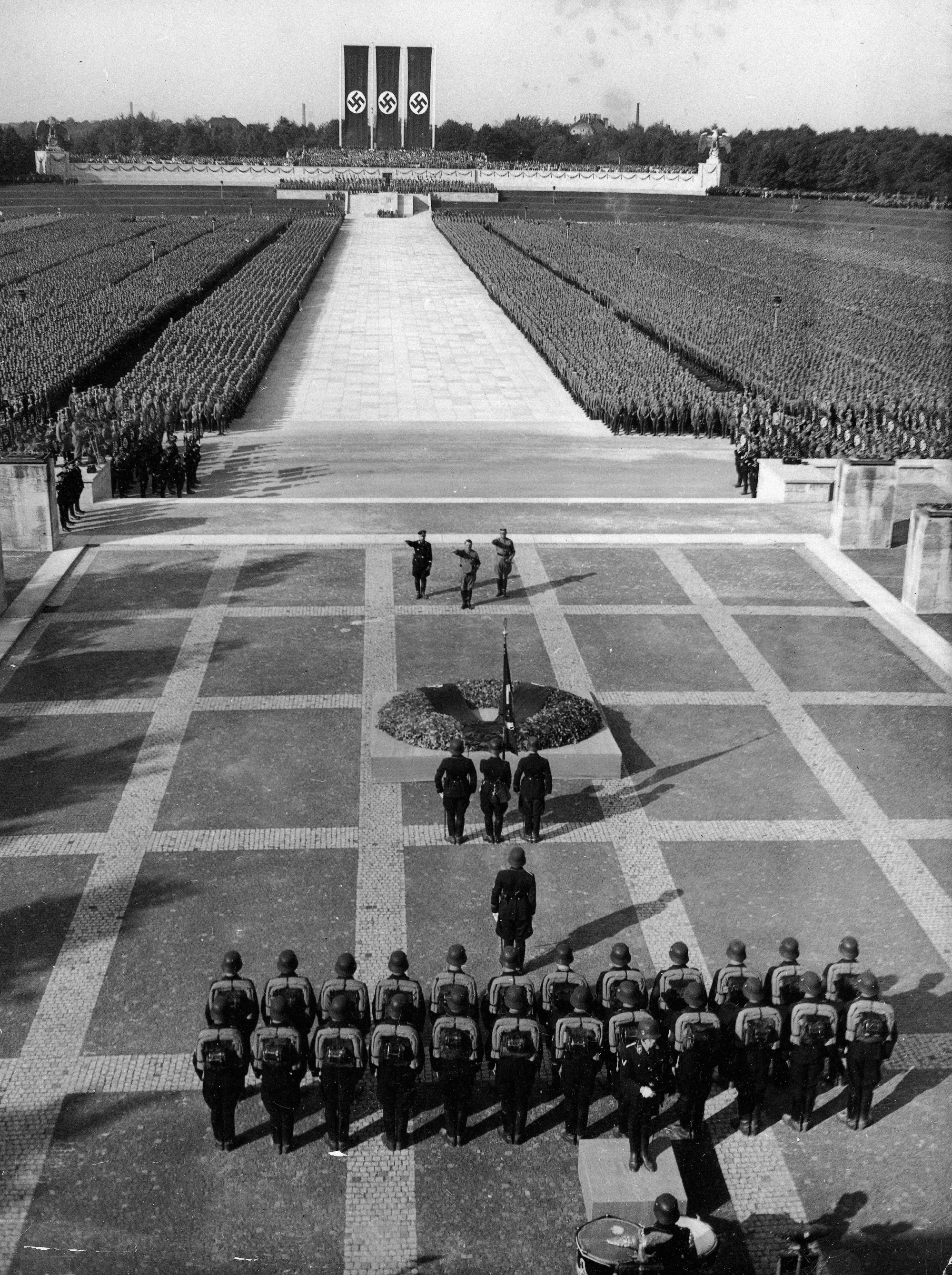
If you can get people to stand in line for a long time, you can fight a war. The nations that are really strong at synchronicity, of course, are Germany and Japan. Go to Germany, go in the subway. Go to Japan, go in the subway. No one is struggling against each other. No one's pushing. Even though it's crowded, people are standing exactly where they should be standing, perfectly. That is the idea of synchronicity. If your people can do that, they can fight a war and win the war. This idea of unity of will. They can stand in line for a long, long time.
Hitler's Speeches and the Unity of Will
We're going to look at some speeches from Hitler. We can see from his speeches he's trying to create unity of will. He's trying to be the Übermensch, the superman who will unite his people like Napoleon and carry them to victory through faith in themselves. The unity of will.
If men wish to live, then they are forced to kill others. The entire struggle for survival is a conquest of the means of existence, which in turn results in elimination of others from these same sources of sustenance. As long as there are peoples on this earth, there will be nations against nations, and they will be forced to protect their vital rights in the same way as the individual is forced to protect his rights. One is either the hammer or the anvil. We confess that it is our purpose to prepare the German people again for the role of the hammer.
He's saying we must unite as a people. We must have unity of will if we are to triumph against our enemies.
Nothing is possible unless one will commands, a will which has to be obeyed by others, beginning at the top and ending only at the very bottom. This is the expression of an authoritarian state, not of a weak battling democracy, but of an authoritarian state where everyone is proud to obey because he knows I will likewise be obeyed when I must take command.
Hitler is not being a dictator. He is trying to create unity of will. He is the leader. He's the Übermensch. But that's only because God demanded him to be so. He will unite the German people into a hurricane, into an ocean to crash itself upon the world.
In the course of my life, I have very often been a prophet, and I have usually been ridiculed for it. During the time of my struggle for power, it was in the first instance the Jewish race which only received my prophecies with laughter when I said that I would one day take over the leadership of the state, and with it that of the whole nation, and that I would then, among many other things, settle the Jewish problem. Their laughter was uproarious, but I think that for some time now they have been laughing on the other side of their face. Today, I will once more be a prophet. If the international Jewish financiers in and outside Europe should succeed in plunging the nations once more into a world war, then the result will not be the Bolshevization of the earth and thus the victory of Jewry, but the annihilation of the Jewish race in Europe.
We don't actually have any concrete evidence for the Holocaust. One piece of evidence for the Holocaust is this speech by Hitler.
I want to explain what he is saying here. What he's saying is, we, the German nation, want to be left alone. We want to be united. We want to be unified. But the capitalists and the communists all seek to undermine us. Who are the communists? Who are the capitalists? The Jews. It's the Jews who are a metaphor for a national elite group of individuals who are conspiring to undermine the vitality and the strength of the German nation. That's what he's saying here.
1939, September 1st, is the beginning of World War II. He's going to explain why this is happening.
As a National Socialist and as a German soldier, I enter upon the struggle with a stout heart. My whole life has been nothing but one struggle for my people, for its restoration, and for Germany. There is only one watchword for that struggle: faith in this people. One word I have never learned: that is, surrender.
He's telling the people, we're going to fight this war again. Why did we lose World War I? Because we didn't have faith. We surrendered. If we all came together and we fought to the very bitter end, we would have prevailed against our enemies.
It is quite unimportant whether we ourselves live, but it is essential that our people shall live, that Germany shall live. The sacrifice that is demanded of us is not greater than the sacrifice that many generations have made. If we form a community closely bound together by vows, ready for anything, resolved never to surrender, then our will will master every hardship and difficulty.
It is the unity of will that matters. 1942, November 8th, is basically at a time in history when the Germans understand they've lost the war. The Americans are now in the war. The Americans are getting ready to invade Europe. The German invasion of the Soviet Union has failed. They're bogged down in the Soviet Union. Germany is overstretched. The entire world has allied itself against Germany, so the war is about to be lost. But let's look at what Hitler has to say.
It is with the same conviction that I now stand before you and it has never left me either since the day on which, as an unknown man in the city, I began to struggle first for the soul of the German people and then on beyond the city for more and more followers. In the beginning, I did not have much more to give than faith, the faith that if anyone pursues a just aim with unchanging and strict loyalty,
And never lets himself be diverted from it, but puts everything into it, then others will be found who are determined to be his followers, and that from this host an ever stronger faith must gradually radiate to the whole people.
This is unity of will. We reject reality. Reality does not matter because we impose our will on reality. As long as we have faith, as long as we have unity of will, we will triumph.
The Legacy of Prussia and the German Question
Let's go back to the beginning. We were talking about Kaliningrad. It is one of the greatest injustices in human history that Königsberg, which was for the longest time the cradle of human civilization, the epicenter of the Enlightenment, is now completely destroyed. This is an idea from Wagner. By destroying this, the world has cursed itself. Let me explain why.
First of all, the German question now is more relevant than ever before. You've destroyed Königsberg, but you have not destroyed the desire for unity among the German people. This is the memory that will not fade. Will the Germans seek vengeance? Will another Hitler arise to unite the German people? What you guys don't know is that the Prussians were one of the main forces opposing Hitler as well as inhibiting Hitler, because Prussia had a very proud culture and it was the strongest part of Germany. But now that they destroyed Prussia, if another Hitler arises, there's really nothing to stop him. That's the first problem.
Second question is, let's go back to this map. Europe and Russia are about to go to war with each other. If you are Europe and you go into Ukraine, you're going to be slaughtered. But this is Kaliningrad, Russian territory, 500,000 Russians. You can blockade Kaliningrad. So, this could be the start of World War III right here. If the Europeans blockade Kaliningrad and they start to try to starve the people, Putin would have no choice but to intervene.
But the main problem is this. Königsberg was one of the main intellectual, scientific, and cultural centers of Europe. Its loss reduced the innovative potential of humanity. Science comes from philosophy. Culture leads to philosophy, which leads to science, which leads to technology. You cannot have science independent of philosophy. When you destroy a center of philosophical innovation, you destroy a center for scientific progress.
How Does a Figure Like Hitler Emerge?
Personal charisma or something?
Where did Hitler come from? How did Hitler become so charismatic?
There's a lot of randomness to life. There's a lot of randomness going on in life. The army wanted to inhibit the growth of the socialist left-wing movement, and it did so by financing these right-wing parties. The Nazi Party was just one of many parties that the army financed and supported. Hitler became a spy, and he became part of this movement, and as such, he became exposed to a lot of the ideas of the Nazi Party. A lot of the ideas come from Nietzsche and Wagner and others as well. Over time, Hitler came to believe that he was the Messiah. He was the Messiah dedicated to restoring German unity.
This is hard to understand, but human population is very diverse, so you always have a subset of people who have these delusions of grandeur. In certain circumstances, they will be proven right. Another way of saying this is, the army needed someone to play the part of the Übermensch, the superman who could unite the German people and create national unity so the army could seek its vengeance against the rest of Europe and unite the German people. They're looking for this role, and then Hitler auditioned for this role, and he got the role.
This is important because this is exactly what happened with Donald Trump. The American military needs an Übermensch to lead America to war against Putin. There were different people who auditioned. Biden auditioned, he was terrible. Harris auditioned, he was terrible. They picked Donald Trump. It's a very similar pattern. It's a very familiar pattern in human history. You can also argue that Napoleon was the same way.
What makes these people different from us, Napoleon, Hitler, Julius Caesar, Trump, is they are the total expression of the desire and will. They have no compassion, no sympathy for anyone. They believe they are here on a divine mission. They are the will itself, and they must impose their will on others to save the world.
You look at Donald Trump. If you want to understand Hitler, look at Donald Trump. The guy is almost 80. He doesn't sleep. He's off traveling around the world all the time. The guy, when he was campaigning, was giving like three speeches a day. He would get up in the morning at four, fly somewhere, give his two-hour speech. People loved him. Then he would get on a plane, fly somewhere else. He could not stop talking to reporters. He has too much energy that comes from the perfect expression of the will. Donald Trump is all will, all desire, all ego, and no sympathy, no empathy, no compassion. That's Hitler and Napoleon.
Won't People Think This Is Reckless?
Reckless or violent?
Won't people rebel against us? Won't people think this is reckless?
What Schopenhauer and Nietzsche and others will say is, what we want first and foremost is a return to unity of will. In the very beginning, the will was God. That's the Big Bang. Then the will expanded itself, and so we find ourselves alone in an ocean of alienation. What our hearts really aspire to is return to a unity of will.
When someone says, "You can be part of a movement to transform the world," that's much more appealing to us psychologically than to say, "Come to school, do your homework, get good grades, do the SAT, get into a top 50 American school, become an accountant, and for 50 years do something meaningless, but make a lot of money, and then you will die a happy person." Seriously, there's no competition. There's no competition.
Donald Trump is saying to Americans, "We will make America great again. We will be a great civilization again." It will require sacrifice. It will require my sacrifice, but it will be worth it because we will make the world whole again.
Again, when you listen to the Hitler speeches, from our perspective, it's not that persuasive. But when you're in a crowd of people, and this man is speaking to you with his voice, it's like Wagner. It's like going to a concert. The music fills you, and it inspires your heart. It makes you want to be the Übermensch. Hitler is just the example, but he's saying you can also aspire to be the Übermensch if you are willing to sacrifice your life for the unity of will.
This is really important. This is far more appealing to people than the idea of materialism. This is religion. Hitler's creating a new religion, and it's intoxicating. The fact that the Germans were able to fight for so long against the entire world is incredible. It was America, Britain, France, Soviet Union against the Germans. The fact that the Germans fought so bravely and fought to the very bitter end just shows you the power of unity of will.
What this also tells us is these things don't die. You can kill a civilization, you can destroy a city, you can massacre a people, but you cannot destroy the desire for unity of will, because that's what fundamentally makes us human.