Civilization #55: Kant, Hegel, and the Theory of Everything
Kant and Dante
My main argument is that Kant is really taking the main thesis of Dante, which is the imagination is the animating force of the universe and love is the unifying force of the universe. What he will do is he will use his epistemology. Epistemology just means theory of knowledge. How do we know what we know? He will do three things. He will clarify it. If you read Dante, it's not very explicit what he's saying. You have to interpret him properly. What Kant will do is make Dante explicit to the world.
Then he will rationalize it. Rationalize it just means that he will remove divinity. He will remove theology from it and create a system of logic. Then he will systemize it. This is the mission of Kant, to take the secret of the universe as first presented in Dante and then create a system of logic that then is able to incorporate itself into science and history and philosophy and the world that we know. Together Dante and Kant really did create the world that we live in today.
The Philosophical Background: Plato vs. Aristotle
Let's first talk about the background. Why is Kant engaged in this project? For most of Western history there have been two major philosophers. They are Plato and Aristotle. Up until Kant you could divide all philosophy into these two major camps.
Plato's World of Forms
Plato believes that God is called the Form of the Good. The Form of the Good is this perfect, immaculate, eternal force that emits, emanates, breathes, thinks, and then he creates something called the ideals. These are the perfect conceptions of beauty, reason, justice. Then these ideals give rise to the forms. These are the perfect encapsulation of these ideals. Think of the perfect horse or the perfect chair or the perfect square.
This is the real world. This is what is true and real. We live in the shadow world. Remember back to the allegory of the cave. Everything in the shadow world is only an imitation of the forms. In this conception what is good is to move towards the Form of the Good, to return to the Form of the Good, and what is evil is to move away from the Form of the Good. That's why for Plato art and poetry are evil, because you're imitating an imitation. For Plato mathematics and philosophy are inherently good because they are teaching you how to return to the Form of the Good.
Plato is important because Plato's ideas become the basis for heaven and earth. This is the basis for Christianity. Remember, in the Catholic Church doctrine our life on this planet doesn't really matter. What matters is our return to heaven to be with God. We say about Plato that he's a dualist. There are three conceptions of the universe.
- There is the materialistic worldview, which is what Aristotle is. Materialistic just says that only things that you can see and touch matter.
- Idealistic is what Hegel will represent, which is that only ideas matter.
- Then Plato believes that both matter and ideas do matter. He's a dualist, whereas Aristotle is a materialist.
Aristotle's Prime Mover
For Aristotle, his god is called a prime mover. The prime mover is the first thing that moves, because when the first thing moves it causes things to move as well. There's cause and effect. In this world what matters is movement. Everything's moving towards something called telos, which is what purpose is. It's a Greek word for purpose. For example, as a teacher my telos is to teach as well as I can, and my mission in life is to constantly learn, to improve and to practice so that my teaching becomes better and better. That's the idea of telos. We can understand through observation and experience what each thing's telos is, and then you can start to categorize things.
Aristotle, his ideas of course become the basis for science. As I mentioned, Aristotle has a materialistic worldview as opposed to Plato's dualistic worldview. Aristotle doesn't really care about things outside the material world. He's only concerned about the here and now. These are the two major schools of thought during antiquity.
The Reemergence of Philosophy: Rationalists, Empiricists, and Skeptics
As the Catholic Church comes into power and it has a monopoly power, it suppresses these philosophical inquiries. But after the Renaissance these schools of thought, Plato and Aristotle, will reemerge. They will reemerge into three major schools of thought.
Taking up Plato's perspective will be people called the rationalists. The three most famous rationalists are René Descartes, Leibniz and Spinoza. They are basically adopting Plato's worldview, which is there is a god, and through mathematics, through logic, we can from first principles reason out the mind of God. The project of rationalism is towards omniscience. Again, this is best represented by Descartes, and this becomes of course the basis for the Enlightenment. That's the first major school of thought, the rationalists. They're also called the Continentals, the Continental philosophy, because it's really based on the continent of Europe.
Opposing the rationalists are the empiricists. These are people who are adopting the Aristotle worldview. The most famous is John Locke. What John Locke believes is our minds are born tabula rasa, which just means blank slate, meaning there's nothing in our minds. The only way that we can acquire knowledge, acquire wisdom is through experience. Experience and something called induction. In logic there are two methods.
- The first is deduction, where you take the general to the specific.
- Then induction is to take the specific and then you generalize it into the abstract.
For example, if I see five boys wearing white shirts, then I can generalize and say that all boys wear white shirts. But if the general principle is all boys wear white shirts, then through deduction I can say, well, you're a boy, therefore you wear a white shirt. That's the idea of empiricism. Of course this becomes the basis for what we call the scientific method.
There's another school of philosophy called skepticism. This was pioneered mainly by a man named David Hume. What David Hume is going to do is he's going to look at this idea of induction and argue, no, you can't do that. You cannot generalize things. Just because you meet one million swans that are white does not mean that all swans are white. It is entirely possible that there's a black swan out there. What David Hume does is he negates induction. What he argues is basically our understanding of the world is based primarily on custom. For him, custom just means consensus. We agree this is right, therefore it is right. There's no inherent truth to this thing.
David Hume is very controversial because he argues that true knowledge is just impossible, which means that the entire project of philosophy is pointless. You know what you know through experience and through custom. You cannot abstract things. You cannot reason out things beyond that, and therefore what's the point of philosophy? That's David Hume.
Kant's Copernican Revolution: The Critique of Pure Reason
What's going to happen is Immanuel Kant is going to read David Hume and be so agonized over his conclusions that he writes something called the Critique of Pure Reason. This is considered the greatest treatise of philosophy ever in human history. It's extremely dense, extremely complicated. Quite honestly I have not been able to complete it. I've tried my best, but it is way too difficult for me. What I'm going to do is oversimplify his argument in order to make it clear for us. He's so fundamental to the development of human civilization that we need to study him. But I'm warning you that I am not in any way an expert on Kant. I hope that this will become a basis for your further study and inquiry into Kant and philosophy.
In his Critique of Pure Reason, what Kant's going to do is he's going to show that all three schools of thought, rationalism, empiricism and skepticism, are all in their own way problematic. In doing so, he's going to construct a new theory of everything, a new theory of the world that will become the cornerstone for neuroscience, physics and artificial intelligence. His contribution to human civilization cannot be understated.
- For Kant this rational school is problematic because he believes that omniscience is just not possible. It is impossible for us to ever achieve the mind of God. There are limitations to the pursuit of knowledge. There are limitations to our capacity to reason. That's the first argument.
- Second argument is the empiricist argument of tabula rasa cannot possibly be true. He's going to show us through a lot of empirical proof that it's not possible for minds to be blank slates. We need to have certain mechanisms of thought already in place for us to engage with the world. That's the problem with the empiricists.
- His problem with Hume is he believes that there's knowledge that is real and inherent and true, and so knowledge can be pursued. Philosophy is important. In fact, for Kant, philosophy is the most important pursuit in human history.
By responding to all three of these major schools, Kant, in his Critique of Pure Reason, is going to create a radical new theory of the world. His own unique epistemology based on the thinking of Dante.
Let's go into his argument very quickly, and again this is an oversimplification. We are all endowed with the capacity to reason. We all have minds, and our minds engage reality. What Kant says is this. The moment that we engage in reality, we create a new universe called appearance. Let me first go over the terminology. It's very important you understand terminology in order to understand Kant.
- For Kant, reality is things-in-themselves, and here he uses the Greek noumena. Things-in-themselves. This is the world that is true and real.
- Then the world of appearance is what I call things-for-us. Things that we see but which may not be true. He uses the Greek word phenomena.
What he's arguing is, within us there is a mechanism in our minds that is always perceiving reality in a way that allows us to understand, interpret and manipulate it. This is his thesis.
A Priori Synthetic Knowledge
Let me first explain how he got to this thesis. What Kant does is this. He tries to reason out what is possible in epistemology, philosophy. What he does is he creates categories. There are four major categories that we need to know. Again, this is a bit technical and complicated, but we need to do this in order to fully understand Kant. What Kant says is there are two types of knowledge. There's a priori and there's a posteriori.
A priori is Latin for things that come before. A posteriori is Latin for things that come after. A priori means knowledge that is independent of experience, things that are universal and necessary, things that are true in themselves. A posteriori of course is things that you learn after you experience them.
He also has two more categories of logic. The first is called the analytical, and then the second is called the synthetic.
- Analytical just means things that are true in themselves. They are true by definition. If I say, for example, a square has four sides, a triangle has three sides, that's an analytical statement because it's true in itself. I can also say that A is A. I can also say that Mary is a woman. These are all just identity statements, things that are true in themselves.
- Synthetic statements are statements that are not analytical, meaning that you need to build these statements based on other information, and they could be false. Just think of synthetic as non-analytical.
What Kant does then is say, well, then if there are two by two, there's four possibilities.
- If you think about what a priori analytical is, that's just what logic is. This is just what's logical.
- A posteriori synthetic is just what we call empirical. This is the John Locke project. Empiricism, things that you know and learn after you experience them.
- Analytical a posteriori just doesn't really matter, because a square has four sides. It doesn't matter if you see a square, four sides, it doesn't really change anything.
The main conflict between David Hume and Immanuel Kant is whether or not a priori synthetic knowledge exists. For David Hume, he says this in his writings, it is impossible for a priori synthetic knowledge to exist. But what Immanuel Kant will show us is it does exist, and he calls it transcendental idealism. Transcendental idealism. He's going to spend his entire book, the Critique of Pure Reason, about a thousand pages, explaining why this must be true. Why is it that you must have a priori synthetic knowledge in your brain in order to understand the world?
Again, this is his main argument, and what it will show us is this. If you study mathematics, if you look at philosophy, if you look at classical physics, Newtonian physics, and you break things down to the most fundamental level, what you will discover is we have to bring in certain assumptions into this field of knowledge for it to exist. These two very basic things that we bring in are called space and time. Space and time.
Space just means sensation, and time is sequence. Time is just an order of things. One, two, three, four, five. Space is just our interaction with the world around us. Unless we have these two basic concepts, no knowledge is possible. Space and time. This is really important, and this is a hard concept to understand. What Kant is saying is that space and time do not exist in reality. Space and time are a projection of our minds in order to substantialize reality in a way that allows us to understand it and manipulate it. Space and time.
In other words, a very simple way to understand this is our minds turn the world into a story. Why? Because if you have space and time, you have causality, cause and effect. Space, time, movement. Now you have causality. Causality is a story. What Kant is saying is we are just imagining reality into a story, and that allows us to understand it.
The Process of Perception
What Kant's going to do after he proves that space and time must exist a priori is he's now going to explain how we take reality and we turn it into appearance. What he's going to show us is that our mind has a process of doing this. This process has three stages. There's apprehension, there's reproduction, and then there's recognition.
- Apprehension is just you're engaging the things-in-themselves.
- Through space-time, by inputting space-time into things-in-themselves, you're able to reproduce it in your brain. You're able to create an image of it in your brain.
- Then what you're going to do in order to understand it is to filter space-time using something he calls categories.
Categories, just think of it as our algorithm. A better word is heuristic. Computers use algorithms, we use heuristics. There are 12 different categories, but there are four major categories.
- The first is quantity. How much of a thing is it?
- Quality. What are the properties of this thing?
- Relation. Is this thing logical or empirical?
- Then modality, which is, what is the strength of the relation of this thing?
I know it's complicated, but later on we will use some examples from real life to better understand how this works. You don't really need to remember the categories. Just remember that what Kant is saying is, inherent in our mind is a heuristic, an algorithm that allows us to turn information into knowledge. When we do this, what happens is we create a schema, a representation of the world which allows for understanding the world.
For example, we see a lot of triangles, but we don't actually have an image of a triangle in our head. We only have a concept of a triangle in our heads. This is true for a lot of things. Then the schema returns to the categories, which allows us to filter the world even more. It is a feedback loop. This is Kant's perception of the world. Again, if you want to know the proof, if you want to know his logic, then you have to read the book for yourself, which will take you about 10 years.
All this is reaffirming Dante's belief that the imagination is the animating force of the world. Without us, reality cannot be alive. It is our imagination that makes reality alive to us.
Kant's Moral Philosophy: The Categorical Imperative
This is from the Critique of Pure Reason. He also wrote a book called the Critique of Practical Reason, where he presents a theory of morality. For Kant, the highest ideal in morality is something called the categorical imperative. This is separate and distinct from something called the hypothetical imperative. The hypothetical imperative is, if you are a child in a school, how should you behave? This is specific. This is circumstantial. The categorical is the absolute. This is how you should always behave. For Kant, there are three major principles that underlie all morality. Let's go over them one by one.
- The first is the idea of universal law. Kant says imagine that each of your actions will be universalized, will be generalized, so that everyone will behave the way you do. For example, you can choose to steal, but imagine everyone stealing. What kind of world would that be? You certainly would not want to live in that world. Behave as though everyone is watching you and everyone's going to do what you're going to do. Be the best possible example to everyone. That's the first principle.
- Second principle is see humans each as an end unto themselves and not as a means. Do not manipulate people, do not use people, treat people with respect.
- The third is the idea of autonomous will, which means everything you do must be something that you reason out yourself. You're not coerced into it. You're not manipulated into doing it. You're not tricked into doing it. It's something that you, sitting by yourself in a room, are able to reason out independently.
This is the idea of the categorical imperative, which Kant believes is what we should all strive for and what we're all capable of doing because we're capable of reason. We're capable of imagination. We're capable of imagining a moral world. This is important because this becomes the basis for what we have today, the United Nations, human rights, international law. That's how influential Kant has been in the development of human civilization.
How can we understand the categorical imperative? Let's go back to Jean-Jacques Rousseau. Remember, Jean-Jacques Rousseau proposed the idea of the general will. The general will is not democracy. Democracy is simply you get everyone to vote. In this room I ask everyone what should we have for lunch? Then someone proposes let's have ice cream, and everyone raises his hand and says, yeah, let's have ice cream. That's democracy.
But for Jean Rousseau, what he argues is the general will is the best interest of people that you can derive just by reasoning it out yourself. If you were all to sit down by yourself and ask what should we have for lunch, it wouldn't be ice cream because ice cream makes you fat, it's too much sugar, it's bad for you. You would probably think we should have salad. The general will represents the best interests of everyone involved. If I were to ask you what should we have for lunch, everyone would say, if we are following a general will, a salad or maybe a chicken breast.
In other words, the categorical imperative is just the individualized general will. It is a general will that you internalize to yourself, and you behave as though you are the general will. That's a way of understanding the categorical imperative.
There's another way of understanding the categorical imperative, and that's using Dante. Remember, we read the Divine Comedy, and Dante's categorical imperative is very simple. Love someone. Doesn't matter who. It could be your wife. It could be your mother, or it could be your child. It could be your best friend. But love that person, and when you love that person then all three things are true. It means you are now going to be your best. It means you are treating this person with respect. It means that you're choosing to love this person.
Love is the unifying force of the universe. That's what Dante is really saying. In other words, Kant is just systemizing what Dante said in the Divine Comedy.
Three Experiments to Understand Kant
For us to better understand Kant's argument, I want to give you three examples to better understand what Kant is saying.
- The first example is imagine you are writing a diary. I want you to write a diary for a whole year. Every day you're writing what happened today. You have 365 separate entries. Every day at night at 9 p.m. you're just reflecting on what happened today. Then at the end of the year, what I want you to do is write one long diary entry. Now, if you think about it, in theory, these separate entries should add up to equal this one long entry. But what you'll find if you actually do this experiment is this long entry that you wrote almost has no relation at all with these 365 separate entries. In other words, what we're doing is constantly every day we are reimagining the world in a new way and we're building on top of this. That's the first experiment. Another way of saying this is all we're doing is we're taking discrete data points, which is what 365 diary entries is doing, and then combining them into one complete story.
- Here's another experiment you can do. Memory. Organize 100 classmates and go to a park together and spend the whole day in a park and organize the day so that everyone's doing the same thing. Everyone's doing the same thing. Then next day, ask all 100 students to write down their experience of that one day. I guarantee you every person will be different. Each person's experience will be unique unto himself, thus affirming what Kant said. The imagination is the animating force of the universe.
- Let's do one more experiment, and this is a thought experiment. This is something you can't do, but let's just imagine it. Imagine you end up on an island. This island is very fertile, very opulent, lots of fruits, lots of fish. You don't have to worry about starving. But one day you go to sleep, and then your mind is wiped clean. It becomes a tabula rasa as proposed by John Locke. You have no more memory. You can't speak. You've lost the capacity of language. You've lost capacity to reason. You don't know where you are. You don't know who you are.
You get up, and now the question then is what will happen to you? If you're John Locke, what's going to happen to you is you're going to starve to death because you don't know what to eat. You take a stone and you put it in your mouth. You take a leaf, you put it in your mouth. You don't know what to eat. You've lost all knowledge. But according to Kant, what Kant would say is, sure, you've lost all knowledge, but because you have a priori synthetic knowledge, because you manipulate reality around you, because your mind is very good at filtering information, categorizing information, it'll take you a very short amount of time to figure out what is edible. You know stones, wood, that's a category of stuff you cannot eat. But then you know fruits, water, fish is another category of things you can eat.
I think just through pure intuition we can figure out, you know what? Kant makes more intuitive sense than John Locke.
Again, the first experiment you can do, and you will discover if you do one long entry it will not correlate to these separate entries. The memory experiment you can also do. The thought experiment you can't really do, but you can reason it out and discover it to be true. That is Kant, a very short, simple introduction to Kant.
Kant, Newton, and Science
Doing this Critique of Pure Reason as a natural philosopher, in maybe a way Newton might have, did he think he was doing science?
Do you know anything about Kant's current reputation in the scientific community?
Two great questions. The first question is how did Kant perceive himself? The second great question is how does science perceive him today? The simple answer is Kant saw himself as a revolutionary thinker. He saw himself as Copernicus. He's going to fundamentally change the way that we perceive the universe. In fact, he calls his Critique of Pure Reason a Copernican Revolution.
Second is Kant's ideas are really the basis for modern-day science. Einstein was heavily influenced by Kant. Einstein read Kant when he was 16, and because of Kant's theories of space-time and through a priori synthetic knowledge, that gives him the theory of relativity. If you study quantum mechanics, you will discover a lot of ideas were heavily influenced by Kant. His influence on science is just incredible.
From Kant to Hegel: Resolving the Unknowable
With Kant, his philosophy is, remember, we interact with the noumena, which gives us the phenomena, the things that we can see, the appearance. There are three major issues that are unresolved in Kant. Kant acknowledges these issues, and he doesn't really provide a solution. These three issues are this.
- The first issue of course is what is the noumena? What are the things-in-themselves? Kant says we can never know. That's the first major issue.
- Second issue is, if our brains are capable of reason through a priori synthetic knowledge, where does knowledge come from? What's the source for our mind?
- The third problem is uniformity. If it is true that we are in fact always projecting onto noumena to create phenomena, how do we know that we're all doing it the same way? How do we know that culturally all cultures are doing it the same way? Are you saying that the Egyptians, the Chinese, the Greeks, they all perceive the world in the same way?
These are the three major unresolved issues in Kant. Noumena, what is it? Kant says we can never know because we cannot imagine ourselves outside of space and time. What is the source for our minds? Kant says we don't know. It's just there. The third is uniformity. How do we know what we see is consistent with each other? Kant says we don't know, but we have to believe it. Otherwise the world doesn't make any sense. How is it possible that without uniformity you can have mathematics and science? But again, the problem with Kant is this is not satisfying.
Hegel is going to come along and he's going to provide a theory of everything. He's going to resolve these three issues for Kant and create an entire system of thought that encompasses everything. Hegel's major insight is, what if as we're perceiving the noumena, the noumena is projecting back onto us? So, it becomes a source for our ability to perceive the noumena. In other words, the noumena is really the source which creates the uniformity.
What is this noumena? The word that Hegel uses is Geist. The Geist. This is a German word that we translate into mind or spirit. Hegel's major work is called the Phenomenology of the Mind, which can also be translated into the Phenomenology of the Spirit. Translators argue about what the translation is. The problem is mind and spirit don't really explain that much.
Imagine Geist as, and this is a bad metaphor, but imagine Geist as the internet and we are individual computers. We're always interacting with this internet. That would give you a basic framework to understand what Geist is. It is a collective consciousness, almost, but that's not accurate. To fully understand what Geist is, we need to go into the etymology of the word. What words were influenced in English by Geist? There are three words that were influenced by Geist.
- The first word is ghost. Ghost is the idea that the Geist is coexisting with us. The Geist is not separate from us. It is coexisting with us. It's here and now.
- Second word is geyser. Geyser, an expansion, a spawning up. The Geist is always growing. It wants to grow and expand.
- The third English word that comes from Geist is gist. The gist of an argument, the essence of an argument.
What Hegel is saying is the Geist is the essence of reality. The Geist comes first. It's the source for who we are.
Again, to understand Geist, think of it as an internet, but the internet that is coexisting with us, that is always expanding forward, and which is the essence of all life itself. That's why we say that Hegel is an idealist. He doesn't care about the material world. He doesn't think it really matters. What matters to him is the Geist itself, the ideas, because that's what drives human history.
The Dialectic and the Movement of History
Let's talk about how he perceives the Geist. How does the Geist actually move? For him, what matters are not the things. What matters is not the ideas. What matters is the movement of things. For Hegel the main thing that moves is the dialectic. This is famous because obviously from the dialectic we have the thesis, which moves to the antithesis, which moves into the synthesis, and this is the movement of human history.
The way to understand this is we all seek self-knowledge. But the way to seek self-knowledge is by asking who we are not, which creates the antithesis. When we have the idea of who we are not, this comes in conflict with who we are, which then creates new knowledge.
In order to understand this idea, let's do a thought experiment. The thought experiment is this. Let's go back to the island, and there's 100 of us. We all sleep in different corners of the island. Again, during the night when we sleep, our minds are wiped clean. We're all now tabula rasa. We have no more memory. We wake up and we forget that there's other people there. We don't even know who we are. When we wake up, what we see is the universe, the space and time. We think that we are the universe, that we are space and time, and there is a reconciliation between us and the world. We're really happy.
But as we move along on the beach, we see someone else. This other person threatens us because it's like us, but it's not like us. Now this person has destroyed my conception of the universe, which is, I am the universe, or I am God. This creates conflict. We fight. We might actually physically fight. We might argue. But over time we create a synthesis, which is, the two of us are now the universe.
The problem is we walk along and we meet another person, another person. This is a constant process. But over time, even though there's conflict, even though there's violence, it's all a natural part of enlightenment. It's all part of the process of reconciliation where eventually all 100 of us rediscover who we are through conflict and differentiation, and we form a collective consciousness. We become what Hegel says is the absolute spirit. Absolute spirit, and that is the progress and the purpose of our lives.
Let me frame it in a different way. What Hegel is saying, and again these are not his words. These are my words, so be careful. But I think this is the best way to explain what he's really saying about the movement of history. God has two forms. God is the Geist. But God is also the universe. Why would God do this? Why would God be both the universe and be the Geist? Because God is trying to create reconciliation between itself and all the things in the universe. It's trying to come to peace, a reconciliation, an awareness between itself and us. The Geist, through the dialectic, is growing and growing until it becomes the universe itself, and that is the end of history.
This is what we call a teleological movement of history, where things are moving towards their purpose. What Hegel says is the world is becoming. Do not think of the world as being, but becoming, as constantly in a process of transformation, of growth, of expansion. Why? Because it wants to become being. The being is when we are completely reconciled to God. That's the end of the world. That's the end of history, the reconciliation between us and God. When we become God and God becomes us, then there's no more differentiation. There's now no more conflict. We are moving towards this because the world is teleological. Every single thing that we do is moving towards the one reunion with God.
To prove this, Hegel discusses the Geist. How do we know the Geist? In culture, we know the Geist through art, philosophy and religion. When you study these three things historically, what you will discover is they're all progressing.
- In terms of art right now, we are in the Romantic period, which is the highest period of art because it is synthesizing all previous periods of art.
- The highest religion is Christianity because it is the beginning of a reconciliation between us and God. Jesus was the great democratic force that allowed us to now all in our own way access God. Before, God was captured and imprisoned by the priests, and Jesus freed God from the priests. So, Christianity is the highest religion.
- Of course, philosophy. What's the highest philosophy? Hegel, because this theory of the Geist is the endpoint of all our knowledge. From the Geist we can now finally move towards reconciliation.
The Legacies of Hegel
There are some major influences. Let's talk about the three major influences, legacies of Hegel.
- By far the most influential of course is the creation of Marxism, because what Karl Marx will do is he will take this theory of Hegel, the movement of history, the dialectic, and he will create something called dialectical materialism. He will invert Hegel because Hegel says it's only ideas that matter. What Marx will say is that, nope, only material things matter. He will invert Hegel, but he will also adopt a lot of Hegelian thinking. The dialectic becomes a very important part of Marxist ideology. That's the first major influence.
- Second major influence is the idea of God is dead. It was not Nietzsche actually who introduced this term. It was Hegel. By God is dead, what Hegel is saying is we need to change our conception of God. Before we thought God was aloof, distant and absolute. Now I'm presenting you a more advanced version of God, which is a God that is moving in us towards itself. God is dead.
- Of course the third major influence is the idea of the nation-state because this theory of Geist becomes part of the nation-state. Now because of Hegel we could believe that the nation-state can have a soul. This will lead to a lot of problems, which include imperialism, war and other really fun things. But we cannot understate the influence of Hegel. That's Hegel.
Kant and Hegel's Abstraction
The contrast is really interesting, because both these philosophers make great intellectuals. I can picture living within one philosophy and being very comfortable saying something concrete about the world. I'm not sure about Hegel. How much do you think he really believed what he was talking about as opposed to, this is a very elegant explanation of the world? They're both abstract, but Hegel seems more abstract.
That's a great point. Kant is very logical. Hegel is very abstract. If you read the Critique of Pure Reason, if you spend enough time on it you will get through it. You will be able to master it. Whereas if you try to read Hegel, especially the Phenomenology of Spirit, it's just impossible. Everyone who reads it will have a different interpretation. The reason why is what Hegel is trying to do, he's trying to synthesize all human knowledge. He's trying to take everything that's happened, everything that we know, and he's trying to synthesize it into a system, which Kant just basically said we can't really do.
I'm not an expert on Hegel, and I don't want to be an expert on Hegel actually because I think I will go crazy if I read too much Hegel. But I do know there's a lot of controversy around Hegel. He's actually regaining popularity in our age because of the idea of the Geist, because we live in a too materialistic world.
The Legacy of Kant and Hegel
Immanuel Kant, for him he was really aware of what he was doing, and his argument was that the Critique of Pure Reason marks a radical new stage in human history. It is like Copernicus. Remember Copernicus, his major contribution was, before we thought we were at the center of the universe, and then Copernicus banished us to the margins of the universe. It's a new way of perceiving the world, and Kant was trying to do the same thing.
Pre-Kant, the philosophers thought that there was an objective reality, and that we were just observers of this objective reality. But through logic and experience we could ultimately access this objective reality. Kant says, no, no, no, the world is entirely subjective. We project our imagination, our ideas onto the universe. We are active participants in the world. This will give rise to the idea of Romanticism, which is that the human imagination is the highest ideal. It in many ways participates in God itself. That is Kant's major revolution.
Let's remind ourselves of the difference between Kant and Hegel. What Kant would say is there are limits to reason. We can never know the mind of God. What Hegel says is, no, the mind of God is a dialectic, and therefore we can know the mind of God.
Kant will say the world is what we will it to be, meaning we have free will. Then Hegel will say we are moving towards the end of history, which we are progressing, but this means we have no free will. Everything has been planned from the beginning. All these conflicts are part of a process of eventual enlightenment.
Kant will say we must believe in God for morality to exist. This is a really important point. Kant is extremely logical. He's very honest, and he says there's nothing I can do to prove God exists, but we must believe God to exist, otherwise we have no morality in this world. He also says we must believe free will exists, even though there's no logical proof of free will, otherwise what's the point of existence? Hegel says God is dead, I've created a new god, and it's a teleological god that is forcing us towards there. These are the three major differences between Kant and Hegel.
Kant's Vindication Through Modern Science
Let's look at the legacy of Kant. What's amazing is the more science progresses, the more Kant is proven right. Neuroscience is telling us today that we hallucinate reality. There are lots of experiments that prove this. Let's go over some really quick examples.
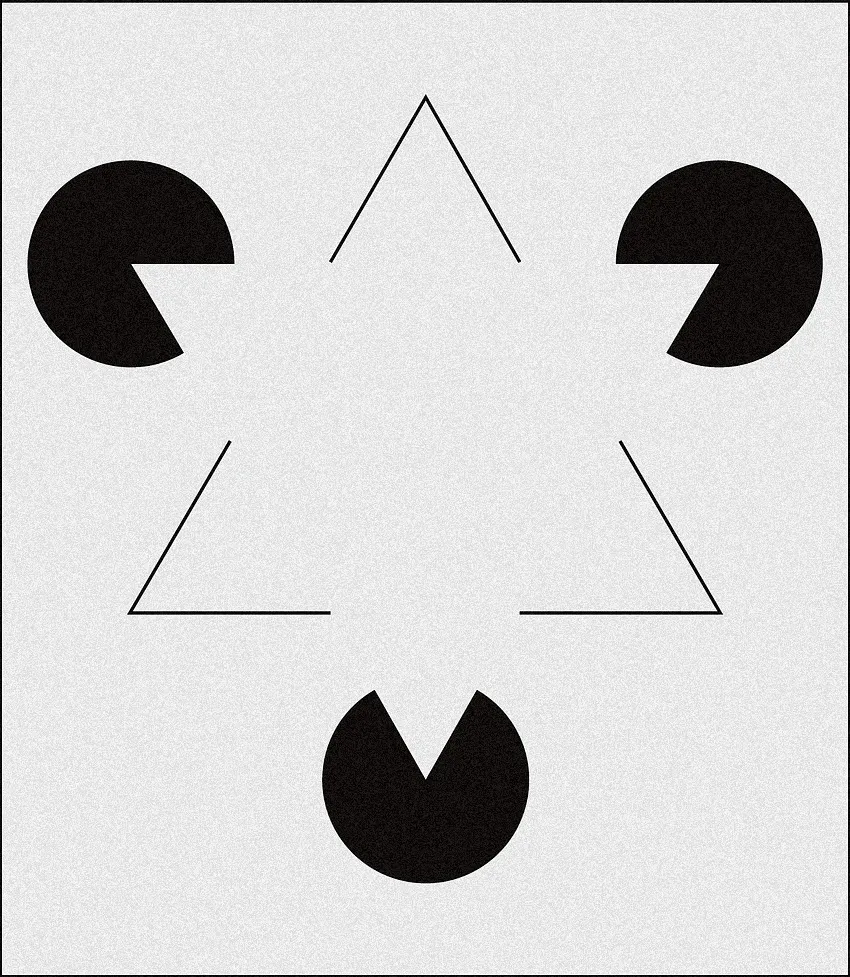
- We see a triangle. Guess what, guys? It doesn't exist. It's just part of our imagination. These lines exist. The triangle doesn't exist. But the first thing we see is this triangle that does not exist.
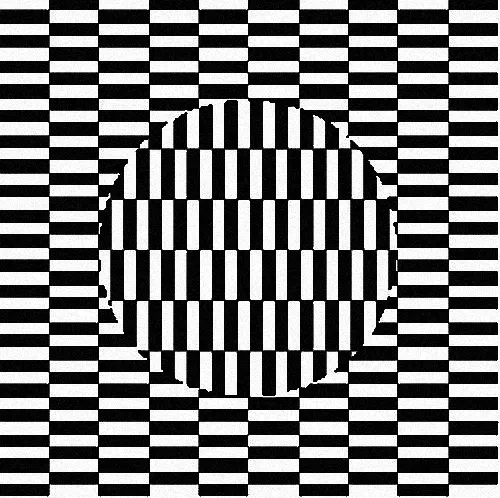
- This thing moves. But we know it doesn't really move. Our mind is playing tricks on us.
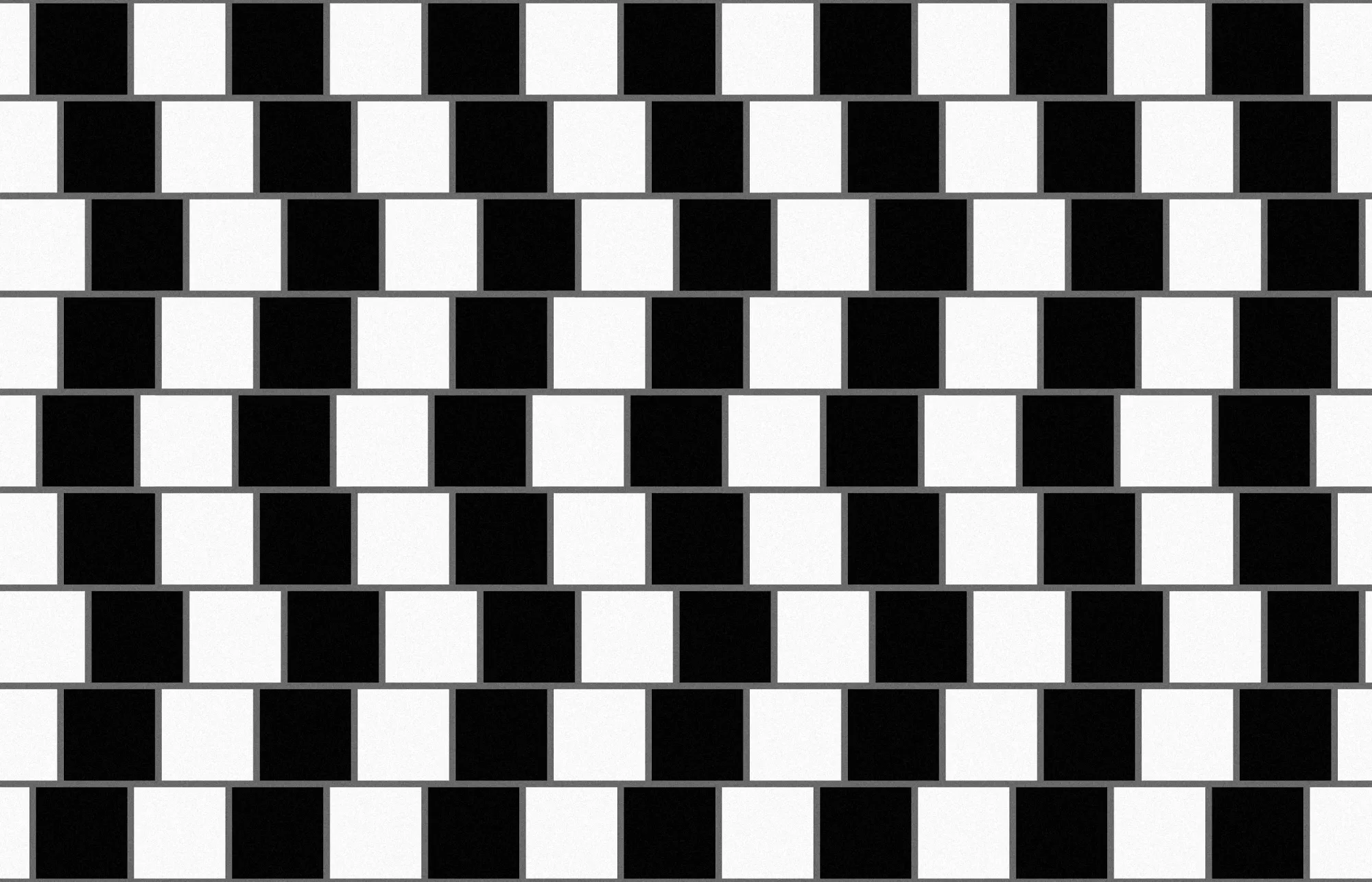
- We see this as slanted. When we actually take them side by side together, you'll see them as parallel. Another mind trick that's being played.
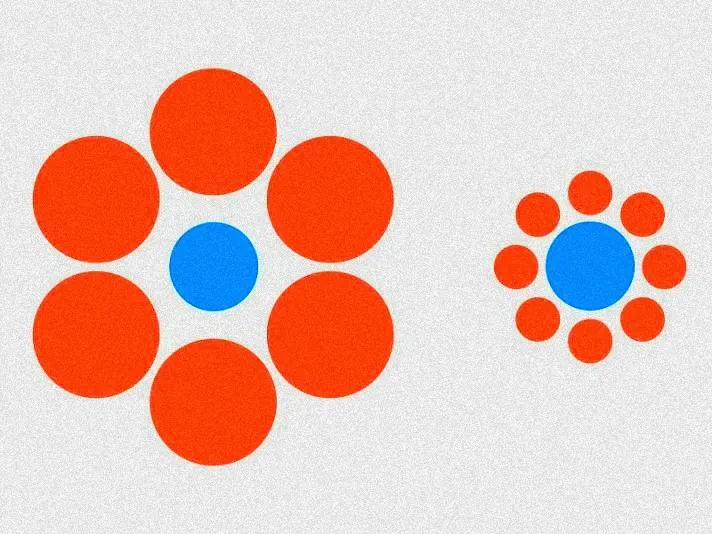
- Which is bigger? They're the same, but because of these circles, we think this is bigger than that. Another mind trick that's being played on us.
- A and B are different colors, right? It's obvious they're different colors, right? But actually, they're the same color. Another mind trick that's being played.
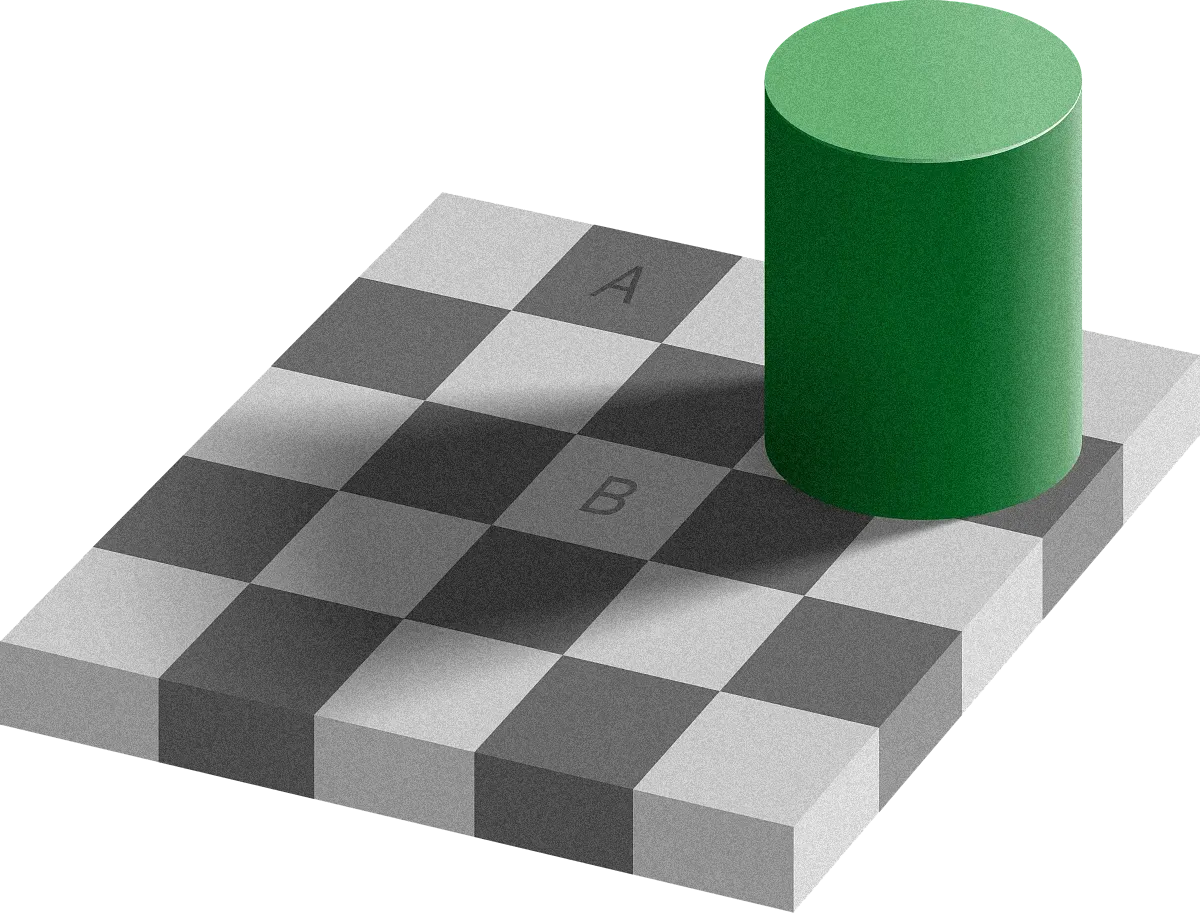
Neuroscientists have done a lot of experiments and they've proven to us that we constantly participate in reality. We hallucinate reality, which is what Kant originally proposed.
Artificial intelligence shows us the limits of the blank slate theory. Let's imagine you actually had a blank slate in your minds. That would be extremely problematic, and we know because of how artificial intelligence works. Let's look at supervised learning. When we talk about artificial intelligence, it doesn't actually exist. What exists is the idea of supervised learning. The idea is this. We're trying to teach a machine, an algorithm, to recognize a picture. What we do is this. We feed a lot of training data into the algorithm. We're talking like millions and millions of pictures. Then we label this data so that the machine is able to, using its own analysis, figure out the differences. It basically turns every picture into a mathematical concept, and then if you train it well enough then it's able to differentiate between a triangle and a circle. That's the idea of machine learning.
Same concept here. You have to feed it millions and millions of pictures, and you have to label these different pictures, and then the machine will mathematically be able to figure out which is which. How the machine does that, we're not really concerned about, but we need to train the machine. The problem with this is it's very expensive, it's very time-consuming.
Now let's compare this with how a human does it. If I just give you a picture of a sheep, you're able to know what a sheep is. Why does that happen? A machine is able to tell you this is a sheep. But what a machine is not able to tell you is, is this sheep real or fake? Is this a real or fake sheep? We think it's fake. But what the machine says is we don't know. The machine is correct. Real, fake are categories of our mind. How do we know this is a fake sheep and not a real sheep?
A machine is saying, if I don't know anything, if I have no a priori synthetic knowledge, then I cannot differentiate between fake and real. But a child, anyone can know this is a fake sheep because obviously we have categories in our minds. A machine could not tell you what this is. Why? Because this has become a schema, a concept. But any child can tell you this is a sheep. Again, this is artificial intelligence showing us that Kant was correct.
As I mentioned, Kant inspired Einstein to dream up the theory of relativity. Einstein read Kant when he was 16. It had a huge influence on Einstein. Space-time curvature is influenced by it, but also the theory of relativity. The theory of relativity is fairly straightforward. Let's just say that I'm sitting on a platform, a train platform, and you guys are across from me. We're not moving, and we know we're not moving. But let's just say that for whatever reason, simultaneously both platforms are moving at the same speed. From our perspective we're still not moving. That's the idea of relativity, where the laws of physics are relative to where we are at the moment. This again is influenced by Kant.
What's really fun is to think about quantum mechanics. Quantum mechanics confirms things-in-themselves, noumena, are not knowable to us. This is a major argument between Kant and Hegel. We looked at light and we want to know what the essence of light is. What are photons? We discover something really problematic, which is we discover that photons are both wavelike and particle-like. They're both wave, movement, and particle, something static. What's even more problematic is you're not able to figure out the state of the light, if it's a wave or a particle, until you actually measure it.
In other words, before you measure particles they are simultaneously occupying many different possibilities, something we call a superposition. This idea of wave function, a wave function is all the probabilities of its position in space. When you measure it, it collapses into one data point. In school we teach you the Bohr model of the atom, but really it's a cloud, meaning we don't know where the electrons are at a certain state. We can only know the probability of where it could be. That's a problem here.
This idea of quantum mechanics, Einstein hated this theory. He thought this was disgusting. There's too much randomness. It's ugly. He hated it. He thought that God as an architect had an elegant mind, and we come up with these theories like quantum mechanics, which actually makes absolutely no sense, you're insulting God.
To disprove quantum mechanics Einstein wrote a paper on something called quantum entanglement. The idea is this. We cannot know the state of things, of atoms, until they are measured. In quantum mechanics things also exist in opposition towards each other. Maybe two atoms are aligned together, and their two states are mirror images of each other. What you can do is this. If you split these two and you send them off in different corners of the universe, according to quantum mechanics the moment you measure the first atom, the second atom must also reveal itself, even though you have not measured it. Also it has to be simultaneous, even though these two atoms could possibly be at different ends of the universe. Quantum entanglement. Einstein says this can't possibly be true. This is a stupid idea, and this proves quantum mechanics doesn't work.
The problem is we've done experiments to prove quantum entanglement actually does work, and this is true. Not only that, but quantum mechanics has proven itself to be the most successful theory in physics of all time because it's given rise to the transistor. The idea of the transistor is if you can understand electrons then you can manipulate electrons in a way that allows you to manipulate it, which allows you to make calculations on it. The transistor has given rise to the computer, which has given rise to the internet, basically creating the world that we live in today. Without quantum mechanics we cannot have the world we live in today.
But again, even though we know quantum mechanics to be true, we don't know why it's true. There are lots of mysteries in quantum mechanics. One of the biggest problems in quantum mechanics is something called Schrödinger's cat. Schrödinger created a thought experiment to show you how problematic quantum mechanics is. Let's just say that you have a cat inside a box, and there's radioactive material inside this box. You don't know, you can never know if this cat is dead or alive. The only thing you can say is it is both dead and alive, which again is problematic. But that's not it. It's even more problematic because another physicist, Wigner, said, let's do another thought experiment.
Let's just say I'm a scientist. I open the box. Then I know the state of the cat now. I didn't know it before. Once I open the box, I can see the cat is alive or dead. Now I know. But let's just say that there's a friend in my laboratory who is observing me, and he has not himself opened the box. When I open the box and I find the cat is dead, what happens to him? There are different possibilities. The first possibility is he now knows. So reality has changed for him once he has this information. The other possibility is he doesn't know, but he thinks he knows. This shows you how problematic quantum mechanics is. You can keep on going like this to the nth degree.
In other words, the question that they're trying to deal with, the question that quantum mechanics isn't really able to resolve is, is reality subjective or objective? Can there be one reality in which we all live, or is reality constantly multiplying subjectively? In other words, whenever we make a decision, whenever we act, it changes reality for us but not for others. Is it possible we all live within our own universe that is unique to us? That's a question quantum mechanics cannot answer, and it creates a huge problem in quantum mechanics.
But if we go back to Kant, the answer's obvious. It is true that we do create our own individual reality. The noumena is something we can never see. This is quantum mechanics. The mind, when it interfaces with the thing-in-itself, creates the world that we live in. This brings us back to the point that the imagination is the animating force of the universe. When we use the imagination, we create our own reality that is distinct from other realities.
Philosophy Creates Reality
Another way of framing this is, what is happening here? Is Kant describing the world we live in, or did he create this reality that we live in? Rather than artificial intelligence, neuroscience, quantum mechanics all confirming what Kant first argued, another way of saying this is Kant gave them the intellectual capacity to come up with these theories by themselves. Another way of saying this is philosophy creates the boundaries of the human imagination, and all science is doing is playing with these boundaries to confirm what is known within these boundaries. That's the radical statement that I want you to think about.
Is science capable of coming up with new ideas by itself? The argument I would make is no, because you can have data. What matters is your interpretation of this data. This interpretation of data comes from the Geist, the collective mind that philosophers like Kant and Hegel created. This is problematic because we live in a world today that is undervaluing philosophy and arts and overvaluing STEM, engineering, technology. What my argument to you is, if that is the case, if we just spend all our money on science, it's all going to be useless.
Because in the Dante world, Dante talks to God, writes the Divine Comedy. The Divine Comedy then inspires Kant to write the Critique of Pure Reason, which inspires Hegel. The two together will go inspire neuroscience, artificial intelligence and quantum mechanics. In other words, it is imagination that creates all reality, not just our individual reality. There are some of us who are geniuses who are able to imagine a new reality which we can now inhabit and participate in.
Kant also conceptualized the United Nations. Ever since Königsberg fell, ever since the Germans lost World War II, we have not made major advances in science. Remember the transistor is not a major advance. It's just technology. It's just taking a science and then expressing it in the world that we live in today. Without culture, without the Geist, is it possible to advance science? I think the answer is no. I think we're stuck where we are because we've abandoned culture. We've abandoned Geist. The Geist.
Immanuel Kant was a citizen of Königsberg. In fact he was called the Königsberg clock. Why? Because he was so regimented. He made sure at a very specific time he would take a walk somewhere. By observing where he was at a certain time, the residents of Königsberg would know what time it is. You can make the argument that Kant created Königsberg because Königsberg would after Kant become the intellectual, scientific center of Europe. But Königsberg also created him, which is an idea which would be very familiar to Hegel.