Secret History #16: The Big Bang of Greek Civilization
Today we focus on Greek civilization and Homer, who wrote the Iliad and the Odyssey. A couple of years ago, I taught the great books. We read the Bible, Dante, Paradise Lost, the Iliad, and the Odyssey. Believe it or not, the students' favorite book was the Iliad. This was written maybe 3,000 years ago by a Greek man living in a different time and a different culture. Even today, Chinese teenagers think he's wonderful. I believe Homer is the big bang of Greek civilization.
From Empire to Innovation
Let's review where we are. Remember that in the beginning, you have a city emerge on a major trade route, occupying a major river. Over time, as the city expands, it will create colonies along the river, and this will create warfare among the city-states because they're trying to control trade. This leads to what we call open cooperative competition, a system that will lead to tremendous innovation. This is what happened in China, in Mesopotamia, and in Egypt.
But then, over time, an empire will emerge, and this will create a bureaucracy. Now, bureaucracy has three major characteristics:
- Centralization: Because of centralization, you now have a monopoly, and so you have a decrease in competition, which means that the society is no longer innovative.
- Censorship: People are no longer free to express what they want. All information is centralized.
- Writing as Propaganda: Writing is a system of control as opposed to a system of knowledge creation or self-expression.
These are the three characteristics of an empire, and this is true for all empires. This was true for Minoan Greece, which was the empire that ruled the Aegean during the Bronze Age. What's interesting, though, is when the Bronze Age collapsed, this system allowed for massive innovation, which gave us the Greeks.
First of all, instead of centralization, you now have something called the polis. You basically have a return to the system of open warfare. The polis means "city-state" in Greek and it gives us the word "politics." Why? Because these poleis were always at war with each other. And because every citizen had to risk his life in a war, every citizen had the right to speak. Before every decision was made, all the citizens could debate. As a citizen, you were required to speak in front of others. As a result, even though you could be a farmer, you had to educate yourself. You had to gain knowledge. You had to learn the art of speaking, what we call rhetoric. This allowed for massive education and innovation in Greece.
Because everyone had to learn, they had to change the writing system from one of propaganda to one of knowledge-seeking. During the Minoan age, the writing system was called Linear B. Linear B is a hard system to learn, but that's the point. They wanted the writing system to be hard to learn because then only the elite could learn it, and that's what differentiates the elite from the people. But now that everyone has to learn, you need a more efficient writing system. So they created a new system called the alphabet, which is the same system we use today because it's so effective.
Let me explain what the alphabet is. In the beginning, when we first started to write, we had pictograms. This is the sun; this is the moon. These are just pictures of words. That's the first step. But then people realized they didn't have to draw out the pictures; they could just use symbols. So now you use symbols, like maybe an O and another symbol, and this becomes "sun moon."
Then people realized there are a lot of words we cannot draw out. But if we make the symbol represent a sound as opposed to an idea, that would be a lot more efficient. Now you can create new words. This is the word now for "monsoon" because all you're doing is adding two sounds together. This is what I call a syllabary. Linear B was a syllabary. The Chinese system is what I call an ideogram; it's not representing sounds, it's representing ideas.
Then people realized that for it to be most efficient, flexible, and versatile, we can just have the symbol represent a part of a sound. So rather than a complete sound, just a part of a sound. Now "M" and "S" become parts of sounds, and you get the word "sum." This is where we get the alphabet from. What the Greeks did was they added vowels to the system. This is the most efficient writing system in the world. It's really easy to learn, as you know from English class, as opposed to Chinese, which is very hard to learn.
The alphabet increased literacy and learning throughout the Greek world. For entertainment, they invited bards—poets—to come and give recitals to talk about the legends of the past. This gave rise to the most famous poet of that time, named Homer. In a centralized system, Homer could not have arisen because he would have been a propagandist. But in this decentralized system where everyone is looking for entertainment and knowledge, Homer could arise. Homer would be the greatest poet of Greek civilization, and he's considered to be the father of Greek civilization.
Homer is famous because he wrote two books, the Iliad and the Odyssey. Actually, he didn't write the books; he recited the poetry, and then his students wrote it down because he himself was illiterate, and we also think he was blind.
The Legend of the Trojan War
The Iliad and the Odyssey are about the Trojan War. From last class, you know that Troy was the center of the world. It was the heart and center of global trade, and that's why pirates kept on raiding Troy. As you also know, facts become stories, and stories become exaggerated over time. That's what gave us the legend of the Trojan War.
Let's go over the basic outline. There are the gods on Mount Olympus. The king god, of course, is Zeus. The three goddesses are Hera, who is the queen goddess; Athena, the goddess of wisdom; and Aphrodite, who is the goddess of love. Hera is the queen, the mother. Athena and Aphrodite are the daughters of Zeus. It's one big family.
One day, they discover a golden apple on Mount Olympus, and the golden apple says, "To the most beautiful in the world." Of course, all three believe it must be theirs, and so they fight and fight. Zeus is going crazy because they won't stop fighting, so he has an idea: he will have a contest. On this contest, the golden apple will be awarded to one of the three. But now he needs to find someone stupid enough to be the judge. He finds this person named Paris, who is a prince of Troy.
Paris meets the three goddesses, and of course, each goddess is trying to bribe him. Hera says, "Paris, if you pick me, I will give you a kingdom. I will make you a king." And Paris is like, "That's a really attractive offer." Then Athena says, "Hey, if you pick me, I will give you all the wisdom in the world. You will be the wisest man in the world." And Paris is like, "Okay, that sounds cool." And then Aphrodite says, "I'm going to give you the hottest girl in the world." And Paris is like, "Yes, that's what I want, man."
So, he chooses Helen. This may sound strange to you. Why would you give up power and wisdom for sex? I was talking to my wife about this because I didn't understand Paris's choice. And she said, "Of course you pick Helen, because what matters to guys is status, face. You're a king, but there are lots of other kings. You have wisdom, but who knows you have wisdom? But hey, if you're walking around the world with the hottest girl, you feel good about yourself." So there you go. My wife knows more than I do.
This is a problem because now Hera and Athena are pissed off, and they want revenge. In fact, they're so pissed off they decide they're going to destroy not just Paris, but the entire Trojan people. They're going to wipe out Troy from the face of the earth. Another problem is that at this time, Helen is married to Menelaus, who is the king of Sparta, and his brother is Agamemnon, who is the king of Argos. Sparta and Argos are the two most powerful places in Greece. So Agamemnon is the king of kings. He is the king of Minoan Greece. They organize this huge army to attack Troy to retrieve Helen.
This battle in Troy will go on for 10 years, and this will give rise to many legends that Homer will use to entertain the Greek people after the fall of the Minoan Empire. Two of the most famous heroes of this time—and there are hundreds—are Achilles and Odysseus. Odysseus is known for being the wisest of the Greeks, the greatest strategist. Achilles is known for being the bravest warrior. Odysseus will come up with the idea of the Trojan horse, which is what ends the war. As you know, the Greeks will sneak inside a wooden horse, pretend that it's a gift to the Trojans, and the Trojans will take the horse inside the city. The Greeks will sneak out at night and kill everyone.
That's the story of the Trojan War. What Homer will do is take this epic legend and turn it into a great story. He does not tell the whole story. He only tells a part of the story: the story of the battle between Achilles and Agamemnon.
The Plot of the Iliad
The story begins like this. Agamemnon has arrived in Troy with his entire army. But Troy is a walled city, and these guys are pirates, so they cannot destroy Troy. What they do is go and raid other islands that are allies of Troy. They capture booty, which includes beautiful young girls, and they have these girls as sex slaves. Now, the custom of war is that if a girl belongs to a powerful family, that family can choose to ransom her back, and you have to give her back. It turns out that Agamemnon likes his girl, but she's the daughter of a powerful priest. The priest says, "Give me back my girl, and I'll give you a lot of money." Agamemnon says, "No, I like her and I'm lonely, so screw off." So this priest gets angry and prays to Apollo, and Apollo unleashes a plague on the Greeks, and everyone's dying.
Achilles discovers what's happened and confronts Agamemnon in a war council. He says, "Agamemnon, you have to give the girl back, or else we're all going to die here." Agamemnon says, "Fine, I will give her back, but only on the condition that I take your girl." Of course, Achilles is pissed off. He's like, "That's not fair." And Agamemnon is like, "Too bad. I'm king." So, Achilles says, "Fine, but I will never fight for you ever again. I'm going to let the Trojans destroy you. I'm the greatest warrior in the world. I'm going to sit back and let the Trojans destroy you."
After that meeting, Achilles goes to his mother, who's a goddess. Her name is Thetis, and she's a river goddess. Achilles says to Thetis, "Listen, mother, could you help me out? Could you tell Zeus to help the Trojans? The reason why is I want the Greeks to lose so that they beg me to save them. I came to Troy to be a hero. So let the Trojans win, and then I'll come and save the Greeks, and I'll be a great hero."
So that's what Thetis does. And Hector, who is the prince of Troy and brother to Paris, discovers that Achilles is absent from the battlefield. So he leads the Trojans against the Greeks, and they're destroying the Greeks. They're at the point where they've almost reached the Greek ships and they want to burn them down, because if they do that, the Greeks cannot resupply themselves and they will all die in Troy.
At this point, Odysseus and the other Greeks say to Agamemnon, "You know what? We need Achilles. Please get Achilles back into the battlefield." Agamemnon says, "Fine. Tell him this: I will give him my daughter in marriage. I will give him all the treasure in the world if he comes and fights for us." So Odysseus and the Greeks go to Achilles and say, "Please, please, please help us." And Achilles says, "Nope." Why? Because Agamemnon is not here. He says, "Where's Agamemnon? I don't need his daughter. I don't need all this money in the world. I'm going to die anyway in battle. So screw off."
So now Achilles and Agamemnon are stuck because Achilles wants Agamemnon to apologize, but Agamemnon doesn't want to lose face. There's a real threat that the Trojans will destroy the entire Greek army. They're about to reach the ships and burn them down. Achilles is watching this and he's like, "Why aren't the Greeks coming and begging me again?" He wants the Greeks to constantly beg him so he can say no. And the Greeks are like, "We know that, so we're not going to come."
Then what happens is Achilles, he's so nervous that he sends Patroclus, who is his lieutenant, to go talk to the Greeks and say, "Hey man, what's going on? Do you need Achilles' help?" And the Greeks say to him, "Patroclus, we know Achilles. He's got this terrible temper. He's not going to come save us, but maybe you can save us, Patroclus." And Patroclus says, "Yes, I can be the hero now." So he runs back to Achilles and says, "Achilles, we're all going to die here. Let me go fight." And Achilles is like, "Fine, you can go fight, but only on the condition that you just save the ships and you do not push the Trojans back to Troy. That's my glory. Do not steal my glory."
Of course, what Patroclus does is he tries to win all the glory for himself. He forces a duel between himself and Hector, and Hector kills Patroclus. Now Achilles is pissed off. Achilles is like, "Screw this. I'm going to go kill Hector." So now Agamemnon and Achilles are best friends because they both want to kill Hector. Achilles duels Hector, kills him, and he is now the greatest warrior in the world. He's proven himself to be the greatest hero in the world. He's saved the Greeks. He's killed Hector. He's avenged his friend Patroclus. He should be the happiest man in the world, right?
And this is the genius of Homer. He now falls into a deep depression. He mutilates Hector's body. He ties Hector's body to his chariot and rides around the city of Troy. All the Trojans are screaming in horror. The gods are like, "This is disgusting, man." The Greeks are like, "No, man. This is a war crime. We don't want to get involved." Achilles is going crazy. He can't sleep. He can't eat. All he can do is mutilate Hector's body.
So now the gods are watching this and saying, "You know what? We shouldn't allow this because this is a war crime, and Hector was always a good subject. So let's broker a peace between Achilles and Priam, who is the father of Hector." In this world, it's important to bury the dead because only by burying the dead can they find eternal peace. Priam wants the body back. Priam himself cannot sleep, and both Achilles and Priam agree to this deal. The gods send Priam into Achilles' tent. Achilles is distracted, and Priam is sitting next to him. At this point, what Priam can do is take a dagger and stab Achilles in the neck and avenge his son.
What he does instead is he kneels down before Achilles and kisses his hand. He submits himself before Achilles. And Achilles is so awed by this that he recognizes that Priam is the greater hero, that Priam has more courage than he does. And now Achilles submits to Priam. The two forgive each other and weep together. And this is how the Iliad ends.
This is a story that tells us that the real battlefield is not out there on the shores of Troy. The real battle is inside our human heart. Why does Achilles fall into depression? Because he himself knows he's the one guilty for the killing of Patroclus. Maybe it was Hector who killed Patroclus, but it was Achilles who made it possible. Why?
- Achilles didn't have to get in a stupid fight with Agamemnon.
- When the Greeks came to beg, Achilles could have said yes.
- Achilles did not have to send Patroclus into battle.
So Achilles knows in his heart that he was guilty, and as such, he could not forgive himself, and so he fell into depression. Priam, by forgiving Achilles, allowed Achilles to forgive himself. It's a problem of forgiveness, and this is the hardest problem in human society. How do you forgive those who've done wrong to you? And how do you forgive yourself for doing wrong unto others? This is the hardest problem in human society. If you can solve this problem, you can create a great civilization. That's what Homer did.
Homer showed us that this is the greatest problem in the human heart. And when we forgive each other, we make the world anew. We rejuvenate the world. We change the world from one of destruction into one of vitality. Priam, by sacrificing himself, by having the courage to forgive Achilles, changed the destiny of himself and his son Hector. Because Achilles gave Hector back and told Priam, "Not only will I give your son back, but I will make sure that you have enough time to ensure a proper funeral for Hector." Achilles himself will ensure the Greeks will not attack Troy during the funeral.
That's the beauty and power of the Iliad. It is the most shocking ending ever. It's the most beautiful, the most poignant, the most tragic ending ever. Even today, we cannot match it. So the question now is, how is it that Homer and the Greeks had such wisdom, and today we don't? The answer is their minds were different back then than they are today. Let me explain why.
The Bicameral Mind and the Wisdom of the Ancients
You know from psychology that we have two hemispheres in the brain: a right hemisphere and a left hemisphere. The right hemisphere is the creative, emotional, caring hemisphere. The left is the logical, analytical, utilitarian hemisphere. So, right does art, maybe left does math. We know this from simple psychology.
There's an American psychologist named Julian Jaynes, and he proposes a really interesting theory. His theory is that the right hemisphere is receiving information from the universe—vibrations from the universe—and the left hemisphere is interpreting this information into reality.
Remember we discussed Kant. What does Immanuel Kant say? He says that there are two realities: the noumena, the world of things in themselves, and the phenomena, the things as they appear to us. What happens is that our brain interacts with the noumena and then filters it back into the phenomena. It uses a filter—time and space—in order to perceive things. Hegel says that this noumena is the Geist, the universe. And as we discussed, the universe is just vibrations.
If you apply all this to Jaynes's theory, what's happening is our right brain is receiving these vibrations, and then our left brain is transforming these vibrations into everyday reality. The question then is, how do we interpret these vibrations? Well, for most of human history, we've interpreted them as gods and spirits. Even though it's not factual, it is truthful in that it allows us to better understand the universe and ourselves. By embracing this model of the brain, we have access to wisdom—the wisdom of Homer and the Greeks. That's why back then, the Greeks were much more creative and wise than we are today. What we've done today is we've shut off this part by saying, "Nope, all that matters is science, logic, and materialism." We've shut down the right brain and we only use the left brain today. That's why we are less creative.
Julian Jaynes wrote a book called The Origin of Consciousness in the Breakdown of the Bicameral Mind. The bicameral mind is just the left and right hemispheres, and these two work together. The right is the receiver of the universe; the left is the interpreter of the universe. He gives an example of this. Why is it that in ancient times when kings died, we buried them with lots and lots of gifts? We buried them as though they were still alive. The answer is, from our perspective, they were still alive.
The burial of the important dead as if they still lived is common to almost all these ancient cultures whose architecture we have just looked at. This practice has no clear explanation except that their voices were still being heard by the living and were perhaps demanding such accommodation. These dead kings propped up on stones whose voices were hallucinated by the living were the first gods.
We lived in a world where we were using both our left and right hemispheres, and as such, we saw spirits, deities, and gods all around us. We interacted with them, and they gave us both inspiration and motivation.
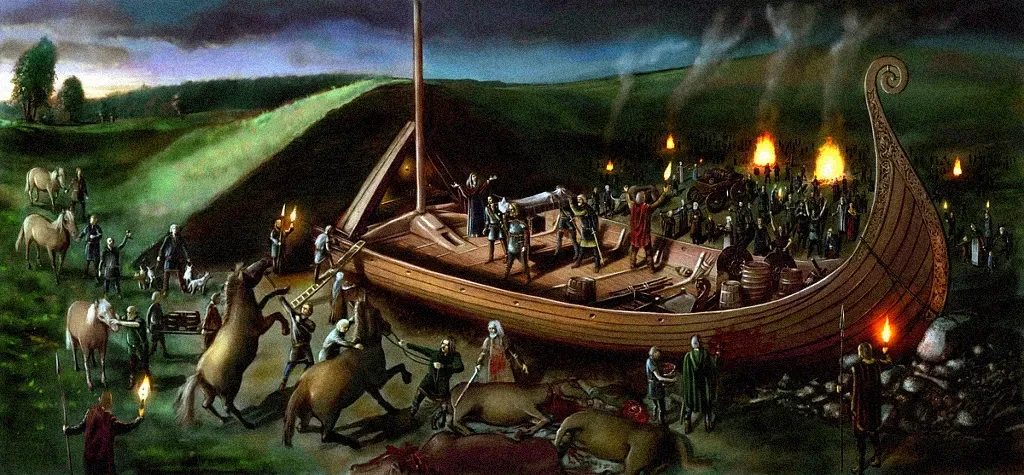
This is a Viking ship burial where a king is being buried with his ship and his horses as though he was still alive. Because from their perspective, he's still alive. He's still able to give us his wisdom.
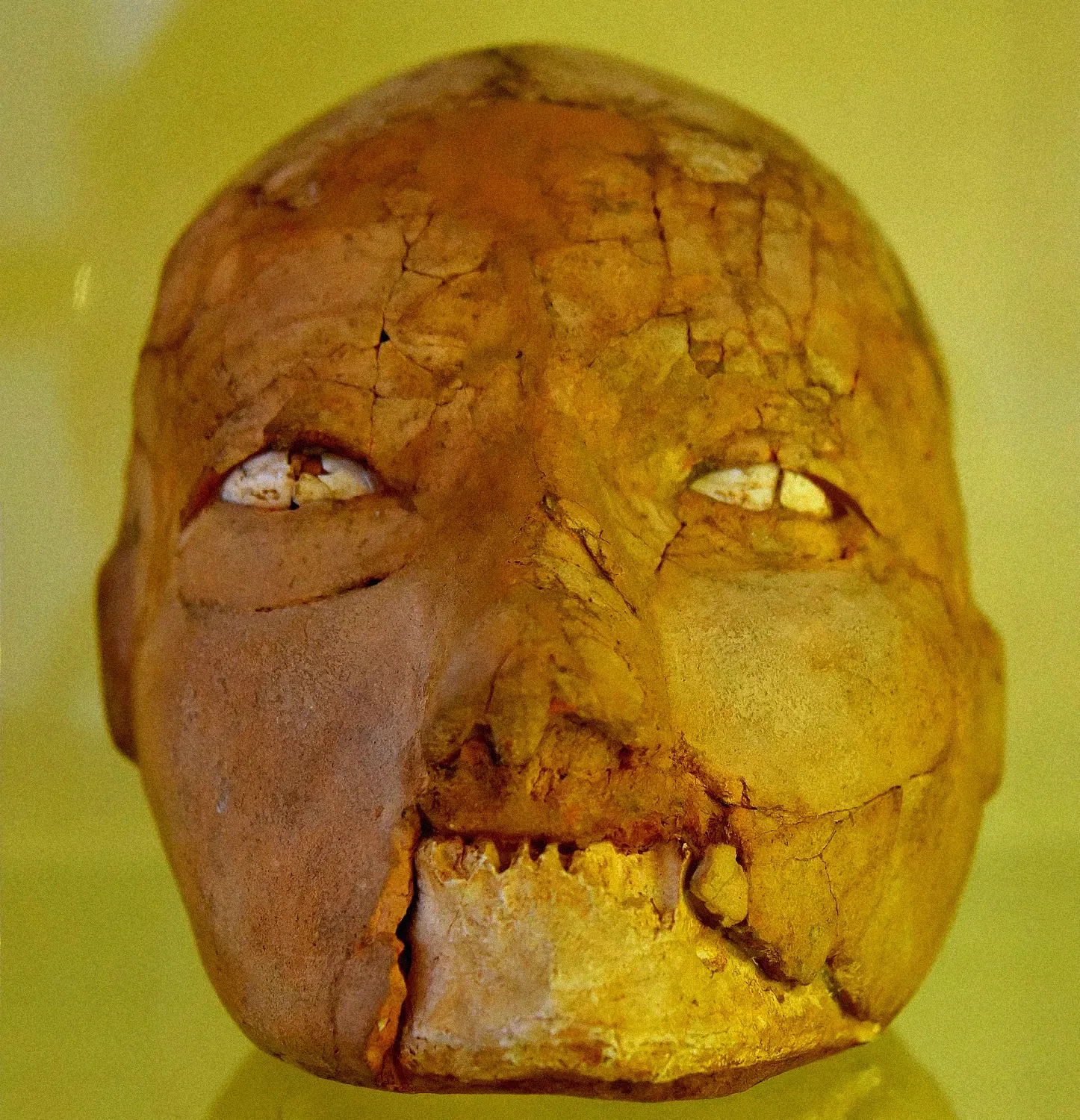
This is the cult of the skull, which is what we found in most Neolithic cultures, the earliest agricultural societies. Why? Because they practiced ancestor worship, and they believed that these skulls were living and they could help you access the dead in the spirit world and draw wisdom and inspiration from them.
This is a book, The Cosmic Serpent, by Jeremy Narby. He tells us that if you just do some basic research, this understanding of the universe where our right brain receives spirits and our left brain interprets it into reality makes a lot of sense. Because the entire universe is itself consciousness. It's all mind, and matter is just what we perceive.
I began my investigation with the enigma of plant communication. I went on to accept the idea that hallucinations could be a source of verifiable information. And I ended up with a hypothesis suggesting that the human mind can communicate in a defocalized consciousness with the global network of DNA-based life. All this contradicts the principles of Western knowledge.
The entire universe is consciousness. Plants have it, animals have it, we have it. And therefore, if we open our minds, we're able to communicate with the entire universe and draw insight. He goes on to say that scientists know this, and our greatest discoveries came from scientists who embraced the consciousness of the universe.
Many of science's central ideas seem to come from beyond the limits of rationalism. René Descartes dreams of an angel who explains the basic principles of materialistic rationalism to him. Albert Einstein daydreams in a tram approaching another and conceives the theory of relativity. James Watson scribbles on a newspaper in a train, then rides his bicycle to reach the conviction that DNA has the form of a double helix.
It's almost as though a spirit is telling the secrets of the universe to the scientists. Just ask yourself these questions, and you will understand that maybe the universe is consciousness.
- Sometimes you think of someone, and then boom, that person calls you. Is that strange? Has that ever happened to you?
- Do you feel as though you're being watched all the time?
- Do you feel as though you're an actor on a stage?
- Do you sometimes feel you're compelled to act as though something has control of your body? Possession.
- Why do certain ideas pop into your head all of a sudden? Do you sometimes feel as though something planted an idea into you?
- Why do you have dreams? Where do dreams come from? What do dreams mean?
- Do you sometimes feel as though you know what someone else is thinking? Is it possible you're sitting with a friend and you know exactly what your friend is thinking even though you're not talking?
- Do you think sometimes that you're having a conversation with a friend inside your head? Your friend is not there, but you're having a conversation with your friend.
- Do you feel as though you have a guardian angel?
I'm sure you're too shy to say this, but I'm sure that you feel as though there is a spirit world. These were not mysteries and questions before because everyone assumed we lived alongside spirits, angels, and demons. Today we ask these questions; before, they didn't ask these questions because everyone just assumed that, yeah, of course, we live alongside angels and demons, and that's why we are who we are.
The Iliad and the Bicameral Brain
The Iliad shows us how the brain worked at that time: a brain that was both materialistic and spiritual, a brain that understood that we lived in different dimensions, and that the gods had more control over us. The gods represented our emotions and the workings of nature.
In the very beginning of the Iliad, Homer says this (this is the translation by Robert Fagles):
Rage—Goddess, sing the rage of Peleus’ son Achilles,
murderous, doomed, that cost the Achaeans countless losses,
hurling down to the House of Death so many sturdy souls,
great fighters’ souls, but made their bodies carrion,
feasts for the dogs and birds,
and the will of Zeus was moving toward its end.
Begin, Muse, when the two first broke and clashed,
Agamemnon lord of men and brilliant Achilles.
The first thing that Homer says is, "Please inspire me, Muse." What he's doing is not creating; what he's doing is channeling. He's drawing inspiration from the gods. When he's speaking to people, he's saying, "I am here as a messenger of the gods. This information is from the gods themselves."
This is the clash between Agamemnon and Achilles, the first meeting that starts off the Iliad. Agamemnon says to Achilles, "Give me your slave girl and get out of here." And Achilles is like, "Screw you. I'm not going to fight for you again." But now Achilles is pissed off. He wants to kill Agamemnon.
Agamemnon broke off and anguish gripped Achilles.
The heart in his rugged chest was pounding, torn...
Should he draw the long sharp sword slung at his hip,
thrust through the ranks and kill Agamemnon now?—
or check his rage and beat his fury down?
As his raging spirit veered back and forth,
just as he drew his huge blade from its sheath,
down from the vaulting heavens swept Athena.
The white-armed goddess Hera sped her down,
Hera who loved both men and cared for both alike.
Rearing behind him, Pallas seized his fiery hair—
only Achilles saw her, none of the other fighters.
Struck with wonder, he spun around, he knew her at once,
Pallas Athena! the terrible blazing of those eyes,
and his winged words went flying: “Why, why now?
Child of Zeus with the shield of thunder, why come now?
To witness the outrage Agamemnon just committed?
I tell you this, and so help me it’s the truth—
he’ll soon pay for his arrogance with his life!”
Her gray eyes clear, the goddess Athena answered,
“Down from the skies I come to check your rage if only you will yield.
The white-armed goddess Hera sped me down.
She loves you both, she cares for you both alike.
Stop this fighting, now. Don’t lay hand to sword.
Lash him with threats of the price that he will face.
And I tell you this and I know it is the truth:
one day glittering gifts will lie before you,
three times over, to pay for all his outrage.
Hold back now. Obey us both.”
Achilles wants to kill Agamemnon, but now he's being possessed by Athena, and Athena says, "Stop."
So she urged
and the swift runner complied at once: “I must—
when the two of you hand down commands, Goddess,
a man submits, though his heart breaks with fury.
Better for him by far. If a man obeys the gods
they’re quick to hear his prayers.”
And with that Achilles stayed his burly hand on the silver hilt
and slid the huge blade back in its sheath.
He would not fight the orders of Athena.
Again, this is not factual. Athena doesn't really exist, but it's truthful in that it gives us insight into how the human brain and human emotions work. Now, what I'm going to do is rewrite this in modern prose to show you the difference.
This is what I wrote myself. It's bad writing, it's modern prose, but you're able to compare and contrast.
"I don't need you. Get out of my sight," roared Agamemnon. He spat on the ground. Achilles' blood boiled, and he reached for the hilt of his sword. He saw all eyes stare at him, but he stayed focused on Agamemnon. He counted the seconds and the steps it would take for him to sprint forward and strike him down. His feet grew heavy, and his legs grew wobbly. He could not move. He felt the thumping of his heart. Achilles snapped around and walked out of the room. He saw all eyes focus on him.
This is factual, but it's not truthful. Do you understand? It doesn't give us insight into why this is happening. The Iliad is truthful but not factual. Modern prose is factual but not truthful.
As I said, Achilles refuses to fight. The Greeks are losing the war, and so the Greeks beg Achilles to come fight. Achilles says no. He sends Patroclus to figure out what's going on, and Patroclus comes back and says, "Let me fight, Achilles." At this point, Achilles should just be like, "We'll fight together," or "Don't go if it's too dangerous." Instead, he says this:
So he pleaded,
lost in his own great innocence...
condemned to beg for his own death and brutal doom.
And moved now to his depths, the famous runner cried,
“No, no, my prince, Patroclus, what are you saying?
Prophecies? None that touch me, none I know of.
No doom my noble mother revealed to me from Zeus.
Just this terrible pain that wounds me to the quick—
when one man attempts to plunder a man his equal,
to commandeer a prize, exulting so in his own power...
That’s the pain that wounds me, suffering such humiliation.
That girl—the sons of Achaea picked her as my prize
and I sacked a walled city, won her with my spear
but right from my grasp he tears her, Agamemnon,
that son of Atreus!—treating me like some vagabond,
some outcast stripped of all my rights!”
The Greek army is about to be destroyed, and Achilles is concerned about his own pride. Agamemnon stole his girlfriend, and he's pissed.
“Enough.
Let bygones be bygones. Done is done.
How on earth can a man rage on forever?
Still, by god, I said I would not relax my anger,
not till the cries and carnage reached my own ships.
So you, you strap my splendid armor on your back,
you lead our battle-hungry Myrmidons into action!
And now, in fact, a black cloud of the Trojans
blasts down on the ships with full gale force—
our backs to the breaking surf, we cling still
to a cramped strip of land, the Argives lost.
The whole city of Troy comes trampling down on us,
daring, wild. Why? They cannot see the brow of my helmet
flash before their eyes. Oh they’d soon run for their lives
and choke the torrent-beds of the field with all their corpses
if only mighty Agamemnon met me with respect.
Now as it is, they’re fighting round our camp.
No spear rages now in the hand of Diomedes,
keen to save the Argives from disaster.
I can’t even hear the battle cry of Agamemnon
break from his hated skull, but that man-killing Hector,
calling his Trojans on, his war cries crashing around me,
savage cries of his Trojans sweeping the whole plain,
victors bringing the Argive armies to their knees!
Even so, Patroclus, fight disaster off the ships,
fling yourself at the Trojans, full force,
before they gut our hulls with leaping fire
and tear away the beloved day of our return.
But take this command to heart—obey it to the end.
You can win great honor, great glory for me
in the eyes of all the Argive ranks, and they,
they’ll send her back, my lithe and lovely girl,
and top it off with troves of glittering gifts.
Once you have whipped the enemy from the fleet
you must come back. Even if Zeus the thunderer,
Hera’s lord, should let you seize your glory,
you must not burn for war against these Trojans,
men who lust for battle—not without me.
You will only make my glory that much less.”
"Me, me, me." All he cares about is me. "Patroclus, you can go to battle, but don't win too much glory. Do not outshine me." And because he says this, what does Patroclus do? He tries to win all the glory for himself. He engages in a duel with Hector, and it costs him his life. So, it's Achilles' fault this is happening, and he knows it.
The psychology here is just so insightful, so deep, so striking. Let's use an analogy to understand the psychology. Let's pretend John and Jill are boyfriend and girlfriend, but they have a fight like boyfriends and girlfriends do, and they break up. They long for each other, but they don't want to apologize to each other. So Jill tells her best friend Jane to talk to John to try to get him to apologize. Jane goes and talks to John, and John says, "You know what? I've had it with Jill. I'd much rather date you because you're more beautiful and more reasonable." Jane is really excited because Jill is prettier than she is. So she runs back to Jill and says, "Hey, John asked me to go on a date. Maybe I can use this opportunity to convince him to apologize." And then Jill says, "Okay, go date him, but whatever you do, don't kiss him."
So what does Jane do? This is reverse psychology. Jill knows that if she says this, Jane's going to kiss John. And Achilles knows that if he tells Patroclus, "Don't win too much glory," Patroclus is going to try to win a lot of glory. And so what happens, of course, is that Patroclus dies. Now Achilles can enter the battlefield and win all the glory for himself. And that's what happens. He kills Hector. He saves the Greeks. But then he goes crazy.
What he does is he ties Hector to his chariot and starts riding around the walls of Troy. It is a war crime. It's disgusting. It's hideous. The Trojans are going crazy. The Greeks are like, "We don't want this, man." The gods are like, "What the hell's going on?" It's mutilation. It's torture.
Now we move to the end of the Iliad. At this point, Priam the king cannot sleep because his son Hector is being mutilated by Achilles. Achilles can't sleep because he cannot forgive himself for the death of Patroclus, and so he takes it out on Hector. The gods are watching this, and they're kind of disgusted.
The games were over now. The gathered armies scattered,
each man to his fast ship, and fighters turned their minds
to thoughts of food and the sweet, warm grip of sleep.
But Achilles kept on grieving for his friend,
the memory burning on, and all-subduing sleep
could not take him, not now... he turned and twisted,
side to side, he longed for Patroclus’ manhood,
his gallant heart—what rough campaigns they’d fought
to an end together, what hardships they had suffered,
cleaving their way through wars of men and pounding waves at sea.
The memories flooded over him, live tears flowing,
and now he’d lie on his side, now flat on his back,
now face down again. At last he’d leap to his feet,
wander in anguish, aimless along the surf, and dawn on dawn
flaming over the sea and shore would find him pacing.
Then he’d yoke his racing team to the chariot-harness,
lash the corpse of Hector behind the car for dragging
and haul him three times round the dead Patroclus’ tomb,
and then he’d rest again in his tents and leave the body
sprawled face down in the dust. But Apollo pitied Hector—
dead man though he was—and warded all corruption off
from Hector’s corpse and round him, head to foot,
the great god wrapped the golden shield of storm
so his skin would never rip as Achilles dragged him on.
And so he kept on raging, shaming noble Hector.
But the gods in bliss looked down and pitied Priam’s son.
They kept on urging the sharp-eyed giant-killer Hermes
to go and steal the body. A plan that pleased them all,
but not Hera, Poseidon or the girl with blazing eyes.
They clung to their deathless hate of sacred Troy,
Priam and Priam’s people, just as they had at first,
when Paris in all his madness launched the war—
he offended Athena and Hera, both goddesses.
But Zeus who marshals the stormclouds warned his queen,
“Now, Hera, don’t fly into such a rage at fellow gods.
These two can never attain the same degree of honor.
Still, the immortals loved Prince Hector dearly,
best of all the mortals born in Troy.
So I loved him, at least. He never stinted with gifts
to please my heart. Never once did my altar lack
its share of victims, wine-cups tipped and the deep, smoky savor.
These are the gifts we claim, these are our rights.
But as for stealing courageous Hector’s body—
we must abandon the idea. Not a chance in the world
behind Achilles’ back. For Thetis is always there,
his mother, always hovering near him night and day.
So, would one of you gods call Thetis to my presence?
so I can declare to her my solemn, sound decree:
Achilles must receive a ransom from King Priam,
Achilles must give Hector’s body back.”
The gods are fighting over what to do, and then Zeus says, "You know what? Let's just broker a peace between Achilles and Priam." So Priam agrees to ransom back Hector's body, and Achilles agrees.
Again, we can write this in modern prose and eliminate the gods, but what you'll see is that it's not as powerful, not as intriguing, not as truthful.
Priam could not sleep and tossed in his bed. His wife and his children came one by one to console the weeping king, but to no avail. His servants tried different sleeping potions, and one by one they failed. In the middle of the night, he screamed at the moon and tore at his graying hair. Priam ached for Hector and felt guilt and remorse for failing his son. Trojan spies watched Achilles drag Hector's body day and night. They took turns spying, and they knew that Achilles could not sleep. They reported this news to Priam, and this gave him hope. He sent an emissary to the Greek camp, and Agamemnon agreed that it was Priam's right to ransom back his son, as is the custom of war. Even after the rage of Achilles, Agamemnon sent a servant to talk to Achilles. Achilles did not hear Priam's offer, but he nodded his head anyway.
It's less powerful, less truthful, less interesting.
Now comes the most powerful part of the Iliad. This is when Priam and Achilles meet for the first time. Priam is snuck into the tent by Hermes.
...the majestic king of Troy slipped past the rest
and kneeling down beside Achilles, clasped his knees
and kissed his hands, those terrible, man-killing hands
that had slaughtered Priam’s many sons in battle.
The king has the opportunity to kill Achilles but chooses instead to kiss his hand and submit before him. This submission destroys the pride of Achilles. It's an emotional duel between Priam and Achilles, and Priam has won.
Awesome—as when the grip of madness seizes one
who murders a man in his own fatherland and flees abroad
to foreign shores, to a wealthy, noble host,
and a sense of wonder runs through all who see him—
so Achilles stared in wonder at majestic Priam.
That's what Priam has done. Priam is like a fugitive who's wanted for murder. He escapes and he should be a slave, but somehow he's become wealthy. By submitting himself before Achilles, Priam has changed the destiny of the world.
His men stared too, trading startled glances.
But Priam prayed his heart out to Achilles:
“Remember your own father, great godlike Achilles—
as old as I am, past the threshold of deadly old age!
No doubt the countrymen round about him plague him now,
with no one there to defend him, beat away disaster.
No one—but at least he hears you’re still alive
and his old heart rejoices, hopes rising, day by day,
to see his beloved son come sailing home from Troy.”
Those words stirred within Achilles a deep desire
to grieve for his own father. Taking the old man’s hand,
he gently moved him back. And overpowered by memory
both men gave way to grief. Priam wept freely
for man-killing Hector, throbbing, crouching before Achilles’ feet
as Achilles wept himself, now for his own father,
now for Patroclus once again, and their sobbing rose
and fell throughout the house.
This is the first time Achilles can now cry. He could not cry before. They've forgiven each other. Why? Because they love their people. Priam saw Hector in the face of Achilles. Achilles saw his father in the face of Priam. And because of their love for others, they found love for each other. Love is the unifying force of the universe. Love is what allows us to forgive ourselves and forgive others. This is the tremendous insight of the Iliad.
To demonstrate how powerful this insight is, let's run a scenario, a thought experiment. Let's just say you're driving a car with your wife and your child home from a restaurant. You've had too much to drink, and then you hit a car, and your wife and your child die. That's the first scenario.
Second scenario: you're driving home, and then a drunk driver hits you, killing your wife and your child. It's not your fault; it's the drunk driver's fault.
Third scenario: you're arguing with your wife, and you're not really watching the road. Then that drunk driver hits you and kills your wife and your child.
These are three different scenarios. Let me ask you a question: in which scenario are you less likely to forgive the drunk driver? One, it's your fault. Two, it's his fault. Three, it's his fault, but it's also your fault. Which one? It's number three. Why? Because you cannot forgive yourself first. If you cannot forgive yourself, you can't forgive others. And guess what? In real life, it's always number three. It's almost never number one or number two.
Forgiveness is something that we encounter every day. Every day we make mistakes, and because we can't forgive ourselves, we can make even more and more mistakes. That's the problem of forgiveness. This is the deepest problem in human society. What the Iliad tells us is that the real struggle is not for power. The real struggle is within our heart. The real struggle is between ourselves. If we forgive ourselves, we can change the world. If we forgive others, we make the world a better place. Because Priam forgave Achilles, Achilles was able to forgive himself, and they made the world a better place. That's the power of the human heart.
The Oral Culture of Greek Civilization
This is what gives rise to Greek civilization. The Greeks engaged in an oral tradition, and in the oral tradition, they were constantly trying to figure out the mysteries of the human heart.
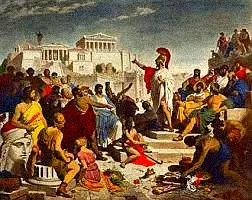
This is Pericles giving his famous funeral oration. Every day, people are speaking because that's what a person does: speaks before others.
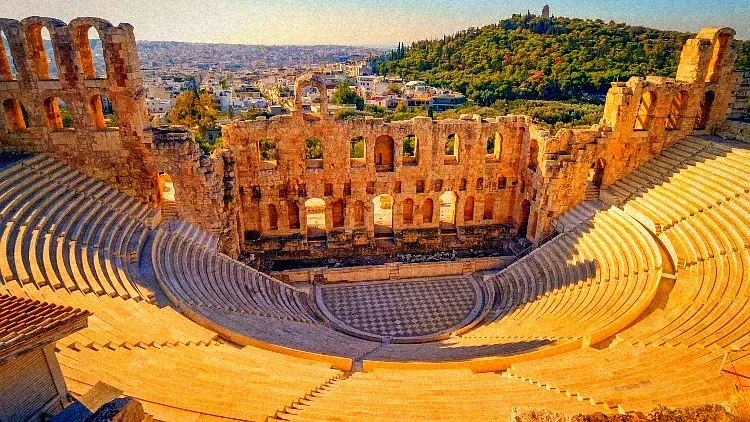
The Greeks were known for their theater. This is the amphitheater in Athens. You can see it seats about 10,000 people. This is what they do for fun. They stage theater, and everyone watches it. The theater plays by Aeschylus and Sophocles are about the human heart, the mysteries of the human heart. So every day, people are thinking about what it means to be human, and that's why they have the greatest civilization in the world.
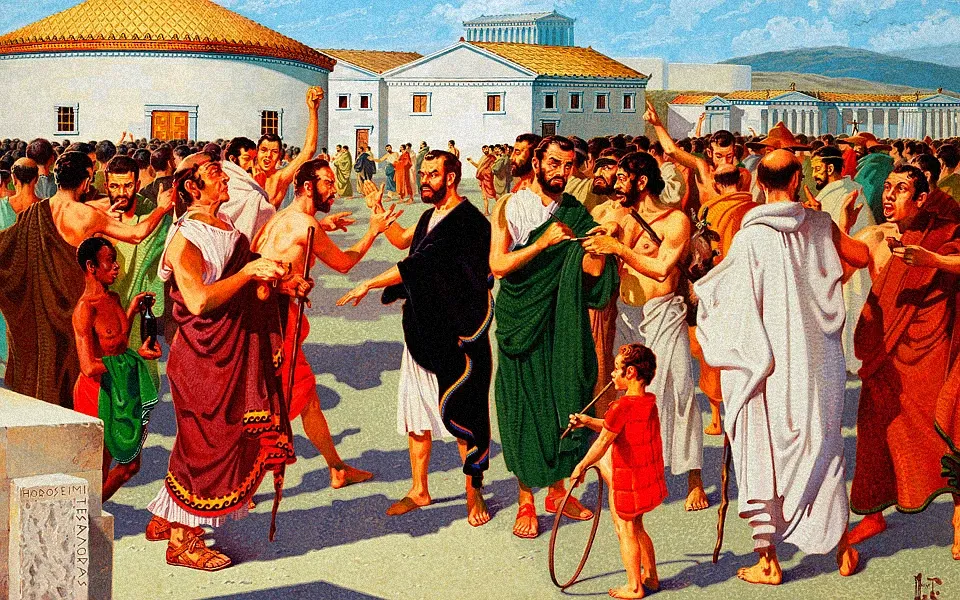
This is the Agora, the marketplace where people come together and just debate. They talk. Socrates was famous for being in the Agora and just finding people to debate.
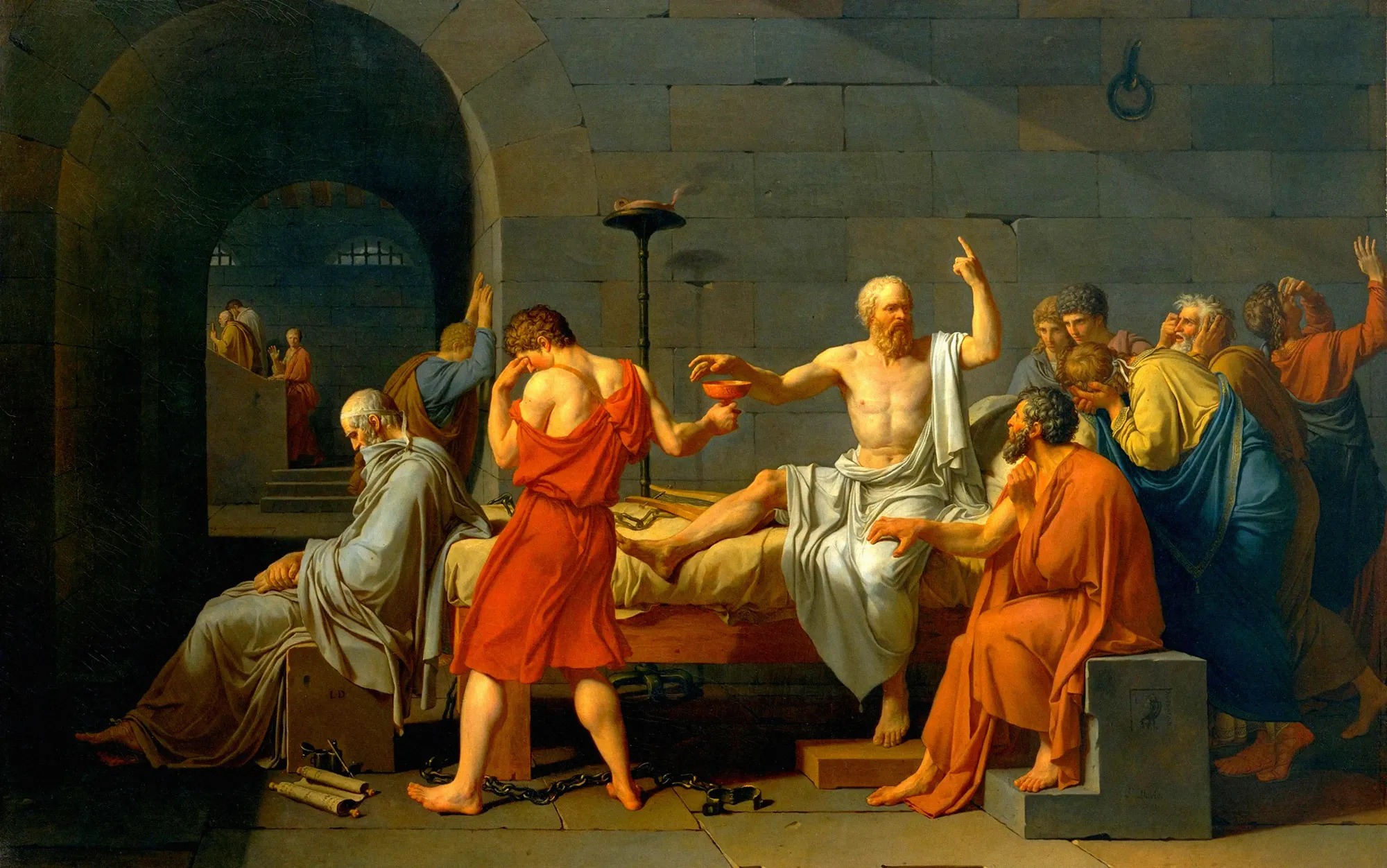
This is the symposia. The symposia is a gathering of wealthy people. What they do is they drink wine and they talk about philosophy, love, death, the meaning of life. The wine is interesting because they'll water down the wine so it's not as strong, and they'll do this for the entire night. This is Socrates engaging in a symposium on love. That's what they do for fun.
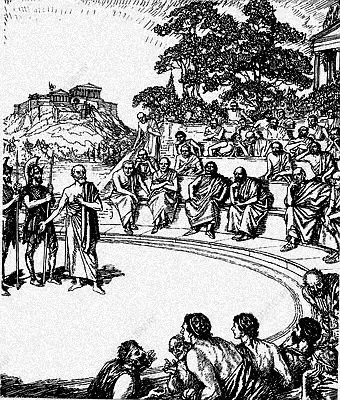
This is the trial of Socrates. If you're charged with a crime, you face a trial, and there are 500 people, and you have to convince those 500 jurors why you're guilty or not guilty. This is an oral culture where every day people are talking with each other, and that's the source of their creativity. And what they're talking about is the Iliad, the Odyssey. They're trying to figure out what Homer meant, what Homer was trying to tell the world in his poetry.
This is Herodotus. Even if you write, the first thing you do when you write is recite your writings to everyone so you understand what the reaction is. Writing comes from community. It comes from understanding the feelings of others. Today, we just write by ourselves, and that's why our writing is crap.
The Loss of the Spiritual and the Rise of Modern Literature
Anna Karenina, considered the greatest novel of the modern period, was written by Leo Tolstoy. It's a really fun novel; I highly recommend it. It's a great book. It starts off by saying:
Happy families are all alike; every unhappy family is unhappy in its own way.Everything was in confusion in the Oblonskys’ house. The wife had discovered that the husband was carrying on an intrigue with a French girl...
It starts with an affair. What happens is that the husband's sister, Anna Karenina, will come from St. Petersburg to try to resolve the issue, but then she'll fall in love with another man, Count Vronsky, and they have an affair together. This affair destroys their families, and it ends with Anna Karenina's suicide. Because what's happening is that she's demanding more and more from Vronsky, and he can't keep up. He's exhausted by the demands of Anna Karenina. This is what she says before she kills herself:
“My love keeps growing more passionate and egoistic, while his is waning and waning, and that’s why we’re drifting apart.” She went on musing. “And there’s no help for it. He has everything for me, and I want him more and more to give himself up to me entirely. And he wants more and more to get away from me. We were walking to meet each other up to the time of our love, and then we have been irresistibly drifting in different directions. There’s no altering that. He tells me I’m insanely jealous, and I have told myself that I am insanely jealous. But it’s not true. I’m not jealous, but I am unsatisfied.”
"I don't have any meaning in my life, and I want this love to give me meaning." It's almost like she's looking for God. We've killed God, and now she's looking for God in affairs, in sex, in lust, and that's why she can't find it.
What I'm going to do is take this and translate it into heroic prose. Let's see how Homer might have written this. I'm not Homer, but this is how he might have written it.
Anna Karenina went to the train station and sat on the bench, waiting for the train to come. Her thoughts were empty and her head low. "Where do you plan to go?" someone asked from the corner. That snapped Anna from her trance, and to her horror, she saw herself. But it was not herself. She was older, with graying hair and drooping eyes. Anna looked as though she had seen a ghost. She was hallucinating herself 20 years from now.
"Who are you?" Anna shouted in horror. "What do you want?"
"Where will you go?" the older Anna asked.
"Where's Vronsky?" Anna shouted. She looked around. The train station was empty.
"You know where he is," the older Anna said with a look of pity on her wrinkled face. Anna got up and walked away. She was being followed. She knows that in time, she'll just be all alone. She sees her own future.
"Anna, where are you going?" the older Anna asked.
"Stop following me!" Anna shouted back, picking up the pace. "I am going to a place where you can't find me."
"Don't do anything rash," the older Anna said, chasing after her.
"Leave me alone!" Anna shouted, and she ran and ran, screaming and screaming. She tripped and fell onto the tracks, right in front of the train.
And then she died. If you do it this way, it gives you more insight into the human mind, the human psyche. And that's what we've forgotten.
What happens when we stop believing in the spiritual? What happens when we disconnect from the right hemisphere of the brain? We clutter our brains with insignificant concerns, pursuits, and details in search of significance. When we kill God, anything can be God. As I said, Anna Karenina, with her affair, is looking for God. She's looking for meaning. Before, when we hallucinated, when we talked with the gods, we had meaning. We had wisdom. We had significance. And now we've lost it.
The result is what we call modern literature, which is complete, utter crap, by the way. We know this because this is Virginia Woolf's To the Lighthouse. It's considered one of the greatest novels of the 20th century. It's not very good. This is a woman talking to herself. It's what we call stream of consciousness.
There were the eternal problems: suffering; death; the poor. There was always a woman dying of cancer even here. And yet she had said to all these children, "You shall go through it." To eight people she had said relentlessly that. And the bill for the greenhouse would be fifty pounds. For that reason, knowing what was before them—love and ambition and being wretched alone in dreary places—she had often the feeling, Why must they grow up and lose it all?
Her mind is wandering and wandering, and she's concerned about the grocery bills. She's concerned about the future. She's concerned about the past. There's no discipline, there's no focus to any of her ideas. This is what we call stream of consciousness, and it's the way we think today. The reality is that we live in a world in which God is dead, in which we're not allowed to imagine a spiritual world, and in a world in which we're only focused on the here and now. As such, we live meaningless, insufficient lives. Our brains are just focused on things that don't matter, and our brains become schizophrenic.