Secret History #21: Roman Anti-Civilization
Before this, we've done Persia, the Jews, and the Greeks. These are the three main civilizations after the Bronze Age collapse. Now, Rome will emerge to eclipse all three and build a world empire. What I will argue to you today is that Rome is the great anti-civilization. Or, you can call it just the evil empire.
The Rise of a Warlike People
Like most great empires, Rome emerged initially at the borderlands of another cultural empire: the Etruscans. The Etruscans were very similar to the Mycenaean Greeks, and they were expanding throughout the Italian peninsula. The thing about empires is that eventually, the people become lazy, arrogant, and stupid, and so they get other people to fight for them.
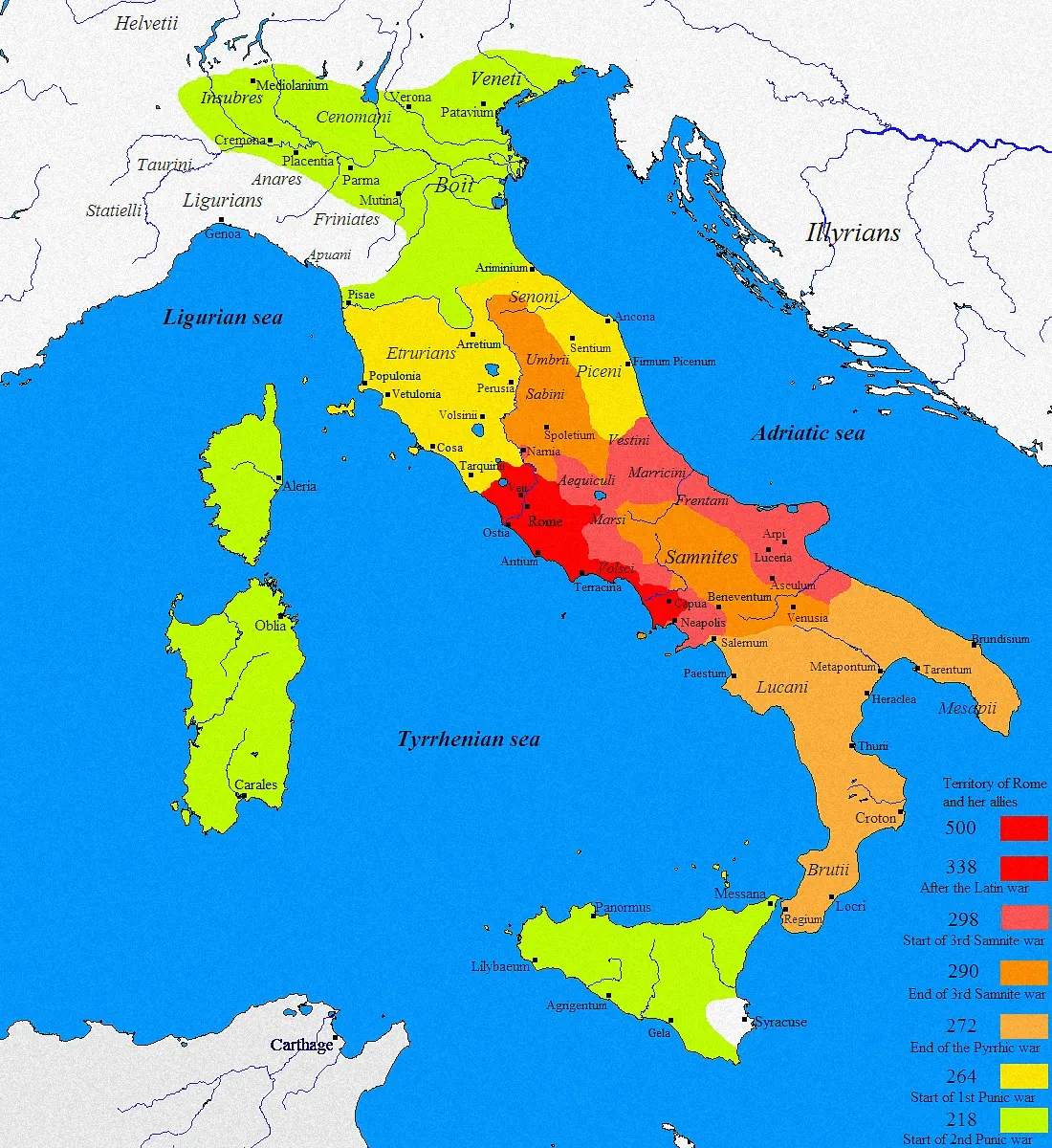
The Romans are here, on the borderlands, and the entire area is surrounded by great warriors. This is a poor region, so they're always fighting for resources. The Romans get recruited as mercenaries, and over time, they will start to emerge as the great power in the Italian peninsula. At this point in history, this is really important: they're surrounded by lots of different, warlike people like them. They triumph because they become the most warlike of everyone. Their entire society is based on war.
Etruscan civilization was very advanced and heavily in contact with the Egyptians and the Greeks, as well as people around them, because they were sea-faring people. This is the civilization that will most heavily influence the Romans. The Etruscans were always at war as well, and as they became wealthier, they would recruit the Romans to fight for them.
This map shows the gradual expansion of Rome. At first, it is actually at the most disadvantaged location because it's surrounded by enemies. It is on flat land, so it's not easily defensible, and it's not really by the coast, making it hard for it to trade. But because it is in such a disadvantaged position, it is forced to be the most martial, the most violent, the most militaristic, and the most aggressive. The culture evolves around that. Slowly over time, they're able to conquer the entire Italian peninsula and then expand to the Mediterranean.
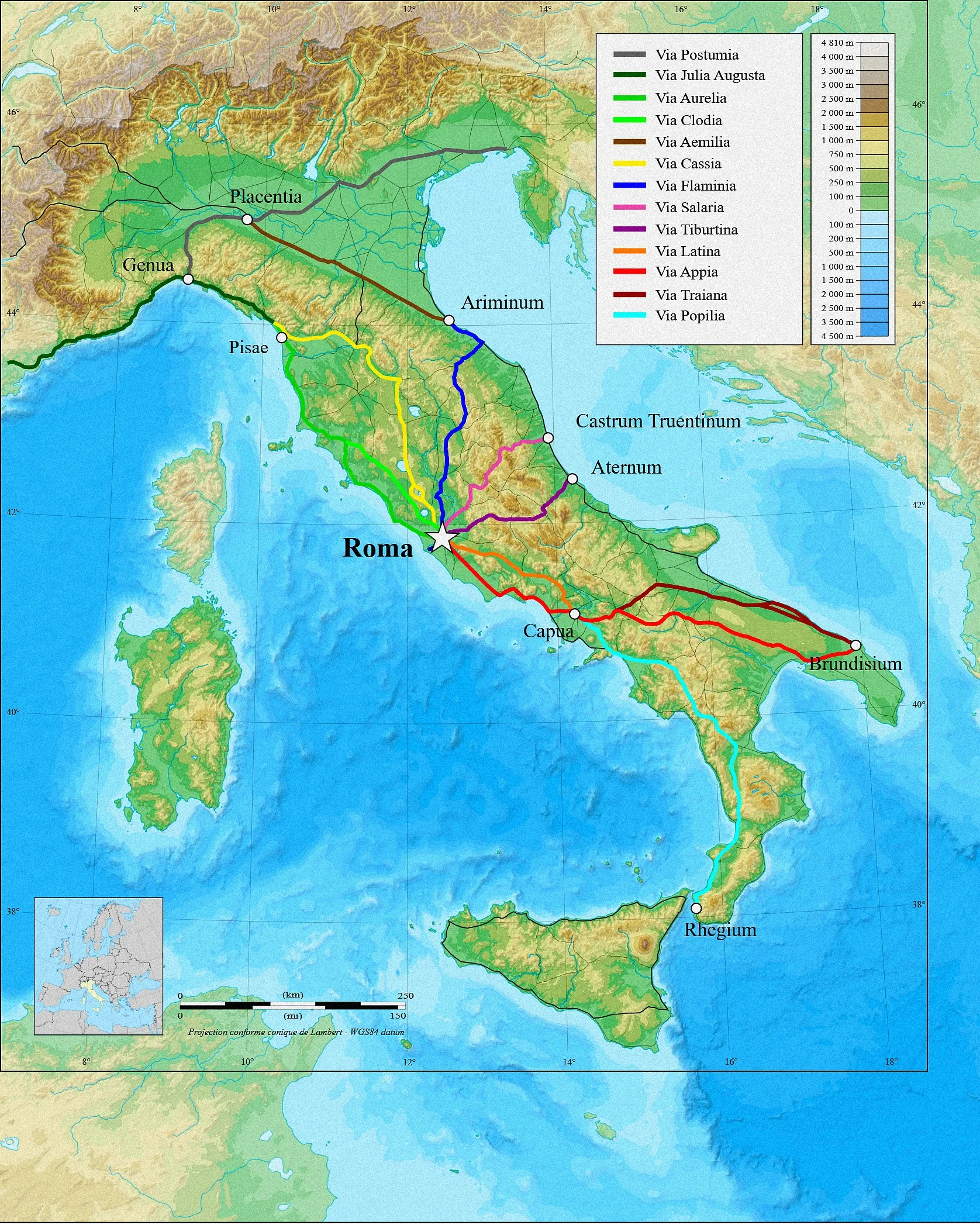
The way Rome expands is through military conquest and then by building roads. This is very impressive because if you've ever been to Italy, it is very hilly. A tremendous effort was required to build roads, but once they built them, they were able to consolidate and navigate their empire.
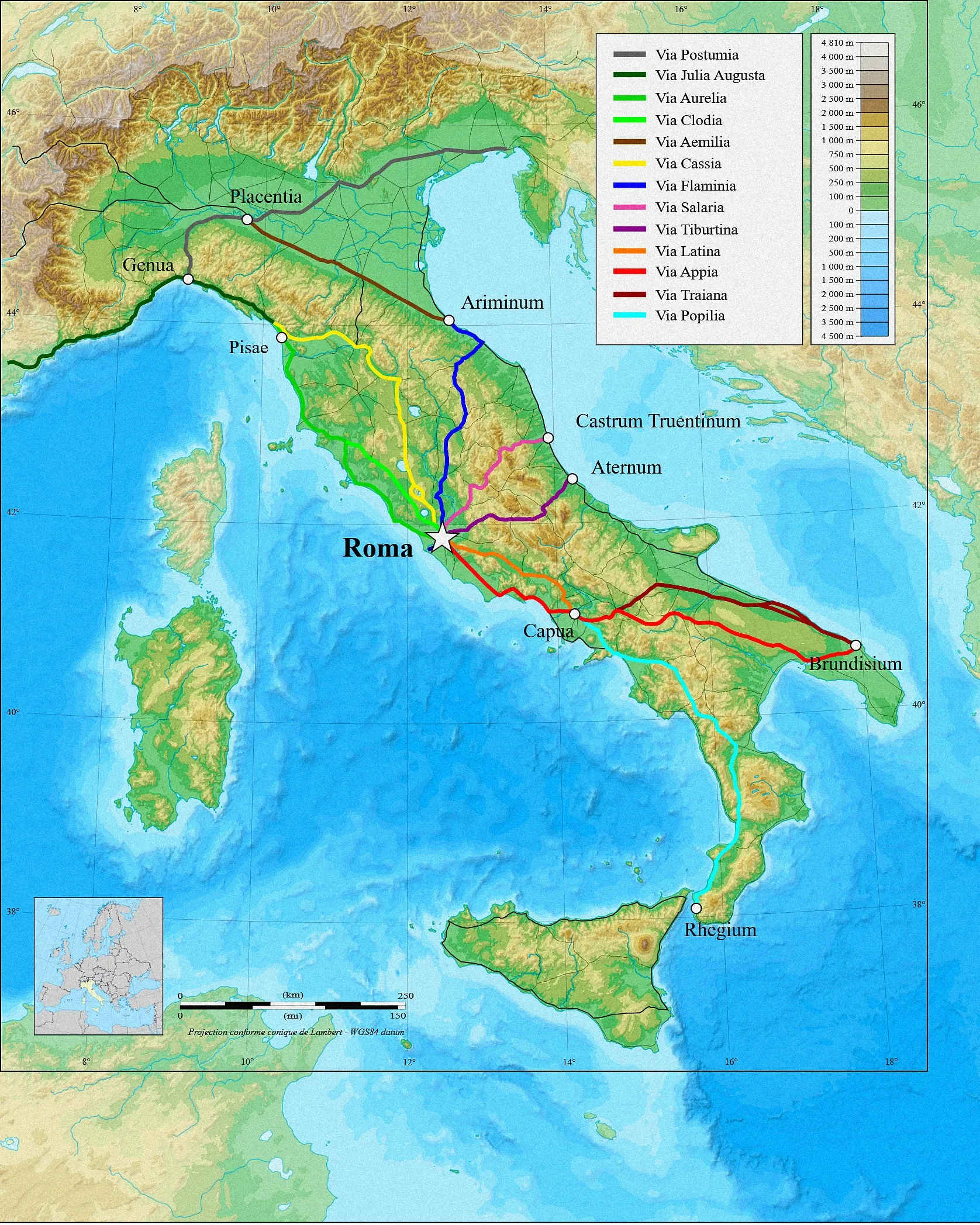
As you can see, Italy is very mountainous. There are not that many rivers, which tells us it's very poor. Because it's very poor, the people tend to be very unified, very aggressive, and they have a deep egalitarianism because only by working together can you ultimately triumph over other people.
There's a main characteristic about Rome in the early days that you must remember: it is poor, it is small, and it is unified. Everyone knows each other. Because of its geographic characteristics, a concept of liberty emerges. Their concept of liberty is obedience—to the fathers, to history, to culture—because only by doing so can you survive as a people.
This is a different concept from the Greeks. The Greeks believe that liberty is the right to speak your mind in front of others. As such, the major difference between the Greeks and the Romans is that in Greece, citizenship is passed on from family to family, but in Rome, citizenship can be earned. It's an open citizenship system. Why? Because if you just obey the fathers, the laws, and the customs, then you can be a Roman citizen.
As Rome expands, it's going to incorporate different people into its culture. As a result, Rome has an advantage that Athens and Sparta don't have: Rome can always replenish its soldiers. As such, it can afford to lose war after war after war. But as it does so, it gets stronger and stronger because it's learning with each defeat. That is the secret to Rome's ultimate victory.
The heart and center of Roman society is the Senate. This is where the leading families come together to discuss the fate of Rome. At this time in history, when Rome is poor, this is not a problem because everyone knows each other and there's no real inequality. Therefore, there can be no corruption. These fathers, the senators, are representing the best interests of all Romans. But over time, as Rome becomes wealthier and wealthier, this becomes a huge problem. As Rome develops more wealth, guess who gets all the wealth? These guys. We'll see this later; as Rome gets wealthier, Rome also becomes much more corrupt.
The Roman War Machine
The Greek fighting system is the hoplite phalanx. The Romans use something called the legions. There are some major differences between these two fighting techniques, even though for their time they are the most advanced.
- Armor & Wealth: The Greek hoplites are heavily armored. Each hoplite needs to buy his own armor, which means that hoplites tend to be small landowners with a bit of wealth. The legionnaires can be poor because it doesn't actually require that much armor to be a legionnaire.
- Training: It takes a lot of training to be a hoplite. You basically have to spend years and years honing your skills because you fight in formation. The legionnaire doesn't need that much training; you can actually go straight into battle.
- Mobility & Terrain: The hoplites use heavy armor, shields, and helmets. The legionnaires are much lighter. The reason why is the legionnaires were developed to fight in a mountainous region. They need to be able to climb and hike up mountains in formation, whereas the Greeks are fighting more on flat land.
Over time, the legionnaires will overwhelm the hoplites.
A typical Roman peasant spends most of his time farming, and when it's required of him, he goes to war. He's not a full-time soldier. As the Romans expand, they move closer and closer to the coast, where there are a lot of Greek colonies. The Greeks are losing to the Romans, so they call for help from their compatriots across the sea. A king named Pyrrhus of Epirus decides to take advantage of this opportunity to go conquer Italy.
He and his hoplites sail over and are destroying the Romans. Battle after battle, Pyrrhus is defeating the Romans. And then he finally says, "If I win one more battle, I'm going to have no more soldiers." This shows you the difference between Greek fighting versus Roman fighting. Greek fighting uses specialized forces that can win battles, whereas the Romans can just keep on replenishing their forces. The Romans don't actually win that many battles, but they win most of their wars.
Rome vs. Carthage: The Punic Wars
As the Romans expand, they eventually reach the Mediterranean. Now they start developing a navy in order to trade with other nations like Egypt and Greece. This brings them into conflict with the Carthaginians. At this time, the main power in the Mediterranean is Carthage. They will fight a war that lasts for decades, nearly 100 years, and ultimately Rome will triumph.
The main reason why Rome triumphs—and this is really important to understand—is the main difference between Carthage and Rome: Carthage is rich, Rome is poor. Why does this matter? Because if you're rich, you can hire mercenaries to fight the war for you, and that's what Carthage does. But Rome is poor; therefore, they must use their own citizens to fight the war. Over time, the citizens become much tougher and more unified, whereas the Carthaginians become more corrupt and decadent. Because the Romans are more invested in the war, they will fight to the end.
The Carthaginians are business people; they're traders, known for their sharp business skills. They do a cost-benefit analysis and decide, "You know what, this war is going to cost us more than if we just surrender." So the Carthaginians surrender the First Punic War, they surrender the Second Punic War, and in the Third Punic War, guess what happens? They're going to be wiped out by the Romans.
That's the Roman mentality: We fight you, we'll fight you to the death, and if we beat you, we will kill every one of you. That's just the Roman war mentality, and that's why they ultimately triumph in the end.
Deconstructing a Myth: The Second Punic War
We actually don't know that much about the history of Rome. The most famous episode during the Second Punic War is when a Carthaginian general named Hannibal Barca, who is in Spain, decides he's going to go destroy Rome. The way he does it is by crossing the Alps. For the longest time, Romans thought that this was a natural barrier. What Hannibal will do is cross the Alps with his war elephants and his army, land in Italy, and start attacking Rome. In three decisive battles, Hannibal will destroy the entire Roman army. He will wipe out the entire Roman army.
At this point in history, Rome needs to surrender. Hannibal sends an envoy to the Senate and tells them, "I destroyed every single one of your soldiers. You have no more army. Therefore, I am willing to talk peace terms." And the Senate is like, "Screw you. Come get us." This marks a turning point in Roman history.
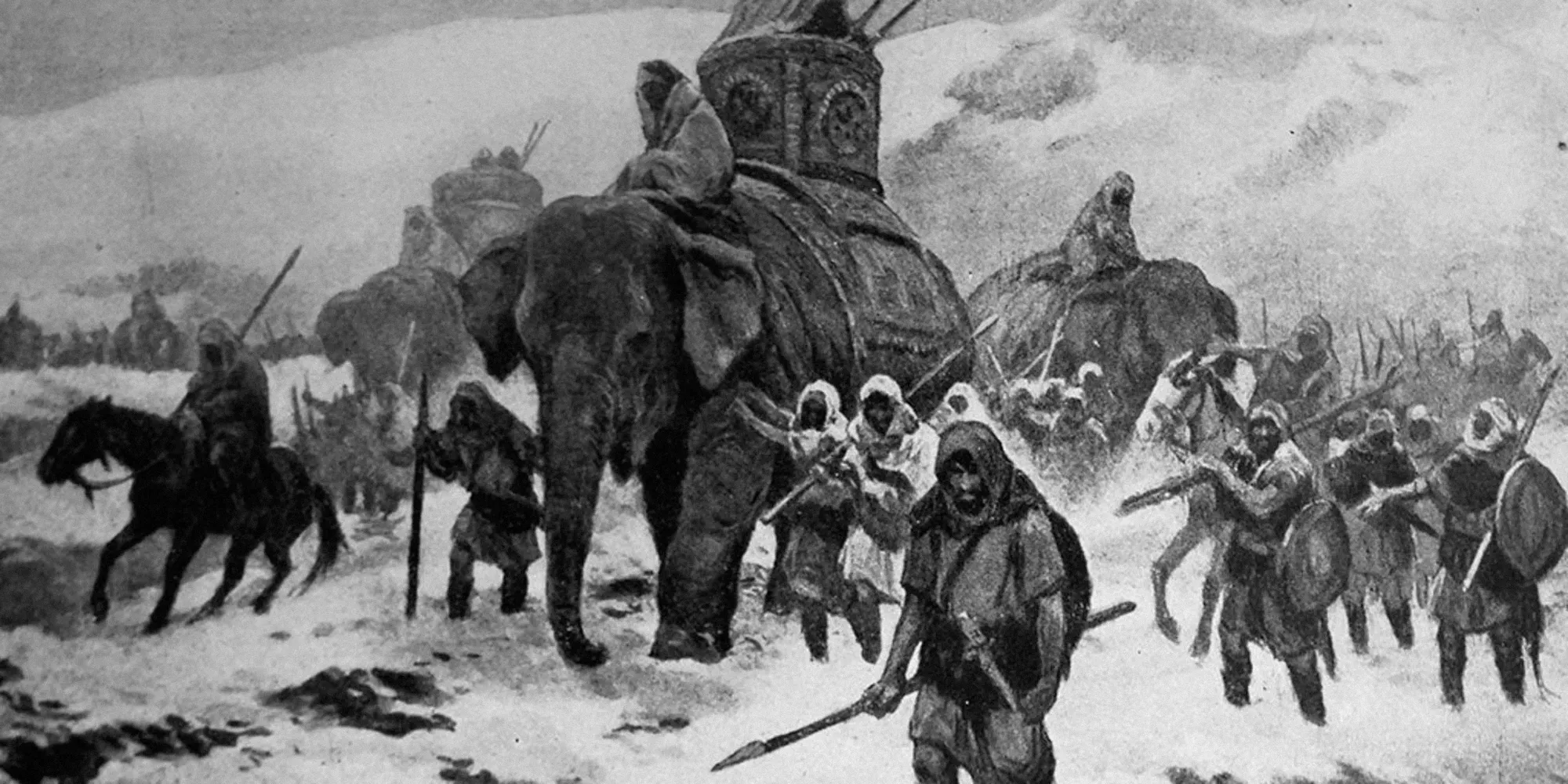
This is Hannibal crossing the Alps, one of the most famous military feats in human history. The first major battle is the Battle of Trebia, where even though Hannibal is undermanned and in enemy territory, he uses a series of brilliant military maneuvers to ambush his enemies. The Carthaginian horsemen lie in the marsh, and then they sneak up and destroy the Romans from the rear.
Next is the Battle of Lake Trasimene. The same thing basically happens, where the Romans are crossing a narrow pass and Hannibal ambushes them from the hills.
And this is the most famous battle: the Battle of Cannae. This is what we call a double envelopment strategy, where the two armies meet, Hannibal sends his cavalry on the wings, they envelop the Roman army, and then they slaughter everyone. The Romans lose between 50,000 to 100,000 men. Their entire army is wiped out because of this battle.
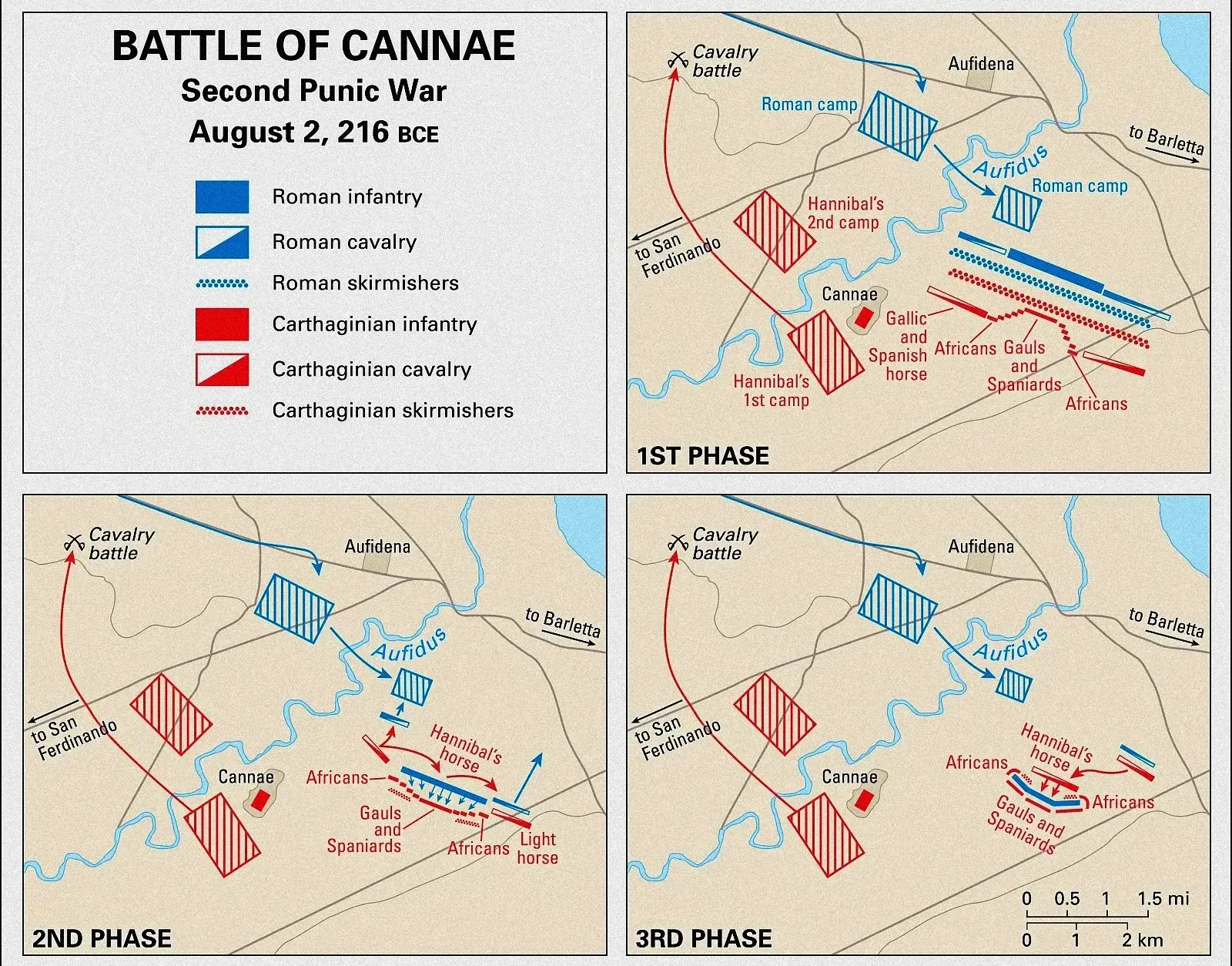
Now, there's a problem with this battle: this has never happened before in human history. In a similar situation, where an army is surrounded by enemies on all sides, what should happen theoretically is they become energized and fight to the end. We don't have an example in ancient times of an entire army being surrounded and slaughtered by the enemy. This is a very strange battle. In fact, if you ask ChatGPT which battles have used a double envelopment strategy, you have the Battle of Cannae, but the next one is in 1940, in World War II. The difference, of course, is that by the 1940s, you have machine guns and tanks. If you surround an enemy, you can destroy them. But not in ancient times. This battle strategy makes no sense from a military perspective.
Also, we can't find the damn place. You would think for a huge battle where 50,000 to 100,000 men are dead, there'd be a lot of bodies. We can't find it. There's no archaeological evidence to prove the battle took place.
A New Historical Framework
So, what's going on here? How do we know what history is true or not? You would think the answer is you just ask historians. The problem is that every historian you talk to tells you the Battle of Cannae must be a historical fact, even though we don't have any evidence for it.
Given that, how can we figure out if it's true or not? We can use a new historical framework to understand history.
- Does the Battle of Cannae fit into a larger historical pattern?
- Does it make sense according to game theory?
- Does religion explain the battle?
When we use this framework to understand the Battle of Cannae, our conclusion must be: it didn't happen. It was completely made up.
Why? First of all, when we have these great military generals like Hannibal Barca, they tend to become a king. Think of Napoleon or Julius Caesar. Hannibal is the first general we have that conquered all of Rome and decided, "I'm going to sit back and retire for the next 15 years." It never happened before. Why didn't he go back to Carthage and claim the kingship?
Second is game theory. If you read Roman history, they tell you that Hannibal, after the Battle of Cannae, was stuck in Italy without resources. Then the question is, why didn't he go to Carthage, conquer the place, and demand the resources he needed to win against Rome? Why is he sitting back? This is a guy who crossed the Alps on his own initiative. The Carthaginians told him, "Don't start a war with Rome," and Hannibal's like, "Nah, I'm going to go across the Alps, thank you very much." This makes absolutely no sense whatsoever.
From a religious perspective, how can we explain what Hannibal did? Roman historians will tell you, "Oh, it's because his father lost against Rome, and he wanted revenge." That makes no sense. Usually, when a Napoleon emerges, it's because he thinks he's a son of God. Think of Napoleon, Alexander the Great, Julius Caesar. They all have a divine mission.
From this, the only conclusion can be, first of all, the battle did not happen. There's no way it could have happened. And second, you can also say that Hannibal Barca did not exist as a person.
But then this leads us to a really huge problem: why would the Romans just make this stuff up? Why would they say, "We fought this battle and 100,000 of our men got killed by this Carthaginian general, Hannibal, who was smarter than us?"
The reason why is Carthage. At this time in history, about 200 BC, Carthage was the most beautiful, the most prosperous, the most cultured city in the world. And what did the Romans do? They burned it to the ground and killed everyone. That's the Roman way.
During the Third Punic War, a Greek named Polybius was a hostage of Rome, and he became the official historian of the Roman Empire. This is the guy who invented the Battle of Cannae. Why? To justify the burning of Carthage. The Romans are like, "Why did we kill the Carthaginians?" Because that's what we do. But Polybius is Greek, and he understands that if Rome is going to be an empire, you need people on your side. You can't go around just killing people; you need to explain your actions.
In other words, Polybius, in order to justify the Roman Empire, created this entire history of the Second Punic War that didn't really happen. Because now it's like, "Okay, well the Romans felt threatened by Hannibal. Hannibal was going to destroy them, so they saw Carthage as a threat, and therefore they had to destroy Carthage." Now it's much more reasonable. Polybius basically made up the entire history of Rome.
The thing to remember about history is that if you're a military power, you don't write history. Why? Because you're not capable of reflection or deep cultural production. The Romans won all these battles and got the Greeks to write their history for them to justify why they did what they did. I hate to say this, but basically, all Roman history is complete nonsense. If you read Roman history, just don't believe anything you read.
The Republic Consumes Itself
After the war against Carthage, after Rome destroys Carthage, Rome is the undisputed leader of the Mediterranean. It's an empire now, but it still keeps on fighting these wars overseas for no particular reason. Why? Because it has no choice in the matter. This is the entire Roman war machine.
Because Rome is a poor place, the only way that it can generate wealth is by conquering other people. The nobility wants to go fight these wars overseas so that they can capture slaves to work their estates. At this time in history, slaves are the main resource that people are fighting over.
To fight these wars, peasants are conscripted into the military. But once they leave the land, they need to feed their families, so they borrow money with their land as collateral. Over time, they can't pay back the interest, they default on the loan, and the landowners—the nobility—seize the land. Then they get the slaves that they conquered to come work this land. Now the peasants have no choice but to go to Rome to look for work because they've lost their land. The Roman state gives them food; it's called a grain dole.
So now the nobility wants to go fight more wars. They bribe the peasants to vote for more wars, and then the peasant can go and maybe win some booty because they have no land. What the Roman war machine is doing is creating slavery, debt, corruption, and inequality.
Over time, wealth becomes more consolidated in fewer hands, which creates conflict between the upper nobility and the lower nobility. The Optimates are the upper nobility, and the Populares are the lower nobility. What's the difference? Optimates just means "the best of the best." Why do I have so much money? Because I'm better than you are. In fact, my entire family is better than you are. Populares is where we get the word "populist" from. This is lower nobility, people like Julius Caesar, who take advantage of the discontent in order to launch their political careers. They promise the peasants more opportunities, to take the wealth of the rich and give it more to the poor.
This is a conflict that will arise in Rome after the end of Carthage, and this will last for centuries until the very end of the Roman Empire. In other words, the Roman war machine doesn't know how to stop. Even when it becomes an empire, all this aggressive military energy translates into civil war. So, if the Romans aren't killing other people, they're killing each other.
Why are wars good at maintaining equilibrium?
Wars are beneficial for reducing the problem of elite overproduction.
- Social Cohesion: You're fighting against another person, so you have to stand together. It creates a dialectic, a hatred of the other, which gives meaning and purpose to life.
- Social Mobility: If you're poor, you go fight a war, you get lucky, you can become pretty wealthy.
- Wealth Destruction and Generation: You're destroying wealth, which allows for more opportunities.
- Survival of the Fittest: Population control. Basically, the stronger survive in war, the weak die off.
- High Fertility Rate: Because so many people are dying, mothers are forced to have more and more children.
- Release of Social Tension: People don't like each other, they go fight a war together, and now they're best friends.
- Innovation, Creativity, Entertainment for Nobility: War is often just the nobility enjoying themselves because it's like playing a chess game. They're not the ones dying. Worst-case scenario, they become hostages.
After Carthage is destroyed, the Romans turn against each other. The first major conflict is the Social War. Basically, Roman allies who were told to fight a war in return for citizenship were not granted citizenship. So they rebelled against the Roman state, which led to civil war. The problem is, you're now fighting the Roman army, so you're not going to win. Eventually, the Roman state had to give in and grant citizenship to these people.
This leads to one of the most radical turning points in Roman history. Right now, there's massive inequality in Rome. The nobility has all the land, they have slaves to work the land, and the peasants are having problems feeding themselves in the cities. So what do you do?
A man named Tiberius Gracchus, a reformer, says, "Hey guys, here's what we're going to do. The rich have all this land. We're not going to touch that because we have to respect private property. But there's all this public land that's not being used. It belongs to the Roman state. We have all these poor people that want to work the land, but they have no land. So what we'll do is this: we'll take public land that no one's touching, give it to the people to work to generate more wealth for our society. We'll have more tax revenue, the people will be happier, and no one gets hurt."
Perfect solution, right? Because he proposed this solution, the nobility beat him to death. Not only did they beat him to death, they beat his brother to death as well. Why did they do this? Because the nobility was like, "How dare you steal OUR PUBLIC LAND FROM US." The nobility felt this public land belonged to them because they were the state. Screw the people.
Of course, this leads to the rise of dictators. There have been different dictators who've come to power and tried to solve the social conflict within Rome. The first is Marius, who promised reform but really didn't deliver. Then you have Sulla. Sulla's solution was really simple: let's just kill all the reformers. Pretty simple. Our problem isn't the inequality; the problem is you've got too many people who propose reform. So he just killed all the reformers. And then after he killed the reformers, he retired.
One of these reformers who got away was Julius Caesar. Because his family was very wealthy, he was able to escape Sulla. But he's a very ambitious man, so now he's going to build his political career based on the discontent of the people.
How can a wealthy person be a member of the Populares?
To clarify, the conflict arises between the upper nobility and the lower nobility. The upper nobility are the Optimates, the people who have all the power. The lower nobility are the children who want that status. So yes, Julius Caesar came from a very wealthy family, but he didn't have status. Money and status are not the same thing. That's why there are civil wars—because people who are part of the elite aren't able to access power, so they scheme on how to access it.
Look at Donald Trump. He has money, but he didn't have political power, which is why he ran for the presidency. All these conflicts that happen in the world are always between the upper nobility and the lower nobility—between the "have a lot" and the "have some but want some more." It's never between the rich and the poor.
The Rise of Caesar and the Fall of the Republic
What Caesar is going to do is bribe his way into office so that he can get a generalship to go invade Gaul (modern-day France). He spends many years there. What's he doing there? If you look at official Roman history, he's trying to pacify the people of Gaul. He has this series of military campaigns, culminating in the Battle of Alesia, one of the most famous battles in history. He has surrounded a village where his enemies are, but his enemies send word to all the Gallic tribes to come and converge against the Romans. So the Romans build fortifications to block out the invaders, fighting wars on both fronts.
Again, we have reason to think that this didn't happen. So what was Caesar doing in Gaul, and why was he starting all these wars? The answer is really simple. There are three reasons.
- Slaves and Wealth: Remember, slaves are the most valuable commodity at this time. He's basically capturing slaves. He's starting these wars in order to capture slaves. Caesar said famously, "I killed a third of the people of Gaul, I enslaved a third of them, and I left a third alone." He basically committed genocide. He probably exaggerated how many he killed. Why? Because if he captures slaves, a lot of this money has to go to the Roman state. But if he pretends to kill the Gauls but actually enslaves them, then all the money goes to him. By enslaving people, he became filthy rich. In fact, he became the wealthiest man in Rome, and he used this money to bribe his friends into office. He became the most politically powerful individual in Rome.
- A Loyal Army: Caesar was trying to build a loyal, private army. Because he was able to give money to these soldiers, they were not only loyal to him, but they also developed a lot of fighting experience while in Gaul. Now Caesar has the world's most powerful army.
- Creating a Myth: The third reason, and this is the most important, is to create a myth of himself as a great conqueror. All these great politicians understand people don't really understand the difference between reality and fantasy. In fact, they don't care about the difference. People will believe what they want to believe. What Caesar was doing was going to Gaul and then getting people to go back to Rome and announce all his victories. We have reason to believe that a lot of these victories were made up, but it gave the impression among the Romans that Caesar was this great conqueror.
Think of Donald Trump. He spent a lot of years in the World Wrestling Federation trying to portray himself as macho, energetic, and strong. Then for over 10 years, he had the most popular television show, The Apprentice, where he pretended to be this savvy genius of a business person. This is what really launched his political career. All these great politicians understand: if you really want to have a great political career, you have to create a myth of yourself as an entrepreneurial military genius.
After Gaul, the Roman Senate gets really annoyed at Caesar because they understand what he's trying to do: he's trying to become king of Rome. They basically try to impeach him and put him on trial. So Caesar rebels against them, and this starts a civil war. Caesar is going to go conquer the entire Roman Empire.
It's one man and his army against the entire empire, so he should have lost. The problem is that the Optimates are really stupid, arrogant, and lazy. General Pompey is fighting for the Optimates against Caesar. Pompey's strategy is really simple: Caesar has control over Italy, but Italy is poor and does not produce enough food. All we have to do is lay siege to Italy, and if we starve them, the war is over. We don't have to fight Caesar. The people will starve, rebel against Caesar, and then Caesar loses the war.
The problem, though, is the Optimates were afraid that if Pompey won the war, they would make Pompey king. So what the Optimates wanted to do was force Pompey and Julius Caesar into a battle and kill both of them. This led to the Battle of Pharsalus. At this time, Caesar needs to fight Pompey, but Pompey doesn't actually have to fight Caesar. The Optimates force him to fight. In this battle, because Caesar has a loyal army, they defeat Pompey, even though Pompey has more soldiers.
Then Caesar will go conquer the entire Roman Empire and make himself dictator of Rome. This, of course, leads to his assassination. Why is he assassinated? Because the Romans are afraid that he'll make himself king, abolish the debt of the people, and reappropriate the land to give it to the people. He'll basically make himself king by making Rome a much more equal and egalitarian place. So they killed him.
This led to more civil war, in which Octavius Caesar (Augustus) will be triumphant because he will inherit Julius Caesar's army. At the Battle of Actium in 31 BC, he will destroy Mark Antony and Cleopatra, making himself the supreme ruler of the Roman Empire. He's really considered the first Roman emperor.
What's really important for us to understand is that at this point in history, the problems of Rome don't really go away. He is emperor, and during his time, things are stable. But after he dies, the Roman Empire goes back into civil war, and it does not stop fighting civil wars until its very collapse. What makes him emperor is the fact that he will take Egypt and turn it into his private property, and he will use the wealth of Egypt to fund the army. So all the soldiers are now loyal to him individually, as opposed to the Roman state.
Forging a Roman Identity
Augustus Caesar was not a military genius, but he appreciated that if the Roman people were to survive, they needed a culture as distinct and as powerful as Greek culture. At this time in history, the Greeks were culturally dominant. He was afraid that over time, all Romans would just become Greeks. So he needed to create a culture that was distinct from the Greeks but also considered much more powerful.
What he does is he takes the work of Polybius, the main architect of the history of the Roman Empire, and he tells the historian Livy to basically rewrite the history, but from a Roman lens as opposed to a Greek lens.
The Founding Myths of Rome
The book starts with the founding of Rome. In the Roman tradition, the Romans are descendants of Troy. Remember, Troy in the Iliad was destroyed by the Greeks through trickery—the Trojan horse. A Trojan general named Aeneas and his family will escape Troy in order to found Rome. In the Roman tradition, all that matters is the father.
Rome is founded by twins, Romulus and Remus, and they will fight for the kingship of Rome.
Remus is said to have been the first to receive an omen; six vultures appeared to him. The augury had just been announced when double the number appeared to Romulus. Each was saluted as king by his own party. The one side based their claim on the priority of the appearance, the other on the number of the birds. Then followed an angry altercation; heated passions led to bloodshed; in the turmoil Remus was killed. The more common report is that Remus contemptuously jumped over the newly raised walls and was forthwith killed by the enraged Romulus, who exclaimed, "So shall it be henceforth with every one who leaps over my walls." Romulus thus became sole ruler, and the city was called after him, its founder.
Romulus and Remus are twins who love each other, yet Rome was founded on violence. That's the very nature of Rome: a city based on violence.
Romulus founds a city called Rome and invites anyone to join him. Over time, they become much more powerful and threaten their neighboring states. These states cannot defeat Rome in war, so they decide, "We can't beat the Romans in battle, but if our daughters don't marry them, they'll be dead after one generation. They won't have any children." So there's this compact among the nations of Italy not to marry into Rome.
The Romans discover this and hatch a plan. They're going to have a major festival and invite all the families to come. Then, they will kidnap the women and rape them.
When the hour for the games had come, and their eyes and minds were alike riveted on the spectacle before them, the preconcerted signal was given, and the Roman youths dashed in all directions to carry off the maidens who were present. The larger part were carried off indiscriminately, but some particularly beautiful girls who had been marked out for the leading patricians were carried to their houses by plebeians told off for the task.
Alarm and consternation broke up the games, and the parents of the maidens fled, distracted with grief, uttering bitter reproaches on the violators of the laws of hospitality and appealing to the god to whose solemn games they had come, only to be the victims of impious perfidy.
This is a very serious crime because when you invite people into your house, there are laws that you must show hospitality to your guests. Otherwise, you will offend the gods themselves, because it's possible the person you invite into your house is a god. What the Romans did was outrageous.
The abducted maidens were quite as despondent and indignant. Romulus, however, went round in person and pointed out to them that it was all owing to the pride of their parents in denying right of intermarriage to their neighbours. They would live in honourable wedlock, and share all their property and civil rights, and—dearest of all to human nature—would be the mothers of free men. He begged them to lay aside their feelings of resentment and give their affections to those to whom fortune had made masters of their persons. An injury had often led to reconciliation and love; they would find their husbands all the more affectionate because each would do his utmost, so far as in him lay, to make up for the loss of parents and country. These arguments were reinforced by the endearments of their husbands, who excused their conduct by pleading the irresistible force of their passion—a plea effective beyond all others in appealing to a woman's nature.
The Romans are pretty disgusting. They rape a woman and say, "It's your fault," or "It's your parents' fault, and I really couldn't control myself. So sorry, but I'll be nice to you."
The fathers are obviously pissed about this, so a huge army is created to rescue the women. Now these Roman soldiers are facing this huge army. As they are about to clash, these women who were raped come screaming forward into the middle and say, "Stop! You're my husband, you're my father. We don't want you to fight."
Then it was that the Sabine women, whose wrongs had led to the war, throwing off all womanish fears in their distress, went boldly into the midst of the flying missiles with dishevelled hair and rent garments. Running across the space between the two armies they tried to stop any further fighting and calm the excited passions by appealing to their fathers in the one army and their husbands in the other not to bring upon themselves a curse by staining their hands with the blood of a father-in-law or a son-in-law, nor upon their posterity the taint of parricide. "If," they cried, "you are weary of these ties of kindred, these marriage-bonds, then turn your anger upon us; it is we who are the cause of the war, it is we who have wounded and slain our husbands and fathers. Better for us to perish rather than live without one or the other of you, as widows or as orphans."
The armies and their leaders were alike moved by this appeal. There was a sudden hush and silence. Then the generals advanced to arrange the terms of a treaty. It was not only peace that was made, the two nations were united into one state, the royal power was shared between them, and the seat of government for both nations was Rome.
This couldn't possibly happen. These women are abducted, the fathers try to rescue them, and then the women say, "Hey, it was our fault. Let's just all be one big family." This is one of the founding myths of Rome. I keep on saying this, but just take all Roman history and throw it in the garbage, because it's basically all made up. None of it is true; these are all just mythologies to create the Roman character. The Rape of the Sabine Women didn't really happen, but it serves as a metaphor for war: if I go kill you, I kill you and I steal your wife, and the wife will thank me. It's creating this mythology where the winners write the history, and the losers have to accept it. When you become a slave, you are not allowed to speak or think for yourself.
The Birth of the Republic
Rome becomes more and more powerful, and now they have a king. But over time, their king becomes very corrupt. His name is Tarquinius Superbus—Superbus just means arrogant. His son falls in love with a noblewoman named Lucretia, but Lucretia is already married. So the prince decides to go rape her.
They found Lucretia sitting in her room prostrate with grief. As they entered she burst into tears, and to her husband's inquiry whether all was well, replied, "No! what can be well with a woman when her honour is lost? The marks of a stranger, Collatinus, are in your bed. But it is only the body that has been violated, the soul is pure; death shall bear witness to that. But pledge me your solemn word that the adulterer shall not go unpunished. It is Sextus Tarquin who, coming as an enemy instead of a guest, forced from me last night by brutal violence a pleasure fatal to me, and, if you are men, fatal to him."
They all successively pledged their word, and tried to console the distracted woman by turning the guilt from the victim of the outrage to its perpetrator, and urging that it is the mind that sins, not the body, and where there has been no consent there is no guilt. "It is for you," she said, "to see that he gets his deserts; although I acquit myself of the sin, I do not free myself from the penalty; no unchaste woman shall henceforth live and plead Lucretia's example." She had a knife concealed in her dress which she plunged into her heart, and fell dying on the floor. Her husband and father raised the death-cry.
Lucretia is raped by the prince, and her husband and his best friend, Lucius Junius Brutus, try to console her. But Lucretia is like, "No, I don't want to be consoled. I want revenge." We're Romans. We fight to the bitter end. If you hit me, I go kill you. If you kill me, I go kill your entire family. That's just the Roman way.
So Brutus leads a revolt against the king. The king is forced out of Rome, and now Rome is a republic, run by the nobility. A lot of people aren't happy with this system because before, if you were good friends with the king, you could do whatever you want. But now you have to follow the laws of Rome. People conspire against the new republic, and a couple of the conspirators include two of Lucius Brutus's sons. The conspiracy is found out, all the conspirators are arrested, and they're condemned to death.
Lucius Brutus decides he's going to put his own sons to death. He orders and organizes the execution of his two sons.
Their punishment created a great sensation, owing to the fact that the consular office imposed upon a father the duty of inflicting punishment on his own children, and he who ought not to have been a spectator was destined to be the one to see it duly carried out. Youths belonging to the noblest families were standing tied to the post, but all eyes were turned upon the consul's children; the others were unnoticed. Men did not grieve more for their punishment than for the crime by which they had incurred it...
The consuls took their seats; the lictors were told off to inflict the penalty. They scourged their bare backs with rods and then beheaded them. During the whole time the father's countenance betrayed his feelings, but the father's stern resolution was still more apparent, as he superintended the public execution.
You're a father, and these are your two sons. You love your two sons more than anything else in the world. You are forced by the law to execute your two sons. Most fathers would be like, "You know what? I'm going to call in sick. I'm going to go home and sleep until my sons are dead." Brutus is like, "No, I'm going to actually watch my two sons get killed. Not only that, but I'm going to organize their execution."
We can imagine Brutus watching as his sons are being beheaded right before him, and he's the one ordering their execution. People are disgusted; they have to look away. People are looking at his expression, and you can see the emotional turmoil in his face. There's hatred, disgust, contempt, guilt. He hates himself. He hates his son, but he hates himself even more. There's all this crazy, hateful energy that's being unleashed.
The Roman way is to take all this energy and turn it against your enemy. That's the secret of the Roman military: to create a society so hateful, so angry, so vicious that people have all this demonic energy in them that they can now use against their enemy.
The king decides to attack Rome because the conspiracy has failed. What does Brutus do? He rides out and meets the army head-on.
Brutus, reconnoitring in advance with the cavalry... Whilst still at a distance Arruns distinguished the consul by his escort of lictors; as they drew nearer he clearly recognised Brutus by his features, and in a transport of rage exclaimed: "That is the man who drove us from our country; see him proudly advancing, adorned with our insignia! Ye gods, avengers of kings, aid me!" With these words he dug spurs into his horse and rode straight at the consul. Brutus saw that he was making for him. It was a point of honour in those days for the leaders to engage in single combat, so he eagerly accepted the challenge. They charged with such fury, neither of them thinking of protecting himself if only he could wound his foe, that each drove his spear at the same moment through the other's shield, and they fell dying from their horses, with their spears sticking in them.
You see what happened. Brutus is traumatized by the execution of his two sons. There is now a void in his heart, a tear in his heart. But this tear is unleashing all this energy that he can now use against his enemy. That is the secret. Trauma is a drug. The Roman way is to use trauma as a drug to empower you against your enemies.
The Roman army is much smaller than the king's army, so the Romans are forced back into their city. They have to hide behind their walls, and they're under siege. A Roman nobleman named Mucius offers a proposal to the Senate. He says, "Listen, we're never going to beat this king's army. What I can do is sneak into his camp and assassinate the king." The Senate agrees.
Mucius swims across the Tiber, sneaks into the enemy camp, and sees it's payday. There are two men—the king and his secretary—giving out money to the soldiers. They look the same, they dress the same, and Mucius doesn't know which is which. At this point, he should be like, "You know what? I'll come back another day." But no, he's like, "It's 50/50. It's a coin flip." So he takes his dagger and stabs the guy. It turns out to be the secretary.
He's arrested and appears before the king. The king says to him, "You tell me the truth, or I will burn you in this fire." Mucius says, "Okay, the truth is this: I am one of hundreds of young Roman men who have sworn to come and kill you. One of us will succeed. I failed today, but tomorrow someone else will come. And if they fail, someone else will come as well."
The king says, "Are you telling the truth? If you are not telling the truth, I will burn you alive." And then Mucius takes his hand and puts it in the fire. His hand is being burned, and he's just standing there. The king is freaked out. He's like, "You Romans are the craziest bastards. You guys are demonic. I'm out of here." The war is over.
"I am a citizen of Rome," he said, "men call me C. Mucius. As an enemy I wished to kill an enemy, and I have as much courage to meet death as I had to inflict it. It is the Roman nature to act bravely and to suffer bravely. I am not alone in having made this resolve against you, behind me is a long list of those who aspire to the same distinction... This is the war which we, the youth of Rome, declare against you. You have no serried ranks, no pitched battle to fear; the matter will be settled between you alone and each one of us singly."
The king, furious with anger, and at the same time terrified at the unknown danger, threatened that if he did not promptly explain the nature of the plot which he was darkly hinting at, he should be roasted alive. "Look," Mucius cried, "and learn how lightly those regard their bodies who have some great glory in view." Then he plunged his right hand into a fire burning on the altar. Whilst he kept it roasting there as if he were devoid of all sensation, the king, astounded at his preternatural conduct, sprang from his seat and ordered the youth to be removed from the altar. "Go," he said, "you have been a worse enemy to yourself than to me. I would invoke blessings on your courage if it were displayed on behalf of my country; as it is, I send you away, exempt from all rights of war, unhurt and safe."
The Romans are crazy. They are demonic. None of this is true. It can't possibly be true. You can't put your hand in a fire and not feel anything. But where this is coming from is the Proto-Indo-European myth. What the Romans are doing is taking this mythology and adapting it to their own history. Everything that we've read is not true, but the Romans thought it was true. And remember, people cannot differentiate between fantasy and reality. As long as you believe it is true, then it's true. This is how Romans behave.
The Aeneid: Propaganda as Culture
Augustus Caesar has a problem in that everyone acknowledges Greek culture to be superior. Why? Because of Homer, because of the Iliad. Remember how the Iliad ends: with an act of love, forgiveness, and compassion. Achilles feels guilt for what he's done. He takes out this rage on Hector, which is a very Roman way. Then Priam comes and forgives Achilles by kissing his hand. This allows Achilles to escape his guilt, and they forgive each other. In the face of Priam, Achilles sees his father. In the face of Achilles, Priam sees Hector. They hug and weep together. This idea of love as a unifying force of the universe becomes the basis of Greek culture and civilization.
The Romans don't like this. For them, if you're a culture based on hate, love is the greatest enemy. So what is going to happen is Augustus Caesar is going to ask a poet named Virgil to rewrite this story in a way that puts hate at the center of the universe, not love.
This is the Aeneid by Virgil. Considered one of the greatest books in human history, it is a complete piece of crap. It's propaganda. Virgil, the most famous poet in the Roman Empire, is being ordered by Augustus Caesar to write the Aeneid, and they write it together. With each draft, Virgil has to read it to Augustus, and Augustus tells him how to rework it so it captures the Roman spirit. When Virgil was about to die, he asked for the book to be burned because, as a poet, he understood that if you are using the gift of God to promote hatred, then you're going to burn in hell. But Augustus said, "No, no, I like it the way it is."
This is a rewriting of the Iliad. The Greeks have broken into Troy and are killing everyone. The son of Achilles, named Pyrrhus, is killing the sons of Priam. Priam faces Pyrrhus and tells him, "You're the son of Achilles. Achilles was a noble person. Have you no mercy?" And he's like, "No," and then he kills Priam.
Suddenly, look, a son of Priam, Polites,
just escaped from slaughter at Pyrrhus’ hands,
comes racing in through spears, through enemy fighters,
fleeing down the long arcades and deserted hallways,
badly wounded. Pyrrhus hot on his heels,
a weapon poised for the kill, about to seize him,
about to run him through—and pressing, pressing home
as Polites reaches his parents, he collapses,
vomiting out his lifeblood before their eyes.
At that, Priam, trapped in the grip of death,
not holding back, not checking his words, his rage:
"You," he cries, "and your vicious crimes! If any
power on high recoils at such an outrage,
let the gods repay you for all your reckless work,
grant you the thanks, the rich reward you've earned!
You've made me see my son's death with my own eyes,
defiled a father's sight with a son's lifeblood.
You say you're Achilles' son? You lie! Achilles
never treated his enemy Priam so. No,
he honored a suppliant's rights, he blushed
to betray my trust, he restored my Hector's
bloodless corpse for burial, sent me safely
home to the land I rule."
With that and with all his might the old man flung his spear
but too impotent now to pierce. It merely grazed
Pyrrhus' brazen shield that blocks its way
and clings there, dangling limp from the boss, all for nothing.
Pyrrhus shouts back: "Well then, down you go,
a messenger to my father, Peleus' son!
Tell him about my vicious work, how Neoptolemus
degrades his father's name. Don't you forget.
Now—die!"
That said, he dragged the old man straight to the altar,
quaking, slithering on through slicks of his son's blood,
and twisting Priam's hair in his left hand,
his right hand sweeping forth his sword, a flash of steel,
he buries it hilt-deep in the king's flank.
Such was the fate of Priam, his death, his lot on earth
with Troy blazing before his eyes, her ramparts down,
the monarch who once had ruled in all his glory
the many lands of Asia, Asia's many tribes.
A powerful trunk is lying on the shore,
the head wrenched from the shoulders, a corpse without a name.
All Roman schoolchildren have to memorize this poetry. Obviously, if you are a Roman schoolchild and you know that Priam is from your ancestors, you have a deep hatred of the Greeks. The entire purpose of the Aeneid is to create hatred of the Greeks in order to create a Roman identity.
The Culture of Anti-Civilization
The Greeks were the greatest civilization we ever had. Why? Because they were a civilization based on reflection, on debate, on openness. This is a modern reenactment of the play The Trojan Women by Euripides, which discusses what happens to the women and children after Troy falls. They become enslaved, the children are killed. When the Greeks watch this play, they have to watch their own darkness. They have to see for themselves their own heart of darkness. It causes tremendous empathy for their enemies. This is the very idea of civilization.
And what do the Romans do? They do this: gladiators. They watch lions eat people. They watch men kill each other. That's the Roman way. The Greeks want to understand and feel empathy for other people. The Romans just want to kill other people. In America today, we have a very similar Roman culture as well. This is American football, of course, and it is pretty violent. It is pretty barbaric.
For fun, the Greek elite organize dinner parties called symposia. In the symposium, people come together and have conversations about love, poetry, and life. They will drink wine, but the wine is watered down so they can keep on drinking for a long, long time. The entire point is just to have a conversation. In Athenian culture, what's important is to be a great speaker, to be intelligent, to engage people in debate and conversation and philosophy.
And what do the Romans do instead? They get drunk, they throw up, and they have orgies. For fun, the Romans have these huge feasts, these huge banquets. What they will do is gorge on the food in the first course, go outside and throw up, so they can join the second course. They will wolf down the food and then go and throw up again. And this is while people on the streets are starving to death. This is the Roman way.
This is really the beginning of secret societies. What secret societies do is they will take these myths—the death of Lucretia, Mucius burning his hand, the rape of the Sabine women—and reenact them in order to build solidarity, trust, and cohesion among the secret members.
Rome becomes the dominant empire at this time, and it is an empire based on hatred. It seems life is hopeless. And so, the universe will send a messenger to remind people there's still hope because there's God in you. This person's name is Jesus.
How do secret societies work?
Why are secret societies so powerful? Let's do a thought experiment. Imagine there are four groups of 100 people each, and there's this huge mountain. The task is to get everyone to the top as quickly as possible.
- Team 1: You guys can do whatever you want.
- Team 2: If everyone gets to the top, you get a million dollars each.
- Team 3: One of the team members has a child who's going to die unless you get to the top, because at the top is a magic doctor who can save your son.
- Team 4: There are these demons that are chasing you, and you won't be able to sleep or live in peace if you don't stop running from these demons.
Who wins? Team four, obviously. Secret societies create so much trauma, so much guilt and hatred and contempt, that they're forced to keep on moving and running. That's the Roman way. Remember Lucius Brutus? He killed his own two sons. What do you do after that? Well, you have to go kill someone else. And then after you kill him, what do you do? You go kill someone else. You keep on going because the guilt of killing your own two sons is too much to bear. If you just stop and rest, your sons will appear before you as ghosts and be like, "Dad, why did you kill us?" You cannot bear that guilt, so you have to keep on moving forward. You rush forward, even if it kills you.
At this point, you have so much guilt, you either conquer the world or you kill yourself. Your choice. And that's why secret societies are so powerful. Not because they have secrets. I imagine they do so much evil in the world that they can only do more evil in order to escape the evil that they've already done. It's as though demons are chasing them.