Civilization #36: Memory of the Norse
We continue the Vikings, and we will look at their worldview, their cultural system. And as I mentioned, I do believe that the Viking culture is truly one of the outstanding cultures in Western civilization. The problem, though, is we know actually very little about the Viking culture. And there are certain reasons for that.
The first reason is that they were purposefully an oral tradition. It is our prejudice, it is our belief that a literary culture is superior to an oral tradition. It's harder to read and write, but what we forget is that when we transition from an oral tradition to a literary culture, we lose a lot in the process. And there are many cultures that had the capacity to read and write, but they chose not to because for them, it was much more important to preserve the oral tradition than it was to adopt literary culture. And as I explain, there are many actually good reasons why you would want to preserve an oral tradition. That's the first reason. The Vikings were purposely an oral-tradition culture.
The second reason is that eventually the Vikings would convert to Christianity. And in this conversion process, which would take generations, they had to abandon a lot of their tradition and heritage, including their mythologies and their historical memory. The Vikings were perceived as barbarians by the Christians. And because of the traumatic Viking encounters with Europe, there was an intention or purpose in trying to eradicate the Viking memory.
Please keep in mind that we don't know that much about the Vikings. What we do know about the Vikings comes from two sources. The first is archaeology. We basically dug up their graves, some of their graves, not all their graves. And through their graves, we're able to reconstruct some of their culture. But the main source of our understanding is through Norse mythology. Unfortunately, we only have a fraction of their entire mythology. Their mythology, it's vast, it's grand, it's epic, it's beautiful, but we only have a fraction of that.
And unfortunately, over time, Christian intellectuals wanted to sanctify or purify the Norse mythology because the Norse mythology is extremely violent and sexual. And so, they basically cleaned it up, which means that a lot of what we have has been interpreted through a Christian lens. So, please be careful about that.
I will try my best to reconstruct the Viking worldview. But please understand there are severe constraints and limitations. And the way I will reconstruct the Viking worldview is by comparing and contrasting it with other mythologies, other civilizations, other cultures, and by using literary interpretation, and ultimately by using my imagination. Please take what I say with a grain of salt. Be skeptical, be suspicious, ask questions. Challenge me where you feel you need to.
Greeks, Romans, and Vikings
Let's look at the Viking tradition in contrast to the Greeks and the Romans. The Greeks, how do they see the world? Remember, their idea of the community was the idea of the polis. The polis gives us our word for politics. And the idea is that a community is a group of men, only men, who come together to debate and argue over the future of the community. And as such, the individual is someone who stands out.
The words they use are eudaimonia or aretē. Eudaimonia means flourishing. You can only flourish if you're standing out among a group of men. Aretē is proving your excellence among a group of men. I'll give you two examples of this Greek worldview.
The first is Achilles from the Iliad. Remember in the Iliad, Achilles tells everyone, "I am in Troy to seek personal glory. I don't care about the Greeks. I don't care about Helen or Troy. I don't care about what others think. I just want to stand out. I care about my own personal glory." And that's why he's willing to let Hector and the Trojans almost destroy the Greek army. That's one example.
Another example is from Herodotus, his book Histories, and it has to do with the Athenian leader Themistocles. This is the year 480 BCE. And in the year 480 BC, the Persians are invading the Greek mainland. Sparta and Athens have united against the Persians. The Persians burned down Athens, and the Athenian people are on their ships. And at this point, the Spartans, who are in command of the military, and the Athenians have a huge argument. The Athenians want to challenge the Persians on the sea and defeat their navy. The Spartans want to use their navy to protect their homeland, the Peloponnese, against the Persian invasion. And they cannot come to an agreement.
What Themistocles does is he sends a spy, a servant, to the king of the Persians and tells him, "Hey, the entire Greek navy is stationed in Salamis, but they're about to run away from you. So, here's a great chance to send your entire Persian navy to crush the Greek navy once and for all." And that's what the king does. And at the Battle of Salamis, the Athenians and the Spartans destroy the Persian navy and turn the course of not only the war but of Western history. Because if the Persians had won that day, then we would be living in a Persian-influenced world as opposed to a Greek-influenced world. When you think about it, what Achilles and Themistocles are doing is what we would call sedition or treason or betrayal. But that's just the Greek worldview.
The Romans had a very different perspective. The community was fundamentally about tradition. And as such, the individual had to be pious to the tradition, had to be loyal to the tradition. They used the word piety. Now, in China, we have a concept called filial piety. Guys, this is very important, completely opposite. In China, filial piety means obedience to your father. What your father says is right. That's what it means. But in Rome, piety means loyalty to the traditions of Rome.
The classic example is Julius Caesar. Julius Caesar wanted to be king. He was about to break a lot of Roman traditions. So, his friends, including his biological son Marcus Brutus, killed him. It was more important for Marcus Brutus to be loyal to the traditions of Rome than to be loyal to his father. That's the Roman tradition.
Then you have the Viking tradition. For the Vikings, and this is very interesting, the community is a set of stories. And stories are not the same as tradition. Tradition is what is passed down. It is what is written down. Stories are memories that are living, that which a community tells about itself. And therefore, there's a flexibility to these stories. They can be reimagined over and over. The basic structure, the outline, is the same, but the community has to constantly relive and reimagine these stories. And therefore, the individual is a person who acts out these stories. Acts out these stories. And he acts out these stories either through ritual, through adventure, or exploration.
A Memorable Story
This is a hard idea to understand. How is this different from the Roman tradition? Let me tell you a story to illustrate this Viking culture. Thirty years ago, a long time ago, I was having lunch with a new friend. And he went to a very good school called Georgetown. It's based in Washington, DC, and it's where Bill Clinton went. This is where a lot of the Washington foreign-policy elite go to school.
And he told me that at Georgetown, there's a tradition, a competition among undergraduates. And the competition is who can go the furthest to do the most useless thing. And a lot of undergraduates participate in this competition. What my friend and his friend did was one day they got in a car, they drove twelve hours to Canada, the Canadian border. They crossed the Canadian border, then they got out of the car and went into the forest to take a piss. Then they got back in the car and drove all the way back to Georgetown. They spent twenty-four hours driving so that they could take a piss in Canada.
Now, you think this sounds really stupid, but the most interesting thing about the story is that it is memorable. Memorable. And what this means is that fifty years after they graduate from Georgetown, people will still remember what they did. Not only that, but they'll tell their friends, they'll tell their colleagues, they'll tell their children. This memory will persist over time. No one can remember who got the best grades at Georgetown that year. No one's going to remember who made the most money in his or her life. But everyone's going to remember these two guys who got in their car for twenty-four hours just so that they could go to Canada to take a piss.
That is Viking culture. It's not about winning glory or protecting tradition. It's about doing what is shocking, what is new, what will add to the imagination and the memory of the community.
Norse Mythology
Their main memory is, of course, their mythology, Norse mythology. And Norse mythology, I would argue, is the greatest mythology in human history. We still have it today. You might have seen these Marvel movies, Thor, the Thor series. There are a lot of TV shows based on the Vikings. The Viking culture, the Norse mythology, is still celebrated today. Let me explain to you why I would argue that Norse mythology is probably the greatest cosmological system we have.
- First, it's grand. In this mythology, there are nine realms. One, two, three, four, five, six, seven, eight, nine. And it's all connected by a world tree called Yggdrasil. No one knows what this world tree looks like, but it's basically the equivalent of God in this system. And in Yggdrasil, there are three gods who control the fate and destiny of the world, called the Norns. It's very grand and epic. Also, what's important to understand is there's something outside this universe.
- Second is that it's complete. What I mean by that is it has a beginning and has an end. The beginning is there's a rift, and from the rift steps a frost giant named Ymir. And then comes a cow, a cosmic cow, who then licks the ice, and that releases another god who will eventually give birth to another god who will give birth to the three major gods, including Odin. And these three major gods will kill Ymir, and from Ymir's carcass they will build the universe. That's the beginning.
But there's also an end. And the end is what they call Ragnarok. Ragnarok. And Ragnarok is the end of everything. It is a final battle between the gods we call the Aesir. Odin is the Allfather, the main god, and all his children are called the Aesir. The Aesir will fight a final cosmic battle between them and their enemies, and in this final battle, everything will die. Nothing will be left. And that's it. - Now, as I mentioned, the Christian tradition will take the story and adapt it for its own ends. In the Christian tradition, Ragnarok does happen. But guess what? After the end of the world, two humans, a man and a woman, will emerge from the destruction and reconstitute the world. That's the Christian tradition. In the Norse tradition, it ends. And you may think to yourself, well, this sounds extremely pessimistic. That's only because we're looking at it from our perspective. From the perspective of the Vikings, the end of the world means that you must cherish every single day. Live with honor. Live with glory. Live with courage. Cherish every moment. And that's the idea.
The third thing about Norse mythology is that it is unified. All the characters, everything that happens, is contained within this mythology and contributes to the development of this mythology. This mythology not only includes gods but also includes humans who are champions of the gods. There's a very famous love story within this mythology between a human named Sigurd and a Valkyrie, who is a servant of the gods, named Brynhildr. Eventually, what will happen is that there'll be a very famous German composer named Wagner who will take the story of Sigurd and Brynhildr and this entire Norse mythology and construct something called the Ring Cycle, which is the most famous opera in German history. And this becomes one of the foundations of modern German culture.
This Norse mythology will also become the inspiration for Tolkien's epic called Lord of the Rings. These are the two most obvious examples of how Norse mythology still impacts our world today. And as we go along, I will show other influences.
Courage, Loyalty, and Resourcefulness
- What Norse mythology is trying to do is create community among the Vikings and instill certain values. The three major values that these stories manifest and express are courage, the courage to explore, the courage to seek what is new and unknown, to venture forth into the unknown, because Vikings are mainly explorers and adventurers. Raiding is only a small part of their community.
- Second is the idea of loyalty. And this is a very important concept. When you go out on new adventures, you're usually going out with your brothers, your friends. It's like a band of brothers. You have to survive. You have to be willing to die for them. You have to die for each other. If the survival of the group requires you to make the sacrifice, you have to do so. Loyalty. Loyalty means love for each other. It does not mean obedience. Remember, the Viking world, it is very egalitarian. There's very little hierarchy. There are high-status people, but they're high-status because they prove themselves worthier than the others, because they're braver, because they are stronger, because they're more clever.
- The last Viking value is resourcefulness. The idea here is when you venture off into the unknown, you cannot know what to expect. You can't plan ahead. You can't be strategic. So, you can only be resourceful, meaning you must respond to the danger as it arises. You have to be very quick-witted. You have to have street smarts. These are the three main values or ideas that Norse mythology is trying to express and instill in the people.
That's a general introduction to Viking culture. Now, what I will do is I will provide evidence and examples for this argument.
Where Do We Come From? What Are We? Where Are We Going?
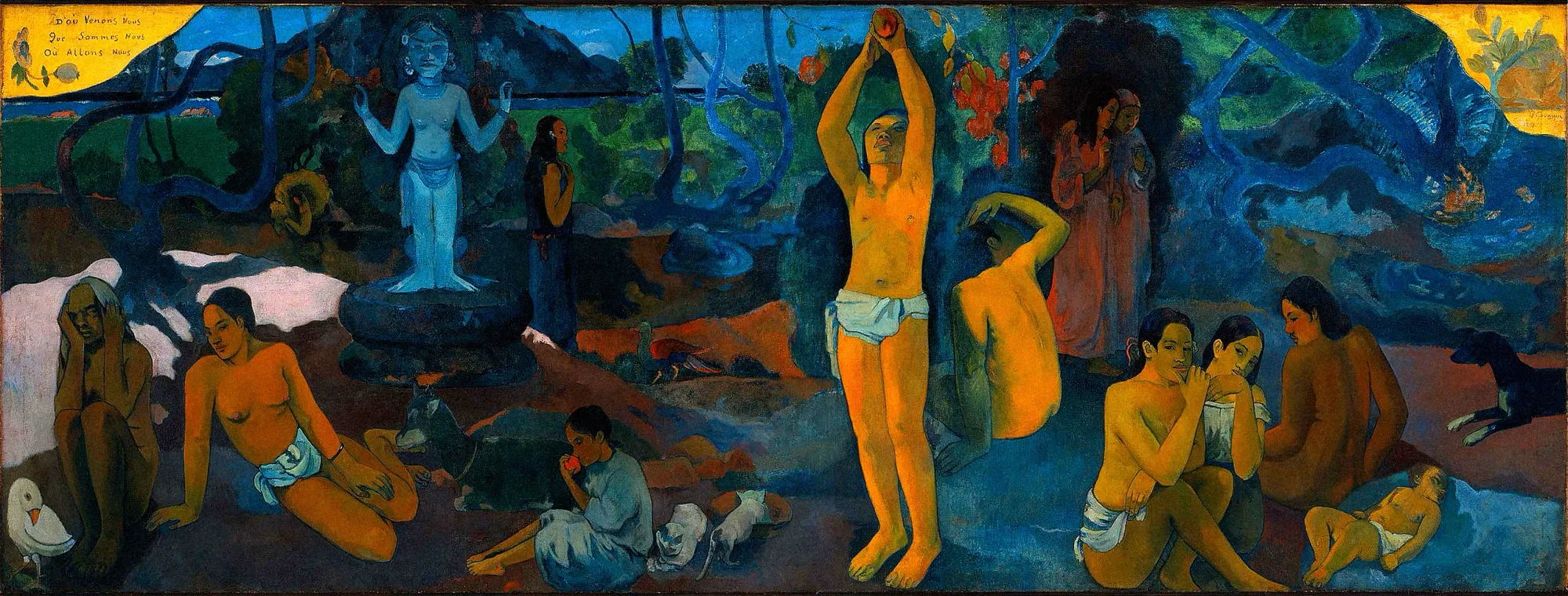
First thing I need you guys to understand is that every culture, every society fundamentally asks itself three questions that this painting from Paul Gauguin captures. Where do we come from? What are we? Where are we going? Every culture is trying to grapple with these three questions. Paul Gauguin, I'm not sure if you know who he is. He is a very famous French artist. He started off actually as a financier, a stockbroker, and then he basically became disgusted with the material lifestyle of modern society. So, he got on a boat and went to Tahiti, where he painted. He interacted with the natives, and through this interaction, he began to grapple with what it means to be a human. What is the human project? And what he believes, and what most anthropologists actually believe, is to be human is to ask these three questions. Where do we come from? Why are we here? Where are we going? And that's ultimately what Norse mythology is trying to grapple with as well.
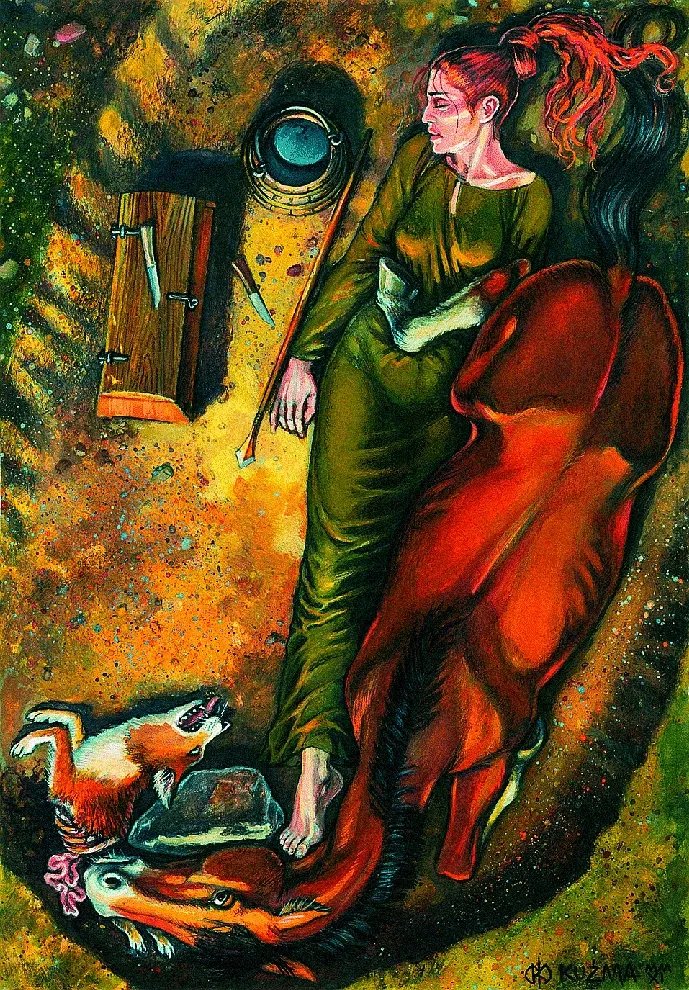
Again, our evidence or understanding of the Vikings comes from archaeology. We are able to dig up their graves, and what we discover, and it's very interesting, is that each grave is unique. And it seems that each grave in its own way is telling a story about who this person is. This grave was not meant just to send this individual into the afterworld but also to remember him or her and his or her achievements and life.
Let's look at some reconstruction of these graves. You can see this woman is buried with tools, an arrow, as well as a dead horse. We're not able to reconstruct her story, but obviously those who knew her knew exactly what the story represented. This is another example where a man is buried with his ship. The Vikings are the only society to bury people in ships. Another example. And as you can see, they're all unique.
In fact, what's really interesting for us is to appreciate that funerals were the most important aspect of Viking society. It's what brought the community together, and it was what they remembered the most. Funerals are what contributed to historical memory in the Viking world. As you can see, this funeral is extremely elaborate, involving a lot of animal sacrifice. These horses are being gathered up to be sacrificed. There's also human sacrifice. And these funerals can last for a long time, ten days.
The Account of Ahmad ibn Fadlan
Again, because the Vikings never wrote anything down, we actually don't know that much about these funerals. In fact, we only have one historical record of a funeral. And this happened in the Viking Rus'. This is the eastern world, near the Volga. And it was written down by a Muslim diplomat and traveler by the name of Ahmad ibn Fadlan. And he is from the Abbasid Caliphate, and he is in the Viking world in order to negotiate a treaty of trade. The Abbasids and the Vikings traded a lot. And as an honored guest, the Vikings invited him to a funeral of a deceased chieftain or king.
Now, there are certain things about this funeral that are important for us. The first thing is that it would last ten days. It's a very elaborate affair that requires a lot of choreography and coordination. The second thing is that a third of the man's wealth was spent on the funeral expenses, so basically a feast for everyone. A third was spent on his funeral clothes that were tailor-made for him. This is like the best clothes. And a third was given to his wife. What this tells us is, first of all, this man, even though he was high-status, he didn't have that much wealth. And second of all, the Vikings are a very egalitarian society. The third thing that's important for us, they didn't care that much about wealth, period. They spent a third on the funeral. They just burn away the money.
What's also important for us to remember is there is a funeral director. There's a woman who ibn Fadlan calls the Angel of Death, who was coordinating and orchestrating this funeral. During the course of this funeral, there are things that happened that actually disgust him.
Before we continue, please keep in mind that ibn Fadlan, he's an observer. He doesn't speak the language. He doesn't know the culture, so he doesn't exactly know what's going on.
Second of all, he's a Muslim, so he has his own cultural worldview that is in conflict with a Viking worldview.
The third thing is he is writing this down after the fact. And if you do that, what often happens is that you will misremember a lot of things.
Please take his description with a grain of salt, with some skepticism. But also, please remember that we have no choice in the matter because this is the only written record of a Viking funeral from this time. So, we have absolutely no choice in the matter. Let's look at what he writes and then try to reconstruct the Viking culture and understanding.
The first thing he says is:
They cut a dog in two and threw the halves into the boat and placed the man's weapons beside him.
Again, they are celebrating his life. They are memorializing his life.
They had two horses run themselves sweaty, cut them to pieces, and threw the meat into the ship. Finally, they killed two cows, a hen, and a cock and did the same with them.
Not only are they remembering him, but they're giving him supplies to help to sustain him as he ventures and voyages into the afterworld. Now, this is interesting. They asked for a human sacrifice, and a slave girl volunteers. Volunteers. Clearly, she didn't volunteer, but she volunteers. And let's see what happens.
Meanwhile, the slave girl went from one tent to the other and had sexual intercourse with the master of each. Every man told her, "Tell your master that I have done this purely out of love for him."
This is really confusing for us. It's a funeral, and they're having sex with the woman who is about to be sacrificed. We have absolutely no idea what's going on, but I'm going to make a guess. I'm going to use my imagination. First, it's important for us to understand who the slave girl is. She's not a normal person. I believe, I would argue that she must be the lover of the deceased chieftain. Why? Here's the logic.
Remember the Iliad. In the Iliad, the entire story begins with a problem. The problem is that Agamemnon, the leader of the Greeks, has kidnapped a girl who happens to be the daughter of a high priest of Apollo. And the priest comes to him and says, "I will give you all the gold in the world, but please give me back my daughter." And all the Greeks said, "You should do that, Agamemnon. Please give back the daughter." That's just the custom of war. A father can ransom the daughter. You have to return her.
But Agamemnon says this, "I'm not going to return her because I love her. I love her more than my wife." And as a result, the high priest prayed to Apollo, who unleashes a deadly plague among the Greeks. The Greeks are dying. So, finally, Achilles steps up and says to Agamemnon, "You have to return the girl." Now, Agamemnon has lost face, so he says to Achilles, "Fine, I will return the girl that I love more than anything else in the world, but you must give me your girl, your slave girl." Achilles gets so angry about this that he refuses to fight for the Greeks, which leads to the disaster of the Trojan War.
What is this telling us? This is telling us that in this world, where these men are far from home and they kidnap these slave girls, they fall in love with them. And in the process of falling in love with them, these great men confer status and power onto these slave girls. I know this is hard to understand, but the slave girl is not a normal girl. She is the lover, the mistress, essentially the wife of the chieftain who's died.
Another question then is why has she volunteered to kill herself? Well, if we continue the logic, then I would argue that it's because without the man, she has no status and power in the community. She'll go back to being a slave, and she might be ostracized. So, by volunteering and sacrificing herself, she will win status and power and honor for her children and for her relatives in the community. She will make her family part of that community. That's why she does this.
Now, the question then is, I don't get it now because if, in fact, the slave girl is the chieftain's favorite mistress, and if this slave girl does in fact love this man, why is she having sex with everyone? And the answer is in this world, gifts are very important. Basically, if you go to war and you win things, you have to share with everyone. What this deceased man is saying, "Now that I'm dead, I give you one final gift, and it's the greatest treasure that I can possibly give you, which is the woman I love."
That's why each man is forced to have sex with her. And they tell this girl, "When you go to your master, tell him I only do this out of my love for him, not for you. I don't have sex with you. I do not want to have sex with you, but I will in order to celebrate him, to honor him, to love him."
In Their Imagination, Are They Having Sex with the Dead Master?
That's a great question. In their imagination, are they having sex with the dead master? Yes, you can make that argument. Because remember, in this world, homosexuality just doesn't exist. It's okay for men to have sex with each other. It's okay for men to have sex together with one woman. And that's how they create intimacy and bonding because, remember, when you're out in war, you have to be able to make the ultimate sacrifice. So, you have to bond with your fellow soldiers. And the best way to bond is through sex. Sex with each other but also sex with other women.
You can make that argument. Again, I don't know what goes on in their heads, but if you extend the logic, yes, then they think they're having sex with the master through the girl. And that's why they say, "I'm only doing this out of my love for him. Not for you, but for him."
The Funeral Continues
Let's continue.
In the afternoon, they moved the slave girl to something that looked like a doorframe, where she was lifted on the palms of the men three times.
The doorframe represents access to the afterworld. She's being sacrificed now.
The first time, she saw her father and mother. The second time, she saw all her deceased relatives. And the third time, she saw her master in Paradise.
What this is, the slave girl, who is not part of the community, what she's really doing is implanting her personal memory into the community as a whole. She's making her family part of the community now. She's talking about her past. And everyone, again, this is a community event. Everyone's observing. Everyone can hear her. So, they know that after she dies, they must honor her memory by honoring her relatives and family.
There it was green and beautiful, and together with him she saw men and young people. She saw her master beckon to her. Then she was brought a chicken, which she decapitated and which was then thrown on the boat.
Again, this is some strange ritual that I have no idea what it means, but it must mean something. Often, what they do is they reenact mythologies. There must have been a famous story where a woman decapitates a chicken for some reason. And she's doing that. They are reliving mythologies. Let's continue.
Thereafter, the slave girl was taken away to the ship. She removed her bracelets and gave them to the old woman.
She took what was most valuable to her and gave it to the old woman, who is the Angel of Death, the funeral director. What she's doing is giving thanks to the old woman. She's paying her. She's giving her a gift. She's bribing her for the honor of being sacrificed.
Thereafter, she removed her anklets and gave them to the old woman's two daughters. Then they took her aboard the ship, but they did not allow her to enter the tent where the dead chieftain lay.
She's about to be sacrificed.
The girl received several vessels of intoxicating drinks, and she sang.
These intoxicating drinks are often psychedelics. The psychedelics are meant to enhance her visuals. Now she's singing.
Before the old woman urged her to enter the tent, "I saw that the girl did not know what she was doing," notes ibn Fadlan.
Ibn Fadlan is completely confused by this, but what we need to understand is this is highly choreographed. Every person knows what to do in this process. It's a ritual, meaning that there's a script in place, and meaning that the chieftain and the slave girl and the old woman all discussed this beforehand. That's the only way this makes sense.
Then the girl was pulled into the tent by the old woman, and the men started to beat on their shields with sticks so her screams could not be heard.
The tent is being surrounded by warriors with shields.
Six men entered the tent to have intercourse with the girl, after which they laid her onto her master's bed beside him.
Six men basically rape her together. And what this is doing is reenacting the memory of being with their chief. Going out on raids, sacking a city, and then raping the woman together. Guys, I know this is terrible. I know this is terrible. But again, we have to try to understand their worldview and their practice.
Two men grabbed her hands and two men her wrists. The Angel of Death looped a rope around her neck, and while two men pulled the rope, the old woman stabbed the girl between her ribs with a knife.
She's being sacrificed by the Angel of Death, and that's how she dies.
Thereafter, the closest male relative of the dead chieftain walked backwards naked, covering his anus with one hand and holding a piece of burning wood with the other.
Again, this must come from a certain mythology. That's the only way we can explain this practice. Why is he going around naked?
He set the ship aflame, after which other people added wood to the fire.
And that's how he dies. Again, this sounds gruesome. What they're doing is they are celebrating the man and implanting his memory into the community. Because everyone participates in this funeral, the man, his memory is now part of the community's collective consciousness. He has become a story within the community, and therefore will be remembered forever for his achievements.
The Roman Triumph and Greek Theater
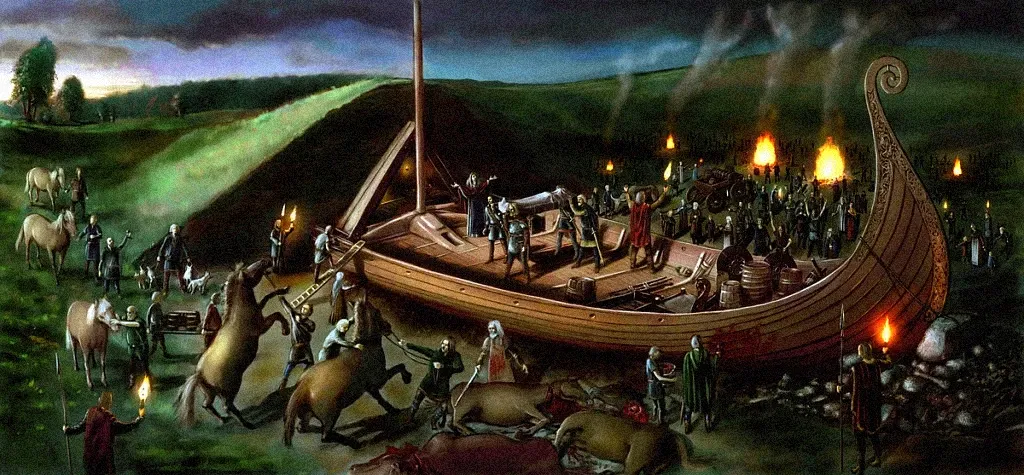
This is, again, a depiction of the funeral. And again, the Greeks and the Romans had equivalents. We'll discuss these equivalents so you better understand what's going on. For the Romans, that's something called the triumph. The triumph was the highlight of Roman life. It was basically a general who won a great conquest, and so he came back in a military parade. The parade would offer a lot of things. It would offer some pictures of the conquered territory. It would parade treasures like elephants or gold captured from the conquered people. It would also parade slaves and captured people, usually kings. And it would feature the soldiers as well as the triumphant general.
What's important for us to remember is at the end of this parade, they go to the Temple of Jupiter, their god, and they would sacrifice these slaves and these captured kings to the god, to the god Jupiter. It's very similar to the funeral.
The Greeks, on the other hand, had theater to build the community's collective consciousness. The community all participated in the theater. There were no professional actors. It was community members that participated in the theater. And the spectators would judge which theater was the best. It was a highlight of the community to pick the best playwright for that year. It was the greatest honor. It's like winning the Nobel Prize, basically.
The theater was very different. They didn't practice any human sacrifice. They didn't parade slaves around. What they did was often write about war from the perspective of the enemy. Euripides wrote something called The Trojan Women, where he wrote about the Trojan women who were raped and captured and kidnapped by the Greeks. And Aeschylus wrote about the Persian loss. That's why the Greek civilization is considered the most imaginative in human history because it practices empathy. It changes perspectives. It's willing to celebrate everyone. That's the Greek world.
Values in Norse Mythology
- Let's talk a little about Norse mythology. Remember what I said was that Norse mythology, its purpose is to express and promote three values, courage, loyalty, and resourcefulness. The example of courage is Odin. At the beginning of the world, Odin, who's a god of knowledge, wants to seek all knowledge. He flies around Yggdrasil, the world tree, and he goes into different realms. And he meets a god at something called the Well of Cosmic Knowledge. If you drink from this well, you gain cosmic knowledge. Odin wanted to drink it, but he had to make an offering. So, he offered what was most valuable to him, which was his eye, guys. His eye. He plucked out his eye, gave it to the god, and drank from the Well of Cosmic Knowledge.
But once he drank from the well and learned cosmic knowledge, he became more curious about the universe. And so, he started to venture into more unknowns. Eventually, he went into the realm of death. And no matter how hard he tried, he could not penetrate this world. There were too many winds. There were too many barriers. So, he killed himself because that's what you do if you want to enter the death world. You have to kill yourself. So, he killed himself, and he was dead for a long time, but in his death, he was able to see all the secrets of the universe. And then afterwards, he resurrected himself.
Odin personifies the idea of courage in the Viking world, to seek the unknown relentlessly, even if it costs you your life and your eye. - The idea of loyalty. In the Norse world, there'll be a Ragnarok. And there's a wolf, Fenris, who will foreshadow the arrival of Ragnarok. He's very dangerous, but when he's born, he's just a little pup. So, the Aesir, the gods, basically decide to adopt him as a pet. They think he's harmless. And his master is Tyr, who is the god of war among the Aesir. But very quickly, Fenris grows to be huge. And now the gods see him as a menace. So, they try to tie him up, but no matter how hard they try, they can't tie him up. And it becomes a game. And Fenris thinks this is really funny.
But the gods become really worried. So, they go to the dwarfs, and they ask the dwarfs to create a magic rope, which they do. And Tyr goes back to Fenris, says, "Hey, let's continue this game of us trying to tie you up."
"Okay, but how do I know that you will release me if I can't get out? Here, put your hand in my mouth, and if you don't release me, I'll take your hand."
The gods discussed this, and Tyr volunteers to do this, knowing that he's going to lose his hand. And that's what happens. They tie Fenris up, and Fenris wants to be released. The gods refuse because he's a menace. And then Fenris just bites off the hand. That's loyalty. Loyalty to your friends. - Resourcefulness. The gods are always at war with the frost giants. One day, a man named the Builder comes to them and says, "I can build you a wall to protect you from your enemies in eighteen months." This is Asgard, the home of the gods. And the Builder says, "I will do this, but I want three things. I want the sun. I want the moon. I want the beautiful goddess Freya in marriage."
The gods are like, "No, that's a stupid deal." But Loki, who is the god of mischief and the blood brother of Odin, says to Odin, "Take the deal, but make it six months. Give him six months. That way, he'll finish about a third of the wall, and we can finish the rest." And Odin thinks that's a great idea. And the Builder agrees to this deal on one condition, that he's allowed to use his horse in order to carry the bricks and the concrete. And the gods agree.
What they don't know is the horse is a magic horse, and the horse is able to travel as fast as light itself. And so, the Builder is able to really quickly build that wall, and he's about to finish the wall. Odin says, "Loki, you got us into this mess. Get us out of this mess, or I will kill you."
What does Loki do? Loki thinks, and he's a shapeshifter. And he's able to shapeshift into a mare, a beautiful horse. The Builder's horse sees the mare and becomes really excited, and he runs off. And the Builder is not able to finish the wall. And Loki gives birth to a horse, a baby horse, that then becomes Odin's horse. That's the idea of resourcefulness.
There are some really funny stories within Norse mythology. One of the funniest is this. Thor has a magic hammer named Mjölnir. He loves it. He loves it so much that he sleeps with it. He puts it under his pillow. One day, he wakes up and finds it missing. Of course, he thinks it must be Loki because Loki is always playing these tricks on the gods. But Loki says, "I didn't do it, and I will find out for you who did it."
Loki explores, and he finds out that it was the frost giant king who stole the hammer. The frost giant king will only return the hammer if the gods give him Freya as a wife. Loki goes back, and Freya says, "Screw off. I'm not going to do this." So, Loki says to Thor, "I have a plan." The plan is he's going to dress Thor up as Freya. He's going to put a wedding dress and a veil on Thor. And Loki will disguise himself as a bridesmaid.
Stupid plan, but they do this. They go off, and the frost giant king doesn't really notice that Freya is a huge man. They have this huge feast. And unfortunately, Thor loves to eat, and he loves to drink. Basically, at this huge feast, Thor is eating this ox. He's drinking all this beer, and he's burping in the process. The frost giant king is kind of confused, but he's also really excited.
At the wedding, the frost giant king presents the hammer Mjölnir to Thor, and he lifts the veil to kiss Thor. And that's when he realizes that it's actually a man. Then Thor gets his hammer and beats the crap out of the king. There are many stories like this which are really funny and imaginative.
The Individual in the Viking World
What do these stories tell us about the understanding of the individual in the Viking world? This is Neil Price. And to prepare for this lecture, I did a lot of research, including listening to his YouTube lecture, which has about a million views on YouTube. But he's a Viking expert. He's an archaeologist. I highly recommend that you listen to his YouTube videos if you're interested in this material. But this is what he has to say about the Viking worldview.
- The individual is shaped by four forces. First is the hamr. The hamr is basically the shell or the shape of the person, the outer being. It may not be the body, actually, but it's the shell.
- Second is the idea of the hamingja. The hamingja, think of it as a pet who follows you around, and it personifies luck. And because it's a pet, you can either nurture the pet or not nurture it. You nurture it by showing courage. In battle, if you enter the battle with courage, the pet will be with you. But if you run away and you hide yourself, the pet might run away. And in the Viking world, all that matters is hamingja. You win if you get lucky, not because you're stronger.
- The third idea is hugr. And hugr is your essence, your soul, who you are really.
- The last idea is fylgja. And fylgja is what you inherit from your family. It is the guardian spirit of your family. Think of it as the collection of your ancestors who whisper you advice in your dreams. Today, we would call this concept intuition. Intuition. That's what it represents.
As you can see, Neil Price and other experts are showing us that we think of the Vikings as barbarians, but in fact, they have a very complicated and nuanced understanding of themselves and the world.
Another question, then, is how are the Vikings able to do this? My argument to you is it's because of the oral tradition. We are simply not as creative as people who tell stories every day and who make stories the heart and center of the community.
Oral, Literary, and Visual Culture
This is an overgeneralization, an oversimplification, but I want us to understand this graph. Before, people lived in the oral tradition. What this meant is they told stories. When you tell stories, you need at least two people. You need the speaker, and you need the listener. You can't do otherwise. You can't tell a story to yourself. So, you need at least two people, but often it was a whole community that participated in the stories.
What this meant is that the stories were living things. They were things that you played with, that were flexible. They were clay. You can change the stories over and over. Each person who told the story would tell it differently. So, there are millions of different versions of these Norse stories that I just told you because each person can interpret that story differently. These are living memories, and that means that each story is unique. There's a concept in cultural theory called the aura, the essence, the soul. And each story has its own soul, if you think about it.
Let's contrast this with literary culture. In literary culture, reading and writing, you have to do it by yourself. You cannot write with a friend. It would be terrible if you did that. But the benefit is that whatever you write leaves you and becomes part of the page. It's permanent now. And as a result, your words can escape time and space. It becomes timeless. We have Homer because Homer's words were written down, even though Homer was probably illiterate.
Today, we live in visual culture. Think of videos. Think of photographs. The first thing to understand is that it's passive. Both in literary and oral culture, you have to participate. You have to use your imagination to make the thing alive. But with a photograph, it's all provided to you. It's a very passive experience. It's self-enclosed, meaning it's impossible for you to add anything to it. But you get more information that way, so there are benefits to visual culture. For example, a map. If you look at a map, it tells you a lot more information than if someone tried to explain it to you with words. And the last advantage of a visual culture is it is universal. If an alien species came down to our planet and looked at our pictures, they would know what's going on, whereas if they heard a story or read a book, they would have absolutely no idea what's going on. This is the oral tradition in contrast with literary culture and visual culture.
The oral tradition is extremely complex. We tend to think that it's just about telling a story. But if you think about it, there are so many variables and nuances and factors in the telling of a story. That's why each version is unique unto itself. I could teach the same material, but if we change the classroom, if we change the students, if we change the lighting, the experience of being in this classroom would change.
The Vikings, the way they told stories is they would tell it in a big hall because, remember, it's usually cold up north. It's snowing outside. They would tell it in a big hall, and it's dark. So, they have a big fire inside the hall, and the storyteller, the bard, would recite the story or tell the story beside the fire as everyone listens.
Some important things to know about this. First is the halls were huge. They were as huge as a Greek amphitheater. So, you can seat about a thousand, two thousand people within the hall. Second is the idea of darkness. When it's dark and you can't see, your ears become much more perceptive. So, the words have become alive. There's more color. There's more detail. There's much more imagery. And third is these words are bouncing off the walls, and they're creating echo and resonance. These words are almost like bonds that unite everyone in the telling of the story.
If you think about it, this experience is very similar to the Ice Age. Remember, last semester, at the very beginning, we did the Ice Age cave paintings. And what we need to understand is people came together in these caves, not to paint in the caves, but to tell stories about where they came from, who they are, and where they're going. And all of our ancestors, every one of them, for thousands of years, participated in this process of converging in these ice caves and hearing stories being told to them in these dark, wet caves. This takes us back to the time of the Ice Age. It's activating a nostalgia within us, and that's why the oral tradition is so powerful.
Telling Stories Together
These stories have to be told in a certain way to excite the audience. Think of this class. In this class, we have no tests. I don't even take attendance. So, when I present material in this class, it has to be interesting for you. Why is it interesting? It's shocking. It has emotions. It has structure. When I come to class, I actually do not script out my class. What I do is I think of the narrative structure, the story I want to tell. And then in class, depending on your reactions, depending on the questions you ask, I will change some of the details in the story to make it much more interesting for you. In the oral tradition, it's a co-creation, collaborative process, and that's what makes it so powerful.
As an experiment, what you can do is this. In class, there might be some material you found really interesting. So, then you go on YouTube—I post these lectures on YouTube—to try to remember the experience. And what you'll find is you cannot because we've switched from oral culture to visual culture. The same is true if it's your birthday. It's your eighteenth birthday. You go out with your friends, and you have a wonderful time. And you're like, "I want to take a picture to remember this experience." But what you will find when you do that is the picture doesn't really capture the experience for you. The picture cannot bring back the feeling for you.
That's why the Vikings were so insistent on maintaining their oral tradition and not transitioning into the literary culture because their oral tradition is what gave the community purpose and meaning. If you gave that up, then your community would lose cohesiveness.
What's the oral tradition? We've mainly lost it, but remember what it is. Let's take two things that you know very well and merge them together, and then you can experience what the oral tradition is. It's basically the immersion of a movie. Think of going to a good movie and remember the immersive power of being in that movie. You are in that movie. You combine it with the intimacy of a conversation. Just think of having this four- or five-hour conversation with your best friend and talking about life and love in general. The oral tradition combines these two things, and that's why it's so powerful. That's why it cannot be remembered.
The Viking oral tradition was extremely powerful, but it was so powerful that it cannot be remembered. It cannot be written down. But as I will show you in future classes, this oral tradition will go on to influence major European civilizations, specifically the Germans and the British, but also the Russians as well.
- For most of human history, we as humans have shared our time together telling stories. Why did we lose the oral tradition? We transitioned to a literary culture that emphasized reading and writing. In school, we have you read books, but we don't have you tell stories. We don't tell stories to you.
- We went from paganism to Christianity. The problem with Christianity is it is extremely sanctimonious. It focuses on what is good and evil, whereas pagan culture, it's whether it's interesting or not interesting, whether it's memorable or not memorable. Live a memorable, interesting, adventurous life. And the Christians are like, "No, that's not good because if you do that, you're going to create a lot of evil. So, live a good life. Avoid committing evil."
- The last thing is we went from an egalitarian world where everyone can contribute to the story to a hierarchical world where the top, the elite, insist on indoctrinating us and controlling how we think. This is why we left the oral tradition and adopted literary and visual culture.
A Story for Malu
I know there's a lot to take in, and it's a lot of information. But let me conclude with a story. I have two young boys, and I sleep with them. And what I do is I tell them stories. I don't have them do math. I don't have them read books. But I tell them stories where I make them the characters, the heroes of the story. I'll tell you one story that I told my youngest son, Malu.
The story goes like this. It is Malu's fourth birthday, and I tell Malu, "On your fourth birthday, something magical happens. You can pray to God, and whatever you wish for, God will grant you your wish." So, Malu was really excited, and he thinks a long time about what he wants. On his fourth birthday, he prays to God and says, "I wish for a room full of strawberries every single day." He says that, and God immediately responds. Immediately, his room is full of strawberries, and Malu loves strawberries. He eats them right away.
The next day, the room is also full of strawberries, and he eats them again. The third day, again. But by the fourth day, he's kind of sick of strawberries. So, eventually, strawberries overflow and fill the house. And then they fill the street. At this time, the neighbors are really worried, and we have to explain to our neighbors, "It's because Malu wished for strawberries, and that's why we have so many strawberries. But hey, let's share strawberries together." And the neighbors are at first happy, but then eventually they get sick of strawberries too. And then the strawberries fill the entire street. Then the city of Beijing is filled with strawberries. Now it's a national emergency. We are trying to resolve this issue.
Then the whole country of China is filled with strawberries. Then the whole continent of Asia is filled with strawberries. Eventually, everyone has to get on a spaceship and get out into space and go to the moon to recolonize the moon. But strawberries keep on overflowing until they reach the moon. At this point, the entire world prays, says to Malu, "Listen, your fifth birthday is tomorrow. Please pray to God and tell him no more strawberries. Malu, if you do this for us, we will make you president and king of the world. We will give you all the chocolate in the world. We'll give you all the gold in the world. Can you please do this? Can you please tell God no more strawberries? If you do that, we'll give you all the chocolate in the world."
And Malu says, "Yes, I will." And then, fifth birthday, Malu closes his eyes, prays to God, and says, "Dear God, I wish for a room full of chocolate every day." And that's how the story ends.
It's a very strange story, but guess what? My sons remember this for a long time. But not only that, it's going to inspire him to think about the story and tell his own stories. All he has to do is change the story a bit, and now he has his own story. He can change the characters. He can change some of the details. That's the power of the oral tradition.
But if I were to write down this story, I couldn't say it in this way. I couldn't do it. Let's see how I would change the story if I wrote it down. Same story, but now I write it down rather than say it to Malu himself.
For his fourth birthday, Malu prayed to God for a room full of strawberries every day. Immediately, his room filled with strawberries. He ate them happily. The next morning, his room filled with strawberries. He ate them. The very next morning, his room filled with strawberries. He did not eat them.
I have to make the story shorter, more compact, so that it's easier to read.
The house filled with strawberries. Then the street filled with them. Then the city. Then the country. On his fifth birthday, Malu prayed to God for no more strawberries. His room became clean, and Malu understood the power of words.
Why am I doing this? Why has literary culture changed the story? Because now I know that the words leave me, and they leave Malu. They go out into the wider world, and therefore people will judge my words. They will think I'm a bad father or whatever. I'm conscious of that. So, I change it in a way that is not so offensive so that people can better appreciate this. You see the difference between oral culture and literary culture.
In oral culture, you can be intimate. Therefore, you can play. You can experiment. You can be curious. You can be adventurous. That's what leads to the imagination. But in a literary culture, everyone is watching you. A hundred years from now, people are still watching you. Therefore, you have a sense of shame. You're very conscious about your effect on people.
A metaphor we can use is this transition from oral tradition to literary culture is really like the story of Adam and Eve, where, because they ate the fruit from the Tree of Knowledge, they developed a sense of shame. They understood that they are naked, and therefore they're being watched. And because of this, they are thrown out of the Garden of Eden. I want to leave you with that metaphor. Oral tradition, we leave it behind, and we think that it's a good thing. But we tend to forget the power and beauty of the oral tradition.
Imagination, Memory, and Civilization
- I leave you with three questions to help us better understand and remember the lecture. The first question is, what is the imagination? What's memory? In the oral tradition, we would think that the imagination is just an extension of the memory. By making our stories memorable, we excite the imagination. Therefore, we allow for the process of creation.
- The second question is, could we have Homer, Dante, and Shakespeare without the oral tradition? And the answer, I think, is no. I think we would not have the greatest poetry in human history if it were not for the oral tradition. In fact, if you think about the past fifty years, what has humanity—even though there's eight billion of us, we have more wealth and technology than ever before—what literary masterpiece have we created? And I can't think of a literary masterpiece of the past fifty to sixty years. There are some very entertaining books, but not of the stature and power of Homer, Dante, and Shakespeare.
- The last question I have is, does civilization make us less creative? Does being civilized make us more ashamed of exploring, of being curious, or playing? Are we less creative because of civilization?